The Janitor Heard Screams from the Second-Floor Boys’ Room. What He Found Inside Changed Everything.
Chapter 1: The Acoustics of Cruelty
The second-floor boys’ bathroom at Oak Creek High was a cathedral of porcelain and indifference. To the students rushing to class, it was just a pit stop. To the teachers, it was a place to avoid, a black hole where detention slips went to die. But to Arthur “Artie” Vance, the sixty-eight-year-old custodian, it was a sovereign state with its own geography and its own grim acoustics.
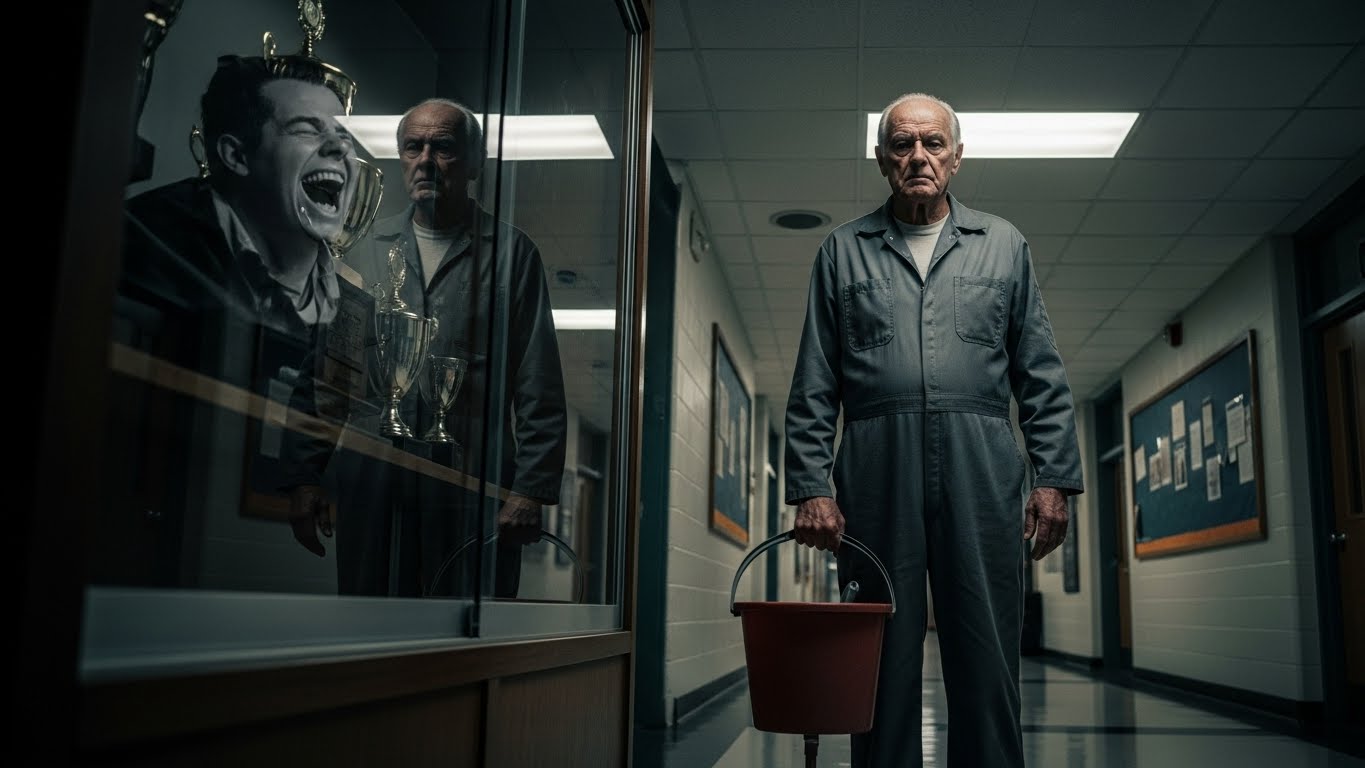
Artie knew the sounds of this room better than he knew the sound of his own voice these days. He knew the squeak of the third stall door, the groan of the pipes when the heating kicked on in November, and the aggressive whoosh of the automatic flush sensors that seemed to trigger at the slightest provocation. He was invisible here, a ghost in a gray jumpsuit pushing a yellow mop bucket that squealed like a dying mouse.
It was a Tuesday afternoon, specifically 2:15 PM, the lull before the final bell. The school was vibrating with that low-frequency hum of teenagers waiting for release. Artie was in the far corner, scrubbing a stubborn scuff mark off the pristine white tile. He liked the work; it was simple. Dirt existed, he removed it, the world was clean again. If only life were that binary.
The heavy wooden door swung open, banging against the stopper. The acoustics of the room changed instantly. The air pressure shifted.
Three boys walked in. Seniors. Artie didn’t need to look up to know who they were. He knew their shoes—expensive sneakers that squeaked with arrogance. He knew their voices—deepened by puberty but still cracking with insecurity. And he knew the smell—too much cologne masking the scent of unwashed gym clothes.
Leading the pack was Brett Halloway. Quarterback, golden boy, the kind of kid whose smile could charm a PTA meeting while his eyes remained dead cold. Flanking him were his disciples, Miller and Davids. They were the muscle, though they looked more like oversized puppies following their master.
“Check the stalls,” Brett said. His voice echoed, bouncing off the hard surfaces, amplified by the ceramic and steel.
Artie paused his scrubbing. He was behind the partition of the handicap stall, the door slightly ajar, his cart blocking him from immediate view. He stayed silent. In his twenty years at Oak Creek, he had learned that invisibility was his best defense.
“Clear,” Miller grunted.
“Good,” Brett said. He turned back toward the entrance. “Get him in here.”
There was a scuffle in the hallway, the sound of rubber soles dragging against linoleum, and then a shove. A fourth figure was propelled into the bathroom, stumbling over his own feet before crashing onto the wet tiles near the sinks.
It was Leo. A freshman. Artie knew Leo because the kid always said “excuse me” when he walked past Artie’s cart in the hall. Leo was small, with messy hair and a backpack that looked heavy enough to crush his spine. He wore glasses that were currently askew on his face.
“Please,” Leo gasped. The word hung in the air, fragile.
“Get up,” Brett commanded. He didn’t yell. He didn’t have to. The bathroom amplified his authority.
Leo scrambled to his feet, backing up until his spine hit the cold porcelain of a sink.
Thud.
The sound was sickeningly dull. It wasn’t the sharp crack of a movie punch; it was the wet, heavy sound of bone meeting ceramic.
“I don’t have it,” Leo stammered, his hands raised in surrender. “I told you, my mom didn’t give me the cash today.”
“This isn’t about the money, Leo,” Brett said, stepping closer. He invaded Leo’s personal space, looming over him. “It’s about the principle. You walked past our table at lunch. You didn’t look down.”
“I… I tripped,” Leo whispered.
“You exist,” Brett corrected. “And right now, you’re annoying me.”
Artie gripped the handle of his mop. His knuckles turned white. He was an old man. He had a bad back and a pension he was two years away from collecting. He had seen this scene play out a thousand times in different forms. Usually, he waited for them to leave, then cleaned up the blood or the tears. It was the unwritten rule: The Janitor sees nothing.
But the sound today was different.
Brett nodded to Miller. Miller stepped forward and open-hand slapped Leo across the face.
Slap.
The sound was sharp, like a pistol shot in the confined space. It ricocheted off the mirrors, the stalls, the ceiling. It was followed immediately by the Whoosh-Gurgle of the automatic flush sensor on the urinal next to them. The machine had sensed the movement and reacted with mechanical indifference.
Leo didn’t cry out. He just whimpered, a low, animal sound of pure fear. He slid down the front of the sink, curling into a ball.
“Stand up!” Brett barked.
Leo shook his head, burying his face in his knees.
Brett grabbed Leo by the collar of his shirt and hauled him up. He slammed him back against the mirror. The glass shuddered.
Thud.
Whoosh-Gurgle. The sensor triggered again.
“You think you can just hide?” Brett whispered, his face inches from Leo’s. “This is my school. Every room, every hallway, every toilet. It’s mine. You’re just a guest.”
Davids laughed, a cruel, hollow sound. “Dunk him, Brett.”
“No, please,” Leo sobbed, the tears finally breaking through. “Please, I have asthma. Please.”
“Asthma?” Brett mocked. “Then you need some water.”
They dragged him toward the toilet stall. Artie’s heart hammered against his ribs. The Vietnam War had been loud—explosions, helicopters, screaming. This was quiet violence, intimate and terrified. The acoustics of the bathroom magnified the scraping of Leo’s shoes, the desperate grasp of his fingernails on the stall door.
Artie looked at his mop. It was a tool of cleaning. Could it be a weapon? No, he’d be fired, maybe arrested. Brett’s father was on the school board. That was the other law of the sovereign state: The rich kids were diplomats with immunity.
Splash.
They shoved Leo’s head toward the bowl.
“Hey!”
The voice didn’t sound like Artie’s. It was rusty, deep, and filled with a command presence he hadn’t used since 1972.
The three seniors froze. They turned their heads slowly toward the handicap stall.
Artie stepped out. He didn’t look like a hero. He looked like a tired old man in a gray jumpsuit with a name patch that was peeling at the corner. But he stood tall, his hands resting on his cart.
“That’s enough,” Artie said. His voice was steady, absorbing the echo rather than creating it.
Brett blinked, processing the intrusion. He smirked. “Go back to cleaning toilets, old man. This doesn’t concern you.”
“I said, that’s enough,” Artie repeated. He pushed his cart forward, the wheels squeaking loudly, cutting through the tension. “Class is starting in two minutes. Get to class.”
Brett released Leo, who slumped to the floor, gasping for air, water dripping from his hair.
“You know who I am?” Brett asked, stepping toward Artie. He was taller than the janitor, younger, stronger.
“I know you’re a boy beating up a child in a bathroom,” Artie said, meeting his gaze. “And I know I have a radio here that connects directly to the resource officer. Now, get out.”
Brett stared at him, weighing the odds. Beating up a freshman was a misdemeanor; assaulting a staff member was a felony. Even his dad couldn’t bury that easily.
“Let’s go,” Brett sneered. He looked down at Leo. “This isn’t over, rat. And you…” He pointed a finger at Artie. “Watch your step, janitor. Floors get slippery.”
The three seniors marched out, leaving the door swinging behind them.
Silence returned to the bathroom. The only sounds were the dripping of water from Leo’s hair and the humming of the fluorescent lights.
Artie walked over to Leo. He reached into his pocket and pulled out a clean, rough paper towel.
“Here,” Artie said softly.
Leo looked up, his eyes wide behind cracked glasses. He took the towel, wiping his face. “Thank you,” he whispered.
“Don’t thank me yet, son,” Artie said, looking at the door where the monsters had just left. “That was just the opening bell.”
Chapter 2: The Hierarchy of Indifference
The next morning, the school felt different to Artie. The hallways, usually filled with the benign chaos of youth, now felt like a minefield. He pushed his wide dust mop down the main corridor, his eyes scanning the faces. He saw Brett Halloway by the trophy case, laughing with a cheerleader. Brett saw him, too. The boy didn’t glare; he just smiled—a small, knowing smile that chilled Artie’s blood. It was the smile of someone who knows the game is rigged in their favor.
Artie found Leo in the cafeteria during third period. The boy was sitting alone at a corner table, picking at a sandwich. He looked smaller than yesterday. The bruise on his cheek was blooming into a dark purple flower, poorly hidden by the hood of his sweatshirt.
Artie parked his cart and pretended to empty the trash can near Leo’s table.
“You okay, kid?” Artie asked, keeping his voice low.
Leo jumped, then relaxed when he saw the gray uniform. “I guess. My mom asked about the bruise. I told her I walked into a door.”
“Classic,” Artie grunted. “Did you report it? To Principal Higgins?”
Leo scoffed, a sound too cynical for a fourteen-year-old. “Higgins? He coaches Brett. Brett is the reason we might go to State this year. If I tell Higgins, Brett gets a slap on the wrist, and I get… I get dead.”
Artie nodded. He knew the politics of Oak Creek High. It was a microcosm of the world outside. The powerful protected their own. The principal, Mr. Higgins, was a man who preferred “peace” over justice. Peace meant no scandals, no police reports, no angry parents calling the superintendent.
Later that afternoon, Artie was summoned to the principal’s office.
“Mr. Vance, come in, come in,” Higgins said, gesturing to a chair. The office smelled of stale coffee and carpet cleaner. Higgins was a soft man, doughy and balding, with a smile that never quite reached his eyes.
“What can I do for you, sir?” Artie asked, clutching his hat.
“I had a concerning report today,” Higgins said, clasping his hands. “From a student. Brett Halloway. He claims you threatened him in the second-floor restroom yesterday.”
Artie felt the heat rise in his neck. “Threatened him? Sir, he was assaulting a freshman. Three of them on one. I stopped it.”
Higgins sighed, taking off his glasses and rubbing the bridge of his nose. “Arthur, look. Boys roughhouse. It’s what they do. Testosterone, high spirits. But Brett said you were aggressive. He said you waved a mop handle at him like a weapon.”
“That is a lie,” Artie said firmly. “I told them to leave. The freshman, Leo, was on the floor, bleeding.”
“I spoke to Leo,” Higgins said smoothly. “He confirmed Brett’s story. He said they were just joking around and you overreacted.”
Artie froze. The betrayal stung, but he understood it instantly. Fear. Pure, unadulterated fear. Leo was terrified that if he told the truth, the retaliation would be worse. By confirming Brett’s story, Leo was trying to buy safety. He was trying to become invisible again.
“Arthur,” Higgins continued, his voice dropping to a warning tone. “You do a good job here. Floors are clean. Trash is empty. But we can’t have staff intimidating students. Especially not… prominent students. The Halloways are big donors to the stadium fund.”
Higgins leaned forward. “You’re two years away from full retirement, Arthur. Don’t throw away your pension over a misunderstanding. Consider this a verbal warning. Stick to cleaning, not policing.”
Artie stood up slowly. His knees popped. The ache in his back flared up, a reminder of forty years of labor.
“Yes, sir,” Artie said, his voice flat. “Just cleaning.”
He walked out of the office, the anger simmering in his gut like acid. He realized then that the bathroom wasn’t just a sovereign state; it was a torture chamber sanctioned by the state. The automatic sensors weren’t the only things indifferent to the violence. The whole building was designed to look away.
He went back to his closet, the small room that smelled of bleach and lemon oil. He sat on a bucket and stared at the wall. He was an old man. He should just keep his head down. He should ride out the clock, collect his check, and go home to his TV dinners.
But he closed his eyes and heard the sound again.
Thud.
The sound of a child’s head hitting porcelain.
He couldn’t unhear it. And he couldn’t let it happen again.
He looked at the shelf where he kept his old electronics. A dusty box sat there. Inside was a smartphone he had replaced three years ago—screen cracked, but camera functional.
Artie made a decision. If the system demanded evidence, he would give them evidence. If they wanted a war, the janitor was going to give them a war. But he had to be smart. He had to be invisible.
Chapter 3: The Trap
A week passed, and the atmosphere inside Oak Creek High grew heavy, like the air before a summer thunderstorm. To the teachers and the administration, it was just “Spirit Week.” The hallways were plastered with banners screaming “GO WILDCATS!” in blue and gold. The cheerleaders were louder, the football players walked with wider struts, and the school was vibrating with a manic, forced positivity.
But to Artie, the school felt like a hunting ground.
He pushed his cart through the corridors, his eyes moving constantly. He watched the predator-prey dynamics shift in real-time. Brett Halloway and his disciples, Miller and Davids, had changed their tactics. They weren’t throwing punches in the hallway anymore. That was too risky after the “misunderstanding” in the bathroom.
Instead, they had moved to psychological warfare.
Artie saw it in the small moments. He saw Miller “accidentally” knock a tray of food out of Leo’s hands in the cafeteria, followed by an exaggerated, mocking apology while the whole table laughed. He saw Davids check-shoulder Leo into the lockers, hard enough to rattle his teeth but soft enough to look like clumsy passing.
They were isolating the prey. They were stripping away Leo’s safe spaces one by one until he was a nervous wreck, jumping at his own shadow.
Artie knew they would go back to the bathroom. It was inevitable. It was their stage. It was the only place in the building without the prying eyes of security cameras. It was where they felt like kings.
Artie decided he had to be ready. He wasn’t a tech genius—he still had trouble programming the digital clock on his microwave—but he knew this building. He knew every crawl space, every vent, every wiring duct that snaked through the walls of Oak Creek High.
On Thursday evening, long after the final bell had rung and the parking lot had emptied of student cars, Artie stayed behind. He told the night shift supervisor, a young guy named Kevin who spent most of his shift on TikTok, that he wanted to deep clean the grout in the second-floor boys’ room.
“Knock yourself out, Artie,” Kevin had said, not looking up from his phone.
Artie dragged a six-foot ladder into the bathroom. The room was silent now, stripped of the terror it held during the day. It just smelled of industrial cleaner and damp paper towels.
He climbed the ladder, his knees protesting with sharp clicks. He used his flathead screwdriver to remove the vent cover high on the wall, directly above the bank of sinks.
It was dark and dusty inside the ductwork. Artie reached into the deep pocket of his jumpsuit and pulled out his “weapon.”
It was an old Samsung smartphone. The screen was cracked in a spiderweb pattern from a drop three years ago, but the camera lens was pristine, and he had cleared the memory card completely. He had rigged it to a portable battery pack, the kind kids used to charge their phones at concerts, taping the two devices together securely with heavy-duty silver duct tape.
He positioned the phone inside the vent, the camera lens peering through the slats of the grille. He checked the angle on the screen. It had a perfect, wide-angle view of the sinks, the mirrors, and the doors to the handicap stall.
He pressed record.
“Let the walls have eyes,” he whispered to himself, his voice sounding raspy in the empty room.
He carefully screwed the vent cover back on. From the floor, the camera was invisible, lost in the shadows behind the grille. He checked the battery indicator. He calculated it would last about twenty-four hours on continuous video.
Friday arrived with a roar.
The school was frantic. It was the day of the big Pep Rally before the Homecoming game. The bell schedule was shortened, the energy was chaotic, and the teachers had given up on actual instruction.
Brett was walking around wearing his varsity jacket like a suit of armor, high-fiving everyone. He looked untouchable.
Artie patrolled the hallway near the second floor, his heart beating a steady, anxious rhythm against his ribs. He felt like a soldier on watch, waiting for the enemy movement.
At 1:00 PM, just after the lunch rush and right before the scheduled assembly, Artie saw the signal.
Miller was standing at the intersection of the B-Wing and the main hall. He was checking his phone, but his eyes were scanning for teachers. He spotted Mrs. Gable turning the corner toward the library. He waited. Once she was gone, he nodded toward the stairs.
Brett and Davids appeared, flanking Leo. They weren’t dragging him this time. They were walking close on either side of him, whispering something. Leo looked pale, his eyes fixed on the floor, walking like a prisoner marching to the gallows.
They disappeared into the second-floor boys’ bathroom.
Miller slipped in last, and Artie heard the distinct click of the deadbolt being thrown from the inside.
Artie’s breath hitched. The trap was set, but now came the hardest part.
He moved his cleaning cart directly in front of the bathroom door. He placed the bright yellow “WET FLOOR” sign prominently in the center of the doorway. He stood there, guarding the entrance, gripping his mop handle.
He didn’t rush in. Not yet.
He needed the evidence. He needed the undeniable truth that Principal Higgins couldn’t spin, couldn’t bury, and couldn’t ignore. He needed the camera in the vent to capture the reality of what these “high spirits” actually looked like.
Inside, the acoustics began their work. The voices drifted through the heavy wood door, muffled but discernible to Artie’s tuned ears.
“You talked to the janitor again, didn’t you?” Brett’s voice. It was low, menacing.
“No, I swear! I didn’t say anything!” Leo’s voice, high-pitched, laced with panic.
Smack.
The sound of flesh on flesh.
“Liar,” Brett hissed.
Artie flinched. Every instinct in his body screamed at him to kick the door down. He hated himself in that moment. He hated that he had to let a child suffer for another minute just to ensure justice could be served. It felt like a betrayal of his duty to protect.
Wait, he told himself. Just thirty seconds. Get the proof.
“We saw you,” Davids laughed. “Talking to the trash man. You think he can save you? He cleans up our crap, Leo. He’s nobody.”
“Please,” Leo begged. “I’ll do anything. Just stop.”
“Anything?” Brett asked.
There was a pause. The silence stretched, filled only by the hum of the building.
“Crawl,” Brett commanded.
Artie’s grip on the mop handle tightened until his knuckles ached.
“What?” Leo whispered.
“You heard me,” Brett said. “Get on the floor. In the water. Bark like a dog and crawl to the stall. If you’re going to act like a bitch, might as well be one.”
Artie heard the shuffle of feet. He heard the wet slap of knees hitting the puddled tile floor.
“Woof,” Leo sobbed. “Woof.”
That was it. The line had been crossed. The camera had seen enough. The soul of the school was rotting, and Artie wasn’t going to stand guard over the decay any longer.
He reached into his pocket and pulled out his master key ring. It was time to end the war.
Chapter 4: The Sovereign State Falls
Artie didn’t just unlock the door; he declared war on it.
He jammed the master key into the lock, twisted it with a violent snap of his wrist, and kicked the door right below the handle. The heavy wood flew open, banging against the metal stopper with a thunderous BOOM that sounded like a cannon shot in the tiled echo chamber.
The scene inside was a tableau of humiliation that would burn into Artie’s memory forever.
Leo was on his hands and knees in a puddle of dirty water near the urinals. His face was streaked with tears and snot. Brett was standing over him, holding his iPhone out, filming the degradation. Miller and Davids were leaning against the sinks, laughing, their faces twisted in ugly amusement.
They spun around at the noise.
Brett lowered his phone, his expression shifting from sadistic glee to annoyance. “You again?” he snarled. “Didn’t Higgins tell you to back off, old man? You want to lose your job?”
Artie didn’t stop moving. He didn’t look like a sixty-eight-year-old man with arthritis. He moved with the focused, terrifying energy of a man who has seen true evil and is done negotiating with it.
He walked straight into the room, past the sinks, past the urinals, ignoring the boys completely. He walked right up to the wall beneath the vent he had rigged the night before.
“He did,” Artie said calmly. His voice was different today. It wasn’t the polite voice of a servant. It was the hard, granite voice of a commander. “But I don’t work for Higgins right now.”
He turned slowly to face them. He pointed a calloused finger up at the vent near the ceiling.
“Smile, boys,” Artie said.
Brett looked up, confused, squinting at the dark slats of the vent. “What? What are you talking about?”
“There’s a camera in that vent,” Artie said, his voice echoing with grim satisfaction. “It’s been recording for eighteen hours. It saw you come in. It saw you hit him. It heard you threaten him. And it definitely just watched you make a human being crawl on the floor for your amusement.”
The color drained from Brett’s face. It happened instantly, like a curtain dropping. The arrogance, the golden-boy confidence, the feeling of invincibility—it all evaporated.
“You’re lying,” Brett stammered. “That’s… that’s illegal. You can’t record in a bathroom.”
“Maybe,” Artie shrugged, leaning back against the wall, crossing his arms over his chest. “But let’s play out the scenario, shall we? I send that video to the local news station. Channel 4 loves a good scandal. Or maybe I post it on the town Facebook page. Or, better yet, I send it directly to the admissions office of that university that just offered you a full ride.”
The silence in the bathroom was heavy, suffocating. The automatic flush sensor on the end urinal triggered—Whoosh-Gurgle—but this time, nobody laughed. The sound underscored the precariousness of their situation.
“Give me the phone,” Brett demanded. He took a step forward, his fists clenching. Desperation was setting in. “Miller, get the ladder. We’re taking it down.”
Miller hesitated, looking between Brett and the janitor.
“Touch that vent,” Artie said, his voice dropping to a gravelly growl that vibrated in the air, “and I will personally ensure you leave this room on a stretcher. I was fighting in the jungle before your daddy was even born, son. Do not test me.”
There was something in Artie’s eyes—a cold, hard steel that these suburban boys had never encountered. They were used to teachers who followed rules, parents who made excuses, and adults who looked the other way. They had never faced a man who was simply, absolutely done with their nonsense.
Brett stopped. He looked at Miller. Miller looked at his expensive shoes. The pack mentality crumbled the moment the alpha showed fear.
Artie turned his gaze to the floor.
“Leo,” he said softly. “Get up.”
Leo was still frozen on his knees, staring up at Artie like he was seeing an avenging angel in a jumpsuit.
“Get up, son,” Artie repeated firmly. “Go to the nurse. Don’t wash your face. Let them see the tears. Then call your mother. Tell her everything. Tell her I have the video. Tell her the janitor has the receipts.”
Leo scrambled up, water dripping from his jeans. He looked at Artie, then at Brett. For the first time in his life, he saw fear in his tormentor’s eyes. It was a revelation.
“Go, Leo,” Artie urged.
Leo bolted. He ran out of the bathroom, his sneakers squeaking on the linoleum, the door swinging shut behind him.
Artie stood his ground, blocking the exit with his body. He was the gatekeeper now.
“Now,” Artie said, reaching for the radio clipped to his belt. “You three are going to stay right here until the police arrive. I already called them.”
“You didn’t,” Brett whispered, his voice trembling. “Please. My dad will kill me.”
Artie tapped the earpiece of his radio, holding eye contact with the quarterback. “Dispatch, this is Vance. I have three assailants secured in the second-floor restroom. Requesting the School Resource Officer immediately. Yes, the video evidence is secured. We have a felony assault in progress.”
He hadn’t actually pressed the transmit button yet. It was a bluff. But in that acoustically perfect room, amidst the smell of fear and cheap cologne, the authority in his voice was absolute.
The sovereign state of the bathroom had fallen. The hierarchy was inverted. The janitor was the judge, the stalls were the jury, and the verdict was about to be delivered.
“Don’t move,” Artie said, pointing at the wall. “Facing the tiles. Hands where I can see them.”
Slowly, defeatedly, the three kings of Oak Creek High turned and placed their hands on the cold white wall, waiting for the real world to come crashing in.
Chapter 5: The Evidence
The minutes following Artie’s radio call stretched like hours. The three boys stood facing the wall, their bravado stripped away by the sheer absurdity of the situation. A janitor, a man they hadn’t bothered to look at for four years, was holding them captive with nothing but a mop bucket and moral certainty.
The door swung open again. This time, it wasn’t a student. It was Officer Danner, the School Resource Officer. A retired state trooper with a buzz cut and a no-nonsense walk.
“What’s the situation, Artie?” Danner asked, his hand resting instinctively near his belt. He took in the scene: the water on the floor, the three varsity athletes facing the wall, and Artie standing guard like a sentry.
“Assault,” Artie said, pointing at the boys. “And hazing. And humiliation. I’ve got the victim, Leo, heading to the nurse. And I’ve got the evidence right there.”
Artie pointed to the vent.
Brett turned his head, desperation creeping into his voice. “Officer Danner, this is crazy. We were just messing around. The janitor is losing it. He trapped us in here.”
Danner looked at Brett. He knew the Halloway kid. He knew the type. “Face the wall, Halloway,” Danner barked. He turned to Artie. “Evidence?”
“I need your help getting it down,” Artie said.
Together, while Danner kept an eye on the boys, Artie climbed the ladder. He unscrewed the vent cover and carefully pulled out the taped-up bundle of battery pack and smartphone. He stopped the recording.
He climbed down and tapped the screen. He scrubbed back the video timeline to ten minutes ago.
“Watch,” Artie said, handing the phone to the officer.
Danner watched. The bathroom was silent except for the tinny audio coming from the phone speaker. “Bark like a dog… crawl…”
Danner’s face hardened. He was a cop, but he was also a father. He looked up from the screen, his eyes narrowing at Brett.
“Messing around?” Danner asked, his voice dangerously low. “That’s what you call this?”
“It’s just a prank,” Miller mumbled, terrified.
“That’s a felony,” Danner corrected. “Turn around. Hands behind your backs.”
The sound of handcuffs clicking was loud in the tiled room. Click-click. Click-click.
It was a foreign sound in Oak Creek High, usually reserved for drug busts or fights in the parking lot. Hearing it applied to the golden boys of the football team felt like the world tilting on its axis.
As Danner marched them out, Brett looked back at Artie. There was no anger left, just shock. “My dad is going to ruin you,” he whispered.
Artie just held up the phone. “Tell him to call me. I’m in the directory.”
Chapter 6: The Power Play
The fallout was nuclear.
By Monday morning, the “incident” was the only thing anyone was talking about. But the narrative wasn’t what Artie expected. The rumor mill, fueled by the football boosters, was spinning a story that a “rogue janitor” had set up a hidden camera to spy on students.
They were trying to flip the script. They were trying to make Artie the predator to save their star quarterback.
At 10:00 AM, Artie was summoned to the Superintendent’s office. It wasn’t just Principal Higgins this time. It was the Superintendent, a slick lawyer for the school district, and sitting in the corner in a three-piece suit, Mr. Halloway—Brett’s father.
“Sit down, Mr. Vance,” the Superintendent said. The air in the room was cold enough to freeze water.
“We have a problem,” the lawyer began, sliding a folder across the table. “You recorded minors in a restroom. That is a violation of privacy laws, state wiretapping statutes, and school policy. We are prepared to terminate your employment immediately and press charges.”
Mr. Halloway smirked. It was the same smirk his son had. “You’re done, janitor. You’ll lose your pension. You’ll lose your house.”
Artie didn’t touch the folder. He didn’t look at the lawyer. He looked straight at Halloway.
“I expected this,” Artie said calmly. He reached into his jumpsuit pocket. He didn’t pull out a weapon; he pulled out a USB drive.
“You’re right about the privacy laws,” Artie said. “It’s a grey area. A good lawyer might get me convicted. A good lawyer might get the evidence thrown out of court.”
He placed the USB drive on the mahogany desk.
“But here’s the thing about the court of public opinion,” Artie continued, his voice steady. “It doesn’t care about wiretapping statutes. It cares about seeing a 200-pound senior make a 90-pound freshman crawl in urinal water.”
Halloway’s smile faltered. “What is that?”
“That,” Artie said, tapping the drive, “is a copy. The original is in a safe deposit box. Another copy is currently scheduled to be emailed to the local news station, the State Athletic Association, and the Dean of Admissions at the University of Michigan at noon today.”
He checked his cheap wristwatch. “You have about ninety minutes.”
“This is blackmail,” the lawyer sputtered.
“No,” Artie said, standing up. “This is a negotiation. You want to fire me? Go ahead. I’m old. I’ll survive. You want to sue me? Do it. But if you try to bury this—if you try to let those boys walk away with a slap on the wrist and blame me—that video goes live.”
He leaned over the desk, invading Halloway’s space. “And once the world hears your son laugh while a boy begs for mercy, there isn’t enough money in your bank account to fix it.”
The room went silent. The power dynamics had shifted again. They thought they were dealing with a janitor. They forgot they were dealing with a man who had nothing left to lose but his integrity.
“What do you want?” Halloway whispered, his face pale.
“I want justice,” Artie said. “Real justice.”
Chapter 7: The Shift
The deal was never written down, but it was honored.
By Wednesday, the official announcement was made. Brett Halloway, Miller, and Davids were expelled from Oak Creek High for “violating the student code of conduct regarding severe harassment.”
The police investigation continued, but the school’s action was swift. The football scholarship to Michigan? Gone. Revoked within hours of the “rumors” reaching the university scouts. Brett Halloway wasn’t going to be playing in the Big House; he was going to be looking for a community college that would take him.
Artie kept his job. There was a quiet understanding that the camera in the vent never existed. The official story became that the janitor “witnessed” the assault and intervened. The video remained Artie’s insurance policy, locked away in the dark.
But the biggest change wasn’t the expulsions. It was the atmosphere.
Leo returned to school the following Monday. He walked through the front doors, terrified. He expected whispers. He expected glares.
Instead, he got nods.
He walked past the trophy case where the football players used to hold court. The team was still there, but they were subdued. They looked at Leo, and they stepped aside to let him pass. The hierarchy had been broken. The fear that Brett had cultivated was gone, replaced by a wary respect for the consequences of cruelty.
Artie was mopping the cafeteria when Leo found him.
Leo didn’t say anything at first. He just stood there, his backpack looking a little lighter than before.
“My mom wanted to come in,” Leo said. “She wanted to yell at the principal. I told her you handled it.”
“It’s handled,” Artie said, wringing out his mop.
“They’re gone,” Leo said, as if he still couldn’t believe it. “Brett is gone.”
“Trash gets taken out eventually, kid,” Artie said. “Sometimes you just have to tie the bag tight.”
Leo smiled—a real smile this time. “Thanks, Artie.”
“Don’t thank me,” Artie grunted, pointing to the table Leo usually sat at. “Just do me a favor. If you see someone else getting pushed around… don’t be invisible. Hear me?”
“I hear you,” Leo said.
Chapter 8: The Legacy
Two years later, Artie Vance finally retired.
His back couldn’t take the buffing machine anymore, and his knees were done with the ladders. On his last day, the school threw a small party in the faculty lounge. There was a sheet cake and a card signed by the teachers. It was polite, standard.
Principal Higgins was long gone, replaced by a woman who actually walked the halls. She shook Artie’s hand and thanked him for his service.
But the real goodbye happened after the party, when the building was empty.
Artie took his cart for one last lap. He walked the second floor. He stopped in front of the boys’ bathroom.
He pushed the door open. The room was exactly the same. The white tiles, the mirrors, the smell of industrial lemon. The automatic sensor on the urinal triggered as he walked in—Whoosh-Gurgle.
“Yeah, yeah,” Artie muttered. “I’m going.”
He walked to the sink where Leo had hit his head. He walked to the stall where the camera had been hidden.
The room was silent. It was just a room. A collection of plumbing and ceramics. It held no power anymore. The ghosts were gone. The acoustics were just echoes of dripping water, not cruelty.
He heard the door open behind him.
He turned around. A junior student walked in. He was tall, confident, wearing a debate team hoodie. He stopped when he saw Artie.
It was Leo. He was taller now, his glasses were trendy, and he stood with his shoulders back.
“Last day?” Leo asked.
“Yep,” Artie said. “Handing over the keys.”
Leo nodded. He looked around the bathroom, the place that had almost broken him. Then he looked at Artie.
“You know,” Leo said, “I’m applying to law school. Pre-law next year.”
“Is that so?” Artie smiled. “Going to be a lawyer?”
“Yeah,” Leo said. “I figure… someone needs to listen to the people who can’t be heard. Someone needs to watch the evidence.”
Artie felt a lump in his throat. He swallowed it down. “Good,” he said. “You’ll be a good one.”
Leo extended his hand. Artie took it. The grip was strong.
“Take care, Artie.”
“You too, Leo.”
Leo walked into a stall. Artie grabbed his cart and rolled it toward the door. He took one last look at the sovereign state he had conquered. It was clean. It was safe.
He turned off the lights. The room plunged into darkness.
Artie Vance walked out into the hallway, leaving the door to swing shut behind him, the final click of the latch sounding like the closing of a book on a story that only the walls would remember.