I Found a Frozen Girl Staring Through My Window on Christmas Morning, and When I Opened the Door, She Handed Me a Picture That Changed My Life Forever. It Was a Photograph Taken 20 Years Ago Inside My Own House, But I Had Never Seen the Girl in It Before.
PART 1
Chapter 1
The silence of a house after a divorce is heavy. It has a weight to it, like a wet wool blanket draped over the furniture. This was my first Christmas alone in the house I used to share with Sarah. The decorations were up—mostly out of habit, or maybe some pathetic attempt to prove I was “fine”—but the tree looked ridiculous standing there in the corner, guarding a pile of nothing.
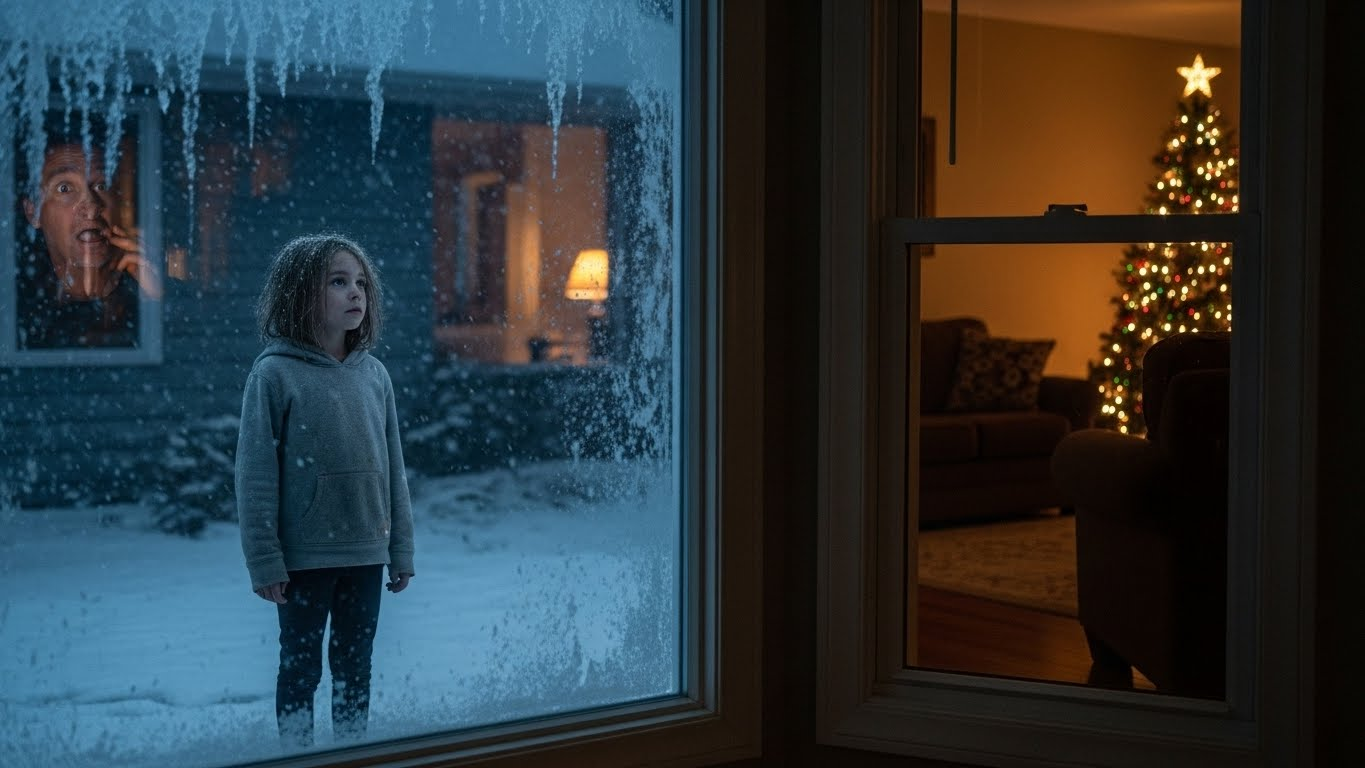
It was 6:00 AM in Eden Prairie, Minnesota. The thermometer on the back deck read ten below zero. The world outside was a bruised purple, the sun struggling to break the horizon. I stood by the front window with a mug of black coffee, feeling the heat seep into my cold fingers, watching the wind whip the snow into little tornadoes on the driveway.
That’s when I saw her.
At first, my brain refused to process the image. It categorized the shape by the old oak tree as a deer, or a trash can blown over by the wind. But trash cans don’t shiver.
She was standing perfectly still, about thirty feet from my front porch. She was small, slight. In this weather, everyone looks like the Michelin Man, bundled in layers of down and Gore-Tex. But she was wearing a hoodie. A thin, grey, cotton hoodie that looked stiff, like it had frozen solid. Her jeans were dark with moisture up to the knees. No hat. No gloves.
I put my coffee down on the coaster, a ring of condensation forming instantly. “What the hell?” I muttered.
We have a neighborhood watch here. We have Ring cameras. We have sensors. People don’t just wander onto lawns in sub-zero temperatures unless they’re drunk, high, or looking for something to steal. My instinct was defensive. I checked the lock on the front door.
But then she turned her head. She wasn’t looking at the door. She was looking at the window. At me. Or rather, through me, at the blinking lights of the Christmas tree.
The look on her face wasn’t malice. It was hunger. Not just for food, though her cheeks were hollowed out, but a starving, desperate hunger for the warmth radiating from my living room. She wrapped her arms around herself, rocking back on her heels.
I watched her for a full minute. She didn’t move toward the house. She just stood there, a statue of misery in the biting wind. The rational part of my brain screamed, Call the cops. Don’t get involved. The human part of my brain, the part that remembered my own daughter who lives three states away now, screamed, She’s going to die.
I unlocked the deadbolt. The clack echoed in the empty foyer.
I opened the door, and the cold hit me like a physical slap. The wind howled, instantly numbing my nose.
“Hey!” I shouted over the gale.
She jumped. It was a visceral flinch, the kind you see in stray dogs that have been kicked one too many times. She took a stumbling step back, her boots slipping on the ice.
“I’m not going to hurt you!” I yelled, stepping onto the porch in my socks. “You can’t stay out there! It’s ten below!”
She didn’t run. She stared at me, her eyes wide and dark, contrasting sharply with her pale, frostbitten skin. Slowly, cautiously, she began to walk toward me. It was an agonizing shuffle. Her legs were stiff from the cold.
As she got closer, the details hit me hard. She wasn’t a kid. She was a young woman, maybe twenty-two or twenty-three. But she looked ancient and infant-like at the same time. Her lips were a terrifying shade of blue.
When she reached the bottom of the porch steps, she stopped. She reached into the pocket of that frozen hoodie. My muscles tensed. I prepared to slam the door.
But she didn’t pull out a knife or a gun. She pulled out a square of paper. It was crumpled, water-stained, and bent at the corners. Her hand shook so violently she almost dropped it.
“Is this…” Her voice was a cracked, dry whisper, barely audible over the wind. “Is this where the warm people live?”
I frowned, confused by the question. “The what? Come inside, please.”
“The picture,” she insisted, thrusting the paper toward me.
I took it. It felt brittle in the cold. I looked down.
The world tilted on its axis.
It was a photograph. A glossy 4×6 print, the colors faded with age. It showed a living room with a stone fireplace and high beams. My living room. Standing in front of the fireplace was a man with thick dark hair and a beard, smiling broadly. He was holding a baby wrapped in a red blanket.
The man was my father. He died ten years ago.
But I’m an only child. And I was born in 1985. The timestamp on the bottom corner of the photo read: DEC 25, 2003.
“Who are you?” I whispered, looking up from the photo.
She opened her mouth to speak, but her eyes rolled back into her head. Her knees buckled. She collapsed forward, hitting the welcome mat with a dull thud.

Chapter 2
Panic is a funny thing. You think you’ll freeze, but I moved faster than I ever have in my life. I scooped her up. She was shockingly light, like a bundle of dry sticks. Her clothes were ice cold, sucking the heat right out of my arms.
I kicked the door shut behind me and laid her on the rug in the foyer. The heat of the house swirled around us, but she was radiating cold like a block of ice.
“Hey! Can you hear me?” I slapped her cheeks lightly. They felt waxy.
I grabbed my phone and dialed 911.
“911, what is your emergency?”
“I have a… a woman here. She’s unconscious. Hypothermia. She was outside in the snow. She’s breathing shallow.”
“Address, sir?”
I rattled off my address. “Please hurry. She’s blue.”
“Paramedics are dispatching now. Is she responsive to pain?”
I pinched her arm. Nothing. “No.”
“Okay, get her warm. Do not use direct heat. Blankets. Body heat. Stay on the line.”
I threw the phone on the floor and ran to the couch, grabbing the heavy knit throw Sarah had left behind. I wrapped the girl in it, tucking the corners under her shaking frame. I ran to the hall closet and grabbed two more comforters. I piled them on top of her until she looked like a cocoon.
I sat there on the floor next to her, watching her chest rise and fall in jagged, terrifying rhythms. My mind was racing, bouncing between the girl dying on my floor and the photograph sitting on the entry table.
December 25, 2003.
I was eighteen that year. I was a freshman in college. I came home for Christmas. I remember that Christmas vividly. Dad was happy. Mom was… Mom was quiet. She was always quiet around the holidays, but that year she seemed distant. I assumed it was empty nest syndrome.
But that photo. That was Dad. No mistaking the scar on his chin or the way he held his shoulders. And the baby?
I looked at the girl’s face. Under the dirt and the bruising of the cold, there was a structure to her face. High cheekbones. A sharp nose.
She looked like my mother.
The realization hit me so hard I felt nauseous. I crawled over to the table and picked up the photo again. I studied the background. The fireplace. The stocking hooks. There were three stockings. One for Dad, one for Mom, one for me.
But the baby wasn’t me. And there was no fourth stocking.
The sirens wailed in the distance, getting louder. I looked back at the girl. She groaned, a low, guttural sound. Her eyes fluttered open. They were unfocused, glassy.
“Dad?” she whispered.
I froze. “No,” I said softly. “I’m… I’m the guy who lives here.”
She blinked, trying to focus on my face. “He said… he said he’d come back.”
“Who?”
“The man in the snow,” she mumbled, her speech slurring. “He put me in the box. He said to wait.”
“What box?” I asked, leaning in close. “Who put you in a box?”
She started to shake again, violent tremors that rattled the floorboards. “The cold box. Under the ground. But I got out. I dug out.”
She grabbed my wrist. Her grip was surprisingly strong. Her fingernails were broken, caked with dark earth.
“Don’t let him find me,” she hissed, her eyes suddenly lucid and terrified. “He’s still watching. He’s always watching the house.”
“Who is watching the house?”
“The man,” she said, her voice dropping to a terrified squeak. “The man who buried Mommy.”
At that exact moment, the doorbell rang.
I jumped, my heart slamming into my throat. It was the police. It had to be the police.
I stood up and looked through the peephole.
It wasn’t the police.
Standing on my porch, staring directly into the peephole as if he knew I was there, was a man in a black coat. He wasn’t a cop. He was holding a shovel.
And he looked exactly like my next-door neighbor, Mr. Henderson. The sweet old man who had brought me cookies when I moved in.
But Mr. Henderson had been in a wheelchair for five years. This man was standing.
PART 2
Chapter 3
I stared through the peephole, my breath hitching in my throat. The fisheye lens distorted his face, stretching his forehead and chin, but I knew who it was. It was Arthur Henderson.
Mr. Henderson lived in the ranch-style house next door. He was seventy years old. He had a white trellis with roses in the summer and a Golden Retriever named Buster. For the five years I’d lived here, I had never seen him without his motorized wheelchair. He’d told me once, over the backyard fence, that Vietnam took his legs.
But now, he was standing. Not just standing—he was looming. He stood tall, his posture rigid and threatening, gripping a rusted spade shovel with leather-gloved hands. The snow swirled around him, but he didn’t blink. He was staring right at the wood of my door, as if he could see the heat signature of my terrified body on the other side.
He reached out and tried the handle.
Rattle. Clack.
The deadbolt held. Thank God, the deadbolt held.
“Open the door, son,” he said. His voice wasn’t the wheezy, kindly rasp I was used to. It was deep, commanding, and utterly devoid of warmth. “You have something of mine.”
I backed away from the door, my socks sliding on the hardwood. “Go away!” I screamed, my voice cracking. “I’m calling the police!”
“The police can’t help her,” he said calmly. “She’s sick. She’s confused. She belongs with me. I’m her caretaker.”
“You’re in a wheelchair!” I shouted, the absurdity of the argument mixing with my terror. “How are you standing?”
He didn’t answer. He just raised the shovel. For a second, I thought he was going to smash the glass panel in the center of the door. I scrambled backward, tripping over my own feet and landing hard on my elbows in the hallway.
Then, the sirens cut through the air.
They were close now. The wail was deafening, bouncing off the suburban houses. Blue and red lights began to strobe against my living room walls, flashing through the curtains like a disco from hell.
I scrambled back up and looked through the peephole again.
He was gone.
There were no footprints leading away from the porch—the wind was blowing so hard it was erasing tracks in seconds. He had vanished into the whiteout just as a patrol car skidded to a halt in my driveway.
I ripped the door open. Two officers were already running up the walk, hands on their holsters.
“He was just here!” I yelled, pointing wildly into the storm. “My neighbor! He had a shovel!”
The officers ignored me, pushing past me into the house. “Sir, step aside! Where is the victim?”
“She’s… she’s in there,” I stammered, pointing to the living room where the pile of blankets lay motionless.
The next ten minutes were a blur of chaotic efficiency. Paramedics rushed in with a stretcher and bags of equipment. They cut the girl’s hoodie open. I saw wires being attached to her chest. I heard terms like “severe hypothermia,” “bradycardia,” and “frostbite stage three.”
I stood in the corner, hugging my own arms, feeling useless. One of the officers, a tall man with a buzz cut and a badge that read Sgt. Miller, approached me with a notepad.
“Sir, are you the homeowner?”
“Yes. Yes, I’m David. David Miller. Wait, are we related?” I asked stupidly, my brain misfiring from shock.
He didn’t smile. “No relation. Tell me what happened.”
“I found her outside. Just standing there. She gave me a photo. Then she collapsed.” I took a breath, trying to steady my hands. “Then my neighbor, Mr. Henderson, he came to the door. He had a shovel. He tried to get in. He said she belonged to him.”
Sgt. Miller looked up from his notes, eyebrows raised. “Arthur Henderson? Next door?”
“Yes! He was standing! He walks, Sergeant. He’s been faking it.”
The sergeant exchanged a look with his partner. It was the kind of look that said, This guy is losing it.
“Sir, we know Arthur. We respond to lift-assist calls at his house twice a month. The man is a paraplegic. He can’t stand.”
“I saw him!” I insisted, my voice rising. “He was right there! He threatened me!”
“We’ll check on him,” Miller said, his tone placating. “Right now, we need to focus on the girl. Do you know her?”
“No. Never seen her before.”
“She had no ID?”
“No. Just… just this.”
I reached into my pocket and pulled out the photograph. The water had warped it slightly, curling the edges. I handed it to the sergeant.
He shined his flashlight on it. “That’s this house,” he noted.
“That’s my dad,” I said, pointing to the man in the photo. “Taken twenty years ago.”
Miller squinted. “Who’s the baby?”
“I don’t know,” I whispered. “I’m an only child.”
The paramedics were lifting the girl onto the gurney. As they passed me, her hand flopped out from under the blanket. It was limp, pale as milk.
“She’s posturing,” a medic yelled. “We need to move! Go, go, go!”
They rushed her out into the snow. The swirling red lights painted the walls again.
“I need to go with her,” I said, stepping forward.
“You can’t,” Miller said, blocking my path. “This is a crime scene now, David. Until we figure out who she is and why a grown man claims to have seen a paraplegic neighbor brandishing a shovel, you need to stay right here.”
“But she knows me!” I argued. “Or she knows my family! She called out for my dad!”
“Stay here,” Miller ordered. “We’ll check the neighbor. Lock your door.”
They left. The heavy door clicked shut. The house was silent again, but the silence felt different now. It wasn’t lonely anymore. It was heavy with secrets.
I went to the window and watched the police trudge through the snow to Henderson’s house. I watched them knock. I watched the door open.
I couldn’t see inside, but a few minutes later, Miller came back out. He walked down Henderson’s driveway and back up to my porch. I opened the door before he could knock.
“Well?” I demanded.
Miller looked annoyed. “Mr. Henderson is in his chair, watching the news. He’s wearing pajamas. He says he hasn’t been outside in two days. His aide confirms it; she’s been there since 7:00 AM.”
“He’s lying,” I said, feeling a cold dread settle in my stomach.
“There are no wet clothes in his house, David. No wet boots. No shovel by the door.” Miller sighed. “Look, stress does funny things to the eyes. You found a dying girl. You’re shaken up.”
“I know what I saw.”
“Get some rest,” Miller said, turning away. “We’ll call you if she wakes up.”
He walked away. I watched him go, feeling a scream building in my chest. I wasn’t crazy. I knew I wasn’t crazy.
I locked the door. I threw the deadbolt. Then I dragged the heavy oak console table from the hallway and shoved it against the door.
If the police wouldn’t believe me, I had to protect myself.
Chapter 4
I paced the living room for an hour. My coffee was cold scum in the mug. Every creak of the house settling in the wind sounded like a footstep.
She said she dug out.
The words echoed in my mind. The cold box. Under the ground.
I stopped pacing. I looked at the photograph again, which I had reclaimed from the sergeant before he left. I sat on the couch and turned on the heavy lamp, holding the picture directly under the bulb.
The background. I needed to look at the background.
Behind my father and the mystery baby, through the window in the photo, there was a blur of white. Snow. It was Christmas, after all. but there was something else. A dark shape in the distance.
I went to the kitchen drawer and dug out a magnifying glass I used for reading model instructions. I hovered it over the photo.
The dark shape wasn’t a tree. It was a structure. A small, wooden structure with a slanted roof.
It was the old garden shed in the far back corner of the lot.
That shed had been falling apart since I was a kid. Dad used to keep the lawnmower in there, but after he died, the roof caved in partially, and I just boarded it up. I hadn’t looked inside it in ten years. It sat right on the property line—the line I shared with Mr. Henderson.
I dug out.
I grabbed my heavy coat, a scarf, and my boots. I went to the garage and found a heavy flashlight and a baseball bat. I didn’t have a gun—Sarah hated them—but the bat felt solid in my hands.
I went out the back door. The wind had died down slightly, but the snow was still falling in thick, heavy flakes. The world was a monochrome of white and grey.
I trudged through the knee-deep snow, my breath pluming in front of me like dragon smoke. The shed was about fifty yards back, nestled in a cluster of pine trees.
As I got closer, I saw it.
A trail.
It wasn’t a walking trail. It was a drag mark. A furrow in the snow, like an animal had crawled on its belly. It started near the shed and wound its way toward my house, eventually disappearing where the wind had swept the yard clean near the porch.
My heart hammered against my ribs. I followed the trail backward, toward the shed.
When I reached the structure, I stopped. The door to the shed was boarded up with two-by-fours, just as I had left it years ago. The rusted padlock was still in place. There was no way anyone had come out of there.
But the drag marks didn’t come from the door. They came from behind the shed.
I walked around the rotting wood structure, stepping over tangled briars buried in snow.
Behind the shed, concealed by a dense thicket of holly bushes, was a patch of disturbed earth. The snow had been pushed aside, revealing a square of plywood flat against the ground. It looked like the entrance to a storm cellar, the kind they have in tornado alley, but we don’t really have those in this part of Minnesota.
The plywood was shoved askew. A dark, gaping hole stared up at me.
I shined my flashlight down into the abyss.
It wasn’t just a hole. There were steps. Rough, earthen steps reinforced with wooden planks, leading down into the darkness.
“Hello?” I called out. The sound was swallowed instantly by the earth.
I gripped the bat tighter and took the first step. Then the second. The air got colder as I descended, smelling of wet dirt and something else—something metallic and sharp. Like old blood.
At the bottom of the stairs, about ten feet down, was a heavy steel door. It was slightly ajar.
I pushed it open with the tip of the bat. It creaked, a high-pitched scream of rusted hinges.
I stepped inside and swept the flashlight beam around.
I wasn’t in a storm cellar. I was in a room. A concrete room, maybe ten feet by ten feet.
The beam landed on a mattress in the corner. It was filthy, stained with yellow and brown fluids. There was a bucket next to it. Chains were bolted to the wall, ending in ankle cuffs.
I gagged, covering my mouth with my gloved hand. The horror of it was physical, a punch to the gut. Someone had been living down here. Someone had been kept down here.
I swept the light to the other side of the room. There was a small wooden table. On it sat a row of objects, neatly arranged.
I walked over, my legs trembling so bad I could barely stand.
There was a hairbrush. A tube of lipstick (Revlon, Cherries in the Snow). A pair of reading glasses.
I recognized the glasses. They were my mother’s. She had lost them the year she “left.”
My dad had told me she ran away with a man from the city. He told me she didn’t want to be a mother anymore. He told me she abandoned us. I hated her for years. I spent two decades hating a woman who I thought chose a new life over me.
I picked up the glasses. Tears froze on my cheeks.
Next to the glasses was a stack of papers. I shined the light on the top sheet. It was a drawing, done in crayon. Stick figures. A tall man, a mommy, a boy, and a baby. The baby was circled in red crayon.
Under the drawing was a notebook. I opened it. The handwriting was jagged, frantic.
Day 4,000?? I don’t know anymore. He brought me a picture of David today. He looks so grown up. He lives in the house now. I can hear his car. Why doesn’t he look for me? Why doesn’t David look for us?
I dropped the notebook. “Mom,” I choked out.
My mother hadn’t left. She hadn’t run away. She had been here. Right here, in the backyard, fifty yards from where I slept, ate, and watched TV.
And “us”?
I looked back at the mattress. Scratched into the concrete wall above it, in what looked like fingernail marks, were two names.
MARGARET LILY
Margaret was my mother. Lily…
The girl. The girl in the snow.
The realization hit me like a sledgehammer. The baby in the photo. The girl on my porch. She wasn’t a stranger. She was my sister.
A sister I never knew I had. A sister born in this concrete box.
Suddenly, a mechanical whirring sound came from the entrance behind me.
I spun around, raising the flashlight.
At the top of the earthen stairs, silhouetted against the grey sky, was the outline of a man. He was sitting in a wheelchair.
But as I watched, he stood up. Slowly. Painfully. But he stood.
Arthur Henderson smiled, his teeth yellow in the gloom. He was holding a remote control in one hand and a gas can in the other.
“You were always a snoopy kid, David,” he called down, his voice echoing in the bunker. “Your father had the good sense to keep his mouth shut. Shame you didn’t learn from him.”
He tossed the gas can down the stairs. It hit the bottom with a clang, the cap popping off. The smell of gasoline filled the small space instantly.
Then, he pulled a flare from his pocket and cracked it. The red light bathed him in a demonic glow.
“Say hello to your mother for me.”
He dropped the flare.
PART 3
Chapter 5
The flare hit the puddle of gasoline with a soft whump that instantly transformed into a roar.
I didn’t think. Instinct took over—the primal animal brain that screams survive. I threw my weight against the heavy steel door, slamming it shut just as a wall of orange flame erupted at the bottom of the stairs.
The sound was deafening, a vacuum-like boom that vibrated through the concrete floor. I spun the locking wheel on the inside of the door, sealing it tight.
For a second, there was silence. Then, the heat began to radiate through the steel.
I was trapped.
I was locked in a ten-by-ten concrete box, buried ten feet underground, with a raging inferno blocking the only exit. The air in the room was already stale, smelling of rot and old fear. Now, it was about to get a lot hotter.
“Think, David, think!” I screamed at myself, shining the flashlight wildly around the room.
The fire outside would suck the oxygen out of the tunnel quickly. Even if the fire didn’t get in, the heat would turn this room into an oven, or the carbon monoxide would seep through the cracks and put me to sleep forever.
I dug out.
Lily’s voice echoed in my head. I dug out.
I scrambled over to the filthy mattress in the corner. I grabbed the edge and flipped it over, tossing it against the far wall.
Underneath, the concrete floor was cracked and broken. A section of the foundation had been chipped away, piece by painful piece. Below the jagged edge of the concrete was a hole.
It wasn’t a tunnel. It was barely a burrow. It looked like something a fox would make, not a human. It was muddy, dark, and terrifyingly narrow. It angled sharply upward into the earth behind the bunker’s wall.
I looked at the steel door. The paint was already starting to blister and bubble. Smoke was wisping in through the seams.
I had no choice.
I grabbed the notebook—my mother’s diary—and shoved it down the front of my coat. I gripped the flashlight in my teeth.
I dove into the hole headfirst.
The cold mud instantly coated my face, blinding me. The space was impossibly tight. My shoulders scraped against rocks and tree roots that tore at my heavy coat. I had to pull myself forward by digging my fingers into the wet clay, inch by agonizing inch.
Panic flared in my chest. I’m going to get stuck. I’m going to die buried in the dirt.
I couldn’t breathe. The air in the tunnel was thin and smelled of wet earth. My chest was compressed so tightly I could only take shallow, sipping breaths.
Keep moving. For Mom. For Lily.
I crawled. My hands were numb. My knees were raw. I felt a sharp root slice across my cheek, but the pain felt distant.
After what felt like hours but was probably only five minutes, my hand broke through into empty space.
Cold air. Freezing, biting, wonderful winter air.
I clawed frantically at the opening, widening it. I pushed my head through and gasped, filling my lungs with the icy wind.
I pulled myself up. I was outside.
I was lying in the snow, hidden deep within the thicket of holly bushes that lined the back fence. The thorns tore at my clothes, but I didn’t care.
I stayed low, pressing my face into the snow to cool my burning skin. I looked toward the shed.
Thick black smoke was billowing out of the hidden entrance behind the shed. The fire was raging down there.
And standing just a few feet away from the smoke, watching with a look of calm satisfaction, was Arthur Henderson.
He was standing tall, his wheelchair abandoned near the tree line. He was smoking a cigarette, watching the smoke rise like he was admiring a bonfire. He thought I was roasting. He thought he had just tied up the last loose end.
I wanted to scream. I wanted to rush him and bash his head in with a rock.
But he had a gun. I saw the bulge under his coat now. And I was exhausted, freezing, and unarmed.
I had to get to the house. I had to get help.
I rolled onto my belly and began to crawl through the snow, using the holly bushes as cover. The wind was my ally now; the howling gale masked the sound of my movement.
I reached the back porch. My fingers were so cold they felt like wooden blocks as I fumbled for my house keys. I prayed he hadn’t locked the back door from the outside.
I slid the key in. It turned.
I slipped inside the kitchen and locked the door behind me, engaging the deadbolt and the chain.
I slid to the floor, my back against the cabinets, shivering violently. I was safe. For now.
But as I looked down at the muddy floor, I realized I had left a trail. A trail of wet, black mud leading from the door to where I sat.
And through the kitchen window, I saw movement.
Henderson had turned around. He was looking at the house. He was looking at the back door.
He knew.
Chapter 6
I didn’t have time to rest. Adrenaline, sharp and electric, surged through my veins, temporarily chasing away the cold.
I scrambled up and ran to the kitchen drawer where I kept the “junk.” Scissors, tape, screwdrivers. I grabbed a long, flathead screwdriver. It wasn’t much, but it was better than nothing.
I needed to call the police again. I reached into my pocket for my phone.
It was gone. It must have fallen out in the tunnel.
“Dammit!” I shouted, the sound echoing in the empty house.
I ran to the living room to use the landline. We still had one, a bundle requirement from the cable company I never bothered to cancel.
I picked up the receiver.
Silence. No dial tone.
The line was dead. Henderson had cut it. He was thorough. He had planned this.
I was cut off. My car keys were on the hook by the front door. If I could get to the garage, maybe I could drive through the snow and get to the station.
I grabbed the keys and sprinted to the door connecting the kitchen to the garage. I yanked it open and froze.
My car, a trusty Subaru Outback, was there. But all four tires were slashed. They sat flat and sad on the concrete. The hood was popped open, wires hanging out like spilled guts.
He had disabled the car before he even came to the door with the shovel. He had trapped me before I even knew I was in a trap.
I slammed the garage door and locked it. I was a rat in a cage.
I backed into the kitchen, my breathing coming in ragged gasps. I needed a weapon. A real weapon.
And then I remembered the attic.
My father had a safe in the attic. He kept his “important papers” there. But I also remembered, vividly, seeing an old revolver in there once when I was a kid. He had caught me looking at it and tanned my hide, telling me never to touch it.
I hadn’t opened that safe since he died. I didn’t know the combination.
But maybe the combination is in the notebook.
I pulled the dirty, water-stained notebook from my coat. My mother’s diary.
I opened it to the back pages. My mother had scribbled frantic notes. Dates. Names. And a series of numbers circled in red ink.
10-24-85
My birthday.
I ran to the hallway and pulled down the attic ladder. I scrambled up into the freezing darkness, pulling the cord for the single bare bulb.
The attic was filled with dust and memories. Boxes of old clothes, Christmas ornaments, broken furniture. In the corner, under a tarp, sat the heavy iron safe.
I fell to my knees in front of it. My fingers were shaking so badly I could barely turn the dial.
10… right to 24… left to 85.
Click.
The handle turned.
I pulled the heavy door open.
There, sitting on a pile of deeds and bonds, was the revolver. A .38 Special. Rusty, but heavy. I checked the cylinder. It was loaded. Six bullets.
I also saw a stack of envelopes in the safe. Thick, manila envelopes. I grabbed one and ripped it open.
Cash. Thousands of dollars in cash.
And a letter. In my father’s handwriting.
To David,
If you are reading this, I am dead. And I pray to God that Arthur Henderson is too.
I am a coward, son. I want you to know that. I am a coward.
When your mother disappeared, I went to the police. I filed the reports. But a week later, Arthur came to me. He showed me a picture of her. She was tied up. He told me he had her.
He told me if I ever went to the police again, he would kill her. Slowly. And then he would kill you.
He wanted money. He always wanted money. He lost his pension gambling. So I paid him. I paid him every month to keep her alive. He kept her in the bunker. He told me she was comfortable. He told me he would release her one day.
Then the baby came. He told me about the baby. He said it was his. He said he was raising a family down there.
I wanted to kill him. Every day, I watched him over the fence and wanted to kill him. But I was afraid. I was so afraid for you.
Forgive me, David. I bought your life with her freedom.
I dropped the letter. Tears blurred my vision. My father wasn’t a villain. He was a hostage. For twenty years, he had lived next door to the monster who had his wife, paying a ransom just to keep his son safe.
And I had hated him for his silence.
CRASH.
The sound of shattering glass came from downstairs.
I froze.
The back door. He had broken the window.
Heavy boots crunched on the glass.
“David!” Henderson’s voice boomed through the house. It was jovial, mocking. “I know you’re in here, boy! I saw the mud! You’re a slippery one, aren’t you?”
I grabbed the gun. I gripped it with both hands to stop the shaking.
“Come out, David!” Henderson yelled. “Let’s have a chat! Just like I used to have with your daddy!”
I heard him walking through the kitchen. He was moving toward the hallway. Toward the attic stairs.
I looked at the open hatch of the attic. The ladder was down. It was a giant arrow pointing right to me.
I quietly clicked the hammer of the revolver back.
“I’m up here, Arthur!” I screamed.
Silence.
Then, a laugh. A dry, wheezing laugh.
“Nowhere left to run, son.”
I heard a heavy step on the first rung of the ladder. The wood creaked.
I aimed the gun at the square of light in the floor.
“Don’t come up!” I warned.
“Or what?” Henderson taunted. “You gonna hit me with a ornament? You don’t have it in you, David. You’re soft. Just like your father.”
A hand appeared on the attic floor. A gloved hand holding a semi-automatic pistol.
Then, Arthur Henderson’s face rose into the light.
His eyes were wide, manic. He raised his gun.
I didn’t think. I didn’t hesitate. I pulled the trigger.
PART 4
Chapter 7
The explosion of the .38 Special in the confined space of the attic was louder than anything I had ever heard. It wasn’t just a sound; it was a physical blow to the head, a pressure wave that popped my ears and filled the air with acrid, stinging smoke.
I didn’t see where the bullet went at first. The recoil jerked my hand up violently.
But I heard the scream.
It was a wet, gargling cry of pain. Henderson’s face, illuminated by the attic light, twisted in shock. A bloom of red appeared instantly on his right shoulder, shredding the fabric of his coat. The force of the slug spun him around like a top.
He lost his grip on the ladder.
His gun clattered to the floor below, followed a split second later by the heavy thud of his body hitting the hallway hardwood.
I didn’t wait to see if he was moving. Adrenaline, cold and sharp, flooded my system. I scrambled down the ladder, skipping rungs, jumping the last three feet.
Henderson was on his back, writhing. He was clutching his shoulder, blood pumping between his gloved fingers, pooling dark and thick on the rug. His face was pale, his eyes wide with shock and rage.
His gun—a black Glock—was lying three feet away from his outstretched hand.
He lunged for it.
I kicked it. It skittered across the floor and slid under the hallway table.
I leveled the revolver at his head. My hands were shaking uncontrollably, but at this range, I wouldn’t miss.
“Don’t move!” I screamed, my voice raw. “Don’t you move a muscle, Arthur!”
He froze, panting heavily. He looked up at me, and slowly, a terrifying grin spread across his blood-spattered face.
“You have… your father’s eyes,” he wheezed, coughing. “But you have her chin. Margaret’s chin.”
“Shut up,” I hissed. “Why? Why did you do it?”
He laughed, a bubbling, wet sound. “Why? Because she was mine, David. Before she met your pathetic father, she was mine. We were high school sweethearts. He stole her with his fancy job and his big house.”
“So you kidnapped her? You locked her in a hole for twenty years?”
“I saved her!” he shouted, wincing as the movement jarred his wound. “I saved her from a boring life! We made a life down there. A pure life. No bills. No noise. Just us.”
“And the baby?” I asked, feeling sick. “Lily?”
“Our daughter,” he whispered, his eyes gleaming with madness. “She’s perfect. She’s never been corrupted by this world. Never seen TV. Never seen the internet. She’s pure.”
“She’s dying of hypothermia in a hospital because of you,” I spat.
“She escaped,” he muttered, angry now. “Ungrateful. Just like her mother. Margaret tried to leave too. Once.”
My stomach dropped. “What did you do to my mother?”
Henderson’s smile faded. He looked at the ceiling, his eyes losing focus. “She got sick. Three winters ago. The heater broke. I tried to fix it, but she was so frail. She just… stopped.”
He looked back at me. “I buried her under the rose bushes. Next to the shed. So she could always be close to me.”
Blind rage, hot and white, threatened to consume me. I tightened my finger on the trigger. I wanted to end him. I wanted to put a bullet right between his eyes for every year he stole, for every lie he forced my father to tell, for the freezing hell he put my sister through.
“Do it,” Henderson whispered. “Be a man, David. Finish it.”
I took a breath. I steadied my hand.
CRASH.
The front door exploded inward. Splinters of wood flew into the hallway as a battering ram smashed through the lock.
“POLICE! DROP THE WEAPON!”
“HANDS! SHOW ME YOUR HANDS!”
Sgt. Miller came through the door first, his service weapon drawn, followed by two other officers. They had their guns trained on me.
“Drop it, David! Now!” Miller shouted.
I looked at Henderson, then at Miller. I slowly lowered the revolver and placed it on the floor. I raised my hands.
“He’s shot,” I said, my voice trembling. “He confessed. He confessed to everything.”
Miller kicked the revolver away and moved in, checking Henderson.
“Dispatch, we have shots fired, suspect down. Send EMS,” Miller barked into his radio. He looked up at me, his eyes hard but understanding. “We saw the smoke from the shed, David. We saw the fire.”
He holstered his gun and grabbed my shoulder. “You okay, son?”
I looked down at the man who had haunted my family for two decades, now bleeding out on my rug.
“I am now,” I whispered.
Chapter 8
The next six hours were a blur of statements, crime scene tape, and flashing lights.
They found the bunker. The fire department put out the blaze before it destroyed everything, preserving the horror of that concrete box for the forensics team. They found the chains. They found the drawings.
And they found the grave under the rose bushes.
They took Henderson away in an ambulance, handcuffed to the gurney. He survived the gunshot. He’s currently in the ICU under heavy guard. The District Attorney is already talking about life without parole. Kidnapping, homicide, extortion. He’ll never see the sun again, except through bars.
But none of that mattered to me.
At 3:00 AM, I walked into the critical care unit of the Fairview Southdale Hospital. The hospital smelled of antiseptic and floor wax—a sharp contrast to the smell of smoke and old earth that still clung to my clothes.
Sgt. Miller walked me to the room. “She’s awake,” he said softly. “She’s asking for the man with the warm house.”
I pushed the door open.
The room was dim, lit only by the monitors beeping rhythmically. In the bed, looking impossibly small among the pillows and blankets, was Lily.
She was clean now. The dirt was gone from her face. Her hair, though matted and chopped unevenly, was brushed back. She was hooked up to IVs, warming fluids pumping into her veins.
She turned her head when I entered. Her eyes—my mother’s eyes—widened.
“You came back,” she whispered. Her voice was stronger now, though still raspy.
I walked to the bedside and sat in the chair. I didn’t know what to say. I didn’t know how to talk to a sister I didn’t know existed six hours ago.
“I told you,” I said, tears pricking my eyes. “I’m David.”
“David,” she tested the name. “Brother.”
She reached out a hand. It was bandaged, her fingers wrapped in gauze from the frostbite, but she reached for me.
I took her hand gently. It was warm.
“Is he gone?” she asked. “The bad man?”
“Yes,” I said firmly. “He’s gone. He can never hurt you again. He can never put you in the box again.”
She let out a long, shuddering breath. “Mommy told me about you. She told me stories every night. She said you were a prince in a castle.”
I laughed, a choked, watery sound. “It’s just a suburban split-level, Lily. But it’s yours now too.”
She squeezed my hand. “She wanted you to have the picture. She hid it for years. She kept it in her mattress. She said… she said if I ever got out, I had to find the warm people.”
“You found us,” I said. “You found me.”
I stayed with her all night. I watched her sleep. I watched the sunrise paint the sky pink and orange through the hospital window.
It was Christmas morning. Technically, it was the day after Christmas now, but it felt like the first real Christmas I’d had in twenty years.
My phone, which the police had recovered from the tunnel entrance, buzzed on the table. It was a text from my ex-wife, Sarah.
Merry Christmas, David. Hope you’re okay.
I looked at the message. Then I looked at Lily, sleeping peacefully, her chest rising and falling in a steady rhythm. I looked at the reflection in the window—a tired man, battered and bruised, but no longer alone.
I typed back:
I’m better than okay. I have a family again.
I put the phone down and pulled my father’s letter from my pocket. I smoothed out the crumpled paper.
Forgive me, David.
I looked up at the ceiling, imagining my dad somewhere up there, finally free of his burden.
“I forgive you, Dad,” I whispered into the quiet room. “You kept us safe. You did good.”
Outside, the snow had stopped falling. The sun was breaking through the clouds, shining on the white world, bright and blinding and new.
THE END.