I went in for a routine drug test to get my dream job, but when the doctor saw my blood results, he didn’t check my pulse—he silently triggered the alarm and locked me in the room.
CHAPTER 1: THE RED FLAG
The email from HR was simple: “Welcome to the team, pending physical.”
That was it. That was the golden ticket I had been waiting for. After six months of rejection letters, ramen noodles, and sleeping on my brother’s lumpy futon in Queens, I finally landed a position as a Lab Tech at St. Jude’s Research Hospital.
It wasn’t just a job; it was the job. Great pay, union benefits, and a foot in the door of the most prestigious medical facility in the state. I could finally move out. I could finally start my life.
I woke up at 6:00 AM, ironed my only good shirt, and scrubbed my face until it was raw. I wanted to look the part. Clean, professional, reliable.
If I had known that walking through those sliding glass doors would end my life as I knew it, I would have turned around and run straight into oncoming traffic on 5th Avenue.
The morning started normally enough. I met with HR, signed a mountain of paperwork about NDAs and safety protocols, and got my ID badge. It felt heavy in my hand—a plastic rectangle of validation.
“Looking good, Alex,” the HR rep, a bubbly woman named Sarah, said as she handed me the lanyard. “Last step is the employee health screening. Just standard procedure to make sure you’re not carrying anything contagious into the sterile zones. Dr. Evans is waiting for you in Room 304.”
I took the elevator up. I was whistling. I literally whistled in the elevator.
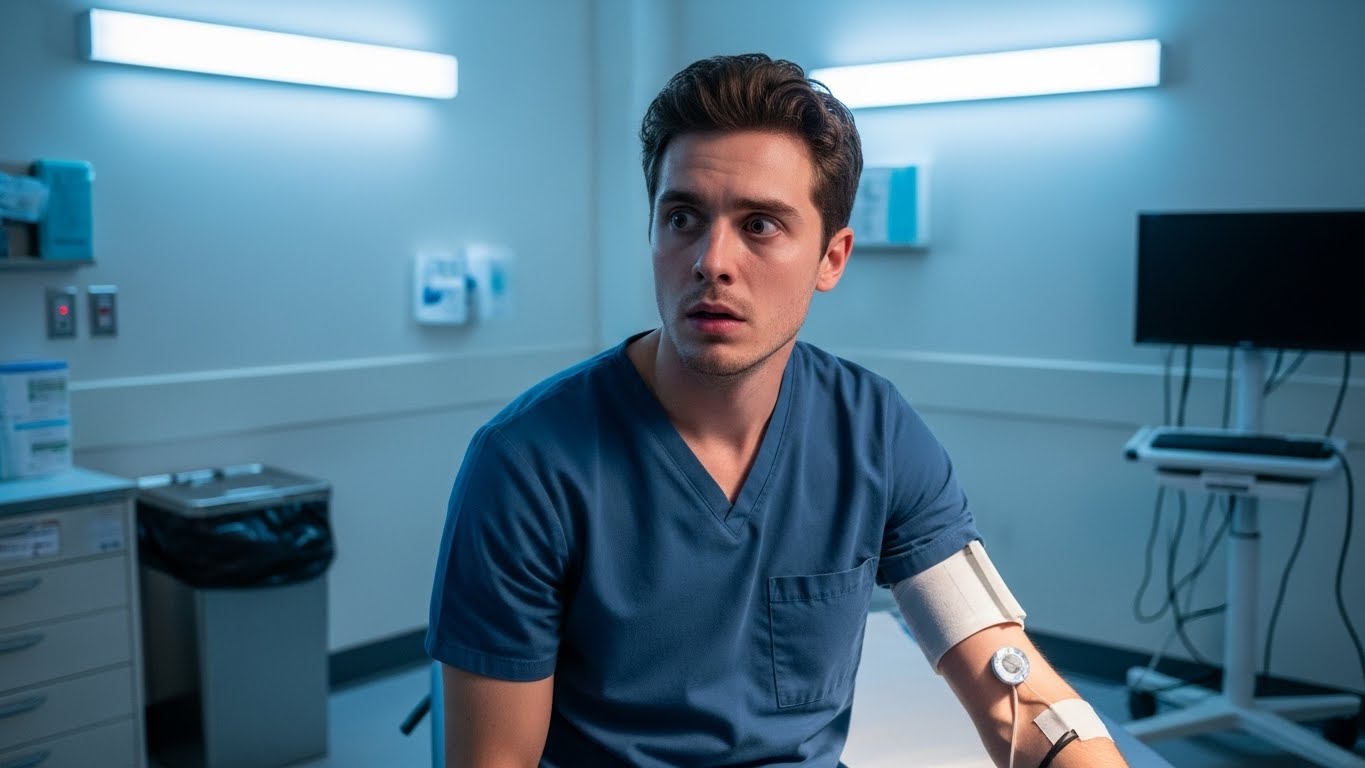
Room 304 was sterile, smelling of rubbing alcohol and latex. Dr. Evans was an older guy, thick glasses, no-nonsense attitude. He didn’t look up from his clipboard when I walked in.
“Arm,” he grunted.
I sat on the paper-covered table and rolled up my sleeve.
“Nervous?” he asked, tying the rubber tourniquet around my bicep.
“Excited,” I corrected him. “Big day.”
He hummed, found the vein, and slid the needle in. I looked away. I hate needles. I watched the little glass vial fill with deep red liquid.
“All done,” he said, slapping a cotton ball on the puncture site. “Wait here. I’ll run this through the rapid analyzer. Takes about ten minutes. Then you’re clear to start.”
He took the vial and walked into the adjoining lab room. The door didn’t close all the way.
I sat there, swinging my legs, checking my phone. I texted my mom: Got the badge! Just doing the blood work. Dinner on me tonight.
Five minutes passed. Then ten.
Then, I heard a noise from the other room.
It was the sound of glass breaking.
“That’s impossible,” I heard Dr. Evans whisper. His voice wasn’t grumpy anymore. It was trembling.
I leaned forward. “Everything okay, Doc?”
Silence.
Then, the sound of rapid typing. Keys being punished.
“Dr. Evans?” I called out, standing up.
“Sit down!” he snapped. His voice was sharp, panicked. “Do not leave that chair, Mr. Mercer. I need to… I need to verify a calibration error.”
He didn’t sound like he was verifying a calibration error. He sounded like he had just seen a ghost.
Through the crack in the door, I saw him pick up the red landline phone on the wall. It wasn’t the regular office phone. It was the emergency line.
He wasn’t looking at the test tubes anymore. He was looking at me through the glass partition. And the look in his eyes wasn’t professional curiosity.
It was pure fear.
“Yes,” I heard him whisper into the phone. “Security. And… call the precinct. Yes, immediately. It’s a match. A 100% match for the Cold Case file. He’s right here.”
Cold Case file?
My blood ran cold.
I stood up. “Doc, what’s going on?”
Dr. Evans slammed the door shut and I heard the click of a magnetic lock engaging.
I rushed to the door. Locked.
“Open the door!” I shouted, pounding on the wood. “What is this?”
“Stay back!” he yelled from the other side. “Security is on the way!”
My heart hammered against my ribs like a trapped bird. I looked around the room. No windows. One door leading to the hallway. And I was locked in.
What the hell was in my blood?
Two minutes later, I didn’t hear security guards. I heard heavy boots. Tactical boots.
The main door to the hallway burst open.
I spun around, expecting a rent-a-cop.
Instead, I was staring down the barrels of three service weapons.
“NYPD! GET ON THE GROUND! NOW!”
CHAPTER 2: THE INTERROGATION
I hit the floor so hard I bit my tongue.
“I didn’t do anything!” I screamed, the taste of copper filling my mouth. “I’m just getting a job!”
“ON THE GROUND! HANDS BEHIND YOUR HEAD!”
A knee slammed into my back, driving the air from my lungs. My face was pressed into the cold linoleum.
“Alex Mercer,” a detective’s voice growled in my ear as the metal cuffs bit into my wrists. “You have the right to remain silent. God knows you’ve been silent for the last six months.”
“Six months?” I gasped, spitting out dust. “I was in college six months ago!”
“Save it for the box, killer,” the cop spat.
He yanked me to my feet.
As they dragged me out into the hallway, past the horrified face of Sarah from HR, I looked back at Dr. Evans. He was holding the printout of my blood analysis like it was a holy relic.
I was shoved into the back of a cruiser. People were filming on their phones. I was the new employee who didn’t even make it to lunchtime before being arrested.
At the precinct, they didn’t put me in a holding cell. They put me in Interrogation Room 1. The serious room.
My prints were taken. My mugshot snapped. I was stripped of my belt and shoelaces.
For an hour, I sat alone, staring at the two-way mirror. I replayed the morning in my head. Had I eaten something? Had I taken the wrong Tylenol? What kind of drug test triggers a SWAT team?
Finally, the door opened.
Two detectives walked in. One was the guy who arrested me—Detective Miller. The other was a woman, Detective Rossi. She looked tired and mean.
She threw a file on the table. It slid across the metal surface and hit my cuffed hands.
“Start talking,” Rossi said.
“About what?” I pleaded. “I don’t know what’s happening. I applied for a job. I gave blood.”
“We know you gave blood,” Miller sneered. “And thank God you did. Because we’ve been looking for that blood for eight months.”
He opened the file.
Inside were photos. crime scene photos.
A bank vault. A shattered safety deposit box. And a dead security guard.
“The Midtown Heist,” Rossi said. “ring a bell?”
“I saw it on the news,” I said. “Everyone did.”
“Eight months ago, a crew hit the Sovereign Bank,” Miller said. “Professional job. In and out in four minutes. But one of them got sloppy. The guard, before he died, managed to slice the arm of one of the perps.”
Miller tapped a photo of a small pool of dried blood on the vault floor.
“We ran the DNA. It was unique. Rare markers. But no match in the system. The perp had no record. We called him ‘The Ghost’.”
He leaned into my face.
“Until today. When ‘The Ghost’ decided to apply for a job at a hospital that automatically runs every employee’s DNA against the state criminal database.”
I stared at him. “You think… you think I robbed a bank and killed a guy?”
“The DNA is a 100% match, Alex,” Rossi said. “One in a billion. It’s you.”
“I’ve never been to the Sovereign Bank!” I yelled. “Check my alibi! Eight months ago… I was in finals week! I was at NYU!”
“We checked,” Miller said calmly. “Your roommates said you pulled a few ‘all-nighters’ at the library. Or so you said. Plenty of time to slip away.”
“I have a scar!” I shouted. “If the guy got cut, I should have a scar on my arm!”
I rolled up my sleeves. My arms were smooth, except for the fresh needle prick from this morning.
Miller paused. He looked at my arms. He frowned.
“Plastic surgery,” he muttered. “Lasers. You used the money to fix it.”
“I have $40 in my checking account!” I screamed. “I eat ramen! Does that look like bank robber money to you?”
Rossi looked at Miller. A flicker of doubt crossed her face.
“He’s right, Miller. The suspect was described as 6’2, heavyset. Alex here is… maybe 5’9 soaking wet.”
“Accomplices lie about descriptions,” Miller snapped. “DNA doesn’t lie. It’s the gold standard. This is our guy.”
He slammed his hand on the table.
“Where is the money, Alex? Where are the diamonds?”
“I don’t have them!” I was crying now. This was a nightmare. I was going to prison for the rest of my life because of a drop of blood.
The door opened again.
A man in a suit walked in. He wasn’t a cop. He was holding a laptop.
“Detectives,” he said. “Step outside. Now.”
“We’re in the middle of a confession,” Miller barked.
“You’re in the middle of a lawsuit,” the suit said. “I’m from the DA’s forensic unit. You need to see this.”
CHAPTER 3: THE CHIMERA
They left me alone for another thirty minutes.
When they came back, Miller looked like he had swallowed a lemon. Rossi looked sympathetic.
They uncuffed me.
“Stand up,” Miller grunted.
“Am I going to jail?” I whispered.
“No,” Rossi said softly. “You’re going back to the hospital.”
“What?”
“Come with us.”
They drove me back to St. Jude’s. Not in the back of the cruiser this time, but in the front seat. No sirens.
We went straight to the lab. Dr. Evans was there, along with the guy in the suit and another doctor I didn’t recognize—a geneticist.
“Mr. Mercer,” the geneticist said. “I’m Dr. Aris. I apologize for the… extreme reaction earlier.”
“You ruined my life,” I said, rubbing my wrists.
“We made a mistake,” Dr. Aris said. “Well, the system made a mistake. Or rather, it told the truth, but we interpreted it wrong.”
He pulled up a diagram on a screen.
“When your DNA matched the crime scene sample, it was a perfect match. But Detective Rossi pointed out the physical discrepancies. Your height. Your lack of scars.”
He paused.
“So, we ran a deeper sequence. We took a swab from your cheek just now, from the water cup you drank from in interrogation.”
“And?”
“Your cheek cells,” Dr. Aris said, “have a completely different DNA profile than your blood cells.”
I blinked. “What?”
“It’s called Chimerism,” Dr. Aris explained. “It’s extremely rare. It happens in the womb. You absorbed a twin early in the pregnancy. You possess two distinct sets of DNA. Your skin and organs have one set. Your blood… carries the DNA of your unborn brother.”
I stared at him. The room spun.
“So… my blood… is my brother?”
” essentially,” Dr. Aris said. “And the blood at the crime scene… it didn’t come from you.”
“It came from someone else,” Rossi stepped in. “Someone who shares that specific DNA profile.”
“But I absorbed the twin,” I said. “He doesn’t exist.”
“Unless,” Dr. Aris said, “you didn’t just absorb a twin. Unless there was a triplet.”
The room went silent.
“A triplet?” I whispered.
“We checked your birth records,” Rossi said. “Your mother was sedated for the C-section. It was a chaotic birth at a county hospital in 1999. The records are… messy.”
Miller pulled out a file.
“We just ran the DNA profile against the national foster care database. We found a hit. A man named Marcus Thorne. Born the same day as you. Same hospital.”
He slid a mugshot across the table.
It was me.
But it wasn’t me. The face was harder. There was a scar over the eye. The neck was thicker. But the eyes… those were my eyes.
“He was separated at birth,” Rossi said. “Clerical error, or maybe illegal adoption. He went into the system. You went home with your parents.”
“Marcus Thorne is the Ghost,” Miller said. “He robbed the bank. He bled on the floor. And because you and he are identical monozygotic triplets—essentially clones in terms of blood DNA—you share the same markers.”
I sat down on a stool. I felt like I was going to throw up.
I had a brother. A triplet. A criminal who killed a guard. And I had almost gone to prison for his crime because my blood told on him.
“So I’m free?” I asked.
“You’re free,” Rossi said. “And you just gave us the lead we needed to catch a cop killer. We have his name now. We have his address.”
CHAPTER 4: THE REUNION
The police left to hunt down Marcus Thorne.
Dr. Evans looked at me, sheepish.
“I… suppose you still want the job?” he asked awkwardly.
I looked at him. I looked at the lab coat.
“I’ll take the job,” I said. “But I’m taking the rest of the day off.”
I walked out of the hospital into the late afternoon sun. My phone buzzed. It was my mom.
How did the physical go? Dinner tonight?
I stared at the screen. How do I tell my mother that she has a third son? A son who grew up alone? A son who became a killer?
I didn’t reply.
Instead, I walked to the subway. But I didn’t go home.
I had seen the address on Miller’s file before he closed it. It wasn’t far. A warehouse district in Brooklyn.
I know I should have let the police handle it. But curiosity is a disease. And I had just found out I was missing a piece of my soul.
I stood across the street from the rundown apartment building.
I saw a man walk out.
He was wearing a hoodie pulled low. He was smoking a cigarette.
He looked up. He saw me standing there.
He froze. The cigarette fell from his mouth.
It was like looking in a distorted mirror. He was me, but broken.
He took a step toward me. I took a step back.
Sirens wailed in the distance. The police were coming.
Marcus looked at the sirens, then back at me. He smiled. A sad, crooked smile.
He tapped his chest, right over his heart, and then pointed at me.
Then he turned and ran into the alleyway.
I watched him go. My brother. The Ghost.
The police cruisers screeched around the corner seconds later.
I turned and walked away.
I got the job. I cleared my name. But as I walked through the city that night, I realized that blood isn’t just thicker than water.
It’s a witness. And sometimes, it tells stories you aren’t ready to hear.
CHAPTER 5: THE FUGITIVE
I didn’t go to work the next day. I couldn’t.
How do you focus on calibrating microscopes when you know your genetic clone is running from the NYPD in a city of eight million people?
I sat in my apartment, watching the news. The headline was everywhere: “THE GHOST IDENTIFIED: MANHUNT UNDERWAY FOR MARCUS THORNE.”
They showed his mugshot—the one from the foster system. It was like looking into a funhouse mirror. He was me, but with harder eyes and a scar that cut through his eyebrow.
My phone rang. It was Detective Miller.
“Mercer,” he barked. “We lost him. He vanished into the subway tunnels near Atlantic Avenue. We need you to come in.”
“I told you everything I know,” I said, pacing my tiny living room. “I saw him for five seconds.”
“We don’t need your statement,” Miller said. “We need your face.”
“Excuse me?”
“He’s spooked. He’s armed. If we corner him, he might shoot. But if he sees you… maybe he pauses. Maybe he doesn’t pull the trigger. You’re the only leverage we have to end this peacefully.”
I hung up. I felt sick. They wanted to use me as bait for a brother I didn’t know existed.
I stared at the wall. I remembered the way Marcus had looked at me in the alley. He didn’t look like a cold-blooded killer. He looked tired. He tapped his heart.
Why?
My buzzer rang.
I froze. I wasn’t expecting anyone.
I walked to the intercom. “Who is it?”
Static. Then, a voice so familiar it made my skin crawl.
“It’s us,” the voice said.
It wasn’t “It’s me.” It was “It’s us.”
I buzzed him in.
I unlocked my apartment door and stood back. A minute later, the door opened.
Marcus slipped inside. He was soaking wet from the rain. He smelled like ozone and old cigarettes. He locked the door behind him and leaned against it, sliding down until he hit the floor.
He was bleeding. A dark stain was spreading across the side of his hoodie.
“You called the cops?” he asked, his voice rasping.
“No,” I said. “Not yet.”
CHAPTER 6: THE MIRROR IMAGE
I grabbed the first aid kit from my bathroom—the one I had bought for my new job.
“Let me see,” I said, kneeling beside him.
Marcus flinched, his hand going to his waistband where I saw the outline of a gun. But he didn’t draw it. He let me lift his shirt.
It was a graze. A bullet had skimmed his ribs. Painful, but not fatal.
“Why did you come here?” I asked, dabbing alcohol on the wound. “This is the first place they’ll look.”
“I had nowhere else,” Marcus grunted, hissing through his teeth. “And… I wanted to see if it was true.”
“If what was true?”
“That you made it out.” He looked at me, his eyes scanning my clean apartment, my ironed shirt, my books. “I used to dream up a brother, you know? In the group homes. When things got bad. I’d imagine there was another version of me out there who was warm. Who was safe.”
He laughed, a bitter sound.
“I robbed that bank to get out,” he admitted. “I owed money to bad people. I wanted to disappear. But I got sloppy. The guard… I didn’t mean to hurt him. He grabbed my arm. The gun went off. It was an accident.”
“It’s still murder, Marcus,” I said softly. “You killed a man.”
“I know,” he whispered. “I see his face every night.”
He looked at the bandage I was applying.
“We have the same blood,” he said. “That’s how they found me, right? Your blood told on me.”
“Yeah,” I said. “Dr. Evans. The test.”
Marcus closed his eyes. “Fate is a funny thing. I spent my whole life running, and my own DNA snitched on me from a brother I never met.”
Sirens wailed outside. Close. Louder than before.
Marcus’s eyes snapped open. He struggled to stand up.
“They’re here,” he said.
“Marcus, stop,” I stood up, blocking his path to the window. “You can’t run anymore. You’re bleeding. They have the perimeter locked down. If you go out that window, they will kill you.”
“Better dead than a cage,” he spat.
“No,” I said firmly. “Not today. I just found you. I’m not watching you die.”
CHAPTER 7: THE NEGOTIATION
Someone pounded on the door.
“POLICE! OPEN UP!”
Marcus pulled the gun. He aimed it at the door.
“Don’t,” I said. I stepped in front of him.
“Move, Alex,” he warned.
“If you shoot, you shoot through me,” I said. My voice was shaking, but my feet were planted. “You said you dreamed of a brother who was safe. Well, I’m here. And I’m telling you, this ends one of two ways. You die in my living room, or you walk out there and face it.”
The pounding got louder. “MERCER! WE KNOW HE’S IN THERE!”
I looked my triplet in the eye.
“You’re not a monster, Marcus. The guard was an accident. But if you shoot a cop today? That’s a choice. Don’t make that choice.”
Marcus looked at the gun. His hand was trembling. He looked at me—at the life I had, the life he could have had if the papers had been shuffled differently in 1999.
“I’m tired, Alex,” he whispered. “I’m so tired of running.”
“Then stop,” I said.
He lowered the gun. He engaged the safety. And he placed it on my coffee table.
“Open the door,” he said.
I walked to the door. I unlocked it and swung it open.
Detective Miller and a SWAT team were in the hallway, shields up, rifles raised.
“Don’t shoot!” I yelled, holding my hands up. “He’s unarmed! He’s surrendering!”
Miller looked past me. He saw Marcus sitting on the floor, hands on his head.
“Secure him!” Miller shouted.
The team rushed in. They tackled Marcus, cuffing him roughly.
As they dragged him out, he looked back at me.
He didn’t look angry. He looked relieved.
“Hey, Alex?” he called out.
“Yeah?”
“Good luck with the job,” he smiled. “Make us look good.”
CHAPTER 8: THE CLEAN SLATE
Three months later.
The hospital lab was quiet. The hum of the centrifuge was the only sound.
“Alex?”
I looked up from my microscope. Dr. Evans was standing there. He didn’t look scared of me anymore. In fact, he looked proud.
“The analysis on the flu samples is done,” I said, handing him the tablet.
“Good work,” he nodded. “You’re fitting in well here.”
“Thanks, Doc.”
It had been a chaotic few months. The trial was swift. Marcus pleaded guilty to manslaughter and robbery. Because he surrendered and because the shooting was proven accidental during a struggle, he avoided the death penalty. He got twenty-five years.
I visited him every Sunday. We sat on opposite sides of the glass, talking about everything we missed. The favorite colors, the allergies we shared, the weird habit we both had of tapping our feet when we were nervous.
It wasn’t a fairy tale ending. My brother was in prison. But he was alive. And for the first time in his life, he was getting help—therapy, education, a chance to be more than just “The Ghost.”
As for me?
I walked out of the hospital that evening. The sun was setting over the city.
I thought about that first day. The fear. The handcuffs. The feeling that the universe was punishing me.
But as I walked toward the subway, I realized it wasn’t a punishment.
If I hadn’t applied for this job, if Dr. Evans hadn’t run that test, Marcus would still be running. He might be dead in a ditch somewhere. And I would have gone my whole life never knowing who I really was.
I stopped at a bodega and bought two candy bars. One for me, and one to bring to the prison on Sunday. Marcus loved Snickers. Turns out, I did too.
I took a bite and smiled.
Life is messy. It’s complicated. Sometimes it’s terrifying.
But if you stay honest, and you face the blood in your veins—both the good and the bad—you can find a way to heal.
I swiped my badge at the station. I had a train to catch. I had a job to do. And for the first time, I knew exactly where I was going.
(END)