I Thought My Newborn Was Stolen From The Maternity Ward, But Then I Saw My 6-Year-Old Son Sprinting Into A Blizzard With Her—And His Reason Why Broke The Doctors’ Hearts
Chapter 1: The Quiet Storm
The blizzard outside was supposed to be the story of the day. In Chicago, a February whiteout is usually the headline—schools closing, highways shutting down, the world turning into a grayscale blur of ice and wind. From the third-floor window of St. Jude’s Medical Center, the city looked like it was being erased.
But inside Room 304, the storm felt a million miles away.
“She’s perfect, Mike,” my wife, Sarah, whispered. Her voice was scratchy, worn down by twenty hours of labor that had ended only three hours ago. She was drifting, fighting the pull of sleep, her hand resting near the plastic bassinet where our daughter, Emily, slept.
I smoothed the hair back from Sarah’s forehead. “You rest. I’ve got everything handled. I just need to go down the hall and sort out the insurance update with the admin desk. They’re saying something about the deductible not clearing.”
Sarah nodded, her eyes already closing. “Don’t be long.”
“Five minutes,” I promised.
I turned to the corner of the room. My son, Leo, was sitting in the oversized vinyl guest chair. He looked so small in the dim room. At six years old, Leo was a sensitive kid. He took everything to heart. If a character in a cartoon got hurt, Leo would cry. When we told him he was going to be a big brother, he had taken it with a solemn gravity, practicing on his teddy bears, learning how to support the neck.
“Hey, buddy,” I said softly.
Leo looked up from his tablet. His headphones were around his neck. He looked anxious, his legs swinging back and forth, hitting the chair. Thump. Thump. Thump.
“I’m going to step out for a second,” I told him. “Mom is sleeping. You watch over your sister, okay? You’re the big brother now. You’re her protector.”
I saw a flash of something in his eyes—fear? Determination? I didn’t analyze it then. I just thought he was overwhelmed. It was a big day.
“Okay, Dad,” he said quietly. “I’ll protect her.”
I smiled, patted his head, and walked out into the hallway. The maternity ward was in that lull period between shift changes. It was quiet. The only sound was the low hum of the vending machine down the hall and the distant squeak of nurse shoes on linoleum.
I walked to the admin station, leaning on the counter to talk to the billing coordinator. It was a mundane conversation. Deductibles. Co-pays. Social Security numbers. It took longer than I wanted—maybe seven or eight minutes.
“Alright, Mr. Hayes, you’re all set,” the coordinator said, stamping a form.
“Thanks.” I rubbed my eyes, feeling the exhaustion of being awake for thirty hours finally hitting me. “I’m gonna go crash.”
I walked back down the hallway, thinking about the nap I was about to take. I was thinking about how lucky I was. A healthy boy, a new baby girl, a wife I adored. I reached for the handle of Room 304.
I opened the door, expecting the warm, stuffy air of the recovery room.
What I found was a vacuum.
The room felt different. Empty. Sarah was exactly where I left her, buried under the blankets. But the silence was piercing.
I looked at the chair. The tablet was on the floor, screen cracked. Leo was gone.
I looked at the bassinet.
The pink blanket was gone. The baby was gone.
For a split second, my brain tried to rationalize it. The nurse took them. They went to the nursery.
“Leo?” I whispered.
Nothing.
“Sarah?” I said, louder.
She didn’t move.
I ran to the bathroom. Empty. I checked under the bed. Empty.
The panic didn’t hit me like a wave; it hit me like a gunshot. It was instant and violent. I spun around and ran out of the room, my boots skidding on the polished floor.
Chapter 2: Code Pink
“Where are they?” I screamed.
The sound of my own voice startled me. It was raw, animalistic.
Brenda, the head nurse, dropped her clipboard. “Mr. Hayes?”
“My kids! They’re gone! The room is empty!”
Brenda didn’t ask questions. She didn’t hesitate. She knew the look in a parent’s eyes when the world has ended. She slammed her hand down on the emergency button under the desk.
Over the intercom, a chime sounded. Three sharp tones.
Code Pink, 3rd Floor. Code Pink, 3rd Floor. All personnel to exits.
“What is that?” I yelled, grabbing her arm. “What does that mean?”
“Infant abduction protocol,” she said, her voice shaking but efficient. “The hospital is locking down. No one gets in or out.”
Suddenly, the hallway was full of people. Security guards in grey uniforms were sprinting from the elevators. Doctors were stepping out of rooms, looking confused. The magnetic locks on the stairwell doors clicked shut with a loud thud.
“My son is missing too,” I told the security chief, Marcus, a frantic stream of words pouring out of me. “Leo. He’s six. He was watching her.”
“Could someone have taken them both?” Marcus asked, scanning the hallway.
“I don’t know! I was gone for ten minutes!”
“Check the cameras!” Marcus barked into his radio. “Now!”
We huddled around the monitor bank behind the nurse’s station. My hands were shaking so bad I couldn’t clasp them together. I stared at the grid of grey screens, praying to see them sitting in a waiting room, or maybe Leo had just taken her for a walk.
“There,” a young guard pointed. “Camera 4. East Wing corridor.”
I leaned in, my breath fogging the screen.
It wasn’t a kidnapper in a ski mask. It wasn’t a stranger.
It was Leo.
He was walking fast, his small body leaning forward against the weight of the bundle in his arms. He had Emily. He was holding her tight, her head tucked under his chin, his arms wrapped around her pink blanket like a vice. He looked terrified, glancing over his shoulder every few steps.
“What is he doing?” I whispered, horror washing over me. “Where is he going?”
“That hallway leads to the loading dock exit,” Brenda said, her eyes widening. “But those doors are alarmed. He can’t—”
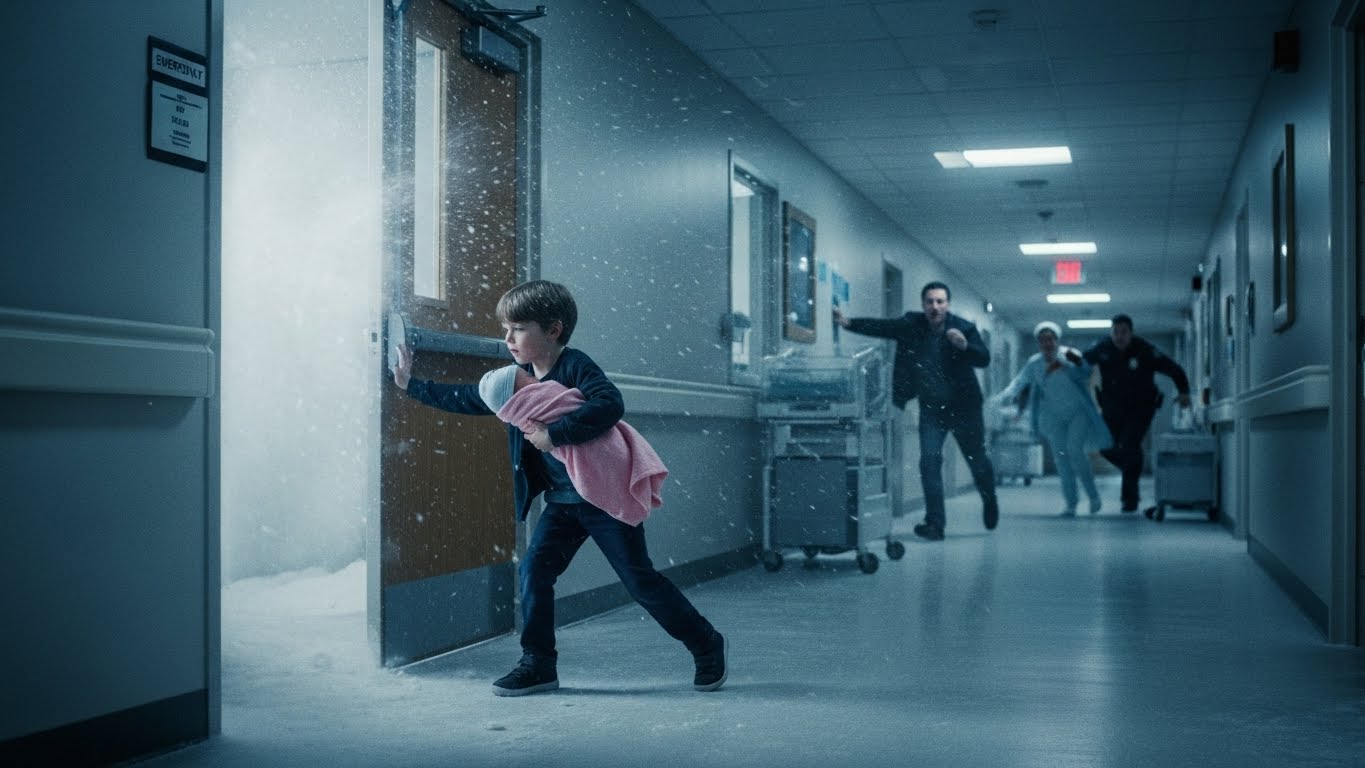
On the screen, we watched Leo reach the double metal doors. He didn’t stop. He threw his shoulder against the panic bar. The doors were heavy, fire-rated steel, but the adrenaline in that little boy must have been superhuman. He shoved. The door cracked open.
Blinding white light flooded the camera lens. The snow was blowing horizontally.
“He’s going outside,” I choked out.
“It’s ten degrees out there,” a doctor said behind me. “The baby… she’s not dressed for that. She’ll be hypothermic in minutes.”
I didn’t hear the rest. I turned and ran.
“Sir! Wait!” Marcus yelled.
I didn’t wait. I sprinted down the East Wing corridor, my heart hammering against my ribs like a trapped bird. I hit the emergency doors so hard my shoulder went numb. The alarm was already blaring, a piercing siren that mixed with the howling wind as I burst outside.
Chapter 3: The Whiteout
The cold hit me like a physical blow. It took the air right out of my lungs. The wind was screaming, whipping snow into my eyes, blinding me instantly. It was a whiteout. I couldn’t see five feet in front of me.
“Leo!” I screamed. The wind tore the name from my mouth and swallowed it.
I looked down. The snow on the concrete ramp was fresh, but there were tracks. Small, dragging footprints. And next to them, no other tracks. Just him. He was alone.
I followed them, slipping on the ice, my flannel shirt instantly soaked. The tracks led away from the building, toward the employee parking lot. Why? Why would he run there?
“Leo! Stop! It’s Dad!”
I ran past parked cars that looked like white mounds. The parking lot lights were haloed in the fog, useless against the density of the storm.
Then, I saw a splash of color.
Red. His winter jacket.
He was huddled behind a dumpster near the edge of the lot, where the hospital grounds met the treeline. He was crouched in the snow, curled around the bundle in his lap.
“Leo!” I lunged forward, falling to my knees in the snow next to him.
He screamed. A high, terrified sound that I will never forget. He scrambled back, crab-walking through the slush, pulling the baby away from me.
“No! Stay away!” he shrieked. “You can’t have her!”
“Leo, it’s me! It’s Dad!” I grabbed his shoulders. He was shaking so hard his teeth were chattering. His face was bright red from the cold.
He looked at me, his eyes wild, pupils blown wide with terror. “Dad?”
“Yes! Give me your sister! She’s going to freeze!”
“No!” He held her tighter, squeezing her so hard I was afraid he’d crush her. “I won’t let you take her! I won’t let them take her!”
“Who, Leo? Who is taking her?”
“The orphanage!” he sobbed, the tears freezing on his cheeks. “I heard them! I heard the nurses! They said the mom didn’t want the baby and they were calling the orphanage people to come get her today! I won’t let them take Emily!”
I froze. The wind howled around us, but for a second, the world stopped.
“What?” I breathed.
“I promised!” he cried, his voice breaking. “You said I’m her protector! I have to save her! We have to run away!”
He tried to stand up, but his legs were too cold. He stumbled.
I didn’t argue. I didn’t explain. Not yet. I just grabbed both of them. I scooped Leo up in one arm and grabbed the bundle of blankets with the other, crushing them both against my chest.
“I’ve got you,” I yelled over the wind. “I’ve got you both. No one is taking her.”
I turned and ran back toward the lights of the hospital, carrying my whole world in my arms, tears streaming down my face that had nothing to do with the cold.
Chapter 4: Thawing Out
Bursting back through the emergency doors was chaos. Security guards swarmed us. Doctors were yelling orders.
“Get them blankets! Get a warmer!”
I collapsed on the floor of the hallway, refusing to let go until I saw Sarah’s doctor.
“She’s breathing,” I gasped, looking at the bundle. Emily let out a sharp, angry cry. It was the most beautiful sound I’d ever heard.
They took Emily to the NICU immediately to check her temperature. They wrapped Leo in heated blankets until he looked like a foil burrito. I sat there on the floor, holding him, rocking back and forth.
“I didn’t let them take her, Dad,” Leo chattered, his teeth still clicking. “I saved her.”
“You did, buddy,” I whispered, burying my face in his wet, snowy hair. “You saved her.”
It took an hour for the chaos to settle. The police had to file a report. CPS was called automatically because of the “abduction,” even though it was the brother.
But the real moment of truth came when we were finally back in the room. Sarah was awake now, frantic, crying, holding Emily—who was fine, thanks to the layers of blankets Leo had wrapped her in.
The room was full. The doctor, Brenda the nurse, Marcus the security guard, and a social worker.
“Leo,” I said gently. He was sitting on the bed next to Sarah, drinking hot cocoa. “Why did you think they were sending Emily to an orphanage?”
Leo looked down at his cup. “I was in the bathroom,” he mumbled. “Before you went to the desk. I heard two nurses talking in the hall.”
Brenda stepped forward, her face etched with concern. “What did you hear, honey?”
“You said…” Leo looked at her, his eyes accusing. “You said, ‘The mother in 304 is exhausted. It’s a shame. The papers are signed. The state is coming to pick up the baby this afternoon.'”
The room went silent.
Brenda’s hand flew to her mouth. She looked at the other nurse, then back at us. Tears welled up in her eyes.
“Oh, sweetie,” she whispered. “Oh no.”
“You were talking about us?” I asked, confused. “Room 304?”
“No,” Brenda shook her head violently. “We were talking about Room 305. Next door.”
She looked at Sarah, then at me. “The woman next door… she’s a surrogate. The intended parents are from out of state. There were legal issues with the handover papers. We were talking about the lawyers coming to pick up the baby, not the state. And the room numbers… the acoustics in this hallway…”
“And the ‘mother didn’t want the baby’ part?” Leo asked, his voice small.
“We said the mother was ‘done with the baby,'” Brenda explained, crying now. “Meaning the surrogate had finished her part of the job. Oh my god.”
It was a perfect storm of misunderstanding. A six-year-old boy, terrified of the changes in his life, hiding in a bathroom, hearing snippets of a conversation about legal documents, surrogacy, and “pick ups,” and mixing up Room 304 with 305.
He thought his parents had signed papers to give his sister away. He thought he was the only line of defense.
“I thought you didn’t want her,” Leo whispered to me, looking up. “I thought you were signing the papers when you went to the desk.”
I grabbed him and pulled him into a hug so tight it probably hurt. “Leo, never. Never, ever. We love her. We love you. We are a family. No one is going anywhere.”
Chapter 5: The Aftermath
The hospital didn’t press charges, obviously. The police report was closed as a “misunderstanding.” But the story didn’t stay inside those walls.
The nurses were heartbroken. They brought Leo extra Jell-O. The security guards high-fived him, calling him “The Protector.”
But that night, as the storm finally broke and the moon shone on the snowdrifts outside, I watched my children.
Emily was back in her crib. Leo was asleep in the chair, his hand dangling through the bars of the crib, clutching the fabric of her sleep sack. He refused to sleep anywhere else.
I took a picture of them. It wasn’t for social media. It wasn’t for the news. It was for me.
It was a reminder that fear can make us do crazy things, but love? Love can make a six-year-old boy charge into a blizzard to fight the whole world for a sister he met yesterday.
The next morning, we were discharged. The drive home was slow, the roads still icy. Leo sat in the back, his car seat next to Emily’s base.
“Dad?” he asked from the back seat.
“Yeah, bud?”
“If the orphanage people come to our house,” he said seriously. “I have my nerf gun.”
I laughed, wiping a stray tear from my eye. “I know you do, Leo. I know you do.”
Chapter 6: The Cold Light of Protocol
The warmth of the blankets and the cocoa didn’t last long. The emotional relief of realizing Leo was safe and Emily was unharmed was quickly replaced by a new, colder reality: bureaucracy.
While we were still thawing out in Room 304, the door opened. It wasn’t a nurse with Jell-O. It was a woman in a sharp grey blazer, holding a tablet, flanked by two police officers and the hospital’s risk management director.
“Mr. and Mrs. Hayes?” the woman asked. Her voice wasn’t unkind, but it was devoid of warmth. “I’m Officer Miller, and this is Agent Reeves from Child Protective Services.”
Sarah sat up in bed, clutching Emily tighter. “CPS? Why?”
“There was a Code Pink,” Agent Reeves stated, stepping forward. “An infant was removed from the maternity ward without authorization and taken into a life-threatening environment. Regardless of the intent, or the fact that the abductor was a sibling, state protocol has been triggered.”
My stomach turned. “He’s six,” I argued, standing up to block their view of Leo, who was shrinking back into the pillows. “He thought he was saving her. It was a misunderstanding.”
“We understand that’s your perspective, Mr. Hayes,” Reeves said, tapping her tablet. “But we have security footage of a six-year-old child exiting a secure facility unnoticed by his parents for nearly ten minutes. We have a newborn who was exposed to ten-degree weather. We need to assess the home environment and parental supervision capabilities before discharge can be authorized.”
The room went deadly silent.
“You can’t be serious,” I hissed. “I went to sign papers. My wife was asleep after labor. He’s a smart kid who made a mistake based on fear.”
“And where did that fear come from?” Reeves asked, her eyes locking onto mine. “Why would a six-year-old be so terrified of his parents giving up a baby that he felt the need to flee? That suggests a chaotic or unstable emotional environment.”
I felt the blood drain from my face. They were twisting it. They were taking the purest act of love my son had ever shown and turning it into a symptom of neglect.
“We need to interview the boy alone,” Reeves said.
“Absolutely not,” Sarah snapped, her mother-bear instinct overriding her exhaustion.
“Ma’am, either we do it here, comfortably, or we do it at the station. This is an active investigation into child endangerment.”
The threat hung in the air like smoke. Leo looked at me, his eyes wide. “Dad? Did I do something wrong?”
I knelt down, ignoring the agents. “No, Leo. You did everything right. These people just need to understand the story so they can write it down in their book. You just tell them the truth, okay? Exactly what you told me.”
As they took Leo to the other side of the room to talk, separated from us by a privacy curtain, I realized the blizzard wasn’t the only storm we had to survive. The system had arrived, and it didn’t care about intentions. It only cared about liability.
Chapter 7: The Interrogation of Innocence
I strained my ears to hear what was happening behind the curtain. The hospital room felt like a courtroom. The cheerful drawings of storks on the walls felt mocking now.
“Leo,” Agent Reeves’ voice was softer now, practiced. “Did your daddy ever tell you he didn’t want the baby?”
“No,” Leo’s voice was small.
“Did your mommy ever scream at the baby? Or at you?”
“No. We were happy.”
“Then why did you run, Leo? It’s very dangerous outside.”
“Because I heard the nurses,” Leo said, his voice gaining a little strength. “They said the mom was ‘done with it’ and the people were coming to take her. I promised Dad I would protect her. He told me I was the Big Brother.”
“So you were scared of the nurses?”
“I was scared of the Orphanage,” Leo corrected. “Dad said we are a family. Families stick together.”
There was a pause. The scratching of a stylus on a tablet screen.
On our side of the curtain, Sarah was crying silently. I held her hand so hard my fingers ached. We were being judged for five minutes of bad timing. If Leo said the wrong thing—if he said we fought, if he said we were too busy—they could put a hold on Emily’s discharge. They could put Leo in foster care while they “investigated.”
The curtain pulled back. Agent Reeves looked different. The hard lines of her face had softened.
She looked at her tablet, then at us.
“He’s very articulate for six,” she said.
“He reads a lot,” I said defensively.
“He told me the color of the blanket the ‘other baby’ was supposed to have. He remembered the specific words the nurses used.” Reeves sighed, closing the cover of her tablet. “I’ve been in this job for fifteen years, Mr. Hayes. usually, when a kid runs, they are running away from home. Your son was running for his family.”
She turned to the police officer. “Mark it as an accidental breach caused by a misunderstanding of hospital staff conversation. No evidence of neglect. Parents were following standard procedure.”
The air rushed back into the room. Sarah let out a sob of relief.
“However,” Reeves added, raising a finger. “The hospital security is another matter. A six-year-old shouldn’t be able to bypass a alarmed fire door. That’s on them, not you. I suggest you don’t worry about CPS, but you might want to worry about the press. The police scanner chatter about a ‘kidnapped infant’ has been picked up.”
She was right. As if on cue, my phone buzzed. Then it buzzed again. Text messages. News alerts.
BREAKING: Attempted Abduction at St. Jude’s—Police on Scene.
The story was out. But they didn’t know the hero was the brother. The world thought someone had tried to steal my daughter.
Chapter 8: The Bond That Froze Over
The discharge the next day was done through the back exit. The hospital administration was desperate to avoid a lawsuit, so they arranged for a private escort to our car to avoid the news vans parked out front.
When we got home, the silence of our house felt different. It was a fortress now.
For the first few weeks, Leo was different. He was clingy. He checked the locks on the front door three times a night. If Emily cried, he was at her bassinet before we could even sit up in bed. The trauma of that run—the cold, the fear, the adrenaline—had left a mark on him.
One night, about a month later, I found him sitting in the hallway outside the nursery. He had his toy lightsaber and a pillow.
“Leo?” I whispered. “What are you doing, bud?”
“Guarding,” he said simply.
I sat down next to him on the floor. “You know nobody is coming for her, right? That was all a big mistake.”
“I know,” he said. He looked down at his lightsaber. “But the wind was really loud that day, Dad. And she was so small.”
“You were brave,” I told him. “Braver than any adult I know. But you don’t have to be a soldier anymore. You just have to be a brother. That means playing with her, making her laugh. Not just guarding.”
He looked at me, the tension finally leaving his small shoulders. “Can I teach her Star Wars when she wakes up?”
“Yeah,” I smiled. “You can teach her everything.”
One Year Later
The winter came back around to Chicago. The snow piled up high against the windows, just like it had that day.
We were in the living room. Emily was one now, wobbly on her feet, holding onto the coffee table. Leo was seven, sitting on the rug building a Lego castle.
Emily let go of the table. She took one step, then two, wobbling dangerously toward the hard edge of the fireplace hearth.
Before I could even lunge, Leo was there. He didn’t panic. He just slid his hand behind her head and gently guided her down to a sit, catching her before she fell.
He looked up at me and grinned. “Got her.”
I looked at the two of them. The boy who ran into a blizzard, and the girl who slept through it. They had a bond that no one else would ever understand. He had carried her through the storm before she even knew her own name.
I thought about that day often. I thought about the fear. But mostly, I thought about the sheer, undeniable force of love that lived inside a six-year-old boy.
The doctors had been horrified because they realized the danger. The nurses had been horrified because they caused the misunderstanding. But I wasn’t horrified.
I was proud.
Because I knew that as long as Leo was around, Emily would never, ever be alone.
The End.