THEY TOSSED HIM OUT LIKE TRASH AT 60 MPH. MY K9 SMELLED THE FEAR BEFORE I SAW THE BLOOD. YOU WON’T BELIEVE WHAT WE FOUND IN THE DITCH OFF HIGHWAY 27.
CHAPTER 1: THE DISPATCH
The heat in Georgia doesn’t just make you sweat; it sits on your chest like a wet wool blanket. It was 2:00 PM, and the asphalt on Highway 27 was shimmering, distorting the horizon line into a watery mirage.

I was sitting in my cruiser, Unit 4-Alpha, parked under the meager shade of a weeping willow near the county line. The AC was blasting, fighting a losing battle against the July sun. In the back, Radar, my three-year-old Belgian Malinois, was pacing in his kennel. He let out a sharp huff, the sound of a dog who was bored and ready to work.
“I know, buddy,” I muttered, taking a sip of lukewarm gas station coffee. “Shift’s almost over.”
I was wrong.
The radio crackled, slicing through the hum of the engine. Usually, dispatch is calm. Bored, even. Not today.
“Unit 4-Alpha, Unit 4-Bravo, all available units,” the dispatcher’s voice was tight, pitched a full octave higher than usual. “We have multiple 911 calls coming in near Mile Marker 88.”
I sat up straight, my hand hovering over the mic.
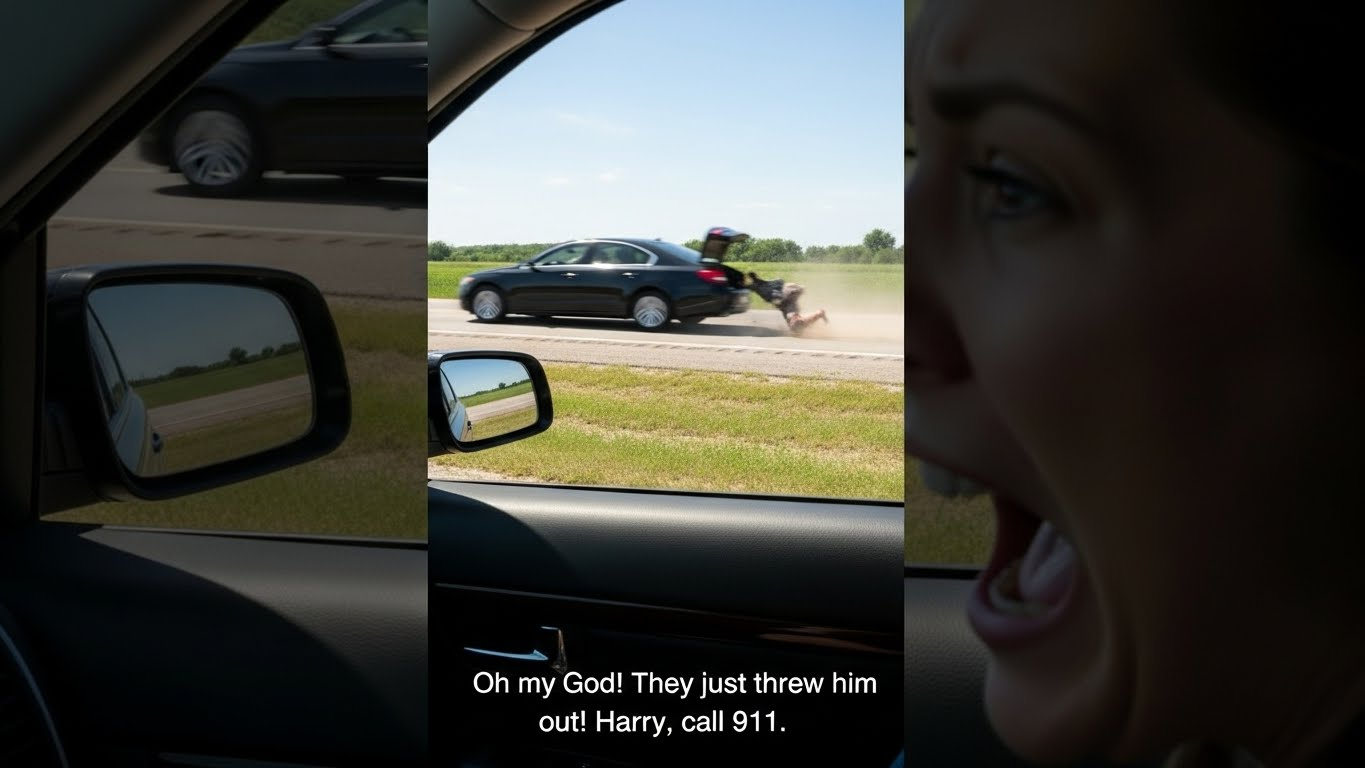
“Witnesses report a black sedan… suspect vehicle traveling southbound at high speed,” she paused, and I could hear her taking a shaky breath. “Witnesses state the rear door opened and… Jesus, Jack… they say a child was pushed out of the moving vehicle.”
The coffee turned to acid in my stomach.
“Repeat,” I said into the mic, my voice sounding foreign to my own ears. “Did you say a child was ejected?”
“Affirmative, 4-Alpha. Witness says the child was pushed. Intentional. The vehicle did not stop.”
I didn’t wait for the rest. I slammed the coffee cup into the holder, flipping the toggle for the lights and sirens. The cruiser lurched forward as I stomped on the gas, gravel spraying against the wheel wells as I peeled out onto the highway.
“Hang on, Radar!” I yelled.
The dog didn’t bark. He braced himself against the cage wall, his eyes locked on the rearview mirror, watching me. He could smell the spike in my cortisol. He knew this wasn’t a traffic stop. This was a hunt.
Mile Marker 88 was ten miles out. It was a desolate stretch of road known as “The Pines.” No houses, no gas stations, just miles of dense commercial timber on one side and swampy marshland on the other. It was coyote country. Snake country.
And now, a kid was out there.
I pushed the cruiser to ninety. The pine trees blurred into a green wall. My mind raced through the physics of it. Sixty miles per hour. A small body hitting the pavement. Road rash. Broken bones. Internal bleeding.
If he’s even alive.
“ETA two minutes,” I radioed in. “Get EMS rolling. Get a bird in the air if we have one.”
“EMS is five minutes behind you, Jack. Be advised, suspect vehicle is gone. You are first on scene.”
I saw the brake lights first. Two civilian cars were pulled over haphazardly on the shoulder, hazard lights flashing against the bright sun.
I skidded to a halt behind a silver Ford F-150. A woman was standing by the guardrail, her hands clutching her hair, her body swaying as if she were about to faint. A man, presumably her husband, was holding her up.
I bailed out of the car, leaving the engine running. I ran to the trunk and popped it. “Radar! Uit!” (Out!).
The Malinois leaped out, landing silently on the pavement. I clipped the long line to his tactical harness.
The woman saw me and pointed a shaking finger down the embankment.
“He went over!” she screamed, her voice raw. “I saw it! The door opened… he was so small… he just tumbled!”
“Where?” I barked, moving to the rail.
“There! By the drainage ditch!” The man yelled. “He rolled right into the brambles. I tried to go down, but I couldn’t find him!”
I looked over the edge. It was a steep drop, maybe twenty feet, leading into a dense tangle of kudzu, blackberry bushes, and tall sawgrass.
There were tire marks on the shoulder where the black sedan had swerved, but no skid marks. They hadn’t braked. They had tried to fling him far enough off the road so he wouldn’t be seen.
“Stay here!” I ordered the civilians. “Do not come down.”
I looked at Radar. “Find him.”
CHAPTER 2: THE SCENT OF FEAR
The descent was brutal. The embankment was steep and slick with loose gravel. I slid half the way down, my boots digging furrows into the red Georgia clay. Radar moved like liquid, low to the ground, his nose working overtime.
At the bottom, the heat was suffocating. The air was thick with humidity and the overwhelming smell of crushed pine needles and rotting vegetation.
“Seek,” I whispered.
Radar put his head down. He cast left, then right. His tail was a metronome, ticking back and forth.
We were in the thick of it now. The briars were waist-high, tearing at my uniform pants. I ignored the sting.
Where is he?
If a child hit the ground at highway speeds, there should be a trail. Broken branches. Flattened grass.
Radar froze. He snapped his head to the left, towards a patch of kudzu that had overgrown an old fallen oak tree.
He inhaled deeply, audibly. Then he looked back at me.
It wasn’t his “alert” look. Usually, when he finds a bad guy, he gets stiff, aggressive. When he finds drugs, he gets excited.
This was different. His ears were pinned back. He looked… worried.
He pulled gently on the lead, guiding me through the thorns. We moved about thirty yards parallel to the road. The noise of the traffic above was muffled now, replaced by the drone of insects.
Then I saw it.
On a patch of dirt near a stagnant pool of water, there was a smear of red. Fresh. Bright.
“Good boy,” I whispered, my heart hammering against my ribs. “Find him.”
Radar tracked the blood trail. It wasn’t a straight line. The kid had crawled. He had dragged himself away from the open, away from the road, deeper into the cover.
Hiding.
Why would a victim hide from the road? Usually, they try to get seen. They try to get help.
Unless they were more afraid of who put them there than they were of dying in the woods.
We reached a concrete drainage pipe, half-buried in the mud. It was old, cracked, and covered in moss. The mouth of the pipe was dark, a gaping black hole in the green landscape.
Radar stopped five feet from the entrance. He lowered his body, his belly almost touching the mud. He let out a sound I’ll never forget—a low, high-pitched whimper that vibrated up the leash and into my hand.
He refused to go closer.
I unclipped the safety strap on my holster. “Sheriff’s Office!” I called out. “I’m here to help you! Can you hear me?”
Silence.
I took a step forward. “I have a dog, but he’s friendly. He’s here to save you.”
Still nothing.
I knelt down in the mud, ignoring the water soaking into my knees. I pulled my tactical flashlight from my belt and clicked it on.
The beam cut through the gloom of the pipe. It illuminated trash, dead leaves, spiderwebs.
And then, about ten feet in, it hit something reflective.
A shoe.
It was a small sneaker, blue and red. Spiderman. One of the Velcro straps was torn loose.
I moved the beam up.
Huddled in a tight ball, pressed against the curved concrete wall, was a boy. He couldn’t have been more than six years old. He was wearing a torn t-shirt that used to be white, now stained brown and red.
He was shaking so hard his teeth were audibly chattering, even in the ninety-degree heat.
When the light hit his face, he didn’t scream. He didn’t cry out for his mom.
He raised his tiny hands up, palms open, trembling.
“Don’t shoot,” he whispered.
The air left my lungs. A six-year-old boy, broken and bleeding in a drainage pipe, begging me not to shoot him.
“I’m not going to shoot you, son,” I said, my voice cracking. I holstered the gun immediately, making a show of it. “I’m Jack. This is Radar.”
Radar crawled forward on his belly, ignoring his training to stay at heel. He crawled right up to the boy and did something that would get him failed in any police academy exam, but made him a hero in that moment.
He licked the blood off the boy’s knee.
The boy lowered his hands slowly. He looked at the dog, then at me.
“Did the Bad Man send you?”
I shook my head, fighting back the rage that was boiling in my veins. “No. No bad men. Just me. We’re going to get you out of here.”
I reached for my radio to call it in, but the boy lunged forward, grabbing my wrist with surprising strength. His eyes were wide, the pupils blown out with adrenaline.
“You can’t!” he hissed. “He’s watching! He said if I tell, he’ll come back and finish it!”
CHAPTER 3: THE PROMISE
“He’s watching?” I repeated, keeping my voice low and steady, though every instinct in my body was screaming to draw my weapon and scan the tree line.
The boy, who told me his name was Toby, nodded frantically. Tears cut clean tracks through the dirt and dried blood on his cheeks. He pressed himself harder into the concrete wall of the pipe, trying to disappear.
“The camera,” Toby whispered, pointing a trembling finger at his own chest.
I frowned, leaning in closer. In the dim light of the flashlight, I saw it. It wasn’t just a knife wound on his shoulder. There was something taped to his shirt, right over his heart.
It was a small, black square. A body camera? No, a GPS tracker. The light on it blinked a slow, rhythmic red.
My blood ran cold. This wasn’t a random act of rage. This wasn’t a parent snapping. This was calculated.
“Okay, Toby, listen to me,” I said, my voice dropping to a conspiratorial whisper. I reached for the tracker, but stopped. If I crushed it, would it send a signal? If I left it, they knew exactly where we were.
I made a split-second decision.
“Radar,” I commanded softly. “Guard.”
The Malinois shifted his weight. He moved between Toby and the mouth of the pipe, his silhouette blocking the sunlight. He let out a low rumble, a sound that vibrated in the damp air.
“See him?” I asked Toby. “Radar is the best hunter in the state. If the Bad Man comes back, Radar will know way before we see him. And Radar doesn’t lose.”
Toby looked at the dog, then back at me. The terror in his eyes receded just a fraction.
“I have to get you to a doctor, Toby. That hurt on your shoulder… it needs fixing.”
Toby winced. “He cut me. He said… he said it was to test the sharpness.”
I clenched my jaw so hard my teeth ached. Test the sharpness.
“We’re going to go now,” I said. “I’m going to pick you up. Radar is going to walk right beside us. Okay?”
I didn’t wait for an answer. I couldn’t. Every second we stayed in this ditch was a second the suspect got further away—or closer, if they were actually doubling back.
I scooped Toby up. He was terrifyingly light. His ribs felt fragile under my hands. He buried his face in my neck, his small arms wrapping around me in a death grip. He smelled of sweat, fear, and that distinct metallic tang of blood.
“Let’s move,” I signaled to Radar.
The climb back up the embankment was hell. The heat had intensified. My boots slipped on the loose gravel. With Toby in my arms, I couldn’t use my hands to balance. I had to rely on leg strength and momentum.
Radar scrambled up ahead, checking the perimeter. He reached the top and barked once—sharp, authoritative. Clear.
I crested the hill, my lungs burning. The two witnesses were still there, joined now by a Georgia State Trooper who had just pulled up.
“EMS is two minutes out!” the Trooper yelled, running toward me. He saw the boy in my arms and stopped dead. “Oh, God.”
“Get the stretcher ready!” I barked, adrenaline making my voice harsh. “And get that radio off! He thinks they’re listening!”
I walked past the stunned civilians. I didn’t want them taking photos. I didn’t want Toby to see their pity.
I made it to the back of my cruiser and sat on the bumper, keeping Toby on my lap. I reached for the GPS tracker on his shirt.
“Toby, I’m going to take this off now. It’s going to stop blinking. Okay?”
He nodded against my shoulder.
I ripped the device off. It was a cheap generic brand, easily bought online. I threw it on the asphalt and stomped on it with my boot. The plastic shattered. The red light died.
“Gone,” I said. “He can’t see you now.”
Toby let out a long, shuddering breath. “Is he gone too? The other boy?”
I froze.
I slowly pulled Toby back so I could look him in the eye.
“Toby… what other boy?”
Toby sniffled, wiping his nose on his arm. “The one in the trunk. He was sleeping. He wouldn’t wake up when the Bad Man opened the door to throw me out.”
The world seemed to tilt on its axis.
This wasn’t an attempted murder. This was a serial event. And there was another child, unconscious, currently traveling south on Highway 27 in the trunk of a black sedan.
I looked at the Trooper. He had heard it too. His face was pale.
“Get on the radio,” I said, my voice deadly calm. “Notify every agency in a hundred-mile radius. We are looking for a black sedan, possibly a Honda or Toyota. Driver is armed and dangerous. And there is a hostage in the trunk.”
CHAPTER 4: THE RACE AGAINST TIME
The ambulance arrived in a swirl of dust and sirens. I usually step back at this point. My job is the scene; the paramedics’ job is the victim.
But not today.
When the paramedics, a veteran team named Sarah and Miller, tried to put Toby on the gurney, he screamed. It was a raw, primal sound that made the hair on my arms stand up. He flailed, kicking out, reaching blindly for me.
“Jack!” Sarah yelled over the noise. “We need to sedate him if he doesn’t calm down! His heart rate is through the roof!”
“No sedation!” I shouted back. “He needs to talk! We need info on the car!”
I stepped in, grabbing Toby’s hand. “Toby! Look at me! Look at Radar!”
I whistled. Radar hopped into the back of the ambulance, sitting instantly by the gurney. He placed his heavy head on the mattress, right next to Toby’s leg.
Toby stopped screaming. He reached out and buried his hand in Radar’s fur.
“I’m riding with him,” I told Sarah. “Miller, you drive. Drive fast.”
“What about your cruiser?” the Trooper asked.
“Leave it. Just get that BOLO (Be On the Lookout) out. Now!”
The ambulance doors slammed shut, sealing us in the air-conditioned box. The siren wailed to life, a comforting rhythm now that we were moving.
Sarah went to work efficiently. She cut the shirt away, exposing the shoulder wound. It was deep, a clean slice. But what caught my eye were the bruises on his ribs. They were old. Yellow and green.
“He’s been held for a while,” Sarah murmured, her eyes meeting mine. “These aren’t fresh.”
“Toby,” I said, leaning close to his ear as Sarah started an IV. “You have to be brave for me. Like Spiderman, right?”
He nodded weakly. The adrenaline crash was coming. His eyelids were drooping.
“The car,” I pressed. “Do you remember anything about the car? Was there a sticker? A dent? Anything?”
Toby blinked, fighting the exhaustion. “It… it smelled like lemons.”
“Lemons. Okay. Good. What else?”
“The music,” he whispered. “Loud. Boom, boom, boom. And… the sticker. On the window.”
“What kind of sticker, bud?”
He traced a shape in the air with his finger. A circle. With a jagged line through it.
“A lightning bolt?” I guessed.
He shook his head. “No. A bird. A mean bird.”
“A hawk? An eagle?”
“Red,” he mumbled. “Red bird.”
I racked my brain. Sports teams? Cardinals? Falcons?
“Toby, the man. What did he look like?”
“Mask,” Toby said, his voice barely audible now. “He wore a mask. Like a skeleton.”
My phone buzzed in my pocket. It was the Sheriff.
“Jack, talk to me,” Sheriff Miller’s voice was gravelly. “State Police have the highway locked down from here to the Florida line. We’ve got choppers up. But we have a problem.”
“What problem?”
“We checked the traffic cams at the exit prior to Mile Marker 88. In the ten-minute window before the 911 calls… forty-two black sedans passed through.”
“Forty-two?” I swore under my breath. “Sheriff, the kid says there’s another boy in the trunk. Unconscious. We don’t have time to stop forty-two cars politely.”
“I know. That’s why I’m authorizing a hard stop on any vehicle matching the description that shows evasive behavior. But Jack… the witness who called it in? The lady?”
“Yeah?”
“She changed her story. She said she saw the license plate. Or part of it.”
“Give it to me.”
“She thinks it started with a ‘Q’. But Jack… Georgia plates don’t start with Q.”
“Government?” I asked. “Or out of state?”
“Maybe. Or maybe fake. But here’s the kicker. A black Impala with tinted windows just blew a weigh station ten miles south of you. Trooper tried to pursue, and the guy brake-checked him. Trooper spun out. Vehicle is doing 120 southbound.”
“That’s him,” I said, a dark certainty settling in my gut. “Does the Impala have a sticker?”
“Trooper didn’t see. But he’s heading toward the swamp roads. If he gets into the bayou, Jack, we’ll never find that car. Or the kid in the trunk.”
I looked at Toby. He had finally succumbed to the shock and was asleep, his hand still gripping Radar’s fur.
“Turn this ambulance around,” I said to Miller through the partition.
“What?” Miller shouted back. “We need to get him to the Trauma Center!”
“Drop us at the crossroads. My deputy is bringing my truck. I’m not going to the hospital.”
Sarah looked at me like I was crazy. “Jack, you can’t leave the victim.”
“He’s safe with you,” I said, unclipping Radar’s lead from the gurney. “But the kid in the trunk isn’t. And that Impala is heading for the swamps.”
I looked at my dog. He was alert, watching me. He knew the tone of my voice. The hunt wasn’t over. It was just beginning.
“We’re going hunting, Radar.”
I grabbed my radio. “Sheriff, I’m taking the swamp boat. If he’s going into the bayou, I’ll cut him off at the Devil’s Elbow.”
“Jack, that’s suicide,” the Sheriff warned. “The Devil’s Elbow is nothing but gators and mud. If he crashes there…”
“If he crashes there, the boy drowns,” I interrupted. “I’ll be there in twenty.”
The ambulance slowed. I hopped out into the blinding sun, Radar at my heels. In the distance, the wail of sirens grew louder. But the silence of the swamp lay ahead, waiting.
PART 3
CHAPTER 5: THE DEVIL’S ELBOW
The “Devil’s Elbow” isn’t on any official map, but every cop in the county knows it. It’s a sharp, blind curve on Old logging Road 9, where the asphalt crumbles directly into the Altamaha River basin. The water there is deep, black, and stagnant.
My deputy, a rookie named Hains, was waiting at the private boat launch two miles north of the curve. The engine of my department-issued airboat was already idling, the massive fan blades chopping the humid air.
“Sheriff said you were crazy!” Hains yelled over the roar as I threw my tactical vest into the boat.
“He’s right,” I shouted back, signaling Radar to jump on board. The dog didn’t hesitate. He scrambled onto the aluminum deck, his claws clicking on the metal, and took his position at the bow, nose into the wind.
“The Impala is doing 110 past the silo,” Hains shouted, checking his radio. “He’ll be at the Elbow in four minutes. You can’t beat him there!”
“Watch me.”
I gunned the throttle. The airboat lurched forward, skimming over the mud and reeds. We didn’t take the river channel. That was too slow. I cut straight through the sawgrass marsh.
The world became a blur of green and brown. The noise was deafening. Marsh birds scattered in panic. I navigated by instinct, banking hard around cypress knees that would rip the hull open if I misjudged by an inch.
Three minutes.
I pushed the throttle to the stops. The engine screamed. We were flying over water that was barely three inches deep.
Radar stood like a statue, his eyes squinting against the wind. He knew the mission. We weren’t tracking scent now; we were intercepting prey.
Two minutes.
I saw the tree line of the old logging road approaching fast on my right. I cut the rudder hard, drifting the boat sideways across a patch of lilies. We burst through the final barrier of reeds and settled into the main channel, parallel to the road.
And then I heard it.
Above the roar of the boat, the high-pitched whine of a V6 engine pushed to its breaking point echoed through the trees.
“There!” I yelled, though no one could hear me.
Through a gap in the pines, I saw a flash of black metal. The Impala was airborne.
The driver had hit the dip before the curve way too fast. The sedan launched off the asphalt, clearing the guardrail completely. It seemed to hang in the air for a second—a black monolith against the blue sky.
Then, gravity took over.
The car crashed nose-first into the murky water of the Devil’s Elbow with a sound like a cannon blast. A geyser of mud and water shot thirty feet into the air.
I killed the fan immediately. The silence that followed was heavy, broken only by the hissing of steam as the hot car engine met the cold swamp water.
The Impala bobbed once, then the heavy front end dragged it down. It began to sink rapidly.
“The trunk!” I screamed at myself. “The kid is in the trunk!”
I steered the boat toward the ripples. The car was already half-submerged, the black water lapping at the rear window.
The driver’s door opened.
A figure in black, wearing a skull mask, clawed his way out. He gasped for air, splashing frantically. He looked at me, then at the sinking car, and started swimming for the far bank—away from me, away from the car.
He was leaving the kid to drown.
I had a choice. Pursue the suspect or save the victim.
It wasn’t a choice at all.
“Radar, STAY!” I commanded.
I dove into the black water.
CHAPTER 6: SILENCE IN THE DEEP
The water was a shock—tepid on the surface, but freezing cold three feet down. It was like swimming in chocolate milk; I couldn’t see my hand in front of my face.
I kicked hard, my boots feeling like lead weights. My hand brushed against the cold metal of the car’s roof. It was tilting forward, nose down, sinking fast toward the muddy bottom.
I felt my way along the roofline to the rear window. It was still above water—barely.
I grabbed the trunk seam. Locked. Obviously.
I surfaced, gasping for air. “Hains! Throw me the crowbar!”
I realized Hains wasn’t there. I was alone. I had left Hains at the dock. It was just me and Radar.
Radar was pacing on the bow of the drifting airboat, barking furiously at the far bank where the driver had disappeared into the woods.
“Damn it!”
I reached for my belt. I pulled out my tactical knife. It had a glass breaker on the pommel.
I took a massive breath and went under again.
The car was fully submerged now. The pressure was building against my ears. I felt for the back windshield. I smashed the glass breaker against it.
Thud.
Underwater, the swing had no power. The safety glass held.
I wrapped my legs around the spoiler for leverage and struck again. And again.
Crack.
The glass spider-webbed. One more hit and it imploded inward.
I reached through the broken glass, slicing my arm on the shards. I felt the back seat latches. I yanked them. The seat folded down.
I pushed myself through the opening, half of my body inside the sinking car. It was pitch black. I flailed my arms, feeling for a body.
My hand brushed a sneaker.
Gotcha.
I grabbed the ankle and pulled. Dead weight.
My lungs were burning. My vision was starting to spot with white lights. I needed air, but if I let go, the car might settle into the silt and trap him forever.
I braced my feet against the rear deck and heaved with everything I had left.
The small body slid through the opening, buoyant in the water. I grabbed him by the shirt—another Spiderman shirt—and kicked for the surface.
We broke the surface together. I gasped, sucking in air that tasted of diesel and mud.
The boy was limp in my arms. His face was pale, his lips blue.
I dragged him to the airboat. Radar was there, leaning over the side, whining. I hoisted the boy onto the metal deck, then hauled myself up, collapsing beside him.
“Come on, come on,” I muttered, positioning his head.
I checked for a pulse. Nothing. No breath.
I started CPR. My wet palms slipped on his chest.
One, two, three, four…
“Breathe, damn you!” I shouted.
I pinched his nose and breathed into his mouth. The chest rose. I went back to compressions.
Radar nudged the boy’s face with his wet nose, letting out a sharp bark.
One, two, three, four…
It felt like hours. It was probably only thirty seconds.
Suddenly, the boy’s body convulsed. He turned his head and retched, coughing up swamp water.
He gasped, a terrible, ragged sound, and started to cry.
I slumped back against the console, my heart hammering a frantic rhythm against my ribs. He was alive.
I looked toward the far bank. The reeds were still swaying where the driver had exited the water. He was gone.
But as I looked closer at the boy, now shivering on the deck of the boat, I saw it.
Clutched tightly in his unconscious hand was a piece of fabric he must have ripped from the driver during the crash or the struggle.
I pried his fingers open gently.
It was a patch. A velcro patch ripped from a tactical vest.
It was a red bird. An angry, stylized hawk.
And underneath the bird, embroidered in gold thread, were three letters that made my blood freeze colder than the swamp water.
DEA.
Drug Enforcement Administration.
The “Bad Man” wasn’t a random kidnapper. He was a Fed. Or someone pretending to be one.
My radio, clipped to my vest, crackled to life. It was wet, but the military-grade casing held.
“Unit 4-Alpha,” the Sheriff’s voice came through, static-filled. “We found the owner of the black Impala.”
I stared at the patch in my hand. “Let me guess,” I rasped. “Government pool vehicle?”
“No,” the Sheriff said. “The car was reported stolen three hours ago. From the driveway of a Judge. Judge Harmon.”
I looked at the terrified boy, then at the patch, then at the dark woods where a man in a skull mask was currently escaping.
Judge Harmon had just presided over the biggest cartel case in Georgia history.
“Sheriff,” I said, my voice low. “Send everything you have to the Devil’s Elbow. And tell the Coroner to bring a body bag.”
“For the kid?”
“No,” I said, watching Radar stare into the trees, his hackles raised. “For whoever comes out of those woods when I go in after them.”
CHAPTER 7: THE BLOOD TRAIL
The sound of an approaching outboard motor cut through the swamp silence. A Game Warden’s skiff, lights flashing, tore around the bend of the Devil’s Elbow.
“Jack!” the Warden screamed, throttling down as he pulled alongside my drifting airboat. “I heard the radio! Is that the kid?”
“He’s breathing, but barely,” I shouted, passing the shivering, coughing boy over the gunwales to him. “Get him to the ambulance at the logging road. Now!”
“What about you?” the Warden asked, eyeing the dark, dense tree line where the suspect had vanished.
“I’m finishing this.”
I didn’t wait for an argument. I slapped the side of the airboat. “Radar, heel.”
We jumped from the bow of the boat onto the muddy bank. The ground was soft, sucking at my boots with every step. The air here was heavy with the smell of decay and sulfur.
“Track,” I commanded.
Radar lowered his head. He didn’t need much encouragement. The scent of the man—fear, swamp water, and adrenaline—was fresh. But there was something else, too.
Blood.
I saw a few drops on a palmetto leaf. The suspect was hurt. Maybe he hit the steering wheel when the car crashed, or maybe he cut himself on the glass climbing out.
We moved fast. The vegetation was thick—saw palmettos, briars, and cypress knees that stuck up like jagged teeth. I moved tactically, weapon drawn, keeping my eyes on Radar’s ears.
If his ears went back, the threat was close.
We tracked him for a quarter-mile deep into the marsh. The sounds of the highway and the sirens faded away, replaced by the ominous quiet of the deep woods.
Then, Radar stopped.
He didn’t just stop; he froze. His hackles—the hair along his spine—stood straight up. He let out a low, guttural growl that I felt in my bones.
He wasn’t tracking anymore. He was indicating a presence.
He’s waiting for us.
I dropped to one knee behind a thick cypress trunk. “Show me,” I whispered.
Radar stared intensely at a dense thicket of cane about thirty yards ahead.
“Sheriff’s Office!” I yelled, my voice booming through the trees. “Come out with your hands up! You have nowhere to go! The swamp ends in deep water a mile back!”
Answered only by the screech of a blue jay.
Then, a voice floated out from the cane. Calm. American accent. Professional.
“You’re making a mistake, Deputy. Turn around. Go back to your dog. Go back to your life.”
“That’s not happening,” I yelled back. “You tried to kill two kids today. You’re not walking out of here.”
“I didn’t try to kill them,” the voice said, closer now. “I was cleaning up a mess. There’s a difference.”
Cleaning up. The term sent a chill down my spine.
“Radar,” I whispered. “Watch.”
I grabbed a loose branch from the ground and tossed it to my left, into a pile of dry leaves. Crunch.
Three shots rang out instantly. Pop-pop-pop.
Silenced.
The bullets tore through the brush where the branch had landed. He was a pro. He wasn’t spraying and praying; he was shooting to kill.
But he had made a mistake. He had revealed his position.
“RADAR! PACKEN!” (Bite!)
I released the lead.
Radar launched himself like a fur-covered missile. He didn’t run in a straight line; he zig-zagged, a blurred shadow moving at thirty miles per hour through the obstacles.
The gunman saw him. I heard him curse. He shifted his aim.
I broke cover, sprinting toward the flank, my weapon raised.
I heard one shot fire. Then a yelp.
My heart stopped.
But then came the scream. It wasn’t Radar. It was a human scream of pure agony.
CHAPTER 8: THE LAST STAND
When I crashed through the cane, the scene was chaotic.
The suspect was on his back in the mud. Radar had him by the right forearm—his shooting arm. The gun, a suppressed Glock, lay five feet away in the dirt.
Radar was thrashing his head, engaging the “bite and hold” with ferocious power. The suspect was punching Radar in the ribs with his free hand, screaming, trying to shake the eighty-pound dog off.
“Drop it!” I roared, leveling my weapon at the man’s chest. “Do it now or I end you!”
The man froze. He looked at the barrel of my gun, then at the snarling dog attached to his arm. He stopped fighting.
“Radar! Loss!” (Let go!)
Radar released instantly but didn’t retreat. He stood over the man’s face, barking inches from his nose, daring him to move.
I kicked the suspect’s gun away and dropped a knee into his back, cuffing him before he could take another breath.
“You have the right to remain silent,” I growled, hauling him to his feet.
I ripped the skull mask off.
He wasn’t a kid. He wasn’t a gangbanger. He was a man in his late forties, with a military haircut and cold, dead eyes.
“Who are you?” I demanded.
He spat blood into the mud. “Does the name ‘Ghost’ mean anything to you, Deputy?”
I stiffened. “Ghost” was a rumor. A fixer for the Cartels operating out of Atlanta. The guy you call when you need witnesses to disappear.
“You’re the one who kidnapped the Judge’s grandkids,” I said, putting the pieces together. The boys. They weren’t random. They were leverage.
“Judge Harmon was getting too chatty,” the man sneered. “He needed a reminder of what he had to lose.”
“Well,” I said, shoving him forward. “He didn’t lose them. And you lost.”
The walk back was slow. Radar was limping slightly on his front left paw. The bullet had grazed him—a flesh wound, but it was bleeding.
“You okay, buddy?” I asked, checking him. He licked my hand and wagged his tail. He was still in work mode.
When we broke out of the tree line back to the Devil’s Elbow, the world had turned into a circus.
There were flashing lights everywhere. Deputies, State Troopers, Paramedics. A news helicopter chopped the air overhead.
As we emerged from the woods—me covered in mud, dragging a handcuffed hitman, with a limping K9 beside me—a silence fell over the crowd.
I saw the Warden. He was standing by an ambulance.
“The boys?” I asked, my voice hoarse.
“They’re alive, Jack. Both of them. They’re asking for the dog.”
I walked over to the ambulance. The back doors were open.
Toby (the first boy) and Sam (the one from the trunk) were huddled together under a thermal blanket. They looked tiny, fragile, and exhausted.
When they saw Radar, their faces changed. The terror melted away, replaced by awe.
“He came back,” Toby whispered.
I lowered the tailgate. “Up,” I told Radar.
Radar hopped up, ignoring his hurt paw. He squeezed himself onto the bench next to the boys. Toby wrapped his arms around the dog’s neck. Sam, the younger one, rested his head on Radar’s flank.
Radar let out a long sigh and rested his chin on Toby’s knee.
A photographer from the local paper, standing behind the police tape, snapped a picture.
The flash was blinding.
I didn’t know it then, but that photo—the rugged, muddy cop, the captured hitman in the background, and the two broken little boys finding comfort in a Belgian Malinois—would be on the cover of every newspaper in the country by morning.
Judge Harmon resigned the next day. The “Ghost” is currently serving two life sentences without parole.
But I don’t care about that.
I care about the fact that every Christmas, I get a card. It’s a picture of two growing boys, playing baseball, fishing, living their lives.
And signed at the bottom, in messy crayon that turned into neat penmanship over the years:
To Jack and Radar. The good guys.
I patted Radar’s head as the paramedics started to work on the boys again.
“Good boy,” I whispered. “Let’s go home.”
[END OF STORY]