Three Bikers Laughed at His Oxygen Tank. They Didn’t See the Golden Trident Hidden Beneath His Jacket—Until the Earth Started Shaking.
Chapter 1: The Quiet Before
The noise hit the diner before they did.
It wasn’t the polite hum of a family sedan or the working groan of a farm truck. It was a scream of chrome, unsecured mufflers, and insecurity. Three engines cut beneath the window, vibrating the silverware on the tables, shaking the last few drops of peace out of the morning.
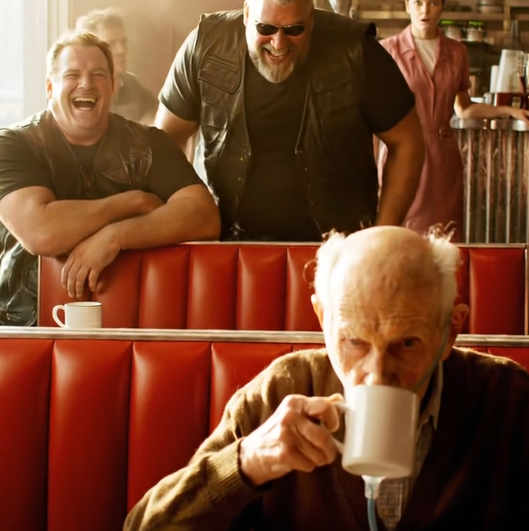
Inside, the Old Man didn’t flinch. He sat in the corner booth, the one where the sunlight hit the vinyl just right, warming bones that felt cold even in the suffocating heat of July. He was small, almost disappearing into the booth. Time had whittled him down, stripping away the bulk of muscle and leaving only the wire and the grit. A clear plastic tube ran under his nose, hooked around his ears, hissing a steady, rhythmic lifeline from the portable tank resting at his feet.
Hiss. Click. Hiss. Click.
He was trying to eat his eggs, but his hands—spotted with age and etched with scars that weren’t from kitchen knives—trembled. Just a little. A faint, persistent vibration that he fought with every deliberate lift of the fork. He moved with an economy of motion that whispered of a time when wasted movement meant death, but now, it just looked like frailty.
The door swung open, the bell jingling cheerfully, a sound that felt entirely wrong for the three men who walked in.
They sucked the air right out of the room. Leather vests that creaked with new stiffness, boots that stomped rather than walked, and the kind of loud, barking laughter that demands everyone look at it. They didn’t just enter a room; they invaded it.
“Coffee,” the lead biker barked, not looking at the waitress. He dropped his helmet on a table that wasn’t his, the heavy plastic thudding against the wood. He was big, heavy with beer muscle and soft living, sporting a beard that hid a weak chin and eyes that scanned the room for something to break.
The waitress, a sweet woman named Clara who had been pouring coffee here since the Reagan administration, froze mid-pour. She nodded, her knuckles white around the glass pot. She knew the type. We all did. Weekend warriors who thought buying a bike bought them respect.
The Old Man in the corner took a sip of water. His hand shook. The ice rattled against the glass. Clink-clink.
That was the mistake. The sound. It drew the Lead Biker’s eyes like a shark turning toward a splash of blood in the water.
He turned, a slow, predatory grin spreading across his face. He nudged his buddy, a younger, wiry guy with a bandana and eyes that darted nervously. “Check it out. We got a rattlesnake in the corner.”
They laughed. It was a cruel, wet sound that coated the diner in grime.
The Old Man didn’t look up. He focused on his plate, his breathing controlled, measured. Inhale for four. Hold for four. Exhale for four. Old habits. Ancient discipline that kept the heart rate low when the world was burning.
“Hey, Pops,” the Leader shouted across the quiet diner, his voice booming unnecessarily. “You gonna take off, or are you just inflating yourself?”
Silence. The other patrons—two farmers discussing corn prices and a young man in a hoodie scrolling on his phone—looked down instantly. Nobody wanted trouble. In a town this small, trouble didn’t just pass through; it lingered.
The Old Man slowly wiped his mouth with a paper napkin. He didn’t answer. He didn’t defend. He simply reached up with a withered hand and adjusted the collar of his faded army-green field jacket.
As he moved, the light caught it. A flash of silver pinned to the heavy canvas. A medal. Old, tarnished, but unmistakable.
Chapter 2: The Line Crossed
The Leader saw it too. He pushed off the counter, his boots heavy on the linoleum. He walked over, his shadow falling over the Old Man’s table, blocking out the sun.
“What’s that trinket?” the biker sneered, looming over him. “You get that at a pawn shop? Or is that for being the best shuffler at the nursing home?”
The Old Man looked up then. His eyes were a washed-out blue, watery and tired, but behind the cloudy cataracts, there was something else. Something hard. Like a stone at the bottom of a river that hasn’t moved in a thousand years.
“It’s mine,” the Old Man said. His voice was like dry leaves scraping together, quiet but carrying a weight that the biker was too stupid to feel. “Please. I’m just eating breakfast.”
“Please?” The biker mocked, mimicking a high-pitched, pathetic whine. He reached out, his thick, grease-stained fingers snatching the medal attached to the jacket. He didn’t rip it off, but he yanked the fabric forward, pulling the frail body with it.
“Hey!” Clara shouted from behind the counter, her voice trembling but brave. “Leave him alone, Rick. He’s a regular.”
“Shut up, Clara,” Rick snapped without looking back. He was twisting the medal, smearing his thumb over the engraving. “Silver Star. Hah. I bet you stole this. Stolen valor is a crime, old man. I should rip this off you right now.”
The Old Man’s hand shot out. It was faster than he looked, grabbing his own lapel, trying to pull away. “Let go.”
“Make me,” Rick laughed.
And then, with a casual cruelty that made the air in the diner turn to ice, Rick lifted his heavy boot and kicked.
He didn’t kick the man. He kicked the cane resting against the table.
It clattered across the floor, sliding under the counter, ten feet away.
“Oops,” Rick grinned, spreading his hands in mock innocence. “Looks like you’re stranded, Grandpa.”
The diner went dead silent. This wasn’t funny anymore. This was a violation. It was the kind of bullying that makes your stomach turn.
In the booth behind them, the young man in the hoodie—let’s call him Caleb—froze. His thumb stopped scrolling. His heart hammered against his ribs like a trapped bird. He was twenty-two, worked at the local hardware store, and had never been in a fistfight in his life. He looked at Rick’s arms, thick as hams. He looked at the other two bikers snickering by the door.
Fear glued him to the seat. The primal instinct to survive told him to look away.
But then, Caleb saw it.
When Rick had yanked the Old Man’s jacket forward, the fabric had parted just enough. Beneath the heavy canvas, pinned to a plaid flannel shirt, was a patch. It wasn’t the Silver Star on the outside. It was something else.
It was gold. An eagle clutching an anchor, a trident, and a flintlock pistol.
The Special Warfare Insignia. The BUD/S Trident.
Caleb’s breath hitched. He knew that symbol. His uncle had been Navy. He knew you didn’t buy that patch. You didn’t find it on eBay. You paid for it in blood, in sand, and in the freezing black water of the Pacific.
He looked at the Old Man again. He looked at the trembling hands.
That’s not fear, Caleb realized with a sudden jolt of electricity that ran down his spine. That’s restraint.
The Old Man wasn’t shaking because he was scared of the bikers. He was shaking because every fiber of his being, every conditioned reflex from twenty years of hunting men much more dangerous than these clowns, was fighting the muscle memory to kill the man standing in front of him.
Caleb moved his hand under the table. He didn’t stand up—he wasn’t a hero. But he unlocked his phone.
He opened his text messages. He found the contact: Uncle Ray (Master Chief).
He typed, his fingers fumbling over the glass: At Joe’s Diner on 4th. 3 bikers cornering an old guy. Has a Trident patch. Real one. Gold. Needs help. Now.
He hit send.
Three dots appeared instantly.
Then a reply: Description?
Caleb typed, glancing up to ensure Rick wasn’t watching: Green jacket. Oxygen tank. Grey hair. He’s not fighting back, Ray. They just kicked his cane.
There was a pause. A long, terrifying ten seconds where the only sound was Rick laughing and the hiss of the oxygen tank.
Then the phone buzzed again.
Don’t engage. Stay down. We’re ten minutes out. Tell Mac help is coming.
Caleb stared at the screen. Mac? They knew him?
The biker, Rick, leaned in closer, his face inches from the Old Man. “You know, my dad was in ‘Nam. He was a real man. Not a fragile little bird like you. You make me sick.”
He reached for the oxygen tube. “Maybe you don’t need this.”
The Old Man’s eyes narrowed. The calm water in them began to churn.
Caleb swallowed the lump in his throat. He had to do something. He couldn’t fight, but he could stall.
“Hey!” Caleb’s voice cracked. It was high and thin, but it cut through the tension.
Rick turned, annoyed. “What do you want, kid?”
“He’s… he’s a veteran,” Caleb stammered. “Show some respect.”
Rick laughed, a deep belly sound that held no joy. “Respect? For this antique? Kid, go back to your phone before I smash it and your face.”
He turned back to the Old Man, his fingers curling around the plastic tubing of the oxygen line. “Let’s see how long you can hold your breath, hero.”
The Old Man didn’t pull away. He didn’t beg. He looked past the biker, out the window, to the horizon where the road met the sky. He closed his eyes.
And then, the coffee in Caleb’s cup began to ripple.
Not from the table shaking. From the floor.
A low vibration, deeper than sound, started to hum through the soles of everyone’s feet. It wasn’t the jagged, screaming noise of the biker’s Harleys.
This was a rumble. A synchronized, thunderous rolling wave.
Rick paused, his hand still on the tube. “What is that?”
The Old Man opened his eyes. He looked at Rick, and for the first time, he smiled. It was a cold, terrifying smile that didn’t reach his eyes.
“That,” the Old Man whispered, “is the tide coming in.”
Chapter 3: The Storm Arrives
The vibration didn’t stop. It grew. It wasn’t just a sound anymore; it was a physical pressure pressing against the glass of the diner windows.
Rick, the biker who had been so loud just moments ago, finally took his hand off the Old Man’s oxygen tube. He looked toward the door, confusion flickering in his eyes. He was used to being the loudest thing in the room. He didn’t know how to handle a noise that was bigger than him.
“What the hell is that?” the younger biker muttered, stepping toward the window.
He peered through the blinds, and his face went pale. “Rick… you need to see this.”
Outside, the world had changed.
It wasn’t a chaotic swarm of motorcycles like a gang. It was a formation.
A line of matte black motorcycles, stripped of chrome and flash, rolled into the parking lot with the precision of a drill team. They moved in perfect synchronization, tires humming on the asphalt. Behind them, two black SUVs glided in like sharks, their windows dark, their movements heavy and deliberate.
There was no revving. No showing off. Just the terrifying, disciplined hum of engines that were built for work, not for play.
They parked in unison. Kickstands down. Engines cut.
The sudden silence was louder than the noise had been.
“Who are they?” Rick asked, his voice losing its edge.
Caleb, still clutching his phone under the table, whispered to himself, “The cavalry.”
The car doors opened. The bikers on the motorcycles dismounted.
These weren’t weekend riders in store-bought leather vests covered in patches they ordered online. These men wore simple clothes—t-shirts, jeans, tactical boots. No colors. No logos.
But you could tell. You could tell by the way they stood. You could tell by the way they scanned the perimeter before they even closed their car doors. Shoulders broad, waists narrow, movements efficient.
They moved toward the diner door not like a mob, but like a wave.
Inside, the air turned thin. The bell above the door jingled again, but this time, it sounded like a warning.
The first man stepped in. He was older, maybe fifty, with hair like steel wool and eyes that looked like they could cut glass. He wore a simple grey t-shirt that couldn’t hide the roped muscle of his arms.
He didn’t look at the waitress. He didn’t look at the menu.
His eyes swept the room in a single second, processing threats, exits, and targets. He saw the bikers. He saw the cane on the floor. He saw the Old Man.
Then, he stepped aside.
Twelve more men filed in behind him. They filled the small diner, lining the walls, blocking the sunlight. They didn’t speak. They didn’t yell. They just stood there, arms crossed or hanging loose by their sides, creating a wall of silent, suffocating pressure.
Rick the biker swallowed hard. He tried to puff out his chest, to reclaim the space he had stolen earlier. “This is a private party, pal,” he stammered, his voice sounding incredibly small.
The man in the grey shirt didn’t even acknowledge him. It was as if Rick was a fly buzzing against a windowpane.
The man walked past the bikers, his boots making no sound on the tile. He walked straight to the corner booth.
Chapter 4: The Salute
Caleb watched, his heart in his throat. He recognized the man in the grey shirt. It was Uncle Ray. But it wasn’t the Uncle Ray who grilled burgers on the Fourth of July. This was Master Chief Ray, a man who had led teams into places the government denied existed.
Ray stopped in front of the Old Man’s table.
The diner was so quiet you could hear the refrigerator compressor humming in the back.
Ray looked at the Old Man. He looked at the oxygen tube. He looked at the frail hands resting on the table.
Then, his eyes dropped to the patch hidden beneath the jacket. The Golden Trident.
Ray’s expression softened. The hard lines of his face melted into something like reverence. He didn’t see a sick old man. He saw a brother. He saw a legend.
Slowly, deliberately, Ray snapped to attention. His heels came together. His back straightened like a rod of iron.
He raised his hand in a slow, crisp salute.
It wasn’t a casual wave. It was the kind of salute you give to a flag, or a coffin, or a king.
Behind him, the twelve other men—Giants who looked like they could tear the booth apart with their bare hands—snapped to attention in unison.
Snap.
Twelve hands rose. Twelve eyes locked on the Old Man.
The Old Man, Mac, looked up. His chin trembled, just for a second. The shame of the last ten minutes, the humiliation of having his cane kicked, the feeling of being useless—it all washed away.
Slowly, painfully, Mac lifted his own hand. It shook, fighting against the Parkinson’s, fighting against the weakness. But he forced it up. He touched his brow.
He returned the salute.
“Commander,” Ray said softly, his voice thick with emotion. “We came as soon as we got the call.”
Mac lowered his hand, his eyes shining. “You didn’t have to come for me, Chief. I’m just… I’m just having coffee.”
“We don’t leave our own behind,” Ray said. “Not ever.”
Rick, the lead biker, was backing away now. He had bumped into the counter. He looked at his two friends, but they were already looking at the floor, wishing they could dissolve into the tiles.
They realized, with a sickening drop in their stomachs, that they hadn’t just bullied an old man. They had poked a sleeping dragon.
Ray turned around.
The moment of tenderness was gone. The face that looked at Rick now was a mask of cold fury.
Ray didn’t shout. He didn’t scream. He stepped forward, invading Rick’s personal space until he was nose-to-nose with the biker. Ray was smaller than Rick, but in that moment, he looked ten feet tall.
“You like kicking canes?” Ray asked. His voice was a low rumble, like a tank idling.
Rick stuttered. “I… it slipped. It was a joke. We were just joking.”
“A joke,” Ray repeated. He looked at the other men lining the wall. “He thinks it’s a joke.”
None of the SEALs smiled.
Ray looked back at Rick. “That man,” he pointed a thumb over his shoulder at Mac, “was swimming in freezing water to disable mines before your father was even born. He has forgotten more about pain than you will ever know.”
Ray leaned in closer. “He didn’t fight back, not because he couldn’t. But because he’s a professional. And you?”
Ray looked at the cheap leather vest. “You’re a costume.”
Chapter 5: The Walk of Shame
Rick’s face turned a blotchy red. He wanted to swing. His ego was screaming at him to do something. But he looked at Ray’s eyes, and he saw absolute certainty. If he moved, he wouldn’t just lose; he would be broken.
“Pick it up,” Ray said.
Rick blinked. “What?”
“The cane,” Ray said. “You kicked it. You pick it up.”
The silence stretched. It was heavy and agonizing. This was the moment. The choice between pride and survival.
Rick looked at the door. It was blocked by three men who looked like they chewed rocks for breakfast.
Slowly, Rick bent down. His knees cracked. The leather of his vest creaked. It was a movement of total submission.
He reached under the counter and grabbed the simple wooden cane. He stood up, his face burning with shame.
“Bring it to him,” Ray ordered.
Rick walked the ten feet to the table. It was the longest walk of his life. Every eye in the diner was on him. Clara the waitress. The farmers. Caleb.
Rick held out the cane. His hand was shaking now, worse than the Old Man’s ever had.
“Here,” Rick mumbled, not meeting Mac’s eyes.
Mac didn’t grab it. He waited. He let the moment hang there, letting the lesson sink into the marrow of the man’s bones.
“Thank you,” Mac said softly. He took the cane. “Be careful on the road, son. Life is fragile.”
It was the ultimate victory. No anger. Just pity.
Ray stepped back. “Get out.”
He didn’t have to say it twice.
The three bikers scrambled for the door, stumbling over each other to get into the sunlight, to get away from the heavy judgment of the room. Their engines roared to life a moment later—a desperate, fleeing sound.
As the noise of the motorcycles faded into the distance, the tension in the diner broke.
Clara let out a breath she had been holding for five minutes. “Coffee’s on the house, boys,” she whispered, wiping a tear from her cheek.
Ray sat down opposite Mac. The other SEALs relaxed, pulling up chairs, turning the terrifying formation into a gathering of brothers.
Caleb watched from his booth, his phone still in his hand. He looked at the Old Man, who was now smiling, really smiling, as Ray poured him a fresh cup of coffee.
The Old Man wasn’t just a victim. He wasn’t just a veteran. He was a part of something eternal.
Caleb looked down at his screen. He typed one last message to his uncle, even though Ray was sitting ten feet away.
Thank you.
The Old Man took a deep breath from his oxygen tube, adjusted his jacket, and took a sip of coffee. The sun caught the Golden Trident one last time.
Silence had returned to the diner. But it wasn’t the silence of fear anymore. It was the silence of peace. The kind of peace you have to earn.
PART 3
Chapter 6: The Language of Ghosts
The adrenaline that had spiked the air in Joe’s Diner began to recede, replaced by a warmth that felt like a family reunion, albeit a deadly serious one.
Ray—Master Chief Ray to everyone else, but just “Ray” to the man in the corner—pulled a chair closer to Mac. The other twelve men, the “ghosts” who had materialized out of the morning mist, didn’t crowd the table. They knew the protocol. They maintained a respectful perimeter, occupying the nearby booths and counter stools, turning the corner of the diner into a temporary command post of brotherhood.
Caleb, still sitting in his booth, felt like an intruder witnessing a secret sacrament. He hadn’t moved. He couldn’t. He was glued to the scene, his phone forgotten on the table. He watched as Clara, her hands shaking slightly less now, moved around the counter with the coffee pot. She poured for the men in the grey shirts. They nodded—sharp, efficient nods of thanks. No wasted words.
“We heard you were in town, Mac,” Ray said, his voice low but carrying clearly in the hushed room. “But we didn’t know you were… unprotected.”
Mac chuckled, a dry, raspy sound that rattled in his chest before being caught by a cough. He tapped the oxygen tank with the toe of his sneaker. “I’m not unprotected, Ray. I’ve got my air. And I’ve got my patience. That’s more armor than most men carry.”
“You shouldn’t have had to endure that,” Ray said, his jaw tightening as he glanced toward the door where the bikers had fled. “Disrespect like that… in a town you fought to keep free.”
“They didn’t know,” Mac said softly. He looked down at his hands, tracing the grooves of his knuckles. “And that’s the point, isn’t it? We did what we did so they wouldn’t have to know. We carried the weight so they could be light enough to float around being idiots.”
Caleb felt a sting in his eyes. The wisdom in that statement hit him hard. It was a level of forgiveness that felt almost superhuman.
One of the younger SEALs, a man with a jagged scar running from his ear to his jawline, stood up and walked over. He didn’t sit. He just stood at attention near the table.
“Sir,” the young SEAL said. “My father served with you. Operation Red Wings. He didn’t make it back.”
The room went deadly silent again. Even the kitchen noises seemed to stop.
Mac looked up, his watery eyes sharpening. He studied the young man’s face, searching for a ghost. Slowly, recognition dawned.
“Thompson,” Mac whispered. “You have his eyes.”
“He told my mom if anything ever happened, to find Mac,” the young SEAL said, his voice cracking slightly. “He said Mac would know the way home.”
Mac reached out, his trembling hand grasping the young man’s forearm. It wasn’t a handshake; it was an anchor. “Your father was a lion, son. A damn lion. He carried three men out of that valley before he went down. You stand tall.”
“I’m trying, Sir.”
“You don’t try,” Mac said, his voice gaining a sudden, surprising steeliness. “You do. You’re wearing the Trident. You’ve already done the hard part. Now you just have to live up to it.”
Caleb watched the exchange, his heart pounding. This wasn’t just a rescue mission. This was a lineage. These men weren’t connected by blood, but by something thicker. They were connected by the things they had lost and the things they had saved.
The waitress, Clara, approached the table with a plate of fresh toast. “I… I didn’t know, Mac,” she said, her voice wobbling. “You’ve been coming here for five years. You never said a word.”
Mac smiled at her, a genuine, crinkling smile. “Clara, you make the best coffee in the state. That’s all that matters. I’m not here to tell war stories. I’m here for breakfast.”
“Well,” Ray said, lifting his mug. “Today, the coffee is on us. And the breakfast. And the rent for the next month, if I have anything to say about it.”
Mac waved him off. “Save your money, Chief. Buy these boys some decent beer. They look too serious.”
Laughter rippled through the diner, breaking the last of the tension. It was the sound of relief, of balance being restored.
Chapter 7: The Definition of Power
As the men ate and talked in low tones, Caleb finally gathered the courage to stand up. His legs felt like jelly. He walked over to the table, his hoodie feeling absurdly childish next to the tactical gear and focused demeanor of the men around him.
Ray looked up, his eyes narrowing slightly, assessing the threat. Then he recognized Caleb. The tension left his shoulders.
“This is the kid,” Ray said to Mac. “This is the one who made the call.”
Mac turned his head. The movement was slow, restricted by age and the stiffness of his neck, but his gaze was direct.
“You’re Caleb?” Mac asked.
“Yes, sir,” Caleb squeaked. He cleared his throat. “Yes, sir.”
“You did good,” Mac said. “Fast thinking. Calm under pressure. You have family in the service?”
“My uncle,” Caleb pointed at Ray. “And my grandfather was Army.”
Mac nodded approvingly. “Good stock.”
Caleb shifted on his feet. There was a question burning a hole in his tongue, one he knew he shouldn’t ask, but he couldn’t help himself.
“Sir?”
“Just Mac, son.”
“Mac… why didn’t you hit him?” Caleb asked. The words tumbled out fast. “When he kicked your cane. When he grabbed your medal. I saw your hand. I saw you make a fist. You could have… you could have hurt him. Even now. You know how.”
The table went quiet. The other SEALs stopped chewing. It was the question everyone wondered but nobody asked. Why does the lion let the hyena nip at its heels?
Mac sighed. It was a long, rattling exhalation that seemed to deflate him slightly. He looked out the window, past the parking lot, past the black SUVs, into the past.
“Son,” Mac began, his voice raspy. “There are two kinds of power in this world. There is the power of noise, and there is the power of silence.”
He gestured vaguely in the direction the bikers had gone. “Those men? That was noise. Loud pipes. Loud voices. Loud threats. They think power is about making other people feel small so they can feel big. They think violence is a tool to fix their own insecurity.”
Mac took a sip of coffee. His hand was steady for a brief moment.
“But real power?” Mac tapped his chest, right over the hidden Trident. “Real power is knowing you can end the fight in three seconds, and choosing not to. It’s knowing that violence is a failure, not a solution. I’ve seen enough blood to fill this diner, Caleb. I’ve seen strong men scream and weak men die. I didn’t survive all that just to come home and break the jaw of some fool who doesn’t know any better.”
He looked Caleb dead in the eye.
“A warrior doesn’t fight because he hates what is in front of him. He fights because he loves what is behind him. Today, what was behind me was Clara. It was you. It was the peace of this town. If I start a brawl, I break that peace. I become just another violent man. And I am too old, and too tired, to be just another violent man.”
Caleb absorbed the words. They hit him harder than a punch. He realized then that the trembling he had seen earlier wasn’t just age; it was the immense physical toll of holding back a hurricane.
“Restraint,” Ray added quietly, “is the highest form of discipline. Any idiot can pull a trigger. It takes a master to keep the safety on.”
Mac nodded. “Stand when honor calls,” he whispered, repeating a mantra that sounded like it came from a very dark, very cold place. “Kneel only when it’s right. Now learn to rise.”
He looked at his cane, leaning against the table where Rick had returned it.
“He kicked my cane,” Mac said. “But he didn’t touch my soul. You remember that, kid. Nobody can take your dignity unless you give it to them.”
Chapter 8: The Long Ride Home
Thirty minutes later, the check was paid—Ray left a stack of bills on the table that would cover Clara’s tips for a month—and the unit prepared to move out.
The departure was as disciplined as the arrival. No lingering. No fanfare.
They stood up in unison. They shook Mac’s hand, one by one. Some hugged him, embracing the frail body with a gentleness that belied their strength.
“We’ll be checking in, Mac,” Ray promised. “I’ve got a guy in the sheriff’s department two towns over. I’ll make sure they know you’re a protected asset.”
Mac scoffed. “I’m not an asset, Ray. I’m a retiree. Just let me fade away.”
“Legends don’t fade, Commander,” Ray said.
They walked out into the bright midday sun. The engines fired up—that low, unified rumble that shook the ground. Caleb stood in the doorway and watched them go. They pulled out in formation, a black streak of justice disappearing down the highway.
The diner felt empty without them, but the air was different now. Lighter. Cleaner.
Mac stayed for another hour. He finished his coffee. He read the newspaper. He acted as if nothing had happened. But every person in that diner treated him differently. When he finally stood up to leave, Clara rushed over to hold the door. The farmers tipped their caps.
It wasn’t celebrity. It was respect. The kind that is silent and heavy.
Later that afternoon, the sun began to dip, casting long, golden shadows across the neighborhood.
Caleb parked his car a few blocks away and walked to the small, white house with the peeling paint at the end of Elm Street. He knew where Mac lived; everyone knew the old veteran’s house, though few had ever stopped there.
He didn’t want to intrude, but he felt he had to close the loop.
He found Mac on the porch. The old man was sitting in a weathered wooden rocking chair, the oxygen tank humming softly beside him. A folded American flag, encased in a triangle of glass and wood, sat on a small table next to his coffee mug.
Mac didn’t look up as Caleb approached. He was watching the trees, listening to the wind rustle the leaves.
“You checkin’ up on me, kid?” Mac asked without turning.
“Just wanted to see if you needed anything,” Caleb said, stopping at the bottom of the steps. “Groceries? Help with the yard?”
Mac turned his head slowly. He looked tired. The energy of the morning had drained him. But the peace was still there.
“I’m good, Caleb. I’ve got everything I need.” He patted the arm of the chair. “I’ve got the sun. I’ve got the quiet. And today, I got to see the boys one last time.”
Caleb nodded. He looked at the flag case. “Was that… from the war?”
“That was for my team,” Mac said softly. “The ones who didn’t get to grow old and drink coffee. I live for them. Every breath I take with this damn machine is a breath they didn’t get. So I don’t waste it on anger.”
Mac closed his eyes, leaning his head back.
“Go home, son,” Mac whispered. “Live your life. Be strong. But be kind. The world has enough fighters. It needs more protectors.”
Caleb swallowed the lump in his throat. He stood up straight. He didn’t know the drill, he didn’t know the protocol, but he knew what he felt.
He raised his hand. It wasn’t perfect, but it was sincere. He saluted the old man on the porch.
Mac opened one eye. A faint smile tugged at the corner of his mouth. He offered a small, barely perceptible nod.
Caleb turned and walked away, the gravel crunching under his feet.
Behind him, the wind picked up, swirling through the trees. It carried the scent of rain and pine. On the porch, the Old Man sat in the silence he had fought for, the silence he had earned.
Real heroes don’t chase attention. They don’t need the applause. They are content to sit in the quiet, guarding the line between the light and the dark, waiting for the tide to come in.