HE LAUGHED AT MY COTTON DRESS AND TOLD ME THE BARGAIN BIN WAS ACROSS THE STREET, NEVER SUSPECTING I WAS ABOUT TO BUY THE BUILDING JUST TO FIRE HIM.
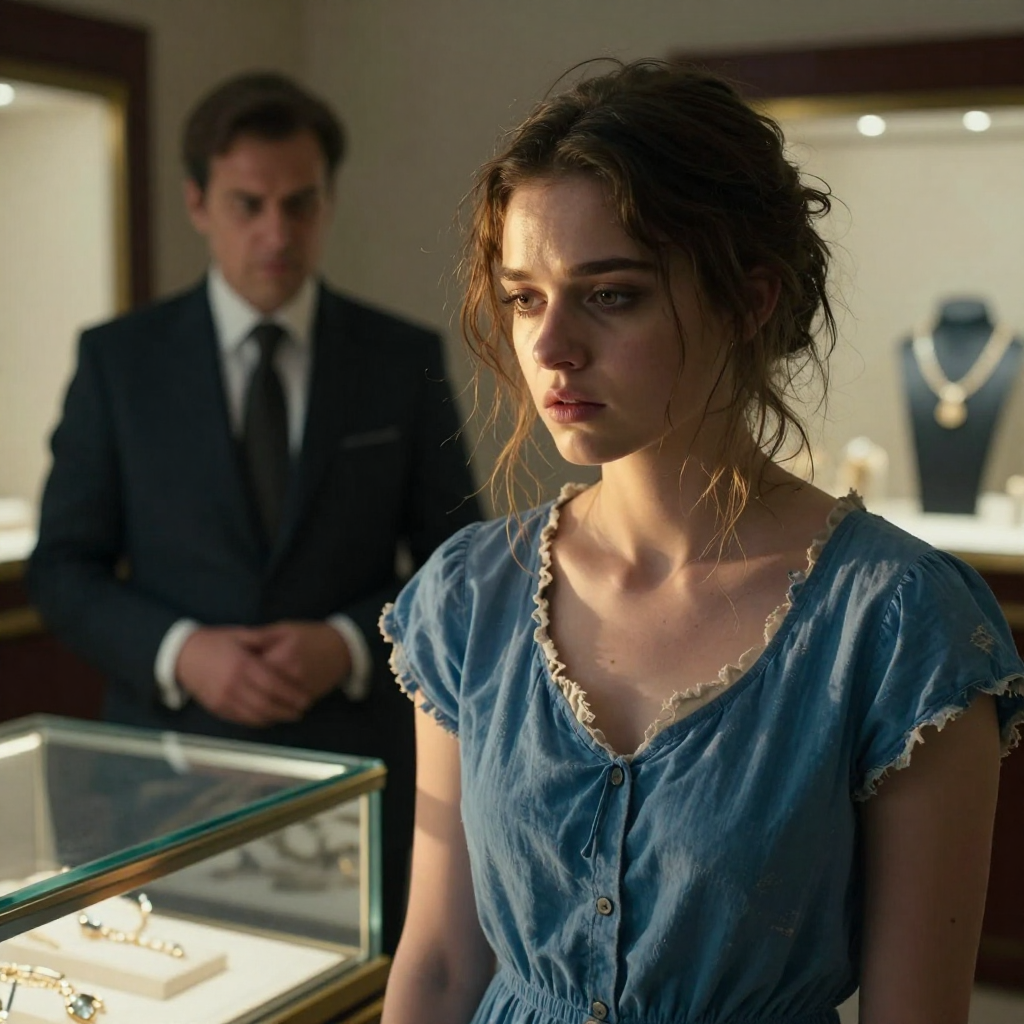
The air inside the boutique was colder than the street, conditioned to a crisp sixty-eight degrees and scented with polished teak and old money. I stood in the center of the showroom, my hands clasped in front of my simple blue cotton sundress, feeling the weight of the silence. It wasn’t a peaceful silence; it was a weapon. The man behind the glass counter, whose nametag read ‘Julian’ in elegant script, had made eye contact with me exactly once—the moment the door chime announced my entry. His gaze had swept down to my canvas sneakers, up to my unstyled hair, and then dismissed me entirely. He was now studiously adjusting a cufflink, pretending I was invisible.
I cleared my throat. Softly. I didn’t want to cause a scene. I hate scenes. “Excuse me,” I said. My voice sounded small in the cavernous, marble-floored room. “I’m looking for the Day-Date. The platinum one with the ice-blue dial.”
Julian didn’t look up. He picked up a microfiber cloth and began wiping a speck of imaginary dust from the glass case, his movements slow and exaggerated. “Reservations only,” he murmured, addressing the air. “And the waitlist is currently closed to the general public.”
“I don’t need a waitlist,” I said, stepping closer. I could feel the heat rising in my cheeks—not from shame, but from a familiar, simmering frustration. My father had taught me that patience was the greatest virtue of leadership, but he had never had to deal with a man like Julian while wearing a twenty-dollar dress. “I’d like to purchase it today. For my father’s seventieth birthday.”
Finally, Julian looked at me. His eyes were flat, bored, and filled with a pity that felt like a slap. He sighed, a short, sharp exhale through his nose. “Miss,” he said, leaning forward slightly, lowering his voice as if doing me a favor. “Please. Don’t embarrass yourself. The price tag on that timepiece is more than most people in your… demographic… earn in a decade. The fashion mall is across the boulevard. They have battery-operated watches. I think you’ll find that more your speed.”
My heart hammered against my ribs. It wasn’t the rejection; it was the assumption. The absolute certainty in his small, narrow mind that appearance dictated worth. I thought of my father, sitting in the solarium back home, his hands weathered from years of building an empire from the sand up, telling me that dignity is what you give to others, not what you demand from them. But Julian was testing that lesson.
“I am asking to see the watch,” I said, keeping my voice steady. “I have the means.”
Julian chuckled. It was a dry, ugly sound. “I’m sure you do. Just like I’m sure you’re late for a bus. Please leave before I call security to escort you out for loitering. You are wasting my time, and time, in this store, is very expensive.”
I stood my ground. I didn’t move. I simply looked at him. The silence stretched again, but this time it was heavy with tension. Julian’s smirk began to falter into annoyance. He reached for the phone behind the counter. “Have it your way,” he sneered.
Before his fingers could touch the receiver, the front door chimed. But it wasn’t a normal chime. It was opened forcefully, held wide. Two men entered first. They were broad-shouldered, wearing identical charcoal suits, ear pieces coiled like clear snakes against their necks. They didn’t look at the watches. They scanned the room—corners, exits, the counter, Julian. The atmosphere in the room shifted instantly from retail arrogance to high-stakes tactical awareness.
Julian froze, his hand hovering over the phone. “I—can I help you gentlemen?” his voice cracked.
They ignored him. One of the men, a giant I knew as Marcus, nodded toward the door. A third man entered. He was older, distinguished, wearing a bespoke suit that cost more than the store’s inventory. It was Tariq, my father’s Chief of Protocol and closest advisor.
Tariq didn’t look at the merchandise. He walked straight to me, his polished shoes clicking sharply on the marble. The transformation in the room was palpable. Julian was staring, his mouth slightly open, trying to process the shift in power dynamics.
Tariq stopped in front of me and bowed low—lower than he bowed for the Prime Minister. He took my hand, the one with the chipped nail polish, and kissed the knuckles. “Your Highness,” he said, his voice deep and resonant. “The King is waiting for his gift. The jet is fueled. We were concerned when you slipped away from the detail.”
I saw the blood drain from Julian’s face. It happened in slow motion. The arrogance evaporated, replaced by a pale, sick realization. He looked from Tariq to the security detail, and finally back to me—the girl in the cotton dress.
“Highness?” Julian whispered, the word strangling him.
I didn’t look at Tariq. I kept my eyes locked on Julian. I saw the terror in his eyes, the sudden understanding that he had just insulted the daughter of one of the world’s most powerful sovereign families. The silence now belonged to me.
“Tariq,” I said softly, my voice echoing in the sudden stillness. “This man says I am a time-waster. He says I belong across the street.”
Tariq turned slowly to face Julian. The look on his face was terrifyingly calm. “Did he now?”
I took a breath, letting the anger settle into cold resolve. “I’ll take the watch, Tariq. Actually,” I paused, looking around the pristine, cold room. “I’ll take them all. Every single watch in the inventory. Except the ones this man has touched. Burn those.”
Julian was shaking now. “Your Highness, please, I didn’t know—”
“And Tariq?” I continued, ignoring the man’s plea. “Find out who owns this building. I want to buy the lease. Today. I think this location would make an excellent shelter for the people he thinks belong across the street.”
CHAPTER II
The silence that followed Tariq’s entrance wasn’t just quiet; it was heavy, the kind of silence that feels like it’s pressing against your eardrums. I stood there, my hands shoved deep into the pockets of my oversized, nondescript hoodie, watching the blood drain from Julian’s face. He looked like a man who had just watched a ghost walk through a solid wall. Tariq didn’t look at Julian. He didn’t look at the other staff members who had gathered like startled birds at the edge of the showroom. His eyes were only for me, fixed with that terrifyingly efficient loyalty that had characterized his service to my family for thirty years.
“The documents are ready, Your Highness,” Tariq said, his voice a low, melodic baritone that sliced through the tension. He signaled to one of the men behind him, who stepped forward with a leather-bound folder. “The transfer of the building lease is being processed as we speak. The inventory buyout is complete. From this moment, this space and everything within it—including the contracts of those employed here—belongs to the Sovereign Wealth Fund’s private luxury division. Specifically, to your personal portfolio.”
I felt a strange, hollow coldness in my chest. This was the exercise of power I had spent most of my life trying to avoid. I liked the anonymity of the world. I liked being just a girl in a coffee shop, or a student in a library, someone who was judged—for better or worse—on the merit of her presence rather than the digits in her bank account. But Julian had taken that from me. He hadn’t just been rude; he had triggered a memory I thought I’d buried, an old wound that throbbed like a phantom limb.
I remembered being seven years old, standing in a boutique in London with my mother. She wasn’t wearing her jewels that day. She was in a simple trench coat, her hair tied back. The saleswoman had looked right through her, answering her questions with one-word dismissals, eventually walking away to serve a woman dripping in recognizable logos. My mother hadn’t been angry. She had just looked tired. Later, when I asked her why she didn’t tell them who she was, she told me, “Amara, if you have to tell someone you are a queen to be treated with dignity, then you are not really a queen in their eyes. You are just a customer with a crown.” I had carried that resentment for twenty years—the injustice of human dignity being tied to the visible signs of wealth.
Julian was trembling now. The arrogance that had stiffened his spine only minutes ago had evaporated, leaving behind a man who looked small and pathetic in his tailored suit. The store’s owner, a man named Mr. Sterling, came bursting through the back offices. He was breathless, his tie slightly askew, his face a frantic shade of crimson. He had clearly received the emergency notification of the ownership transfer.
“Your Highness! Your Highness, please,” Sterling gasped, nearly tripping over his own feet as he reached us. He didn’t even look at Julian. He went straight for a deep, theatrical bow that felt more insulting than the previous neglect. “There has been a terrible, catastrophic misunderstanding. If I had known… if the store had been informed of your arrival…”
“If you had known,” I interrupted, my voice sounding distant even to myself, “you would have treated me with the basic courtesy you owe to any human being who walks through your door. But because you didn’t know, you allowed your employee to treat me like a trespasser.”
Sterling turned on Julian with a ferocity that was almost physical. “Julian! What have you done? You idiot! You arrogant, short-sighted fool!”
Julian tried to speak, his throat working convulsively. “I… I was only… the brand standards, sir… she didn’t look like…”
“That’s enough,” I said. The word wasn’t loud, but it stopped Sterling’s tirade instantly. I looked at Julian. This was the moment of the moral dilemma I always faced. If I were a better person, I would show him the mercy he didn’t show me. I would give him a lecture and let him keep his job. But I thought of the countless others—the students saving for a graduation gift, the modest fathers looking for a retirement watch—who had likely walked in here and been made to feel small by this man. If I let him stay, I was endorsing the system that wounded my mother.
“Mr. Sterling,” I said, looking at the owner but pointing toward Julian. “He is finished. I want him out of this building within the next five minutes. No severance. No recommendations. His career in luxury retail ends here, today.”
It was a public execution of a career. The other staff members watched in a terrifying, frozen silence. Julian looked at me, and for a second, I saw a flash of genuine terror in his eyes. He knew. He knew that in this city, in this industry, my word was a finality from which there was no appeal. He had gambled on the idea that I was nobody, and he had lost everything.
“Pack your things,” Sterling hissed at him. “Do not let me see you here when I turn around.”
Julian didn’t argue. He couldn’t. He turned and walked toward the back, his shoulders slumped, his footsteps echoing on the marble floor. It was irreversible. I felt a flicker of guilt, a sharp pang in my gut. I had just destroyed a man’s livelihood over a few minutes of rudeness. Was I being just, or was I just being a tyrant? The line between the two felt dangerously thin.
“Tariq,” I said, turning away from the spectacle. “Take the entire current inventory of the Day-Date and Submariner models. Pack them. We are leaving.”
“And the building, Highness?” Tariq asked, his pen hovering over a ledger.
“Close it,” I said. “Board it up. I don’t want it operating as a store anymore. We’ll figure out what to do with the space later. Maybe a community center. Maybe nothing. Just… get the watch for my father.”
We left the store in a procession of black SUVs, the irony of my ‘simple’ outing now fully dissolved into the reality of my status. As we drove through the sun-drenched streets toward the palace, I held the small, green leather box in my lap. Inside was the platinum Rolex Day-Date with the ice-blue dial, the one I had originally come for. It felt heavier now. It felt like it cost more than just the retail price.
I had a secret that I kept even from Tariq, a secret that drove this frantic need to make my father’s 70th birthday perfect. My father, King Malik, was tired. Not just the tiredness of age, but the deep, bone-weary exhaustion of a man who knew his heart was failing. His doctors spoke in hushed tones in the palace corridors, using words like ‘mitral regurgitation’ and ‘limited intervention.’ He refused the surgeries. He wanted to die in the house he was born in, not in a sterile clinic in Switzerland. This birthday wasn’t just a milestone; it was quite possibly our last together. That was why I had gone alone. I wanted the gift to be a piece of the real world, a piece of a daughter’s effort, not just another item ordered by a staffer.
When we arrived at the palace, the transition was jarring. From the chaotic, public confrontation in the city to the cool, incense-scented silence of the royal residence. I changed out of my hoodie and into a simple but elegant silk abaya. I scrubbed my face, trying to wash away the heat of the afternoon’s anger.
I found my father in his private library, a room that smelled of old paper and cedarwood. He was sitting by the window, a book of poetry open on his lap, though he wasn’t reading. The light hit the side of his face, highlighting the deep lines of a life spent carrying the weight of a nation. He looked fragile. It broke my heart every time I saw him like this, the lion in winter.
“Amara,” he said, his voice brightening as he saw me. He reached out a hand, and I took it, feeling the papery thinness of his skin. “You’ve been out. Tariq told me you had an… adventurous afternoon.”
I sat on the footstool beside his chair. “Tariq talks too much.”
“He’s worried about you. We both are. You have your mother’s spirit, but you also have her habit of trying to walk through the world as if it won’t catch fire when you touch it.” He smiled, a slow, knowing thing. “I heard you bought a building today.”
I looked down at the watch box in my hands. “I didn’t want to buy a building, Baba. I just wanted to buy you a gift. I wanted to do it myself. I wanted to be… normal. Just for an hour.”
“And?” he asked gently.
“The world doesn’t let us be normal,” I whispered. I felt the tears pricking at the corners of my eyes, a sudden, sharp vulnerability that I only ever showed him. “A man at the shop… he was so cruel. He looked at my clothes and saw someone who didn’t exist. He saw someone who wasn’t worthy of his time. It made me so angry. Not for me, but for everyone he treats like that.”
My father sighed, a long, rattling sound. He took the green box from my hands and opened it. The platinum shimmered in the soft light of the library. He didn’t look at the watch for long; he looked at me. “You bought the store to punish him. You used the crown like a hammer.”
“I did,” I admitted, my voice trembling. “And now I feel… I feel like I lost the very thing I went out to find. I wanted to be a daughter buying a gift. I ended up being a Princess destroying a career.”
“Amara, listen to me,” he said, leaning forward. The effort made him wince slightly, and I moved to help him, but he waved me off. “Power is a curse because it robs you of the ability to be truly seen. But you must never apologize for demanding dignity. That man didn’t lose his job because of your title. He lost his job because he forgot that the person in front of him was a human being. That is a lesson some people only learn through loss.”
He reached out and stroked my hair. “But you must be careful. If you fight every slight with a palace, you will soon find yourself living in a fortress of your own making, with no way out and no one who dares to tell you the truth.”
“I just wanted you to have something special,” I said, leaning my head against his knee. “Something that wasn’t just… a formality.”
“It is special,” he said, sliding the watch onto his wrist. It looked massive on his thinning arm, a heavy anchor of luxury on a body that was slowly drifting away. “Not because of the brand. But because my daughter went into the lion’s den of the common world and fought a battle for her old father. Even if she used a tank to win a sword fight.”
I laughed, a wet, shaky sound. In that moment, the public spectacle at the Rolex boutique felt a million miles away. Here, in the quiet of the library, I wasn’t the woman who had just closed a store and fired a man with a snap of her fingers. I was just a girl who was terrified of losing the only person who truly knew her.
But the peace was short-lived. A knock came at the door—the rhythmic, insistent knock of the Royal Guard. Tariq entered, his face uncharacteristically pale. He held a tablet in his hand, his thumb scrolling rapidly through a feed.
“Your Highness,” Tariq said, his voice tight. “We have a problem. Someone in the store… one of the other customers. They recorded the entire encounter. The argument with Julian, my entrance, your decree to buy the building.”
I stood up, my heart sinking. “How bad is it?”
Tariq turned the screen toward us. It was a video, already racking up millions of views. The caption read: *‘Mystery Girl in Hoodie Turns Out to be Princess Amara, Buys Entire Building to Fire Salesman Who Snubbed Her.’*
The comments were a war zone. Some hailed me as a hero of the working class, a ‘Robin Hood’ of retail. Others called me a spoiled tyrant, a symbol of the very inequality I claimed to hate. But it wasn’t the public opinion that made my blood run cold. It was the fact that the secret I had worked so hard to keep—the fact that I was in the country at all, and not at the diplomatic summit in Geneva where I was supposed to be—was now global news.
I looked at my father. The light in his eyes had faded, replaced by a sharp, political clarity. The vulnerability of our moment was gone. The world had broken in.
“The Council will see this,” my father said quietly. “They will see it as a lack of discipline. As a sign that I can no longer control my own house.”
“I’m sorry, Baba,” I whispered. “I didn’t think…”
“That is the problem with being who we are, Amara,” he said, his voice regaining its kingly steel. “We do not have the luxury of not thinking. Every action we take, even a gift of love, is a political statement. And right now, you have just declared war on the very image of stability we need to maintain.”
He stood up, the Rolex on his wrist catching the light like a spark. “Tariq, prepare the briefing. We need to get ahead of this before the opposition uses it to question the succession.”
As they began to talk strategy, I stood there in the center of the room, feeling more alone than I had in the store. I had tried to be a person, and in doing so, I had endangered the crown. The moral dilemma I had faced in the shop—whether to fire Julian—seemed small now compared to the one I faced here. To save my father’s reputation and his grip on power, I would have to become the very thing the video accused me of: a cold, calculating figurehead who cared more about optics than people.
The trigger had been pulled. The event was public. The video was irreversible. My secret was out, my father’s health was a ticking clock, and the old wound of my mother’s humiliation was now bleeding into the future of an entire kingdom. I looked at the green box discarded on the floor. It was just a watch. But it had cost us everything.
CHAPTER III
I woke to the sound of a world that hated me. It wasn’t the birds or the desert wind hitting the palace glass. It was the rhythmic, electronic pulse of a thousand notifications, a digital landslide that had buried my reputation while I slept. I reached for my phone, my fingers trembling slightly. The screen was a blur of headlines. ‘The Rolex Rampage.’ ‘The Tyrant Princess.’ ‘Amara’s Cold Heart.’ The video from the boutique had been edited with surgical malice. It didn’t show Julian’s sneer or his whispered insults about my lineage. It showed me—looming, wealthy, and untouchable—systematically dismantling a working man’s life for the crime of a bad mood. I looked at the view count. Twenty million. In six hours.
I sat up, the silk sheets feeling like lead against my skin. I had thought I was reclaiming my dignity. I had thought I was honoring my mother’s memory by refusing to be small. Instead, I had handed my enemies the very rope they needed to hang me. Tariq was already at my door. He didn’t knock; he burst in. His face was the color of ash. He didn’t need to speak. The silence between us was heavy with the realization that we had played right into a trap we hadn’t even seen. ‘The Council is convening an emergency session,’ he said, his voice a low gravel. ‘They’re calling it a character assessment. But Amara, we both know what it is. It’s a coup.’
I dressed in black. No jewelry. No silk. I wanted to look like a widow of my own making. As I walked through the vaulted corridors toward the East Wing, I could feel the eyes of the palace staff on me. These were people who had known me since I was a child, people who had served my father with devotion. Now, they looked at the floor when I passed. They had seen the video. They had seen the girl who bought a building just to fire a salesman. They didn’t see a leader; they saw a spoiled child with too much power and not enough soul. The weight of their silence was louder than any protest.
In the Council Chamber, the air was cold. My father, King Malik, sat at the head of the table. He looked older than he had yesterday. His skin was translucent, like fine parchment stretched too thin. Across from him sat my cousin, Elias. Elias was ten years my senior, a man who wore his ambition like a tailored suit. He had always been the ‘stable’ alternative, the one who navigated bureaucracy while I navigated my own emotions. Beside him were the three Elders of the Council—men who viewed the monarchy not as a birthright, but as a business that was currently losing market value.
‘Amara,’ Elias said, his voice dripping with a fake, oily concern. ‘The streets are in an uproar. There are crowds forming at the North Gate. They aren’t cheering for the King’s birthday. They’re demanding accountability for his daughter.’ He tossed a tablet onto the table. It showed a live feed of the gates. People were holding signs. Some were printed, most were handmade. They featured my face crossed out with red ink. ‘The timing of this… outburst,’ Elias continued, ‘is particularly unfortunate given the rumors regarding His Majesty’s health.’ He glanced at my father, who remained unnervingly still.
I felt a cold spike of fear. ‘What rumors, Elias?’ I asked, though I already knew. ‘The rumors you’ve been feeding the press?’ Elias smiled, a thin, sharp line. ‘The public is questioning the stability of the succession. They see a King who is frail and a Princess who is volatile. They are asking if this family is still fit to lead. The Council has received a formal petition to review the Regency Act. They want to bypass you, Amara. They want a steady hand. They want me.’ I looked at my father, waiting for him to roar, to dismiss them, to defend me. But he just sat there, his hand resting on the table, shaking almost imperceptibly. He was losing his grip on the room, and he knew it.
‘I acted in defense of the crown’s dignity,’ I said, my voice sounding hollow even to me. ‘That man, Julian, was abusive. He insulted the King.’ Elias laughed. It was a short, bark-like sound. ‘Did he? Or did you just lose your temper? Because we found Julian. Or rather, he found us. He’s currently under the protection of a private legal firm—one funded by a subsidiary of your own rivals, the Al-Fayed group. He has a very different story to tell. He claims you entered the store looking for a fight. He claims you baited him.’
The room seemed to tilt. I remembered Julian’s face—that specific, calculated arrogance. He hadn’t just been a rude salesman. He had been a performer. He knew who I was the moment I walked in. He knew the simple clothes were a disguise. He had been coached to push every button I had, to poke at the ‘old wound’ of my mother’s low status until I bled. And I had given him exactly what he wanted. I had given them the ‘Rolex Rampage.’ I had traded my future for a moment of petty vengeance. I felt a sudden, sickening wave of vertigo. I wasn’t the hunter; I was the prey.
‘You set this up,’ I whispered, staring at Elias. He didn’t blink. ‘I merely observed a liability,’ he replied. ‘The fact that you are so easily manipulated is exactly why you cannot sit on that throne. You are a danger to the institution.’ He turned to the Council Elders. ‘I move for an immediate vote on the Regency. The King is clearly incapacitated by his daughter’s scandals. We must protect the state.’ The Elders nodded. It was happening. The walls were closing in, and I was the one who had built them. I looked at my father again. He tried to stand, his face contorting with the effort. ‘The Council… does not have… the authority…’ he began, but his voice broke into a wet, hacking cough.
Suddenly, the heavy mahogany doors at the back of the chamber swung open. Tariq entered, but he wasn’t alone. He was flanked by two men in dark suits—Internal Security. But they weren’t looking at me. They were looking at Elias. Tariq held a manila folder, his face set in a grim mask. ‘There has been a development,’ Tariq announced, ignoring the protocol of the chamber. ‘We have intercepted a series of encrypted communications between Julian Vance’s legal team and an offshore account linked directly to Prince Elias’s private estate.’
The silence in the room was absolute. Elias’s composure didn’t break, but his eyes darkened. ‘This is a desperate fabrication,’ he sneered. Tariq stepped forward and laid a series of bank transcripts on the table. ‘The payments began three weeks ago. Two days after the King’s medical records were moved to the private wing. You didn’t just observe a liability, Elias. You manufactured a crisis. You hired a man to provoke a member of the Royal Family to trigger a constitutional clause. That isn’t politics. That’s treason.’
I felt a surge of hope, but it was short-lived. The Elders looked at the papers, then at each other. They weren’t horrified by the corruption; they were weighing the power shift. Corruption they could manage. A viral video of a tyrannical princess they could not. ‘Even if this is true,’ the head Elder said, his voice cold and clinical, ‘the damage to the public trust is done. The Princess’s actions are captured on film. The Prince’s actions are hidden in bank ledgers. The mob at the gate doesn’t care about bank ledgers. They care about the girl who bought a store to fire a man.’
I stood up, my chair scraping harshly against the floor. ‘I will speak to them,’ I said. ‘I will tell them the truth.’ Elias laughed again, louder this time. ‘And what truth is that, Amara? That you were too stupid to see a trap? That you’re so arrogant you think you can buy your way out of a scandal? Go ahead. Step out on that balcony. See if they listen to you or if they throw stones.’ He was right. The truth was too complicated for a headline. The lie was simple, visceral, and already halfway around the world.
My father suddenly gasped. It wasn’t a cough this time; it was a sharp, jagged intake of air. He clutched his chest, his face turning a terrifying shade of gray. ‘Father!’ I screamed, rushing to his side. He collapsed back into his chair, his eyes rolling toward the ceiling. The Council scrambled. Tariq shouted for the medics. In the chaos, Elias didn’t move. He just stood there, watching my father die, his face a mask of cold calculation. He saw his path to the throne clearing in real-time. If the King died now, in the middle of this scandal, with me disgraced, the Council would have no choice but to appoint Elias as Regent.
‘Get the doctors!’ I yelled at the Elders, who were frozen in indecision. ‘Now!’ One of them finally ran for the door. I knelt at my father’s feet, holding his cold, trembling hand. ‘Stay with me,’ I whispered. ‘Please, not like this.’ Outside, the roar of the crowd grew louder. I could hear the chants now. They were rhythmic, angry, a wall of sound pressing against the palace glass. They wanted blood. They wanted justice. They wanted the Princess gone. And inside, my father was slipping away in the arms of the daughter who had broken his heart.
I looked up at Elias. He was leaning against the table, a slight smirk playing on his lips. ‘It’s over, Amara,’ he said quietly, so only I could hear. ‘You lost the moment you walked into that shop. You thought you were showing power. All you showed was how small you really are.’ I felt a rage hotter than anything I had felt in the boutique. It wasn’t the rage of a spoiled girl; it was the cold, hard fury of a woman who had lost everything and had nothing left to fear.
I looked at Tariq. ‘The video,’ I said, my voice steady despite the chaos. ‘The full security footage from the boutique. The audio. Everything. Is it ready?’ Tariq nodded. ‘We have the raw files. But Amara, if you release the full audio, the world will hear what he said about the King. They’ll hear the truth about the illness.’ I looked at my father’s gray face. The secret was already out. Elias had seen to that. The only thing left to save was the soul of this family.
‘Release it,’ I commanded. ‘Everything. The payments, the provocations, the full, unedited recording of my own arrogance. Don’t hide anything. Let them see all of it.’ Tariq hesitated. ‘It will destroy your reputation forever. You’ll be the Princess who was played for a fool.’ I gripped my father’s hand tighter. ‘I’d rather be a fool than a puppet. And I’d rather be hated for the truth than loved for a lie.’
As the medics rushed into the room with a crash of equipment, I stood up. I didn’t wait for them to stabilize him. I didn’t wait for the Council to vote. I walked toward the balcony doors. The sunlight was blinding as I pushed them open. The roar of the crowd hit me like a physical blow. Thousands of faces looked up, a sea of anger and resentment. I walked to the edge of the stone railing. I didn’t have a microphone. I didn’t have a script.
I looked down at the people my mother had come from. The people I had forgotten in my quest to be ‘royal.’ A stone whistled past my head, clipping my shoulder. I didn’t flinch. I just stood there, tall and silent, letting them see me. Not the girl in the video. Not the heiress. Just a daughter whose father was dying inside, and who had finally realized that power isn’t something you buy—it’s something you earn through the fire.
Behind me, in the chamber, the monitors began to beep frantically. A long, sustained tone pierced through the noise of the crowd. The sound of a heart stopping. The world seemed to pause. The wind died down. The crowd grew eerily silent, sensing the shift in the air. I turned my head back toward the room. I saw the medics leaning over my father. I saw Elias straightening his tie, preparing to step out and announce his regency.
I looked back at the crowd. My phone buzzed in my pocket. One final notification. Tariq had done it. The ‘True Rolex Files’ were live. In that second, millions of phones in the crowd chirped in unison. A wave of movement rippled through the mass of people as they looked down at their screens. They saw the payments. They heard Julian’s coached insults. They heard my own voice, sharp and entitled, but they also heard the trap being sprung.
Elias stepped out onto the balcony beside me, his face composed into a mask of mourning. He didn’t know yet. He hadn’t checked his phone. He raised his hands to speak, to claim the crown over my father’s cooling body. I turned to him, and for the first time in my life, I felt truly powerful. ‘Look at them, Elias,’ I whispered. He looked down, expecting silence or cheers for the new savior. Instead, he saw ten thousand people looking up from their phones, their anger shifting from me to him. The hunter had become the hunted. And as the first cries of ‘Traitor!’ began to rise from the pavement, I realized that the survival of the monarchy didn’t matter anymore. Only the truth did. But the cost was my father’s life, and a throne that was now sitting in the middle of a battlefield.
CHAPTER IV
The silence after my father’s fall was the loudest thing I’d ever heard. It swallowed the Council’s bickering, Tariq’s desperate defense, even the dull roar of the city outside. Then came the screaming. Not panicked, but raw, animalistic grief. It echoed in the chamber, bouncing off the portraits of stern-faced kings who’d never faced a crisis like this. I stood frozen, Elias’s betrayal a dull throb beneath the sharper agony of losing my father. He lay still, his eyes open, staring at nothing. My kingdom had fractured in a single, sickening moment.
They carried him out. The guards moved with a strange, hesitant reverence, unsure if they were still protecting a king or just carrying a body. I watched them go, feeling utterly detached. Tariq was at my side, his hand hovering, never quite touching. I knew what he wanted to say – that I was in charge now – but the words wouldn’t come. Couldn’t come. The weight of the crown felt like a physical burden, crushing my spine.
Elias was gone. Slipped away in the chaos, no doubt. Part of me wanted to hunt him down, drag him back, make him face what he’d done. But another part, the exhausted, broken part, just wanted to collapse. I let Tariq lead me away, back to the hollow safety of the palace. The city outside was a pressure cooker, ready to explode. I could feel its rage building, fueled by grief, betrayal, and years of simmering discontent.
My first act as… what? Regent? Queen? Usurper? I didn’t know. My first act was to lock myself in my father’s study. The room smelled of old leather, pipe tobacco, and a faint, lingering hint of his cologne. I sat in his chair, the leather worn smooth by years of his presence. On his desk, a half-finished letter. Addressed to me. I couldn’t bring myself to read it. Not yet. I just sat there, surrounded by his ghosts, and let the silence consume me.
**PHASE 1: THE WIDENING RIFT**
The video, of course, was everywhere. Every screen, every news feed, every whispered conversation. My ‘Rolex Rampage’ replayed endlessly, a constant reminder of my initial spark that had led to this conflagration. The news outlets juxtaposed it with images of my father’s lifeless body being carried from the council chamber. The comments sections were a cesspool of hate, grief, and accusations. Some blamed Elias, others blamed me, and many blamed the entire royal family.
The palace walls felt thin, fragile. The city’s anger vibrated through the stone, a constant, menacing hum. I couldn’t sleep. Every time I closed my eyes, I saw my father’s face, his eyes wide with shock and then… nothing. Tariq tried to reassure me, to tell me that things would calm down, that the public would eventually see the truth. But I saw the doubt in his eyes. He knew as well as I did that the truth was a messy, complicated thing, easily twisted and manipulated.
My family… what was left of it… was falling apart. My mother was inconsolable, lost in a haze of grief and medication. My siblings were either terrified or furious, unsure of where their loyalties should lie. The Royal Council, those vipers, were circling, each vying for position, each trying to exploit the power vacuum. They called meetings, issued statements, made promises they couldn’t keep. I ignored them. I couldn’t bring myself to engage in their petty games.
Then came the delegations. Representatives from various factions within the city, each with their own demands, their own agendas. Business leaders, religious figures, community organizers. They wanted answers, they wanted promises, they wanted… change. I met with them, listened to their grievances, nodded and murmured appropriately. But inside, I was empty. I had no answers, no promises, no plan. I was a hollow shell, wearing a crown that didn’t belong to me.
The funeral was a spectacle. The streets were lined with mourners, some genuinely grieving, others simply curious. The media was out in full force, capturing every tear, every grimace, every whispered word. I stood beside my mother, her hand trembling in mine, and tried to project an image of strength, of resolve. But inside, I was crumbling. The weight of the world was on my shoulders, and I didn’t know if I could bear it.
After the funeral, a message arrived. A single, unmarked envelope, delivered by a nervous palace guard. Inside, a photograph. A picture of Julian, the salesman from the boutique, sitting at a café, laughing. On the back, a single word: ‘Congratulations.’ The rage that had been simmering inside me finally boiled over. I crumpled the photograph in my fist, my knuckles white. This wasn’t over. Not by a long shot.
**PHASE 2: THE COST OF TRUTH**
The first real blow came from Geneva. The Swiss Consortium, the one responsible for managing the Royal Family’s vast wealth, froze our assets. They cited ‘instability’ and ‘breach of fiduciary duty.’ It was a calculated move, designed to cripple us financially and force my hand. Without access to the royal treasury, I couldn’t fund social programs, pay the palace staff, or even maintain basic security.
Tariq was furious. He wanted to retaliate, to threaten legal action, to expose the Consortium’s own shady dealings. But I stopped him. I knew that fighting them would be a long, drawn-out battle that we couldn’t win. Besides, they weren’t entirely wrong. We *were* unstable. And my actions *had* breached some kind of unspoken duty.
The second blow was more personal. My sister, Fatima, announced her engagement to a prominent member of the Royal Council, a man old enough to be her father. It was a blatant power play, a way for her to secure her own position in the new regime. I confronted her, begged her not to do it. But she was adamant. She accused me of ruining everything, of bringing shame upon the family. I walked away, feeling the familiar sting of betrayal.
Then came the defections. One by one, members of the palace staff began to disappear. Loyal servants who had been with my family for years, gone without a word. Some were offered better positions by rival factions, others simply feared for their safety. The palace felt emptier, colder, more vulnerable. The silence was broken only by the whispers of the few who remained, their faces etched with fear and uncertainty.
I started spending my days in my father’s study, poring over old documents, trying to find some clue, some guidance. His letter remained unopened on the desk. I couldn’t bring myself to read it. It felt like a final goodbye, a confirmation that he was truly gone. Instead, I focused on the practical matters, the logistical challenges of running a kingdom on the brink of collapse.
The city was growing more restless. Protests erupted daily, fueled by unemployment, inequality, and a deep-seated distrust of the monarchy. The police struggled to maintain order, their efforts often making things worse. I knew that we were close to the breaking point. One spark, one wrong move, and the whole thing could explode.
And then, Elias resurfaced. Not in person, but through a series of anonymous online posts. He claimed that he had been acting in the best interests of the kingdom, that my father had been a weak and ineffective ruler, that I was unfit to lead. He painted himself as a patriot, a savior. And to my horror, some people believed him.
**PHASE 3: SHADOWS OF JUSTICE**
Tariq found him. Or, rather, he found *where* he was. A small, secluded villa on the coast, far from the city’s chaos. I didn’t hesitate. I told Tariq to prepare a security detail. I was going to confront Elias.
He argued, of course. Said it was too dangerous, that I should let the authorities handle it. But I wouldn’t listen. This wasn’t about politics or power. It was about family. About betrayal. About justice.
The villa was opulent, hidden behind high walls and guarded by private security. I brushed past them, my face grim, Tariq and his team close behind. Elias was inside, sitting on the terrace, sipping wine and watching the sunset. He looked… relaxed. Almost smug.
He didn’t seem surprised to see me. He simply smiled, a cold, calculating smile that sent a chill down my spine. “Amara,” he said, his voice smooth and oily. “To what do I owe this… honor?”
I didn’t waste time on pleasantries. “Why, Elias?” I asked, my voice trembling with rage. “Why did you do it?”
He shrugged. “For the good of the kingdom,” he said, his eyes glinting in the fading light. “Your father was weak. You were… reckless. I had to act.”
“You killed him,” I said, my voice barely a whisper.
“He was already dying,” Elias said, his voice dismissive. “I simply… accelerated the process.”
I lunged at him, my hand raised to strike. But Tariq grabbed my arm, pulling me back. “Don’t,” he said, his voice low and urgent. “Don’t give him what he wants.”
I took a deep breath, trying to control my anger. “You’re going to pay for this, Elias,” I said, my voice cold and hard. “You’re going to pay for everything.”
He laughed. “What are you going to do, Amara? Arrest me? Imprison me? You don’t have the power anymore. The kingdom is crumbling. You’re finished.”
He was wrong. I still had one card left to play. One last, desperate gamble.
I turned to Tariq. “Get the cameras,” I said. “I want the world to see this.”
Elias’s smile faltered. He knew what I was planning. He knew that I was about to expose him for what he truly was.
I looked directly into the camera, my face pale but resolute. “My name is Amara,” I said, my voice clear and strong. “And I’m going to tell you the truth about my cousin, Elias…”
I laid it all out. The conspiracy, the betrayal, the lies. I showed the evidence, the documents, the recordings. I didn’t hold back. I didn’t spare myself. I exposed everything, even the parts that made me look bad.
Elias watched in silence, his face growing paler with each passing moment. When I was finished, he simply stared at me, his eyes filled with hatred and despair.
“You’ve ruined everything,” he said, his voice barely audible.
“No, Elias,” I said. “You ruined everything. I’m just cleaning up the mess.”
**PHASE 4: THE PRICE OF LEADERSHIP**
The aftermath was swift and brutal. The video went viral, even faster than my ‘Rolex Rampage.’ The public turned on Elias with a vengeance. Protests erupted outside his villa, demanding his arrest. His allies deserted him, one by one. The Royal Council, sensing the shift in power, scrambled to distance themselves from him.
He was arrested within hours. Charged with treason, conspiracy, and murder. His trial was a media circus, broadcast live around the world. He tried to defend himself, to claim that he had been acting in the best interests of the kingdom. But no one believed him. The evidence was overwhelming.
He was found guilty on all counts. Sentenced to life in prison. I didn’t attend the sentencing. I couldn’t bear to see him, to witness his downfall. Part of me felt vindicated. But another part, the human part, felt… sad.
But even with Elias behind bars, the kingdom remained fractured. The protests continued, the divisions deepened. The economy was in freefall, the social fabric was tearing apart. I was running out of time, out of options.
I finally opened my father’s letter. It was short, simple, and heartbreakingly honest.
*“My dearest Amara,”* it read. *“I know that I haven’t always been the best father. I’ve been too focused on the crown, on the kingdom, to see the person you truly are. But I want you to know that I’m proud of you. You are strong, intelligent, and compassionate. You have the courage to do what is right, even when it’s difficult. The kingdom is in your hands now. I trust you to make the right choices. Follow your heart. And never forget who you are.”*
His words gave me strength, clarity. I knew what I had to do.
I called a meeting of the Royal Council. They arrived with trepidation, unsure of what to expect. I looked at them, at their faces filled with greed, ambition, and fear. And I knew that they were the problem. The monarchy itself was the problem. It was outdated, corrupt, and unsustainable.
“I have made a decision,” I said, my voice clear and strong. “I will not be taking the throne.”
The room erupted in chaos. The council members protested, argued, threatened. But I stood my ground.
“The monarchy is abolished,” I said. “Effective immediately.”
I established a transitional council comprised of leaders from every district. They were diverse, representing a wide spectrum of beliefs. It was a start.
I walked away from the palace, leaving the past behind me. The city awaited me, a changed nation.
The Rolex felt heavy in my pocket.
I sold it the next day and donated all the money to a community center.
CHAPTER V
The throne room felt wrong. Empty. Stripped of its purpose. Days ago, it had been the epicenter of power, intrigue, and ultimately, my father’s undoing. Now, standing amidst the echoing silence, I felt only a profound sense of liberation mixed with a bone-deep weariness. The crown jewels were already inventoried, cataloged, and would soon be placed in a national museum. The throne itself was… gone. Melted down, I supposed. Or maybe gathering dust in some forgotten warehouse. It didn’t matter. It was just a chair.
My sister, Fatima, found me there. She had been avoiding the palace, spending most of her time at our family’s estate outside the capital. I don’t blame her.
“Are you alright?” she asked, her voice soft.
I turned, forcing a smile. “As alright as one can be after dismantling a kingdom.”
She managed a weak smile in return. “It was the right thing to do, Amara. Everyone knows it.”
“Knowing it and feeling it are two different things,” I admitted. I had expected a surge of triumph, a sense of victory. Instead, I felt… hollow. Like a puppet whose strings had been cut. I looked at Fatima and noticed something in her eyes that I had not noticed before. Sadness. A lot of it.
“What are you going to do now?” she asked.
I shrugged. “Help the council, I suppose. Make sure this transition doesn’t completely fall apart.” I paused, then added, “What about you? Are you going to stay away?”
Fatima looked down at her hands. “I don’t know. Everything feels so different now.”
“It is different,” I said gently. “But different doesn’t have to mean bad.”
She looked up at me, her eyes filled with tears. “I miss him, Amara,” she whispered. “I miss Father so much.”
I stepped forward and hugged her tightly. I missed him too. More than I could put into words. But I couldn’t afford to fall apart. Not now. Not when so much depended on me. At least, that’s what I kept telling myself.
—
The first few weeks after the abolition were chaotic. The Transitional Council, a mix of elected officials, community leaders, and a few (carefully vetted) former royal advisors, struggled to find its footing. Old loyalties clashed with new ideals. Bureaucracy tangled with revolutionary fervor. Every decision, from garbage collection to international trade agreements, became a battleground.
Tariq was invaluable. He navigated the political minefield with a skill I didn’t possess. He knew everyone, understood the nuances of every faction, and somehow managed to keep everyone talking. He was also my shield, deflecting the endless stream of criticism and demands that came my way. Without him, I would have drowned.
“They expect too much,” I complained to him one evening, after a particularly brutal council meeting. “They think I have all the answers.”
He smiled, a weary but reassuring smile. “They expect leadership, Amara. And you are providing it. Even when you doubt yourself.”
“But what if I fail? What if this whole thing collapses?”
He placed a hand on my arm. “Then we pick up the pieces and start again. That’s all we can do.”
His words calmed me, but they didn’t erase the fear. The fear of failure. The fear of letting everyone down. The fear that I was simply not good enough to lead this country through such a turbulent time. I would catch Tariq looking at me sometimes with such a look of concern. It was too much. I needed to get out of the Palace.
One morning, I told the council that I needed to visit the regions. I said that I needed to see the people and hear their concerns first hand. The council was not keen on the idea. They said it was too dangerous, too soon. But I insisted. I needed to do it.
—
We started in the rural villages, the places most neglected by the old regime. I met farmers struggling to make a living on barren land. I met teachers trying to educate children in dilapidated schools. I met mothers who had lost their sons to preventable diseases. Their stories were heartbreaking, infuriating, and they fueled a fire in me that had been dormant for too long.
I visited a small village where the water supply was contaminated. The people were forced to drink from a polluted stream, and as a result, many of them were sick. I saw children with bloated bellies and listless eyes. It was unbearable.
I promised them that I would do everything in my power to get them clean water. I didn’t know how I was going to do it, but I knew that I had to try. I felt ashamed of myself. I had been so preoccupied with the political machinations in the capital that I had forgotten about the real people who were suffering. I had been so focused on dismantling the monarchy that I had neglected the needs of the people.
I was so focused on dismantling the monarchy that I had neglected the needs of the people. Tariq accompanied me to every village, every meeting, every heartbreaking encounter. He didn’t offer empty platitudes or false promises. He simply listened. He took notes. He offered practical solutions.
One evening, as we sat by a campfire outside a small village, I asked him, “Why do you do it, Tariq? Why do you put up with all of this?”
He looked at me, his eyes reflecting the flickering flames. “Because I believe in this country, Amara. And I believe in you.”
His words touched me deeply. I had never felt so understood, so supported. He saw something in me that I didn’t see in myself. He saw a leader, a fighter, someone who could make a real difference in the world. That night, I began to see it too.
But I still felt guilty. I was tired. I was still grieving my father. I was scared.
—
The turning point came during a visit to a textile factory in a working-class district of the capital. The factory was the largest employer in the area, but it was on the verge of collapse. The owner, a man named Omar, explained that he was struggling to compete with cheaper imports. If the factory closed, hundreds of people would lose their jobs.
I listened to Omar’s story with growing frustration. It was the same story I had heard in countless villages and towns across the country. The people were struggling, the businesses were failing, and the government was doing nothing to help.
“What can I do?” I asked Omar, feeling a surge of helplessness.
He looked at me with a mixture of hope and skepticism. “You can use your influence, Princess,” he said. “You can persuade the council to implement policies that support local businesses. You can create a level playing field.”
I hesitated. I was no longer a Princess. But I understood his point. I still had a voice. I still had influence. And I could use it to help the people.
That night, I drafted a proposal for a series of economic reforms designed to support local businesses and create jobs. I presented it to the council the next day. The debate was fierce. Some council members argued that the reforms were too expensive, too radical. Others worried about the impact on foreign investment.
But I stood my ground. I spoke passionately about the need to protect local jobs and support local businesses. I spoke about the people I had met in the villages and towns across the country. I spoke about Omar and his struggling factory. I spoke about the future of our country.
In the end, the council voted in favor of the reforms. It was a narrow victory, but it was a victory nonetheless.
As I left the council chamber, I felt a sense of accomplishment that I had never felt before. I had used my power not to rule, but to serve. I had used my voice not to command, but to advocate. I had used my influence not to enrich myself, but to help others.
The next day, I visited Omar’s factory. He greeted me with tears in his eyes. “Thank you, Princess,” he said. “You saved us.”
I smiled. “I didn’t do it alone, Omar,” I said. “We did it together.”
I realized that true leadership wasn’t about crowns or thrones or titles. It was about serving the people. It was about listening to their needs. It was about fighting for their rights. And it was about working together to build a better future.
After that, things began to change. The council started to function more effectively. The economy began to stabilize. People started to believe in the future again. I knew that there were still many challenges ahead, but I also knew that we were on the right track.
I dedicated myself to this work. I helped establish a foundation to address the kingdom’s social and economic problems. My sister, Fatima, became involved and threw herself into it with a passion. We opened schools. We helped farmers. We built hospitals. And slowly, but surely, we began to heal our nation.
One day, Tariq came to me with a proposition. The council wanted him to run for a seat in the next election. They believed that he was the best person to lead the country forward. He had asked for my advice.
“You should do it, Tariq,” I said without hesitation. “You would be a great leader.”
He smiled. “What about you, Amara? What will you do?”
I looked out the window, at the bustling city below. “I’ll be here,” I said. “Helping in any way I can.”
I knew that my role would continue to evolve. I was no longer a princess, but I was something more. I was a servant of the people. And that was a title I was proud to hold. Years from that moment, as the nation grew into a thriving democracy with Tariq as a trusted advisor, I stood in the background. Helping where needed, but ultimately letting the new world take hold. I found peace with my father’s death. I realized that all of my experiences led me to this point. I could never take back my past, but my past experiences gave me the wisdom to succeed.
The day that Tariq was fairly elected, I went back to the throne room. But this time, it was different. It was now a public space, part of the nation’s museum. I sat in one of the chairs that lined the wall. The chairs that were for common people. And I smiled.
My journey had been turbulent, painful, and transformative. I had lost my father, my crown, and my illusions. But I had gained something far more valuable: a purpose.
It was time to step back completely. To allow the new government to fully take over. I was no longer needed, but it was OK. It was better than OK.
And with that, I walked away. I could finally rest.
It had been a long journey, but I learned a valuable lesson. That power wasn’t just given; it was earned.
END.