A Marine Mocked an Old Man Sitting Alone. Then a General Walked In and Dropped a Salute That Stopped the Whole Base.
Chapter 1: The Intruder in the Tent
The heat inside the General Purpose tent was a physical weight, a thick blanket of humidity trapped under olive-drab canvas. It smelled of diesel fumes from the external generators, stale popcorn from the concession stands, and the sharp, metallic tang of brass polish.
It was Fleet Week. The base was open to the public, a rare window where civilians could wander past the checkpoints and touch the edges of a world usually closed to them. The air buzzed with the low roar of a thousand conversations, the crying of tired children, and the thrum of excitement.
In the far corner of the tent, away from the shiny recruiting posters and the polished display cases of modern weaponry, sat a man who seemed to belong to none of it.
He was old in a way that suggested he had been eroded rather than aged. His skin was like parchment paper left out in the sun—thin, spotted, and translucent. He sat on a gray metal folding chair, his hands resting on his knees, motionless. He wasn’t looking at the displays. He wasn’t looking at the families walking by. He was staring at a point in the middle distance, seeing something that wasn’t there.
“Sir, what’s your rank?”
The voice cut through the hum of the crowd like a serrated knife.
It didn’t come as a question. It came as a challenge.
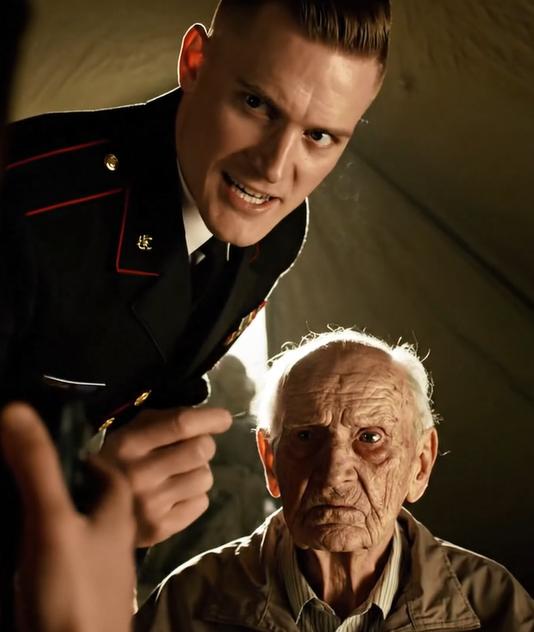
Corporal Avery stood directly in front of the old man. Avery was young, barely twenty-two, with a haircut so fresh the skin on the sides of his head was still pale. His uniform was impeccable. Creases sharp enough to cut paper. Boots polished to a black mirror. He stood with his legs apart, thumbs hooked into his belt, radiating the specific kind of arrogance that only exists in young men who have been given a title but haven’t yet been tested by fire.
The old man didn’t blink. He didn’t even seem to hear the voice. He sat like a stone in a rushing river, letting the noise flow around him.
“No answer?” Avery pushed harder. He smirked, glancing back at his two friends—Privates who were hanging back, snickering into their hands. “Come on, old-timer. You can tell me. Corporal? Private? Or did you just wander in from the retirement shuttle looking for the free cookies?”
The snickering behind him grew louder. It was a pack mentality. The Alpha was barking, and the pack was reinforcing the noise.
A young mother, pushing a stroller near the display of MREs, paused. She looked at the Corporal, then at the old man, her face tightening with discomfort. She pulled her child’s hand closer, steering the stroller away. People instinctively move away from conflict, especially when it feels cruel.
“You can’t just sit in the Marine family tent if you never served,” Avery continued, his voice rising. He was performing now. He had an audience. “This area is for personnel and their families. Not tourists. Rules apply to everyone.”
The old man finally moved.
It was a slow, glacial movement. His hand, shaking with a tremor that rattled the fabric of his trousers, lifted slowly to his collar. He wore a faded blue windbreaker over a plaid shirt. On the collar of the shirt, pinned awkwardly through the fabric, was a small, dull piece of metal.
It wasn’t a rank insignia. It wasn’t a ribbon. It looked like a piece of jagged scrap metal, dark and tarnished.
Avery followed the hand with his eyes. He squinted at the pin.
“What is that?” Avery laughed, a sharp, barking sound. “Is that supposed to be a unit crest? Did you get that out of a cereal box, Grandpa?”
The old man’s fingers brushed the metal. A caress. A check. Still there.
“I asked you a question,” Avery snapped, his patience evaporating. The heat of the tent was making him irritable, and the old man’s silence felt like disrespect. “State your rank. Now.”
The old man lifted his chin. His neck was ropy with age, the cords of muscle standing out. He looked up at Avery. His eyes were a startlingly pale blue, clouded with cataracts, but behind the haze, there was something rock-solid.
“I’m just here to look around, son,” the old man said.
His voice was quiet. It sounded like gravel crunching under boots. It wasn’t weak, but it was used up. The voice of a man who had said all the important words he was ever going to say decades ago.
Avery’s face flushed. The word son hit him like a slap.
“Son?” Avery repeated, stepping closer. He loomed over the chair, invading the old man’s personal space. “That’s cute. You think we’re the same? You think because you bought a hat at a gas station you can sit here?”
Avery tapped his own chest, hitting the ribbons there. “I earned this uniform. I went through Parris Island. I serve my country. You? You look like you served yourself at the buffet too many times.”
The cruelty was unnecessary. It was excessive. But Avery was insecure. He was a clerk who had never deployed, never seen combat, and deep down, he was terrified that he wasn’t a “real” Marine. Bullying an old man made him feel big. It made him feel powerful.
“I think you need to leave,” Avery said, pointing toward the bright rectangle of sunlight at the tent’s entrance. “The exit is that way.”
The old man didn’t look at the exit. He looked at Avery’s boots. Then his belt. Then his eyes. He was reading him. Not with anger, but with a profound, sad understanding.
“I’m not hurting anyone,” the old man whispered.
“You’re loitering,” Avery countered. “And you’re disrespecting the uniform by pretending to be one of us. So, unless you have a military ID in that pocket, you need to walk.”
Chapter 2: The Weight of a Shadow
The air in the tent seemed to thicken, the humidity binding with the tension to create a suffocating pressure. The background noise—the chatter of families, the sales pitches of vendors—faded into a dull roar, leaving the confrontation in the corner isolated, like a spotlight had been turned on.
Harold Winters, ninety-two years old, felt the vibration of the young man’s voice more than he heard the words. His hearing aids were turned down low; he preferred the world muffled. It was softer that way.
He looked at the young Corporal. He didn’t see a bully. He saw a boy. A boy with smooth skin and eyes that had never seen a friend freeze to death in a foxhole. He saw a boy who thought the uniform was a costume of power, rather than a burial shroud waiting to happen.
“I have ID,” Harold said softly.
He reached for his back pocket. The movement was agonizingly slow. His shoulder joint grinded, bone on bone. His fingers, twisted by years of labor and the relentless march of arthritis, fumbled with the fabric.
“Today, Grandpa,” Avery muttered, checking his watch theatrically. “We don’t have all week.”
One of the Privates behind Avery whispered something about “fighting the Battle of the Naptime,” and they snickered again.
Harold ignored them. He pulled out his wallet. It was a bi-fold, the leather worn so smooth it looked like polished wood. The edges were fraying. He opened it with trembling hands.
Before he could extract a card, Avery reached down and snatched the wallet from his grasp.
“Let’s see what we’re dealing with,” Avery announced, projecting his voice so the nearby civilians could hear. He was playing to the crowd, trying to frame this as a security measure rather than harassment.
Avery flipped through the plastic sleeves.
“Driver’s license… expired two years ago,” Avery read, shaking his head. “Library card. A picture of…” He paused, looking at a black and white photo tucked into the folds. It was a woman, young and beautiful, standing in front of a 1940s porch. Avery scoffed and flipped past it. “And… nothing. No military ID. No VA card. Nothing.”
He snapped the wallet shut and tossed it back onto Harold’s lap. It landed with a soft thud.
“Stolen valor,” Avery declared, crossing his arms. “That’s what this is. You come in here, you sit in the VIP section, you let people think you’re a hero. It’s pathetic.”
Harold picked up the wallet. He smoothed the leather where Avery’s fingers had been, a gesture of quiet dignity. He didn’t defend himself. He didn’t explain that his military ID had been lost in a house fire ten years ago, or that the records in St. Louis had burned up in the 70s.
He didn’t explain that he didn’t need a card to know who he was. The shrapnel still lodged in his left hip was ID enough. The nightmares were ID enough.
“I served,” Harold said. It was a whisper, fragile as smoke.
“Yeah?” Avery sneered. “Where? The mess hall? Or did you fight in the Great Papercut War?”
Harold’s gaze drifted again. He wasn’t looking at Avery. He was looking at the collar pin.
“Korea,” Harold breathed.
The word hung in the air. Korea. The Forgotten War.
Avery laughed. “Korea? Right. Sure. Everyone’s a war hero when there’s no one left to fact-check them.”
Avery leaned down, his face inches from Harold’s. “Look, if you were in Korea, you’d have a ribbon. You’d have a hat. You’d have something better than this…” He reached out and flicked the pin on Harold’s collar with his index finger.
Clink.
The sound was tiny, but it echoed in Harold’s soul.
“This piece of trash,” Avery finished. “What is this? A Cracker Jack prize?”
Harold’s hand flew up to cover the pin, protecting it. His eyes flashed—a sudden spark of the man he used to be. A man who had held a rifle with frozen fingers. A man who had walked out of hell when thousands hadn’t.
“Don’t touch it,” Harold said. The voice wasn’t gravel anymore. It was steel.
Avery blinked, taken aback by the sudden sharpness. But his ego wouldn’t let him back down.
“I’ll touch whatever I want in my tent,” Avery hissed. “Now get up. I’m escorting you out.”
He reached for the old man’s arm, intending to haul him out of the chair.
“Corporal!”
The voice didn’t come from the old man. It came from the aisle behind them. It was a voice that didn’t need to shout to be heard. It was deep, resonant, and carried the absolute, crushing weight of authority.
Avery froze. His hand hovered inches from Harold’s arm.
He turned slowly.
Standing ten feet away was a man who looked like he had been carved out of granite. He was older, perhaps late forties, with sleeves rolled up to reveal forearms that looked like bridge cables. He wore the chevrons of a Gunnery Sergeant.
But it wasn’t just the Gunny.
Behind the Gunnery Sergeant, flanked by two MPs, was a man in Dress Blues. The sunlight caught the stars on his collar. Two stars. A Major General.
The General wasn’t looking at the crowd. He wasn’t looking at the displays. His eyes were locked on the scene in the corner. Specifically, his eyes were locked on the dull, jagged pin that Corporal Avery had just called “trash.”
The General’s face was unreadable, but his eyes were burning.
Avery snapped to attention so fast his spine audibly cracked. “General! Sir! I was just removing a unauthorized civilian who—”
“Silence,” the Gunnery Sergeant said. He didn’t shout it. He just dropped the word like a guillotine blade.
The General walked forward. He moved with a predator’s grace, silent and terrifying. He walked past Corporal Avery as if the young man didn’t exist. He walked straight to the folding chair.
The crowd held its breath. The mother with the stroller stopped. The vendors stopped selling. The entire tent seemed to tilt on its axis, sliding toward this single point in time.
The General stopped three feet from Harold Winters.
Harold looked up. He didn’t try to stand. He couldn’t. But his eyes met the General’s, and for a second, two warriors spoke a language that required no words.
Then, slowly, deliberately, the General raised his white-gloved hand to the brim of his cover.
He held the salute.
He held it for one second. Two seconds. Three.
It was an eternity.
Avery watched, his mouth slightly open, his brain unable to process what he was seeing. A two-star General was saluting a disheveled old man in a windbreaker.
“Sir,” the General said, his voice thick with emotion. “I didn’t know you were with us today.”
Harold lowered his hand from the pin. He offered a small, tired smile.
“Just looking, General,” Harold whispered. “Just remembering.”
The General lowered his salute, then turned slowly to face Corporal Avery. The look on the General’s face was no longer respectful. It was the look of a man who was about to dismantle another man’s soul, piece by piece.
“Corporal,” the General said softly. “Do you know what you just touched?”
Avery shook his head, his face pale as a sheet. “No, sir. It… it looked like scrap metal, sir.”
“Scrap metal,” the General repeated. The words tasted like acid in his mouth.
“That ‘scrap metal,’” the General said, his voice rising just enough to carry to the back of the silent tent, “is a piece of a 60-millimeter mortar shell. It was pulled out of this man’s chest at the Chosin Reservoir in 1950. He kept it so he would never forget the men who died pulling him out of the snow.”
The General took a step closer to Avery.
“You didn’t just touch a pin, Corporal. You touched a gravestone.”
Chapter 3: The Coldest Winter
“You touched a gravestone.”
The General’s words didn’t just hang in the air; they sucked the oxygen right out of the room.
Corporal Avery felt the blood drain from his face so fast it made his knees unlock. He grabbed the back of a plastic chair to steady himself, his knuckles turning white. The arrogance that had inflated his chest only moments ago had vanished, replaced by a nausea that churned in his gut.
He looked at the jagged piece of metal on the old man’s collar.
A moment ago, it was trash. A moment ago, it was a joke. Now, it looked terrifying. It looked like a piece of a nightmare that had physically manifested in the middle of a Fleet Week tent in San Diego.
“I… I didn’t know,” Avery stammered. His voice was small, cracking like a teenager’s. “Sir, I swear, I thought he was just… some homeless guy.”
“And that makes it better?” the General asked. His voice was dangerously low. It wasn’t the screaming of a drill instructor; it was the quiet, precise articulation of a man who held the power to end a career with a single phone call. “You think the Marine Corps values are conditional? You think dignity is something you only offer to men with shiny brass on their shoulders?”
The General took a step back, looking Avery up and down with an expression of profound disappointment. It was worse than anger. Anger passes. Disappointment lingers.
“You’re dismissed from this area, Corporal,” the General said. “Stand by at the command post. Do not speak to anyone. Do not leave the base. Is that clear?”
“Yes, sir,” Avery whispered. He tried to salute, but his hand felt like it weighed a thousand pounds. He turned, his boots scuffing the dirt, and walked away. The walk of shame was long. The crowd parted for him, not out of respect, but out of the awkward desire to avoid the contagion of his failure.
But Harold Winters didn’t see the Corporal leave.
Harold wasn’t in San Diego anymore.
The stress of the confrontation, the adrenaline, and the sudden appearance of the General had acted like a key, unlocking a door he kept double-bolted in the back of his mind. The heat of the tent faded. The smell of popcorn vanished.
The white noise of the crowd was replaced by the whistle of a wind so cold it could freeze sweat before it hit the ground.
Harold’s eyes glazed over. His breathing hitched.
He was twenty years old again.
He was in the mountains of North Korea. November, 1950.
The Chosin Reservoir.
In his mind, the canvas walls of the tent dissolved into the gray, snow-blind horizon of the suppression zone. The temperature was thirty degrees below zero. It was a cold that defied biology. It turned rifles into clubs because the lubricants froze. It turned morphine syrettes into useless needles of ice. It turned men into statues.
“Winters!”
The voice screamed in his memory. It was Captain Richards.
Harold looked down at his hands. In the tent, they were wrinkled and spotted. In his mind, they were wrapped in shredded wool mittens, black with frostbite and gun oil.
“They’re coming!” Richards screamed again.
And then he heard it. The sound that haunted his sleep for seventy years. The sound of bugles. The eerie, discordant notes drifting through the snowy mist, signaling the next wave of the Chinese assault.
Harold squeezed his eyes shut in the tent, a tear leaking out. The people watching thought he was crying from the General’s kindness. They didn’t know he was crying because he was back in hell.
He could feel the weight of the BAR (Browning Automatic Rifle) in his hands. It was heavy, reassuring, and terrifying. The metal burned his skin through the gloves.
They came out of the snow like ghosts. White uniforms against white ground. Thousands of them. The ground shook.
“Hold the line!” Richards yelled. “Don’t you give them an inch, Marines! Hold the damn line!”
Harold fired. The recoil slammed into his shoulder, a rhythmic bruising that felt like a heartbeat. He fired until the barrel glowed cherry red in the twilight. He fired until the brass casings melted into the snow around his boots.
But they kept coming.
An explosion rocked the earth—a mortar round landing ten feet away.
The shockwave lifted Harold off his feet. He felt a sensation like a baseball bat slamming into his chest. No pain at first. Just the impact.
He landed hard in the frozen mud. He gasped for air, but his lungs wouldn’t work.
He looked down. There was a hole in his parka. A jagged, smoking piece of the mortar shell was protruding from his chest, pinned against the bone, smoking in the freezing air.
He tried to pull it out. His fingers slipped on the blood. The blood didn’t run; it froze into a red slush instantly.
“Winters!”
Captain Richards was there, dragging him by the collar, pulling him behind the wreck of a Jeep.
“I got you, son. I got you.”
“Sir,” Harold gasped, the taste of copper filling his mouth. “I can’t… I can’t breathe.”
“You’re not dying today, Marine,” Richards grunted, tearing open a field dressing with his teeth. “You’re going home. You hear me? You’re going to get old. You’re going to get fat. You’re going to sit on a porch and complain about the weather.”
Another bugle sounded. Closer this time.
Richards looked at the ridge. He looked at Harold. He looked at the few remaining men of Fox Company.
“Take his ammo,” Richards ordered the medic. “Get him to the truck.”
“Sir?” Harold wheezed.
“I’ll buy you time,” Richards said. He grabbed Harold’s BAR. He stood up, silhouetted against the snowy sky, a lone figure against a tidal wave of history.
“Go!” Richards screamed.
The last thing Harold saw, before the pain dragged him into darkness, was his Captain charging forward, firing into the white void, buying Harold’s life with his own.
Chapter 4: The Relic of Sacrifice
“Mr. Winters? Harold?”
The voice was soft, pulling him back from the precipice.
Harold blinked. The snow vanished. The white void was replaced by the concerned face of the General.
Harold took a ragged breath. His hand was clutching the pin on his collar so hard his knuckles were white. The pain in his chest was gone, replaced by the dull ache of memory.
“I’m here,” Harold whispered. “I’m here.”
The General was kneeling. A two-star General, kneeling in the dirt of a GP tent, putting himself at eye level with a Private First Class.
“I’m sorry, sir,” the General said quietly. “We didn’t know you were on base. If we had known…”
“I didn’t want a fuss,” Harold said, his voice regaining some of its texture. “I just wanted to see the young ones. They look so… young.”
“They are,” the General agreed. “Younger than we ever were, I think. Or maybe we just got old fast.”
The General gestured to the Gunnery Sergeant standing a few feet away. The Gunny stepped forward, holding a bottle of water. He unscrewed the cap and handed it to Harold with a reverence usually reserved for religious artifacts.
“Thank you, Gunny,” Harold said.
The Gunnery Sergeant nodded. “My honor, Mr. Winters.”
The crowd had grown. The whisper network had activated. “That’s the guy.” “What guy?” “The Medal of Honor recipient.” “No way.” “Yes way. The General is kneeling.”
A silence had fallen over the entire side of the tent. It wasn’t the awkward silence of the confrontation earlier; it was a sacred silence. The kind you find in cathedrals or cemeteries.
The General stood up, brushing the dust from his pristine trousers. He turned to the crowd. He didn’t have to ask for their attention; he had it.
“Ladies and gentlemen,” the General said, his voice projecting easily. “Marines.”
He placed a hand gently on Harold’s shoulder.
“We talk a lot about heroes during Fleet Week. We show you the planes. We show you the tanks. We show you the technology.”
He paused, looking around the room, making eye contact with the young Marines who were watching, wide-eyed.
“But the Marine Corps isn’t built on technology. It’s built on men like Harold Winters.”
The General looked down at Harold.
“Mr. Winters was at the Chosin Reservoir. For those of you who don’t know your history, that was one of the darkest, coldest, and most brutal battles this country has ever fought. The unit was surrounded. Outnumbered ten to one. Temperatures that would kill a man in minutes.”
The General pointed to the pin on Harold’s collar.
“That young Corporal earlier… he called this trash.”
A ripple of angry murmurs went through the crowd. The mother with the stroller looked furious. The veteran in the wheelchair shook his head in disgust.
“This,” the General continued, “is a fragment of a Chinese mortar round. It was removed from Mr. Winters’ chest in a field hospital in Japan. It missed his heart by two millimeters.”
Harold touched the pin subconsciously. He remembered the surgeon dropping it into a metal pan. ‘A souvenir,’ the doctor had said. ‘You’re the luckiest bastard alive.’
Luck. Harold didn’t feel lucky. He felt heavy.
“Mr. Winters’ unit, Fox Company, held a vital pass,” the General said. “They held it for five days. Because they held that pass, ten thousand Marines were able to escape the trap and make it to the sea. Ten thousand men came home, had children, had grandchildren, because Harold Winters stood his ground.”
The General’s voice cracked slightly.
“Mr. Winters is a recipient of the Medal of Honor.”
The gasp was audible.
The Medal of Honor. The highest award for valor in action against an enemy force. It was a mythical status. Most recipients received it posthumously. To see a living recipient was like seeing a unicorn.
Harold shrank into his chair a little. He hated this part. He didn’t want the applause. The medal didn’t belong to him. It belonged to Richards. It belonged to the boys who were still frozen in the North Korean dirt.
“I didn’t do anything special,” Harold mumbled, looking at the floor. “I just didn’t run.”
“And that,” the General said, “is everything.”
Chapter 5: The Lesson
The atmosphere in the tent had shifted from a public gathering to a private ceremony.
The General turned back to Harold. “Sir, I would like to escort you to the VIP viewing stand for the air show. And I’d like to have a Corpsman look at that cough I heard earlier.”
Harold smiled, a dry, crinkly smile. “I’m fine, General. Just old dust in old lungs.”
“Humor me,” the General said. “I can’t have my best guest wheezing.”
As Harold began to stand, the Gunnery Sergeant stepped in instantly to offer an arm. Harold took it. He didn’t need it, but he took it because he knew it mattered to the Gunny.
As they began to move toward the exit, the crowd parted.
And then, something happened that wasn’t in the protocol.
A teenage boy, maybe sixteen, wearing a Junior ROTC t-shirt, stepped forward. He looked terrified, but he pushed through his fear.
“Mr. Winters?” the boy asked.
The procession stopped. The General looked at the boy, but didn’t intervene.
“Yes, son?” Harold asked.
The boy swallowed hard. “My… my great-grandfather was in Korea. He was in the 1st Marine Division.”
Harold’s eyes softened. “Is that so?”
“He passed away last year,” the boy said, his voice trembling. “He never talked about it. But he had a picture of a frozen mountain in his room. He said… he said the only reason he made it home was because the guys on the hill held the road open.”
The boy’s eyes filled with tears.
“Was that… was that you?”
Harold looked at the boy. He saw the generational echo. The pain that travels down bloodlines.
“We all held the road, son,” Harold whispered. “We all did.”
The boy stiffened. He stood as straight as he could. And then, he snapped a salute. It wasn’t perfect. His elbow was a little low, his hand a little cupped. But it was pure.
Harold let go of the Gunny’s arm. He straightened his own back, fighting the arthritis, fighting gravity. He lifted his hand.
He returned the salute. Slow. Sharp. Perfect.
“Carry on,” Harold said.
The boy lowered his hand, wiping his eyes.
As Harold walked out of the tent, flanked by the General and the MPs, the applause started. It wasn’t raucous cheering. It was a slow, rolling wave of clapping. Respectful. Deep.
Outside the tent, the sun was blindingly bright compared to the gloom inside. The air was fresh, smelling of the ocean.
The General led Harold toward a waiting black SUV. But before Harold got in, he paused.
“General?”
“Yes, Mr. Winters?”
“That boy. The Corporal. Avery.”
The General’s face hardened instantly. “He will be dealt with, sir. He’s a disgrace to the uniform. I intend to process him for administrative separation. You don’t treat civilians like that, and you certainly don’t treat veterans like that.”
Harold shook his head slowly.
“Don’t throw him out,” Harold said.
The General looked surprised. “Sir? After what he said to you?”
“He’s a fool,” Harold said. “But he’s a young fool. If you kick him out now, he’ll just be a bitter civilian who hates the Corps. He’ll never learn.”
Harold looked at the pin on his collar.
“He needs to understand,” Harold said. “He needs to feel the weight. Punishment is easy, General. Teaching is hard.”
The General studied the old man’s face. He saw the wisdom that only comes from surviving the impossible. He saw a mercy that was harder to find than courage.
“What do you suggest, Mr. Winters?”
Harold looked toward the museum building in the distance.
“Give him a job where he has to look at the faces,” Harold said. “Make him clean the display cases. Make him polish the boots of the mannequins. Make him read the citations. Every day. Until he knows the names by heart.”
Harold climbed into the SUV, his joints popping.
“Let him earn his way back,” Harold said as the door closed. “Or let him quit. But give him the chance to choose.”
The General stood by the car door for a long moment, watching the old man settle into the leather seat. He nodded to himself.
“Gunny,” the General barked.
“Sir!” The Gunnery Sergeant was at his side instantly.
“Get Corporal Avery. Bring him to my office. And bring a bucket and a mop.”
“Aye, aye, sir.”
The SUV pulled away, the flags on the fenders snapping in the wind. Harold Winters was gone, whisked away to VIP lounges and officer’s messes.
But inside the tent, the air was still heavy. The spot where he had sat felt charged, like the air after a lightning strike.
People lingered near the empty folding chair.
The mother with the stroller walked over. She reached down and touched the back of the metal chair, as if checking to see if it was real.
“Who was that?” her little girl asked, tugging on her shirt.
The mother picked up the child. She looked at the empty chair, then at the exit where the black car had vanished.
“That,” the mother said, her voice trembling slightly, “was a giant.”
Chapter 6: The Long Polish
Corporal Avery didn’t sleep that night.
He sat in his barracks room, staring at the wall. The image of the General’s salute played on a loop in his brain. The feeling of the crowd’s eyes on him—burning, judging—made his skin crawl.
He had expected a court-martial. He had expected to be screamed at until his ears bled.
He didn’t expect the quiet.
At 0500, his door opened. It wasn’t the MPs. It was Gunnery Sergeant Ramirez.
“Get dressed, Avery,” Ramirez said. His voice was flat. No emotion. “Work uniform. No rank insignia.”
Avery scrambled into his cammies, his hands shaking. “Where… where are we going, Gunny? The brig?”
Ramirez didn’t answer. He just turned and walked out. Avery followed, jogging to keep up.
They walked across the silent base, the morning mist clinging to the grass. They didn’t go to the legal building. They didn’t go to the admin center.
They went to the Command Museum.
It was a large, stone building filled with the history of the Corps. Planes hanging from the ceiling, tanks parked on the floor, walls covered in photos of men who had died in places most people couldn’t find on a map.
Ramirez led him to the Korean War exhibit.
It was a dimly light section, designed to look like a frozen mountain pass. There were mannequins dressed in heavy parkas, holding rifles with frozen actions. There were photos of bearded, hollow-eyed men eating beans out of frozen cans.
Ramirez pointed to a janitor’s closet.
“There’s a toothbrush, a rag, and a bottle of brass polish in there,” Ramirez said.
Avery blinked. “Gunny?”
“The General spoke to Mr. Winters,” Ramirez said. He looked at Avery with a mixture of pity and contempt. “Mr. Winters asked for mercy. He said you were just a stupid kid who didn’t know the weight of the clothes he was wearing.”
Avery felt a lump form in his throat. The old man had defended him? After everything he’d said?
“You’re going to clean this exhibit,” Ramirez said. “You’re going to clean every inch of it. You’re going to scrub the floor tiles with that toothbrush. You’re going to polish the glass until it’s invisible. And while you do it, you’re going to read.”
Ramirez pointed to the plaques on the wall. Thousands of names.
“Mr. Winters’ unit lost eighty percent of its men in five days,” Ramirez said. “You’re going to learn their names. You’re going to learn where they were from. You’re going to learn how they died.”
Ramirez stepped closer, his face inches from Avery’s.
“And if I come back here and find a single speck of dust on the memory of those men,” Ramirez whispered, “I will personally shred your contract and throw you out the gate. Do you understand?”
“Yes, Gunny,” Avery croaked.
“Get to work.”
Ramirez left. The heavy doors clicked shut.
Avery was alone.
He stood in the silence of the museum. He looked at the mannequin nearest to him. It was frozen in a scream, bayonet fixed.
Avery walked to the closet. He got the toothbrush. He got the rag.
He knelt on the floor, right in front of the plaque that listed the casualties of the Chosin Reservoir.
He started to scrub.
Scrub. Scrub. Scrub.
The sound was tiny in the big room.
He read the first name. PFC James Miller. age 19. Ohio. He read the second. Sgt. Robert Cole. age 22. Texas.
He scrubbed.
And for the first time in his life, as he knelt on the hard floor in the dim light, Corporal Avery began to understand what the uniform actually meant.
It wasn’t a suit of armor. It was a debt.
And he had a lot of work to do to pay it back.
Here is the final part of the story.
—————FULL STORY (PART 3)—————-
PART 3
Chapter 7: The Ghost in the Glass
The first week was punishment. The second week was torture. By the fourth week, it became a religion.
Corporal Avery spent every morning from 0400 to 0700 in the Korean War wing of the Command Museum before reporting for his regular duties. He didn’t complain. He didn’t speak. He just worked.
His knees developed calluses from kneeling on the terrazzo floor. His fingers smelled permanently of brass polish and lemon oil.
At first, he had scrubbed with anger. He scrubbed because he was humiliated. He scrubbed because he hated the General, hated the Gunny, and hated the old man for getting him into this mess. He felt like a victim.
But silence is a powerful teacher.
When you spend three hours a day alone in a room filled with the artifacts of dead men, the silence starts to talk to you.
It started with the boots.
One morning, while cleaning the glass case housing a mannequin dressed in winter gear, Avery noticed the boots. They weren’t plastic props. They were real. They were cracked, dried leather, shaped by the feet of a man who had walked through hell.
The placard next to them read: Boots worn by PFC Thomas J. Miller, KIA at Chosin Reservoir, Nov 28, 1950. Age 19.
Avery stopped scrubbing. He looked at the reflection of his own face in the glass. He was twenty-two. Three years older than Miller was when he died.
Miller never got to buy a car. He never got to drink a legal beer. He never got to yell at a referee during a Super Bowl. He froze to death on a mountain so that Avery could stand here, seventy years later, complaining about waking up early.
Avery looked at his own reflection, and for the first time, he didn’t see a “Marine.” He saw a child playing dress-up.
The anger drained out of him, replaced by a hollow, aching shame. It wasn’t the embarrassment of getting caught anymore. It was the crushing realization of his own smallness.
He began to read every placard. Not skimming them—reading them.
Sgt. Bill O’Connor. Dragged three men to safety after losing his own legs to mortar fire.
Cpl. David Ruiz. Stayed behind to man a machine gun to cover the retreat. Body never recovered.
He memorized the names. He memorized the faces in the grainy black-and-white photos. The hollow eyes. The thousand-yard stares. These weren’t characters in a movie. They were boys who loved their mothers, who had sweethearts waiting, who were terrified, and who held the line anyway.
One Tuesday, about two months into his detail, his old friends—the ones who had laughed in the tent—found him outside the barracks.
“Hey, Avery,” one of them jeered, tossing a cigarette butt on the ground. “How’s the janitor duty? You get promoted to Sergeant of the Mop yet?”
They laughed. It was the same laugh from the tent. The pack laugh.
Avery didn’t get angry. He didn’t defend himself. He just looked at the cigarette butt smoldering on the pavement.
He bent down, picked it up, and walked it to the trash can.
“Hey, we’re talking to you,” the friend said, confused by the lack of reaction. “Don’t be such a boy scout. That old guy really got in your head, huh?”
Avery turned to them. His eyes were different. The frantic need for approval was gone.
“His name is Harold,” Avery said quietly.
“Who?”
“The old guy. His name is Harold Winters. He’s a Medal of Honor recipient. And he’s got more courage in his pinky finger than the three of us have in our entire lives.”
The friends fell silent. They looked at Avery like he was a stranger.
“You guys want to laugh, go ahead,” Avery said, his voice steady. “But I’ve got work to do.”
He walked away. He didn’t look back. He realized he didn’t fit in with them anymore. He had outgrown them.
That afternoon, Gunnery Sergeant Ramirez walked into the museum. He didn’t bark orders. He stood by the entrance, watching Avery polish the frame of a citation.
Avery didn’t notice him at first. He was too focused. When he finally turned and saw the Gunny, he didn’t jump. He just nodded.
“Afternoon, Gunny.”
Ramirez walked over. He ran a white-gloved finger over the top of the display case. It came away clean.
“You’ve memorized this citation, Corporal?” Ramirez asked.
“Yes, Gunny.”
“Recite it.”
Avery didn’t look at the wall. He looked straight ahead.
“For conspicuous gallantry and intrepidity at the risk of his life above and beyond the call of duty… Private First Class Harold Winters… fearlessly exposed himself to devastating enemy fire… refused evacuation despite severe wounds… held the northern pass… ensuring the survival of his company.”
Avery’s voice didn’t waver. He spoke the words like a prayer.
Ramirez watched him for a long moment. The Gunny’s eyes, usually hard as flint, softened just a fraction.
“Your detail ends next week, Avery,” Ramirez said. “You’ve done your time.”
Avery looked at the boots in the case.
“I’d like to keep doing it, Gunny,” Avery said.
Ramirez raised an eyebrow. “Excuse me?”
“I’d like to request permanent assignment to the history detail on weekends,” Avery said. “There are… there are a lot of names I haven’t learned yet. I owe them that.”
Ramirez didn’t smile, but he nodded. A slow, respectful nod.
“I’ll put in the paperwork,” Ramirez said. “Good work, Marine.”
It was the first time in three months anyone had called him a Marine. And for the first time in his life, Avery felt like he might actually be starting to earn it.
Chapter 8: The Second Salute
Three months later. A Tuesday afternoon.
The VFW Hall (Veterans of Foreign Wars) was a low, brick building on the outskirts of town. It smelled of stale beer, pine cleaner, and decades of cigarette smoke trapped in the ceiling tiles.
It was a place where time moved slower. A sanctuary for men who had seen too much and said too little.
The door opened, and a young man walked in. He wasn’t in uniform. He wore a clean button-down shirt and slacks. He looked nervous, twisting his hands together.
The bartender, a Vietnam vet with a gray ponytail, looked up. “Help you, son? We don’t open the kitchen ’til five.”
“I’m looking for Mr. Winters,” the young man said. “Harold Winters.”
The bartender squinted. “Harold’s in the back. Corner table. Same place he’s been every Tuesday for twenty years.”
The young man took a deep breath. He walked past the pool tables, past the framed photos of platoons from 1968 and 1991 and 2004.
In the far corner, bathed in the light of a dusty window, sat Harold.
He looked exactly the same as he had in the tent. The same windbreaker. The same worn face. He was staring out the window, watching the traffic go by, his coffee cup untouched.
Avery stopped five feet away. His heart was hammering against his ribs like a trapped bird.
He cleared his throat.
“Mr. Winters?”
Harold turned slowly. His eyes narrowed for a second, adjusting to the light, and then they widened with recognition. He didn’t look angry. He didn’t look triumphant. He just looked… waiting.
“Corporal Avery,” Harold said softly.
“It’s just Avery, sir,” he said. “I’m off duty.”
“Nobody is ever really off duty, son,” Harold said. “What are you doing here?”
Avery took a step forward. He had rehearsed this speech a thousand times in the quiet of the museum. He had planned to apologize, to beg for forgiveness, to explain how much he had changed.
But now, standing in front of the man who had pulled shrapnel out of his own chest to save his friends, the speech felt cheap.
Avery dropped his hands to his sides.
“I came to say thank you,” Avery whispered.
Harold tilted his head. “Thank me? I almost got you court-martialed.”
“No, sir,” Avery shook his head. “You saved me. I was… I was lost. I was wearing the uniform, but I was empty inside. I thought being a Marine meant being better than everyone else.”
Avery’s voice cracked. He fought to keep it steady.
“I’ve been reading the names, sir. Miller. O’Connor. Ruiz. I’ve been cleaning their boots. And I realized… I realized I’m not standing on the ground. I’m standing on their shoulders.”
A tear slipped down Avery’s cheek. He didn’t wipe it away.
“I was arrogant. I was cruel. And I am so, so sorry. I didn’t know what honor was until you showed me what mercy looked like.”
Silence filled the corner of the room. The bartender was pretending to wipe a glass, but he was listening.
Harold looked at the young man. He saw the change. He saw the humility that had replaced the hubris. He saw the boy who had become a man.
Harold smiled. It was a genuine smile this time, reaching his eyes.
He kicked out the chair opposite him.
“Sit down, Avery,” Harold said.
Avery hesitated. “Sir, I don’t want to intrude…”
“I said sit,” Harold commanded gently. “I’m tired of drinking alone.”
Avery sat. He sat on the edge of the chair, respectful, attentive.
“You read about Miller?” Harold asked, his voice distant.
“Yes, sir. Thomas Miller. Age 19.”
Harold nodded, his eyes misting over. “Tommy. We called him Tommy. He had a laugh that could cut through a blizzard. He gave me his last pair of dry socks two hours before he died.”
Harold looked at Avery.
“That’s what you keep, son. Not the medals. Not the rank. You keep the socks. You keep the stories. Because if we don’t tell them, who will?”
Avery leaned in. “Tell me, sir. Please. I want to know.”
And so, Harold talked.
He talked for hours. He talked until the sun went down and the neon lights of the beer signs flickered on. He talked about the cold. He talked about the fear. He talked about the brotherhood that is forged when the world burns down around you.
Avery listened. He didn’t look at his phone. He didn’t look at the clock. He listened as if his life depended on it. Because he finally understood that it did. His soul depended on it.
Epilogue: The Winters Initiative
The change didn’t stop with Avery.
Stories like that don’t stay quiet. The story of the Corporal and the General and the Old Man spread through the base. It spread through the Corps.
Six months later, the base commander signed a new order. It was officially called “The Veteran Integration & Mentorship Program,” but everyone called it “The Winters Initiative.”
Under the new order, every graduating class of recruits was required to spend one full day at the local VFW or American Legion before they shipped out.
They weren’t there to recruit. They weren’t there to parade.
They were there to listen.
They sat at tables with men who had fought in Vietnam, in the Gulf, in Afghanistan. They asked questions. They heard the truth about war—not the movie version, but the real version. The cost. The pain. The love.
And every year, during Fleet Week, a special ceremony was held in the GP tent.
It wasn’t a ceremony for a weapon system. It was a ceremony for history.
In the center of the museum, right next to the Medal of Honor display, a new case was added.
It was small. Simple.
Inside, resting on a velvet cushion, was a replica of a jagged, dull piece of shrapnel. A simple, ugly pin.
The plaque beneath it didn’t list a rank. It didn’t list a battle. It simply read:
“The Weight of Silence” Dedicated to those who carry the scars we cannot see. And to those who must learn to recognize them.
Visitors would stop and look at it. Some were confused. They wanted to see the gold, the silver, the shiny things.
But the Marines knew.
They would stop. They would straighten their backs. And they would offer a slow, silent salute to the piece of rusty metal.
Because they knew that sometimes, the most valuable thing in a room isn’t the thing that shines the brightest.
It’s the thing that endured the fire.
And in the back of the room, if you looked closely during Fleet Week, you might see a Master Sergeant—older now, with gray at his temples—standing quietly in the corner, ensuring no one disrespected the display.
Master Sergeant Avery.
He never missed a shift. He never let the glass get dirty.
And every time he looked at that pin, he heard a gravelly voice in his head, reminding him of the most important lesson a soldier can ever learn:
“I’m just here to look around, son.”
“We all are. Just looking around, trying to live up to the ones who can’t.”