The Muddy Collar at the Sunrise Clinic – storyteller
Chapter 1: The Stain
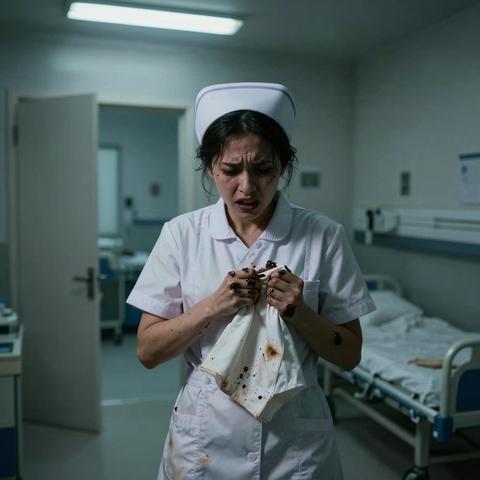
The fluorescent lights of the Sunrise Clinic hummed with a sickly, rhythmic buzz, a sound that usually lulled Elena into a false sense of security. Tonight, however, the noise felt like a serrated blade against her nerves. She stood over the industrial steel sink in the utility room, her knuckles white as she scrubbed at the cervical collar she had pulled from the room of Patient 402.
The mud was wrong. It wasn’t the dark, rich soil of the surrounding valley, nor was it the common track-dirt from the parking lot. It was a thick, viscous, obsidian-colored sludge that defied the scalding water and industrial detergent. As she scrubbed, her brush caught on something jagged. Elena pulled back, her heart hammering against her ribs like a trapped bird.
Embedded deep within the foam padding of the collar wasn’t just grit, but a shard of metallic, frost-cold alloy—a piece of something that looked like it had been sheared off a heavy machine.
Don’t look at it. Just get rid of it, her mind raced, but her curiosity was a parasite. She turned the collar over. The mud was warmer than it should have been. It pulsed.
A sudden, sharp metallic thud echoed from the hallway, followed by the sound of shuffling footsteps that didn’t sound quite human—heavy, rhythmic, and wet. Elena froze, her breath hitching in her throat. She looked toward the door, which stood slightly ajar, spilling a slice of sterile, flickering light into her cramped, darkened sanctuary.
“Is someone there?” she called out, her voice barely a whisper. She cursed herself for the tremor in her tone.
There was no reply, only the sound of a doorknob slowly being tested—not turned, but tested—by something that didn’t understand how locks worked. The mud in the sink began to smoke, releasing a faint, metallic scent of ozone and rot. Elena grabbed the collar, her hands trembling violently, and backed into the corner, praying the shadows were deep enough to hide her from whatever was waiting on the other side.
The clinic was supposed to be a place of healing, but tonight, the walls felt like they were shrinking, closing in to keep a secret that was never meant to be uncovered.
Chapter 2: The Echo in the Walls
The doorknob ceased its erratic testing. Silence, heavy and suffocating, descended upon the utility room. Elena leaned back against the cold tile wall, her chest heaving. The ozone smell intensified, stinging her nostrils, making her eyes water. She cast a desperate glance at the collar in the sink, then back to the door.
She reached for the heavy steel handle of the supply cupboard, intending to shove it against the door to bar it, but her hand stopped in mid-air. The sound returned. It wasn’t at the door anymore. It was coming from inside the wall behind the industrial laundry unit.
It was a wet, sliding sound, rhythmic and insistent, like something massive dragging its weight through the ventilation shafts.
They didn’t tell me about the architecture, she thought, her mind spiraling. This wing was supposed to be decommissioned.
She moved with agonizing slowness toward the laundry unit. The fluorescent light above flickered violently, then plunged the room into a deep, strobing darkness. In the brief flashes of light, she saw the mud on the floorboards—it was spreading. It wasn’t just a pile; it was a vein, creeping across the linoleum like black, liquid rot.
Elena snatched a heavy wrench from the maintenance kit on the counter. She felt foolish, a nurse armed with a rusted tool, but it was the only thing that felt solid in a room that was suddenly bending its own geometry.
She approached the vent cover near the floor. It was slightly buckled, as if someone—or something—had tried to pry it open from the other side.
“Who’s there?” she barked, the authority of her profession momentarily overriding her terror. “I’m calling security. I mean it.”
A voice replied. It didn’t come from the vent. It came from right behind her ear, cold and distorted, like a recording played at the wrong speed.
“The collar… it needs to be fed, Elena.”
She spun around, swinging the wrench in a blind arc, but hit nothing but empty, stale air. The room felt wider now, the walls stretching into an impossible, cavernous abyss. She was no longer in a utility room. She was standing in the center of a labyrinth, and the only light source left was the pulsating, obsidian-stained collar sitting abandoned in the sink.
She realized then that the patient in 402 hadn’t left; they had simply integrated into the infrastructure of the clinic itself.
Chapter 3: The Membrane
The floor beneath Elena’s feet ceased to be linoleum. It felt soft, yielding, and sickeningly warm, as if she were walking atop a giant, dormant muscle. She stumbled, the wrench clattering loudly—a sound that seemed to be swallowed by the walls before it could even echo.
The air was thick with the scent of ozone and something cloyingly sweet, like decaying lilies. She looked down. The obsidian sludge was no longer just a stain; it had climbed the legs of her scrubs, threads of black liquid stitching themselves into the fabric. She tried to wipe them away, but the substance didn’t smudge—it sank into her skin, leaving behind a faint, tingling numbness that crawled up toward her shoulder.
This isn’t a building, she realized with a jolt of pure, unadulterated horror. It’s a host.
She forced herself to move, her boots making a soft, squelching sound with every step. She needed to reach the emergency stairwell, the heavy steel fire door at the end of the hall. It was only twenty feet away, but the distance felt like a mile. The fluorescent lights were no longer flickering; they were throbbing in time with a slow, deep vibration that pulsed through the floorboards.
“Hey!”
The shout came from behind her. Elena spun around, her heart leaping into her throat. Dr. Aris, the night shift supervisor, was standing at the end of the corridor. His lab coat was pristine, his posture unnaturally rigid. But there was something wrong with the way he held his head—tilted at an angle that suggested a broken neck, though his face remained perfectly serene.
“Elena, you’re agitated,” he said. His voice was smooth, devoid of its usual clinical rasp. “You have the collar. You’ve seen the potential. Why are you resisting the integration?”
Elena gripped the wrench so hard her knuckles turned translucent. “Stay back, Aris. What did you do to this floor? What is that?” She gestured wildly at the black, webbed veins that were now crawling up the hallway walls.
Aris didn’t blink. His eyes, usually a dull brown, were now entirely solid, mirroring the obsidian hue of the sludge. He took a step forward, his feet making no sound on the floor.
“Integration is not an action, Elena. It is a return to form,” he whispered, his jaw unhinging slightly, revealing a dark, pulsing cavity where his throat should have been. “The clinic doesn’t just treat the sick. It harvests the echoes of their pain to grow. And you… you have so much potential to offer the foundation.”
Elena realized with a paralyzing chill that Dr. Aris hadn’t been standing in the hallway; he had emerged directly from the surface of the wall, and the wall was now closing behind him, leaving her with no path back to the world she knew.
Chapter 4: The Collective Pulse
Elena didn’t scream. The terror had peaked, plateaued, and then solidified into a cold, clinical clarity. She watched as Dr. Aris—or the thing wearing his likeness—rippled against the wall like a reflection in disturbed water.
The floor beneath her boots pulsed with a rhythmic, wet thwump. It was the clinic’s heartbeat.
“You think this is a prison,” Aris murmured, his voice now a chorus of overlapping tones, like a radio scanning through stations. “It is a sanctuary for the unfinished. Look at the collar, Elena. See how it recognizes you?”
Elena glanced down. The obsidian sludge had traveled up her arm, blooming across her collarbone like a dark, intricate tattoo. It wasn’t painful. It was… anchoring. The numbness in her arm gave way to a strange, heightened sensitivity. She could feel the building. She could feel the pipes shivering with the pressure of the subterranean liquid; she could feel the faint, desperate vibrations of the other patients in the wing, their consciousnesses woven into the very masonry.
She tightened her grip on the wrench, not to strike, but for stability.
“I am not unfinished,” she said, her voice steady, surprisingly devoid of fear. “I am the one who keeps the charts. I am the one who knows the dosage.”
Aris tilted his head, his neck snapping with a sound like dry branches breaking. He smiled, a gesture that didn’t reach those solid, ink-black eyes. “Then be the one who administers the final dose.”
He held out a hand. In his palm rested a second shard, identical to the one she had found in the collar. It shimmered with a sickly, internal bioluminescence.
Elena looked at the shard, then at the pulsating walls that were now beginning to lean inward, eager and expectant. She realized that the “emergency exit” wasn’t a door at all—it was the point where the clinic finished its digestion of the occupant. If she ran, she would just be running deeper into the throat of the beast. If she stayed, she would become part of the infrastructure, a sentient cog in a machine built of pain and mud.
She reached out. Her fingers brushed the cold, vibrating metal of the shard.
As their skin touched, the clinic let out a long, low groan that vibrated through her very marrow. The ceiling above them peeled back, not to reveal the sky, but to reveal a vast, interconnected network of tunnels stretching out into the dark, infinite expanse of the earth.
“Now,” Aris whispered, his voice resonating from the walls themselves. “Tell us, Elena. What do we do with the next one?”
Elena looked into the dark abyss above, then back at the clinic, her face an unreadable mask of cold, borrowed authority. She gripped the wrench and the shard, feeling the dual weight of her humanity and the encroaching void.
“We start with the intake,” she replied, her voice no longer her own.
The lights in the hallway flared to a blinding, piercing white, then vanished, leaving the Sunrise Clinic perfectly, terrifyingly silent.
Thank You for Following the Story of “The Muddy Collar”
I hope you enjoyed this descent into the shifting, sentient corridors of the Sunrise Clinic. Thank you for your curiosity, your participation in the narrative, and for stepping into this world of dark architecture and unsettling transformations. Keep watching the walls—they might just be listening.