“Our Squad Was Ambushed In The Mountains With No Way Out… Then I Looked At What The Quiet Nurse Was Holding.” – storyteller
Chapter 1: The Descent into Silence
The wind didn’t just howl in the Qashqai Mountains; it shrieked like a dying animal, tearing at our thermal layers and turning our breath into jagged shards of ice. We had been pinned down in this godforsaken natural amphitheater for six hours. The enemy, whoever they were—they never showed their faces, just the persistent, rhythmic thwip-thwip of sniper fire—had us boxed in.
“Check your sectors!” Sergeant Miller roared, his voice cracking against the gale. He was hunkered behind a shelf of slate, blood from a scalp wound matting his hair to his forehead. “If they rush, we make it expensive for them!”
I looked across the narrow trench we’d clawed into the frost. Elena, our field nurse, was sitting in the corner, her back to the rock face. She was the quiet one, the type of person you could work with for months and still feel like you didn’t know. She hadn’t fired a shot. She hadn’t even checked her sidearm.
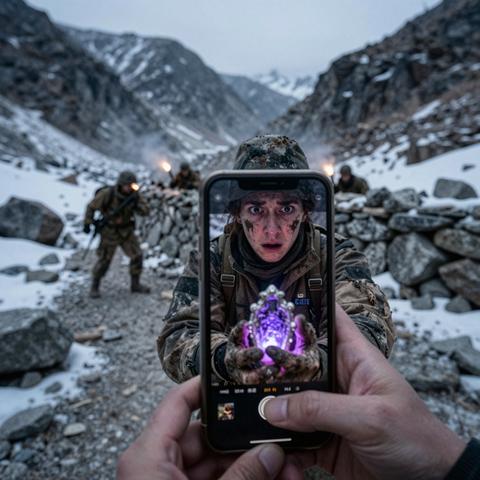
She was hunched over something tucked deep inside her tactical vest, her hands moving with a delicate, rhythmic precision that looked like prayer. The ambient noise of the battle—the incoming rounds pinging off the stone, the desperate shouting of the boys—seemed to bleed into a dull, muffled roar, as if the world was retreating from her.
I crawled over, my muscles screaming in the sub-zero air. “Elena, what the hell are you doing? We need suppressive fire, not whatever that is.”
She didn’t look up. Her fingers were trembling, not from the cold, but with a frantic, pulsing energy that seemed to bleed out from her skin. “It doesn’t want us to fight,” she whispered. Her voice was thin, barely audible over the wind, yet it cut through the chaos with terrifying clarity. “It wants us to listen.”
A mortar shell slammed into the ridge above us, showering our position in pulverized rock and blinding snow. The impact knocked the wind out of me, leaving me gasping in the dust. When the ringing in my ears finally subsided, the gunfire had ceased.
The silence that followed was heavy, artificial, and suffocating. It was as if someone had reached out and muted the entire world.
“Miller?” I wheezed, pushing the debris off my chest.
No answer. I turned my head, expecting to see my squadmates returning fire, but they were all frozen. Miller was staring directly at Elena, his rifle lowered, his jaw slack. Every single one of them was paralyzed, their eyes wide, locked onto the object Elena had finally pulled from her vest.
It was a jagged, obsidian shard, perfectly geometric yet impossibly dark, pulling the dying twilight into its center. It hummed—a low, visceral frequency that I felt in my marrow, not my ears. A faint, violet luminescence began to bleed from its edges, casting long, dancing shadows against the snow that didn’t match the light of the setting sun.
“Elena,” I breathed, my hand creeping toward my holster despite myself. “What is that thing?”
She looked up at me then. Her eyes were different. The pupils were dilated, reflecting that same sickly violet glow, and for the first time, I realized that the fear wasn’t for the enemy surrounding us. It was for what the artifact had just invited into our world.
Chapter 2: The Geometry of Dread
The sound wasn’t gone; it had simply shifted its frequency. The wind, the gunfire, the distant rumble of the front—it had all been compressed into a low-frequency, pulsating hum that vibrated inside my teeth.
Elena stood up, but she didn’t look like a nurse anymore. She looked like a conduit.
She held the obsidian shard flat in her palms. It wasn’t just glowing now; it was breathing. The violet light expanded and contracted in sync with her own pulse. When the light hit the surrounding snow, the crystals didn’t melt; they fractured into impossible, non-Euclidean patterns that made my eyes ache if I stared at them too long.
“Elena, put that down!” Miller shouted.
He had his sidearm drawn, but his hand was shaking violently. He wasn’t aiming at the enemy ridge anymore. He was aiming at the light.
“You don’t understand, Sergeant,” she whispered, her voice echoing as if she were speaking from the bottom of a deep well. “They aren’t here to kill us. They are here to collect what was left behind.”
From the dense fog that clung to the mountain pass, the figures finally emerged. They weren’t men. They were tall, spindly silhouettes wrapped in shifting, slate-colored cloaks that seemed to be made of the same material as the mountain itself.
They moved with a sickening fluidity, their limbs elongating and retracting in ways that defied human anatomy. They didn’t walk; they drifted, their feet hovering inches above the frozen shale.
One of them, the lead creature, stopped about thirty paces from us. It had no face, only a smooth, featureless surface where the features should be, reflecting the violet pulse of the artifact.
“What the hell is that?” Private Jensen sobbed, curling into a ball behind his pack. “What is that thing?”
The creature raised a long, spindly arm. The space around it began to ripple like water disturbed by a stone.
Suddenly, the air pressure spiked. My ears popped painfully, and a sharp, metallic tang filled my throat. The creature wasn’t attacking us; it was scanning the environment. It was searching for something.
“They’re looking for the resonance,” Elena said, her voice devoid of panic. She stepped forward, leaving the protection of our meager shelter. “They’re looking for the anchor.”
She held the shard higher. The violet light intensified, turning the twilight into a blinding, ultraviolet strobe.
The creature stopped. Its featureless face turned toward her, and for a split second, I felt an intrusion in my own mind—a cold, clinical sensation of being cataloged, measured, and ultimately deemed irrelevant.
Then, the creature reached out. It didn’t reach for a weapon, but toward the very air around Elena, pulling at the fabric of reality until a jagged, glowing fissure began to tear open in the center of the mountain pass.
“It’s not an invitation,” I realized, the horror finally settling into my gut like lead. “It’s a doorway.”
Chapter 3: The Weight of the Void
The fissure wasn’t just a tear in the sky; it was a wound in reality itself. Edges of jagged, impossible color—hues that don’t exist in the natural spectrum—spilled out, cauterizing the freezing air. The temperature plummeted further, past the point of frostbite, into a realm where the very atoms of the mountain seemed to lose their cohesion.
Miller scrambled backward, his boots sliding uselessly on the slick ice. He had dropped his weapon, his hands clawing at his tactical vest as if trying to rip off his own armor, but his eyes remained glued to the opening portal.
“Close it, Elena!” he screamed, his voice raw, stripped of all authority. “Close that damn thing before it pulls us all in!”
Elena didn’t move. She was anchored to the spot, her body trembling with a violent, rhythmic intensity. The obsidian shard in her hand had grown, stretching like molten glass, now glowing with a blinding violet intensity that made the surrounding snow appear grey and dead by comparison.
The creatures, those spindly, featureless horrors, began to shed their cloaks. Underneath, they were nothing but lattices of dark, refractive energy, shifting and reconfiguring themselves to match the geometry of the portal. They weren’t just stepping through; they were merging.
One of them moved toward me. It didn’t walk; it simply ceased to exist in one point of space and reappeared a foot closer, its form flickering like a corrupted video file. I felt the pressure against my skull, a crushing weight that forced me to my knees. It felt like my memories were being indexed, cataloged, and discarded.
“This is not an invasion,” Elena’s voice resonated, not in my ears, but directly inside my consciousness. “It is a harvest.”
“What do you mean, a harvest?” I managed to choke out, my lungs burning. The air was becoming too thin to breathe, saturated with that strange, metallic scent of ozone and something ancient, something that smelled like dust from a dead star.
Elena finally looked at me. Her eyes were no longer human. The pupils had vanished, replaced by rotating, complex fractals of violet light.
“They don’t want the land,” she said, her voice dripping with a terrifying, hollow detachment. “They want the bio-signatures. They want the imprint of everything that has suffered here.”
She turned back to the portal. The lead creature extended a limb that ended in a razor-sharp, translucent filament, hovering it inches from the swirling rift.
“We are the fuel, sergeant,” she whispered. “The war, the blood, the fear—it was all just a catalyst to prime the lock. And they’ve been waiting for someone to open it.”
As if on cue, the entire mountain pass groaned, a deep, tectonic rumble that shook the bedrock beneath us. The sky above the ridge turned an bruised, sickly purple, and I realized with a jolt of paralyzing dread that the exit we had been banking on was gone. The world around us was folding, retracting into the darkness that poured from the rift, leaving us stranded in a pocket of space that no longer followed the rules of Earth.
Chapter 4: The Price of Survival
The ground beneath us shifted again, a nauseating tilt that sent my stomach into my throat. The physical laws of the mountain were unraveling; the jagged rocks turned translucent, revealing a roiling, violet abyss beneath our feet. I looked at Miller, but he was gone—or rather, he was elsewhere. He sat in the same spot, but his body was flickering, overlapping with an image of himself from seconds ago, then minutes, then hours. He was being stretched across time.
“Elena, stop it!” I roared, the sound swallowed instantly by the hungry vacuum of the rift. “Look at what you’re doing to them!”
Elena turned to me, and for a fleeting second, the violet fractals in her eyes cleared. I saw the girl who had shared ration packs with us, the woman who had patched my shrapnel wounds with steady, practiced hands. She was weeping, real tears that froze into tiny, jagged diamonds as they hit the air.
“I didn’t open this,” she sobbed, her voice cracking under the pressure of a thousand discordant whispers. “I was just the battery, sergeant. They’ve been waiting for a mind to bridge the gap, and I was… I was the only one who didn’t fight back.”
The lead creature drifted closer, its elongated limbs beginning to blur, merging into the swirling light of the portal. It wasn’t interested in me. It reached past me, its long, ethereal fingers grazing Elena’s shoulder. The contact sent a shockwave of raw, unfiltered agony through the clearing.
I realized then that the “harvest” wasn’t just about us. It was about everything. The war, the history of this mountain, the very concept of conflict was the currency they traded in. They were feeding on the entropy we had created.
I lunged for her, not to stop her, but to pull her away. My hand closed around her tactical vest, and the moment I touched the obsidian shard, the world turned inside out.
I saw it all—not in images, but in raw, sensory data. I saw the creatures building civilizations in the spaces between seconds. I saw them watching us like children playing with matches, waiting for the precise moment of maximum volatility to strike.
The shard wasn’t a weapon. It was a mirror.
“If we give it back,” I screamed into the void, “the feed stops!”
Elena looked at me, her face pale, her spirit clearly fracturing under the weight of the collective consciousness invading her mind. “They don’t take returns, sergeant. You have to break the connection.”
I didn’t think. I couldn’t afford to. I grabbed the shard with both hands, the freezing obsidian burning into my palms, and slammed it against the sharpest edge of the nearest rock shelf.
The sound was not a crack, but a shriek—a deafening, reality-tearing wail that shattered every bit of ice within a mile. The violet light imploded, pulling the creatures, the rift, and the very air out of the pass in a violent, singular vacuum.
I was thrown backward, my head slamming into the frozen earth. Darkness rushed in, heavy and merciful. When I finally opened my eyes, the mountains were silent. The snow was falling again, soft and white. There was no rift. There was no Elena. There was only the sound of my own ragged, lonely breathing in the deep, cold dark.
Thank you for following this journey through the Qashqai pass. The mystery of the quiet nurse remains, but the connection has been severed—or has it?