4 Hours After Getting Out Of Prison, – storyteller
Chapter 1: The Weight of Concrete
The iron gate groaned—a sound that lived in his marrow now—before slamming shut with a finality that rattled his teeth. Four years. Forty-eight months of gray walls, scheduled misery, and the slow erosion of a man’s identity.
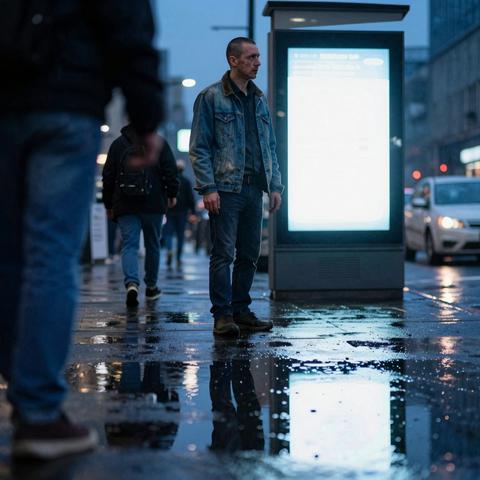
Elias stepped off the bus and onto the pavement. The city didn’t care that he was back. It didn’t pause. It didn’t exhale. It just kept moving in a blur of neon and exhaust.
He stood frozen, his feet rooted to the spot, holding a thin, plastic grocery bag. It contained his entire life: a change of clothes, a few letters he couldn’t bring himself to read, and the address.
Forty-eight months of planning for this exact moment, and I feel like a ghost haunting a city that’s forgotten how to see me.
The air smelled different here—oily, metallic, and sharp. Commuters swarmed around him like schools of panicked fish. They didn’t look at his face. They didn’t see the hollows beneath his eyes or the way his shoulders stayed hunched, perpetually braced for a blow that wasn’t coming.
He shifted his weight, his hand dipping into his jacket pocket. His fingers brushed against the crumpled, water-stained piece of paper. He didn’t need to look at it to know what was written there. The ink was burned into his mind.
A police cruiser crawled by, the searchlight sweeping across the storefronts. The beam caught Elias’s face for a fraction of a second. His heart hammered against his ribs like a bird in a cage. He instinctively ducked his chin into his collar, turning away until the red and blue lights faded into the chaotic river of traffic.
The city had changed. The shop where he’d bought coffee with her on their last Sunday was gone, replaced by a sleek, soulless tech storefront. The silence he had craved in the yard was now his enemy. It was too loud, too bright, too demanding.
He pulled the paper out. The address was barely legible, smudged by sweat and humidity. He took a step forward, then another, weaving through the crowd. His pace quickened. He wasn’t walking anymore; he was hunting.
He reached the payphone booth on the corner of 5th and Main. It was a relic, flickering under a dying streetlamp. He stared at the receiver, his breath hitching in the cold, damp air.
I told you I was coming back for you.
He lifted the receiver, his hand trembling as he started to punch in the number he’d memorized during those long, sleepless nights in solitary.
But before the first digit hit, a sleek black sedan pulled up silently to the curb. It didn’t belong to the neighborhood. The tires didn’t even crunch on the grit of the gutter.
Elias froze. The rear window began to slide down with a sound like a slow, metallic breath. He knew that car. He knew the silhouette sitting in the darkness of the backseat.
The air left his lungs in a ragged gasp. He wasn’t just a free man anymore; he was a target.
Chapter 2: The Glass Barrier
The window slid down with a hiss of hydraulic precision.
Elias stood paralyzed, his knuckles white around the handset of the payphone. The air inside the booth felt suddenly thin, sucked away by the cold wind blowing off the car’s interior.
Inside the shadows of the sedan, a silver lighter flicked open. A sharp, orange flame illuminated a pair of tailored leather gloves and a face Elias hadn’t seen in four years—Victor.
Victor didn’t look like a man who spent his time waiting in parked cars. He looked like an architect of misery, relaxed and composed, the cherry of his cigarette glowing like a baleful eye in the dark.
“You look tired, Elias,” Victor said. His voice was smooth, carrying the low-frequency rumble of a predator that didn’t need to shout to establish dominance. “Four years in a cage, and you still haven’t learned that some doors are meant to stay locked.”
Elias couldn’t breathe. His heart was a frantic drum in his ears. He wanted to run, to drop the phone and lose himself in the crushing weight of the city, but his feet were lead.
“I’m not looking for trouble, Victor,” Elias managed, his voice sounding thin and scraped against his throat. “I’m just going home.”
Victor laughed, a dry, humorless sound that blended into the distant screech of a subway train. He leaned forward, the interior light of the car catching the hard, unyielding line of his jaw.
“Home? Is that what you call it?”
Victor gestured to the street, to the anonymous faces rushing past, to the towering glass monoliths that scraped the sky.
“You think this city belongs to you? You’ve been scrubbed from the ledgers, Elias. You don’t exist here anymore. The moment you walked out of those gates, you became a variable. And I don’t like variables.”
A drop of rain hit the glass of the booth, distorting the world outside. The streetlamp overhead flickered once, twice, and then plunged them into a deep, bruising violet shadow.
Elias saw a man in a trench coat emerge from the corner of his eye—a shadow stepping out of another shadow. He felt the cold prickle of awareness on the back of his neck. He was being boxed in.
“Get in the car,” Victor commanded. It wasn’t a request.
Elias looked at the receiver in his hand. He still hadn’t dialed the number. The address on the crumpled paper in his pocket felt like it was radiating heat, a secret that could get him killed.
He had to decide in a heartbeat.
If he ran, he might make it into the subway tunnels, but he’d be hunted from the start. If he got in the car, he was signing his own death warrant, but he might get one more chance to deliver the message he had carried across four years of hell.
He looked at the sedan, then at the dark, unforgiving sprawl of the city.
“I’m not going anywhere with you,” Elias spat, his voice hardening into a jagged edge of resolve.
He slammed the phone receiver back into the cradle, shattering the plastic housing, and turned to bolt into the chaotic, surging tide of the crowd.
Chapter 3: The Geometry of Shadows
Elias moved, but he didn’t run like a frightened man; he ran like a wolf that knew the terrain.
He didn’t head for the open sidewalk where the streetlights formed pools of visibility. Instead, he dove into the narrow, trash-choked alley between a bakery and an abandoned dry cleaner. The air here was thick with the smell of damp cardboard and rotting produce. His boots crunched on broken glass, a sound that seemed deafening in the sudden stillness of the passage.
Behind him, he heard the heavy, rhythmic thud of leather-soled shoes hitting the pavement—not a frantic run, but a steady, professional pursuit. They weren’t rushing because they knew where he was headed.
They’re herding me, he realized, his chest heaving. They want me to lead them to her.
He reached the end of the alley, a dead end blocked by a ten-foot chain-link fence topped with rusted barbed wire. He scrambled up, his hands tearing against the cold metal. He vaulted over the top, his coat snagging on a barb, tearing a jagged hole in the fabric as he dropped to the asphalt on the other side.
He landed hard, rolling to absorb the impact, and scrambled to his feet. He was in the labyrinth of the shipping district now. Towering stacks of shipping containers created a shifting, claustrophobic maze of steel and rust.
The silence was worse than the noise of the main street. Here, every drip of water, every distant groan of wind against metal, sounded like an approaching footstep.
Elias ducked behind a stack of weathered, blue containers, his breath hitching as he tried to remain deathly quiet. He pulled the crumpled paper from his pocket one last time. He checked the coordinates again. He wasn’t far. Just two more blocks, behind the old customs warehouse.
A beam of light sliced through the darkness—a tactical flashlight. It danced over the corrugated steel walls, coming closer, then stopping.
“You’re making this harder than it needs to be, Elias,” a voice called out. It wasn’t Victor. It was deeper, more clinical. “The girl isn’t where you think she is. She’s already been moved.”
Elias gripped a loose steel pipe leaning against the container. His knuckles were raw, blood mingling with the grime on his skin.
“Liar,” he whispered into the dark.
“Is she?” the voice echoed, bouncing off the steel walls to make it sound as if the speaker were everywhere. “Check your pocket, Elias. The note. Did you think we wouldn’t find that, too?”
Elias froze. He looked down at the paper. For the first time, he noticed a faint, chemical shimmer on the ink. A tracker.
He hadn’t been hunting them; they had been using him as a homing beacon to find exactly where he was hiding the last piece of the puzzle.
A cold, hollow sensation opened up in his gut. He hadn’t just put himself in danger; he had led the wolves right to the doorstep of the only person who still mattered. He turned, abandoning the path to the warehouse, and started sprinting in the opposite direction, praying he could draw them away before it was too late.
Chapter 4: The Exchange
The rain began to fall in earnest, turning the grimy asphalt of the shipping district into a slick, obsidian mirror. Elias didn’t look back. He shoved the paper into his mouth, chewing until the fiber turned to a bitter, unrecognizable pulp, and swallowed it. He wasn’t a tracker anymore. He was just a man in the dark.
He scrambled over a stack of rusted pallets, his lungs burning with the sharp, cold air. His vision blurred at the edges—a side effect of the adrenaline and the sudden physical exertion he hadn’t prepared for in four long years.
He reached the back of the customs warehouse, a structure that looked like a jagged tooth against the city skyline. There was a rusted service door, slightly ajar, swaying in the wind with a rhythmic, metallic screech. He didn’t hesitate. He slipped inside.
Inside, the warehouse was a cavern of shadows and towering crates. The only light came from a single, high-mounted halogen lamp buzzing with an irritating, frantic energy.
Standing in the center of the concrete floor, surrounded by silhouettes, was a small, fragile figure.
“Elias?”
The voice was shaky, quiet, but it cut through the hum of the city outside like a blade. It was Sarah. She was standing perfectly still, her hands bound with plastic ties, her eyes wide and reflecting the harsh, clinical light.
The shadows around her shifted. Victor stepped out, his tailored coat now damp from the rain, his expression one of bored amusement. He didn’t have a gun drawn; he didn’t need to. He held a small, black drive—the only reason Elias had been released, the only reason he was still breathing.
“You’re predictable, Elias,” Victor said, his voice echoing in the vast, empty space. “That’s why you’re useful. You think with your heart. It makes you weak.”
Elias stepped into the light, his hands raised, his palms open. He didn’t look at Victor. He looked at Sarah.
“Let her go, Victor,” Elias said, his voice steady now, devoid of the frantic energy from earlier. “You have the location. You know where the records are stored. You don’t need her.”
Victor smiled, a slow, thin movement of his lips. “I don’t need her. But I do need to ensure you never walk into my life again. That’s the problem with men like you—you’re like a persistent infection.”
Victor signaled to the shadows. Two men emerged, their movements fluid and practiced. Elias braced himself, his muscles coiling. He knew he wouldn’t walk out of here, but he knew he would make sure Sarah did.
“Run, Sarah,” Elias whispered, his voice barely audible over the hum of the lights.
“Elias, no—”
“Run!”
He lunged forward, not toward Victor, but toward the crates. He slammed his shoulder into a stack of heavy barrels, sending them toppling into the path of the approaching men. The metallic crash echoed like a thunderclap.
In the chaos, Elias saw Sarah bolt toward the side exit. Victor didn’t even flinch. He just watched, his eyes cold and calculating, as he reached into his jacket.
The final price of his freedom had been paid in blood and shadows. As the first shot rang out, Elias didn’t feel fear. He felt the absolute, hollow weight of a mission completed.
The warehouse doors slammed shut, sealing the echoes inside.
Outside, the city continued its relentless, indifferent pulse. A siren wailed in the distance, growing louder, but the streets were empty. The rain washed away the grime of the day, leaving nothing but the cold, wet pavement and the flickering, lonely lights of a city that never remembers the ghosts it creates.
Thank you for following Elias’s journey. The story of his four-year path to redemption—and the heavy price he paid to finish it—is now complete. I hope you enjoyed this intense, noir-inspired narrative.