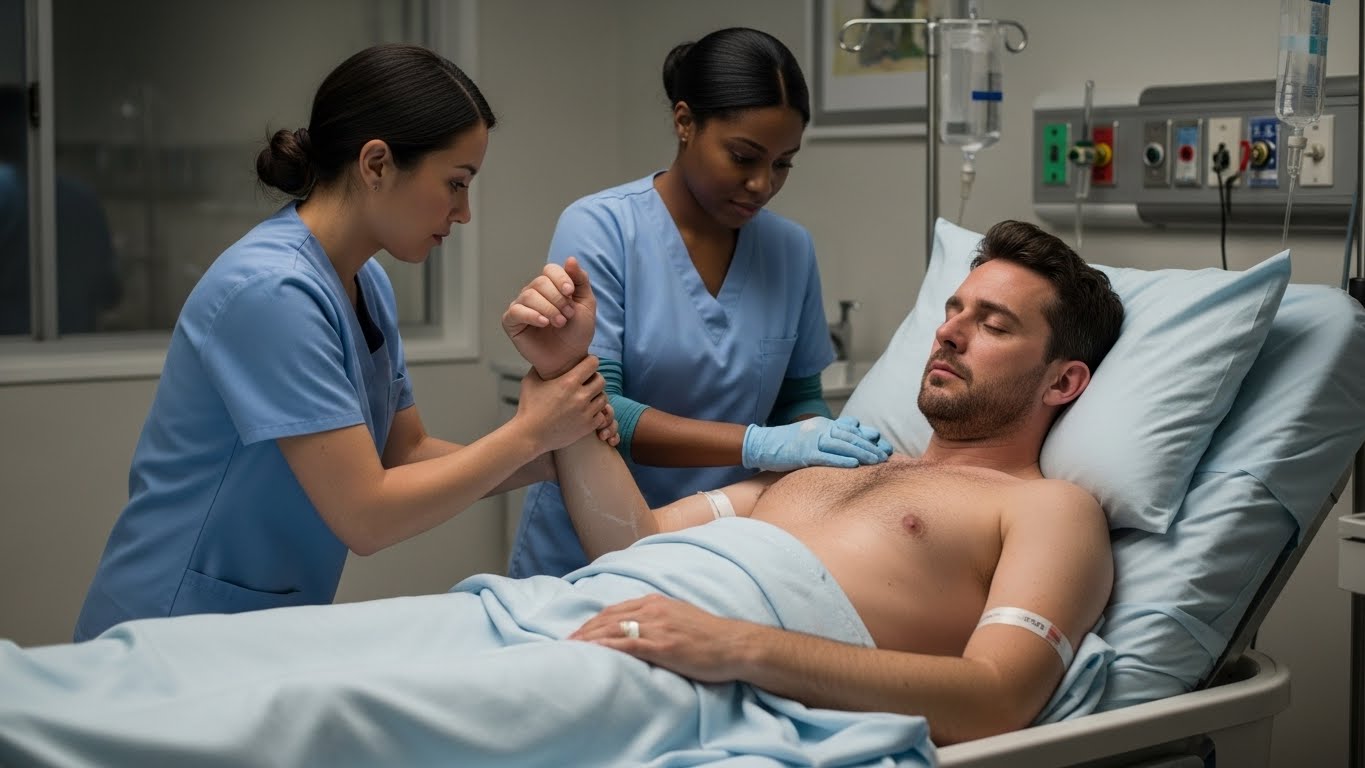
They told me he was just a vegetable, a billionaire playboy who crashed his Ferrari and lost his mind. Everyone at the hospital ignored him, treating him like a piece of furniture. But when I was assigned to bathe him, I saw tears in his eyes. I talked to him when no one else would. Then, one night, while I was washing his chest, his hand shot up and grabbed my wrist. His first words weren’t a thank you—they were a warning that changed my life forever and exposed a deadly secret his own family tried to bury.
CHAPTER 1: THE GHOST IN SUITE 404
The air in Dr. Harris’s office was always three degrees colder than the rest of the hospital, a fact I attributed less to the HVAC system and more to the man himself.
I stood awkwardly in the doorway, shifting my weight from one sneaker to the other. I was twenty-six, a nurse at Westbridge Private Hospital in Seattle for two years, and getting summoned to the Head of Neurology’s office usually meant one of two things: you were getting fired, or someone had died on your watch.
“Sit, Anna,” Dr. Harris said, not looking up from the mountain of paperwork on his mahogany desk.
I sat. The leather chair creaked, sounding like a gunshot in the quiet room. Outside the floor-to-ceiling windows, the grey Seattle drizzle blurred the city skyline, turning the Space Needle into a ghostly smear.
“I’m moving you,” he said abruptly, finally locking his steel-grey eyes on mine. “Top floor. The Penthouse Suite.”
My stomach did a nervous flip. The Penthouse wasn’t just a room; it was a fortress. It was where the VIPs went to heal—or to die—in privacy.
“Is there a specific patient, sir?”
Harris sighed, rubbing his temples. He looked exhausted. “Grant Carter.”
The name hit me like a physical shove. Everyone in the Pacific Northwest knew Grant Carter. He was the ‘Boy Wonder’ of tech, the thirty-two-year-old CEO of Carter Enterprises who had revolutionized AI technology. He was handsome, ruthless, and, for the last twelve months, the world’s most famous vegetable.
“The billionaire?” I asked, my voice barely a whisper. “I thought he was… stable.”
“He is stable,” Harris said, his voice dropping. “That’s the problem. He’s stable, he’s persistent, and he’s completely unresponsive. His family pays a fortune for that suite, but the staff… they’ve given up, Anna. They treat him like a piece of furniture. They go in, check the numbers, change the IV, and leave.”
He leaned forward; his expression intense.
“I need someone who won’t just keep him alive. I need someone who will care for him. It’s a full-care assignment. Hygiene, physical therapy range-of-motion exercises, bathing. It’s intimate, it’s exhausting, and it’s not for the weak-hearted. Can you handle it?”
I thought about the rumors. They said Grant Carter was arrogant. They said he drove his Aston Martin off the Aurora Bridge because he was drunk on his own power. But looking at Dr. Harris, I didn’t see a tabloid story. I saw a doctor who was desperate for a nurse with a heart.
“I’ll do it,” I said.
The suite smelled of expensive lilies and sterile sadness.
It was larger than my entire apartment. Dark wood paneling, velvet curtains drawn against the afternoon light, and in the center of the room, a state-of-the-art medical bed that looked like a spaceship.
And there he was.
Grant Carter.
I walked over slowly, the soft squeak of my shoes the only sound against the rhythmic whoosh-hiss of the ventilator.
He was thinner than his magazine covers, his cheekbones sharp enough to cut, his skin a pale, translucent alabaster. But even in this state, ravaged by a year of stillness, he was devastatingly striking. His dark hair had grown out slightly, curling over the white pillowcase.
I set my basin of warm water on the bedside table.
“Hi, Grant,” I said softly. It felt ridiculous talking to a man who, by all medical accounts, wasn’t there. But my grandmother always told me that the soul listens even when the brain sleeps.
“I’m Anna. I’m going to be looking after you now.”
Silence. Just the beep of the cardiac monitor. Beep… beep… beep.
I pulled the sheet down to his waist, preserving his dignity with a towel, and dipped the sponge into the warm, soapy water.
“I heard the other nurses weren’t very chatty,” I continued, wringing out the sponge. “Sorry about that. You’re stuck with me now, and I never shut up.”
I began to wash his arm. His muscles were atrophied, soft under my touch, but the bone structure beneath was solid. As I moved the warm sponge over his shoulder, I felt a strange sensation. A heaviness in the air.
It was the feeling you get when you’re walking down a dark street and you know, you just know, someone is watching you.
I froze. I looked at his face.
His eyes were closed. His chest rose and fell in the mechanical rhythm of the machine. He hadn’t moved a muscle.
“Stop it, Anna,” I whispered to myself. “Don’t get spooked.”
I continued the bath, moving to his chest. There were faint scars there—remnants of the surgeries that had put him back together after the crash. I traced one gently with the cloth.
“You really did a number on yourself, didn’t you?” I murmured.
As I washed his left hand, lifting his fingers to clean between them, I paused. His hand was large, his fingers calloused—surprising for a tech CEO. Maybe he played guitar? Or rock climbed?
“I promise I’ll take good care of you,” I said, patting his hand dry and placing it gently back on the sheet.
I turned to grab the lotion, my back to him for a split second.
Rustle.
The sound was tiny. The friction of fabric against fabric.
I whipped around.
Grant lay exactly as he had a second ago. But the sheet… the sheet I had just smoothed over his legs was slightly bunched near his left thigh.
My heart hammered against my ribs. Had I done that? I must have.
I stared at him for a long minute, waiting for a twitch, a breath, anything. Nothing.
“Okay,” I exhaled, my breath shaky. “Just gravity. Just the sheets settling.”
But as I left the room that evening, turning off the main lights and leaving him in the soft glow of the monitors, I couldn’t shake the feeling that the ghost in Suite 404 wasn’t a ghost at all.
CHAPTER 2: THE SOUND OF SILENCE
Two weeks passed. The rain in Seattle didn’t stop, and neither did my routine with Grant.
My shift started at 7:00 PM and ended at 7:00 AM. The night shift. It was the quietest time in the hospital, a time when the world narrowed down to the circle of light around the nurse’s station and the rhythmic sounds of the machines in the rooms.
I had fallen into a rhythm with him.
“Good evening, Mr. Carter,” I’d say, bursting in with my coffee. “You’ll be happy to know that the cafeteria is serving something they call ‘meatloaf’ but looks suspiciously like a hockey puck. You’re lucky you’re on the feeding tube.”
I knew I was using humor as a shield. It was heartbreaking work. Every night, I bathed him, turned him to prevent bedsores, and performed passive range-of-motion exercises on his limbs to keep his joints from freezing up.
And every night, I talked.
I told him about my cat, Barnaby, who was on a diet he resented. I told him about my ex-boyfriend, Mark, who had broken up with me via text message. I read him the news—mostly the financial section, figuring he’d want to know his stock prices were holding steady despite his absence.
“Your brother, Nathan, gave a press conference today,” I told him one Tuesday, wiping down his face with a warm cloth. “He says he’s ‘honoring your legacy’ by launching that new drone project you shelved. He looks… stressed.”
I was cleaning the curve of his jawline when it happened again.
I was looking directly at his face.
His eyelid fluttered.
Not a full blink. Just a tiny, rapid vibration of the lashes.
I froze, my hand hovering over his cheek. “Grant?”
I waited. Ten seconds. Twenty.
Nothing.
“Did you hear me?” I whispered, leaning close. “Grant, if you can hear me, do that again.”
Silence.
I felt foolish. It was probably a REM spasm. Even coma patients had involuntary twitches.
The next morning, I caught Dr. Harris in the hallway.
“I think he’s responding,” I said, breathless.
Harris paused, looking over his clipboard. “Responding how? Verbalization?”
“No. Micro-movements. His eyes fluttered when I mentioned his brother. And last week, I swear his hand moved.”
Harris gave me a sympathetic, patronizing smile. “Anna, it’s common for caregivers to project agency onto patients. It’s called ‘wishful thinking bias.’ Reflexive muscle spasms are normal. It doesn’t mean cortical involvement.”
“It felt different,” I insisted. “It felt… deliberate.”
“Keep monitoring him,” Harris said dismissively, walking away. “But don’t get your hopes up. The damage to his frontal lobe was catastrophic.”
I stood there, fuming. I knew what I saw.
That night, I was angry. Not at Grant, but for him.
“He thinks you’re gone,” I told Grant as I started his evening bath. The water was steaming, smelling of lavender soap. “He thinks you’re just a broken machine.”
I took his hand—his left hand—and submerged it in the warm basin to wash it.
“But I don’t think you are,” I said, my voice thick with emotion. “I think you’re trapped in there. And it must be hell. Screaming and no one can hear you.”
I gently massaged his palm with my thumb.
“I’m listening, Grant. I’m right here.”
And then, I felt it.
Unmistakable.
His index finger pressed against my palm.
It wasn’t a twitch. It was a push. Weak, trembling, but purposeful.
I gasped, dropping the washcloth into the water. “Grant?”
I stared at his hand.
Slowly, agonizingly slowly, his ring finger curled inward. Then his middle finger.
He was trying to make a fist. He was trying to hold on to me.
Tears pricked my eyes. “Oh my god. You are in there.”
I looked up at his face. His expression was still blank, but the energy in the room had shifted violently. It wasn’t a hospital room anymore; it was a battleground, and Grant Carter had just fired the first shot in his war to return.
CHAPTER 3: THE GRIP OF DEATH
The breakthrough didn’t happen quietly. It happened with the force of a thunderclap.
It was three nights after the finger movement. The storm outside was battering the hospital windows, wind howling like a wounded animal. The lights in the suite flickered occasionally, adding to the tension.
Grant had been restless all day. His heart rate was slightly elevated—90 beats per minute instead of his usual steady 72. The night nurse shift report said he’d been “agitated,” though how a comatose man could be agitated was a mystery to them.
I knew why. He was fighting.
“Okay, big guy,” I said, rolling up the sleeves of my scrubs. “Let’s get you cleaned up. Maybe the warm water will help you relax.”
I prepared the bath. I was tired; my double shift was taking its toll. I moved with practiced efficiency, but my mind was elsewhere.
I pulled back the sheet to wash his chest. His skin was clammy tonight, a sheen of sweat on his forehead.
“You’re fighting something off, aren’t you?” I murmured, wringing out the cloth. “Just breathe, Grant. Just breathe.”
I placed the warm cloth on his sternum, wiping down toward his abdomen.
“I was thinking about reading you The Great Gatsby tonight,” I chattered, trying to fill the silence. “I know it’s cliché, but—”
Suddenly, a guttural sound tore through the room.
“Hhhhuuuhhh…”
It was a wet, ragged gasp. Like a drowning man breaking the surface.
I jumped back, dropping the cloth. “Grant?”
His chest heaved. The heart monitor went crazy, the steady beep turning into a frantic beep-beep-beep-beep.
Before I could reach for the call button, his hand—the right one this time—shot up.
It was a blur of motion.
His fingers locked around my wrist.
The grip wasn’t weak. It was iron. It was desperate. It was painful.
“Grant!” I yelped, trying to pull back, but he wouldn’t let go.
And then, his eyes snapped open.
They weren’t the glassy, unfocused eyes of a vegetable. They were a piercing, electric blue. They were terrified. They were wild.
He stared right at me. Not through me. At me.
His mouth opened, his jaw working painfully against the dryness of his throat. He was trying to speak, but only air and choked sounds came out.
“Grant, it’s okay! You’re safe!” I cried, using my free hand to slam the red EMERGENCY button on the wall. “I’m Anna! I’m your nurse!”
He shook his head violently, his eyes darting to the door, then back to me. He pulled me closer, his nails digging into my skin.
He forced a breath into his lungs, his face turning red with the effort.
“Not…” he rasped. The voice was like gravel grinding together. “Not… safe.”
My blood ran cold.
“What?”
He pulled me down, his eyes wide with panic.
“Hide… me,” he choked out. “He… watched.”
“Who watched, Grant? Who?”
“The… road,” he gasped, his grip trembling now, his energy fading as quickly as it had come. “Not… accident.”
The alarms were blaring in the hallway now. I could hear the thundering of footsteps approaching.
“Code Blue! Room 404!” someone shouted outside.
Grant’s eyes started to roll back. The surge of adrenaline was crashing.
“Don’t… tell… him,” he whispered, his voice barely audible over the sirens.
“Don’t tell who?” I begged, tears streaming down my face.
“Nathan,” he breathed.
And then his hand went limp. His eyes fluttered shut.
The door burst open. Dr. Harris and a crash team flooded the room.
“What happened?” Harris roared, rushing to the bedside, checking pupils, shouting orders. “BP is spiking! Get me 2mg of Lorazepam, stat!”
I stood frozen against the wall, clutching my bruised wrist. The red marks of Grant’s fingers were already forming on my skin.
I watched them work on him, stabilizing him, sedating him back into the darkness.
They thought he had just had a seizure. They thought it was a medical crisis.
But I knew the truth.
I looked at my wrist. Not accident.
Grant Carter hadn’t crashed his car. Someone had tried to kill him. And that someone was his own brother.
CHAPTER 4: THE BLACK SUV
The next forty-eight hours were a blur of medical miracles and police tape.
Grant didn’t slip back into a coma. He slept, exhausted, but when he woke up the next morning, he was… present.
Dr. Harris called it “The Lazarus Effect.” He was preening for the medical journals, talking about “delayed neural pathway regeneration.”
But the Grant Carter who woke up wasn’t the confident billionaire from the magazines. He was broken.
His memory was fractured like a shattered mirror. He knew his name. He knew he was in a hospital. But the last year? Gone. The accident? A black hole.
I was assigned to be his primary care nurse around the clock. Harris said it was because Grant responded best to me. I knew it was because Grant panicked whenever I left the room.
It was three days after he woke up. The police had come and gone, asking perfunctory questions. “Do you remember the crash, Mr. Carter?” “Was it raining?”
Grant had shaken his head, frustrated, clutching his temples. “I don’t know. It’s just noise. Screeching metal.”
The police ruled it a closed case. Accident due to speeding and weather conditions.
But that night, after the lights were dimmed, Grant couldn’t sleep.
I sat in the armchair by his bed, reading a book.
“Anna?”
His voice was stronger now, though still raspy.
I looked up. “Yeah? Need some water?”
“I lied,” he said into the darkness.
I put the book down slowly. “To the police?”
He turned his head to look at me. The moonlight caught the sharp angle of his jaw. “I remember.”
I moved to the side of the bed, lowering my voice. “What do you remember?”
He closed his eyes, and I could see the rapid movement of his eyes beneath the lids, reliving the horror.
“It wasn’t just rain,” he whispered. “I was driving home from the shareholders’ meeting. I had… I had told Nathan I was going to audit the books. I found discrepancies. Millions missing.”
My breath hitched. The motive.
“I was on the bridge,” Grant continued, his hands clenching the sheets. “A black SUV. No license plates. It had been tailing me for miles. I tried to speed up to lose it.”
He swallowed hard.
“I hit the brakes for the curve. The pedal… it went all the way to the floor. Nothing. No resistance.”
He opened his eyes, and they were filled with a haunted, terrifying clarity.
“They were cut, Anna. My brakes were cut.”
“Oh my god,” I whispered.
“The SUV rammed me,” he said, his voice shaking. “It pushed me. Toward the rail. And when I went over… I saw him.”
“Who?”
“Standing by the side of the road. He had pulled over to watch. He wanted to make sure I went down.”
“Nathan?” I asked, dreading the answer.
Grant shook his head. “No. Not Nathan. Nathan is a coward; he wouldn’t get his hands dirty. It was a hired gun. But I saw the text message on my phone right before I drove. Nathan sent me a location. He lured me to that bridge.”
He reached out and took my hand. His grip was gentle now, but his hand was ice cold.
“They think I’m brain damaged, Anna. They think I don’t remember. That’s the only reason I’m still alive. If Nathan knows I remember… he’ll finish the job.”
“We have to go to the police,” I said urgency rising in my chest.
“No!” Grant hissed. “Nathan owns half the precinct. He has payrolls everywhere. Who are they going to believe? The confused, brain-damaged patient, or the acting CEO of Carter Enterprises?”
“Then what do we do?” I asked, feeling the walls of the room closing in.
Grant looked at me, and for the first time, I saw a flash of the old CEO—the strategist, the genius.
“We need proof,” he said. “I need my phone. The one that was in the car. The police report said personal effects were recovered and stored.”
“It would be in the hospital archives,” I realized. “Patients’ belongings are kept in the basement storage until discharge.”
“Anna,” he said, his eyes pleading. “If that phone still works, if that text message is there… we have him. But you have to get it. And you can’t let anyone see you.”
I looked at the door. I looked back at him. I was a nurse, not a spy. I was supposed to be changing IVs, not stealing evidence.
But looking at Grant—the man who had held onto my hand in the darkness, the man who had been left to die by his own blood—I knew there was no choice.
“I’ll get it,” I said.
Grant squeezed my hand. “Be careful. If Nathan finds out… we’re both dead.”
I stood up, smoothed my scrubs, and walked toward the door. I was about to break every protocol in the hospital. I was about to declare war on a billionaire.
But as I stepped into the hallway, the only thing I felt was a cold, hard determination.
Game on.
CHAPTER 5: THE GRAVEYARD OF SECRETS
The hospital basement was a different world entirely. If the penthouse suite was heaven, and the ER was purgatory, the Archives were the underworld.
At 2:00 AM, the hallways were deserted. I moved silently, my rubber-soled nursing shoes making no sound on the linoleum. I had told the night shift supervisor I was going down to the vending machines in the lobby for a caffeine fix. If anyone asked, I was just a tired nurse looking for a Diet Coke.
I slipped past the security desk. Old Joe, the night guard, was snoring softly, his cap pulled low over his eyes. I held my breath, tiptoeing past him toward the service elevator.
My heart was hammering against my ribs like a trapped bird. I had never stolen anything in my life. I returned library books early. I reported extra change to cashiers. And now, here I was, about to burglarize the hospital’s secure storage for a billionaire who might still be hallucinating.
Ding.
The elevator doors slid open with a groan. The basement air hit me—stale, smelling of cardboard, dust, and old cleaning chemicals.
I navigated the maze of shelving units. Row A… Row B… Row C.
“Personal Effects – Long Term Care.”
My hands were shaking as I scanned the labels. Anderson… Baker… Campbell…
Carter, G.
There it was. A clear plastic bin, sealed with red tamper-evident tape.
I looked around. Shadows stretched long and distorted across the concrete floor. The hum of the generator was the only sound. I pulled a pair of scissors from my scrub pocket—the ones I used for cutting bandages—and sliced the tape.
I opened the lid.
Inside lay the remnants of Grant’s old life. A torn bespoke suit jacket, stained with dried blood that had turned brown with age. A shattered Rolex watch, its face frozen at 11:42 PM—the time of the crash. A wallet made of Italian leather.
And the phone.
It was an ultra-thin smartphone, the screen spiderwebbed with cracks. The casing was bent slightly from the impact.
I picked it up. It felt cold and heavy in my hand. This was it. The black box. The evidence that could take down an empire—or get us both killed.
I shoved the phone and the wallet into the deep pocket of my scrubs. I didn’t dare take the clothes; they would be missed. I resealed the box as best I could, pressing the cut tape down to hide the breach.
I turned to leave, walking briskly back toward the elevator.
Clack. Clack. Clack.
Footsteps. Hard, leather-soled shoes hitting the concrete.
I froze behind a stack of file boxes.
The elevator I had just come down in was opening again. Voices drifted out.
“…I want the files pulled tonight. Everything from the last twelve months.”
My blood turned to ice. I knew that voice. It was smooth, arrogant, and laced with a menacing impatience.
Nathan Carter.
“Mr. Carter, the archives are closed,” a nervous administrator stammered. “We need a court order to release medical records.”
“I don’t need a court order to see my brother’s files,” Nathan snapped. “He’s incompetent. I am his power of attorney. I want to see every nurse’s note, every observation log. Someone is putting ideas in his head, and I want to know who.”
He was hunting. He knew Grant was waking up. He knew something was wrong.
I pressed myself flat against the shelving unit, holding my breath until my lungs burned. They were walking down the main aisle, away from me, toward the medical records section, not the personal effects.
I had a window. A tiny, ten-second window.
As soon as they turned the corner into Row F, I bolted. I sprinted toward the stairwell, easing the heavy fire door open and slipping inside just as I heard Nathan’s voice echo.
“Wait. Who was down here?”
I didn’t wait to hear the answer. I ran up four flights of stairs, my legs burning, clutching the shattered phone in my pocket like a lifeline.
CHAPTER 6: THE GHOST IN THE MACHINE
I burst into Suite 404, locking the door behind me. I was gasping for air, sweat trickling down my back.
Grant was sitting up in bed, his eyes wide with worry. “Anna? Did you get it?”
I couldn’t speak. I just nodded, pulling the smashed phone from my pocket and handing it to him.
He took it, his hands trembling—not from fear, but from the physical weakness that still plagued him. He ran his thumb over the cracked screen.
“It’s dead,” I whispered. “The battery is probably fried.”
“The battery doesn’t matter,” Grant muttered, a flicker of his old intensity returning. “The cloud sync… if I can just get the SIM card into a working device… Anna, give me your phone.”
I handed him my cheap Android. He worked with a surprising dexterity, popping the SIM tray of his smashed phone with a paperclip I gave him. He transferred the card into my phone.
“Come on,” he whispered. “Come on…”
He booted it up. He tapped rapidly, bypassing security protocols, his fingers flying.
“I need a laptop,” he said, not looking up. “The files are encrypted. I need more processing power.”
“I have my laptop in my bag,” I said, grabbing it from the chair.
For the next hour, the hospital room turned into a command center. Grant Carter, the tech genius, was back. He wasn’t just a patient anymore; he was a shark in his element. He hooked the phone to the laptop, running code that scrolled down the screen in a waterfall of green text.
“He tried to wipe it,” Grant said, his voice hard. “He tried to remote-wipe my cloud account three days after the crash. But he’s an idiot. He didn’t know about the phantom backup drive I built for the company prototype.”
“Did you find the text?” I asked, leaning over his shoulder.
“Better,” Grant said. His eyes darkened. “I found the money.”
He pointed to the screen. A wire transfer. Five hundred thousand dollars. Sent from a shell company registered to Nathan Carter to a man named ‘Vargas’—a known fixer in the underworld.
The date was two days before the crash.
“And here,” Grant clicked open an audio file. “My phone… it has an auto-record feature for unknown numbers. It’s a security protocol I wrote.”
He pressed play.
A voice crackled through the laptop speakers. Rough. Deep.
“Mr. Carter. It’s done. The brake lines are clean cuts. Look like wear and tear unless you check the microscope. He won’t make the curve.”
Then, Nathan’s voice. “Make sure you watch. I want confirmation he’s down.”
The room fell silent. The evil of it was suffocating. It wasn’t just greed; it was hate. Pure, distilled hate.
“He’s going to come here,” Grant said, closing the laptop. His face was pale, but his jaw was set like granite. “He was in the basement looking for logs. He suspects I know.”
“We need to call the police,” I said, reaching for the room phone.
“No,” Grant stopped me. “If we call the police now, he’ll lawyer up. He’ll claim the recording is a deep-fake AI. He’ll claim the transfer was for ‘consulting’. He has the best defense team money can buy.”
“Then what do we do?”
Grant looked at the door. “We let him come. We let him think he’s won. And we catch him in the act.”
“Grant, you can’t fight him,” I argued, looking at his frail body. “You can barely walk.”
“I don’t need to fight him physically,” Grant said, looking at me with a fierce trust. “I have you.”
CHAPTER 7: THE BROTHER’S KEEPER
The confrontation happened sooner than we expected.
At 4:00 AM, the electronic lock on the suite door beeped.
Beep. Beep. Click.
It wasn’t a keycard entry. It was an override code. The kind only administrators—or major donors—had.
Grant lay back against the pillows, closing his eyes, feigning sleep. I stood by the window, my heart pounding so hard I thought it would bruise my ribs. I had positioned my phone on the bookshelf, the camera lens hidden between two medical textbooks, recording.
The door opened.
Nathan Carter walked in. He looked impeccable in a charcoal suit, despite the hour. But his eyes were manic.
He locked the door behind him.
“You can stop pretending, Grant,” Nathan said, his voice echoing in the silent room. “I saw the access log. Someone accessed the cloud backup from this location an hour ago.”
Grant opened his eyes. He didn’t look sleepy. He looked dangerous.
“Hello, Nathan.”
Nathan sneered, walking closer to the bed. He ignored me completely, as if I were just a piece of equipment.
“You always were too smart for your own good,” Nathan said, pacing at the foot of the bed. “You should have just died on that bridge. It would have been a tragedy. A legend. Now? Now it has to be messy.”
“Why?” Grant asked calmly. “Was it just the money?”
“Just the money?” Nathan laughed, a high, broken sound. “You treated me like an employee! I am your older brother! But dad gave you the company. The press called you the genius. And I was just ‘Grant Carter’s brother.’ I built the infrastructure while you played with code!”
He reached into his jacket pocket. He pulled out a syringe.
“What are you doing?” I shouted, stepping forward.
Nathan whipped around, finally acknowledging me. “Sit down, nurse. Or you join him.”
“It’s a simple overdose,” Nathan said, turning back to Grant. “Potassium chloride. It stops the heart. Looks like a cardiac arrest. Tragic. Complications from the coma.”
He moved toward the IV line.
“Don’t do it, Nathan,” Grant said. “It’s over.”
“It’s over when I say it’s over!” Nathan lunged for the IV port.
“NO!” I screamed.
I didn’t think. I just reacted. I threw myself between Nathan and the bed, shoving his arm away.
“Get out of my way, you stupid bitch!” Nathan roared, backhanding me.
His heavy ring caught my cheekbone. Pain exploded in my head. I stumbled back, hitting the wall.
“Anna!” Grant shouted.
The sight of me getting hit flipped a switch in Grant. With a roar of adrenaline that defied his atrophy, Grant threw the covers off. He swung his legs out and launched himself at his brother.
He didn’t have the strength to punch, but he had the element of surprise. He tackled Nathan around the waist, dragging him down to the hard floor.
They grappled. The syringe skittered across the floor.
Nathan was stronger, healthier. He easily overpowered Grant, pinning him down, his hands closing around Grant’s throat.
“Die!” Nathan screamed, spit flying. “Just die!”
Grant was gasping, his face turning red.
I shook off the dizziness. I saw the syringe. I grabbed it.
I didn’t use the needle. I grabbed a heavy metal vase from the bedside table.
“Get off him!” I screamed.
I swung the vase with both hands.
CRACK.
It connected solidly with the back of Nathan’s shoulder. He howled in pain, his grip loosening just enough.
Grant bucked his hips, throwing Nathan off.
At that exact moment, the door exploded inward.
“POLICE! GET ON THE GROUND!”
Armed officers swarmed the room. Dr. Harris was behind them, looking terrified.
I had texted Harris the audio file ten minutes ago with a message: Call the cops. Penthouse. Now.
Nathan scrambled up, holding his shoulder, looking for an escape. But there were three Glocks pointed at his chest.
“Nathan Carter, you are under arrest for attempted murder,” the lead officer shouted.
Grant sat up on the floor, coughing, rubbing his bruised throat. He looked up at Nathan, his eyes cold and devoid of any brotherly love.
“You were right about one thing, Nathan,” Grant rasped. “It is messy.”
As they handcuffed Nathan and dragged him out, shouting obscenities, Grant didn’t watch him go.
He crawled over to where I was slumped against the wall, bleeding from my lip.
“Anna,” he breathed, reaching for my face with shaking hands. “Are you okay? God, Anna…”
“I’m fine,” I sobbed, the adrenaline crashing. “I’m fine.”
He pulled me into his arms, burying his face in my neck. And there, on the floor of the hospital room, the billionaire wept.
CHAPTER 8: THE REAL RECOVERY
The scandal of the “Carter Attempted Murder” dominated the news cycle for months. Nathan pleaded guilty in exchange for a life sentence without parole. The evidence—the recording, the wire transfer, the syringe—was insurmountable.
But I didn’t watch the news. I was too busy.
Grant’s recovery was grueling. He had to relearn how to walk without a limp, how to build his strength back. He had to rebuild his company, purging the toxic elements Nathan had installed.
But this time, he wasn’t doing it alone.
I had resigned from Westbridge Hospital. I had a new job now: Private Nurse and “Personal Consultant” to the CEO of Carter Enterprises.
Six months later.
The Carter Estate was hosting its annual charity gala. It was the first time Grant was appearing in public since the “incident.”
The ballroom was filled with Seattle’s elite—diamonds, tuxedos, and fake smiles.
I stood on the balcony, looking out at the gardens, trying to calm my nerves. I was wearing a deep navy gown that Grant had bought for me. It cost more than my car. I felt like an imposter.
“Hiding?”
I turned. Grant was there. He looked like the magazine covers again—tuxedo tailored to perfection, standing tall, his cane the only sign of what he had been through.
“Just… taking a breather,” I smiled. “It’s a lot of people.”
He walked over to me, leaning his cane against the railing. He looked healthier, happier. The shadows were gone from his eyes.
“They’re all just noise, Anna,” he said softly. “You know that.”
“They’re your investors, Grant.”
“I don’t care,” he said. He reached out and took my hand, interlacing our fingers. “I spent a year in silence. I had a lot of time to think about what matters. And when I woke up… when I saw you fighting for me… I knew.”
He turned to face me fully. The sounds of the party faded into the background.
“Knew what?” I asked, my heart doing that familiar flip.
“That I didn’t want to live a single day without you.”
He reached into his pocket.
My breath caught.
He didn’t kneel—his leg was still too stiff for that—but he held out a ring. It wasn’t a flashy, massive diamond. It was a vintage sapphire, surrounded by smaller diamonds. Elegant. Timeless.
“Anna Monroe,” he said, his voice thick with emotion. “You saved my life. You saved my soul. You are the only person who saw me when I was invisible. Will you marry me?”
Tears blurred my vision. I thought back to the cold hospital room, the sponge baths, the terrifying night in the basement, the vase crashing down on Nathan’s shoulder.
We had been through war.
“Yes,” I whispered. “Yes, Grant.”
He slipped the ring onto my finger. It fit perfectly.
He pulled me close, kissing me under the moonlight. It wasn’t a desperate kiss like the ones in the movies. It was a promise. A promise of safety, of loyalty, and of a love that had literally defied death.
From the ballroom, applause erupted as someone spotted us. But neither of us looked.
I was looking at Grant. And he was looking at me.
The vegetable. The billionaire. My husband.
And as he held me, I realized that Dr. Harris was wrong. The job wasn’t for the weak-hearted. It was for the strong. And we were the strongest of them all.
[END OF STORY]