THE STARVED CHEF: I FED THE WORLD MY EGO, BUT I LET MY WIFE DIE HUNGRY FOR MY LOVE
Chapter 1: The Golden Cage
The heat in the kitchen of “Eclat” was a physical weight, a living thing that pressed against the skin and filled the lungs with the scent of seared foie gras, reduced balsamic, and pure, unadulterated ambition.
“Service!” Julian roared, slamming a plate onto the stainless steel pass. “Garish! The micro-greens are off-center by three millimeters. Do it again.”
“Yes, Chef!” The sous-chef, a terrified twenty-two-year-old named Marcus, didn’t argue. He scraped the fifty-dollar scallop into the trash and started over.
Julian wiped his brow with a pristine white cloth. At fifty, he was a lion of the culinary world. Three Michelin stars. A waiting list of six months. A face that graced the covers of Bon Appétit and Food & Wine. He was a man who demanded perfection in a world that was inherently messy.
The kitchen was a symphony of chaos that only he could conduct. Clattering pans, the hiss of steam, the sharp chop-chop-chop of knives. It was opening night of his new flagship location in Manhattan. The investors were in the private dining room. The critics were at Table 4.
Bzzt. Bzzt.
Julian’s phone vibrated against the metal counter. He ignored it. Personal phones were forbidden during service, a rule he broke only because he owned the place.
Bzzt. Bzzt.
He glanced at the screen. Clara.
He felt a flash of irritation. Clara knew better. Clara knew that opening night was war. Clara, his wife of twenty-five years, was the silent engine that kept his life running so he could play god in the kitchen.
He picked up the phone to silence it. A text message popped up.
Happy 25th Anniversary, Jules. The roast is in the oven. I’m wearing that blue dress you liked. Please come home. 8:00 PM?
Julian checked the clock on the wall. It was 9:30 PM.
He felt a momentary twinge of guilt, quickly suffocated by the adrenaline of the service. He couldn’t leave. The Truffle Risotto needed to be finished tableside for the Mayor. The wine pairing for the third course was being debated.
He typed a quick reply, his thumbs flying over the glass screen with the same speed he used to deboning a quail.
Investors are here. It’s a madhouse. Can’t make it. Don’t wait up. Order takeout if you’re hungry. Love you.
He hit send. He didn’t wait for a reply. He tossed the phone back onto his desk in the glass-walled office overlooking the kitchen.
“Where is my risotto?” Julian bellowed, turning back to his army. “If that rice is mushy, I will fire every single one of you!”
He grabbed a spoon. He tasted the sauce. It was rich, complex, layered with earth and cream and money. It was perfect. It was everything he lived for.
He didn’t think about the roast drying out in an oven across town. He didn’t think about the blue dress. He didn’t think about the woman who had ironed his chef whites that morning, kissing his cheek and whispering, “Knock ’em dead, tiger.”
He raised a glass of vintage champagne with the investors at midnight. He laughed. He soaked in the applause. He was the King of New York.
Chapter 2: The Silence
It was 2:15 AM when Julian’s town car pulled up to the pre-war building on the Upper West Side. He stepped out, the cold night air biting through his coat, but he was insulated by the warmth of expensive cognac and victory.
The doorman nodded sleepily. “Good evening, Mr. Vance. Big night?”
“Huge night, Henry,” Julian grinned. “Huge.”
He took the elevator up to the penthouse. He expected the apartment to be dark. He expected Clara to be asleep in the guest room—her passive-aggressive way of punishing him for missing dinner. He was ready for the silent treatment in the morning. He would buy her a bracelet. Maybe a trip to Turks and Caicos. That usually fixed it.
He unlocked the door.
The apartment wasn’t dark. It was dimly lit by the flickering ghosts of candles.
“Clara?” he called out, loosening his tie. “I know, I know. I’m a bastard. But wait until you hear what the Times critic said.”
Silence.
Not the peaceful silence of sleep. A heavy, thick silence. The kind that presses against your ears.
He walked into the dining room.
He froze.
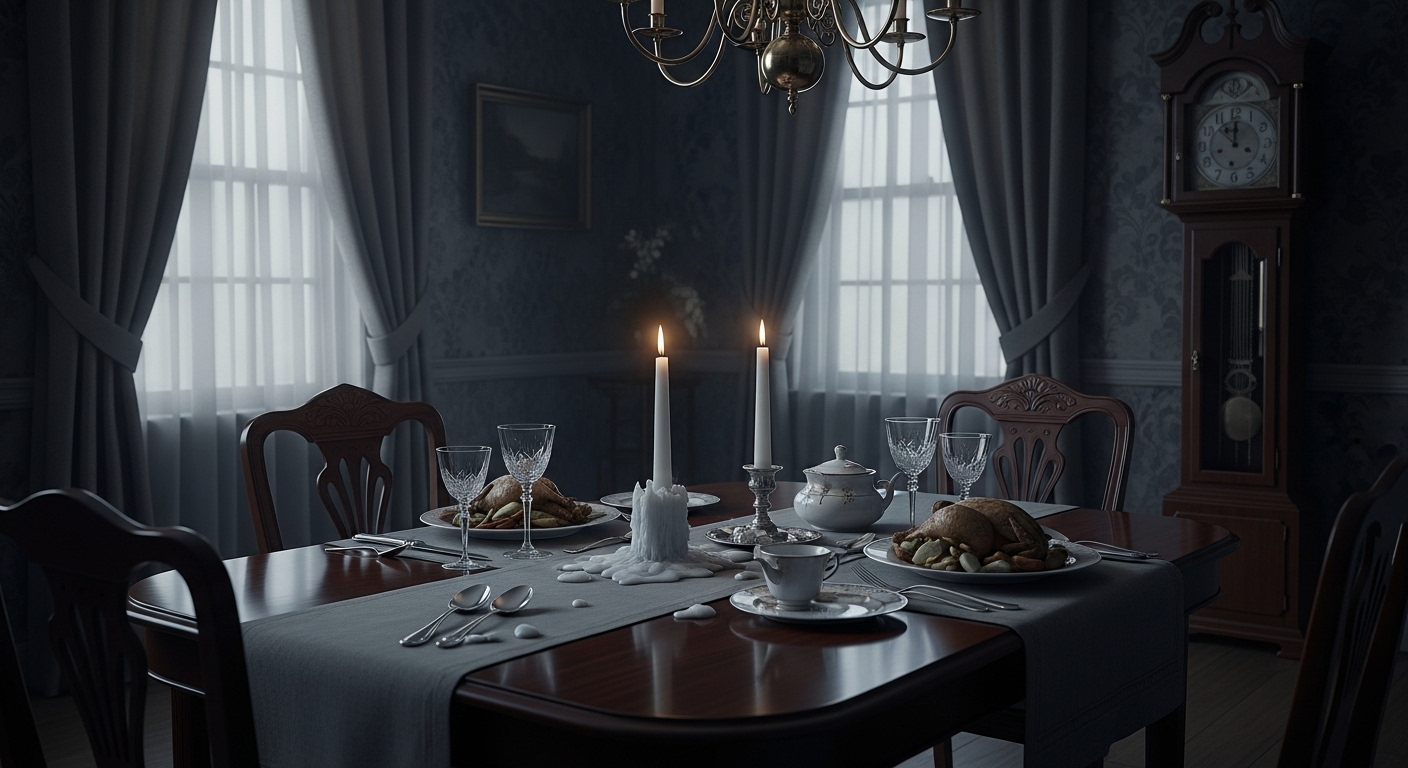
The table was set for two. The good china—the Wedgwood they had bought in London ten years ago—was laid out. The crystal glasses were filled with red wine that had gone stagnant.
In the center of the table, two tall taper candles had burned all the way down to the brass holders. The wax had pooled and dripped onto the pristine white tablecloth, hardening into jagged, white scars.
The roast beef was sitting on a platter in the center. It was gray and cold, the fat congealed around the edges.
“Clara?” Julian’s voice wavered.
He walked toward the kitchen.
“Clara, stop playing games. I’m tired.”
He pushed open the swinging door.
Clara was there.
She wasn’t cooking. She wasn’t cleaning.
She was lying on the black and white checkered floor. One of her shoes—a silver heel—had slipped off her foot. Her hand was outstretched toward the counter, as if she had been trying to reach for the phone.
“Clara!”
Julian dropped his bag. He rushed to her, his knees slamming onto the hard tile.
He grabbed her shoulders. “Clara! Wake up!”
She was warm, but barely. Her breathing was shallow, a terrifying, ragged rattle in her chest. Her eyes were half-open, staring blankly at the sub-zero refrigerator he had insisted on installing.
“Oh god. Oh god, no.”
He fumbled for his phone—the same phone he had used to dismiss her five hours ago. His fingers, usually so precise, were clumsy and shaking. He dialed 911.
“My wife,” he choked out. “She’s… she’s not waking up. Please. Hurry.”
He looked at the table in the other room. The perfect setting for a celebration that never happened. He looked at the cold food.
For the first time in thirty years, Julian Vance, the man who controlled every element of his environment, was completely and utterly helpless.
Chapter 3: The Cold Door
The ambulance ride was a blur of lights and sirens. Julian sat in the back, holding Clara’s limp hand. He was still wearing his chef’s jacket. It was stained with a drop of red wine from the toast with the investors. Now, it looked like blood.
They burst into the Emergency Room of Mount Sinai.
“Male, 50s, massive CVA, unresponsive,” the paramedic shouted, rattling off vitals that meant nothing to Julian.
A team of doctors and nurses swarmed the stretcher. They moved with the same urgency as his kitchen staff, but the stakes weren’t a Michelin star. The stakes were Clara.
Julian ran alongside the gurney. “I’m her husband! Let me stay with her!”
“Sir, you have to wait here!” a nurse shouted, holding up a hand.
They reached the double doors of the trauma unit.
The gurney flew through.
The nurse stopped Julian. “We need room to work. Please, sir. The waiting room.”
She pushed him back gently but firmly.
Thud.
The heavy, mechanical doors swung shut in his face.
Julian stood there in the hallway. The fluorescent lights hummed—a sickly, buzzing sound. The smell of antiseptic burned his nose, replacing the smell of truffles and ego.
He looked at his hands. These hands were insured for two million dollars. These hands could debone a fish in seconds. They could plate a dish that made grown men weep.
But right now, they were useless. They hung at his sides, empty and trembling.
He stumbled backward into the waiting room. It was empty, save for a sleeping homeless man in the corner.
Julian collapsed into a plastic chair. On the coffee table in front of him lay a crumpled magazine.
It was Culinary Age.
And there, on the cover, smiling arrogantly with crossed arms and a gleaming knife, was Julian Vance.
The headline screamed: CHEF OF THE CENTURY: THE MAN WHO HAS IT ALL.
Julian stared at his own face. He looked confident. Powerful. Invincible.
He grabbed the magazine and hurled it across the room. It hit the wall and fluttered to the floor, a worthless pile of glossy paper.
“I have nothing,” he whispered to the empty room. “I have absolutely nothing.”
Chapter 4: The Diagnosis
Three hours later, a doctor emerged. He looked exhausted.
“Mr. Vance?”
Julian shot up. “How is she? Is she…?”
“She’s alive,” the doctor said, rubbing his neck. “But it was a massive hemorrhagic stroke. We’ve stopped the bleeding, but the pressure on her brain was significant and prolonged.”
The doctor looked at Julian, his eyes narrowing slightly. “Mr. Vance, did you not notice the warning signs?”
“Warning signs?” Julian stammered.
“She has had unmanaged hypertension for years. Her medical records show she’s missed her last three check-ups. She must have been complaining of headaches? Dizziness? Blurred vision?”
Julian opened his mouth, but no sound came out.
Headaches? Had she mentioned headaches?
He thought back to last week. He was yelling about the saffron shipment. Clara had been rubbing her temples in the kitchen. “Jules, could you lower your voice? My head is pounding.”
What had he said? “Take an Advil, Clara. I’m trying to run a business.”
And two days ago. She had stumbled on the rug. “I’m just tired,” she had said. “Just a little dizzy.”
He hadn’t even looked up from his laptop.
“I… I didn’t know,” Julian whispered. “I was… busy.”
“Busy,” the doctor repeated. The word hung in the air, heavy with judgment.
The automatic doors of the ER entrance slid open.
“Dad!”
It was Leo. Their eighteen-year-old son. He was wearing a hoodie, his eyes wild with panic. He had driven in from his college dorm in Jersey.
“Where is she?” Leo demanded, rushing up to them.
“She’s in surgery recovery,” Julian said, reaching out to hug his son. “Leo, I—”
Leo shoved him.
It wasn’t a playful shove. It was a violent, two-handed push that sent Julian stumbling back against the wall.
“Don’t touch me,” Leo spat. “This is your fault.”
“Leo, please,” Julian begged. “It was a stroke. I couldn’t have—”
“She told me!” Leo screamed, tears streaming down his face. “She called me last week. She said she felt sick. She said her heart was racing.”
“Why didn’t she go to the doctor?” Julian asked, his voice cracking.
“Because of you!” Leo shouted. The nurses at the station stood up, watching. “She said, ‘I can’t go now, Leo. Your father is opening the restaurant next week. He’s stressed. If I get sick, it will distract him. I don’t want to be a burden.'”
Leo stepped closer, getting right in his father’s face.
“She didn’t go to the doctor because she didn’t want to ruin your opening night. She died trying to be convenient for you.”
The words hit Julian harder than any physical blow. Convenient.
She had treated her own life as secondary to his risotto. And he had let her. He had trained her to be invisible so he could shine.
Julian slid down the wall until he hit the floor. He put his head in his hands and wailed—a guttural, animal sound of pure, undiluted regret.
Chapter 5: The Taste of Regret
Clara survived, but she didn’t come back.
The stroke had devastated her frontal lobe. She was in what the doctors called a “persistent vegetative state.” She could breathe on her own. She could open her eyes. But there was no one home.
Two weeks after the incident, Julian walked into “Eclat.”
The staff stood at attention. “Chef on deck!”
“Stop,” Julian said quietly.
He walked into his office. He signed the papers his lawyers had prepared. He sold his majority share to the investors. He resigned as Executive Chef.
“Are you crazy, Julian?” his partner asked. “We’re booked solid for a year. You’re walking away from millions.”
“It’s just food,” Julian said. “It’s just dinner.”
He went home. He had the dining room—the room where she had set the table for their anniversary—cleared out. He rented a hospital bed. He hired a night nurse.
But during the day, he was the nurse.
The great Chef Julian, who used to scream if a garnish was misplaced, now spent his days learning how to change IV bags and prevent bedsores.
But the most important ritual was the food.
Clara couldn’t chew. She needed purees.
Julian didn’t open jars of baby food. He went to the market at 5:00 AM. He bought the freshest carrots, the sweetest organic peas, the most tender veal.
He came home and cooked. He cooked with more focus and love than he had ever given a paying customer. He roasted the carrots to bring out the natural sugars. He braised the meat for twelve hours until it melted. He blended them into silky, velvet mousses.
He would sit by her bedside, a silver spoon in his hand.
“Open up, Clara,” he would whisper, gently touching her lips.
Her eyes would stare blankly at the ceiling, or drift toward the window. She didn’t know who he was. She didn’t know he was the famous chef.
“This is carrots with a hint of ginger,” he would say, sliding the spoon into her mouth. “Remember? We ate this in Paris on our honeymoon.”
He would wipe her chin. He would hold her hand.
“I’m sorry,” he would say. He said it a thousand times a day. “I’m sorry I missed dinner. I’m sorry I missed everything.”
Leo came to visit on weekends. He watched his father—this man who used to be a titan, now reduced to a servant. He saw the dark circles under Julian’s eyes. He saw the tenderness.
Slowly, the wall between father and son began to crumble. Not all at once. But bit by bit.
“She liked a little nutmeg in the spinach,” Leo said one day, standing in the doorway.
Julian looked up, tears in his eyes. “She did. You’re right. I’ll add some.”
Chapter 6: The Flash of Life
Six months passed.
It was a rainy Tuesday. The sky was gray, mirroring the mood in the apartment. Clara’s vitals had been dropping. The doctor said it wouldn’t be long now. Her body was simply winding down.
Julian was in the kitchen. He wasn’t making a puree today.
He was baking.
He was making a Vanilla Sponge Cake. It was the simplest thing in the world. Flour, sugar, eggs, vanilla bean. It was what Clara’s mother used to make her when she was a little girl. It was the smell of safety.
The scent filled the apartment. Warm, sweet, comforting. It smelled like a hug.
Julian took a small piece of the warm cake. He mashed it with a little warm milk until it was a paste.
He walked into the room. He sat on the edge of the bed.
“Clara,” he whispered. “I made cake. Vanilla sponge.”
He held the spoon under her nose. The steam rose up.
And then, a miracle.
Clara’s nostrils flared slightly. Her head, which hadn’t moved voluntarily in months, turned. Not much. Just an inch.
Her eyes, usually foggy and drifting, sharpened. They locked onto Julian’s face.
For a terrifying, beautiful second, she was there. She saw him. She saw the grief, the age, the love.
A single tear rolled down her cheek.
Her lips parted. She tried to speak. It was a struggle, a fight against the short-circuiting wires of her brain.
“Eat,” she breathed. It was barely a whisper.
She wasn’t asking to eat. She was telling him.
She looked at his gaunt face. She looked at his thin arms. Even in her final moment, staring into the abyss, she was worried that he wasn’t taking care of himself. She was worried he was hungry.
Her eyes closed. The tension left her face. She let out a long, soft sigh, and the machine next to the bed flatlined into a steady, high-pitched tone.
Julian dropped the spoon. He buried his face in her neck and sobbed until his voice gave out. He realized then that she had loved him more than he had ever deserved. She died telling him to live.
Chapter 7: The New Menu
One Year Later.
The sign above the door didn’t say “Eclat.” It didn’t have gold lettering. It was a simple wooden sign, hand-painted.
CLARA’S TABLE.
It wasn’t a restaurant. Not really.
Inside, there were no white tablecloths. There were no reservations. There were just three long, communal tables made of reclaimed wood.
The kitchen was open. And standing there, wearing a simple blue apron, was Julian.
He wasn’t screaming. He was stirring a massive pot of chicken noodle soup. He was chopping fresh bread.
The door opened. A man walked in. He was wearing a tattered coat and pushing a shopping cart. He looked hesitant.
“Come in,” Julian called out, smiling. “Soup is hot.”
An elderly woman followed. Then a young mother with a crying baby.
There were no prices on the menu. The sign by the door read: Pay what you can. If you can’t, pay it forward with kindness.
Julian didn’t stay in the kitchen. He ladled the soup into bowls. He carried a tray to the table.
He placed a bowl in front of the homeless man.
“Rosemary bread today,” Julian said. “My wife’s recipe.”
“Thank you, Chef,” the man mumbled.
Julian didn’t walk away. He pulled out a chair. He sat down next to the man. He had a bowl of his own.
He looked at the empty seat across from him. He imagined Clara sitting there, smiling, wearing that blue dress.
He picked up his spoon.
“Let’s eat,” Julian said.
And for the first time in five years, Julian Vance didn’t just taste the food. He ate it. He shared a meal with another human being. He fed his body, but more importantly, he fed the starving, hollow part of his soul.
He had lost his stars, but he had finally found his way home.