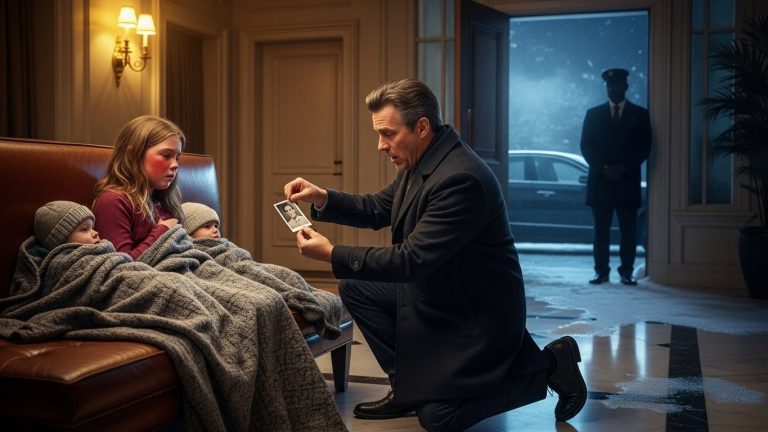
THE PRICE OF ETERNITY: What They Found in the Basement of St. Jude’s Will Haunt You Forever
Chapter 1: The Silent Sanctuary
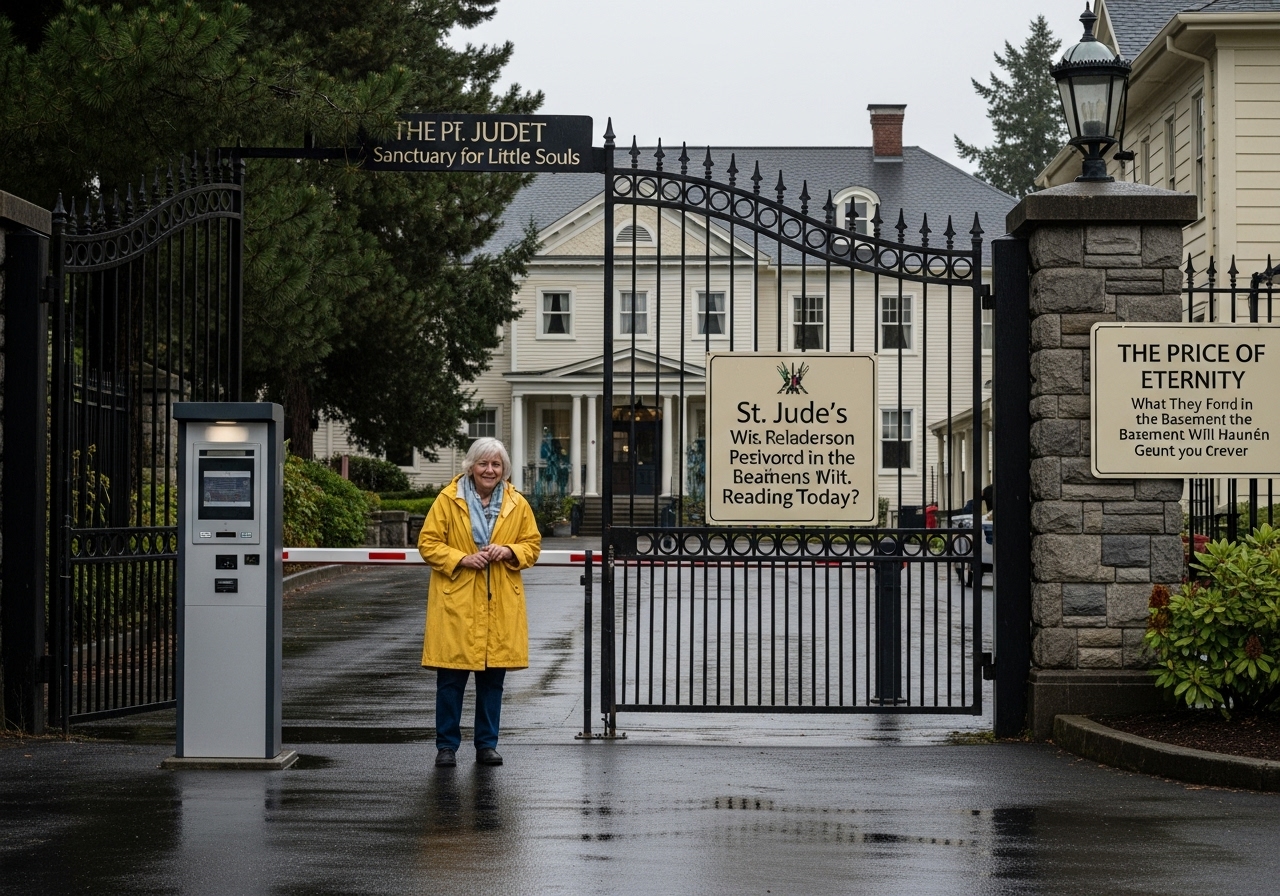
The rain in Seattle didn’t wash things clean; it just made the grime slicker. Martha felt that damp cold settle deep into her knees, a familiar ache that served as her morning alarm clock at sixty-eight years old. She adjusted her raincoat, tightening the belt around a waist that had thickened slightly over the years, and looked up at the imposing iron gates of St. Jude’s Sanctuary for Little Souls.
To the outside world—and specifically to the wealthy donors of King County—St. Jude’s was a miracle. It was a fortress of Victorian brick and modern glass, nestled in a manicured estate that smelled of pine needles and money. It was the place where the unwanted children of the state were polished into diamonds.
But Martha, a retired pediatric nurse with forty years of experience in emergency rooms and ICU wards, knew that children were not diamonds. Children were messy. They were loud. They scraped their knees, they caught colds, and they cried when they dropped their ice cream.
Here, at St. Jude’s, the children did none of those things.
Martha swiped her volunteer badge at the security kiosk. The guard, a burly man named Henderson who looked more like a bouncer than a caregiver, gave her a curt nod.
“Morning, Martha. Reading circle today?”
“As always, Mr. Henderson,” Martha smiled. It was her “little old lady” smile—harmless, sweet, and entirely fabricated. It was the best camouflage she had. “I brought The Velveteen Rabbit. It was my grandson’s favorite.”
The mention of her grandson, Toby, sent a sharp pang through her chest, but she didn’t let it show. Toby had died six years ago from a rare autoimmune disorder. The silence in her house had become deafening, driving her here, to volunteer three days a week. She needed the noise of children.
But St. Jude’s was quiet. Too quiet.
She made her way to the Blue Room, the recreation area for the six-to-ten-year-olds. The room was spotless. The toys were high-end—educational tablets, wooden puzzles imported from Sweden, plush dolls that looked brand new.
Sitting on the rug were twelve children. They looked up as she entered.
“Good morning, Miss Martha,” they chorused in unison.
“Good morning, my dears,” Martha said, settling into the rocking chair.
She looked at them. Their skin was flawless. Not a single patch of eczema, not a bruised shin, not a runny nose among them. Their cheeks had a rosy, almost painted-on glow. They were beautiful. And they terrified her.
“Today,” Martha said, opening the book, “we are going to read about becoming Real.”
As she read, her eyes scanned the room. She focused on Leo. Leo was seven, a wisp of a boy with eyes the color of storm clouds. He was the only one who ever showed a spark of something… distinctly human. Sometimes he fidgeted. Once, she saw him trying to hide a drawing of a monster under his pillow. He reminded her of Toby so much it physically hurt.
Today, Leo looked different. He was sitting perfectly still, but his left hand was scratching at his forearm. A rhythmic, desperate scratching.
Martha paused the story. “Leo, honey? Is everything alright?”
Leo stopped scratching immediately. He put his hands in his lap, his posture stiffening. “I am fine, Miss Martha. Thank you for asking.”
It was a rehearsed line. Martha knew the cadence of a coached child.
“Come here a moment,” she beckoned gently. “Let me see that arm.”
Leo hesitated, his eyes darting toward the camera in the corner of the ceiling. The red light blinked slowly.
“It’s okay,” Martha whispered, leaning forward to block the camera’s view with her body. “Just let Martha look.”
Leo rolled up the sleeve of his pristine white uniform.
Martha’s breath hitched.
Starting at his wrist and snaking up toward his elbow was a rash. But it wasn’t poison ivy, and it wasn’t hives. The skin was purple and mottled, the veins beneath bulging black and thick, creating a spiderweb pattern that pulsed.
Martha had seen this only once before. Thirty years ago, during a hushed-up clinical trial for a steroid treatment that was supposed to cure muscular dystrophy. The drug had been banned because it caused rapid cellular degradation in exchange for temporary muscle growth. It cooked the body from the inside out.
” does it hurt?” she asked, her voice trembling.
“It burns,” Leo whispered, a single tear leaking from his eye. “Like fire ants.”
“How long have you had this?”
“Since my shot on Tuesday.”
“Shot?” Martha frowned. “Flu shot?”
“The Vitamin Shot,” Leo said. “Dr. Thorne gives it to us himself. He says it makes us perfect so the mommies and daddies will want us.”
Martha felt a cold chill slide down her spine. Dr. Aris Thorne. The director. The saint of Seattle. The man with the silver hair and the dazzling smile who was on the cover of Time magazine last month.
“Martha?”
She jumped. Standing in the doorway was Nurse Ratched—well, her name was Nurse Simmons, but Martha called her Ratched in her head. Simmons was tall, severe, and had eyes like a shark.
“What are you doing with Subject… with Leo?” Simmons asked, her voice clipped.
“He has a rash,” Martha said, standing up, her nurse instincts taking over. “A severe reaction. Look at this venous tracking. He needs to be taken to the infirmary immediately. He could be going into septic shock.”
Simmons walked over, glanced at the arm, and yanked Leo’s sleeve down roughly.
“It is merely a contact dermatitis. He is allergic to the new laundry detergent. We are handling it.”
“That is not dermatitis,” Martha argued, her voice rising. “I was a nurse for forty years, Simmons. That looks like systemic toxicity. He needs bloodwork.”
“You were a nurse,” Simmons sneered, stepping into Martha’s personal space. “Now you are a volunteer who reads fairy tales. Do not confuse your role here, Martha. We have the finest medical team in the country.”
Simmons grabbed Leo by the shoulder. “Come along, Leo. It’s time for your… treatment. We’ll put you in the Quarantine Wing until your skin clears up.”
“No,” Leo whimpered, his composure cracking. “Please, not the Quiet Room. I’ll be good. I won’t scratch.”
“Move,” Simmons ordered.
Martha watched helplessly as the little boy was dragged away. As he looked back over his shoulder, the fear in his eyes wasn’t the fear of a child in trouble. It was the fear of an animal entering a slaughterhouse.
That night, Martha couldn’t sleep. She sat in her kitchen, the ticking of the wall clock echoing in the empty house. She drank tea that had gone cold an hour ago.
The Vitamin Shot. Systemic toxicity. The Quiet Room.
She thought about Toby. She remembered how she had fought for him, fighting doctors, fighting insurance companies, fighting fate itself until his last breath. She hadn’t been able to save him.
But Leo was still alive.
Martha stood up, her joints popping. She walked to the hallway closet and pulled out a shoebox from the top shelf. Inside was her old stethoscope, a blood pressure cuff, and a set of lockpicks she had confiscated from her rebellious teenage son thirty years ago—and subsequently learned how to use because, well, you never knew.
“You’re an old fool, Martha,” she whispered to the empty room.
She grabbed her coat. She wasn’t going back to read The Velveteen Rabbit. Tomorrow, she was going to find out what was really happening in the Quarantine Wing.
Chapter 2: The Serum of Sins
The next morning, the atmosphere at St. Jude’s had shifted. It was subtle, but Martha felt it. The security guard, Henderson, watched her a fraction of a second longer than usual. The receptionists stopped talking when she walked by.
“Leo is resting,” Nurse Simmons told her when she arrived at the Blue Room. “He is contagious. No visitors.”
“I understand,” Martha said, her face a mask of grandmotherly compliance. “I just wanted to leave this for him.” She placed the copy of The Velveteen Rabbit on the desk. “I’ll just go tidy up the library.”
The library was on the second floor, adjacent to the administrative offices. It was also directly above the service elevator that she had noticed the janitorial staff using—the only elevator that went down to the sub-basement.
Martha waited until the hallway was clear. She pulled a “Cleaning in Progress” sign from her tote bag and hung it on the library door. Then, she slipped out the back service entrance.
She moved with a purpose that defied her age. Her arthritis burned, but the adrenaline was a powerful anesthetic. She found the service elevator. It required a keycard.
Martha didn’t have a keycard. But she had spent twenty years working the night shift at Metro General, and she knew that janitorial staff often hid spare cards in the fire extinguisher box for easy access during shift changes. It was a universal laziness of human nature.
She opened the red box next to the elevator. There, taped behind the nozzle, was a magnetic card.
“Gotcha,” she muttered.
She swiped it. The doors slid open. She pressed ‘B2’.
The elevator descended smoothly. When the doors opened, the smell hit her first.
It wasn’t the smell of a basement. It was the smell of a high-tech hospital—ozone, bleach, and something metallic, like copper. The air was freezing.
She stepped into a long, white corridor. It was silent. Glass walls lined the hallway.
Martha peeked into the first room. It was a laboratory. Microscopes, centrifuges, and rows of freezers. But it was the labels on the freezers that made her stop.
AETHELGARD BIOTICS – PROPERTY OF RESTRICTED RESEARCH DIV.
Aethelgard Biotics. Martha knew the name. They were a pharmaceutical giant, the kind that advertised during the evening news with commercials showing people running through fields of wheat while a soft voice listed side effects that included death and stroke. They made billions on anti-aging creams and experimental gene therapies.
Why were they funding an orphanage?
She moved further down the hall. She saw a door labeled “Quarantine / Observation.”
It had a small window. Martha stood on her tiptoes to peer inside.
Her hand flew to her mouth to stifle a scream.
It wasn’t a bedroom. It was a ward. There were ten beds. In each bed lay a child, hooked up to IV drips and monitors. But they weren’t sleeping. They were… suspended.
Their eyes were open but unseeing. Their skin was translucent. And they looked old.
Not old like her. But their hair was thinning. Their skin was papery. It was as if they were aging in fast-forward, yet their bodies remained small.
She scanned the beds. She found Leo.
He was strapped down. His skin, which had been perfect yesterday, was now gray. The rash on his arm had turned black. A bag of clear fluid was dripping into his veins. The label on the bag read: HGH-Suppressant / Telomere Regeneration Sequence – Phase 4.
Martha pulled out her phone. Her hands were shaking so badly she almost dropped it. She snapped a photo of the room, then a photo of the bag.
She heard footsteps. Heavy, confident footsteps echoing on the tile.
Martha looked around frantically. There was a laundry cart filled with soiled scrubs near the door. She dove behind it, squeezing herself into the gap between the cart and the wall, praying her heavy breathing wouldn’t give her away.
Two men walked into view. One was Dr. Thorne. The other was a man in a sharp business suit she didn’t recognize.
“…results are promising, Aris,” the suit said. “The wealthy don’t care about the cost. They care about results. If you can prove that the harvested plasma reverses cellular decay, we can charge ten million a dose.”
“The efficacy is there,” Dr. Thorne’s smooth voice replied. “But the vessels… the children. They burn out too fast. Subject 402—the boy, Leo—is rejecting the sequence. His organs are shutting down.”
“How long does he have?”
“Twenty-four hours, maybe less. We’ll need to harvest what we can tonight, then process the disposal. We’ll list it as pneumonia. The usual protocol.”
“Pity,” the suit said, sounding bored. “He had a good genetic profile. Make sure the incinerator is prepped. We don’t want a repeat of the mess last winter.”
They walked past her hiding spot. Martha squeezed her eyes shut, tears streaming down her face.
Harvest. Disposal. Incinerator.
They weren’t orphans waiting for homes. They were livestock. They were being used as incubators for an elixir of youth for billionaires who refused to die gracefully.
Martha waited ten minutes after they left before she moved. She felt sick, a deep, visceral nausea. But beneath the sickness, there was a rage so hot it felt like it could melt the steel walls around her.
She needed help. She couldn’t call the police—Dr. Thorne had mentioned the “usual protocol,” which implied this had been going on for a long time. He was powerful. He likely owned the police chief.
She needed proof that couldn’t be buried. And she needed to get Leo out.
She made her way back to the elevator, her mind racing. Tonight was the Annual St. Jude’s Charity Gala. The Governor was coming. The press would be there. The richest people in the state would be drinking champagne directly above this slaughterhouse.
Martha’s eyes hardened.
“You want a show?” she whispered, clutching her phone. “I’ll give you a show.”
She drove straight to a dilapidated pharmacy in the questionable part of town. It was run by George, a man she had worked with in the 80s who had lost his license for selling painkillers to veterans under the table, but who had a heart of gold and a chemistry degree that rivaled any Ivy League professor.
“Martha?” George squinted over the counter. “You look like you’ve seen a ghost.”
“Worse, George,” Martha slammed the phone down on the counter, showing him the picture of the IV bag. “I need you to tell me what this is. And then I need you to give me something that wakes a child up from a chemically induced coma. Fast.”
George looked at the photo. His face went pale. “Martha… this is military-grade gene editing stuff. Where did you get this?”
“St. Jude’s.”
“Jesus,” George breathed. “If you go back there, they’ll kill you.”
“They’re going to kill a seven-year-old boy tonight, George,” Martha said, her voice steady. “Now, give me the adrenaline. And give me something to break a lock.”
Chapter 3: The Gala of Nightmares
The St. Jude’s Annual Gala was a spectacle of opulence. The Great Hall was draped in gold silk. Crystal chandeliers shimmered overhead. A string quartet played Mozart while waiters in white gloves circulated with trays of caviar and champagne.
The room was filled with the elite. Women in designer gowns laughed, their necks dripping with diamonds. Men in tuxedos discussed stocks and golf. At the center of it all was Dr. Aris Thorne, looking every bit the savior in a velvet tuxedo, shaking hands and accepting checks.
“To the children!” he toasted, raising his glass. “Our future!”
“To the children!” the crowd echoed.
Martha watched from the shadows of the kitchen service entrance. She was wearing a caterer’s uniform she had swiped from the laundry van outside. She had her hair tucked under a cap. In her pocket was a syringe George had prepared, a heavy flashlight, and a small pry bar.
She checked her watch. 8:45 PM. Thorne’s speech was at 9:00. She had fifteen minutes.
She moved through the kitchen, blending in with the chaos of the catering staff. She slipped down the back stairwell, descending back into the belly of the beast.
The silence of the basement was even more terrifying tonight, knowing the party raging above. She reached the Quarantine Wing.
The door was locked electronically. Martha didn’t hesitate. She jammed the pry bar into the seam and threw her entire body weight against it. She groaned as her arthritic shoulder protested, screaming in pain, but the metal gave way with a loud CRACK.
She was in.
The room was dimly lit. The hum of the machines was the only sound.
She ran to Leo’s bed. He looked worse than this morning. His breathing was shallow, a rattling sound in his chest.
“Leo,” she whispered, checking his pulse. It was thready.
She pulled out the syringe. “Please work, George. Please work.”
She injected the stimulant into his IV line.
For a moment, nothing happened. Then, Leo gasped. His back arched. His eyes flew open. They were bloodshot, the whites completely red from the hemorrhaging vessels.
“Miss… Martha?” he croaked.
“I’m here, baby. I’m here.” She began unhooking the wires. “We’re leaving.”
“I can’t walk,” Leo cried softly. “My legs… I can’t feel them.”
“You don’t have to walk.” Martha grabbed a wheelchair from the corner. She lifted him—he was horrifyingly light, like a bird made of hollow bones—and settled him into the chair.
She threw a blanket over him to hide the IV lines still trailing from his arms.
“Going somewhere, Martha?”
Martha froze.
Dr. Thorne was standing in the doorway. He wasn’t smiling anymore. In his hand was a scalpel, gleaming under the fluorescent lights.
“I knew you were trouble,” Thorne sighed, stepping into the room. “You old nurses. You never know when to stop caring.”
“You’re a monster,” Martha spat, standing between Thorne and the wheelchair. “These are children.”
“They are supply,” Thorne corrected calmly. “Do you know who is upstairs, Martha? The CEO of Aethelgard. A Senator. A Tech Mogul. They are terrified of aging. They will pay anything to stay young. These children… they are nobodies. Dropped off by junkies and failures. I am giving their lives meaning. Their biology will save the people who actually matter.”
He took a step closer. “I can help you, too, Martha. Your knees hurt, don’t they? We have treatments. You could have twenty more years. Pain-free.”
Martha looked at him. She thought of the pain in her knees. She thought of the emptiness of her house.
Then she looked at Leo, trembling in the chair, bleeding from his eyes.
“My pain,” Martha said, her voice low and dangerous, “reminds me that I’m human. Something you forgot a long time ago.”
She grabbed a tray of glass vials from the counter next to her—the serum worth millions—and hurled it at Thorne’s face.
Thorne screamed as the glass shattered, the liquid splashing into his eyes. He dropped the scalpel, clutching his face.
“Run, Leo!” Martha yelled, grabbing the wheelchair handles.
She didn’t run for the service elevator. That was too slow. She ran for the freight lift at the end of the hall that opened directly into the main ballroom behind the stage.
She slammed her hand on the ‘UP’ button. The gears ground to life.
“Stop her!” Thorne shrieked, stumbling after them, blood and serum mixing on his face.
The lift doors closed just as Thorne slammed into them.
The lift ascended slowly. Martha gripped Leo’s hand. “Listen to me, Leo. When these doors open, there are going to be a lot of people. I want you to look at them. Don’t hide. Let them see you.”
“I’m scared,” Leo wept.
“I know. But you are the bravest boy I know. Braver than all of them.”
The lift jolted to a stop.
Chapter 4: The Sun on the Porch
The ballroom was silent as the Governor finished his introduction. “And now, the man of the hour, Dr. Aris Thorne!”
The applause began.
But Dr. Thorne didn’t walk out.
Instead, the heavy velvet curtains behind the stage parted as the freight lift doors ground open with a mechanical screech.
The applause faltered. The music stopped.
Martha pushed the wheelchair out onto the center of the stage, directly into the spotlight intended for Thorne.
A collective gasp ripped through the room.
They didn’t see a charming doctor. They saw an old woman in a dirty caterer’s uniform, hair wild, pushing a wheelchair. And in the wheelchair sat a child who looked like a broken doll. Leo’s hospital gown was stained. His skin was gray. And blood was weeping from his eyes, streaming down his face like red tears.
“Ladies and Gentlemen!” Martha’s voice boomed, fueled by pure, unadulterated rage. She didn’t need a microphone. “You paid for a miracle! Here is your receipt!”
She ripped the blanket off Leo, revealing the blackened veins, the needle marks, the emaciated limbs.
“This is what you are buying!” Martha screamed, pointing at the stunned billionaires in the front row. “He is seven years old! His name is Leo! And he was being harvested so you could have smoother skin!”
Cameras flashed. The press, sensing blood, surged forward.
“Security!” someone shouted.
But it was too late. The doors to the ballroom burst open. Not security—but the police. George had called them. And he had sent the photos Martha took to every news outlet in Seattle an hour ago.
Dr. Thorne stumbled onto the stage from the side entrance, looking deranged, his face red and blistering. “She’s lying! She’s a senile old woman! It’s a quarantine breach!”
But Leo looked up. He looked directly at the camera broadcasting live to the local news. He lifted his arm, showing the rotting tracking marks.
“He hurts us,” Leo said, his voice amplified by the microphone on the podium. “He says we are just batches. Am I a batch?”
The silence that followed was heavy enough to crush the building.
Then, chaos erupted.
Three Years Later.
The porch of Martha’s farmhouse was bathed in golden afternoon light. The air smelled of cut grass and fresh lemonade.
Martha sat in her rocker, a heating pad on her knees. She was seventy-one now, and she moved a little slower, but her eyes were bright.
“Martha! Watch this!”
She looked up. Leo was running across the yard. He had a slight limp—the nerve damage in his legs would never fully heal—and he had to take medication daily for his kidneys. But he was running. He was chasing a Golden Retriever puppy that was tripping over its own paws.
Leo was ten now. His cheeks were sun-browned. The gray pallor was gone, replaced by freckles. He laughed, a loud, uninhibited sound that rose up into the trees.
The scandal had destroyed Aethelgard Biotics. The trials had lasted two years. Thorne was serving life without parole. St. Jude’s had been razed to the ground, the land turned into a memorial park.
It hadn’t been easy. Martha had been dragged through the mud by Thorne’s lawyers. She had lost her savings fighting legal battles to adopt Leo. She was tired.
But then Leo caught the puppy, tumbling into the grass, giggling as the dog licked his face.
Martha picked up the framed photo on the table next to her. It was a picture of Toby, her grandson.
“I couldn’t save you, my angel,” she whispered to the photo. “But I didn’t let them take another one.”
She took a sip of her lemonade and watched Leo play. She didn’t have millions of dollars. She didn’t have eternal youth. She had creaky joints and a small pension.
But looking at the boy who was supposed to be “disposed of” three years ago, now alive and loved, Martha knew the truth.
She was the richest woman in the world.