Bullies Mocked A Disabled Boy For His “Trash” Backpack. They Didn’t Know It Belonged To The Hero Who Saved The Police Chief.
Chapter 1: The Weight of Silence
The rain in Oak Creek, Virginia, didn’t just fall; it felt like it was trying to wash the town gray. It was a cold, biting Tuesday afternoon in late October. The sky was a bruised shade of purple and charcoal, hanging low over the manicured lawns and red-brick architecture of Oak Creek Middle School.
For ten-year-old Leo Bennett, the rain was just another obstacle in a world built for people who could move faster than he could.
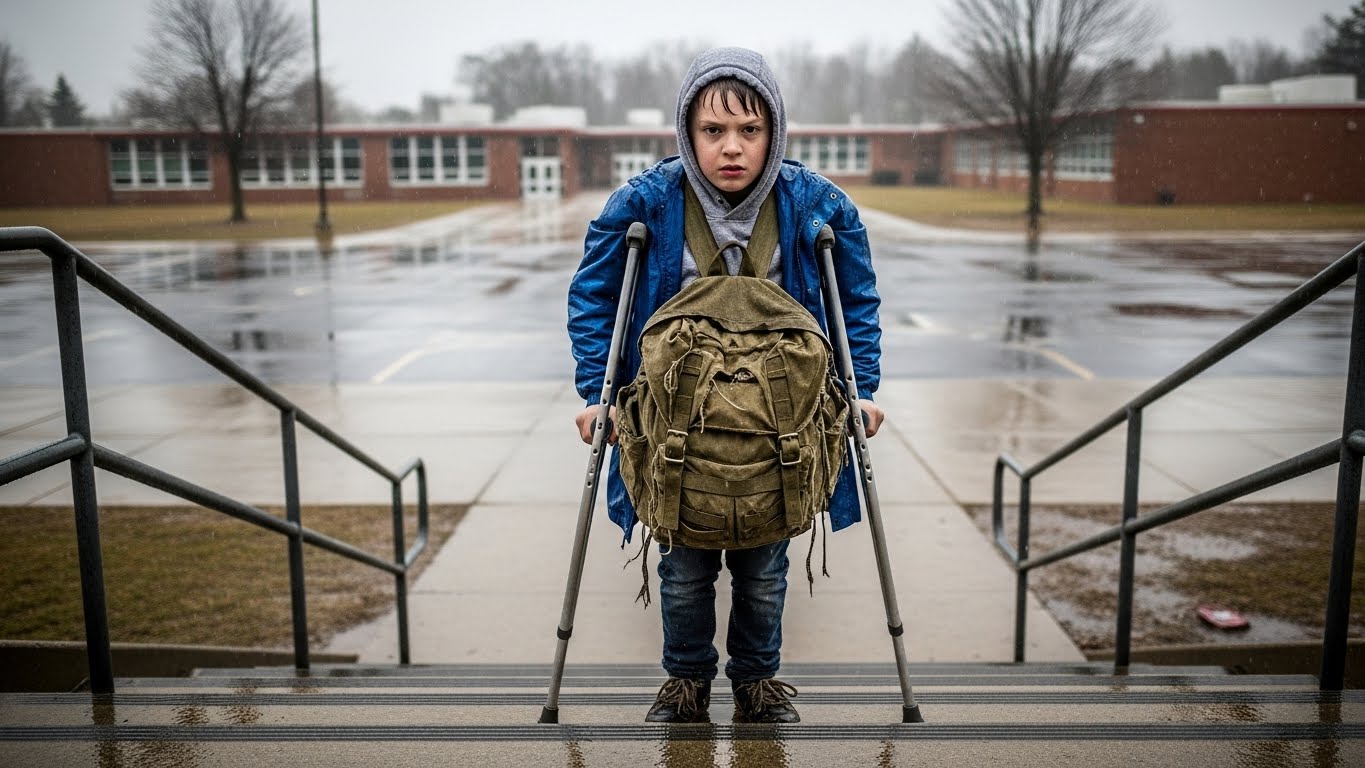
Leo stood at the top of the concrete stairs leading down to the pickup zone. The wind whipped his windbreaker against his thin frame. He tightened his grip on his forearm crutches, the metal cold and slick under his palms. His legs, encased in steel and plastic braces hidden beneath his jeans, ached with a dull, throbbing rhythm that synced with the pounding rain.
But the heaviest thing Leo carried wasn’t his own body weight. It was the backpack.
It was an olive-drab tactical rucksack, visibly old and frayed at the seams. It was far too large for a ten-year-old boy. The straps were cinched as tight as they would go, yet it still hung low, bumping against his lower back with every awkward step he took. It had patches where the fabric had worn through, and a faint, stubborn stain of oil—or perhaps something else—near the bottom pocket. To the casual observer, it looked like garbage. To the wealthy students of Oak Creek, it looked like a target.
To Leo, it was the only hug he had left from a father he could barely remember.
“One step,” Leo whispered to himself, a mantra he repeated a thousand times a day. “Just one step.”
He maneuvered the right crutch down to the first wet step. The rubber tip squeaked, slipping slightly before finding purchase. His heart hammered against his ribs. The worst part of his day wasn’t the physical pain; it was the audience.
Below him, the semi-circular driveway was clogged with luxury SUVs—Range Rovers, BMW X5s, Escalades. The engines idled with a low, expensive purr. Wipers slapped back and forth rhythmically. Behind the tinted glass, parents sat scrolling through their phones, checking emails, or chatting on hands-free devices. They were physically present but entirely absent, cocooned in their heated leather seats, oblivious to the world outside.
Leo took another step. He was halfway down when he heard them.
“Hey, look! It’s the broken toy.”
The voice was nasally and dripping with entitlement. Leo didn’t need to look up to know it was Brandon Vance. Brandon was fourteen, held back a year, and wore sneakers that cost more than Leo’s monthly medical bills. Flanking him were Kyle and Mike, his loyal lieutenants in cruelty. They were the “Wolf Pack,” the sons of the town’s wealthiest developers and lawyers. They moved with the swagger of boys who had never been told ‘no’ in their entire lives.
“Nice bag, Gimp,” Kyle sneered, stepping into Leo’s path at the bottom of the stairs. “Did you find that in a dumpster? Or did the Salvation Army reject it?”
Leo stopped. He stabilized himself on the second-to-last step, looking down at them. “Leave me alone, Kyle,” Leo said, his voice quiet but steady. He had learned that shouting didn’t help. Shouting just made them laugh harder.
“We’re just trying to help,” Mike chimed in, grinning. He took a sip from a large soda cup. “That thing looks heavy. Doesn’t it hurt your little twisted legs?”
“Move,” Leo said, trying to step around them.
Brandon stepped forward, blocking the path. He was a head taller than Leo. “You don’t give orders here, cripple. You take them. That’s how the food chain works. And right now, you’re looking like prey.”
The rain intensified, drumming against the hood of a nearby Mercedes. Inside the car, a woman applied lipstick in the rearview mirror, not once looking out the side window where three teenagers were cornering a disabled child.
“I need to go home,” Leo said, his knuckles turning white on the crutch handles.
“Home to who?” Brandon laughed. “Your mom works double shifts at the diner, right? She’s probably flipping burgers right now to pay for your crutches. Maybe if we throw this trash away,” he gestured to the backpack, “you’ll be able to walk faster.”
“Don’t touch it,” Leo warned. A sudden, fierce fire ignited in his chest. He could handle insults about his legs. He was used to the stares. But the bag was off-limits. The bag was sacred.
“Ooh, he’s got a temper,” Kyle mocked, feigning fear. “What are you gonna do? Hit me with your stick?”
Brandon’s eyes narrowed. The cruelty in them wasn’t just childish mischief; it was cold, calculated malice. He looked at Leo’s crutch, then at the puddle of muddy water gathering at the base of the stairs.
“Let’s see how well you balance,” Brandon whispered.
Before Leo could react, Brandon lashed out. His expensive basketball shoe connected hard with the shaft of Leo’s right crutch.
It wasn’t a hard kick, but it was precise. The rubber tip skidded across the wet concrete. Leo’s center of gravity vanished. He gasped, his arms flailing, but there was nothing to grab. The world tilted violently.
He hit the ground hard.
The impact knocked the breath out of him. Cold, gritty mud soaked instantly through his jeans and windbreaker. His left brace scraped loudly against the pavement. He landed on his side, his cheek pressing into the dirty water. The pain in his hip was sharp and immediate, a hot spike of agony that made his vision blur.
Above him, the laughter erupted. It wasn’t just a chuckle; it was a howl of amusement.
“Timber!” Mike yelled, high-fiving Kyle.
Leo lay there for a second, blinking away tears of pain and humiliation. The rain felt colder now. He tried to push himself up, his hands sinking into the mud. He looked toward the cars. Surely, someone saw. Surely, one of the adults in the idling luxury cars would roll down a window.
The woman in the Mercedes was checking her teeth in the mirror. A man in a Lexus was talking animatedly on his phone, looking right through Leo as if he were part of the landscaping.
Nobody was coming.
Chapter 2: The Desecration
Leo gritted his teeth, forcing himself into a sitting position. The mud coated his hands, turning his skin gray. He reached for his crutch, which had skittered a few feet away.
“Ah, ah, ah,” Kyle said, stepping on the crutch with his foot. “Not so fast.”
“Give it back,” Leo said, his voice trembling. He hated that he was trembling. He wanted to be like the man in the picture—strong, stoic, unbreakable. But he was ten, and he was cold, and he was alone.
“I think we need to inspect the cargo first,” Brandon said, his eyes fixing on the olive-drab backpack that had slipped off Leo’s shoulder during the fall. “See if there’s anything dangerous in there. You know, school safety protocols.”
“No!” Leo lunged for the bag, dragging his heavy legs through the sludge.
He was too slow. Brandon snatched the bag up by the straps. He held it aloft, dangling it like a trophy.
“God, this thing stinks,” Brandon wrinkled his nose. “It smells like… old attic and desperation.”
“Please,” Leo begged, abandoning his dignity. “Please, just give it back. Keep the crutch. Just give me the bag.”
“Why?” Brandon sneered. “What’s in here? Your lunch? A diary about how sad your life is?”
With a violent jerk, Brandon unzipped the main compartment. He turned the bag upside down and shook it.
Leo watched in horror as his world tumbled out into the mud.
First came his math notebook, the pages fluttering open and instantly soaking up the brown water. Then his pencil case, cracking as it hit the pavement. Then his lunch box.
And then, the frame.
It was a simple wooden frame, 5×7 inches. It held a black-and-white photograph. It slid out of the bag and landed face-up in the slush.
The glass didn’t break, but a splash of mud obscured the image.
“Oops,” Mike laughed. “Butterfingers.”
Leo didn’t care about the notebook. He didn’t care about the pencil case. He crawled. He didn’t try to stand up. He dragged his body over the rough concrete, his braces scraping, moving toward the photograph.
Brandon stepped in front of the picture, looking down at it. He wiped a smudge of mud away with his toe.
“Who is this?” Brandon asked, squinting at the photo. “Some guy in a costume? Is this your dad? He looks like a loser. Probably got kicked out of the army for being too dumb.”
“Shut up!” Leo screamed. It was a raw, guttural sound that tore from his throat. “Don’t you talk about him!”
“Or what?” Brandon laughed, kicking the frame.
The frame spun across the wet asphalt, skidding face-down into a deeper puddle.
“He’s useless,” Brandon spat, looking down at Leo. “Just like you. Look at you. You can’t even walk right. You’re just a broken toy. You are useless to society. My dad says people like you are just drains on the tax system. We pay for you to exist.”
Leo finally reached the puddle. He plunged his hands into the freezing water and pulled out the frame. He wiped it frantically with his muddy sleeve, but he was only smearing the dirt around. He pulled the frame against his chest, curling his body around it, shielding it from the rain and the boys.
He remembered his mother’s voice. “Your father was a lion, Leo. You have his heart.”
But right now, he felt like a mouse.
“Aw, he’s crying,” Kyle mocked. “Baby wants his bottle.”
“Let’s cool him off,” Mike said, lifting the lid from his large soda. It was full of ice and sticky caramel liquid.
They circled him, predators toying with a wounded animal. Leo squeezed his eyes shut. He hugged the picture of Captain James Bennett against his heart. He prepared for the cold splash of the soda. He prepared for the final humiliation.
He waited.
And waited.
But the soda never fell.
Instead, a sound cut through the rain—a sound that made the blood in Brandon’s veins turn to ice.
Whoop-Whoop.
It was a siren. Short, sharp, and authoritative.
Tires screeched. An engine roared—not the polite purr of a luxury SUV, but the aggressive growl of a V8 interceptor.
Leo opened his eyes.
A black Dodge Charger, unmarked but unmistakably law enforcement, had mounted the curb. It had driven right up onto the sidewalk, blocking the exit, cutting off the Wolf Pack’s escape route. The grill of the car was inches from Brandon’s legs.
The door opened.
A boot hit the pavement. A heavy, black combat boot, polished to a mirror shine despite the weather.
Chapter 3: The Intervention
The man who stepped out of the car seemed to block out the grey sky.
Chief Thomas Miller was a legend in Oak Creek, though few of the new, wealthy residents knew why. They just knew him as the grumpy old man who refused to retire. He was in his sixties, with close-cropped silver hair and a face carved from granite. He was a big man, broad-shouldered and stiff-backed.
Today, for reasons the boys couldn’t comprehend, he wasn’t in his usual patrol uniform. He was wearing his full dress blues. Gold braids hung from his shoulder. Medals—rows and rows of them—clinked softly on his chest. He looked like a statue of war come to life.
The silence that descended on the courtyard was absolute. Even the rain seemed to quiet down.
Brandon dropped his hands to his sides, the soda cup slipping from his fingers and spilling onto his own expensive sneakers. He swallowed hard. “Chief… Chief Miller. We were just…”
Miller didn’t look at Brandon. He didn’t look at Kyle or Mike. To him, in that moment, they were less than the mud on his boots.
He walked past them. He moved with a heavy, purposeful gait.
Miller stopped in front of Leo.
The Chief of Police, the man who terrified the mayor and the city council, slowly lowered himself. He knelt in the mud. He didn’t care about the razor-sharp crease in his dress trousers. He didn’t care that the slush was soaking into the fabric of a uniform that commanded respect.
“Leo,” Miller said. His voice was surprisingly soft, like gravel wrapped in velvet.
Leo looked up, shivering, mud streaked across his face. He clutched the frame tighter. “Chief?”
“Let me see it, son,” Miller said gently, extending a hand.
He was wearing white ceremonial gloves.
Leo hesitated, then slowly handed the muddy frame to the giant man.
Miller took it with a reverence that stunned the onlookers. He pulled a pristine white handkerchief from his pocket. With slow, deliberate movements, he wiped the mud from the glass. He cleaned the edges. He polished it until the face in the photo was visible again.
It was a picture of two young men in desert fatigues. One was smiling, handsome and vibrant—Captain James Bennett. The other was younger, thinner, with a bandage around his head, looking at James with pure adoration. That younger man was Thomas Miller.
Miller stared at the photo for a long moment, his jaw tightening. Then, he handed it back to Leo.
“Secure that, soldier,” Miller whispered.
He reached out and grabbed Leo’s backpack. He dusted it off, treating the frayed fabric as if it were made of silk. He placed it gently on the dry concrete under the overhang. Then, he turned back to Leo.
“Ready to stand?” Miller asked.
“I… I fell,” Leo stammered.
“We all fall,” Miller said. “It’s about who helps us up.”
Miller placed his large hands under Leo’s arms and lifted him effortlessly. He stabilized the boy, adjusted his braces, and retrieved the crutches. He wiped the mud off the handle of the right crutch with his own glove before handing it back.
Only when Leo was standing tall, his dignity restored, did Chief Miller turn around.
The transformation was terrifying. The gentle grandfather vanished. The War Dog appeared.
Miller stood up to his full height. He turned slowly to face Brandon, Kyle, and Mike. The boys were trembling now. They had realized, too late, that they had woken a sleeping dragon.
A crowd had gathered. Parents had finally stepped out of their cars, sensing the drama. Phone cameras were raised.
“It was just a joke, Sir,” Brandon squeaked, his voice cracking. “My dad… my dad knows the Mayor. He pays your salary.”
Miller took one step forward. Brandon took two steps back.
“Your dad,” Miller said, his voice booming across the courtyard, loud enough for every parent in every luxury car to hear, “pays my salary. That is correct.”
Miller looked at the crowd, then back at the boys.
“But this boy’s father?” Miller pointed a gloved finger at Leo. “He paid for your freedom.”
Chapter 4: The Revelation
The confusion on the bullies’ faces was genuine. They were children of privilege, disconnected from history, disconnected from the cost of the peace they enjoyed.
Miller reached down and picked up the tattered olive-drab backpack. He held it up for the crowd to see.
“You called this trash,” Miller said, his voice shaking with suppressed rage. “You asked if he got it from a dumpster.”
He turned the bag so the name tape was visible. It read: BENNETT.
“This bag has been to Hell and back,” Miller declared. “It has been soaked in the blood of good men. It has carried ammunition, medical supplies, and the letters of men who never made it home.”
Miller turned to the school building behind them. He pointed to the bronze plaque mounted near the entrance—a plaque the students walked past every day without reading.
“Can anyone tell me the name of this courtyard?” Miller barked.
Silence.
“It is the Captain James Bennett Memorial Courtyard,” Miller roared.
The crowd gasped. A few parents covered their mouths.
“Ten years ago,” Miller continued, his eyes locking onto Brandon’s, “in the Korengal Valley of Afghanistan, a patrol was ambushed. They were pinned down. Outnumbered. Taking heavy fire.”
Miller’s voice cracked, just for a second.
“The unit commander took a bullet to the leg. He couldn’t walk. The order was given to pull back. But the Captain… Captain Bennett refused to leave his man behind.”
Miller walked closer to Brandon. The boy was shaking visibly now.
“Captain Bennett ran back into the kill zone. He took three rounds to the chest. But he didn’t stop. He picked up that wounded commander. He carried him—on his back—for three miles to the extraction point. He saved that man’s life. And then… he died.”
Miller paused. He let the weight of the words settle.
“That wounded commander,” Miller tapped his own chest, the medals clinking, “was me.”
Tears streamed down Miller’s weathered cheeks, but he didn’t wipe them away.
“I am alive today because Leo’s father decided that my life was worth more than his own. I am standing here, able to watch you grow up, able to police this town, because James Bennett gave everything.”
He turned to the crowd of parents.
“You drive your expensive cars. You buy your children $200 sneakers. You live in safety. And you let your children mock the son of the man who paid the bill for that safety?”
The shame in the courtyard was palpable. The woman from the Mercedes had lowered her head. The man with the Lexus had put his phone away.
Miller turned back to the bullies. They looked small. Pathetic.
“You called him useless,” Miller whispered, his voice deadly calm. “You said he’s a broken toy. Let me tell you something, son. Leo has cerebral palsy because he fought a war before he was even born. He fights a war every single day just to put one foot in front of the other. He has more courage in his pinky finger than you three have in your entire lineage.”
Brandon looked down at his feet. He was crying now—tears of shame and fear.
“You want to know what ‘useless’ is?” Miller asked. “Useless is having all the advantages in the world and choosing to be cruel. Useless is having a strong body and a weak character.”
Miller turned his back on them. He was done with them. They were destroyed, not by violence, but by the truth.
He walked back to Leo. The little boy was standing tall, tears mixing with the rain on his face. He didn’t look like a victim anymore. He looked like the son of a hero.
Chief Miller snapped his heels together. He stood rigid. And then, slowly, crisply, he raised his hand in a salute.
It wasn’t a quick gesture. It was the slow, respectful salute reserved for superior officers.
“Captain Bennett,” Miller said to the boy.
Leo, balancing on his crutches, straightened his back. He didn’t salute back—he knew he hadn’t earned it yet—but he nodded.
Behind Miller, two other officers who had arrived in a second squad car stood at attention and saluted as well.
Then, a slow clapping started.
It was the woman in the Mercedes. She had gotten out of her car, uncaring of the rain ruining her hair. She was clapping. Then the man in the Lexus. Then the other students.
The applause grew. It washed over the courtyard, drowning out the sound of the rain. It was an apology. It was a promise to do better.
Brandon, Kyle, and Mike stood alone, isolated in the middle of the crowd, shrinking under the weight of their own actions.
Miller lowered his salute. He smiled at Leo—a genuine, warm smile.
“Your mom is working a double shift, right?” Miller asked.
“Yes, sir,” Leo said.
“Well, I can’t have my partner’s son taking the bus in this weather,” Miller said. He grabbed the muddy backpack and slung it over his own shoulder—the shoulder with the gold braid. “And I seem to recall a promise I made to your dad about buying you ice cream whenever I saw you.”
“You don’t have to, Chief,” Leo said.
“I don’t have to do anything, Leo. I get to,” Miller said. He placed a hand on Leo’s shoulder and guided him toward the Charger. “Let’s go. I think the squad car has heated seats.”
As Leo got into the passenger seat of the police interceptor, he looked out the window. He saw Brandon still standing in the rain, looking lost. Leo didn’t feel anger anymore. He just felt… light.
The backpack was in the back seat. The photo was safe. And for the first time in a long time, Leo realized he wasn’t walking alone.
Chief Miller climbed into the driver’s seat, started the engine, and pulled away, leaving the stunned town of Oak Creek with a lesson they would never forget.