They Told Me She Ran Away Barefoot in a Blizzard. The Snow Told Me They Were Lying.
CHAPTER 1: The Call
The dispatch call came in at 11:42 PM on a Tuesday.
“Unit K-9 One, copy for a missing juvenile. Six years old. Last seen wearing pink pajamas. No shoes. Address is 4420 Oakridge Lane.”

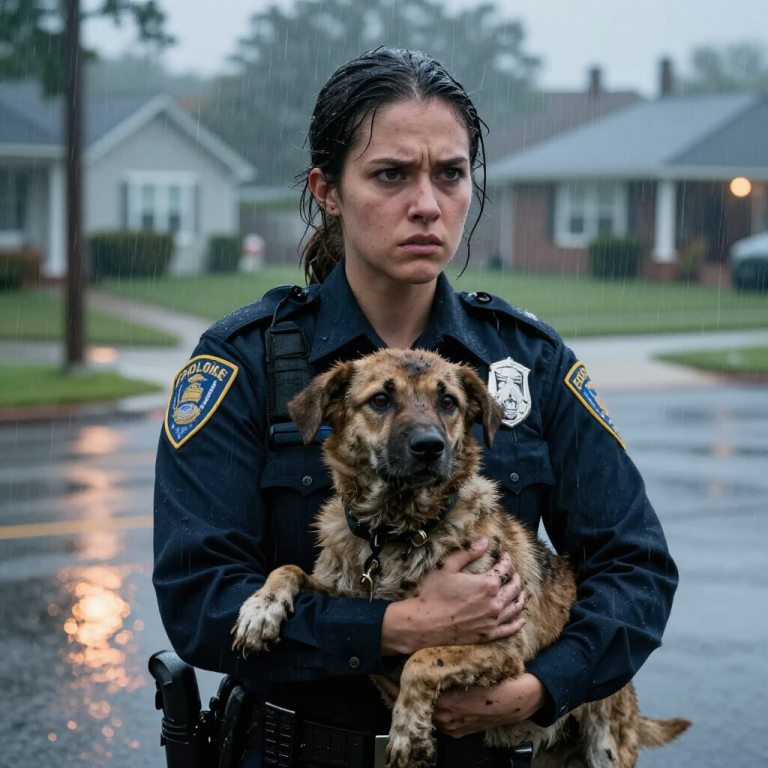
I froze, my hand hovering over the coffee cup I had just bought from the gas station. I looked out the windshield of my cruiser. The Minnesota winter was screaming tonight. It was four degrees below zero, and the wind chill was pushing it to minus twenty. The kind of cold that hurts your teeth when you breathe. A grown man wouldn’t last an hour out there without serious gear.
A six-year-old in pajamas? She didn’t have hours. She had minutes.
I looked back at Titan, my partner. He was a ninety-pound Belgian Malinois, a ball of muscle and instinct currently asleep in the heavy-duty kennel behind my seat. He didn’t know it yet, but he was about to become the most important creature on earth tonight.
“Unit K-9 One, show me en route,” I radioed in. My voice was steady—force of habit—but my grip on the steering wheel was white-knuckled. “ETA four minutes.”
I flipped the sirens on. The wail cut through the silent, frozen streets. I drove fast, the tires crunching over the fresh layer of powder that was rapidly turning into ice.
Oakridge Lane. I knew the area. It was “The Hill.” Massive, new-build suburban fortresses where the driveways were heated and the problems were usually hidden behind heavy oak doors. People up here didn’t lose their kids. They hired people to watch them.
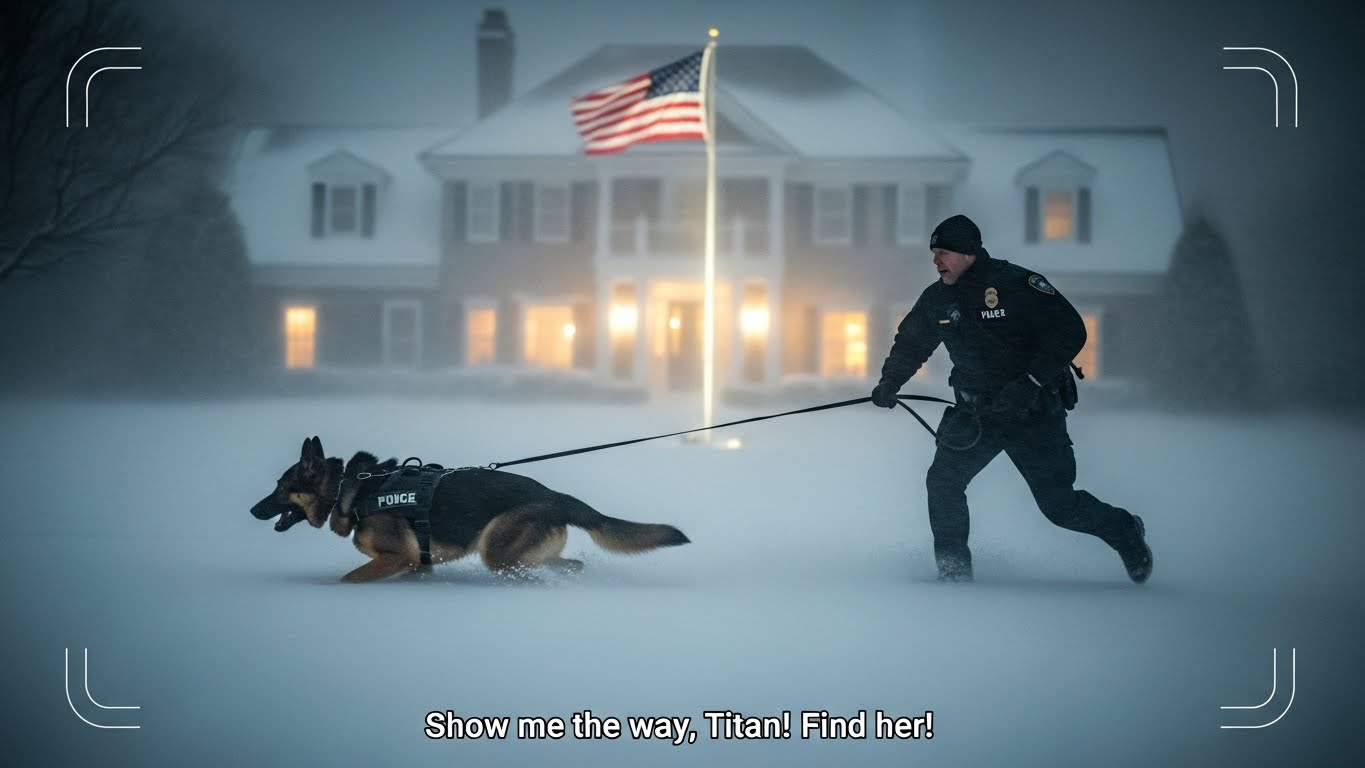
When I pulled up to the house, it was imposing. A brick monster with three luxury cars in the driveway. The porch light was on, casting a sickly yellow glow on the swirling snow.
I parked the cruiser at an angle, keeping the engine running to keep the heat blasting for when—if—we found her.
I hopped out, the cold hitting me like a physical blow to the chest. I went to the back door and popped the kennel.
“Let’s work, Titan,” I said.
He jumped out, shaking his fur, instantly alert. His ears swiveled, catching the sound of the wind, the distant sirens, the crunch of my boots. He looked at me, waiting for the command. He knew the tone of my voice. This wasn’t a drug bust. This wasn’t a suspect apprehension. This was a hunt.
I walked up the driveway, Titan heeling perfectly at my left side.
The front door opened before I could ring the bell. The father met me. He was a tall man, wearing a thick cable-knit sweater and holding a tumbler of amber liquid. Scotch, probably. He didn’t look like a man whose daughter was freezing to death in the wilderness. He didn’t look frantic. He looked… annoyed.
“Officer,” he said, blocking the doorway slightly. “Glad you’re here. This is ridiculous.”
“Where was she last seen?” I asked, skipping the pleasantries.
“She’s having an episode,” he said, taking a sip of his drink. “She just… bolted. Out the back door. We’ve been calling her for twenty minutes.”
I stopped. I stared at him. “Twenty minutes?” I repeated, my voice dropping an octave. “Sir, it is four degrees below zero. In this weather, twenty minutes is a lifetime. Why didn’t you call sooner?”
He shrugged, shifting his weight. “She does this for attention. We thought she was hiding in the shed. We checked, she wasn’t there. So, we called.”
My gut twisted. I’ve been a cop for fifteen years. I’ve worked homicide, narcotics, and now K9. I know the smell of a lie. It smells distinct, usually mixed with fear or arrogance. This was arrogance. Pure, unfiltered arrogance.
“I need something with her scent. Now,” I commanded, stepping past him into the warmth of the foyer.
The heat inside was suffocating, a stark contrast to the death trap outside. It smelled of expensive candles and roast beef.
The stepmother was in the kitchen, leaning against the marble island, scrolling on her phone. She didn’t even look up when I walked in with a ninety-pound police dog.
“There’s a dirty pillowcase in the laundry room,” she said, waving a manicured hand vaguely toward a hallway. “Use that.”
She was too calm. They were both too calm. Usually, parents are hysterical. They’re grabbing my uniform, begging me to find their baby. These two acted like they had lost a set of keys.
I walked into the laundry room and grabbed a small pillowcase with a cartoon unicorn on it. I brought it up to my nose briefly. It smelled like lavender detergent and something else—sweat and fear. Subtle, but there.
I looked down at Titan. He was vibrating with energy, his golden eyes locked on me.
“Ready, buddy?” I whispered.
I took the pillowcase back outside, leaving the suffocating warmth of the house behind. I needed the cold. The cold told the truth.
CHAPTER 2: The Track
We stood on the back patio. The wind was whipping around the corners of the house, creating miniature tornadoes of snow.
I presented the pillowcase to Titan. “Find her, buddy. Find her.”
Titan buried his nose in the fabric. I could hear the sharp intake of air as he processed the molecular signature of a lost little girl named Lily. He inhaled deeply, cataloging the scent, separating the lavender from the child, the fear from the fabric.
Then, he snapped his head up.
This is the moment that always gets me. The switch flip. He went from a dog to a biological tracking instrument.
I expected him to pull toward the open gate on the left, the logical exit for a runaway child heading toward the street or the neighbor’s house.
He didn’t.
He pulled hard toward the right. Toward the locked side yard. Toward the darkest part of the property where the manicured lawn met the wild, unkempt woods.
“Trust your dog,” the trainers always tell you. It’s the golden rule. Even when it doesn’t make sense, trust the dog.
We moved fast. The snow in the backyard was knee-deep in drifts. Titan was a machine, plowing through the white powder, his nose skimming the surface.
I watched him closely. He wasn’t tracking a running child. When a person runs, the scent pools in specific intervals. Step, step, step.
Titan was confused. He was circling, then moving forward, then circling again.
He stopped at the edge of the patio concrete. He whined. A low, high-pitched sound that he only made when he was distressed. He looked back at me, his eyes reflecting the tactical light from my flashlight.
I shone the beam down at the snow where he was standing.
There were no footprints leading away from the patio.
My heart hammered against my ribs. If she ran away, there would be footprints. Even in a blizzard, the depressions would last for an hour or so before filling up.
I knelt down, brushing the top layer of fresh powder away.
There were no footprints. But there were grooves.
Two parallel lines, dragging through the snow. Small, frantic grooves that were quickly being filled in by the blizzard.
She hadn’t run away. She hadn’t bolted.
She had been dragged. Or she was crawling.
“Seek!” I yelled, giving Titan the lead.
He bolted. He hit the end of the thirty-foot tracking lead so hard he almost dislocated my shoulder. We were running now, sprinting toward the tree line.
The wind howled, trying to erase the world around us, but Titan had a lock. He dragged me over a frozen creek, the ice cracking ominously under my boots. We smashed through a patch of thorns that tore at my uniform pants, drawing blood. I didn’t feel it. I only felt the ticking clock in my head.
Twenty-five minutes since she was “last seen.” Thirty minutes.
Hypothermia sets in fast for a child. The body shunts blood to the core. Confusion sets in. Then sleepiness. Then the heart stops.
We were deep in the woods now. The suburban lights were gone, swallowed by the trees and the storm. It was just me, the dog, and the beam of my flashlight cutting through the falling snow.
Titan was panting, his breath coming in massive clouds of steam. He was working harder than I’d ever seen him work.
Suddenly, he stopped.
He didn’t bark. He didn’t jump.
He just stood still, staring at the base of a massive, ancient oak tree about fifty yards ahead. The tree was surrounded by heavy brush, a place no six-year-old would accidentally wander into.
Titan lay down in the snow.
That was his passive alert. That was his signal.
I found it.
I unholstered my flashlight and ran, stumbling over hidden roots.
“Lily!” I screamed against the wind. “Lily!”
Nothing but the roar of the storm.
I reached the tree. Titan was there first, nudging a small mound of snow at the base of the trunk.
I fell to my knees, frantic. I dug with my gloved hands. My gloves were soaked instantly, freezing my fingers, but I dug.
I brushed away the white powder.
And I saw it.
A patch of pink fleece.
She was curled into a ball so tight she looked like a discarded doll. Her knees were pulled up to her chest, her head tucked down. She was wearing thin cotton pajamas. No coat. No hat.
And she was barefoot. Her feet were purple.
“Dispatch!” I roared into my radio, my voice cracking. “I have the child! Sector four, in the woods! She is unresponsive! I need EMS now! Code 3 to the residence!”
I grabbed her shoulders. They were hard. Rigid.
I rolled her over. Her skin was the color of marble. Her lips were blue. Her eyes were closed.
She wasn’t shivering.
That was the worst sign. Shivering is good. Shivering means the body is still fighting. When the shivering stops, the body is giving up.
“No, no, no,” I whispered. I ripped off my heavy tactical jacket, exposing myself to the biting wind. I didn’t care.
I wrapped the jacket around her tiny frame, engulfing her. I pulled her onto my lap, trying to transfer every ounce of my body heat into her.
“Lily, come on,” I said, rubbing her back vigorously through the jacket. “Come on, sweetheart. Wake up.”
Titan moved closer. He curled his warm, massive furry body around her legs, pressing his head against her stomach. He was whining softly, licking her frozen hand.
I checked for a pulse.
It was faint. Thready. A ghost of a heartbeat against my fingertips.
“Stay with me,” I commanded, rocking her.
Then, her eyelids fluttered.
Just a crack.
She looked up. Her eyes were unfocused, glassy. She looked at me, then past me, through the trees, toward the faint glow of the house in the distance.
Her lips moved. No sound came out.
I leaned my ear down close to her mouth.
“Did…” she whispered. Her voice was like cracking ice. “Did I do a good job?”
I pulled back, confused, tears instantly freezing on my cheeks. “What?”
“Daddy said…” she wheezed, her breath shallow. “Daddy said if I… if I stayed quiet by the tree… I could come back inside. Am I allowed to come back inside yet?”
I froze.
The rage that filled my chest was hotter than any fire. It burned through the cold, through the exhaustion.
I looked back at the house. That warm, expensive fortress where a man stood drinking scotch and a woman scrolled on her phone.
They hadn’t lost her. They hadn’t disciplined her.
They had put her out here like a dog.
“Yes, baby,” I choked out, pulling her against my chest so tight I was afraid I’d break her. “You did a good job. You did a perfect job.”
I stood up, lifting her effortlessly in my arms. She weighed nothing.
“But you’re never going back into that house again,” I whispered into the storm. “Over my dead body.”
Titan stood up, his hackles raised, looking back toward the house. He let out a low, menacing growl.
He knew.
We began the run back. But this wasn’t a rescue mission anymore.
It was the start of a war.
CHAPTER 3: The Longest Mile
The run back to the house was the hardest physical thing I have ever done in my life.
I am a big guy. I lift weights. I train for endurance. But running through two feet of snow, in sub-zero temperatures, carrying a fifty-pound child while adrenaline dumps toxic waste into your bloodstream—it destroys you.
My lungs burned as if I were inhaling broken glass. My legs felt like lead. But I didn’t slow down. I couldn’t.
Every time I looked down at the bundle in my arms, I saw her blue lips. I saw the frost on her eyelashes.
“Titan, go! Home! Go home!” I shouted, breathless.
Titan was forging the path ahead of me. He was breaking the snow drifts with his chest, creating a wake for me to run in. He knew the urgency. He didn’t stop to sniff or explore. He was in rescue mode.
As we broke through the tree line and back into the manicured backyard, the scene had changed.
The silence was gone. The night was now a chaotic strobe light of red and blue.
An ambulance had arrived, its boxy frame backed all the way up the driveway. Another patrol car was skidding to a halt on the street.
I saw the parents. They were still on the porch.
The father was standing with his arms crossed, watching the lights like he was watching a boring movie. The stepmother was talking to a uniformed officer, gesturing wildly with her phone in her hand.
When I burst into the circle of light from the backyard, screaming for a medic, the stepmother stopped talking.
“I have her!” I bellowed. “She’s hypothermic! Get the stretcher! Now!”
Two paramedics jumped out of the rig. I knew them—Miller and Kowalski. Good guys. Veterans.
They didn’t ask questions. They saw the blue skin, the limp limbs, and they moved with practiced, terrifying speed.
I laid Lily onto the gurney. The moment she left my arms, I felt a phantom cold wash over my chest where she had been.
“Core temp is going to be critical,” Miller said, ripping open a warming pack. “Get her in the rig. Crank the heat.”
As they were strapping her in, the father walked down the porch steps. He didn’t run. He walked.
He approached the gurney. He looked down at his daughter, who was hovering on the edge of death.
“Is she okay?” he asked.
His tone wasn’t fearful. It was… inconvenient. It was the tone of a man asking if his flight was delayed.
I snapped.
I stepped between him and the ambulance, my chest heaving, steam rising off my uniform. I was shaking, not from the cold, but from a violence I was barely holding back.
“Back off,” I growled. It came out deeper and darker than my normal voice.
“Excuse me?” He bristled, straightening up. “That is my daughter. You can’t tell me to—”
“I said back the hell off!” I roared, shoving a finger in his face. Titan, sensing my aggression, let out a bark that sounded like a gunshot. He lunged to the end of his lead, teeth bared, eyes locked on the father’s throat.
The father stumbled back, his face finally showing an emotion: fear.
“Get in the car, sir,” the other officer, a rookie named Davis, stepped in, putting a hand on the father’s arm. “Let the medics work.”
I turned back to the ambulance. Miller was looking at me.
“She’s bradycardic, Sarge,” Miller said, his voice low. “Heart rate is dropping. We gotta go. Now.”
“I’m riding with her,” I said.
“What about the dog?”
“Davis!” I yelled at the rookie. “Take Titan. Put him in my unit. Keep the heat on. Don’t let anyone touch him.”
I didn’t wait for an answer. I jumped into the back of the ambulance. The doors slammed shut, sealing us in a bright, warm box that smelled of rubbing alcohol and diesel fumes.
As the siren wailed and we lurched forward, I looked down at Lily. They were cutting the pink pajamas off her.
That’s when I saw it.
It wasn’t just the cold.
Her ribs were visible, counting them was easy. She was malnourished.
And on her back, crisscrossed like a roadmap of pain, were scars. Some old and white, some new and angry red.
Miller looked at me. He stopped working for a split second, his eyes wide.
“Sarge,” he whispered. “These aren’t from the woods.”
“No,” I said, my voice trembling with rage. “No, they’re not.”
I took her tiny, ice-cold hand in mine.
“You fight, Lily,” I whispered. “You fight, because I’m going to destroy them. I promise you.”
CHAPTER 4: The Map of Pain
The hospital emergency room was a controlled riot.
When a pediatric code comes in, the atmosphere changes. The jokes stop. The casual chatter dies. Everyone moves with a singular, desperate focus.
We burst through the double doors, Miller shouting vitals.
“Female, six years old. severe hypothermia. Core temp read 88 degrees. Heart rate 45 and dropping. Signs of chronic abuse.”
That last part—signs of chronic abuse—hit the trauma team like a physical slap.
They swarmed her. Doctors, nurses, respiratory therapists. I was pushed to the wall, a helpless observer in a dirty, wet uniform.
I watched them insert IVs. I watched them drape her in the “bear hugger”—a device that blows hot air to rewarm the body. I watched the cardiac monitor, the green line beeping sluggishly.
Beep… … … Beep… … … Beep.
It was too slow.
“She’s going into V-fib!” a doctor shouted. “Charging paddles! Clear!”
My heart stopped.
I watched the little body jump as the electricity hit her.
“No change. Again! Clear!”
Thump.
“We have a rhythm. Sinus bradycardia. She’s back. Let’s get that temp up, people, but slowly. Watch for afterdrop.”
I slumped against the wall, sliding down until I hit the floor. I put my head in my hands. I was shivering now. The adrenaline was wearing off, leaving behind a cold, hollow exhaustion.
A nurse walked over to me. She was older, with kind eyes and tired lines around her mouth. She handed me a blanket and a cup of lukewarm coffee.
“She’s a fighter, Officer,” she said softly.
“Is she going to make it?” I asked, looking up.
“The cold actually preserves the brain,” she said. “If we can warm her up without sending her into shock again… she has a chance. But…”
She hesitated.
“But what?”
“I saw the intake exam,” she whispered, glancing back at the trauma room. “The hypothermia is the least of her problems. That little girl has been through hell.”
I nodded. “I saw the scars.”
“It’s not just scars,” she said, her voice tightening. “Old fractures. Ribs that healed wrong. A spiral fracture in the left arm that suggests twisting. Malnutrition. She weighs thirty-five pounds. A six-year-old should be forty-five, fifty.”
She looked at me, her eyes hard. “Who are the parents?”
“Rich people,” I spat. “People with a big house and expensive lawyers.”
“Well,” she said, straightening her scrubs. “I don’t care how rich they are. I’m documenting every millimeter of that child’s body. They won’t talk their way out of this.”
Just then, the double doors of the ER swung open.
It was the father. And the stepmother.
They looked out of place in the sterile, chaotic hallway. He was wearing a camel-hair coat over his sweater. She had touched up her makeup.
They walked up to the nurse’s station like they were checking into a hotel.
“We’re here for Lily,” the father said. “We’re the parents.”
I stood up. The blanket fell off my shoulders.
I walked toward them. My boots squeaked on the linoleum. I was dirty, covered in mud and pine needles. I probably smelled like wet dog and sweat.
The father saw me approaching. He stopped.
“You again,” he sneered. “Look, I want to file a complaint about your conduct. You threatened me. You set your dog on me.”
I didn’t stop walking until I was six inches from his face. I’m six-foot-two. He was maybe six-foot. I loomed over him.
“You want to file a complaint?” I asked, my voice dangerously quiet.
“Yes. And I want to speak to your supervisor. And I want to see my daughter.”
“You aren’t seeing anyone,” I said. “This is a crime scene now.”
“Excuse me?” The stepmother piped up. “She’s our child. You can’t keep us from her.”
“She is a victim,” I said, turning my gaze to her. “And you two are the suspects.”
“Suspects? For what?” The father laughed, a nervous, incredulous sound. “She ran away! We told you!”
“I found her by the old oak tree,” I said.
The color drained from the father’s face. It happened instantly. One second he was flushed with indignation, the next he was grey.
“The tree where she said she had a ‘job’ to do,” I continued, watching his eyes. “The tree where she said Daddy told her to wait until she was allowed back inside.”
He opened his mouth, but no sound came out.
“And then there are the scars,” I said, stepping closer, forcing him to take a step back. “The broken ribs. The starvation.”
“She falls a lot,” the stepmother said quickly. Too quickly. “She’s clumsy. She has… brittle bones.”
“We’ll see what the doctors say,” I said. “But right now, you are not parents. You are perps.”
“Officer!”
I turned. It was Captain Reynolds, my supervisor. He was walking briskly down the hall, flanked by two detectives.
“Captain,” I said. “Do not let these people in that room.”
Reynolds looked at me. He saw the look in my eyes. He saw the mud on my uniform. He looked at the parents, who were now trying to look like aggrieved victims.
“Step aside, Sergeant,” Reynolds said to me.
My heart sank. “Captain, they—”
“I said step aside,” Reynolds repeated. He turned to the detectives. “Take Mr. and Mrs. Vance to Interview Room B. Separate them. Read them their rights.”
The father’s eyes bugged out. “Rights? Am I under arrest?”
“You’re being detained for questioning regarding the attempted homicide of a minor,” Reynolds said, his voice flat and professional.
“Attempted homicide?” the stepmother shrieked.
“Get them out of here,” Reynolds ordered.
As the detectives guided the protesting couple away, Reynolds turned back to me. He put a hand on my shoulder.
“Go home, Jack. You’re done.”
“I’m not leaving her,” I said.
“You’re emotional. You’re compromised. You almost assaulted a suspect in the ER waiting room.”
“I saved her life.”
“And you did a damn good job,” Reynolds said. “But you can’t work this case. It’s Conflict of Interest 101. You’re the finding officer. You’re a witness. Go home. Shower. Feed Titan. Write your report in the morning.”
I looked at the doors to the trauma room. I could see the doctors through the small glass window. They were stepping back.
Lily was stabilized.
“I’ll go,” I said. “But Captain?”
“Yeah?”
“Check the basement,” I said.
Reynolds frowned. “The basement? Why?”
“Just a hunch,” I lied. It wasn’t a hunch. It was something I had seen in Titan’s eyes back at the house. He hadn’t just alerted to the woods. Before we went outside, he had paused at the basement door. He had whined.
I had ignored it then because the mission was outside. But Titan never lied.
“Check the basement,” I repeated. “And tell the crime scene guys to look for a lock on the outside of the door.”
Reynolds stared at me for a long moment. Then he nodded. “I’ll make the call.”
I walked out of the hospital into the freezing night. The cold didn’t bother me anymore. I was burning with a different kind of fuel now.
I went to my cruiser. Titan was waiting. He barked when he saw me, wagging his tail.
“We got her, buddy,” I whispered, resting my forehead against the metal mesh of the kennel. “But we aren’t done yet.”
I didn’t go home. I drove to the precinct parking lot, reclined my seat, and waited for dawn.
Because I knew that when the sun came up, the secrets hidden in that house on Oakridge Lane were going to come out. And I wanted to be there when they did.
CHAPTER 5: The Dungeon Beneath the Suburb
I woke up with a stiff neck and a mouth that tasted like old coffee. The sun was rising over the precinct parking lot, turning the grey slush into blinding white.
My phone buzzed. It was a text from Detective Martinez, an old friend from the Crime Scene Unit.
“You were right. You need to see this. We’re still at the house.”
I didn’t wait. I started the cruiser, threw a beef jerky stick to Titan in the back—his breakfast for now—and drove back to Oakridge Lane.
The scene looked different in the daylight. Less spooky, more clinical. The yellow tape was stark against the white snow. Neighbors were gathered in tight clusters, holding mugs of coffee, whispering, pointing. They were the same people who “didn’t hear anything” for years.
I flashed my badge at the rookie guarding the perimeter and ducked under the tape.
Martinez met me at the front door. He looked sick. Martinez has seen bodies decomposed for weeks; he’s seen gang hits. He doesn’t get sick.
“Jack,” he said, lighting a cigarette even though he was standing inside the foyer. “You nailed it with the basement.”
“What did you find?” I asked, dread pooling in my stomach.
“Come look.”
We walked through the kitchen. The smell of the expensive roast beef was gone, replaced by the chemical tang of fingerprint powder and the stale air of something rotting.
The basement door was in the hallway. It was a solid oak door, heavy.
And right there, at eye level, was a heavy-duty sliding deadbolt.
Installed on the outside.
“Who puts a deadbolt on the outside of a basement door?” Martinez asked rhetorically. “You lock things in, not out.”
He slid the bolt back and opened the door.
A waft of cold, damp air hit us. It smelled of mold, urine, and bleach. A terrifying cocktail.
We walked down the wooden stairs. The basement was finished—carpeting, a pool table, a big screen TV area. It looked like a normal “man cave.”
“Keep going,” Martinez said, pointing to a small door in the far corner, behind the furnace. It looked like a storage closet.
I walked over. This door also had a lock on the outside. A padlock hasp. The padlock was currently hanging open.
I pulled the door open.
It wasn’t a closet.
It was a concrete cell. Maybe six feet by six feet. No windows. No ventilation. The walls were unfinished concrete, cold to the touch.
In the corner lay a thin, stained crib mattress. No sheets. No pillow. Just a bare, yellowed piece of foam.
Next to it was a plastic bucket.
And on the wall… that was what broke me.
On the grey concrete, drawn in what looked like crayon or maybe chalk, were crude pictures.
A sun. A flower. A dog that looked remarkably like a shepherd.
And words, written in shaky, childish block letters:
I WILL BE GOOD. I WILL BE QUIET. I AM SORRY.
The words were written over and over again, covering the wall like the frantic scrawls of a prisoner in an asylum.
“We found a baby monitor hidden in the ceiling joists,” Martinez said, his voice quiet. “It connects to the master bedroom. They could hear everything. Every cry. Every beg for water.”
I stepped inside the room. It was freezing. Colder than the rest of the house.
“There’s no heat duct in here,” I noted.
“No,” Martinez said. “And look at the door frame.”
I looked. There were scratch marks on the inside of the wood. Deep gouges. From fingernails.
“She tried to dig her way out,” I whispered.
“We found a schedule taped to the back of the door,” Martinez said, handing me an evidence bag.
I looked at the piece of paper inside. It was typed. Laminated.
06:00 – Wake up. Bathroom bucket. 06:15 – Silent Reflection (Closet). 07:00 – Chores (Snow shoveling/Weeding). 08:00 – School (If behavior permits). 16:00 – Inspection. Any flaws = Night in the Box.
“Night in the Box,” I read aloud. “This isn’t discipline. This is a concentration camp.”
“There’s more,” Martinez said. “We found the food log. They were feeding her 500 calories a day. Rice. Broth. While they were eating steak upstairs.”
I crushed the plastic bag in my hand. The rage was back, vibrating in my fingertips.
“Where are they?” I asked.
“Holding cell at the precinct. Lawyer is already there. High-priced scumbag named Sterling.”
“Sterling,” I spat. “Of course.”
“Jack,” Martinez warned. “Don’t do anything stupid. The evidence is solid. The room speaks for itself.”
“Does it?” I asked, looking at the scratch marks one last time. “Rich people have a way of explaining away rooms. They’ll call it a ‘time-out zone.’ They’ll say she had behavioral issues. They’ll say she was dangerous.”
“She’s six!”
“I know,” I said, turning away from the cell. “But I need to hear it from her. I need her to bury them.”
I walked out of the basement, past the pool table, past the luxury. I needed to get back to the hospital.
Because Titan was waiting in the car, and I had a feeling Lily was going to need her guardian angel today.
CHAPTER 6: The Good Girl List
The Pediatric ICU was quiet, a stark contrast to the ER the night before. Machines hummed rhythmically. Nurses moved in soft-soled shoes.
I found Lily’s room at the end of the hall. Room 402.
I knocked softly on the open door.
She was awake.
She looked tiny in the hospital bed, swallowed by white sheets and tubes. The IV line in her arm looked like a rope compared to her twig-like wrist. Her face was still pale, but the blue tinge was gone.
She was staring at the ceiling, unmoving.
“Hey there,” I said softly.
She flinched. Her eyes snapped to me, wide with panic. Then, she recognized me.
“Mr. Policeman,” she whispered.
“It’s Jack,” I said, walking in slowly, keeping my hands visible. “And I have a friend outside who wants to say hi, but they don’t allow dogs in the hospital.”
A ghost of a smile touched her lips. ” The big doggy?”
“Titan. Yeah. He’s sleeping in my car. He told me to check on you.”
I pulled a chair up to the side of the bed. “How are you feeling?”
“Warm,” she said. She said the word like it was a miracle. “I’m really warm. And I had Jell-O. Red Jell-O.”
“Red is the best flavor,” I agreed.
She looked at me, her expression turning serious. “Did… did my Daddy come?”
My heart broke. Even after everything—the cold, the basement, the bucket—she was still looking for him. That’s the tragedy of kids. They love their abusers because they don’t know any better. They think the abuse is their fault.
“No, sweetie,” I said carefully. “Your Daddy and your stepmom… they are in a timeout. A big timeout.”
“Because I was bad?” she asked, her lower lip trembling. “Because I ran away?”
“No!” I said, maybe a little too forcefully. I softened my voice. “Lily, look at me. You were never bad. You are a hero. You survived the storm.”
She shook her head. “No. I have a list. The Good Girl List. Mommy… Stepmommy gave it to me.”
“What list?”
“If I do everything on the list, I get to eat dinner at the table,” she explained earnestly. “But I never finish it. I always mess up. I drop a spoon. Or I speak too loud. Or I leave a smudge on the window.”
She held up her hands. Her fingers were bandaged.
“I tried to clean the window,” she whispered. “But it was so cold.”
I reached into my pocket and pulled out my notepad. “Lily, I need you to be brave for me. Can you tell me what happened last night? Before you went outside?”
She went quiet. She picked at the blanket.
“It’s okay,” I said. “You’re safe here. Nobody can hurt you. Titan is outside.”
She took a deep breath.
“Stepmommy was mad,” she began, her voice barely audible. “She couldn’t find her necklace. She said I stole it.”
“Did you?”
“No! I don’t touch her things. I promise!” Tears welled up in her eyes. “But she didn’t believe me. She told Daddy I was a thief and a liar.”
She paused, swallowing hard.
“Daddy was drinking his special juice. He gets… sleepy when he drinks it. Or mad. He told me to stop crying. He said he was sick of looking at me.”
I wrote everything down, my pen digging into the paper.
“Then what happened?”
“Stepmommy said I needed to cool off,” Lily whispered. “She opened the back door. She said… she said if I wanted to be part of this family, I had to learn to appreciate the warmth. She told me to go stand by the big tree. The ‘Thinking Tree’.”
“And your shoes?” I asked.
“She took them,” Lily said simply. “She said shoes are for people who deserve to walk inside.”
I closed my eyes for a second, fighting the urge to punch the wall. Shoes are for people who deserve to walk inside.
“She locked the door,” Lily continued. “I waited. I counted to one hundred. Then two hundred. It got really cold. My feet hurt. Then they stopped hurting. They felt like… wood.”
“And then?”
“Then I got sleepy,” she said. “I sat down. I knew I wasn’t supposed to sit down. That breaks the rules. But I was so tired. I thought… maybe if I just slept a little bit, I could wake up and try again to be good.”
She looked at me, her eyes piercing.
“Am I going to jail?” she asked.
“What? Why would you go to jail?”
“Stepmommy said if I told anyone about the rules, the police would come and take me to jail. She said the police hate bad little girls.”
I stood up. I couldn’t sit anymore.
I walked over to the bed and knelt down so I was eye-level with her.
“Lily,” I said firmly. “Your stepmother is a liar. The police don’t hate you. We work for you. Titan works for you. I work for you.”
I took her uninjured hand.
“And I promise you, the only people going to jail are the ones who put you out in that snow.”
The door opened. It was a suit. A woman in a grey blazer, holding a briefcase. Social Services.
“Officer?” she said. “I’m Sarah from CPS. I need to take custody of the minor.”
“She stays here,” I said, standing up and blocking the bed. “She’s not medically cleared.”
“I know,” Sarah said, looking tired. “But we have a situation. The father’s lawyer is already filing for emergency custody. He claims the child has a history of mental illness and self-harm, and that the ‘room’ in the basement was a sensory deprivation therapy room recommended by a doctor.”
“That’s a lie,” I growled.
“They have a signed letter from a psychiatrist,” Sarah said, dropping the bomb. “Dr. Aris. He’s on their payroll, probably, but it’s legal documentation. They are trying to spin this as you interfering with a medical treatment plan for a troubled child.”
I felt the blood drain from my face.
They were going to do it. They were going to use their money to turn the victim into the villain.
“They aren’t taking her,” I said. “Not while I’m breathing.”
Sarah looked at me, then at Lily.
“Then you better get more evidence, Jack,” she whispered. “Because the hearing is tomorrow morning. And right now, it’s their word against a six-year-old’s.”
I looked at Lily. She had fallen back asleep, clutching the red Jell-O cup like a lifeline.
I needed something undeniable. The basement was bad, but they had an explanation. The malnutrition? They’d claim she had an eating disorder.
I needed the smoking gun.
And then I remembered.
The stepmother’s phone.
When I was in the kitchen, she was scrolling. When the ambulance came, she was recording.
Narcissists don’t just torture; they document. They like to re-watch their power.
“I have to go,” I told Sarah. “Guard this door. Don’t let anyone in. Not even the Chief of Police.”
I ran out of the room. I had to find that phone.
Here is the final part of the story (Chapters 7 & 8).
—————-FULL STORY (PART 4 – FINAL)—————-
CHAPTER 7: The Smoking Gun
I drove back to the precinct like a madman. The roads were plowed now, the black asphalt slick with salt, but my mind was still stuck in that freezing backyard.
When I burst into the bullpen, the atmosphere was tense. It was quiet—too quiet.
I saw why.
Standing at the Sergeant’s desk was a man in a three-piece charcoal suit. He had hair that cost more than my car and a smile that looked like it was carved out of shark cartilage.
Sterling. The parents’ lawyer.
He was arguing with Captain Reynolds.
“My clients have been held for six hours,” Sterling was saying, his voice smooth and projecting just enough for everyone to hear. “You have no physical evidence of intent. You have a tragic accident involving a child with a history of behavioral wandering. I am demanding their immediate release and the return of their personal effects. specifically, Mrs. Vance’s phone, which contains sensitive business contacts.”
My heart hammered. The phone.
He knew. He knew what was on it. You don’t demand a phone back that urgently unless it holds the keys to your coffin.
Reynolds looked tired. “We have a warrant pending, Mr. Sterling.”
“Pending isn’t signed,” Sterling countered, checking his Rolex. “If you don’t have a judge’s signature in ten minutes, I’m filing a motion for unlawful seizure.”
I walked up to the desk. Reynolds saw me and his eyes widened. “Jack, get out of here.”
“The necklace,” I said, breathless.
Sterling turned to look at me, sniffing disdainfully. “Excuse me?”
I ignored him and looked at Reynolds. “Lily told me why they put her out. The stepmother accused her of stealing a necklace. She claimed she didn’t have it. If that necklace is in the house, it proves the motive for the punishment was a lie. But if the necklace is not in the house… maybe it’s because the stepmother hid it.”
I pointed at the evidence bags sitting on the back counter.
“Or maybe,” I said, my voice rising, “she has it on her.”
Sterling stepped in front of me. “You are not searching my client.”
“We don’t need to search her,” I said, grabbing a pair of latex gloves from the box on the counter. “We already did. Upon booking.”
I walked over to the clear plastic bag labeled VANCE, ELENA – PERSONAL EFFECTS.
Inside, amidst a tangle of expensive jewelry, a watch, and a phone, was a diamond pendant.
“Is this the necklace?” Reynolds asked, catching on.
“Lily said it was a diamond heart,” I bluffed. I didn’t know for sure, but I gambled. “Looks like a heart to me.”
I looked at Sterling. “If she had the necklace the whole time, then putting the kid outside wasn’t discipline. It was torture for sport.”
Just then, the fax machine whirred. A moment later, a detective ran out of the back office waving a paper.
“Warrant signed!” he yelled. “Judge Miller just authorized the digital dump of all devices!”
Sterling’s face twitched. For the first time, the shark smile dropped.
“This is harassment,” he muttered, grabbing his briefcase. “I’ll see you in court.”
“You won’t make it to court,” I said as he stormed out. “Martinez! Get that phone to Cyber. Now!”
I followed Martinez into the tech lab. It was a dark room humming with servers. The tech guy, a wiz kid named Kevin, plugged the phone into the Cellebrite machine.
“It’s an iPhone,” Kevin said. “Passcode locked. But… ah, she’s not a criminal mastermind. The code is 1-2-3-4-5-6.”
“You’re kidding,” I said.
“Arrogance,” Martinez muttered. “She didn’t think anyone would ever dare look.”
The screen lit up. Kevin worked his magic, bypassing the cloud sync and dumping the data onto the main screen.
“Photos,” I commanded. “Check the ‘Recently Deleted’ folder.”
Kevin clicked.
The folder was full. Dozens of files deleted just before the police arrived.
“Play the last video,” I said. The timestamp was 11:20 PM. Twenty minutes before I got the call.
Kevin hit play.
The audio filled the small room. It was the sound of wind howling.
The video was shaky, shot vertically. It showed the back door, open a crack. Through the crack, you could see Lily.
She was standing in the snow, banging on the glass. She was crying, her mouth moving in silent pleas.
Then, the stepmother’s voice came from behind the camera. It was calm. Cruel.
“Look at her, David. She looks like a little rat out there.”
The father’s voice laughed in the background. “Let her freeze a bit. Toughen her up. Maybe she’ll think twice about interrupting my scotch time.”
The camera zoomed in on Lily’s freezing feet.
“Oh, look,” the stepmother cooed. “Her toes are turning purple. Do you think they’ll fall off? That would be ugly.”
“Give her ten more minutes,” the father said. “Then we’ll unlock it. If she’s still awake.”
The video ended with the sound of the door being slammed shut and the deadbolt sliding home.
The room was silent.
Martinez looked green. Kevin was staring at his shoes.
I felt a coldness in my stomach that had nothing to do with the weather. This wasn’t negligence. This wasn’t bad parenting.
“Premeditated,” Reynolds said from the doorway. He had been watching. “Torture. Conspiracy.”
He looked at me.
“Jack,” he said softly. “Go tell the parents they aren’t going home. Ever.”
CHAPTER 8: Warmth
I stood behind the one-way glass of Interview Room B.
Elena Vance, the stepmother, was sitting at the metal table. She looked bored. She was picking at her nails.
She didn’t know Sterling had left. She didn’t know about the video.
Reynolds walked into the room. He didn’t sit down. He just placed a laptop on the table, opened it, and pressed play.
I watched her face.
As the sound of her own voice filled the small concrete room—Do you think they’ll fall off?—her boredom vanished. Her eyes went wide. She went pale, then red.
She looked up at Reynolds.
“I… we were just joking,” she stammered. “It was a prank. For… for TikTok.”
“A prank?” Reynolds asked, his voice dead calm. “The District Attorney is calling it Attempted Murder in the First Degree, Aggravated Child Abuse, and Kidnapping.”
“My husband made me do it!” she screamed, the facade cracking completely. “He’s the one who hates her! He says she reminds him of his ex-wife! I just wanted to make him happy!”
I walked away from the glass. I didn’t need to see any more. They would turn on each other like rats in a bucket. They would spend the next twenty years in prison, blaming each other while the world forgot their names.
I had somewhere more important to be.
Six Months Later
The Minnesota spring is a beautiful liar. It comes late, but when it arrives, it explodes with green.
I was in my backyard. The snow was a distant memory. The grass was thick and lush.
I threw the tennis ball. It sailed in a high arc across the lawn.
Titan launched himself after it, a blur of fur and muscle. But he wasn’t the only one running.
“I’m gonna get it! I’m gonna get it!”
Lily was sprinting through the grass. She wasn’t fast enough to beat Titan, but she was fast.
She was wearing bright yellow sneakers. She loved shoes now. She had ten pairs. I bought her a new pair every week for the first month until the social worker told me to slow down.
She was different. Her cheeks were round and pink. She had gained twelve pounds. The shadows under her eyes were gone.
Titan grabbed the ball, but instead of bringing it to me, he dropped it at Lily’s feet. He nudged her hand with his wet nose.
She giggled, grabbing the ball and throwing it—about five feet.
Titan pretended to struggle to catch it, stumbling over his own paws to make her laugh. That dog was a better actor than he was a cop.
I sat on the porch swing, sipping coffee.
It hadn’t been easy. The foster care system is a nightmare of red tape. But being the hero cop who saved her—and having the entire police force backing my application—helped.
I was technically her foster dad for now. The adoption papers were sitting on my kitchen counter, signed by me, just waiting for the judge’s stamp next week.
The nightmares were getting better. She still slept with a nightlight, and she panicked if the house got too cold, so we kept the thermostat at 74 degrees, even in April. My electric bill was astronomical. I didn’t care.
Lily ran up to the porch, breathless, her forehead glistening with sweat. Titan trotted beside her, panting happily.
“Jack!” she yelled. “Did you see? I almost beat him!”
“I saw,” I smiled, reaching out to tuck a strand of hair behind her ear. “You’re getting faster every day.”
She climbed up onto the swing beside me. She didn’t flinch anymore when I moved quickly. She leaned her head on my shoulder.
“Is it going to snow again?” she asked, looking at a fluffy white cloud.
“Not for a long time,” I promised. “And when it does, we’ll have hot cocoa, and we’ll build a snowman, and then we’ll come inside and sit by the fire.”
She thought about this for a moment.
“And I can keep my shoes on?”
I looked down at her yellow sneakers.
“You can wear your shoes on the couch, on the table, I don’t care,” I laughed, kissing the top of her head. “You never have to take them off.”
Titan hopped up onto the swing on her other side, sandwiching her between us. A ninety-pound dog and a two-hundred-pound man, guarding a forty-pound girl.
She closed her eyes, basking in the sun.
“I like it here,” she whispered.
“I like you here too, Lily.”
The dispatch radio in the house crackled to life, a low murmur of the city’s problems. But I ignored it. I was off duty.
I looked at the scars on her arm, fading white lines against her tan skin. They would always be there. But they were just history now.
The cold was gone. The pack was together. And for the first time in a long time, the world felt warm.
THE END.