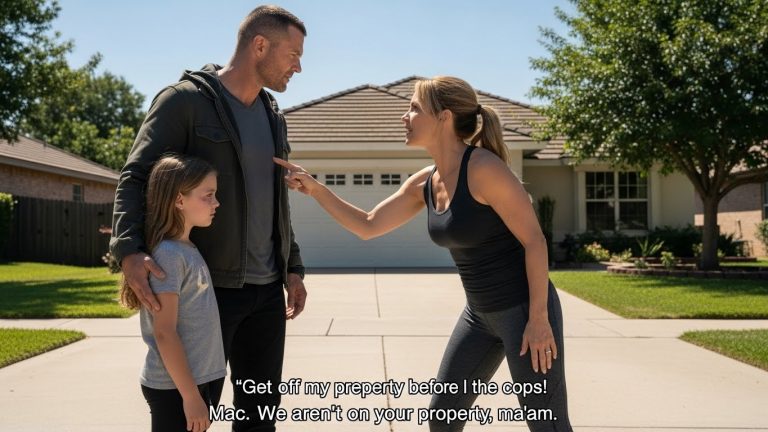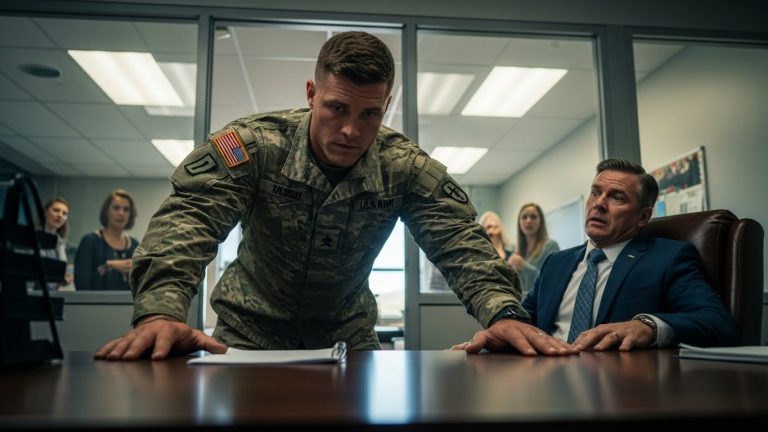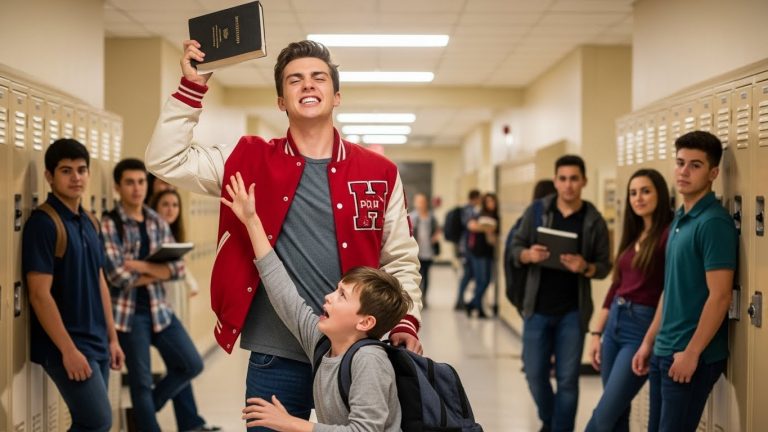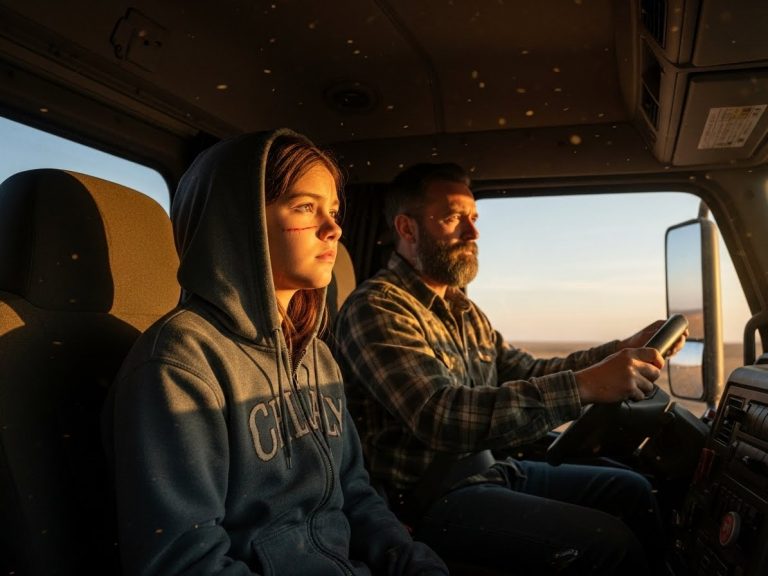
They thought she was an easy target. They didn’t know who her father was.
Chapter 1: The Ghost in the Drop-Off Line
The rain in Seattle doesn’t wash things clean; it just makes the grime slicker. I sat in my beat-up ’04 4Runner, the engine idling with a rough shudder that matched the tremor in my left hand.
The windshield wipers slapped back and forth. Thwack-hiss. Thwack-hiss. A metronome for my headache.

I hate the pickup line. It’s a battlefield I wasn’t trained for. In the Teams, you know who the enemy is. You know the rules of engagement. Here, at Oak Creek Middle School, the enemies wear expensive yoga pants and drive glistening Range Rovers, and the warfare is psychological.
I checked the rearview mirror. My eyes looked tired. The scar running from my jaw to my earlobe turned purple in the cold. I pulled my beanie lower. Just keep your head down, Miller. Get Lily. Go home. Don’t make a scene.
That was the mantra my therapist gave me. Reintegration requires de-escalation.
The bell rang. A chaotic flood of backpacks and bright jackets spilled out of the double doors. I scanned the crowd. Old habits die hard. I wasn’t looking for my daughter like a normal dad; I was scanning for threats.
Sector one clear. Sector two clear.
Then I saw her.
Lily. My little girl. She was twelve going on six, small for her age, with her mother’s eyes and my stubborn chin. But she wasn’t walking like she usually did. She was trudging. Shoulders hunched up to her ears. Head down, staring at the wet pavement.
She was walking alone. The crowd parted around her like she was contagious.
And then she turned slightly to navigate around a puddle, and I saw it.
My breath hitched in my throat. The air in the car suddenly felt thin, like I was at high altitude without a mask.
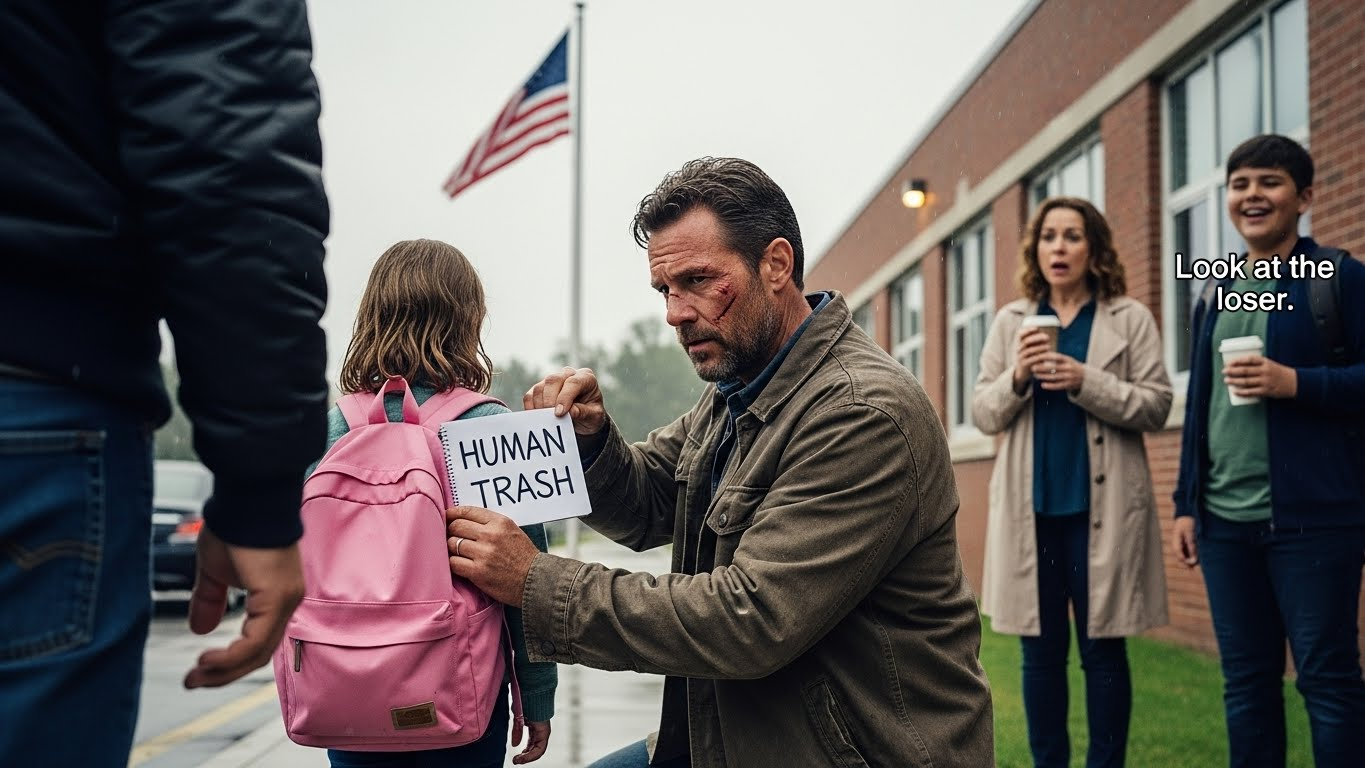
There, taped squarely to the back of her pink puffer jacket, was a sheet of college-ruled notebook paper. The edges were crinkled.
Written in thick, jagged Sharpie were two words:
HUMAN TRASH.
My vision tunneled. The sounds of the rain, the idling engine, the NPR radio station—it all dropped away into a dead silence. All I could hear was the rushing of blood in my ears. It sounded like the ocean at night before a breach.
A group of three boys walked behind her. They were pointing at her back, laughing. Not hiding it. Just pointing and laughing.
I looked at the sidewalk. Two teachers stood under the awning, staying dry. One was checking her phone. The other was looking right at Lily. Right at the sign.
She didn’t move. She didn’t call out. She took a sip of her latte and looked the other way.
My hand moved to the door handle. The metal felt cold.
De-escalation, the voice in my head whispered.
Neutralize the threat, the other voice screamed. The voice that had kept me alive in Kandahar and Yemen.
I opened the door.
Chapter 2: Zero Dark Thirty
I stepped out into the rain. I didn’t feel the cold. My boots hit the asphalt with a heavy, wet thud.
I didn’t run. You don’t run unless you’re under fire. You move with purpose. You move with a predator’s grace.
I shut the car door. It didn’t slam. It clicked shut. Controlled. Everything had to be controlled because if I lost control right now, I would scare Lily.
I walked through the line of idling luxury SUVs. A woman in a white Mercedes honked at me because I was crossing in front of her. I turned my head and looked at her through her windshield. Just for a second.
Her hand froze on the horn. She looked at my eyes—dead, flat, shark eyes—and she hit her door locks. Smart lady.
I reached the sidewalk. The crowd of kids seemed to sense a change in atmospheric pressure. The laughter behind Lily died down, replaced by confused murmurs. I wasn’t wearing camo. I was wearing jeans and a dark grey hoodie under a thrift-store jacket. But posture tells a story louder than clothes.
I walked straight to Lily.
She sensed someone behind her and flinched, curling tighter into herself.
“Lily,” I said. My voice was gravel, but soft.
She froze. She turned slowly, terror in her eyes. When she saw it was me, the dam broke. Her lower lip trembled, and the tears mixed with the rain on her cheeks.
“Dad?” she whispered. “Can we go? Please, just let’s go.”
She didn’t know about the sign. She just knew the world was laughing at her, and she didn’t know why.
I went to one knee. The wet pavement soaked through my jeans instantly. I was now at eye level with her. I gently took her shoulders.
“In a minute, baby girl. Hold on.”
I spun her around gently.
The three boys who had been laughing were standing five feet away. They were big kids. Eighth graders. Football jackets. They looked at me, realizing their fun had been interrupted by a grown-up, but they weren’t scared yet. They were arrogant.
I reached out and peeled the tape off Lily’s jacket.
Rrrrip.
The sound was unnaturally loud.
I held the paper up. The ink was starting to run from the rain, making the word TRASH look like it was bleeding.
I stood up. I’m six-foot-two. I turned to the boys.
“Who put this on her?” I asked.
Silence.
The leader, a kid with blonde hair and an expensive watch, smirked. “Maybe she put it on herself. She fits the description.”
The other two snickered.
The teacher under the awning finally decided to intervene. She bustled over, her heels clicking.
“Excuse me, sir! You can’t be on the sidewalk. You need to get back in your vehicle. You’re blocking the flow of traffic.”
I didn’t look at her. I kept my eyes on the blonde kid. I memorized his face. I memorized the insignia on his jacket. Oak Creek Tigers. Wrestling Team.
“Sir!” the teacher said, louder, putting a hand on my arm.
That was a mistake.
I didn’t strike her. I didn’t shove her. I just turned my head and looked at her hand on my sleeve, then looked at her face.
It was the “thousand-yard stare.” It’s the look of a man who has seen things that would shatter her reality. It’s the look that says, I am a dangerous animal, and you are touching me.
She snatched her hand back like she’d touched a hot stove. She gasped, stumbling back a step.
“This,” I held up the paper, my voice low and devoid of emotion, “was on my daughter’s back. You watched her walk past you.”
“I… I didn’t see…” she stammered.
“You saw,” I said. “You saw, and you did nothing. Which makes you worse than them.”
I looked back at the boys. The smirk was gone from the blonde kid’s face. He was looking at my hands. My knuckles were white, clutching the paper ball.
“Game over,” I whispered.
I took Lily’s hand. “Let’s go, Bug.”
We walked back to the car in silence. The sea of parents and students parted for us. I could feel their eyes. They were judging my old car, my scar, my clothes. They thought they were the kings and queens of this little town.
I started the engine. As we pulled away, I looked in the rearview mirror one last time. The blonde kid was laughing again, high-fiving his friends.
He thought he had won. He thought I was just another helpless, poor dad who would go home and cry about it.
I reached into the center console and touched the folded American flag I kept there.
They had no idea. The mission hadn’t ended when I retired. It just changed theaters.
And I never lose.
Chapter 3: Target Package
The drive home was suffocating. The silence in the 4Runner wasn’t the peaceful kind; it was the heavy, pressurized silence of a bomb squad waiting for the counter to hit zero.
Lily sat in the passenger seat, staring out the window. She had wiped her tears, but her eyes were red and puffy. She looked so small wrapped in that pink jacket, the ghost of the “HUMAN TRASH” sign still lingering in my mind like a burn on my retina.
We lived in “The Hollows,” a nickname the locals gave the older, run-down neighborhood on the south side of Oak Creek. It was where the service workers lived—the people who cleaned the mansions and mowed the lawns of the people who mocked my daughter.
I pulled into the driveway of our small rental. The porch light was out again. I’d have to fix that.
“Hungry?” I asked, killing the engine.
“Not really,” Lily mumbled, grabbing her backpack.
“I’m making spaghetti,” I said, a tone that didn’t leave room for argument. “You need fuel.”
Inside, the house was cold. I cranked the thermostat, knowing the heating bill would kill me next month, but I didn’t care. I needed her to feel warm. Safe.
As I boiled the water, I watched her from the kitchen. She was sitting at the wobbly dining table, pretending to do homework. But her pencil wasn’t moving.
I served the pasta. We ate in silence for three minutes.
“Who is he?” I asked. I didn’t look up from my plate.
Lily froze. “Who?”
“The blonde kid. The one laughing.”
“It doesn’t matter, Dad.”
I put my fork down. The metal clinked against the ceramic. “Lily. It matters. In my line of work, we call it intel. Information is safety. I can’t help you if I don’t know the terrain.”
She looked down at her lap, twisting a loose thread on her jeans. “Brayden. Brayden Vance.”
Vance. The name hit me like a ricochet.
In a town like Oak Creek, the name Vance was royalty. Greg Vance owned the biggest luxury car dealerships in three counties. His face was on billboards, bus benches, and commercials. He was the guy who donated the new scoreboard for the football stadium. He was the guy the mayor had lunch with.
“And how long has Brayden been… bothering you?” I asked, keeping my voice level.
Lily hesitated. Then, the dam broke again.
“Since the start of the year,” she whispered, her voice cracking. “He calls me ‘Trailer Trash.’ He knocks my books out of my hands in the hallway. He told everyone my mom left because she couldn’t stand being married to a loser like you.”
The air in the room dropped ten degrees.
My hand gripped the edge of the table so hard the wood groaned.
“He said that?”
She nodded, tears spilling onto the table. “He said you’re just a broken-down janitor with a soldier costume. He said… he said nobody would miss us if we just disappeared.”
I stood up. I walked to the window and looked out at the dark street.
My hands were shaking. Not from fear. From the adrenaline dump of a thousand combat drops all hitting me at once.
They attacked me? Fine. I can take it. I’ve been shot, stabbed, and blown up. Sticks and stones.
But attacking my daughter? Using her mother’s memory as a weapon? Making her feel worthless because my bank account was empty?
That wasn’t bullying. That was psychological warfare.
And I wrote the book on psychological warfare.
“Finish your dinner, Lil,” I said. My voice was calm. Terrifyingly calm.
“Dad, please don’t do anything crazy,” she pleaded, looking at my back. “Brayden’s dad… he knows everyone. If you get in trouble, we’ll get evicted. Please.”
I turned and gave her a smile I didn’t feel. “I’m not going to do anything crazy, honey. I’m just going to handle it. The right way.”
I sent her to bed at nine.
At 9:05 PM, I opened the old footlocker at the base of my bed. It smelled of canvas and gun oil.
I didn’t take out the weapons. I didn’t need a rifle for this. Not yet.
I took out a notebook. A standard-issue tactical field book.
I sat at the kitchen table with a laptop that was three years obsolete. I started typing.
Target: Brayden Vance. Asset: Greg Vance. Objective: Neutralize threat.
I spent the next four hours digging. Open-source intelligence. Social media. Public records.
I found out everything. Brayden was the star wrestler. The golden boy. His Instagram was full of flex photos and parties.
But I looked closer. I looked at the background of the photos. I looked at the comments. I looked for the cracks in the armor.
I found a video from three months ago. A locker room prank. Brayden and his crew were hazing a freshman. It was brutal. It was borderline criminal. And it had been buried. Deleted from the main page, but archived on a burner account someone had tagged.
I saved the video.
Then I looked up Greg Vance. The car dealer. The pillar of the community.
I found divorce records. I found a lawsuit from a former employee for assault that was settled out of court. I found patterns.
Bullying wasn’t just a Brayden thing. It was a family tradition.
I closed the laptop at 2:00 AM.
In the Teams, we had a saying: Slow is smooth. Smooth is fast.
I wasn’t going to storm the castle. I was going to dismantle the foundation, brick by brick.
I slept for three hours. No dreams. Just the mission.
Chapter 4: Rules of Engagement
The next morning, I drove Lily to school. I didn’t drop her off at the curb. I parked the car.
“Dad, what are you doing?” she asked, panic rising in her voice.
“I have a meeting,” I said. “Go to class. Keep your head up. If anyone says anything, you look them in the eye and say nothing. Silence makes people nervous.”
She nodded, unsure, and ran into the building.
I adjusted my collar. I was wearing my best button-down shirt. It was flannel, and it was ironed. I walked into the administrative office.
The receptionist looked at me over her glasses. She saw the scar. She saw the rough hands. She immediately categorized me: Problem.
“Can I help you?” she asked, not smiling.
“I need to speak with Principal Skinner. Immediately.”
“Do you have an appointment?”
“No. Tell him it’s regarding a hate crime committed on school grounds yesterday against a minor.”
Her eyes widened. The phrase “hate crime” triggers liability alarms. She picked up the phone.
Two minutes later, I was walking into Skinner’s office.
Skinner was a soft man. Soft hands, soft suit, soft spine. He had a fake smile plastered on his face as he motioned for me to sit.
“Mr. Miller, is it? I heard there was an… incident yesterday.”
“An incident,” I repeated. I reached into my pocket and pulled out the crumpled “HUMAN TRASH” sign. I smoothed it out on his mahogany desk.
Skinner looked at it and sighed, leaning back. “Yes. Unfortunate. We’ve spoken to the staff on duty. They didn’t see who placed it.”
“It was Brayden Vance,” I said.
Skinner’s smile twitched. “That’s a serious accusation. Do you have proof?”
“My daughter told me. And I saw him laughing about it.”
Skinner chuckled, a condescending sound that grated on my nerves. “Mr. Miller, let’s be reasonable. Brayden is a spirited young man, yes. A bit of a jokester. But he’s an honor student. An athlete. Sometimes kids… tease. And Lily, well, she’s a bit sensitive, isn’t she? Maybe she misread the situation.”
I stared at him. The room went quiet. The clock on the wall ticked.
“You’re telling me,” I said, my voice dropping an octave, “that sticking a sign on a twelve-year-old girl calling her ‘human trash’ is a joke? You’re telling me that’s ‘teasing’?”
Skinner stopped smiling. He leaned forward, his voice taking on a harder edge. “Look, Mr. Miller. I know you’ve had a… difficult transition back to civilian life. We have your files. We know about the PTSD. We know you’re struggling financially.”
He paused, letting the insult land.
“We try to be accommodating to families like yours. But you can’t come in here making wild accusations against a family like the Vances. Greg Vance funded the new library. He sits on the school board. If you start a war you can’t win, the only one who gets hurt is Lily.”
There it was. The threat.
Be quiet, poor man. Or we will crush you.
I stood up slowly. I picked up the sign from his desk and folded it neatly.
“You’re right, Principal Skinner,” I said.
He relaxed, thinking he’d won. “I’m glad you see reason.”
“I do,” I said. “I see that the system is broken. I see that you are not a protector of children; you are a guard dog for the rich.”
I walked to the door and stopped, hand on the knob.
“You mentioned my transition,” I said, not looking back. “You mentioned my skills. You should have read the whole file.”
“Excuse me?” Skinner asked.
I turned my head. “If I wanted a war, Principal, you wouldn’t be sitting in that chair. I don’t want a war. I want justice. And since you won’t give it to me…”
I opened the door.
“…I’ll serve it myself.”
I walked out of the office. The bell rang for the passing period. The halls filled with students.
I saw Brayden Vance by the lockers. He was holding court with his friends. He saw me coming out of the office.
He smirked. He nudged his friend and pointed at me. He mouthed something that looked like “Loser.”
I didn’t stop. I didn’t glare. I just walked past him.
But as I passed, I did something I hadn’t done in years. I let my “civilian mask” slip. Just for a fraction of a second.
I locked eyes with him. I didn’t look at him like an adult looks at a child. I looked at him like a wolf looks at a wounded deer. I projected a singular, psychic message: I see you. And you are not safe.
Brayden’s smirk faltered. He blinked, looking confused, then unsettled. A shiver seemed to run through him.
I walked out the double doors into the fresh air.
Phase One was complete: Identify the enemy. Confirm lack of institutional support.
Now it was time for Phase Two: Disruption.
I pulled out my phone and dialed a number I hadn’t called in six years. A number with a Virginia area code.
“Yeah?” a voice answered on the second ring. Gritty. Tired.
“Barney,” I said. “It’s Jax. I need a favor. I need a satellite sweep and a full background check. Deep dive. Financials, encrypted messages, everything.”
“Jax?” The voice sounded awake now. “You in trouble, brother?”
“No,” I said, watching the American flag snap in the wind above the school. “But some bad people are about to be.”
“Who’s the target?”
“A local warlord,” I said. “He thinks he owns the village. I’m going to show him he doesn’t even own his own house.”
“Copy that. Send me the coordinates.”
I hung up.
Skinner was right about one thing. Brayden was a wrestler.
The State Qualifiers were this Friday. The whole town would be there. Greg Vance would be there, front row, cheering for his golden boy.
That seemed like the perfect time to introduce them to reality.
I got in my car. My hands weren’t shaking anymore.
The dog wasn’t just awake. The dog was off the leash.
PART 2 (Continued)
Chapter 5: The Glass House
Wednesday night. The rain had stopped, leaving the air crisp and cold.
I sat in the glow of my laptop screen. My kitchen table was covered in papers, but not bills this time. It was a dossier.
Barney had come through. He always did. In less than twenty-four hours, he had stripped the Vance family down to their digital skeletons.
“You sitting down, Jax?” Barney had asked when he sent the encrypted file.
“Always.”
“The kid, Brayden? He’s a menace. But the dad? He’s the architect.”
I scrolled through the files. It was worse than I thought.
The video I had found—the locker room hazing—was just the tip of the iceberg. Barney had dug up chat logs from a group chat named “The Kings.” It was Brayden and his wrestling buddies.
They didn’t just bully kids; they hunted them. They picked targets—usually scholarship kids or kids from the Hollows—and systematically destroyed them until they transferred or dropped out.
And here was the smoking gun: A chain of emails between Principal Skinner and Greg Vance.
Subject: The incident in the locker room. From: Skinner To: Vance “Greg, we have a problem. The freshmen parents are threatening to go to the police. The video is circulating.”
Reply from Vance: “Handle it. I just cut a check for the new scoreboard. Make the video disappear. Tell the parents if they press charges, their kid loses his spot on the team. I’ll take care of the local PD if it goes that far.”
I leaned back in my creaky wooden chair. My coffee had gone cold.
They weren’t just bullies. They were a crime syndicate disguised as a suburban family. They used money to silence victims and fear to control the narrative.
I looked at the time. 11:00 PM. Lily was asleep. I walked into her room silently. The floorboards knew the weight of my step and didn’t squeak.
She was curled up in a ball, clutching a stuffed bear she’d had since she was three. Her face was relaxed, free from the terror of the school hallway.
I brushed a stray hair from her forehead.
“I promised I’d protect you,” I whispered. “I’m sorry I let the perimeter get breached.”
I went back to the kitchen. I didn’t feel anger anymore. Anger is hot; it burns energy. I felt cold resolve. This is the state where operators live. The “switch” had been flipped.
I picked up a flash drive. I loaded the emails, the chat logs, and the recovered video onto it.
Then I picked up my phone. I wasn’t going to leak it to the news. Not yet. That’s too messy, too slow.
I wanted them to feel it. I wanted them to know it was coming.
Psychological warfare Rule #1: Paranoia is more destructive than a bullet.
I found Greg Vance’s personal cell number in the dossier.
I sent a single text message from a burner app. No words. Just a screenshot of his email to Skinner.
Then I waited.
Thirty seconds later, the phone buzzed. He was calling.
I let it ring.
He texted: Who is this? What do you want? Money?
I didn’t reply. I turned off the phone.
Let him sweat. Let him stare at the ceiling all night, wondering which ghost from his past had come back to haunt him.
Tomorrow was the Weigh-In for the State Qualifiers. The calm before the storm.
I was going to be there.
Chapter 6: The Weigh-In
The gymnasium smelled of stale popcorn, floor wax, and testosterone.
It was Thursday evening. The State Qualifier Weigh-In is a ritual. It’s where the lions parade around to intimidate the sheep.
The bleachers were half-full. Parents, scouts, and hangers-on.
I walked in. I wasn’t hiding in the back. I walked right down to the front row of the bleachers, directly across from the scales.
I wore my field jacket. I didn’t cross my arms. I sat with my hands on my knees, perfectly still. A statue in a room full of nervous energy.
Greg Vance was there, of course. He was standing on the mat, wearing a tailored Italian suit that cost more than my car. He was laughing with the wrestling coach, slapping backs, acting like he owned the building. Which, essentially, he did.
Then he saw me.
His laugh died in his throat. He froze. He looked at me, then looked around to see if I was with anyone.
I just held his gaze. I gave him a small, polite nod.
He excused himself from the coach and walked over to the barrier separating the mat from the stands. He looked flushed. He knew who had sent the text.
“Mr. Miller,” Vance said, his voice low and tight. “You’re out of your element.”
“Am I?” I asked. I didn’t stand up.
“I know it was you,” he hissed. “You think you can blackmail me? Do you know who I am in this town?”
“I know exactly who you are, Greg,” I said. “You’re a man who buys silence because he can’t earn respect.”
He gripped the railing. His knuckles were white. “Name your price. How much to make the ‘files’ disappear? Five thousand? Ten?”
I laughed. It was a dry, humorless sound.
“You think this is about money?” I looked him up and down with genuine pity. “That’s your problem. You think everything has a price tag. My daughter’s dignity isn’t for sale.”
“Then what do you want?” he snapped.
“I want you to watch,” I said softly.
“Watch what?”
“Watch the house of cards fall.”
Just then, the team marched out for weigh-ins. Brayden was at the front. He looked like a Greek god—blonde, muscular, arrogant. He stripped off his warm-up jacket and stepped onto the scale.
He flexed for his friends.
Then he looked into the crowd and saw his dad. He smiled. Then he followed his dad’s eyeline and saw me.
Brayden’s smile vanished. He looked like he’d seen a ghost.
I remembered the look I gave him yesterday. He remembered it too.
I tapped the breast pocket of my jacket. Just a subtle tap.
Brayden looked at his dad. Greg Vance looked pale. The connection was made. They knew I had something, but they didn’t know when I would use it.
The fear was taking root.
“Stay away from my son,” Vance threatened, but his voice wavered.
“I don’t need to get near him,” I said, standing up. “The truth travels faster than I do.”
I turned to leave.
“Hey!” Vance shouted, drawing the attention of half the gym. “If you try anything, I’ll bury you! I’ll have you arrested for harassment! You’re nothing! You’re trash!”
I stopped. The gym went silent. Everyone was looking at us.
I turned back slowly.
“Careful with that word, Greg,” I said, my voice carrying clearly through the quiet gym. “Trash is what you throw away. I’m the guy who takes it out.”
I walked out of the gym. I could feel their eyes on my back.
I had planted the seed. Tonight, they would panic. They would make mistakes. They would try to cover their tracks, and in doing so, they would create new evidence.
Tomorrow was the tournament.
I wasn’t going to just ruin their weekend. I was going to end their reign.
As I walked to my car, my phone buzzed. It was Barney.
“Jax. I found one more thing. You’re gonna want to see this. It’s not just the school. Vance is using the dealership to move stolen parts. State level crimes.”
I smiled in the darkness.
“Send it to the State Police,” I said. “But tell them to wait until tomorrow afternoon. I want the arrest to have an audience.”
“Copy that. Happy hunting, Jax.”
“Target acquired,” I whispered.
PART 2 (Continued)
Chapter 7: The Judgement Day
Friday night. The Oak Creek High School gymnasium was a cauldron of noise and body heat. This was the State Qualifiers. The bleachers were packed to the rafters.
I walked in with Lily by my side. She held my hand tight. She was terrified of showing her face, but I told her: “Head up. Shoulders back. You are not the victim today. You are the witness.”
We found seats near the top of the bleachers, commanding a view of the entire arena. From up here, the wrestling mats looked like small islands in a sea of spectators.
Down on the floor, the “Vance Auto Group” logo was plastered everywhere. Banners, mats, and the massive new digital scoreboard hanging from the center of the ceiling. It was Greg Vance’s temple, and he was the high priest.
I spotted him courtside, sitting in the VIP section next to Principal Skinner. But Greg didn’t look like a king tonight. He looked pale. He was sweating, constantly checking his phone, looking over his shoulder. He was a man waiting for a bomb to go off, not knowing where it was hidden.
Brayden was warming up on Mat 1. He looked ferocious, but his movements were jerky. Agitated. He kept scanning the crowd. When his eyes finally found me in the upper rows, he froze.
I didn’t wave. I just sat there. A dark silhouette in the crowd. The constant reminder.
The matches began. The crowd roared. Bodies slammed against the mats.
Brayden tore through his first two opponents. He was aggressive, borderline illegal in his moves. He was wrestling with fear, converting it into violence.
Then came the semi-finals. Brayden vs. a kid from a neighboring district. A quiet kid.
Brayden slammed the kid down. The referee blew the whistle. Brayden got up and shoved the kid’s head into the mat after the whistle.
The crowd booed. Greg Vance stood up and yelled at the ref, “Let them play!”
I checked my watch. 7:45 PM.
I pulled out my phone. I had a secure line open to Barney.
“Asset in position?” I typed.
“Green light. On your command, boss,” Barney replied.
I looked down at Greg Vance. He was red-faced, screaming at a line judge. He felt untouchable. He felt that his money insulated him from the rules of decency.
I looked at Lily. She was watching Brayden with fear in her eyes. She remembered the taunts. She remembered the “Trash” sign.
“Watch the scoreboard, baby,” I whispered.
“Why?” she asked.
“Just watch.”
I hit send on the text: “Execute.”
Suddenly, the massive digital scoreboard in the center of the gym flickered. The score of the current match—12 to 0 in Brayden’s favor—glitched.
The screen went black.
A hush fell over the crowd. People pointed up. “What’s wrong with the board?”
Then, static cut through the silence. A loud, screeching audio feedback loop tore through the PA system. Everyone covered their ears.
When the screen came back on, it wasn’t showing the wrestling match.
It was showing a locker room.
The video was grainy but clear. It was the video I had found. Brayden and his two friends, cornering a small freshman boy. They were pouring bleach on his clothes. They were laughing. The audio was crystal clear.
“You think you belong here?” Brayden’s voice boomed through the gym speakers, echoing off the walls. “You’re nothing. You’re garbage.”
On the screen, Brayden kicked the crying boy.
The gym went deathly silent. Two thousand people, frozen.
On the mat, the real Brayden stood paralyzed. He looked up at the giant screen, seeing his own crime played out in high definition.
Greg Vance was frantic. He was running toward the scorer’s table, waving his arms. “Turn it off! Cut the power! It’s a fake! Turn it off!”
But the video didn’t stop. It cut to a black screen with white text.
EMAIL RECORD: GREG VANCE to PRINCIPAL SKINNER
“Make the video disappear. I just cut the check for the scoreboard. Bury it.”
A collective gasp swept through the stands. A murmur of outrage started to build, low like thunder.
Greg Vance stopped running. He looked up at the screen. His own words, magnified ten feet tall.
Skinner, sitting in the front row, put his head in his hands.
But we weren’t done.
The screen shifted again. This time, it was a spreadsheet. Rows and rows of serial numbers. VIN numbers. And a header: VANCE AUTO GROUP – STOLEN PARTS INVENTORY.
“Oh my god,” a woman in front of me whispered. “That’s my car. That’s my VIN number.”
The murmur turned into a roar. People were standing up. Parents were shouting. The illusion of the perfect, wealthy family was shattering in real-time, right in the arena they had paid for.
I looked at Lily. Her mouth was open. She looked from the screen to me.
“Dad?” she whispered.
“I told you,” I said, my voice steady. “The truth travels fast.”
And then, the doors at the far end of the gym burst open.
Chapter 8: The Clean Sweep
The visual was striking. Through the double doors marched six officers. But they weren’t the local Oak Creek police who played golf with Greg Vance.
They wore the broad-brimmed hats and gray uniforms of the State Troopers.
The crowd parted for them like the Red Sea. The sound of their boots on the hardwood floor cut through the chaos.
Greg Vance saw them coming. He looked for an exit. He looked at the side doors, but two more Troopers were already standing there.
He was trapped in the center of the gym, under the glow of the scoreboard that was currently displaying his felony indictments.
The lead Trooper, a tall man with a jaw of granite, walked straight up to Greg. He didn’t shout. He didn’t make a scene. He just pulled a pair of handcuffs from his belt.
“Gregory Vance,” the Trooper’s voice carried without a microphone. “You are under arrest for Racketeering, Grand Larceny, and Conspiracy.”
“This is a mistake!” Greg sputtered, his face turning a violent shade of purple. “Do you know who I am? I want my lawyer! This is a setup! That man up there—” he pointed wildly into the stands, trying to find me. “He hacked the system!”
The Trooper spun Greg around and slammed the cuffs on. Click-click.
“You have the right to remain silent,” the Trooper said. “I suggest you use it.”
On the mat, Brayden Vance was crumbling. His opponent, the kid he had been beating, was standing up, looking confused. The referee didn’t know what to do.
Brayden looked at his father being marched out in cuffs. Then he looked at the crowd.
Nobody was cheering for him anymore. The “Kings” of the school—his wrestling buddies—were quietly slinking away, trying to distance themselves from the blast zone.
Brayden looked small. For the first time in his life, he wasn’t the predator. He was prey.
The crowd started to boo. Not at the wrestling, but at the Vances. A chant started from the student section—the kids who had been bullied, the ones who had been silenced.
“Na na na na… hey hey hey… goodbye.”
It was cruel. It was mob justice. But it was earned.
I stood up. “Come on, Lily. Show’s over.”
We walked down the bleachers. As we reached the floor level, Principal Skinner was trying to sneak out a side exit.
I stepped into his path.
He stopped, startling like a deer.
“Mr. Miller,” he squeaked. “I… I had no idea about the criminal activities. I was just—”
“You were complicit,” I said, leaning in close. “You sold out children for a scoreboard. The School Board already has the emails. Start packing your desk, Skinner.”
I didn’t wait for his response. I put my hand on Lily’s back and guided her toward the exit.
As we walked past the wrestling mat, Brayden was sitting on the edge, head in his hands, weeping.
Lily stopped.
She looked at the boy who had called her “Human Trash.” She looked at the boy who had made her life a living hell.
She took a step toward him.
“Lily, no,” I warned softly.
She ignored me. She walked up to the edge of the mat.
Brayden looked up, his eyes red, snot running down his nose. He saw the girl he had tormented. He flinched, expecting her to scream at him, to spit on him.
Lily just looked at him. She didn’t smile. She didn’t yell.
“It’s not true,” she said clearly.
Brayden blinked. “What?”
“What you wrote on my back,” she said. “It’s not true. And now everyone knows who the real trash is.”
She turned around and walked back to me, her head held high.
We walked out of the gym into the cool night air. The parking lot was filled with flashing blue and red lights. The State Police were towing Greg Vance’s luxury SUV. It was likely evidence now.
We got into my beat-up 4Runner. The engine started with its usual rough shudder, but tonight, it sounded like the purr of a chariot.
I pulled out of the parking lot, driving past the chaos, past the ruin of the Vance dynasty.
“Dad?” Lily asked after a few minutes of silence.
“Yeah, Bug?”
“Did you… did you do all that?”
I kept my eyes on the road. The rain had started again, a gentle mist.
“I just turned on the lights, Lily,” I said. “Whatever was hiding in the dark… that was already there. I just made sure people saw it.”
She reached over the center console and squeezed my arm. Her hand was small, but her grip was strong.
“You’re not a loser, Dad,” she whispered. “You’re a hero.”
I swallowed the lump in my throat. I wasn’t a hero. I was a father. And in my world, that was a higher rank than Admiral.
“How about some ice cream?” I asked. “I think we can afford the good stuff tonight.”
“Chocolate,” she said, finally smiling. A real smile.
I looked in the rearview mirror one last time. The school was fading into the distance. The war was over.
The dog could go back to sleep now. But one eye would always stay open.
END.