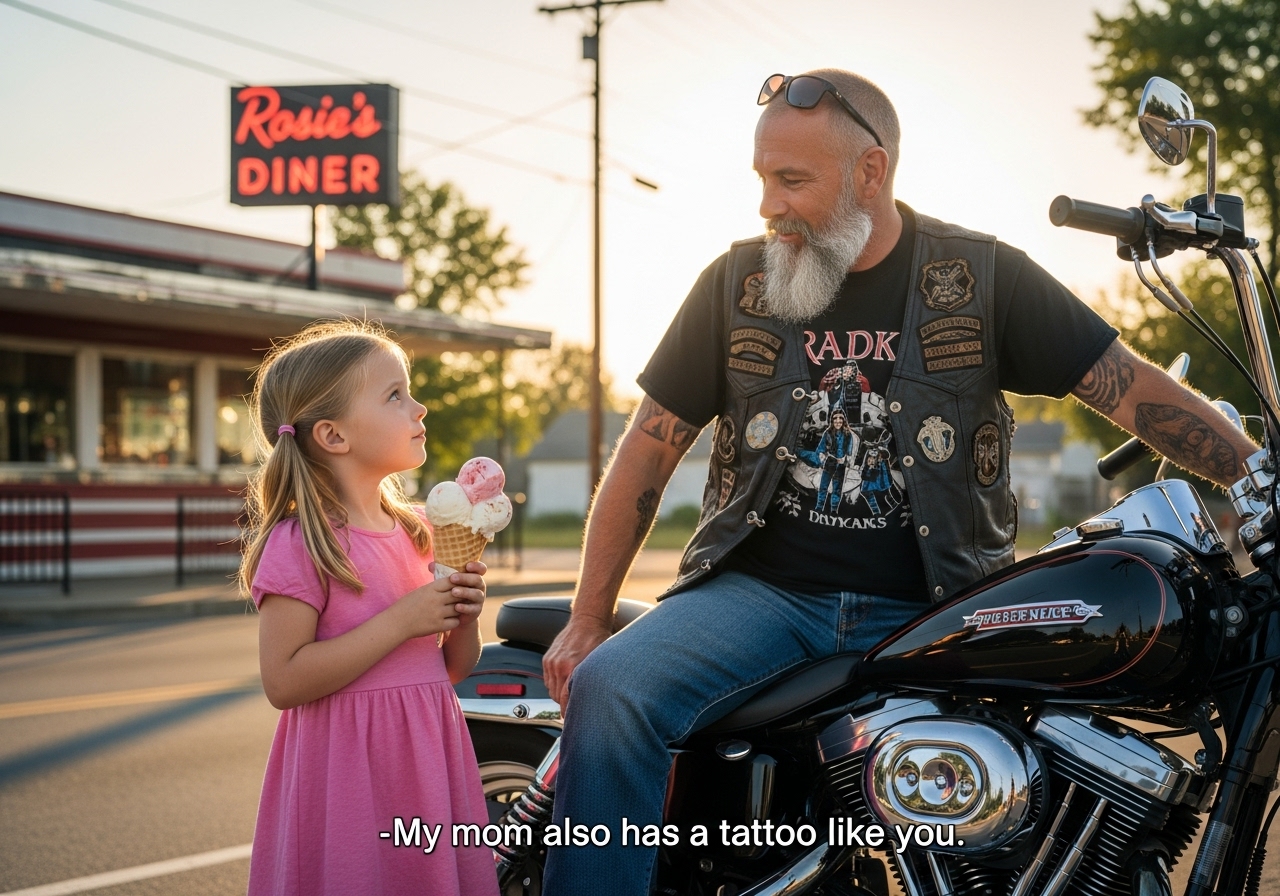
“My mother has a tattoo just like yours,” the 8-year-old girl told the old biker. His world stopped.
Chapter 1: The Shepherd’s Mark
The heat coming off the asphalt of the rural Nevada gas station was a physical thing, a shimmering wall that made the distant mesas tremble. Arthur “Grizz” Thompson felt it soaking through the worn soles of his boots as he filled his tank, the smell of high-octane gas a familiar, acrid perfume. He was a man in his late 60s, built like the busted-down refrigerator he’d hauled to the dump last week—wide, solid, and long past his prime. His cut, the leather vest of the Hells Angels, was a road map of his life, covered in patches that had lost their color decades ago. But it was the faded ink on his right forearm that told the real story.
People gave him a wide berth. A family in a minivan, the kids pressing their faces to the glass, hurried inside the convenience store. A salesman in a cheap suit, gassing up a rental, wouldn’t even meet his gaze. Grizz was used to it. He cultivated it. Fear was a fence, and he preferred to be left alone.

He was wiping a smear of oil from his chrome tank when a small voice piped up beside his knee.
“Hello, sir.”
Grizz froze. He looked down. Standing there, unafraid, was a small girl, maybe eight years old. She was all knees and elbows, with solemn brown eyes that looked entirely too old for her face. She was holding a half-melted ice cream cone.
He didn’t grunt or scowl. He just waited. Kids were a different species, one he hadn’t interacted with in… he couldn’t remember how long.
She pointed a sticky finger, not at the grinning skull on his vest, but at his forearm, which he’d exposed by rolling up his sleeve against the heat. “My mother has a tattoo just like yours,” she said, her voice clear and matter-of-fact. “She said it was to guide the lost.”
Grizz’s blood, thick and slow in the desert heat, turned to ice water. He looked from the girl’s face to his arm. To the tattoo. It was a simple, faded-blue design: a shepherd’s crook laid over a compass rose. It wasn’t a club tattoo. It was from another life, another war, another world. It was the insignia of a long-disbanded Long Range Reconnaissance Patrol (LRRP) unit from his time in Vietnam. A unit of six. Five were dead. He was the last.
“No one has this mark, kid,” he said, his voice a gravelly rumble he hadn’t used for conversation in days. “No one.”
“My mother does,” the girl insisted, with the simple, unshakeable faith of a child. “She’s sick. We’re on a trip.”
Grizz’s eyes scanned the parking lot. The rental sedan. The minivan. And… a battered, late-90s sedan, the color of a faded bruise, parked by the air pump. The rear window was blocked with pillows and bags. The front passenger seat was occupied by a woman.
He looked back at the girl. “Show me.”
The girl, whose name he’d learn was Ava, took his massive, oil-stained hand without a flicker of hesitation and led him toward the car. As they got closer, the image in the passenger seat resolved, and Grizz’s stomach tightened.
The woman was his age, maybe a bit younger, but the illness had hollowed out her cheeks and put deep, purple shadows under her eyes. An oxygen tube snaked from a small, portable tank to her nose. Her hair was thin, tucked under a faded bandana. She was asleep, her breathing shallow.
And on her left forearm, resting on the door’s armrest, was the tattoo. A shepherd’s crook over a compass. It was newer than his, the lines sharper, but it was the same.
He must have made a sound, a low growl of disbelief, because the woman’s eyes fluttered open. They were the same solemn, brown eyes as the girl’s. They widened slightly at the sight of him—this large, leather-clad man being led by her daughter. Then, her gaze dropped to his arm, which Ava was still holding.
Her eyes locked on his tattoo. The air between them crackled. Her expression shifted from fear to a kind of pained, shocking recognition.
“Who… who are you?” she rasped, her voice thin as onion skin.
“I was about to ask you the same thing,” Grizz said, his voice quiet, all the menace gone. “That mark. Who gave it to you?”
“My… my father,” the woman said, struggling to sit up. “He designed it. He was a… a shepherd. In the war.”
Grizz felt the ground tilt. He put a hand on the roof of the car to steady himself. “Your father. What was his name?”
“Donovan,” she said, her eyes filling with tears, not of sadness, but of some powerful, unleashed memory. “Michael ‘Shep’ Donovan.”
“Shep…” Grizz whispered the name. A name he hadn’t said aloud in forty years. Shep. The artist. The joker. The man who had designed their tattoo, claiming they were “shepherds, guiding lost souls through the jungle.” The man who had bled out in a Huey helicopter, his hand in Grizz’s.
“I’m Sarah,” the woman said, her breath catching. “He was my father. He died in my arms, at the VA hospital in ’95. From the Agent Orange. I’m a veteran, too. Gulf War. A nurse.” She held up her arm. “I got this… I got this to honor him. To remember what he fought for.”
Grizz stared at the woman. This wasn’t just a stranger. This was Shep’s legacy. This was the daughter of his best friend, his brother, dying in a heap of a car at a desolate gas station.
“He… he told me about you,” Sarah whispered, her eyes searching his face. “He called you ‘Grizz.’ He said you were the last one. He said you were the one who held his hand.”
Grizz couldn’t speak. He just nodded, the tight, painful knot in his throat threatening to undo him completely. The fence he’d built around himself for forty years didn’t just crumble; it was annihilated.
Ava looked between the two adults, her small face creased with confusion. “Mommy, is he a shepherd, too?”
Grizz looked down at the little girl, and then at the dying woman who was his best friend’s child. He was no longer just an old biker. He was a guardian. He was the last of his unit. And this was his watch.
“Get your things, kid,” Grizz said, his voice suddenly full of a purpose he thought had died in the jungle. “You’re not sleeping in this car tonight. Neither of you.”
He pulled out his wallet and turned to the salesman at the next pump, who was now staring openly. “You,” Grizz barked. “Go inside. Get me the key to the motel across the street. The biggest room they have. Put it on this.” He tossed a credit card at the man’s chest.
For the first time in his life, Arthur “Grizz” Thompson knew exactly why he was still alive.
Chapter 2: The Failure
The “Starlight Motel” was a classic, U-shaped relic from the 1960s, its neon sign flickering with half the letters burned out. The room Grizz had strong-armed the terrified clerk into giving them was on the ground floor, and it smelled of industrial disinfectant and stale cigarettes. But it had two beds, and the air conditioner, when Grizz punched it, roared to life with a blast of cold air.
He half-carried Sarah inside, her arm draped over his shoulder. She weighed almost nothing, a bundle of twigs. He settled her on the bed nearest the window, propping her up with the thin pillows. Ava, her ice cream long forgotten, immediately went to the small bathroom and returned with a damp washcloth, which she placed on her mother’s forehead. The practiced, gentle way she did it spoke of a long, heartbreaking education in caregiving.
Grizz stood in the doorway, feeling large and useless. The patches on his vest, which had once felt like armor, now seemed like childish stickers.
“I’ll get you some food,” he mumbled, turning to leave.
“Wait,” Sarah’s voice, though weak, still had a core of authority. The nurse. The soldier. “You don’t… you don’t have to do this. We’re fine.”
“The hell you are,” Grizz shot back, the anger in his voice not directed at her. “You’re Shep Donovan’s daughter, and you’re dying in a parking lot. That’s not fine. That’s a failure.”
“It’s not your failure,” she whispered, her eyes closing.
“It’s someone’s,” he said grimly. He left, letting the door slam shut.
He returned twenty minutes later with a plastic bag full of food from the diner next door—hot soup, bread, a small carton of milk for Ava, and a black coffee for himself. They ate in near silence. Ava ate quickly, her eyes on the small television, while Sarah picked at the bread.
“Now,” Grizz said, pulling the room’s single chair to the foot of her bed. “You’re on a trip, Ava said. Where to?”
Sarah put the bread down. The story came out, not in a flood, but in a series of hard, brittle pieces. She was driving to Boulder, Colorado. Her estranged sister lived there. A sister she hadn’t spoken to in five years, not since a fight about their father’s will, which had consisted of little more than his medals and a mountain of debt.
“She’s… not a warm person,” Sarah said, trying to find a diplomatic word. “But she’s all I have left. She’s all Ava has left. I just need to get there. I need to know my daughter won’t be… alone.”
Grizz’s jaw tightened. “What about your benefits? You’re a veteran. You’re sick. The VA…”
A sound escaped Sarah’s lips, a bitter, dry laugh that turned into a cough. She fumbled for her water. “The VA,” she repeated, her voice dripping with an irony so profound it was almost poison. “I’ve been fighting them for two years, Grizz. Two years.”
She had been a nurse in a field hospital during the Gulf War. She’d spent months breathing in the smoke from the oil well fires, the “burn pits,” the cocktail of toxins that the government had, for decades, refused to acknowledge. Now, it was late-stage lung cancer, aggressive and inoperable.
“It’s a presumptive condition now, you know,” she said, tapping her chest. “They finally admitted it. But my claim… it’s ‘stalled.’ That’s the word they use. ‘Stalled.'”
She told him about the phone calls, the hours on hold, the endless loop of automated menus. She told him about the paperwork—the DD-214 they claimed they’d lost, the medical records from 1991 they insisted were “incomplete,” the bureaucratic error on one form that had sent her entire file back to the bottom of a pile in an office three states away.
“While I was fighting them, I couldn’t work,” she continued, her voice flat. “I used up my savings. I sold my car, got… that.” She motioned toward the window. “I sold my father’s medals. Don’t tell him.” She tried to smile. “Then, last month, the bank… they foreclosed. We were fighting for our benefits, for our lives, and they took my home.”
Grizz felt a familiar, cold fury rising in his chest. The same fury he’d felt when the politicians had called them “baby-killers” when they’d returned from ‘Nam. The same fury he’d felt watching Shep die in a VA hospital that reeked of neglect. It was the fury of betrayal.
“They just… stalled,” Sarah said, the tears finally coming, hot and silent. “They stalled me, and they knew… they knew they just had to wait. That I’d run out of time. That I’d die, and it would be one less problem for them to solve. One less file to process.”
This was the desperate road trip. She had packed what she could, grabbed Ava, and started driving. Her last resort. To hand her daughter off to a sister who didn’t want her, so she wouldn’t be swallowed by the foster system when she finally passed, which she knew could be any day. She was dying because the system had failed her. She was dying because of a clerical error.
Grizz stood up so fast the chair scraped against the linoleum. Ava flinched, her eyes wide. Grizz instantly softened his posture, but the rage was still thrumming through him.
He looked at Sarah, this warrior who had been defeated not by an enemy, but by paperwork. He looked at Ava, Shep’s granddaughter, who was about to be an orphan.
“No,” he said, the word a low growl. “They don’t get to win. The bastards don’t get to win.”
“Grizz, what can you do?” she asked, her voice hopeless. “It’s over.”
“It’s not over,” he said. He walked to the door and stepped out into the cool desert night. The rage was a fire in his veins. He looked at his bike, his only companion for twenty years. It wasn’t enough. This wasn’t a fight for one man. This was a fight for a platoon.
He reached into his vest, past the knife, past the club papers, and pulled out an old, beat-up flip phone. He scrolled through a short list of names, all of them road names. He found the one he was looking for: “Road Dog.”
He pressed ‘call’ and held the phone to his ear. It rang twice.
“Yeah,” a gruff voice answered.
“Road Dog, it’s Grizz.”
A pause. “Grizz. It’s been a while, brother. You in a jam?”
“Not me,” Grizz said, looking through the motel room window at the small girl watching a cartoon. “I’m in Beatty. At the Starlight Motel. And I’m calling in my marker.”
The silence on the other end was absolute. The ‘marker’ was a sacred thing. Grizz had saved Road Dog’s life in a bar brawl in ’08, a situation that would have seen Road Dog in prison or the morgue. He had never, ever, mentioned it again. Until now.
“What do you need?” Road Dog’s voice was different. Not a friend’s, but a president’s. It was all business.
“I need the chapter,” Grizz said. “I need everyone. And… is Doc Holliday still with you?”
“He is.”
“Bring him,” Grizz said. “And tell him to bring his briefcase.”
He hung up without saying goodbye. He looked up at the stars, the same stars he’d seen over the jungle canopy while Shep had sketched their tattoo.
“I’m coming, Shep,” he whispered. “A little late, but I’m coming.”
Chapter 3: The Gathering of Shepherds
The next day was a limbo of waiting. Grizz got them an extension on the room, paying cash. He sat in the chair outside the door, ostensibly cleaning parts of his carburetor, but in reality, he was standing guard. He was a sentry. Sarah slept for most of the day, the first real sleep she’d had in weeks, the exhaustion and the stress finally catching a small reprieve.
Ava, however, was a quiet whirlwind. She seemed to accept Grizz’s sudden, intimidating presence as a new fact of life. She would come out of the room, sit cross-legged on the pavement a few feet away, and watch him work.
“Why do they call you Grizz?” she asked in the late afternoon, as the sun began to dip and paint the sky in shades of orange and purple.
“Because I’m grumpy, and I sleep a lot,” Grizz rumbled, not looking up from the piece of chrome he was polishing.
“No, you’re not,” she said. “You’re sad.”
Grizz’s hands stopped. He looked at the girl. She wasn’t being cute or clever. It was a simple observation. “A lot of people are sad, kid.”
“My mom’s sad,” she offered. “And sick. Are you sick?”
“Just old,” he said.
“My grandpa Shep was old. My mom says he was a hero. She says the shepherds in the picture were heroes.”
“They were just men, Ava,” Grizz said, his voice softer. “Just men, trying to get home.”
“Did you get home?”
Grizz looked out at the long, empty highway, a black ribbon stretching into the void. “Still working on it.”
Sarah woke up as the sun set, and the three ofAte dinner from the same diner, a quiet, makeshift family. Sarah’s color was a little better, the lines of pain around her mouth had softened. She was still wary, the hope in her eyes as fragile as a butterfly’s wing.
“Who did you call?” she asked, her voice just above a whisper. “The police? The VA?”
“No,” Grizz said, finishing his coffee. “Not the police. And definitely not the VA. I called… family.”
“Hells Angels,” she stated, not a question.
Grizz nodded. “Some of us… a lot of us… we’re vets, too. We know the system. We know the failure.”
“Grizz, I don’t want trouble,” she pleaded. “I don’t want… violence. Not around Ava.”
“This isn’t a problem you fix with violence,” Grizz said, standing up. “This is a problem you fix with… righteous fury. Get some rest, Sarah. Both of you.”
He went back to his post outside the door. Night fell, deep and quiet. The desert air turned cold. The broken neon sign of the motel cast a flickering, reddish light.
And then, he heard it.
It started not as a sound, but a vibration. A low, thrumming pulse in the soles of his feet, coming from the highway. It grew, separating into distinct, throaty rumbles. It was the sound of Harley-Davidson V-Twin engines, not one or two, but a dozen.
Grizz stood up. He walked to the edge of the motel’s parking lot, a silhouette against the flickering “Starlight.”
The sound became a roar. A line of single headlights appeared on the dark highway, a cavalry charge of chrome and steel. They slowed, turned, and one by one, a dozen Hells Angels rolled into the parking lot. They were big men, most of them Grizz’s age, their vests covered in the same patches. They parked their bikes in a precise, intimidating line, their engines cutting off in a staggered, thunderous echo.
The silence that fell afterward was heavier than the noise had been.
A man dismounted from the lead bike. He was as wide as Grizz, with a long, grey braid down his back. This was “Road Dog,” the President. He walked up to Grizz, and the two men didn’t shake hands. They clasped forearms, a warrior’s greeting.
“Grizz,” Road Dog said.
“Road Dog,” Grizz replied. “Thanks for coming.”
“You called the marker, brother. We came.”
Another man was getting off his bike, and he was the last person anyone would expect. He was smaller, wearing wire-rimmed glasses, and under his cut, he wore a button-down shirt. He was carrying a polished leather briefcase. This was “Doc” Holliday, who, before joining the club, had been one of the top corporate lawyers in San Francisco.
“You said there was a paperwork problem,” Doc said, his voice crisp.
“The worst kind,” Grizz said.
He led Road Dog and Doc to the motel room. He knocked gently. “Sarah? It’s Grizz. The family I told you about? They’re here.”
The door opened. Sarah stood there, her small frame dwarfed by the doorway, with Ava hiding behind her legs. She looked at the three massive, leather-clad men, and her eyes filled with fear.
Grizz stepped in front of her, turning to Doc. “This,” he said, “is Sarah Donovan. Gulf War vet. Nurse. Daughter of ‘Shep’ Donovan, First Recon.”
Doc Holliday’s professional demeanor cracked. He looked at Road Dog, then back at Grizz, his eyes wide. “Shep’s… as in, our Shep?”
“No,” Grizz said. “My Shep. My unit.”
Doc’s expression changed. The lawyer was gone, replaced by something else. He stepped forward, removing his glove.
“Ma’am,” Doc said, his voice gentle. “My name is ‘Doc’ Holliday. I was a Marine. My apologies for the late hour. May we come in? I understand you’re having some trouble with the Veterans Administration.”
Sarah looked from Doc’s kind, intelligent eyes to Grizz’s steady gaze, and then to Road Dog, who was standing at the door, his arms crossed, looking not at her, but at the parking lot, as if he were already on guard.
She nodded, and for the first time, the fragile wing of hope in her chest beat a little bit stronger. She stepped aside and let them in.
Chapter 4: The Two-Front War
The motel room became a war room. The bikers who had been waiting in the parking lot fanned out, taking up positions. They weren’t loud or rowdy. They were disciplined. Two men went to the diner and returned with a dozen coffees and sweet rolls. They formed a quiet perimeter around the motel, “guarding” the family. The other guests at the motel saw the vests and the bikes and wisely decided to stay in their rooms.
Inside Room 114, Doc Holliday had taken over the small table. He’d plugged in a laptop, and a portable printer was humming. Sarah, energized by the sudden surge of action, was sitting on the bed, her boxes of files splayed open. Ava was in the corner, given a coloring book by a large biker with a skull tattoo on his face, who was now patiently explaining to her the proper way to color a dragon.
“Okay, Sarah, let’s go from the top,” Doc said, all business. “This ‘clerical error’ on your 10-10EZ form. They said you checked the wrong box for ‘service-related disability’?”
“They said I didn’t have a diagnosis at the time,” Sarah explained, her voice gaining strength. “But my doctor had submitted… it’s in here somewhere…”
“Doesn’t matter,” Doc said, already typing. “Under 38 CFR 3.160, the VA has a ‘duty to assist.’ They were legally required to request those records, not ‘stall’ the claim. They’ve been in violation for eighteen months.”
Grizz and Road Dog watched from the door. “This is his thing,” Road Dog murmured to Grizz. “Doc hates bullies. And the government is the biggest bully of all.”
Doc Holliday got on the phone. It was nine a.m. on the East Coast. He wasn’t calling the 1-800 number. He was calling the direct line for the Regional Office Director in D.C. He was using a voice Grizz hadn’t heard before—a smooth, silk-and-steel baritone that radiated absolute, unquestioned authority.
“Yes, Mr. Henderson, this is counsel for Sarah Donovan… No, you’ll be speaking with me… That’s correct… I am currently looking at a direct violation of… Yes, I’ll hold.” He put the phone on mute. “He’s fetching his supervisor. Good.”
While the legal war was being waged, Road Dog turned to Grizz. “You said her house was foreclosed?”
“Last month,” Grizz confirmed. “She’s got all she owns in that car. The rest… I assume the bank took it.”
Road Dog nodded. He pulled out his own phone and made a call. “Skinner. I need a U-Haul, the biggest one you can find. And I need a storage unit in Pahrump, paid for, for one year… Yeah, now. And bring the prospects. We’ve got work to do.”
He hung up. “What’s the address?”
Grizz looked at Sarah, who was watching Doc in stunned silence. “Sarah. Your house. Where is it?”
She told him. It was 100 miles back, outside of Vegas.
“Not a problem,” Road Dog said. “We’ll have her things safe by nightfall.” He dispatched half the group. The rumble of bikes leaving was the sound of a mission in progress.
Back in the room, Doc was on the offensive. “Mr. Davies, I appreciate your position. Now, let me explain my position. As of this moment, my client is terminally ill and homeless due to what is, at best, gross negligence, and at worst, a willful and malicious denial of benefits… A media inquiry? I don’t know what you’re… Oh, of course. I’m just a simple biker. But I do have the cell phone number of a reporter at the Washington Post who loves stories about veterans. Shall I use it?”
There was a long, squawking silence from the phone.
“I thought not,” Doc said coolly. “Now, here’s what’s going to happen. You are going to find Ms. Donovan’s file. You are going to expedite it. And you are going to have an approval for full benefits, retroactive, on my desk… which is currently a motel table… by noon. Or my next call is to that reporter. And my second is to your Congressman.”
He hung up. He smiled at Sarah. “They’re going to call back in ten minutes, very apologetic, and ask for your social security number again.”
“Just like that?” Sarah asked, her voice trembling.
“The system is run by people, Sarah,” Doc said, his voice kind. “And people are lazy, and they are cowards. You just have to find the one person who is more scared of you than they are of their boss.”
The phone rang. Doc picked it up. “Mr. Davies, how kind of you to call back…”
Three hours later, the U-Haul, filled with Sarah’s boxed-up life—her furniture, her photos, her father’s flag—was on its way to a secure storage unit. And an email, with an official VA letterhead, printed from the motel’s wheezing printer.
Claim: APPROVED. Status: Expedited.
But Doc wasn’t done. “That’s not enough,” he said. He got back on the phone. “Mr. Davies, one last thing. My client is in a motel in Beatty, Nevada. She is not in condition to travel. She requires palliative care. Top-tier palliative care. And you’re going to pay for it… Yes. Now.”
An hour later, a state-of-the-art medical transport ambulance pulled into the Starlight Motel’s parking lot, its lights off. The bikers moved their Harleys to clear a path, the leather and chrome making way for the sterile white van.
Two paramedics came in. They were professional, but they were clearly unsettled by the dozen Hells Angels watching their every move.
“Ma’am,” one said. “We’re here to take you to St. Jude’s. We have a private room waiting for you.”
Sarah looked at Grizz, her eyes full. She couldn’t speak.
“It’s okay, Sarah,” Grizz said, his hand on her shoulder. “We’ve got you. We’ve got Ava.”
As they loaded her into the ambulance, she reached out and grabbed Grizz’s vest. “He would be so proud of you, Grizz.”
“He’d be proud of you, Sarah,” Grizz said. “You fought the good fight.”
He turned to Ava, who was clutching his hand. “We’re going for a little ride, kid. We’re gonna follow your mom.”
Grizz mounted his bike, the roar of the engine a prayer. The ambulance pulled out, and the entire chapter of Hells Angels formed a V-formation behind it, a rumbling honor guard, escorting Shep Donovan’s daughter on the last, most important ride of her life.
Chapter 5: The Last Watch
The nurses at St. Jude’s were, to put it mildly, terrified. The palliative care wing was a place of quiet, of whispered condolences and the gentle beep of monitors. It was not a place for a dozen large men in leather vests.
But the bikers weren’t there to cause trouble. They took over the waiting room, a silent, imposing force. They drank the bad coffee, read the old magazines, and spoke in low rumbles. When a nurse timidly asked them to keep it down, Road Dog simply nodded and said, “Yes, ma’am. We’re just here for our sister.”
Grizz didn’t go to the waiting room. He stood watch.
For three days, he did not leave the hallway outside Sarah’s door. He stood, or sometimes sat on the floor, his back against the wall, a sentinel. The nurses learned to walk around him. He ate when one of his brothers brought him a sandwich. He slept in thirty-minute increments, sitting up. He was a shepherd, and this was his last watch.
He and Ava, who was being cared for by Doc and his wife in a nearby hotel, would go in together to see Sarah. The new care had worked wonders. She was out of pain, her breathing was easy. She wasn’t in a car, choking on dust. She was in a clean, soft bed, with a view of the mountains.
She and Grizz talked. They talked about Shep. Grizz told stories Sarah had never heard, about the monsoons, about the jokes, about the sheer, unadulterated goodness of her father. And Sarah told Grizz about her life, about her service, about Ava.
“She’s so smart, Grizz,” she whispered on the third day, her voice very thin. “She’s… she’s got his eyes. My dad’s eyes.”
“She’s a Donovan,” Grizz agreed, his voice thick.
“Grizz,” she said, her grip on his hand surprisingly strong. “Don’t… don’t let the sister take her. My sister. She’s… hollow. She won’t love her. Don’t let Ava go to her. Please.”
“The state…” Grizz began.
“You’re a shepherd,” she whispered, her eyes closing. “Guide the lost.”
That evening, Sarah passed away in her sleep. Ava was holding one of her hands. Grizz was holding the other. She didn’t pass in a car on the side of a road. She passed with dignity, surrounded by family, while a guard of honor stood vigil outside her door.
The Hells Angels paid for the funeral. It was a small service, but it was perfect. A military honor guard was there—Doc had made sure of it. They played “Taps.” They folded the flag and, after a moment’s hesitation, the honor guard presented it not to Ava, but to Grizz, the ranking veteran present.
As the bikers stood in a silent formation, their fists over their club patches, Grizz held the folded flag.
The fight was over. But the war wasn’t.
Two weeks later, Grizz was in a place he hated more than a VA office: family court.
Sarah’s sister had been contacted. As Sarah had predicted, she’d “formally declined to take custody.” The state’s social services were moving to put Ava into the foster system.
Grizz stood before the judge. He was not the biker from the gas station. His beard was trimmed. His hair was slicked back. He wore a clean, pressed suit that Doc had bought for him. He looked, the judge noted, like a respectable, if slightly terrifying, old man.
Doc Holliday, acting as his attorney, presented the case. “Your Honor, Mr. Thompson is a decorated Vietnam veteran. He was a close personal friend of Ava’s grandfather, Michael ‘Shep’ Donovan. He has secured a new, three-bedroom apartment. He has a stable income from his military pension and, uh, his business investments.” (The “business investments” were the club’s backing.)
“He’s a Hells Angel,” the social worker said flatly. “He’s in a gang.”
“He’s the president of a non-profit organization that assists veterans,” Doc countered smoothly, “and he is the only family this child has left.”
The judge looked at Grizz. “Mr. Thompson. Why do you want to do this? You’re in your late 60s. Raising a child is… a lot.”
Grizz stepped forward. He didn’t look at Doc or the social worker. He looked at the judge.
“Your Honor,” he said, his voice quiet but filling the room. “For forty years, I’ve been… lost. I was just… waiting to die. And then this little girl found me. She’s the daughter of a soldier, and the granddaughter of my brother. My unit… we had a code. A shepherd’s code. To guide the lost.”
He paused, swallowing. “I’m not lost anymore, Your Honor. And I’m not going to let her be, either. I failed her mother. I let the system beat her. I’m not going to fail that little girl. I am… I am her shepherd. It’s the last mission I have.”
The judge looked at Grizz for a long, silent minute. She looked at Ava, who was sitting in the back, drawing a picture. She looked at the file. She looked at the social worker.
“Guardianship granted,” she said, and banged her gavel.
The epilogue was quiet. There was no big celebration. There was just a small, clean house on the outskirts of Pahrump. There was a rusted-out Harley in the garage, and a brand-new, bright-pink bicycle with training wheels next to it.
One evening, Grizz was in the backyard, hunched over the pink bike, trying to fix the chain, cursing under his breath.
The back door slid open, and Ava came out, holding a juice box. She watched him for a minute.
“You’re doing it wrong, Grizz,” she said, pointing. “The gear is stuck. You have to push it back like this.”
She put her juice box down, and her small, nimble fingers undid in ten seconds what he’d been fighting for twenty minutes. The chain spun freely.
Grizz sat back on his heels, covered in grease, and looked at her. She smiled, her first full, genuine smile.
“I’m smart,” she said. “My mom told me.”
“Yeah, kid,” Grizz said, a slow smile spreading across his own face. “Yeah, you are.”
He was a shepherd. And for the first time in his life, he was finally home.