I FOUND A CATATONIC BOY IN THE WOODS WEARING A $5,000 COAT—I CURED HIS ‘BLINDNESS’ WITH MY GRANDMOTHER’S REMEDIES, BUT THEN A BLACK HAWK HELICOPTER LANDED IN MY YARD AND ARMED MEN DRAGGED HIM AWAY.
Chapter 1: The Boy Who Saw Nothing
The October air in the Cascades has a specific kind of bite. It doesn’t just chill your skin; it gets into your bones, a wet, penetrating cold that settles deep in the marrow. That damp freeze is the first thing I remember about that Tuesday. The second is the silence.
My name is Emily. I live with my Grams in a cabin that’s been in our family for four generations, tucked so deep in the Washington state timberlands that the government census taker gets lost every decade and eventually just gives up. We live off the grid, not because we’re hiding, but because this is how we’ve always been. We grow our own food, we chop our own wood, and we heal our own. Grams is a master herbalist, and I’m her apprentice. We’re the people the locals come to when the sterile white walls of the county clinic feel colder than the sickness itself.

That day, I was checking my traplines—for rabbits, usually. We needed the meat for the stew pot and the fur for winter lining.
The woods were dead silent. Too silent.
Usually, you hear the chatter of the Stellar’s Jays or the rustle of squirrels in the underbrush. But today, nothing. That’s a bad sign. In the wild, silence means a predator is near. I figured a cougar, maybe a black bear coming down from the higher elevation. I slid my skinning knife from its leather sheath on my belt, my heart thumping a low, steady drum against my ribs.
I smelled the creek before I saw it—the scent of wet stone and decaying cedar. And that’s when I saw him.
He was just… standing there.
He was balanced precariously on the slick, moss-covered rocks by the water’s edge. He couldn’t have been more than ten years old. And he was wrong. Everything about him was wrong for these woods.
He was wearing a coat that looked like it cost more than our pickup truck. It was a sleek, black, quilted thing—Moncler or Canada Goose, maybe. His shoes were shiny, patent leather loafers, now caked in thick, brown mud. He was porcelain pale, his dark hair plastered to his forehead by a cold sweat.
But it was his eyes. God, his eyes.
They were open, staring straight ahead across the rushing water, but they were off. Like the power was cut to the house but the lights were left on. They were empty, flat, lifeless. He was staring, but he wasn’t seeing.
“Hey,” I called out, my voice sounding too loud and jagged in the stillness. “Hey, kid! Are you okay?”
No response. Not a twitch of a muscle. Not a blink.
I moved closer, slow and deliberate, the way you would approach a spooked deer or a cornered dog. “Kid? Can you hear me?”
I was ten feet away. Then five. I waved my hand aggressively in front of his face. Nothing. He just stood there, trembling. It was a tiny, involuntary tremor racking his small body, vibrating through that expensive coat. His lips were a terrifying shade of blue.
“Oh, God,” I whispered, holstering my knife. “You’re freezing.”
I touched his hand. It was like gripping a block of ice. I looked around frantically. No one. No frantic parents, no hikers with trekking poles, no car on the logging road two miles back. Just the endless, quiet, towering woods. Who leaves a child like this? A blind child?
“Okay,” I said, more to myself than to him, trying to keep the panic out of my voice. “Okay, we’re going home.”
I grabbed his icy hand firmly. “My name is Emily. I’m going to help you. We’re going to my cabin. It’s warm. We have a fire.”
He flinched at my touch—a violent, full-body jerk, like he’d been electrocuted—but he didn’t pull away. He was rigid. Stiff as a board. I had to gently, physically turn his body and guide him.
He walked like an automaton, his expensive shoes slipping and stumbling on the roots and rocks. He didn’t lift his feet; he dragged them. I practically had to carry him the last half-mile up the ridge. By the time I saw the smoke from our chimney, my arms were burning, but fear was the only thing fueling me.
Chapter 2: The Diagnosis
When I burst through the heavy oak door of the cabin, Grams looked up from the woodstove. She was grinding dried mullein in her mortar, her glasses perched on the end of her nose.
“Emily? Who in God’s name…?” Her eyes widened as she took in the sight of the boy.
“Found him by the creek, Grams,” I panted, kicking the door shut against the wind. “He’s frozen. And… Grams, I think he’s blind. He hasn’t said a word.”
Grams, ever the pragmatist, didn’t waste time asking questions. She moved with the speed of a woman half her age.
“Get those wet clothes off him. Now. Wrap him in the wool blanket—the heavy one. I’ll get the kettle.”
We stripped off the absurdly expensive clothes. The coat, the cashmere sweater, the silk undershirt. Underneath all that wealth, he was just a skinny little kid, all ribs and sharp angles. His skin was translucent, blue veins mapping a geography of suffering across his chest.
We wrapped him in the rough, warm wool. Grams sat him in the rocking chair right next to the cast-iron stove. She gently turned his face to the light coming from the kerosene lamp. She peeled back his eyelids with her calloused thumbs.
“No,” she said softly, peering into his empty pupils. She moved the lamp back and forth. His pupils constricted. They reacted to the light.
“The eyes are clear,” she murmured, stepping back and wiping her hands on her apron. “This ain’t a physical blindness, Em. The hardware works fine.”
“Then why can’t he see?” I asked, towel-drying his wet hair.
Grams looked at him with a mixture of pity and anger. “This is in his head. Psychogenic fugue, maybe. Or hysterical blindness. Something… something broke him, child. Fear. Trauma. He saw something he didn’t want to see, so his brain just… turned the switch off.”
For three days, he sat in that rocking chair. He was a statue. We fed him rich bone broth by the spoonful, tilting his head back like a baby bird. We rubbed warmth back into his limbs with a salve Grams made from cayenne, arnica, and St. John’s Wort to stimulate the nerves.
We didn’t turn on the radio. We didn’t talk loudly. We just let the cabin exist around him.
On the fourth day, he blinked.
On the fifth day, he turned his head when I dropped a spoon on the floor.
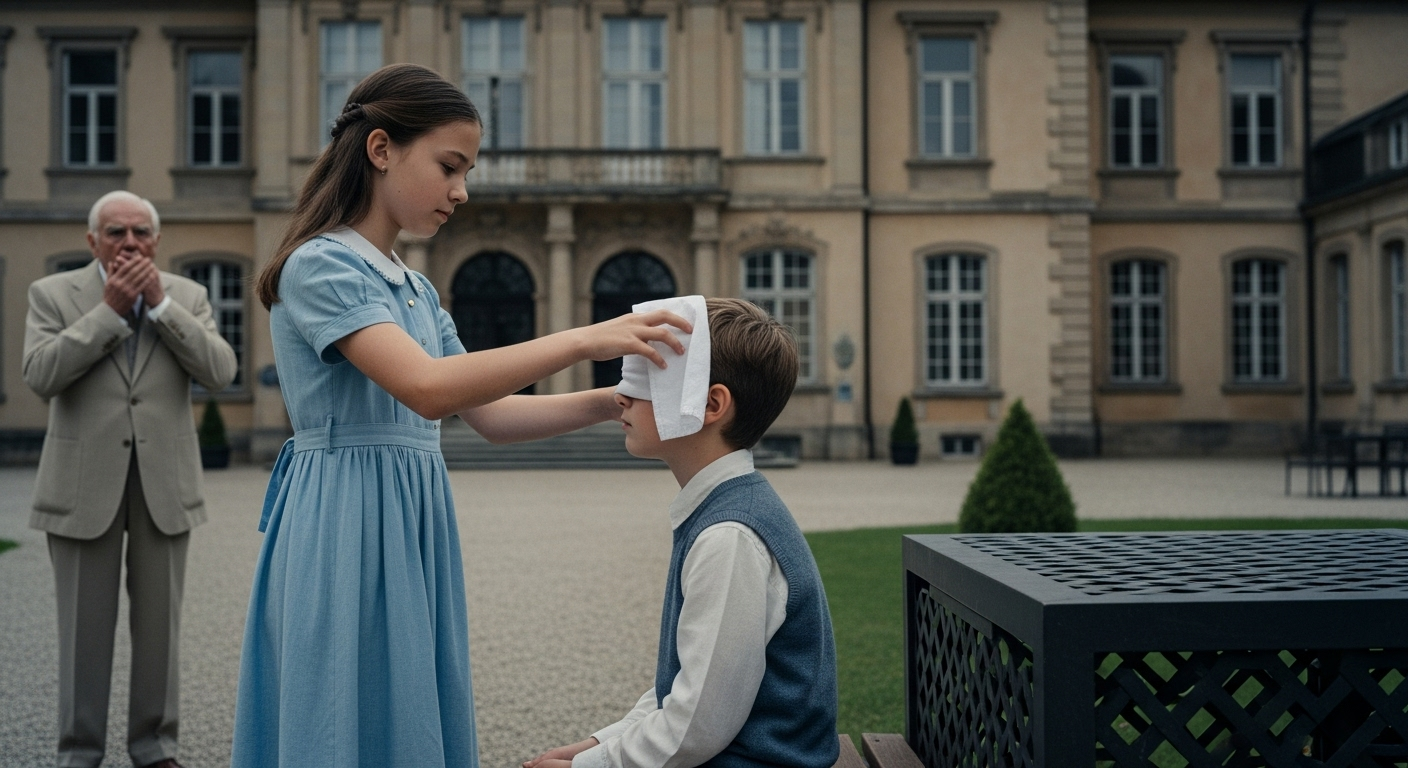
On the sixth day, I was sitting on the rug at his feet, reading a book aloud—just an old field guide to mushrooms, reading the Latin names like poetry—and I felt a cold hand touch my arm.
I stopped mid-sentence. I looked up.
He was looking at me. Actually seeing me. The lights were back on.
“Who…” his voice was raspy, like dry leaves scraping together on pavement. “Who are you?”
“I’m Emily,” I smiled, tears pricking my eyes. “You’re safe here. This is my Grams.”
He took a deep, shuddering breath, the first real breath I’d seen him take since the creek. Tears welled up in those big, dark eyes and spilled over.
“My dad…” he whispered, terror creeping into his face, contorting his features. “He said I wasn’t perfect. He said I was broken. He said he had to… return me.”
“Return you?” Grams asked, stepping closer, her voice hard as flint. “You ain’t a pair of shoes, boy.”
“He owns everything,” the boy trembled. “He owns the doctors. He owns the police.”
Before I could ask what that meant, before I could ask for his name, the cabin started to shake.
At first, I thought it was an earthquake. The Cascades are active, after all. The cast-iron pans rattled on the wall hooks. The floorboards vibrated beneath our feet. Dust drifted down from the rafters.
But then came the sound. The distinctive, rhythmic thwup-thwup-thwup of rotors. Loud. Deafeningly loud. Not the high whine of a news chopper or the rumble of a rescue flight. This was heavy. This was aggressive.
“Grams?” I yelled over the noise.
Grams stood up, her face setting into a mask of resolve. She grabbed her double-barreled shotgun from the rack above the mantle. “That ain’t no ranger, Emily.”
I ran to the window, pulling back the gingham curtain.
Hovering just above the clearing, whipping the hundred-foot pine trees into a frenzy, was a black helicopter. No markings. No tail numbers. Just sleek, menacing metal reflecting the grey sky.
Men were rappelling down ropes. Fast. Efficient. Men in full tactical gear. Black helmets, black vests, assault rifles strapped to their chests. They moved like a single organism.
“They’re here for him,” the boy whispered.
I turned to look at him. He wasn’t looking at the window. He had curled into a tight ball on the floor, hands clamped over his ears, rocking back and forth.
“They’re here to throw me away,” he sobbed. “He found me.”
“Lock the back door, Em!” Grams shouted, cracking the shotgun open to check the load.
But it was too late.
The front door didn’t just open. It exploded inward, kicked off its hinges by a boot the size of a cinderblock. Splinters of oak flew across the room.
The cold wind rushed in, killing the warmth we had spent a week building. Three men filled the doorway, their rifles raised, the laser sights dancing across the cabin walls—red dots searching for prey.
One of the red dots landed on the boy’s chest.