I Agreed to Pretend to Be a Stranger’s Dad for a Parent-Teacher Meeting. I Walked Into the Classroom and Realized It Was a Trap.
Chapter 1: The Proposition in the Rain
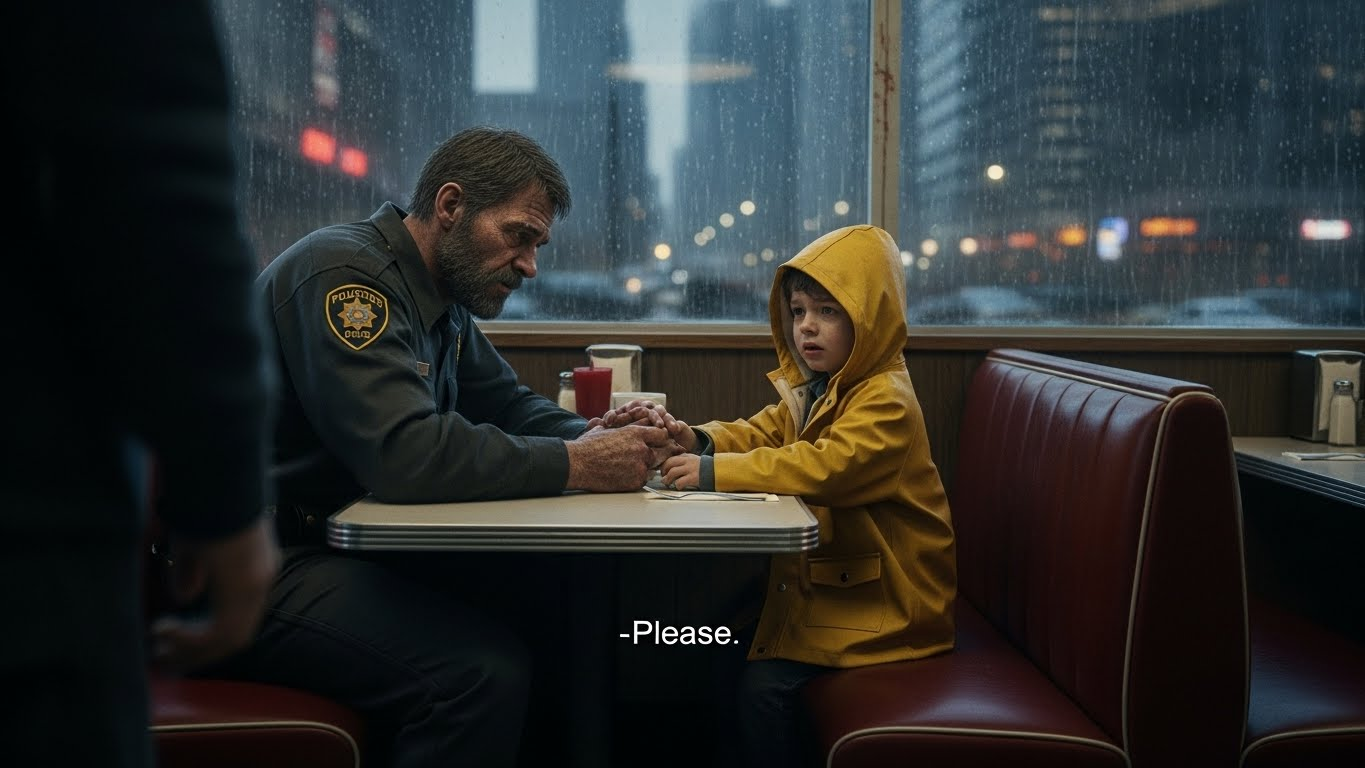
It was raining in Chicago. Not the romantic, misty kind of rain you see in the movies, but the freezing, aggressive slush that seeps into your socks and makes your bones ache. I was sitting at a corner booth in “Louie’s,” a place that smelled permanently of burnt bacon and floor cleaner, watching the droplets race down the greasy windowpane.
I liked Louie’s because nobody looked at you there. You could be a saint or a sinner, and as long as you paid for your bottomless coffee, you were just another body taking up space. That’s all I wanted to be. A body. Invisible.

I was three years sober and two years out of prison. I had a job guarding a warehouse on the South Side that nobody ever tried to rob because there was nothing in it worth stealing. My life was small, contained, and safe.
Then the bell above the door jingled, cutting through the low hum of the refrigerator.
I didn’t look up at first. I just stared at the black swirls in my mug. But then I felt it. That prickly sensation on the back of your neck that tells you eyes are on you.
I shifted in the vinyl booth. Standing three feet away was a kid.
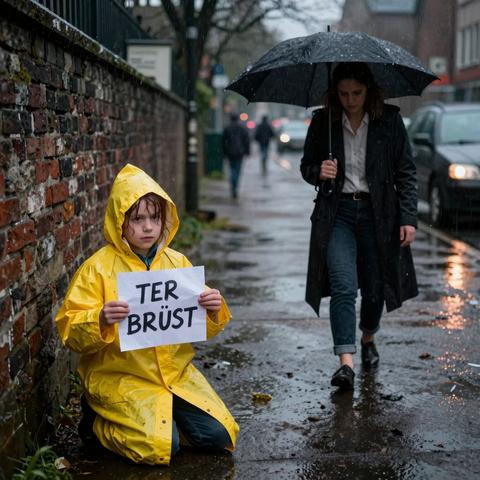
He couldn’t have been more than ten. He was drowning in a yellow raincoat that was two sizes too big, the hood pulled up over a mop of wet, dark hair. He was clutching a backpack to his chest like it contained the nuclear codes. But it was his eyes that stopped me cold.
They were wide, blue, and terrified. Not “I lost my toy” terrified. They held the kind of raw, animal panic I used to see in the yard at Stateville Penitentiary.
“Can I help you, kid?” my voice rasped, unused for hours.
He flinched. He literally took a step back, his knuckles turning white on the backpack straps. He looked around the diner. It was empty except for Louie dozing behind the counter.
The boy stepped closer, lowering his voice to a frantic whisper. “Mister, are you… are you busy?”
I looked at my empty calendar, my empty apartment, my empty life. “Looks like I’m free until the end of time. What do you need? Money? I don’t have much.”
“No,” he shook his head violently, sending rainwater flying. He reached into his pocket and pulled out a crumpled five-dollar bill and a handful of quarters. He slammed them onto the sticky table. “I can pay you. It’s all I have.”
I frowned, sitting up straighter. “Put that away. What are we talking about here?”
He took a deep, shuddering breath. “I need… I need a dad.”
The silence stretched out, heavy and confused. “You need a what?”
“A dad,” he repeated, his voice cracking. “Just for an hour. Please. The parent-teacher conference is at 4:00. It’s at Lincoln Elementary, just three blocks over. If… if my dad doesn’t show up, Mrs. Halloway said she’s going to call Social Services. She said she has to.”
I leaned back, the alarm bells in my head starting to ring. “Okay, slow down. Where is your real dad?”
The kid’s face shut down. It went completely blank, a mask of defense that no ten-year-old should know how to wear. “He’s busy,” the boy said, the lie tasting like ash in the air. “He travels. Please. You just have to sit there, nod, and sign a paper. That’s it. Then I’ll give you the money.”
“Kid, I can’t just walk into a school and—”
“Please!” He grabbed my hand. His skin was ice cold. “If they call the state… they’ll take me. I can’t go back to the system. I can’t.”
That word. The system.
It hit me in the gut. I knew the system. I knew the foster homes where the doors didn’t have locks and the basements smelled like mold and fear. I looked at his wrists, protruding from the raincoat. There was a faint, yellowing bruise on his left forearm. Finger-shaped.
He wasn’t hiding a bad grade. He was hiding from someone. Or protecting someone.
My instinct—the one that had kept me alive in prison—screamed at me to walk away. Don’t get involved, Jack. This is messy. This is dangerous. This isn’t your problem.
I looked at the crumpled five-dollar bill. I looked at the rain lashing the window.
“What’s your name?” I asked.
“Leo,” he whispered.
I sighed, drained the rest of my cold coffee, and stood up. I felt the weight of the decision settling on my shoulders like a concrete block.
“Alright, Leo,” I said, grabbing my coat. “I’m Jack. Let’s go get you that signature.”
Chapter 2: The Lion’s Den
The walk to Lincoln Elementary was a blur of gray slush and biting wind. Leo walked two paces ahead of me, his head down, moving with a speed that suggested he wanted to get this over with before I changed my mind.
I tried to get a read on him. “So, what’s the story, Leo? What am I supposed to be? A doctor? An astronaut?”
He didn’t laugh. He didn’t even turn around. “You’re a mechanic. You work nights. That’s why you’re tired. That’s why you haven’t been around. Your name is David. David Miller.”
“David Miller,” I tested the name. “Generic. I like it. And the mother?”
Leo stopped. He stood perfectly still on the sidewalk, the rain matting the hair to his forehead. He turned to me, and for a second, he looked a hundred years old.
“She died last year,” he said flatly. “Car accident.”
“I’m sorry,” I said, feeling like a heel.
“Just stick to the script,” he snapped, turning back toward the brick building looming ahead.
Lincoln Elementary looked less like a school and more like a fortress. Heavy brick, high fences, metal detectors at the entrance. It was a typical inner-city Chicago school, underfunded and over-policed.
As we approached the front steps, my heart started hammering against my ribs. Impersonating a parent wasn’t a felony, probably, but it definitely wasn’t legal. If they asked for ID, we were screwed.
“Do you have a plan for the ID check?” I hissed as we climbed the concrete stairs.
“Just walk like you own the place,” Leo muttered. “Security guy is Mr. Henderson. He sleeps half the time. Just wave and keep walking.”
Sure enough, the guard at the desk was slumped over a crossword puzzle. He barely glanced up as I breezed past, offering a tired salute. He grunted and went back to 7-Down.
We were in.
The hallway smelled of floor wax, wet wool, and anxiety. It was lined with construction paper art—turkeys made of handprints, dreams written on clouds. It felt alien to me. I hadn’t been in a school in thirty years.
“Room 302,” Leo whispered. “Mrs. Halloway. She’s… intense.”
“Intense how?”
“She asks a lot of questions. Just say you’ve been working double shifts to pay the medical bills from Mom. That shuts people up.”
Smart kid. Too smart.
We reached Room 302. The door was slightly ajar. Inside, I could see a woman sitting at a desk, organizing a stack of papers with surgical precision. She was sharp—angular features, glasses on a chain, hair pulled back so tight it looked painful.
Leo took a deep breath. He looked up at me, and the tough-guy act crumbled for a split second. “Don’t mess this up, Jack. Please.”
“I got you,” I said, hoping it was true.
I pushed the door open.
“Mrs. Halloway?” I boomed, putting on my best ‘tired but loving blue-collar dad’ voice.
The woman’s head snapped up. Her eyes narrowed behind her thick lenses. She didn’t smile. She didn’t stand up to greet us. She just stared at me, then at Leo, then back at me.
Her gaze felt like a physical searchlight. It lingered on my hands (rough, scarred), my jacket (cheap, thrift store), and my boots (work-worn).
“Mr… Miller?” she asked, her voice dry as paper.
“That’s me,” I said, stepping into the room and extending a hand. “Sorry we’re late. Traffic on the I-90 was a nightmare, and with the rain…”
She ignored my hand.
“Sit down,” she commanded.
I sat in one of those tiny plastic chairs made for second graders. My knees were up to my chest. I felt ridiculous. Leo stood next to me, rigid as a board.
“I must say,” Mrs. Halloway said slowly, clasping her hands on the desk. “I was surprised to hear you were coming. Leo has told us… very little about you.”
“I work a lot,” I said quickly. “Nights. Mechanic shop over in Cicero. Trying to keep the lights on, you know?”
“Mmm-hmm,” she hummed. She opened a file folder. “Leo is a bright boy, Mr. Miller. But we are concerned. He falls asleep in class. He hoards food from the cafeteria. And…”
She pulled out a drawing. It was crude, done in crayon. It showed a stick figure of a boy hiding under a bed. Standing over the bed was a large, dark figure scribbled in chaotic black lines. The black figure had red eyes.
“He drew this on Monday,” Mrs. Halloway said, her eyes locking onto mine. “When the school counselor asked him who the man in black was, Leo wouldn’t speak.”
My mouth went dry. I looked at the drawing. It radiated fear.
“And,” she continued, her voice dropping an octave, “We ran a check on the emergency contact number on file for ‘David Miller.’ It’s disconnected.”
The air in the room suddenly felt very thin.
“Changed my plan,” I lied smoothly, though my palms were sweating. “Couldn’t afford the bill. Got a burner phone now. I can give you the new number.”
Mrs. Halloway didn’t write anything down. She leaned forward. “Mr. Miller, are you aware that there is a police cruiser parked outside the main entrance right now?”
My heart stopped.
“Is there?” I managed to choke out.
“Yes,” she said. “Because I called them ten minutes ago.”
She smiled then, but it wasn’t a nice smile. It was the smile of a trap snapping shut.
“You see,” she whispered, “I know David Miller died four years ago. So, tell me… who exactly are you, and what are you doing with this boy?”