The Hospital Fired Her For Saving A Life—Moments Later, A Navy Helicopter Landed And The Commander Dropped A Bombshell That Ruined The Chief Surgeon’s Career.
Chapter 1
“Dr. Brooks, you’re fired.”
The sentence hung in the sterile air of Memorial Hospital’s Trauma Bay 4, heavier and colder than the lead apron hanging on the back of the door. Dr. Talia Brooks didn’t flinch. She stood over the gurney, her blue scrubs dark with blood that wasn’t hers, her chest heaving with the exertion of the last ten minutes.
Under her gloved hands, the rhythm on the cardiac monitor was steady. Beep. Beep. Beep. A beautiful, artificial sinus rhythm.
“Did you hear me, Resident?” Dr. Harrison Mitchell, the Chief of Surgery, stepped into the room. He was a man who wore his authority like armor, tailored and expensive. His silver hair was perfectly coiffed, a stark contrast to the chaotic, bloody scene before him. “Step away from the patient.”
Talia peeled her eyes away from the elderly man she had just pulled back from the brink of death. “He was in cardiac arrest, Dr. Mitchell. Penetrating trauma to the chest. The pericardial sac was full of blood. He didn’t have time for the OR. I had to perform a bedside thoracotomy.”
“Unauthorized,” Mitchell snapped, checking his watch as if checking the time of death for her career. “You are a third-year resident. You do not crack a patient’s chest open in the ER without an attending present. You violated three separate hospital protocols.”
“I saved his life,” Talia said, her voice quiet but edged with steel. She stripped off her bloodied latex gloves, the snap echoing in the silent room. Nurses and interns stood pressed against the walls, eyes wide, trying to make themselves invisible. They knew the hierarchy here. Mitchell was God. Talia was just a sacrifice.
“You exposed this hospital to a massive liability lawsuit,” Mitchell hissed, stepping closer, invading her personal space. “If he had died—and by all rights, with your level of training, he should have—we would be sued into bankruptcy. We follow protocol for a reason, Dr. Brooks. We do not play hero.”
“I didn’t play hero,” Talia replied, meeting his gaze. “I practiced medicine.”
“You practiced recklessness. Pack your locker. Security will escort you out in twenty minutes.”
The walk down the corridor was a gauntlet of shame. This was the reality of modern American medicine that Talia had tried so hard to adapt to—a world where liability waivers often held more weight than a pulse. She kept her head high, staring straight ahead, ignoring the whispers that trailed her like smoke.
“Did she really cut him open?” “Mitchell is livid.” “There goes her medical license.”
She reached the locker room, her hands shaking slightly as she removed her badge. It wasn’t the fear of unemployment that made her tremble; it was the adrenaline crash. The feeling of the scalpel in her hand, the specific resistance of the sternum, the heat of the blood—it had woken something up inside her. Something she had spent four years trying to put to sleep.
She threw her scrubs into the bin and changed into jeans and a t-shirt. She grabbed her backpack, took one last look at the hospital that had been her home for three years, and walked out the back exit.
The California sun hit her like a physical blow. The employee parking lot was a shimmering expanse of asphalt and heat waves. Talia walked to her beaten-up Honda Civic, the car of a student drowning in loans. She sat in the driver’s seat, gripping the steering wheel until her knuckles turned white.
“It’s okay,” she whispered to herself. “You can go to urgent care. You can do telemedicine. You don’t need the trauma center.”
She was lying to herself. She needed the trauma center like she needed oxygen.
She reached for the ignition key, but her hand froze. A vibration started in the soles of her feet. The rearview mirror began to shake, blurring the image of the hospital behind her.
Then came the sound.
It wasn’t the high-pitched whine of the hospital’s standard medical transport chopper. This was a deep, thumping bass that resonated in the chest. Thwup-thwup-thwup-thwup.
Talia looked up through the windshield.
A shadow swallowed the parking lot. A massive, matte-gray MH-60 Seahawk helicopter was descending, not toward the helipad, but directly toward the flat roof of the administrative wing, right above the main entrance. It was coming in hot, aggressive, military-style.
Security guards in the lot were scattering, dropping their coffees, hands flying to their radios. The sheer displacement of air from the rotors sent a trash can tumbling across the asphalt.
Talia didn’t run. She opened her car door and stepped out, her eyes narrowing against the dust storm. She knew that sound. She knew that bird.
And she knew that a Navy Seahawk didn’t land at a civilian hospital unless something had gone incredibly, catastrophically wrong.
Chapter 2
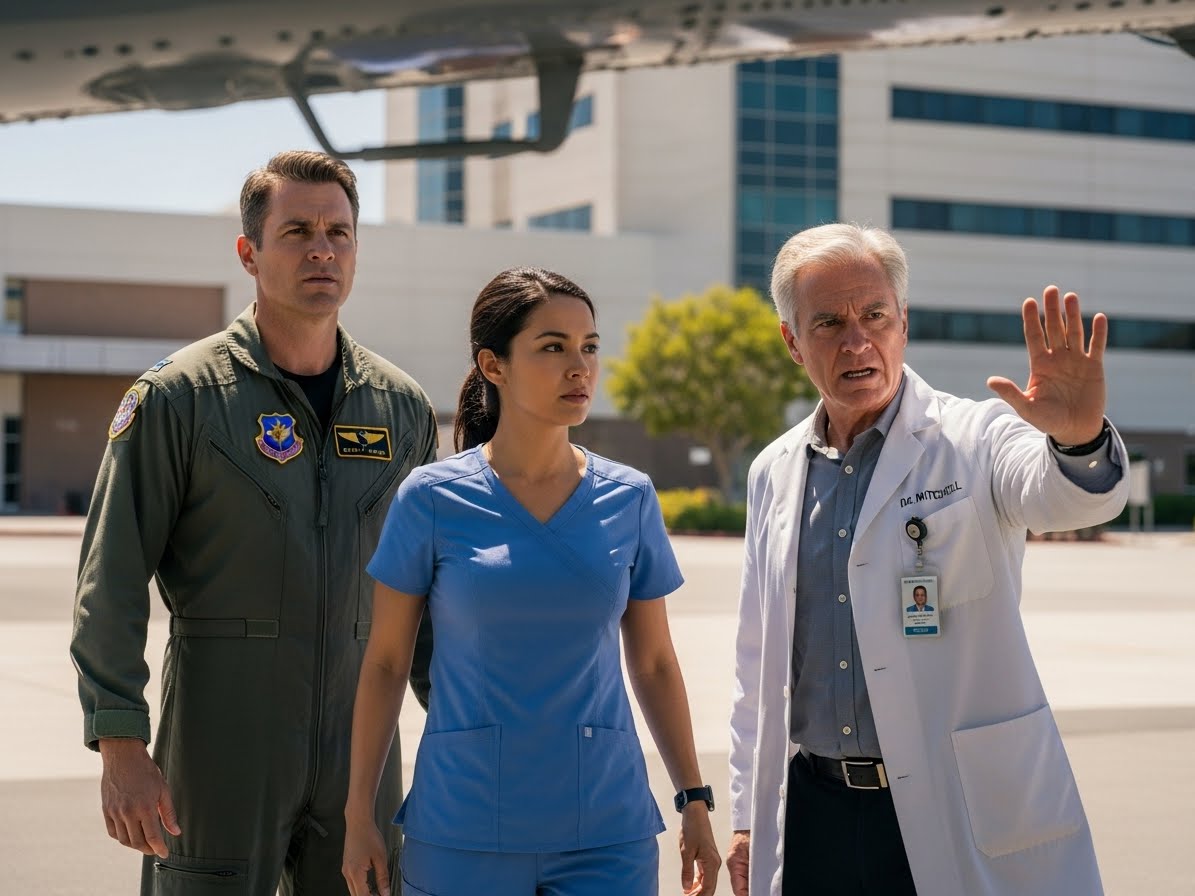
The chaos was immediate. The hospital’s automatic doors slid open and people poured out—curious visitors, confused patients in wheelchairs, and the hospital administration, led by a furious Dr. Mitchell.
The helicopter touched down with a heavy thud, the suspension groaning. The rotors didn’t spin down; they kept turning, ready for immediate lift-off. The side door slid open.
A man jumped out. He was dressed in a flight suit, helmet under his arm, his dark hair matted with sweat. Commander Jake Rodriguez scanned the area with the intensity of a man looking for a target. He ignored the security guards waving their arms at him. He ignored the stunned crowd.
He spotted Dr. Mitchell, who was marching toward the helicopter with the self-righteous fury of a bureaucrat whose lawn was being trampled.
“You!” Mitchell screamed over the roar of the engines. “What do you think you’re doing? This is a private facility! You are endangering my patients!”
Rodriguez didn’t even slow down. He walked straight up to Mitchell, invading his space with a physical dominance that made the surgeon shrink back.
“I need Dr. Talia Brooks,” Rodriguez shouted, his voice gravelly and desperate. “Where is she?”
Mitchell blinked, caught off guard. “Dr. Brooks?”
“Get her. Now.”
“That is impossible,” Mitchell sputtered, straightening his white coat. “Dr. Brooks has been terminated. She was fired for gross misconduct not twenty minutes ago. She is likely leaving the premises as we speak.”
Rodriguez froze. “Terminated?”
“For cause,” Mitchell said, regaining his composure. “She is reckless. Dangerous. I removed her before she could kill someone.”
Rodriguez let out a short, sharp curse. He turned away from Mitchell, scanning the parking lot. His eyes swept over the rows of cars, the gathering crowd, until they locked onto a lone figure standing by a Honda Civic fifty yards away.
Talia hadn’t moved. She stood with her arms crossed, watching the scene unfold with an unreadable expression.
“Talia!” Rodriguez roared, waving his arm.
The crowd turned. Hundreds of eyes shifted from the drama at the helicopter to the small woman in jeans and a t-shirt.
Talia let out a long sigh. She locked her car. She began to walk toward them.
She didn’t walk like a civilian doctor. She didn’t scurry or rush. She moved with a measured, efficient stride, her eyes scanning the perimeter, checking the rooftops, checking the exits. It was a walk born of muscle memory, a ghost from a life she had buried.
As she approached the circle of confrontation, Mitchell stepped between her and the Commander.
“Dr. Brooks, I told you to leave,” Mitchell sneered. “If you do not vacate the property, I will have the police involved.”
“Move,” Rodriguez growled, stepping around Mitchell. He grabbed Talia by the shoulders, his grip tight. “T, tell me you’re still sharp.”
“I just performed a thoracotomy in the ER with a scalpel and a rib spreader,” Talia said calmly. “I’m sharp, Jake. What’s the op?”
“Lieutenant Harris. Ejected at sea. The parachute malfunctioned. He took the impact on his chest. Our flight surgeon says it’s cardiac tamponade, but he’s afraid to go in. He says he doesn’t have the hands for it.”
Talia nodded, her mind already shifting gears. “Tamponade. The pressure is crushing the heart. He needs a window cut in the pericardium. If you don’t relieve the pressure, he codes.”
“Exactly. And you’re the only one I know who can do it on a moving deck in ten-foot swells.”
“Wait, wait, wait!” Dr. Mitchell interjected, his face turning a shade of purple that suggested impending stroke. “Commander, you cannot be serious. You are asking a fired resident—a girl—to go with you to perform surgery on a military officer? This is insanity! I have board-certified trauma surgeons inside who are far more qualified!”
Rodriguez turned on him, his patience evaporating. “Your board-certified surgeons are used to air conditioning and perfect lighting, Doctor. I need someone who can operate while the world is exploding around them.”
“She is a liability!” Mitchell screamed, pointing a finger at Talia. “She has no experience! She is a student!”
Rodriguez looked at Talia. A small smile touched his lips. “You didn’t tell him, did you?”
Talia shook her head. “It wasn’t relevant to my residency.”
“Tell him what?” Mitchell demanded. “What are you hiding?”
Rodriguez leaned in close to Mitchell, his voice dropping to a dangerous whisper that carried across the silence of the awe-struck crowd.
“Dr. Mitchell, before she was scrubbing floors in your ER, ‘Resident’ Brooks was the lead trauma medic for the 1st Special Forces Operational Detachment-Delta. She has performed more surgeries in the back of a Blackhawk under enemy fire than you have performed in your entire sanitized career.”
The blood drained from Mitchell’s face. The whispers in the crowd stopped instantly.
“She’s not a student,” Rodriguez finished. “She’s a legend.”
He turned back to Talia. “We’re burning daylight, T. Harris doesn’t have time for a résumé review.”
Talia looked at Mitchell one last time. The arrogance was gone from his eyes, replaced by a dawn of horrifying realization.
“Commander,” Talia said, stepping toward the helicopter. “Let’s go save a pilot.”
As the rotors spun up to full speed, whipping dust into Dr. Mitchell’s stunned face, Talia Brooks climbed into the belly of the beast and left her civilian life behind.
Part 2
Chapter 3
The interior of the Seahawk was loud, smelling of hydraulic fluid, sweat, and jet fuel. It was a smell that instantly transported Talia back four years, to the dusty plains of Kandahar and the mountains of the Hindu Kush.
She strapped herself into the jump seat opposite Rodriguez. The crew chief handed her a headset. She pulled it on, the noise dampening to a dull roar.
“ETA to the ship?” Talia asked, her voice clear over the comms.
“Twelve mikes,” Rodriguez replied. “The USS Abraham Lincoln is conducting maneuvers just off the coast. Harris was on a training sortie.”
“Vitals?”
“BP is 70 over 40. Heart rate is 130 and thready. Sats are dropping. He’s gray, T. He’s fading fast.”
Talia closed her eyes for a second, visualizing the anatomy. The heart, encased in its tough sac. The blood filling that sac, squeezing the ventricles, preventing them from filling. It was a mechanical problem with a mechanical solution, but the margin for error was razor-thin. One slip of the scalpel and you cut the coronary artery. Game over.
“What do you have on board the carrier?”
“Basic infirmary. X-ray. Ultrasound. We have a general surgeon, Dr. Evans, but he’s… he’s Navy generic. Good with appendicitis and broken legs. He took one look at the ultrasound showing the fluid around the heart and froze. Said he needed a specialist.”
“He was right to freeze,” Talia said. “If you miss the landmark, you kill him.”
Below them, the Pacific Ocean was a churning gray expanse. Talia looked at her hands. They were steady now. The trembling from the parking lot was gone. The mission had taken over.
“Why didn’t you tell them?” Rodriguez asked, watching her. “The hospital. Why didn’t you tell them who you were?”
Talia looked out the window. “I wanted to be a doctor, Jake. Not a ‘war hero.’ I wanted to learn how to heal people without a gun strapped to my leg. I thought if I told them, they’d never let me be just… a resident. They’d always see the medic.”
“Well,” Jake grinned, “I think the cat is out of the bag now. Mitchell looked like he swallowed a grenade.”
“Mitchell is the least of my problems. If this pilot dies, I’m practicing medicine without a license on federal property. I could go to Leavenworth.”
“If this pilot dies,” Jake said grimly, “nobody is going to care about your license. He’s the Admiral’s nephew.”
Talia groaned. “Of course he is.”
The helicopter banked hard. “Visual on the deck,” the pilot announced. “LZ is hot. We have a medical team standing by.”
The aircraft carrier USS Abraham Lincoln loomed out of the mist, a floating city of steel. The flight deck was a choreographed ballet of chaos. Yellow shirts directing traffic, green shirts hooking up catapults. They were landing near the island, where a team with a gurney was waiting.
The wheels hit the non-skid deck with a jolt.
“Go, go, go!”
Talia unbuckled and jumped out. The wind on the flight deck was ferocious, smelling of brine and exhaust. She didn’t wait for an escort; she spotted the medical team and sprinted toward them.
A frantic-looking man in a white Navy uniform met her. This had to be Dr. Evans.
“Dr. Brooks?” he shouted over the wind. “Thank God. He’s crashing. BP is 60 palp. He’s unconscious.”
“Let’s move!” Talia ordered, taking point. She grabbed the side of the gurney as they ran toward the hatch. She looked down at the patient. Lieutenant Harris was young, maybe twenty-five. His face was ash-gray, his neck veins distended—Beck’s Triad. Classic tamponade.
They burst into the ship’s medical bay. It was cramped, swaying slightly with the ship’s movement.
“Get him on the monitor,” Talia barked. “I need an ultrasound probe, a 16-gauge spinal needle, and a thoracotomy tray. Now!”
Dr. Evans hesitated. “We don’t have a sterile field set up for a thoracotomy. The risk of infection—”
Talia spun on him. “Infection takes three days to kill him. The pressure on his heart will kill him in three minutes. Give me the scalpel.”
She didn’t wait. She grabbed the ultrasound probe, slathering it with gel. She placed it on the pilot’s chest, right below the sternum.
There it was on the screen. A black halo around the heart. Fluid. Lots of it. The right ventricle was collapsing with every beat, struggling to open against the pressure.
“He’s in electromechanical dissociation,” the nurse called out. “I have rhythm on the monitor, but no pulse!”
“He’s coding,” Talia said. “I’m going in.”
She didn’t have time to scrub properly. She splashed Betadine on the pilot’s chest, grabbed a syringe attached to a long needle, and looked at the monitor.
“Jake,” she said, not looking up. “Hold his shoulders. If he wakes up when I pierce the sac, he’s going to thrash.”
“Got him.” Rodriguez pinned the pilot’s shoulders to the table.
Talia positioned the needle at a 45-degree angle, just below the ribcage, aiming toward the left shoulder. Aiming for the heart.
“Inserting,” she whispered.
Chapter 4
The medical bay went silent. The only sound was the hum of the ship’s engines and the frantic beeping of the alarm signaling no pulse.
Talia advanced the needle. It was a terrifying procedure blindly. Go too shallow, you get nothing. Go too deep, you puncture the heart muscle itself and cause a fatal arrhythmia.
She felt a pop. A subtle release of resistance.
She pulled back on the plunger.
Dark, non-clotted blood swirled into the syringe.
“I’m in,” she said. “Aspirating.”
She drew out 50cc of blood. Then 100cc.
“Look at the monitor!” the nurse gasped.
The flat line spiked. A pulse wave appeared. Low at first, then stronger.
“We have a pulse!” Dr. Evans shouted, checking the carotid. “It’s strong. BP is coming up. 80 over 50… 90 over 60.”
Talia didn’t stop. “The needle isn’t enough. The blood is going to re-accumulate. I need to open the pericardium and find the bleeder. Dr. Evans, you’re my assist. Can you retract?”
Evans looked at her with newfound respect. “Yes, Doctor. I can retract.”
“Good. Scalpel.”
For the next hour, Talia Brooks wasn’t a fired resident. She wasn’t a civilian. She was an artist. She opened the chest, identified the laceration on the right ventricle caused by the blunt force of the impact, and sutured it while the heart continued to beat under her hands. The ship rolled in the swells, the floor tilting, but Talia’s body compensated automatically, her hands remaining perfectly still relative to the patient.
“Suture tied,” she announced finally. “Bleeding is controlled. Pericardium is drained.”
She stepped back, her forehead slick with sweat.
“BP is 120 over 80,” the nurse reported. “Sinus rhythm. He’s stable.”
Talia exhaled, a long, shuddering breath. She stripped off her gloves and leaned against the bulkhead. Her legs felt like jelly.
Rodriguez walked over and handed her a bottle of water. “Nice work, T. Just like Fallujah.”
“Better than Fallujah,” Talia smiled weakly. “The air conditioning works here.”
Dr. Evans was staring at the monitor, then at Talia. “I… I’ve never seen a pericardial window done that fast. Not even by the attendings at Bethesda. Where did you say you trained?”
“University of California,” Talia said, taking a sip of water. “And the 75th Ranger Regiment forward surgical team.”
Evans swallowed hard. “Right. Well. I’ll… I’ll write up the post-op notes.”
“Dr. Brooks?”
Talia turned. The pilot, Lieutenant Harris, was blinking his eyes open. He was groggy, fighting the anesthesia, but he was looking right at her.
“Hey,” she said softly, stepping to his side. “Take it easy, Lieutenant. You had a rough landing.”
Harris squinted at her. “I know you,” he rasped. His voice was barely a whisper.
“We just met,” Talia said.
“No,” Harris shook his head slightly. “Kandahar. 2019. My convoy… hit an IED. You… you pulled me out of the Humvee. You put a tourniquet on my neck.”
Talia froze. She looked closely at the pilot’s face. Without the oxygen mask and the swelling, she saw it. The scar on his jaw.
“Corporal Harris?” she whispered. “You were a driver.”
“Mustang,” he grinned painfully. “Went to flight school… became an officer. I never forgot your face, Doc. The Angel of Death. That’s what we called you. Because when you showed up, death left.”
Talia felt tears prick her eyes. “Well, Lieutenant. Looks like I’m making a habit of saving your ass.”
The door to the sickbay opened. A tall man with stars on his collar walked in. Admiral Black. The ship’s captain was with him.
“Atten-hut!” Rodriguez barked.
“As you were,” the Admiral said, waving them down. He walked straight to the gurney, looked at his nephew, then turned to Talia.
“My medical officer tells me you performed a miracle here, Doctor.”
“Just procedure, sir,” Talia said, standing at attention out of habit.
“Commander Rodriguez tells me you were fired from your hospital this morning.”
Talia winced. “Yes, sir.”
The Admiral took a step closer. “Well, that’s unacceptable. The United States Navy does not let talent like this go to waste. Dr. Brooks, how would you like a job where your skills are actually appreciated?”
Chapter 5
The flight back to the hospital was different. The sun was setting, painting the sky in bruised purples and oranges. Talia sat in the open door of the helicopter, her legs dangling over the Pacific, watched by a safety strap.
She had a job offer. A direct commission. Lieutenant Commander Brooks. Head of Trauma Training for the Pacific Fleet. It was everything she had run away from, and yet, sitting here with the wind in her face, she realized it was everything she missed.
But first, she had unfinished business.
“We’re coming up on the hospital,” the pilot announced. “There’s… uh… quite a crowd, ma’am.”
Talia leaned out. The parking lot of Memorial Hospital was packed. News vans with satellite dishes were parked in rows. A crowd of hundreds—staff, patients, and onlookers—was gathered near the entrance.
“Looks like you’re famous, T,” Rodriguez yelled over the comms. “Someone live-streamed the landing.”
The helicopter touched down. This time, there was no Dr. Mitchell running to scream at them. Instead, there was silence as the rotors spun down.
Talia hopped out. Rodriguez flanked her. They walked toward the entrance.
The crowd parted. And there, standing at the front, was Dr. Mitchell. He looked smaller than he had this morning. His tie was loosened. He held a cardboard box in his hands.
Beside him stood the Hospital Board Director, a stern woman named Mrs. Galloway.
“Dr. Brooks,” Mrs. Galloway said, her voice projecting clearly. “Please, come here.”
Talia approached. She didn’t know if she was about to be arrested or sued.
“Dr. Mitchell has something to say to you,” Mrs. Galloway said, looking at the Chief of Surgery with icy contempt.
Mitchell looked up. His eyes were red-rimmed. “Dr. Brooks. I… I was wrong.”
Talia said nothing. She let him speak.
“The patient you operated on this morning,” Mitchell continued, his voice trembling. “Mr. Henderson. He woke up an hour ago. He is neurologically intact. You saved his life. And the protocols… the protocols I cited were guidelines, not laws. I used them to punish you because I was intimidated by your skill.”
He took a breath. “I have tendered my resignation as Chief of Surgery, effective immediately.”
A murmur went through the crowd.
“And,” Mrs. Galloway stepped in, “The Board would like to offer you his position. Acting Chief of Surgery. With a formal apology and a significant raise.”
Talia looked at the hospital. She looked at the faces of the nurses who had been afraid to look at her this morning. They were smiling now. Cheering.
She looked at Rodriguez, who gave her a subtle nod.
She looked at Mitchell, a man broken by his own ego.
“Thank you, Mrs. Galloway,” Talia said, her voice carrying across the silent parking lot. “But I can’t accept.”
“Why not?” Galloway looked stunned. “It’s the opportunity of a lifetime.”
“Because I realized something today,” Talia said, glancing at the helicopter behind her. “I don’t belong in a hospital where rules matter more than lives. I don’t belong in a place where I have to apologize for saving a dying man.”
She turned to Rodriguez. “Commander, is that offer still open?”
“Does a bear sit in the woods?” Rodriguez grinned.
Talia turned back to the crowd. “I’m going back to the Navy.”
The cheer that erupted from the crowd was deafening. Even the nurses were clapping. Mr. Henderson’s family, who had been standing near the back, pushed forward to hug her.
Talia Brooks had lost her job, saved two lives, destroyed a tyrant’s career, and found her true calling, all before dinner time.
She walked back toward the helicopter, the sunset reflecting off the gray hull. She wasn’t running away this time. She was going home.
Chapter 6: The Siege
The moment the Seahawk lifted off from the Memorial Hospital roof for the second time, carrying Dr. Talia Brooks away from the wreckage of her civilian career, the real war began. It wasn’t fought with bullets or scalpels, but with lawyers, press releases, and the brutal court of public opinion.
Talia sat in the back of the helicopter, the adrenaline of the day finally beginning to bleed out, replaced by a bone-deep exhaustion. Across from her, Commander Rodriguez was already on his secure tablet, scrolling through feeds with a grim expression.
“You need to see this,” Rodriguez yelled over the rotor noise, handing her the device.
It was a video. Shaky, vertical, clearly shot on a phone from the hospital parking lot. It showed the confrontation between Rodriguez and Mitchell. It showed Talia sprinting to the chopper. But what made Talia’s stomach drop was the caption overlaid in bold red text: HOSPITAL FIRES HERO DOCTOR, NAVY STEALS HER BACK.
It had twelve million views. In two hours.
“The internet is eating Mitchell alive,” Rodriguez said. “But a cornered animal bites back. Don’t think this is over just because you’re in the air.”
He was right. By the time they landed at Naval Air Station North Island, the narrative was already twisting.
While Talia was being debriefed by excited medical officers and filling out mountains of paperwork for her reinstatement, Dr. Harrison Mitchell was holding a press conference on the steps of Memorial Hospital.
Talia watched it on a TV in the mess hall, nursing a black coffee.
Mitchell looked composed, the picture of a concerned medical administrator. He wasn’t the screaming tyrant from the parking lot anymore. He was smooth, slick, and dangerous.
“While we respect the military,” Mitchell told the bank of microphones, “we cannot allow emotion to dictate medical standards. The fact remains that Ms. Brooks performed an unauthorized, unsterile surgical procedure on a civilian patient. This is assault. It is malpractice. Regardless of the outcome, she broke the law. We have filed a formal complaint with the State Medical Board to permanently revoke her license, and we are pressing charges for criminal negligence.”
The room in the mess hall went silent. The other sailors looked at Talia.
“He’s suing you?” a young ensign asked, outraged. “For saving a life?”
Talia stared at the screen. Mitchell wasn’t just trying to fire her; he was trying to ensure she never practiced medicine again, anywhere. He was burning the earth so nothing could grow.
“He’s terrified,” Talia said softly. “He knows if he doesn’t destroy me, the inquiry will destroy him.”
Just then, the double doors of the mess hall swung open. Captain Torres, the base commander, strode in, flanked by two men in sharp suits who definitely weren’t military.
“Dr. Brooks,” Torres said. “These gentlemen are from the Judge Advocate General’s Corps. JAG.”
One of the lawyers, a Lieutenant Commander with eyes like flint, stepped forward. “Dr. Brooks, my name is Lt. Commander Sterling. The Navy takes a very dim view of civilians threatening our personnel. Dr. Mitchell wants a legal fight? We’re going to give him a war.”
The next three days were a blur of depositions and strategy meetings. The story had become a national firestorm. #TeamTalia was trending on Twitter. Veterans’ groups were protesting outside Memorial Hospital. But Mitchell held firm, leveraging his political connections on the State Medical Board to fast-track a hearing.
He wanted to strip her of her license before the Navy could fully process her commission. It was a race against time.
On the third night, Talia sat in her temporary quarters on base, unable to sleep. Her phone buzzed. It was an unknown number.
“Hello?”
“Is this the Angel of Death?” a weak voice rasped on the other end.
Talia froze. She smiled, tears stinging her eyes. “Hello, Lieutenant Harris.”
“I hear you’re in some trouble because of me, Doc,” Harris said. He sounded tired, but alive. “My uncle, the Admiral… he’s pretty upset about this Mitchell guy.”
“It’s just politics, Harris. Focus on getting better.”
“Doc,” Harris said, his voice firming up. “I’m not just a pilot. I’m a witness. And I’m not the only one. Mitchell thinks he’s fighting a resident. He doesn’t realize he’s fighting a platoon.”
Chapter 7: Ghosts of Kandahar
Before the legal showdown, Talia had to face something harder: the memories she had unlocked.
Returning to the military world was like putting on an old, comfortable boot that still had a pebble in it. The structure, the respect, the camaraderie—it was all there. But so was the trauma.
She was assigned to Balboa Naval Hospital to assist in training while her legal status was in limbo. Walking through the wards, seeing young men and women missing limbs, seeing the vacant stares of TBI patients, it brought Kandahar rushing back.
She found herself standing outside Room 402. Lieutenant Harris’s room.
She took a breath and knocked.
“Enter,” Harris called out.
She walked in. Harris was sitting up, pale, hooked to monitors, but looking surprisingly good for a man who had his heart stitched up a few days ago.
“At ease, Doc,” Harris joked, pointing to the chair.
Talia sat. For a long time, they didn’t speak. They just looked at each other, two survivors of the same bad day in 2019, reunited by another bad day in 2023.
“You disappeared,” Harris said quietly. “After the IED. After you patched us up. You just… vanished. I looked for you.”
“I rotated out,” Talia said, looking at her hands. “I was done, Harris. Four tours. I lost my team chief in the third one. I lost my best friend in the fourth. When I got to you… when I had my hands in your neck trying to stop that bleed… I promised myself if you lived, I was done. I couldn’t wash the blood off anymore.”
Harris nodded slowly. “So you went to San Diego. To the suburbs. Tried to pretend you were normal.”
“I tried to be a doctor who fixed colds and broken arms,” Talia said bitterly. “I wanted boring. I wanted safe.”
“But safe isn’t you, T,” Harris said. “I saw the video of you in that parking lot. You looked more alive in that grainy footage than you probably have in three years of civilian rounds.”
“I almost lost my career for it.”
“No,” Harris corrected her. “You found your career. That hospital? That Chief of Surgery? That was a cage. You’re a tiger, Brooks. You don’t belong in a petting zoo.”
Talia laughed, a dry, cracked sound. “Mitchell is trying to put the tiger down, Harris. The hearing is tomorrow. If the State Board revokes my license, the Navy can’t commission me as a doctor. I’ll be nothing.”
Harris reached out and grabbed the remote for his TV. He clicked it on to a news channel.
“You haven’t seen the news in the last hour, have you?”
“No. I’ve been avoiding it.”
“Look.”
The screen showed the front of Memorial Hospital. But it wasn’t just protesters anymore. There were rows of motorcycles. The Patriot Guard Riders. And behind them, men and women in wheelchairs, on crutches, wearing VFW hats.
The reporter was interviewing a man with a prosthetic leg.
“We heard the medic who saved the Rangers at Firebase Charlie is in trouble,” the veteran told the camera. “Mitchell says she’s reckless. We say she’s the reason we’re breathing. We’re here to testify.”
Talia put a hand to her mouth.
“You saved a lot of people, Doc,” Harris said softy. “They didn’t forget. And they aren’t going to let you fight this alone.”
Talia looked at the screen, at the faces of men and women she had treated in the dust and the heat years ago. She had thought she was hiding from her past. She realized now that her past was an army, and it had just arrived to protect her.
“I have to go,” Talia said, standing up. The fear that had been gnawing at her stomach for days was gone, replaced by a cold, hard resolve.
“Where are you going?”
“To prepare,” Talia said. “Mitchell wants a fight? I’m going to bring him the whole damn war.”
Chapter 8: The Verdict
The hearing of the California State Medical Board was held in a sterile, wood-paneled conference room in downtown San Diego. It was supposed to be a closed session, but the media pressure had forced them to allow a live feed.
Dr. Harrison Mitchell sat at the plaintiff’s table, looking smug. He was flanked by three high-priced corporate lawyers. He had the binders, the bylaws, the protocols. He had the paperwork that said he was right.
Talia sat at the defense table. She wasn’t wearing a suit. She was wearing her Navy Dress Blues, the uniform she had earned the right to wear again. Beside her sat Lt. Commander Sterling, the JAG lawyer.
The Chairman of the Board, a stern man named Dr. Aris, banged the gavel.
“We are here to review the complaint against Dr. Talia Brooks regarding the unauthorized thoracotomy performed on October 12th. Dr. Mitchell, you may proceed.”
Mitchell stood up. He spent twenty minutes weaving a tale of chaos. He painted Talia as a rogue agent, a traumatized veteran who couldn’t distinguish between a battlefield and a modern hospital. He used words like “unhinged,” “insubordinate,” and “liability.”
“Medicine is about order,” Mitchell concluded, smoothing his tie. “It is about following the established hierarchy. Dr. Brooks believes she is above that hierarchy. If we allow residents to cut open patients whenever they feel like it, we do not have a hospital. We have a slaughterhouse.”
It was a compelling speech. Talia could see the Board members nodding. Mitchell was one of them—an administrator, a bureaucrat. They understood his language.
“Dr. Brooks,” the Chairman said. “Your defense?”
Sterling stood up, but Talia put a hand on his arm. “I got this,” she whispered.
She stood up. She didn’t walk to the podium. She walked to the center of the room, standing between the Board and Mitchell.
“Dr. Mitchell talks about order,” Talia began, her voice steady. “He talks about hierarchy. He talks about the ‘rules’ of medicine.”
She turned to face the Board.
“But he forgot the first rule. The only rule that actually matters. Primum non nocere. First, do no harm.”
She gestured to the screen behind the Board.
“I would like to call my first witness. Not in person, but via video link.”
The screen flickered to life. It was Mr. Gerald Patterson, the elderly man she had operated on in the ER. He was sitting in a recliner at home, looking pale but alive. His granddaughter was sitting on his lap.
“Mr. Patterson,” Talia said. “Can you tell the Board what happened that day?”
“I remember the pain,” Patterson said, his voice raspy. “I remember fading out. I saw the lights go dim. And I heard a man’s voice—that fella sitting right there, Dr. Mitchell—saying to wait. Saying to follow protocol.”
The room went deadly silent.
“And then,” Patterson continued, “I heard her. Dr. Brooks. She didn’t argue. She just worked. She reached into my chest and she squeezed my heart. She literally squeezed life back into me. If she had listened to him…” Patterson pointed a shaking finger at the camera. “My granddaughter wouldn’t have a grandpa today.”
Mitchell shifted uncomfortably in his seat.
“I have seventeen other affidavits,” Talia said, dropping a thick stack of papers on the table. “From nurses. From interns. From patients. All stating that Dr. Mitchell has consistently delayed care to protect administrative metrics. All stating that he creates an environment of fear where doctors are afraid to save lives because they might get sued.”
She turned to Mitchell.
“You called me reckless, Doctor. You said I brought the battlefield to the hospital. You’re right. I did. Because in the battlefield, we don’t care about your liability insurance. We care about the patient. And maybe, just maybe, American medicine needs a little more of that combat mindset.”
The Chairman looked at the stack of affidavits. He looked at Mr. Patterson on the screen. He looked at the live feed comments scrolling on a monitor to the side, which were overwhelmingly on Talia’s side.
“Dr. Mitchell,” the Chairman asked, “Is it true that you ordered security to remove Dr. Brooks while her hands were still inside the patient’s chest?”
Mitchell stammered. “I… it was a heated situation… I was concerned about infection…”
“Yes or no?”
“Yes,” Mitchell whispered.
The Chairman closed his folder.
“The Board finds that Dr. Brooks acted within the scope of extreme emergency necessity. Her license is valid. Furthermore,” the Chairman glared at Mitchell, “We are opening a formal inquiry into the administrative practices of Memorial Hospital under Dr. Mitchell’s tenure. This hearing is adjourned.”
The room erupted. Mitchell slumped in his chair, defeated. His career wasn’t just over; his legacy was ashes.
Talia didn’t gloat. She didn’t smile. She just nodded to the Board, shook Sterling’s hand, and walked out of the room.
Outside, the press was waiting. The cameras flashed, a blinding sea of light. Reporters shouted questions.
“Dr. Brooks! How does it feel to win?” “Dr. Brooks! Are you going back to Memorial?” “Dr. Brooks! What are you going to do now?”
Talia stopped at the bottom of the steps. She looked at the crowd. She saw the veterans who had ridden their bikes to support her. She saw Commander Rodriguez leaning against a black SUV, waiting for her.
She stepped up to the microphones.
“I didn’t win,” Talia said. “The patient won. That’s all that matters.”
“Will you return to civilian practice?” a reporter asked.
Talia looked at Rodriguez. She looked at her Dress Blues.
“No,” she said. “I’m a Navy doctor. And I have a flight to catch.”
She pushed through the crowd, ignoring the shouting questions, and got into the SUV.
“Where to, Commander?” Rodriguez asked as they pulled away.
“The airfield,” Talia said, leaning back and closing her eyes. “I hear there’s a new batch of medics training for deployment. They need to know how to crack a chest without asking for permission.”
Rodriguez laughed. “Welcome back, T.”
As the SUV merged onto the highway, heading toward the base, Talia watched the city of San Diego roll by. She had lost her job, she had been sued, and she had been dragged through the mud.
But for the first time in four years, the shaking in her hands was completely gone.
She was ready for the next mission.