THEY THOUGHT I WAS JUST A SIMULATOR INSTRUCTOR. THEY NEVER KNEW I WAS THE DEADLIEST PILOT THE AIR FORCE HAD EVER BURIED—UNTIL THE SKY CAUGHT FIRE.
PART 1
Chapter 1: The Heat and the Hiding Place
The sun baked the sprawling Texas air base, its heat radiating off the tarmac in shimmering, oily waves. It was the kind of heat that sat heavy in your lungs, tasting of ozone and burnt rubber. Pilots bustled between hangars, flight crews shouted orders over the roar of auxiliary power units, and the engines of F-35s and Raptors hummed like restless predators waiting to be unleashed.
Amid the chaos, I walked quietly across the runway apron. My olive-green jumpsuit was plain and unmarked, devoid of the patches and unit insignias that decorated the chests of the active-duty hotshots. My stride was calm, unhurried, preserving energy against the oppression of the midday sun.
To most, I was simply Emily Rhodes. Another face at the base, a civilian contractor who spent her days in the air-conditioned twilight of the flight simulator building, drilling rookies on basic aviation skills. I was the lady who told them to watch their fuel mixtures. The patient voice in their ear when they panicked during an instrument landing.
I never raised my voice. I never boasted at the bar on Friday nights. And I absolutely never hinted at the life I had before this.
Few knew the truth. In fact, most of the people who knew the truth were either dead or buried under so many non-disclosure agreements they couldn’t tell their wives what they did for a living.
Five years ago, I wasn’t Emily Rhodes. Under the call sign “Ghost Hawk,” I was one of the Air Force’s top combat pilots. My name was whispered with a mix of jealousy and awe among the fighter squadrons. I’d flown missions that officially didn’t exist, in airspace that officially we were never in. Ghost Hawk was the shadow you sent into enemy skies when failure wasn’t an option and diplomacy had failed.
But fame, even silent fame, came with a price.
My final mission—Kandahar, 2019—ended in fire and chaos. It left scars on my body that were hidden by my flight suit, and scars on my soul that were impossible to hide if you looked close enough. I lost my wingman, Falcon, that day. I listened to him burn over the radio while I was ordered to return to base.
When I walked away from combat, I vowed never to climb into a cockpit again. I was done with death.
Instead, I buried myself here. I instructed recruits, training them on flight simulators that mimicked the complexity of modern jets but without the danger. My teaching style was patient, calm, almost detached.
The rookies respected me, though they found me mysterious.
“You’ve flown before, haven’t you, Ms. Rhodes?” a trainee named Miller had asked just last week, noticing the effortless way I demonstrated a complex aerial maneuver on the stick to correct his grip.
I had only smiled, brushing the question away like a stray fly. “Everyone flies a little in this job, Miller. Focus on your vector.”
No one suspected that the quiet woman guiding them had once flown with lethal precision across war-torn skies.
That morning started like any other. I sipped my black coffee in the simulator control room, watching three nervous recruits struggle through basic aerial dogfight exercises. The screens flickered with digital horizons and wireframe enemies.
“Your throttle’s too stiff, Miller,” I murmured through the headset, watching his telemetry spike. “Loosen your grip. Feel the aircraft respond. You’re not wrestling it. You’re dancing with it.”
My tone was steady, almost meditative. But somewhere far above the clouds, reality was about to crash into our quiet little world.
Chapter 2: The Scramble
It started as a faint sound, easily ignored at first. A low vibration that rattled the spoon against the saucer of my coffee cup. But then the Klaxons roared, and the base’s calm rhythm shattered instantly.
The intercom blared with sharp, jagged urgency.
“ALERT. UNIDENTIFIED AIRCRAFT APPROACHING RESTRICTED AIRSPACE. ALL ACTIVE PILOTS REPORT TO STATIONS IMMEDIATELY. THIS IS NOT A DRILL.”
My coffee slipped from my fingers, shattering against the linoleum floor. The dark liquid spread like an oil spill, but I didn’t look down.
From the window, I could see base personnel erupting into motion. Pilots sprinted toward hangars, struggling to zip flight suits as they ran. Engineers scrambled to prep jets for launch, removing “Remove Before Flight” tags with frantic haste. Radios crackled with tension.
I stood frozen, watching the chaos unfold. Something about the tone of the alarm knotted my gut. It wasn’t just a drill. It wasn’t just an airspace violation. I’d heard alarms like this before—back when lives were seconds away from being lost. This was a Threat Level Alpha.
“Ms. Rhodes! You need to head to the bunker!” a young airman shouted as he rushed past the simulator room door.
I nodded silently, though my feet didn’t move toward the bunker. Instead, I found myself drawn toward the main command tower. Curiosity and a deep, sickening unease pushed me forward. It was like a magnet pulling at the iron in my blood.
Inside the command center, the atmosphere was electric with fear. The air smelled of sweat and overheating electronics. Large wall-sized monitors displayed a red blip moving rapidly across the radar screen.
A voice called out from the telemetry station, “Unidentified drone moving at Mach speeds, closing in on civilian airspace! It’s crossed the perimeter. Estimated time to breach Dallas metro airspace: 10 minutes.”
“Get the Raptors up there now!” The Base Commander, a stern man named Vance, barked. His face was flushed with urgency.
“Sir!” another officer replied, panic creeping into his tone. “We’ve got a problem. Raptor One’s pilot just collapsed in the briefing room. Possible seizure. He’s out cold. Medics are on him.”
“Launch Raptor Two!” Vance yelled.
“Raptor Two is grounded, Sir! Critical hydraulic fault discovered during pre-flight. It’s unflyable.”
Vance slammed his fist against the table. “We have a rogue military drone loaded with God-knows-what heading for a population center, and you’re telling me we don’t have a single pilot?”
“All other qualified pilots are on rotation or leave, Sir. We have the jet—Raptor Three is fueled and prepped on the tarmac as a spare—but we have no one to put in the seat.”
My pulse quickened. I shouldn’t be here. I wasn’t part of this world anymore. But my instincts, sharpened from years of combat, screamed at me.
My eyes locked on the tactical display. The rogue drone was moving fast. Its trajectory aimed dangerously close to a populated area. Every second they hesitated could mean disaster.
An older officer, Major Halloway, was scanning the emergency rosters. He froze. He looked up, his gaze shifting across the crowded room until it landed on me. I was standing quietly at the back, trying to blend into the shadows.
Halloway knew. He was one of the few.
“Sir,” Halloway said. “I know someone who might be able to fly.”
Vance turned, his eyes narrowing. He followed Halloway’s finger.
“Her?” Vance asked, incredulous. “That’s the simulator instructor. Rhodes. She’s a civilian.”
“She’s not just an instructor, Sir,” Halloway said, his voice dropping to a near whisper that somehow carried across the silent room. “She’s Ghost Hawk.”
The room went dead silent.
I felt every pair of eyes on me. My throat tightened. Ghost Hawk. I hadn’t heard that name spoken aloud in years. It felt like a ghost rising from the grave, dragging my past into the present.
“You?” Vance asked, disbelief flickering across his face. “You flew Echo Squadron?”
I said nothing. I could feel the weight of memories pressing on my chest. I’d sworn I’d never fly again. Not after Falcon. The faces of my lost squadmates haunted me every night. Climbing back into a cockpit felt like opening a wound that had never truly healed.
But the drone on the radar didn’t care about my pain. It didn’t care about my promises. It was coming, and they were running out of time.
Vance’s voice softened, losing its command edge. “We don’t have anyone else, Rhodes.”
My heart pounded. I looked at the radar, then at the young recruits standing frozen in fear near the door. They were too inexperienced for this. If they went up, they died.
I was the only one who could stop what was coming.
I drew a slow, shuddering breath. I pushed the memory of Falcon’s burning jet out of my mind and locked it away in a steel box.
“Prep the Raptor,” I said, my voice steady.
PART 2
Chapter 3: The Resurrection of Ghost Hawk
The command tower was a storm of movement and sound, voices clashing with the shrill beeps of warning systems, but I felt strangely detached from it all. I had spoken the words—Prep the Raptor—and now the universe was realigning itself around that decision. There was no taking it back.
I turned and walked out of the command center, the heavy steel doors sealing the noise behind me.
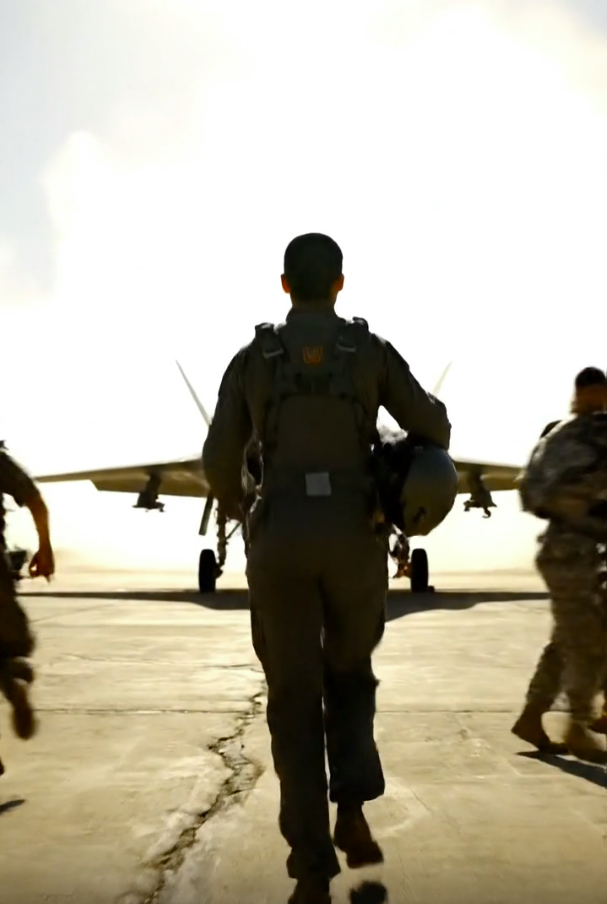
Technicians were already scrambling to ready the F-22 on the tarmac. I could hear their boots pounding against the polished floors of the hangar corridor as I made my way to the locker room. It had been five years since I had felt this specific weight—the crushing, suffocating pressure of a moment where hesitation could cost lives.
A young logistics officer, a girl no older than twenty-two, ran up to me with a bundle of gear. She looked terrified.
“Ma’am, we pulled this from the reserve locker. It’s a standard issue G-suit and helmet. I don’t know if it fits.”
I took the bundle. The fabric felt rough and familiar against my hands. “It’ll fit,” I said quietly. “Flight suits expand. So do pilots.”
I stepped into the locker room and stripped off my civilian coveralls. My hands were shaking, just a little. I stared at them, willing them to still. Not now, I told myself. You can fall apart later. You can drink yourself into oblivion tonight. But right now, you need to be steel.
I pulled on the G-suit. It was tight, compressing my legs and abdomen. It was designed to squeeze blood back into the brain during high-G maneuvers to prevent passing out. To me, it felt like a corset of armor. I zipped the front, checked the seals, and grabbed the helmet.
When I stepped out onto the tarmac, the heat hit me like a physical blow. The air shimmered, mixing with the acrid, chemical smell of JP-8 jet fuel. It was the smell of my youth, the smell of war, the smell of fear.
The F-22 Raptor sat at the end of the apron, a dark, angular beast brooding under the Texas sun. It looked alien, a predator carved from shadow and geometry. Mechanics were rushing around it, checking hydraulics, fuel lines, and weapon systems with frantic precision.
Major Halloway was waiting by the ladder. He looked at me, his eyes scanning my face, looking for the cracks.
“Do you still remember the start-up sequence?” he asked quietly, almost as if he was afraid I would say no.
I looked up at the cockpit canopy, gleaming in the sunlight. “Once you’ve flown a Raptor, Major,” I replied, my voice firm, “you never forget. It’s not a machine you operate. It’s a suit you wear.”
Halloway nodded, a grim smile touching his lips. “You saved an entire strike team over Kandahar. If anyone can stop that drone, it’s you. But Emily… this isn’t 2019. You’re rusty.”
“I know,” I said. “Let’s hope the bike riding analogy holds up.”
I didn’t answer him further. I couldn’t. The memories of Kandahar were flashing in my mind like a strobe light. Sunset over burning poppy fields. The sharp rattle of anti-aircraft fire. The screaming voice of Falcon over the comms before the signal cut out into static.
I clenched my jaw until my teeth ached. I’m not flying for glory, I reminded myself. I’m flying so no one else has to burn today.
I walked toward the jet, my boots crunching against the gravel. Every step felt heavier than the last, as if gravity itself was trying to keep me on the ground.
A young technician was at the bottom of the ladder. He handed me the data slate for the pre-flight check. He stared at me with wide eyes, like a rookie meeting a ghost.
“Ma’am… you’re cleared for launch in five minutes,” he stammered. “Is it… is it true? Are you her?”
I looked at him. He was so young. He had his whole life ahead of him. Falcon had been that young once.
I took the slate, signed it without looking, and handed it back. “Get the chocks pulled, Airman. We’re burning daylight.”
I climbed the ladder. The cockpit was a familiar womb of glass and switches. I lowered myself into the ACES II ejection seat. It was hard, unforgiving. I buckled the harness straps, pulling them tight across my chest until it was hard to breathe. I needed that pressure. I needed to feel held.
The cockpit displays flickered to life as I flipped the battery switch. The familiar glow of the Multi-Function Displays (MFDs) washed over me.
Canopy coming down.
The glass shell lowered, sealing me off from the noise of the base. Suddenly, it was just me and the hum of the avionics. The world outside—the frantic crew, the shouting officers, the heat—became a silent movie.
“Systems online,” a mechanic confirmed through my headset. “APU is running. You are green on all boards.”
I placed my hands on the throttle and stick. The HOTAS (Hands On Throttle-And-Stick) controls were cold metal. I closed my eyes for a fraction of a second.
Breathe in. Breathe out. You are not Emily Rhodes. You are not a teacher. You are Ghost Hawk.
“Tower, this is Ghost Hawk,” I said into the mask. My voice sounded amplified, breathing rhythmic like Darth Vader. “Requesting immediate departure.”
There was a pause on the other end, as if the controller was stunned to hear that call sign on the frequency.
“Ghost Hawk… Tower copies. You are cleared for immediate takeoff, Runway One-Liner. Wind is calm. Give ’em hell, ma’am.”
I pushed the throttle forward. The twin Pratt & Whitney F119 engines roared to life behind me, a deep, guttural scream that vibrated through the frame of the jet and into my spine. The Raptor surged forward.
I steered it onto the runway. The long strip of concrete stretched out before me, disappearing into the heat haze.
“Launching,” I whispered.
I slammed the throttles to full military power and engaged the afterburners.
The kick was instantaneous. Thirty-five thousand pounds of thrust slammed me back into the seat. The acceleration was violent, beautiful, and terrifying. The hangar blurred. The runway lights became streaks of white.
At 140 knots, I pulled back gently on the stick.
The nose lifted. The wheels left the ground.
The vibration of the wheels vanished, replaced by the smooth, deadly glide of flight. I retracted the gear and banked sharp right, climbing straight up into the vertical. The G-forces hit me—four, five, six Gs. My vision grayed at the edges, my suit inflating to squeeze my legs, forcing blood to my head.
I gritted my teeth and forced air into my lungs using the specialized breathing maneuver—the hick-hick-hick sound of a pilot fighting gravity.
I broke through the cloud layer at 10,000 feet, bursting into a world of blinding white and deep, endless blue.
The fear melted. The hesitation vanished.
I was flying again. Truly flying.
Chapter 4: The Hunter and the Prey
From the control tower, I knew all eyes were fixed on my radar blip as it streaked into the sky.
“She’s climbing fast,” I heard an officer say over the open channel, his voice laced with awe. “Angels twenty… Angels thirty… she’s pushing Mach 1.5 in a vertical climb.”
“She’s moving like she’s part of the jet,” Halloway’s voice replied, closer to the mic. “She is. Ghost Hawk was born for this.”
I leveled out at 40,000 feet, scanning the vast emptiness. The sky here was a darker shade of blue, bordering on violet. It was peaceful, deceptively so.
“Tower, I’m at Angels Four-Zero. Give me a vector,” I said, my eyes scanning the HUD (Heads-Up Display).
“Ghost Hawk, bogey is forty miles out, bearing zero-nine-zero. It’s moving fast, skimming the cloud tops at Angels Three-Five. Intercept in ninety seconds.”
“Copy,” I replied. “Master arm on.”
I flipped the switch. The weapons panel lit up. The Raptor was no longer just a plane; it was a loaded gun.
The drone appeared on my HUD as a glowing red diamond. It wasn’t flying in a straight line. It was weaving, shifting altitude unpredictably.
“I have a radar contact,” I reported. “Closing speed is… high. This thing is fast.”
“Ghost Hawk, do not engage until you have visual confirmation,” Commander Vance instructed. “We need to know what we’re shooting at.”
“Copy that,” I said. But part of me already knew this wouldn’t be a simple identify-and-shoot.
The Raptor sliced through the thin air, closing the distance in heartbeats. Ten miles. Five miles.
“Tally-ho,” I said, my breath catching in my throat. “I have visual.”
The drone wasn’t like the Predators or Reapers I was used to seeing—clunky, propeller-driven things that loitered for hours. This was something else. It was jet-powered, sleek, and painted a matte, light-absorbing black. It looked like a shard of obsidian flung into the sky. Its wings were swept back aggressively, and it had no cockpit, just a smooth, blind dome where a pilot should have been.
“Tower, visual confirmed,” I said, keeping my voice level. “Target is a stealth combat drone, delta-wing configuration. No markings. It looks… expensive.”
“It’s military grade,” Vance said. “Possibly experimental. It’s definitely not one of ours.”
“It’s maneuvering,” I said, noticing the subtle shifts in its control surfaces. “It’s… twitchy.”
I brought the Raptor alongside it, keeping a safe distance of about half a mile. I wanted to see how it would react.
The moment my radar painted it, the drone reacted.
It didn’t just turn; it snapped. It rolled ninety degrees and dove instantly, dropping like a stone.
“Whoa!” I jerked the stick, banking hard to follow. “Target is taking evasive action! It knew I was there the second I looked at it.”
“It’s AI-controlled, Ghost Hawk,” Halloway warned. “It has 360-degree sensors. It sees you better than you see it.”
I pushed the nose down, chasing the black shard into the clouds. The white mist swallowed us, and for a second, I was flying blind, relying entirely on the green glow of my instruments.
“This thing moves weird,” I muttered. “It doesn’t fly like a pilot. It flies like a calculator.”
“What do you mean?” Vance asked.
“It’s too perfect,” I said, gritting my teeth as I pulled out of the dive at 15,000 feet. “It doesn’t drift. It doesn’t hesitate. It’s flying the math.”
The drone leveled out ahead of me, picking up speed. It was heading straight for the suburban sprawl of the outer metro area.
“Ghost Hawk, that drone is five minutes from civilian airspace,” Vance’s voice was tight. “We cannot let it reach the city. If it goes down over downtown Dallas…”
He didn’t have to finish the sentence. A crash alone would kill people. If it was carrying a payload…
“Rules of Engagement?” I asked.
“Shoot to kill,” Vance ordered. “Splash it. But try to bring it down over unpopulated terrain.”
“Copy. Engaging.”
I thumbed the weapon selector to AIM-9X Sidewinder. The heat-seeking missiles were my best bet for a close-range dogfight. A high-pitched tone filled my helmet—the growl of the missile seeking a heat source.
“Tone,” I said. “Locking on.”
I had the shot. It was clean.
My finger hovered over the trigger. Just squeeze it. End it.
But then, the drone did something impossible.
It slammed on the airbrakes—if it even had them—and performed a “Cobra” maneuver, pitching its nose straight up to ninety degrees, turning its entire body into a giant airbrake.
I overshot it instantly.
In less than a second, the hunter became the prey. I was now in front of the drone.
“Damn it!” I shouted, slamming the throttle to full afterburner and pulling hard into a climb to get away from its nose.
“Ghost Hawk! Spike! Spike!” The Radar Warning Receiver (RWR) screamed in my ear. A shrill, terrifying warble that meant one thing: Someone is locking onto you.
“It’s painting me!” I yelled. “It has fire control radar! This thing is armed!”
“Evasive! Break right!” Halloway shouted.
I threw the Raptor into a violent right bank, dumping flares. Bright magnesium fireballs erupted behind me to confuse any heat-seekers.
I craned my neck, looking back over my shoulder. A smoke trail zipped past my left wing—a missile.
“Missile launch! Missile launch!” I screamed. “It fired on me!”
The missile detonated a hundred yards away, but the shockwave slapped the Raptor like a giant hand. The jet shuddered, alarms blinking amber on the dash.
“I’m hit? No, just turbulence from the blast,” I checked the vitals quickly. “I’m okay. But this isn’t a surveillance drone, Commander. It’s a fighter. And it just tried to kill me.”
“It’s protecting itself,” Halloway said. “It has a survival protocol.”
“No,” I said, breathing hard, the adrenaline flooding my system like ice water. I pulled the Raptor up into a loop, trying to get back behind the drone. “That wasn’t defense. That was a trap. It baited me into overshooting.”
I leveled out, sweat stinging my eyes. The drone was circling back, coming head-on.
“It’s thinking,” I whispered. “It’s learning.”
Chapter 5: The Algorithm of Death
The sky was no longer empty. It was an arena.
The drone and I circled each other at 20,000 feet, two gladiators in a coliseum of clouds. The drone was relentless. Every time I tried to get a lock, it countered. It didn’t just dodge; it anticipated.
If I banked left, it was already rolling right. If I tried to climb, it dove. It was checking my moves against a database of millions of flight hours, finding the counter-move before my neurons could even fire the signal to my hands.
“Ghost Hawk, status,” Vance barked. “You have three minutes before it reaches the outer suburbs.”
“I can’t get a clean shot!” I yelled, struggling against the G-forces of a tight turn. My body felt heavy, my vision tunneling. I wasn’t twenty-five anymore. The physical toll was hitting me harder and faster than it used to. “It knows the textbook, Vance! It knows every standard Air Force maneuver!”
“Then stop flying by the book!” Halloway cut in. His voice was calm, anchoring me. “Emily, listen to me. That machine is running algorithms. It predicts based on probability. It expects you to fly like a trained US Air Force pilot.”
“I am a trained US Air Force pilot!” I snapped, rolling inverted to dive away from another burst of cannon fire from the drone. Tracers zipped past my canopy, bright angry hornets.
“No,” Halloway said. “You’re Ghost Hawk. You survived because you took risks no logical pilot would take. You need to be irrational. You need to do the math wrong.”
I leveled out, gasping for air. Do the math wrong.
The drone was on my six o’clock now, chasing me. The RWR was screaming again. It was locking on for a second shot.
I looked at the terrain below. We were over sparse farmland now, but the dense grid of housing developments was visible on the horizon, creeping closer.
I closed my eyes for a split second. I saw Falcon again. I saw the moment he died. He had tried to outrun a missile. He had done the logical thing—full afterburner, dispense flares. The missile had ignored the flares and hit his engine.
Logic had gotten him killed.
Don’t think, Falcon had told me once, drunk at a bar in Guam. Thinking is slow. Feeling is fast. The sky doesn’t care about your physics equations, Em. The sky is chaotic.
“Okay,” I whispered. “You want chaotic? Let’s get chaotic.”
I cut the throttle. Completely to idle.
The Raptor’s engines spooled down. The sudden loss of thrust was jarring. The jet became a falling brick.
“Ghost Hawk, your airspeed is dropping! You’re stalling!” The tower screamed.
“I know!” I gritted my teeth.
The drone, expecting me to accelerate or turn, was caught off guard. It closed the distance too fast. Its sensors expected a fleeing target, not a falling one.
It overshot me again, flashing past my canopy so close I could see the rivets on its fuselage.
“Now!”
I slammed the throttle to full military power, skipping the afterburner to save fuel, and stomped on the rudder pedal. I engaged the Raptor’s thrust vectoring—the nozzles on the engines tilting to physically push the tail around.
The jet spun on its axis, a flat spin that should have been unrecoverable. It was a maneuver called the “J-Turn,” but I did it sloppy, ugly, and violent.
I was now facing the rear of the drone.
“Fox Two!” I screamed, squeezing the trigger without waiting for the perfect tone.
The Sidewinder leaped off the rail, a trail of white smoke marking its path.
The drone tried to flare, but the distance was too short. The missile detonated near its left wing.
BOOM.
A fireball erupted.
“Hit! Good hit!” I yelled.
But as the smoke cleared, my heart sank. The drone was damaged—smoke was trailing from its left side, and it was listing—but it was still flying.
“It’s still airborne,” I reported, my voice grim. “I clipped it, but I didn’t kill it. And now it’s angry.”
The drone stabilized. I could see its control surfaces twitching rapidly, compensating for the damage. It wasn’t retreating. It turned its nose back toward me.
And then, it did something that chilled me to the bone.
It stopped weaving. It stopped dodging. It accelerated straight at me, full speed.
“Ramming speed,” I realized. “It’s out of missiles. It’s going to try to collide with me.”
“Ghost Hawk, get out of there!” Vance shouted. “It’s a kamikaze run!”
“I can’t let it go,” I said, my voice eerily calm now. “If I dodge, it heads for the city. It’s damaged. It might crash into a school or a mall. I have to finish this.”
“Emily, don’t you do it,” Halloway pleaded. “Don’t you trade your life for a machine.”
I checked my fuel. Low. I checked my weapons. One missile left. The cannon was full.
The drone was closing. Head-on. Closing speed: Mach 2.
I gripped the stick until my knuckles turned white. The ghost of Falcon was in the cockpit with me, his hand on my shoulder.
One last dance, Ghost.
“I’m not trading,” I said. “I’m winning.”
I pushed the nose down, entering a dive straight toward the hard deck. The drone followed. We were racing toward the ground, playing the ultimate game of chicken.
“Come on,” I whispered, watching the altimeter unwind. 15,000… 10,000… 5,000…
The ground was rushing up—brown fields, fences, trees.
“Pull up, Ghost Hawk!” The proximity warning system barked. PULL UP. PULL UP.
“Not yet,” I hissed.
At 2,000 feet, the drone was still glued to me. It calculated that I would pull up at 1,000 feet to survive. It was waiting for my move.
I didn’t pull up at 1,000.
I waited until 500.
“NOW!”
I yanked the stick back with every ounce of strength I had, straining the airframe to its breaking point. The Raptor groaned, the wings flexing. The G-forces hit me like a semi-truck—nine Gs. My vision went black. I was flying on instinct alone.
The Raptor scooped out of the dive, skimming the treetops, leaves swirling in the jet wash.
The drone, damaged and slightly slower to react due to the hit I’d scored earlier, tried to match the turn.
It failed.
It couldn’t handle the structural stress with a damaged wing.
I heard the explosion before I saw it. A massive crunch of metal hitting earth, followed by a shockwave that rattled my teeth.
I climbed, fighting the blackness in my vision, gasping for air as the Gs eased off. I banked the jet and looked down.
A crater burned in the empty field below. A twisted wreck of black metal lay smoking in the center.
“Splash one,” I rasped, my voice barely a croak. “Target destroyed. No civilian casualties.”
The radio was silent for a heartbeat.
Then, the control room erupted. I could hear the cheering even through the distortion of the headset.
“Solid copy, Ghost Hawk!” Vance shouted, and I could hear the relief in his voice. “Target is confirmed down. You did it. Bringing you home.”
I slumped in the seat, the adrenaline crash hitting me instantly. I felt exhausted, old, and incredibly heavy. My hands were shaking uncontrollably now.
“Copy, Tower,” I said. “Heading home.”
But as I turned the jet toward the base, a warning light flickered on my dash.
HYDRAULIC PRESSURE LOW – SYSTEM B.
Then another.
ENGINE 2 FIRE.
My stomach dropped. I looked at the rearview mirrors. Smoke was trailing from my right engine. The stress of that final pull-up, combined with the shockwave from the missile earlier… I had pushed the old girl too hard.
“Tower,” I said, my voice steady again. “We have a problem. I’m leaking hydraulics and I’ve got a fire in engine two. I might be walking home.”
The cheering in the tower died instantly.
“Ghost Hawk, eject,” Vance ordered immediately. “You are over unpopulated terrain. Punch out. Don’t risk it.”
I looked at the ejection handle between my legs. It was the safe option. The logical option.
But then I looked at the jet. I felt the vibration of the one good engine still humming, still fighting to keep us in the air. This machine had saved my life. It had done everything I asked of it.
“Negative,” I said. “I’m not crashing a billion-dollar aircraft if she can still fly.”
“Emily, don’t be a hero,” Halloway warned.
“I’m not,” I said. “I’m a pilot. And I’m bringing her in.”
PART 3
Chapter 6: The Long Limp Home
Smoke was beginning to curl inside the cockpit now—a thin, acrid ribbon that smelled of burning wire and fear.
“Engine two is gone,” I said, my voice vibrating against the mask. “I’m shutting it down. Discharging fire bottle.”
I flipped the switch to cut the fuel feed to the right engine and hit the extinguisher button. A dull thump reverberated through the airframe as the halon gas flooded the engine bay. The fire warning light flickered and died, but the damage was done. The Raptor yawed violently to the right, the loss of thrust on one side threatening to throw me into a spin.
I slammed the left rudder pedal forward, fighting the drift. My leg trembled with the effort.
“Hydraulic pressure is critical,” the onboard computer droned, its synthesized voice eerily calm given that we were falling out of the sky. “Flight controls in degraded mode.”
“I know, I know,” I grunted, wrestling the stick. It felt heavy, like moving a spoon through drying cement. The fluid that powered the ailerons and elevators was bleeding out somewhere over the Texas scrubland. I was flying a seventy-thousand-pound lawn dart.
“Ghost Hawk, you’re dropping below glide slope,” Halloway’s voice crackled in my ear. He sounded terrified. “Altitude is two thousand feet. Speed is two-ten. You’re too heavy and too slow. You’re going to stall.”
“If I speed up, the vibration will tear the wing off,” I replied, scanning the horizon. “I have to ride the edge.”
I was playing a deadly game of physics. I needed speed to stay airborne, but speed stressed the damaged airframe. I needed altitude to glide, but I didn’t have the thrust to climb.
“Emily,” Vance broke in. “The runway is five miles out. Emergency crews are rolling. But you need to be honest with me. Can you make the threshold?”
I looked at the HUD. The velocity vector—the little circle that showed where the jet was actually going—was hovering just below the horizon line.
“I’m going to be short,” I admitted. “I’m going to have to glide her in. No go-around. I get one shot.”
The heat in the cockpit was rising. The environmental control system had likely failed along with the right engine. Sweat ran down my back in rivets, soaking the flight suit. My arms burned. My neck ached from the earlier G-forces.
I closed my eyes for a blink, just a microsecond.
I saw Falcon’s face. He was smiling, that crooked grin he had right after a successful sortie. “Easy on the stick, Em. She wants to fly. You just have to let her.”
“I’m letting her,” I whispered to the ghost. “But she’s fighting me.”
I focused on the distant strip of gray concrete shimmering in the heat haze. It looked impossibly small. A tiny island of safety in a sea of disaster.
“Gear down,” I said, reaching for the lever.
This was the moment of truth. If the hydraulics were truly gone, the gear wouldn’t lock. I’d be belly-flopping a thirty-million-dollar jet onto concrete at 150 miles per hour.
I pulled the lever.
Clunk.
Clunk.
…Silence.
I looked at the indicator lights.
Nose Gear: Green. Left Main: Green. Right Main: Red.
“Damn it,” I hissed. “Right main gear is unsafe. It’s dangling.”
“Ghost Hawk, abort!” Vance shouted. “If you touch down with asymmetric gear, you’ll cartwheel. You’ll explode. Eject! That is an order!”
My hand moved to the ejection handle. I could pull it. The canopy would blast off, the rockets under my seat would fire, and I’d float down to safety. The jet would crash, burn, and be written off.
But then I looked at the school and the housing development passing underneath my left wing. If I ejected now, the uncontrolled jet would bank right—toward the missing thrust—and likely slam into those houses.
“Negative,” I said, my voice cold and hard. “I’ve got civilians below. I’m riding it in.”
“You’re going to die, Emily,” Halloway said softy.
“Not today,” I said. “I’m going to bounce it.”
“Bounce it?”
“I’m going to slam the left side down hard. Force the right gear to snap into place with the impact. It’s stupid, it’s dangerous, and it’s going to hurt.”
“It’s suicide,” Vance said.
“It’s flying,” I corrected.
Chapter 7: The Final Approach
The runway rushed up to meet me, expanding from a toothpick to a wide, gray highway.
I was coming in hot. Without full flaps to slow me down, my approach speed was 180 knots—nearly 200 miles per hour. That was way too fast for a landing with a bad gear and one engine.
“Two miles out,” the tower called. “Wind is crossing from the south at ten knots.”
“Copy,” I gritted out.
The crosswind was pushing me toward the dead engine. I had to crab the jet, pointing the nose into the wind just to fly straight.
On the ground, I could see the flashing lights of the fire trucks lining the runway. They were waiting for a funeral.
I could picture the control room. The recruits—Miller and the others—standing with their hands over their mouths. The veteran officers staring at the telemetry, praying to a God they hadn’t spoken to in years.
“One mile. You’re drifting right!”
“I have it!” I yelled, fighting the stick with both hands.
The ground proximity alarm started blaring. WOOP WOOP. PULL UP.
“Shut up,” I snarled at the computer.
I crossed the runway threshold. The asphalt blurred beneath me, streaks of black tire marks on gray.
“Flare,” I whispered.
I pulled the stick back. The nose rose. The Raptor floated for a second, suspended on a cushion of air.
Then, gravity took over.
I slammed the stick to the left, putting all the weight on the good gear.
SCREECH.
The left tire hit the runway with a puff of blue smoke. The jet shuddered violently.
Now for the gamble.
I let the momentum carry the right wing down. I prayed the partially deployed gear wouldn’t collapse. I prayed the impact would force the locking mechanism to engage.
The right side dropped.
BANG.
The sound was like a gunshot inside the cockpit. My head slammed against the side of the canopy.
“Did it hold?” I screamed into the silence of my own mind.
The jet didn’t tip. The wing didn’t dig into the concrete. We were rolling.
“Gear is holding!” I shouted. “Braking!”
I stomped on the toe brakes. Nothing. The hydraulics were too weak. I was careening down the runway at 150 miles per hour with no brakes.
“No brakes! No brakes!” I called. “Deploying hook!”
The F-22 had an emergency tail hook, like a carrier plane, for exactly this situation. I hit the release button.
Sparks showered behind me as the hook scraped the asphalt, hunting for the arresting cable stretched across the end of the runway.
I saw the end of the pavement coming. Beyond it was a grass field and a drainage ditch. If I hit that ditch at this speed, the jet would flip and disintegrate.
“Catch,” I begged. “Come on, catch.”
WHAM.
The hook snagged the cable.
The deceleration was brutal. It threw me forward against the harness straps so hard I felt a rib crack. The air was squeezed out of my lungs.
The jet groaned, metal screaming against metal, as the cable stretched, slowing the beast down.
We skidded left, tires screaming, smoke billowing up around the cockpit.
And then… we stopped.
The silence that followed was absolute.
The engine whined down. The alarms finally ceased their screaming. The only sound was my own ragged breathing, loud and harsh in the mask. Haaa-shhh. Haaa-shhh.
I sat there for a moment, unable to move. My hands were locked onto the controls, fingers cramped into claws.
“Ghost Hawk,” Vance’s voice came through, trembling. “Status?”
I reached up with a shaking hand and unclipped my oxygen mask. The air in the cockpit tasted of sweat and burnt rubber, but it was the sweetest thing I had ever tasted.
“Tower,” I wheezed. “The bird is down. Pilot is… pilot is okay.”
Chapter 8: The Aftermath
I popped the canopy release. The glass shell hissed and lifted, letting in the roar of the approaching fire trucks and the oppressive Texas heat.
I unbuckled the harness, wincing at the sharp pain in my chest. Broken rib, definitely. Bruises everywhere else.
I climbed out of the cockpit, my legs feeling like jelly. I stood on the edge of the fuselage for a moment, looking at the scorched paint on the right wing, the smoke still drifting from the engine.
She was battered. She was broken. But she was here.
I slid down the ladder, my boots hitting the tarmac. I nearly collapsed, but a pair of strong hands grabbed me.
It was Halloway.
He didn’t say anything. He just held me up, gripping my flight suit by the shoulders. He looked me in the eye, and I saw tears in his.
“You crazy son of a bitch,” he whispered. “You actually did it.”
Behind him, a jeep screeched to a halt. Commander Vance jumped out, followed by the three recruits from the simulator room.
Miller ran up, his eyes wide, looking from the smoking jet to me. He looked like he was seeing an alien.
“Ms. Rhodes?” Miller stammered. “You… you flew that?”
I wiped a streak of soot from my forehead and straightened my back. I wasn’t just the simulator instructor anymore. I wasn’t the tired woman hiding in the dark.
“Yeah, Miller,” I said, my voice raspy but strong. “I flew it.”
Vance walked up, inspecting the damage to the jet. He shook his head in disbelief. “I’ve seen aces fly, Rhodes. I’ve seen the best. But I have never seen anyone take a broken bird and a rogue AI and turn them both into scrap metal in under twenty minutes.”
He turned to me and offered a salute. It wasn’t a perfunctory gesture. It was slow, respectful.
“Thank you, Ghost Hawk.”
I returned the salute, my hand heavy but steady.
“Just doing the job, Sir.”
Paramedics pushed through the crowd, trying to get me onto a stretcher. I waved them off.
“I’m fine,” I said. “I just need water. And maybe some aspirin.”
I walked away from the ambulance, moving toward the hangar where the shade waited. The recruits parted like the Red Sea to let me pass. They weren’t looking at me with polite indifference anymore. They were looking at me with something else. Reverence.
Miller fell into step beside me.
“Ma’am,” he said quietly. “Are you… are you going to teach us that? The J-Turn? The landing?”
I stopped and looked at him. I saw the hunger in his eyes. The same hunger I had when I was twenty. The hunger Falcon had.
I smiled, and for the first time in five years, the smile reached my eyes.
“Not today, Miller,” I said. “Today, class is dismissed.”
I looked back at the runway one last time. The F-22 sat there, dark and brooding against the setting sun. The smoke had stopped, leaving only the heat shimmering above the metal.
I had spent five years running from the sky, afraid that it would kill me like it killed Falcon. But today, the sky hadn’t killed me. It had saved me. It had reminded me who I was.
I wasn’t broken. I was just grounded.
But if the alarm rang again… if the world needed the ghost to rise one more time…
I knew the answer.
I took a deep breath of the hot, jet-fuel-scented air.
I’d be ready.
THE END.