Marine Colonel Demanded Her Call Sign—When She Whispered “Phantom Seven,” The Entire Room Froze in Shock.
PART 1
Chapter 1: The Shadow of the Golden Boy
The cornfields of Iowa don’t just grow crops; they grow silence.
It’s a heavy, thick silence that hangs over the land, especially in the dead of winter when the stalks are cut and the earth is gray and hard as iron.
That was where she learned to be invisible.
Her name was Sarah, but in her hometown, she was mostly known as “Daniel’s little sister.” Daniel was the sun, and she was just the shadow cast by his light.
Daniel was the quarterback. Daniel was the prom king. Daniel was the one who laughed so loud it rattled the windows of their farmhouse. He was going to take over the farm, or maybe run for mayor, or maybe fix the whole world with just that smile of his.
Sarah was different. She was small, the kind of small that makes people worry. She spoke in a voice that rarely rose above a whisper. In school, she walked the hallways hugging the lockers, trying to take up as little space as possible.
When the bullies teased her, she didn’t fight back. She didn’t cry. She just stared at the tips of her sneakers until they got bored and walked away.
But silence isn’t weakness. Sometimes, it’s just a container for things too heavy to say out loud.
Then came the war.
Daniel enlisted right out of high school. It was the Fourth of July when he told everyone. He stood on a picnic table at the county fair, a beer in one hand, shouting about duty and honor and coming back a hero. The town cheered. Sarah just watched him, her stomach twisting into a knot she couldn’t explain.
He shipped out in August.
The letters came frequently at first. Full of bravado and jokes about the food. Sarah kept every single one in a shoebox under her bed. She idolized him. To her, he wasn’t just a brother; he was proof that someone from their small, quiet world could matter.
Then the letters stopped.
The silence returned, but this time, it was different. It wasn’t the peaceful silence of the fields. It was a suffocating, waiting silence.
It broke on a Tuesday afternoon.
Sarah was in the kitchen washing dishes when she saw the black sedan crunching up the gravel driveway.
She knew.
Before the two Marines in dress blues even stepped out of the car, she knew. She saw the way they walked—stiff, formal, burdened.
When they knocked, the sound echoed like a gunshot.
Her mother’s scream wasn’t a sound; it was a physical blow that tore the house apart. Her father, a man made of oak and callus, crumbled against the doorframe as if his spine had been removed.
The folded flag ended up on the mantle, encased in wood and glass.
The house died that day. Her parents became ghosts, haunting their own hallways. Her father started drinking until he passed out in his recliner. Her mother stopped speaking entirely, just staring out the window at the empty road, waiting for a car that would never come back.
In that house of grief, Sarah became invisible again. But something had changed inside her.
The grief didn’t crush her. It calcified. It hardened into something cold and sharp.
She spent nights sitting on the porch, looking at the same stars Daniel must have seen in the desert. She thought about his loud laugh. She thought about his confidence. And she realized that all that noise, all that charisma, hadn’t saved him.
He had been a hero. And heroes die.
She didn’t want to be a hero. She wanted to be the thing that survived.
On her eighteenth birthday, she didn’t ask for a cake. She didn’t ask for a party.
She put on her raincoat, tied her hair back in a severe knot, and walked five miles into town in the pouring rain.
She pushed open the door to the recruitment office. A bell chimed, sounding ridiculous and cheerful against the gray day.
The recruiter was a heavy-set Sergeant with coffee stains on his shirt. He looked up, expecting a delivery driver or a lost kid. When he saw Sarah—dripping wet, pale, looking like a strong wind could blow her into the next county—he actually chuckled.
“Lost, sweetheart?” he asked.
Sarah walked to the chair opposite his desk and sat down. She didn’t dry off. She didn’t smile.
“I want to enlist,” she said.
The Sergeant laughed again, putting his pen down. “Look, I appreciate the patriotism. Really. But the Marines? We’re not the Girl Scouts. You want to serve? Go talk to the Air Force. Or better yet, go to college.”
“I want the infantry,” she said. Her voice was flat. Dead.
The Sergeant’s smile vanished. He looked at her closely for the first time. He saw the way her hands were clenched on her lap—not in nervousness, but in control. He saw the hollowness in her cheeks, the dark circles under her eyes that spoke of sleepless nights.
“You have any idea what you’re asking for?” he said, his voice dropping. “You’re a farm girl. You’ve probably never been yelled at in your life. You think you can handle a 20-mile hike with eighty pounds on your back? You think you can handle a Drill Instructor screaming in your face until you forget your own name?”
“My brother did,” she said.
“And where’s your brother now?” the recruiter asked, testing her. It was cruel, but he had to know.
“Arlington,” she replied.
The word hung in the air.
Sarah reached into her pocket and pulled out Daniel’s picture. She set it on the desk.
“He was the loud one,” she whispered. “He was the strong one. And he didn’t make it. Maybe loud isn’t what you need. Maybe you need someone who knows how to be quiet.”
The recruiter stared at the photo, then at her. He saw the grief, yes. But beneath the grief, he saw iron.
He opened his drawer and pulled out a packet of forms.
“It’s going to be hell,” he warned her. “They will try to break you every single day.”
“Good,” Sarah said, picking up the pen. “Let them try.”
Chapter 2: Forged in Fire
Parris Island isn’t a place. It’s a machine. A grinder designed to strip away humanity and leave only instinct.
From the moment the bus doors hissed open, the chaos was absolute.
“GET OFF THE BUS! MOVE! MOVE! MOVE!”
The shark attacks began immediately. Drill Instructors in their iconic campaign covers swarmed the recruits, faces contorted in rage, veins bulging in their necks.
Sarah was a magnet for their hate.
She was the smallest recruit in the platoon. She looked fragile. To the Instructors, she was a liability. A crack in the foundation that needed to be stomped out before it brought the whole building down.
“LOOK AT THIS!” Senior Drill Instructor Miller screamed, stopping inches from her nose. “DID MOMMY SEND HER DOLL TO CAMP? ARE YOU LOST, LITTLE GIRL?”
Spittle hit her face. Her ears rang from the volume.
“NO, SIR!” she screamed back, her voice cracking.
“I CAN’T HEAR YOU! OPEN YOUR MOUTH!”
“NO, SIR!”
“YOU ARE WEAK!” Miller roared, pointing a knife-hand at her chest. “YOU ARE GOING TO GET PEOPLE KILLED! GO HOME!”
She didn’t blink. She stared straight through him, focusing on a spot on the wall behind his head. Daniel, she thought. Daniel is watching.
The physical training was worse than the yelling.
The obstacle course was a nightmare for someone her size. The “O-Course” walls were taller than she was. The ropes burned her hands raw. The rucksacks weighed nearly half her body weight.
During the hikes, her body screamed. Her hips felt like they were being ground into dust. Her feet blistered, the skin peeling away in bloody strips inside her boots.
Every step was a battle against gravity. Every mile was a prayer for death.
Recruits started dropping. Big guys—football players, gym rats—they crumpled on the side of the road, weeping, begging to stop.
Sarah didn’t stop.
She learned to disconnect from the pain. She treated pain like a roommate she didn’t like but had to live with. Hello pain, she would think as her legs burned. You’re loud today.
She fell behind, often. The Instructors would circle her like wolves, mocking her, kicking dirt at her boots.
“GIVE UP!” they chanted. “JUST QUIT! GO HOME TO DADDY!”
But she never quit. She would drag her body across the finish line, vomit in the sand, wipe her mouth, and stand back up.
At night, the barracks were filled with the sound of weeping. Girls crying for their mothers, for their boyfriends, for their old lives.
Sarah lay in her bunk, staring at the springs of the bed above her. She didn’t cry. She had no tears left. She visualized Daniel’s flag-draped coffin. That was her fuel. That was the fire that kept her warm when the world was cold.
Then came the rifle range.
This was the great equalizer. On the obstacle course, size mattered. On the hike, muscle mattered.
But with a rifle? Only the mind mattered.
It was a humid Tuesday when they marched to the firing line. The air was thick with sand gnats and the smell of gunpowder.
Most recruits were shaking. Their adrenaline was too high. They were jerking the trigger, anticipating the recoil, flinching at the noise.
Sarah lay in the prone position, the M16 nestled into her shoulder.
It felt heavy, but it also felt… right.
She closed her eyes for a second. She blocked out the shouting Instructors. She blocked out the heat. She slowed her heart rate down.
Thump… thump… thump…
She opened her eyes. The target was 500 yards away. A tiny black silhouette dancing in the heat haze.
She exhaled. A long, slow breath that emptied her lungs.
In that space between breaths, the world stopped spinning.
Squeeze.
The rifle kicked.
She didn’t flinch. She racked the bolt. Adjusted. Exhaled.
Squeeze.
Again. And again. And again.
She fell into a rhythm. It was hypnotic. It was the first time in months she felt peace.
“CEASE FIRE! CEASE FIRE!”
The Instructors walked down the line, checking the targets. They screamed at Recruits who missed. They berated those who were sloppy.
Then, Drill Instructor Miller stopped at Sarah’s target.
He stood there for a long time. He took off his hat and wiped his forehead. He leaned in closer, squinting.
“Lane 14!” he bellowed. “Who is on Lane 14?”
“RECRUIT CARTER, SIR!” Sarah shouted from the line.
Miller turned slowly. He walked back towards her, the gravel crunching under his boots. The other recruits held their breath, expecting her to get destroyed.
Miller looked down at her. His face wasn’t angry anymore. It was confused.
“Get up,” he said. His voice wasn’t a scream. It was a normal speaking voice, which was terrifying.
Sarah scrambled to her feet.
Miller held up her target sheet.
At 500 yards, most recruits were happy to hit the paper.
Sarah hadn’t just hit the paper. She had put ten rounds into a cluster the size of a grapefruit, dead center in the chest of the silhouette.
“You shoot before, Carter?” Miller asked, eyeing her suspiciously.
“No, sir. Just a BB gun at cans on the farm.”
Miller looked at the target, then back at the small, exhausted girl standing before him.
“You’re a freak of nature, Carter,” he muttered.
He walked away, shaking his head. But as he passed the other Instructors, Sarah saw him point at her. She saw them look.
That night, the teasing in the barracks stopped.
The other recruits looked at her differently. They realized that the quiet girl, the one who looked like she would break if you touched her, was holding something dangerous inside.
“Did you see her target?” one girl whispered in the dark.
“Yeah,” another replied. “She didn’t even blink. It was like she wasn’t even there. Like a ghost.”
Ghost.
The word floated in the air.
Sarah rolled over in her bunk, pulling her blanket tight. She liked the sound of it.
Ghosts couldn’t be hurt. Ghosts couldn’t bleed. Ghosts could walk through fire and come out the other side.
She closed her eyes.
I’m coming, Daniel, she thought. I’m just getting started.
PART 2
Chapter 3: The Art of Disappearing
Graduation was a blur of dress blues and polite applause, but the real test began the moment the ceremony ended.
Sarah wasn’t just a Marine now; she was an anomaly.
She was assigned to the School of Infantry, but her target scores had flagged her for something else. Advanced marksman training. It was a boys’ club, a place where testosterone hung in the air thicker than the humidity.
When she walked into the briefing room, thirty heads turned. Thirty pairs of eyes scanned her, dismissive and amused.
“Looks like the mess hall sent a waitress,” one guy whispered. A ripple of laughter moved through the room.
Sarah didn’t react. She found an empty seat in the back, dropped her pack, and stared straight ahead. She wasn’t there to make friends. She was there to become a weapon.
The training moved from the firing line to the field. This was where the “Ghost” nickname truly took root.
Stalking lanes were the ultimate test of patience. The objective was simple: move from point A to point B through dense brush, identify a target, and fire a blank shot—all without being seen by the instructors scanning the field with high-powered optics.
Most Marines tried to be fast. They crawled quickly, snapping twigs, disturbing the vegetation.
“I SEE YOU, JONES!” an instructor would scream. “YOU’RE DEAD! GET UP!”
Sarah didn’t try to be fast. She tried to be nothing.
She learned to create a “ghillie suit”—a mesh of burlap and local vegetation attached to her uniform. But the suit was just a tool. The real camouflage was in her mind.
She lay in a muddy ditch for six hours during one exercise. Ants crawled into her ears. A spider wove a web between her rifle scope and her helmet. The sun baked the back of her neck until her skin blistered.
She didn’t twitch. She slowed her breathing until her chest barely rose. She became a rock. A log. A shadow.
The instructors grew frustrated. They knew she was out there. They swept the field with binoculars. They walked the lines, looking for the shine of a scope or the outline of a boot.
Nothing.
“Carter, come out!” the lead instructor finally yelled, checking his watch. “Time’s up!”
Five feet away from his boot, a patch of grass stood up.
The instructor jumped back, his hand instinctively going to his sidearm.
Sarah rose slowly from the earth, mud caked over her face, her eyes the only clean thing on her. She had been lying right in front of him for two hours.
“I had a shot, Sergeant,” she whispered, her voice raspy from dehydration. “I had a shot twenty minutes ago.”
The instructor stared at her, his heart racing. He looked at the spot where she had been. It just looked like dirt.
“How?” he asked. “How the hell did you do that?”
“I stopped being human,” she said simply. “Humans get uncomfortable. Humans want to move. I just became dirt.”
That night, the laughter in the barracks died completely. The guys who had called her a waitress now avoided eye contact. They were superstitious. Soldiers always are.
They started whispering that she didn’t have a pulse. That she slept with her eyes open.
She was assigned to a Reconnaissance unit—a rare placement, almost unheard of. But the Corps goes where the talent is, and her talent was undeniable.
Her Squad Leader was Sergeant Holly. A man carved out of granite, with a scar running from his ear to his jawline. He had done three tours. He had seen everything.
He looked at Sarah’s file, then at her.
“I don’t care about your scores,” Holly grunted, tossing the file onto his desk. “Paper targets don’t shoot back. You hesitate out there, you die. You cry, you die. You freeze, you die. Understand?”
“Yes, Sergeant.”
“You have a call sign yet?”
“Some people call me Ghost,” she said.
Holly snorted. “Ghost. That’s cute. We’ll see if you’re a ghost or just a corpse when the bullets start flying.”
He didn’t know it yet, but he was looking at the deadliest weapon in his arsenal.
Chapter 4: Welcome to the Sandbox
Afghanistan hit her like a physical blow.
It wasn’t just the heat, which felt like opening an oven door and leaving it open. It was the smell. Diesel fuel, burning trash, ancient dust, and the copper tang of fear.
The landscape was alien. Jagged mountains that looked like broken teeth against the sky. valleys that held shadows even at noon.
Sarah’s unit was deployed to a Forward Operating Base (FOB) in the Helmand Province. It was “Indian Country”—hostile territory where the Taliban controlled the night.
For the first two weeks, nothing happened.
It was the waiting that broke people. The boredom. Marines cleaned their weapons until the finish wore off. They played cards until the decks fell apart. They stared at the horizon, waiting for it to explode.
Sarah spent her time on the roof of the command post, looking through her spotting scope. She memorized the rhythm of the valley. She learned which rocks the goats climbed. She learned what time the local men went to the mosque. She learned the normal patterns of life so she could spot the abnormalities.
Then came the first patrol.
“Gear up,” Holly barked one morning before the sun was even up. “We’re sweeping the village to the east. Intel says they’re moving weapons through the market.”
Sarah checked her gear. M4 carbine with a specialized optic. Sidearm. Knife. Water. Ammo.
She felt a flutter in her stomach—not fear, but anticipation. It was the same feeling she used to get before a big test in school, only the penalty for failure here wasn’t an ‘F’. It was a flag on a coffin.
They moved out in a column, boots crunching on the gravel. The silence was heavy.
They entered the village. It was a ghost town. Doors were shut. Windows were shuttered. A lone dog barked in the distance, a ragged, ugly sound.
“Keep your spacing,” Holly hissed over the comms. “Something feels wrong.”
Sarah was near the rear, scanning the rooftops. Her eyes flicked from shadow to shadow.
She saw it.
A glint of light on metal. High up on a ridge overlooking the market. Just a flash, lasting a fraction of a second.
“Contact front! Ridge line, two o’clock!” she said into her mic. Her voice was calm, conversational.
Before anyone could process her warning, the world exploded.
An RPG (Rocket Propelled Grenade) wooshed down from the ridge, slamming into the ground twenty feet in front of the lead vehicle. Dust and shrapnel filled the air.
CRACK-THUMP. CRACK-THUMP.
Machine gun fire erupted from the ridge. The ambush was textbook. They were pinned down in the open.
“TAKE COVER!” Holly screamed. “RETURN FIRE! RETURN FIRE!”
Marines dove behind mud walls and vehicle tires. The noise was deafening. It was chaos. Men were shouting, radios were screeching.
Sarah didn’t dive.
She dropped to one knee behind a low stone wall. She took a breath.
The world slowed down. The screaming faded. The explosions became background noise.
She raised her rifle. Through her scope, she saw the chaos magnified. She saw the muzzle flashes on the ridge.
She found the machine gunner. He was tucked behind a boulder, spraying bullets at her friends.
Distance: 400 meters. Wind: 5 mph left to right. Elevation: slightly high.
She did the math in a heartbeat.
She exhaled.
Squeeze.
The rifle bucked against her shoulder.
Through the scope, she saw the gunner’s head snap back. He collapsed over his weapon. The machine gun went silent.
But there was another one. An RPG operator popping up to fire again.
She shifted her aim. Smooth. Fluid. No panic.
Squeeze.
The second man dropped, the rocket launcher falling uselessly from his hands.
“The gunner is down!” someone shouted. “Who got the gunner?”
Sarah didn’t answer. She was already scanning for a third target.
She saw a sniper on a rooftop to the left, lining up a shot on Sergeant Holly. Holly was exposed, shouting orders, unaware of the crosshairs on his chest.
Sarah didn’t have time to warn him.
She swung her rifle. This was a harder shot. Moving target. Bad angle.
She didn’t think. She let instinct take over. The ghost inside her pulled the trigger.
The enemy sniper fell from the roof, his rifle clattering to the street below.
Holly turned, wide-eyed, looking at the dead man who had been seconds away from killing him. He looked back at the line.
He saw Sarah. She was reloading, her face a mask of absolute indifference.
The firefight lasted another ten minutes, but the momentum had shifted. Without their heavy weapons, the ambush crumbled. The enemy retreated into the mountains.
When the dust settled, the Marines stood up, shaking the dirt off their gear. The adrenaline crash hit them—hands shaking, knees weak.
Holly walked over to Sarah. He looked at the ridge. He looked at the rooftop.
“You take those shots?” he asked.
“Yes, Sergeant.”
“You saved my life.”
“I was just doing my job, Sergeant.”
He stared at her. He had seen killers before. He had seen men who enjoyed it, and men who hated it.
But he had never seen anyone who looked at killing like it was doing laundry. Just a task to be completed.
“You’re not a ghost,” Holly muttered, lighting a cigarette with trembling hands. “Ghosts don’t shoot like that. You’re a damn reaper.”
Chapter 5: The Valley of Ghosts
Word spread.
It always does. In a war zone, there are no secrets.
They started calling her the “Angel of the Ridge” or “The Silent Seven” (because she was in Squad 7). But the name that stuck, the one that began to be whispered by the enemy, was different.
Intercepted Taliban radio chatter spoke of a Shaitan—a demon. A small shadow that brought death from nowhere.
But legends are heavy. And soon, Sarah would have to carry the weight of hers into the darkest place on earth.
The mission came down three months into the deployment.
“We have a problem,” the Captain said, pointing to a map on the wall. “This valley here. The locals call it the ‘Throat of the Wolf.’ We call it ‘Hell.'”
A convoy of supply trucks had been ambushed and disabled in the narrowest part of the valley. A team of Marines was pinned down, surrounded on high ground. They were running low on ammo. Night was falling.
“We are the rescue team,” the Captain said. “We go in, we extract them, we get out. But be warned… the terrain is a nightmare. It’s a kill box.”
Sarah checked her magazines. She packed extra. She had a bad feeling about this one.
They inserted via helicopter at dusk, landing two klicks south of the ambush site. The valley was terrifying—steep, jagged walls rising up on both sides, creating a corridor of darkness.
As they moved in, the silence was oppressive.
“Eyes up,” Holly whispered. “Watch the skylines.”
They found the convoy an hour later. It was a wreck. Burning trucks, scattered gear. The pinned-down Marines were huddled behind the engine blocks, firing sporadically at the shadows above.
“Friendly! Friendly coming in!” Holly shouted.
They linked up. The pinned Marines looked like they had been through a meat grinder. Sunken eyes, cracked lips.
“They’re all around us,” the squad leader of the trapped unit whispered. “They’re waiting for us to move. As soon as we step out, they rain fire.”
Holly looked at the ridge lines. “We can’t stay here. We’re sitting ducks. We have to push through.”
But as soon as they tried to move, the valley lit up.
Tracer fire poured down like rain. It was a coordinated attack from three sides. The Marines returned fire, but they were shooting at ghosts. The enemy was well-hidden in caves and crevices high above.
“WE’RE PINNED!” a corporal screamed. “WE CAN’T MOVE!”
Sarah was crouched behind a burning tire. She looked up at the cliff face. It was nearly vertical.
“Sergeant,” she said, keying her mic. “I can’t get a line of sight. They’re too deep in the rocks.”
“Well, find a way!” Holly barked. “Or we all die here!”
Sarah looked at the terrain. She saw a narrow fissure in the rock face, about fifty yards to their right. It was a suicide climb. Loose rock. No cover. Exposed to the enemy.
But if she could get up there… she would be on their flank. She would be behind them.
“I’m going up,” she said to herself.
She didn’t ask for permission. She knew Holly would say no.
She stripped off her heavy pack. She kept only her rifle, her sidearm, and her ammo vest.
“Cover me!” she yelled to the Marine next to her.
“Where are you going?” he shouted.
“Hunting.”
She broke cover.
Bullets kicked up dirt around her boots as she sprinted for the cliff. She hit the rock face and started climbing.
It was brutal. The rocks cut her hands. Her boots slipped on the shale. Every muscle in her body screamed.
Below her, the battle raged. She could hear the screams of wounded men. She could hear Holly shouting orders.
She forced herself to move faster. Don’t look down. Don’t look down.
She reached a ledge, pulled herself up, and rolled into a shadow. She was high now. Above the smoke.
She crept forward along the ridge.
She saw them.
A nest of five fighters, hidden in a cave mouth, firing down onto her squad. They were laughing. They thought they had won.
They didn’t see the shadow detach itself from the darkness behind them.
Sarah raised her rifle. She was less than fifty feet away.
She didn’t feel anger. She didn’t feel hate. She felt a cold, crystalline clarity.
Pop. Pop. Pop.
Three shots. Three bodies slumped over.
The remaining two fighters spun around, confused, terrified. They saw a small figure standing in the moonlight, rifle raised.
Before they could raise their AK-47s, she ended it.
The machine gun nest went silent.
Below, the Marines noticed the change in fire.
“The flank is clear!” Holly shouted. “Push! Push now!”
But Sarah wasn’t done. She moved along the ridge, leaping from rock to rock. She cleared a second position. Then a third.
She was a phantom, appearing where she couldn’t possibly be, striking, and vanishing before the enemy could return fire.
Panic spread through the Taliban ranks. They shouted that the mountain itself was attacking them. They broke and ran.
The valley fell silent.
Down on the valley floor, the Marines looked up. They couldn’t see her. They just saw the dark, jagged outline of the mountains.
“Who is that?” a rescued Marine asked, staring up in awe. “Who cleared the ridge?”
Holly pressed his radio handset.
“Carter? Carter, report.”
Static.
“Carter, do you copy?”
For a long moment, there was only the sound of the wind. Then, a voice cut through the static. Calm. Even. Unshaken.
“This is Phantom Seven. The ridge is clear. You are safe to move.”
Phantom Seven.
She had chosen it in the moment. The number seven for her squad. Phantom for what she had become.
Holly looked at the radio, a chill running down his spine.
“Copy that, Phantom Seven,” he whispered. “Bring it home.”
That night, she didn’t walk back into base. She floated.
She was covered in dust and blood—some of it hers, most of it not. Her uniform was torn. Her hands were raw.
But as she walked past the convoy she had saved, the Marines didn’t cheer. They didn’t clap.
They stood up. They took off their helmets. They watched her pass in a silence that was louder than any applause.
She had gone up that mountain a Marine. She came down a legend.
But legends attract attention. And attention is dangerous.
The Colonel wanted to see her.
PART 3
Chapter 6: The Room Where Silence Scream
The walk to the Command Operations Center (COC) felt longer than the climb up the ridge.
Sarah’s boots were still caked with the gray dust of the valley. She hadn’t slept in thirty hours. Her hands, usually steady as stone, had a faint tremor—not from fear, but from the adrenaline crash that follows near-death experiences.
The base was buzzing. As she passed the chow hall and the mechanic bays, heads turned. The whispers followed her like a wake behind a boat.
“That’s her.” “That’s the one.” “Phantom.”
She ignored them. She kept her eyes forward, her face a blank mask. She knew what was coming. Officers didn’t like anomalies. They liked order. They liked predictable outcomes. And what she had done in the valley was anything but predictable.
She pushed aside the heavy canvas flap of the COC tent and stepped inside.
The air was frigid, cooled by industrial air conditioners humming loudly to protect the banks of computers and radios. The room smelled of stale coffee, ozone, and high-stakes stress.
A dozen officers were huddled around a massive topographical map table. Majors, Captains, senior enlisted staff. They were debating supply lines and grid coordinates.
But the moment Sarah stepped onto the plywood floor, the conversation died.
One by one, they turned.
They looked at her scuffed boots. Her torn uniform. The smudge of grease on her cheek. She looked small, impossibly small, standing amongst these giants of authority.
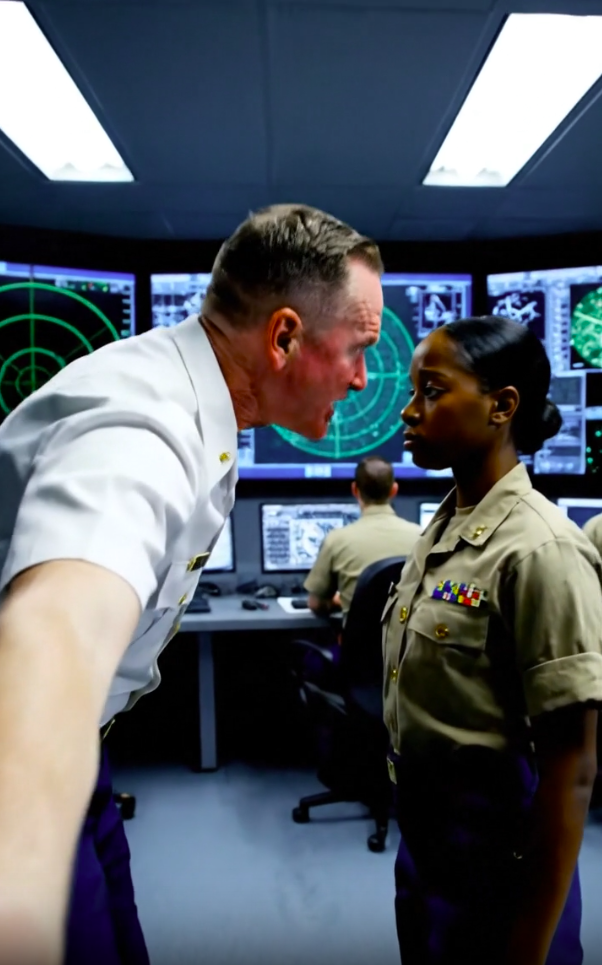
At the head of the table stood Colonel Vance.
Vance was a legend in his own right. Old Corps. He had gray steel wool for hair and eyes that looked like they could burn a hole through a tank. He didn’t tolerate nonsense, and he certainly didn’t tolerate myths.
“Clear the room,” Vance said. His voice was low, but it carried instantly to every corner of the tent.
The other officers hesitated for a fraction of a second, glancing between the Colonel and the small Marine, before shuffling out. The tent flap closed, leaving them alone.
Vance walked slowly around the table. He didn’t speak at first. He just circled her, like a shark inspecting a new swimmer.
“Report,” he said finally.
“Lance Corporal Carter, reporting as ordered, sir.”
“I read the After Action Report,” Vance said, picking up a clipboard. He tossed it back onto the table with a clatter. “Sergeant Holly claims you scaled a vertical face, flanked a reinforced enemy position alone, and neutralized five targets in under two minutes.”
He stopped in front of her, leaning down so his face was level with hers.
“He also claims you moved through a kill zone without drawing fire. He claims you’re a ‘ghost’.”
Sarah stared at the Colonel’s collar insignia. “Sergeant Holly is a good Marine, sir. He might be exhausted.”
“Don’t play games with me, Marine,” Vance snapped. “I have men out there scared of their own shadows. And now I have other men thinking they’re invincible because they have a guardian angel watching over them.”
He paced away, rubbing his temples.
“Rumors are dangerous, Carter. They create expectations. If Marines think you’re magic, they’ll get sloppy. They’ll take risks they shouldn’t take because they think you will save them.”
He spun around, pointing a finger at her.
“I need to know who I’m dealing with. Are you a Marine? Or are you a liability?”
Sarah felt a flash of heat in her chest. For the first time, the mask slipped.
“I am whatever the mission needs me to be, sir.”
Vance narrowed his eyes. “And what is that?”
“Alive,” she said.
The Colonel paused. He stepped closer again. The tension in the room was thick enough to choke on.
“They have a name for you,” he said softly. “I’ve heard it. On the radio. In the mess hall. Even the locals are saying it.”
He waited.
“What is it?” he demanded.
Sarah took a breath. She thought about the valley. She thought about the terrified faces of the men she had saved. She thought about her brother, Daniel, who had died because no one was there to watch his flank.
She looked the Colonel in the eye.
“Phantom Seven, sir.”
The words hung in the cold air.
Vance froze. He had heard the whispers, sure. But hearing it from her—this small, unassuming woman who looked like she should be in a college library, not a war zone—shook him.
It wasn’t arrogance. It was a statement of fact.
He looked at her, really looked at her, for the first time. He saw the hollowness in her eyes that comes from seeing too much death. He saw the tension in her hands. He saw the absolute, terrifying resolve.
He realized then that the rumors weren’t just stories. They were warnings.
“Phantom Seven,” Vance repeated, tasting the words.
He walked back to the map table and leaned heavily on it. He looked at the red pins marking enemy territory.
“You understand,” he said, his voice changing, losing its edge of anger and gaining a heavy tone of command. “That if you accept this… if you let them call you that… you can never fail them. Not once. A human can make a mistake. A legend cannot.”
“I know, sir,” Sarah whispered.
“You are carrying a heavy weight, Marine. Heavier than your ruck.”
“I can carry it.”
Vance stared at her for a long moment. Then, he nodded. A slow, respectful nod.
“Dismissed, Phantom.”
Sarah turned and walked out.
As she stepped back into the blinding desert sun, she felt it. The change. The Colonel hadn’t broken her. He had authorized her.
The legend was official now.
Chapter 7: The Burden of Belief
The weeks that followed the meeting with Colonel Vance were different.
Sarah wasn’t just a squad member anymore. She was a talisman.
Before patrols, Marines from other platoons would come up to her. They wouldn’t say much. They would just nod, or touch her shoulder, or ask if she had checked her gear. It was a superstition. Touch the Phantom, and you’ll make it home.
It was exhausting.
Sarah felt the eyes on her constantly. In the chow hall, people watched how she ate. In the gym, they watched how she lifted. She felt like she was living in a glass box.
But the real pressure was on the field.
Every time they went outside the wire, the squad looked to her. If the convoy stopped, they waited for her signal. If a dog barked, they watched her reaction.
She couldn’t have a bad day. She couldn’t be tired. She couldn’t be scared.
One night, during a routine patrol through a poppy field, the burden nearly crushed her.
It was a moonless night. Visibility was zero. They were moving through tall stalks of poppy, the air thick with the smell of wet earth.
“Hold up,” Sarah whispered.
The squad froze instantly.
“What is it, Seven?” Holly asked over the comms.
“I don’t know,” she said. “Something feels off.”
She scanned the darkness with her night-vision goggles. Green static. Shadows. Nothing moving.
But the hair on the back of her neck was standing up.
“I don’t see anything,” a private named Miller whispered nervously. “Maybe it’s nothing.”
“Quiet,” Sarah hissed.
She closed her eyes. She listened.
The wind rustled the poppy stalks. A cricket chirped. And then… a faint, metallic click.
It was the sound of a safety latch being disengaged.
“AMBUSH! LEFT FLANK!” Sarah screamed, diving forward.
The night erupted.
An enemy machine gun opened up from ten yards away. If she hadn’t yelled, if she hadn’t heard that single click, the entire squad would have been cut in half.
“CONTACT LEFT!”
The Marines returned fire, aggressive and violent. Sarah rolled onto her back, firing her carbine through the stalks.
It was a messy, close-quarters brawl. Grenades exploded, throwing dirt and plant matter into the air.
In the chaos, Private Miller took a round to the leg. He screamed, falling into a muddy irrigation ditch.
“Man down!”
Sarah didn’t think. She crawled through the mud, bullets snapping over her head like angry hornets. She grabbed Miller by his vest and dragged him behind a berm.
“I’m bleeding! I’m bleeding!” Miller panicked, his eyes wide and white in the darkness.
“Look at me!” Sarah grabbed his face, her hands slippery with mud. “Look at me, Miller!”
He focused on her.
“You’re not dying tonight,” she said. Her voice was calm, terrifyingly steady. “Not while I’m here.”
She applied a tourniquet with practiced speed, tightened it until he groaned, and shoved her rifle back into his hands.
“Cover this angle. If anything moves, shoot it.”
She left him there and vanished back into the poppy field.
She moved like smoke. She flanked the machine gunner who had pinned them down. She didn’t shoot him from a distance this time. She was too close.
She appeared out of the darkness right next to him. Two shots. Problem solved.
By the time the medevac helicopter arrived, the field was secure. Miller was loaded onto the bird, pale but alive.
As the helicopter lifted off, kicking up a storm of dust, Sergeant Holly sat down in the dirt next to Sarah. He was shaking.
“That was too close,” he said.
Sarah didn’t answer. She was wiping blood off her hands. It wasn’t hers.
“You heard that click,” Holly said, looking at her with a mix of awe and fear. “Over the wind. Over the gear. You heard a safety click.”
“I got lucky,” Sarah said.
“No,” Holly shook his head. “Luck runs out. You don’t.”
He leaned in close.
“But you’re tired, Sarah. I can see it. You’re carrying them all.”
“That’s the job,” she said, staring at the fading lights of the helicopter.
“Just make sure you save some of yourself,” Holly warned. “If the Phantom dies, this whole unit dies with you. They believe in you more than they believe in God right now.”
Sarah looked at her hands. They were trembling again.
She realized then that the Colonel was right. She wasn’t a person anymore. She was a structure. A load-bearing wall. And if she cracked, the whole house would come down.
She made a fist, forcing the trembling to stop.
I won’t crack, she promised herself. Not until everyone is home.
Chapter 8: The Long Flight Home
The deployment ended not with a bang, but with a signature on a piece of paper.
Orders came down. They were rotating out. A fresh battalion was coming to replace them.
The last few days were a surreal mix of packing and goodbyes. The tension that had held them upright for seven months began to dissolve, leaving them exhausted and raw.
On the final morning, the unit stood in formation on the flight line. The C-130 transport plane sat waiting, its ramp open like a giant mouth.
Colonel Vance walked down the line. He shook hands with the officers. He nodded to the NCOs.
When he reached Sarah, he stopped.
The formation went silent.
Sarah stood at attention, her eyes fixed on the horizon. She looked different than the girl who had arrived months ago. Her skin was weathered. There were fine lines around her eyes. She looked older, harder.
Vance extended his hand.
“Carter,” he said.
She took it. His grip was iron.
“You proved me wrong,” Vance said quietly, so only she could hear. “I thought you were a liability. You were the best asset I had.”
“Thank you, sir.”
“They’re going to talk about you,” Vance said. “The new guys coming in… they’re already asking where Phantom Seven slept. They’re asking if the stories are true.”
He released her hand.
“Let them talk. Legends are good for morale. Just remember… you don’t have to be the Phantom back in Iowa. You can just be Sarah.”
She nodded, but she wasn’t sure if that was true. Could she just be Sarah again? Could she go back to the quiet farm, to the grocery store, to the silence of the cornfields, after what she had become?
She boarded the plane.
The interior of the C-130 was dark, smelling of hydraulic fluid and sweat. She found a seat in the webbed netting and strapped in.
Around her, Marines were cheering. They were talking about burgers, about beers, about girls they hadn’t seen in months. They were already mentally home.
Sarah leaned her head back against the vibrating fuselage. She closed her eyes.
She pictured the mantle in her living room. The folded flag.
She pictured Daniel.
I did it, Danny, she thought. I finished it.
She reached into her pocket and pulled out the small, crumpled photo of her brother. It was worn now, the edges fraying, the image fading.
She looked at his smile. It didn’t hurt as much as it used to. The sharp, stabbing grief had been replaced by a dull, heavy ache.
She had walked into hell because of him. She had become a ghost because of him.
But as the plane taxied down the runway and roared into the sky, leaving the dust and the death of Afghanistan behind, she realized something.
She hadn’t just survived for him. She had survived for herself.
She looked around the plane. She saw Miller, his leg bandaged, sleeping with his mouth open. She saw Holly, reading a crumpled magazine. She saw the faces of thirty men who were going home to their mothers and wives because she had been watching the dark.
She wasn’t just Daniel’s little sister anymore. She wasn’t the quiet girl who hid in the hallways.
She was Phantom Seven.
And even though the war was over for her, the legend would stay. It would drift through the valleys of Helmand like smoke. It would be whispered in boot camps in South Carolina.
She tucked the photo back into her pocket.
The plane banked, turning west. Towards the ocean. Towards home.
Sarah Carter took a deep breath, and for the first time in a long time, she fell asleep without dreaming of the dead.
The Ghost was finally resting.
THE END.