I Called Her a “Zombie” Because of Her Scars. Then the General Showed Me the Classified Footage.
PART 1
Chapter 1: The Broken Doll
The humidity at Fort Valor didn’t just make you sweat; it felt like a warm, wet towel being wrapped tight around your face, slowly suffocating you. It was 0500 hours in the heart of Georgia. The sun hadn’t even bothered to rise yet, probably because it knew what was coming.
I stood in formation with sixty other recruits, all of us fresh off the bus, smelling of stale fear and civilian laundry detergent. We were soft. We knew it. The drill sergeants knew it. The very dirt under our boots seemed to know it.
My name is Jace Monroe. Back home, I was the quarterback. I was the guy who dated the head cheerleader. I was the one who never had to try very hard because everything just… worked out. I walked into Basic Training with a chip on my shoulder the size of a tank. I thought I was already a soldier. I thought this was just a formality.
I was wrong. But I wouldn’t realize just how wrong I was until she walked out of the mist.
The fog was clinging to the parade ground, thick and gray. We were shivering, half from the morning chill, half from the screaming we expected to start any second. But there was no screaming. Just the rhythmic crunch of boots on gravel.
Crunch. Drag. Crunch. Drag.
The sound was uneven. Someone was limping.
I nudged the guy next to me, a nervous kid named Lewis from Montana. “Check this out,” I whispered, smirking. “They sending us the cripples now?”
Then she emerged.
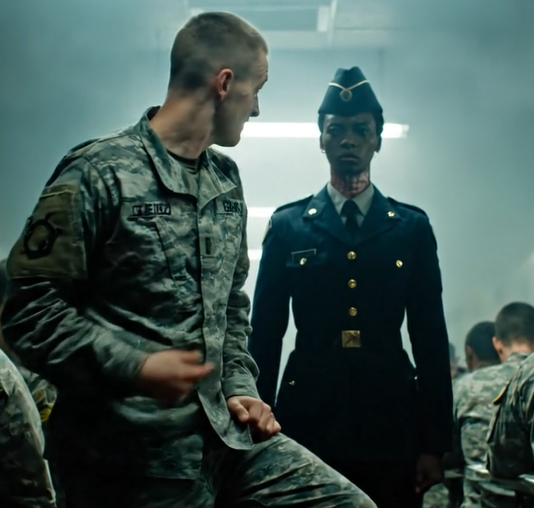
Sergeant Riley Dawson wasn’t tall—maybe five-five on a good day—but the air around her seemed to freeze. She didn’t look like the other instructors. She didn’t look like a recruitment poster.
She looked like a survivor of a horror movie.
Her face was a roadmap of violence. Thick, pale keloid scars trailed down her right cheek, twisting and pulling the skin tight before disappearing beneath the collar of her OCP uniform. Another scar, jagged and angry, curled along her forearm, visible just under the rolled-up sleeve.
She walked with a heavy, deliberate limp, favoring her left leg as if every step was a negotiation with gravity.
I stifled a laugh. It bubbled up in my throat, fueled by my own arrogance and the sheer absurdity of it. This was our instructor? This broken doll?
“Who let the zombie in?” I whispered to Lewis, loud enough for the guys around us to hear.
Lewis went pale. He stared straight ahead, eyes locked on the horizon. “Shut up, Monroe,” he hissed.
I grinned. ” seriously, man. Look at her. They must have stitched her together from leftovers in the med bay.”
A ripple of chuckles moved through the ranks. It was that nervous, high school locker room laughter—the kind that feeds on bullying to hide insecurity. I thrived on it. I wanted them to know I wasn’t afraid. I wasn’t intimidated by a woman who looked like she needed a cane just to get to the mess hall.
Riley stopped ten paces in front of us. She didn’t scream. She didn’t pace like a tiger. She just stood there, letting the silence grow heavy, pressing down on our chests.
She scanned the line. Her eyes were dark, devoid of emotion. They weren’t dead eyes, exactly—they were just… old. Ancient. When her gaze landed on me, I puffed my chest out. I dared her to say something. I wanted the confrontation. I wanted to prove that I was the alpha here, even as a recruit.
She held my gaze for three seconds.
In those three seconds, I felt a strange chill, like a door opening in a dark room. But she didn’t blink. She didn’t grimace. She didn’t even acknowledge the smirk plastered on my face. She just moved on to the next face.
“I am Sergeant Dawson,” she said. Her voice wasn’t loud, but it cut through the morning air like a serrated blade. It was raspy, damaged. “I am not your mother. I am not your friend. I am the wall between you and failure. Do you understand?”
“Yes, Sergeant!” we shouted back.
“Then move.”
That was it. No theatrics. Just a command.
As we scrambled to grab our gear, I leaned in close to Lewis again. “She walks like she’s got one leg in the grave. I bet she tripped over her own ego to get those scars.”
I made sure to say it loud. I wanted her to hear.
And she did. I saw her back stiffen, just for a fraction of a second. A micro-movement. But she didn’t turn around. She kept walking, that rhythmic crunch-drag, crunch-drag fading into the fog.
I thought I had won. I thought she was weak. I thought ignoring me was a sign of submission.
I didn’t know that she wasn’t ignoring me. She was cataloging me.
Chapter 2: The Silence Before the Storm
The first week was a blur of physical agony.
Georgia in July is a cruelty that should be outlawed. The heat rose from the asphalt in shimmering waves. My hands blistered. My feet felt like raw hamburger meat inside my boots. We ran until we vomited, and then we ran some more.
But through it all, there was the “Zombie.”
Sergeant Dawson ran us hard. No mercy. No excuses. But the thing that drove me crazy—the thing that ate at my ego like acid—was that she did it with us.
Most drill sergeants would run alongside the formation, shouting cadence, or maybe drive behind in a truck. Not Riley.
She strapped on a rucksack that looked heavier than mine. She took the lead. And she ran.
Every step looked painful. I could see the wince in her eyes when her left boot hit the pavement, the subtle hitch in her stride. But she never slowed down. She never stopped. Sweat soaked through her cammies, darkening the scars on her neck, making them look like rivers on a map.
It infuriated me.
It didn’t make sense. How could someone so broken be faster than me? I was the quarterback. I was in my prime. She was… damaged goods.
“She’s gotta be on painkillers,” I muttered one afternoon during a 10-mile ruck march. We were trudging through thick brush, the air thick with gnats. “I swear, she’s powered by WD-40 and narcotics.”
“Give it a rest, Monroe,” Lewis panted, struggling under the weight of his pack. “She’s leading the pack. You’re barely keeping up.”
“She’s doing it for sympathy,” I spat back, wiping sweat from my eyes. “She wants us to feel sorry for her. ‘Oh, look at the poor hero, struggling for her recruits.’ It’s an act.”
Lewis shook his head. “Why are you so obsessed with her, man? She hasn’t done anything to you.”
“She exists,” I said, dark and irrational. “She acts like she’s a legend when she belongs in a hospital bed.”
That night, in the mess hall, I decided to escalate.
We were exhausted. The room smelled of industrial cleaner and boiled vegetables. Everyone was keeping their heads down, shoveling food into their mouths as fast as possible. But I needed the attention. I needed to re-establish the pecking order.
I stood up, holding my tray, and did a mock limp over to the trash can. I dragged my left leg, contorted my face into a grotesque grimace, and hissed in a raspy voice.
“I am the wall between you and failure,” I mocked, pitching my voice low.
A few guys snickered. Some looked away, uncomfortable.
“Y’all ever wonder what she looked like before she got melted?” I asked loudly, sitting back down. “Bet she was hot. Shame. Now she looks like a candle that was left in the sun too long.”
The table went silent.
It wasn’t a normal silence. It was the kind of silence that happens when the air pressure drops before a tornado hits.
I looked up. Lewis was staring over my shoulder, his eyes wide with panic.
I turned around slowly.
Sergeant Dawson was standing right behind me.
I hadn’t heard her approach. For someone with a limp, she moved like a ghost. She was standing barely a foot away. I could see the texture of the scar tissue on her cheek. I could smell the gun oil and dust on her uniform.
My heart hammered against my ribs. This was it. She was going to scream. She was going to flip the table. She was going to give me the reaction I wanted, and then I would know I had gotten under her skin.
“Private Monroe,” she said.
Her voice was cool. calm. Detached.
I stiffened, slowly standing up to face her. “Yes, Sergeant?”
She stared at me. There was no anger in her eyes. That was the terrifying part. If she had been angry, I could have handled it. Anger is human. Anger implies you care.
But she looked at me with a profound, empty disappointment. It was the way you look at a car that won’t start, or a tool that’s broken beyond repair.
“Finish your food,” she said quietly.
I blinked. “Sergeant?”
“Finish your food,” she repeated, her voice flat. “You’re on latrine duty until further notice. The smell should mask the garbage coming out of your mouth.”
She didn’t wait for a response. She didn’t make a scene. She turned—pivot, drag—and walked away. Her rhythm was steady. Unbothered.
The silence in the mess hall stretched out for minutes after she left.
I sat back down, my face burning. Not from shame—not yet—but from the sharp, stinging bite of being neutralized. She hadn’t fought me. she had dismissed me.
“Dude,” Lewis whispered, not looking at me. “You are digging your own grave.”
“Whatever,” I muttered, stabbing a fork into my potatoes. “She thinks she’s above us. Just because she’s got some scars doesn’t make her special.”
I looked at the door she had walked through. I hated her. I hated her calm. I hated her strength. And more than anything, I hated the nagging voice in the back of my head that whispered, She’s stronger than you, and you know it.
I crushed that voice down. I told myself I was the victim here. I told myself she was just a tyrant with a tragic backstory.
I had no idea that the backstory wasn’t tragic. It was terrifying. And I had no idea that very soon, I would be begging that “broken doll” to save my life.
Chapter 3: The Simulation
The third week brought a shift in the atmosphere. The “weed-out” phase was over; now, the real training began. The air at Fort Valor grew heavier, charged with the electricity of live-fire exercises and simulated combat.
For me, the latrine duty was grueling, but my pride was stubborn. I scrubbed toilets until my hands were raw, fueled by a toxic mix of resentment and determination. I’ll show her, I thought. I’ll outlast her.
One afternoon, we were briefed on a tactical movement drill.
“We are entering the woods,” Riley announced, standing before us. She looked tired today. The limp was more pronounced, her face paler than usual against the jagged red of her scars. “This is a simulated combat zone. You will be tired. You will be disoriented. You will stay alert, or you will fail.”
I adjusted my gear, rolling my eyes at Lewis. “Don’t trip on a root, Sergeant,” I muttered under my breath.
The woods were dense, a tangle of Georgia pine and kudzu that swallowed the light. We moved in squads. I was on point, feeling confident. This was just a game of laser tag with higher stakes, right?
We moved deeper into the thicket. The humidity was suffocating.
Then, chaos erupted.
Hidden speakers blasted the sound of AK-47 fire—deafening, looping cracks that echoed off the trees. Smoke grenades popped to our left and right, filling the air with thick, acrid purple fog.
“Contact front!” someone screamed.
My heart leaped into my throat. Even though I knew it was fake, the lizard brain took over. The noise was overwhelming. I couldn’t see five feet in front of me.
“Move! Move to cover!”
I scrambled over a fallen log, my breath coming in jagged gasps. The smoke was blinding. I turned to signal Lewis, but he was gone. I was alone in the gray haze.
Suddenly, a shape loomed out of the fog.
I panicked. I froze. It’s the one thing you are never, ever supposed to do in combat. I stood there, flat-footed, rifle pointed at the dirt, paralyzed by the sensory overload.
A hand grabbed my vest.
It wasn’t a gentle tug. It was a violent yank that nearly lifted me off my feet.
“Get down!”
Riley’s voice was right in my ear, raw and fierce. She slammed me into the dirt behind a ridge just as a “simulated” explosion rocked the ground where I had been standing.
She was on top of me, pressing my head down. I looked up and saw her face inches from mine. The scars on her cheek were flushed red with exertion. Her eyes weren’t dead anymore. They were burning.
“You froze,” she hissed, her breath hot on my face. “You stood there like a target.”
“I… I couldn’t see…” I stammered.
“Bullets don’t care if you can see!” she roared, dragging me up by the strap of my gear. “Move! Keep moving!”
She didn’t let go of me. She practically dragged me through the rest of the course. She limped, yes—but she moved with a ferocity that terrified me. She knew exactly where the cover was. She knew exactly when to duck. It was like she could smell the danger before it happened.
We burst out of the tree line and hit the rally point. I collapsed on the grass, heaving, my lungs burning.
Riley stood over me. She wasn’t even breathing hard. She looked down at me with that same crushing disappointment.
“I didn’t need saving,” I lied, wheezing. My ego was trying to protect itself, even as my body trembled. “I was assessing the situation.”
Riley crouched down. She got close—uncomfortably close.
“You were dead,” she whispered. “In a real firefight, you died three minutes ago. And because you died, your squad died trying to cover you.”
She stood up and brushed the dirt off her knees.
“Next time, Private Monroe, don’t freeze. Or don’t sign up.”
She walked away, fading back into the command tent.
I lay there, staring at the sky. The adrenaline was fading, replaced by a cold knot in my stomach. For the first time, the “Zombie” insult felt hollow. She had dragged me. She had hauled 180 pounds of dead weight through the woods on a bad leg, and she hadn’t hesitated.
But I wasn’t ready to admit I was wrong. Not yet. I was still Jace Monroe, the quarterback. I just needed to get my head in the game.
Chapter 4: The Crack in the Armor
That night in the barracks, the mood was somber. The simulation had humbled a lot of us. But I was angry. I felt like she had embarrassed me on purpose.
“She grabbed me way too hard,” I complained, checking my shoulder for bruises that weren’t there. “It’s excessive force. She’s taking her PTSD out on us.”
“Shut up, Jace,” Lewis said from the top bunk. His voice was tired.
“Excuse me?”
“I said shut up,” Lewis swung his legs over the side. “Everyone saw it. You froze. She pulled your ass out of the fire. Just take the L, man.”
“She’s a hazard,” I insisted, my voice rising. “Someone with that much damage shouldn’t be training us. She’s unstable.”
The door to the barracks swung open.
The room went dead silent.
Riley walked in. She wasn’t in her uniform anymore; she was wearing PT gear—shorts and a t-shirt. It was the first time we had seen her arms fully exposed.
The scarring didn’t stop at her forearm. Her entire right arm was a landscape of twisted tissue, burn marks that looked like melted wax. It went all the way up to her shoulder.
She didn’t yell. She didn’t have to. She walked to the center of the room.
“You think this is about me?” she asked. Her voice was low, echoing off the concrete walls.
She looked directly at me.
“You think I’m here because I have nowhere else to go? You think I enjoy running up that hill on a leg that’s held together by titanium pins?”
I swallowed hard. “No, Sergeant.”
“You think you know what war is,” she continued, stepping closer. The room felt like it was shrinking. “You think it’s movies. You think it’s heroics. It’s not. It’s noise. It’s confusion. It’s the smell of burning rubber and… meat.”
She paused, her eyes glazing over for a split second before snapping back to focus.
“I had friends like you, Monroe. loud. Fast. Cocky. They were the first ones to scream when the IED hit. And they were the ones who didn’t come home because they froze.”
She let that hang in the air.
“I don’t care if you like me. I don’t care if you respect me. But I will not let you die because you’re too busy staring at your own reflection to see the threat.”
She turned to leave. At the door, she stopped.
“Get some sleep. Tomorrow, we go harder.”
When she left, I sat on my bunk, staring at the floor. My hands were shaking. I wanted to be angry. I wanted to crack a joke. But I couldn’t. The image of her arm—the sheer violence written on her skin—was burned into my retinas.
“You know who she is, right?” Lewis whispered in the dark.
“Drill Sergeant Dawson,” I muttered.
“No,” Lewis said. “I heard the instructors talking in the admin office. Her call sign wasn’t Dawson. It was Phoenix.”
“Phoenix?”
“Yeah. Because she rose from the ashes. Literally.”
I rolled over, facing the wall. “Go to sleep, Lewis.”
But I didn’t sleep. I lay awake for hours, listening to the breathing of fifty other men, thinking about fire, and thinking about the way she had looked at me. Not with hate. But with pity.
Chapter 5: The Summoning
Two days later, the intercom crackled to life during morning inspection.
“Private Jace Monroe. Report to General Coleman’s office immediately.”
The blood drained from my face. The General? Recruits didn’t go to the General. You went to the General if you were being discharged. Or arrested.
“Ooh, someone’s in trouble,” a guy named Miller snickered.
Riley shot him a look that silenced him instantly. Then she looked at me. “Move, Private. Don’t keep the General waiting.”
I walked to the administration building with legs that felt like lead. My mind was racing. Did she report me? Was this about the ‘Zombie’ comment? Was I getting kicked out?
I reached the office door, took a deep breath, and knocked.
“Enter.”
General Coleman was a mountain of a man with silver hair and eyes that looked like they could cut glass. He was sitting behind a massive oak desk.
“Private Monroe. Sit.”
I sat. The chair was uncomfortable. The room was cold.
“You’ve been under Sergeant Dawson’s command for three weeks,” Coleman said, not looking up from a file on his desk.
“Yes, sir.”
“I hear you’ve been… colorful. With your commentary.”
I felt sweat trickle down my back. “Sir, I—”
“Quiet.”
Coleman closed the file. He looked at me then. “I’m not going to lecture you on insubordination, Private. I think you’re immune to lectures. You have an ego problem. And ego gets people killed.”
He stood up and walked over to a large monitor on the wall.
“I’m going to show you something. This is classified footage. It’s from the archives of Operation Enduring Freedom. Sector 4. Kandahar Province.”
He picked up a remote.
“You think Sergeant Dawson is broken? You think she’s a ‘Zombie’? Watch.”
He pressed play.
The screen flickered to life. It was grainy, shaky footage taken from a convoy dashboard camera. The date stamp was four years ago.
I watched a line of Humvees rolling down a dusty road. It looked boring. Routine.
Then, the world exploded.
The lead vehicle—the one right in front of the camera—vanished in a ball of orange fire and black smoke. The sound, even through the speakers, was a distorted, gut-wrenching CRUMP.
The camera shook violently. Dust covered the lens. There was screaming. “IED! IED! Ambush!”
Through the dust, I saw movement.
A soldier stumbled out of the second vehicle. It was a woman. She wasn’t limping then. She was moving fast, rifle up, screaming orders that the microphone couldn’t pick up over the chaos.
It was Riley.
She looked different. Younger. No scars.
She ran toward the burning Humvee.
“She’s going for the extraction!” a voice on the video screamed. “Dawson, get back! The fuel tank!”
She ignored them. She ran straight into the fire.
I watched, mesmerized and horrified, as she reached into the inferno. The flames were licking at her uniform. She grabbed a soldier by the vest and dragged him out, tossing him to the medics who were taking cover.
Then she went back in.
“Jesus,” I whispered.
She pulled a second man out. Her sleeve was smoking. She beat the flames out against her leg and dove back into the wreckage a third time.
This time, the fire flared up, engulfing the cabin.
“Dawson!” someone screamed.
For ten agonizing seconds, nothing happened. I thought she was dead. I watched the screen, my hands gripping the arms of the chair so hard my knuckles turned white.
Then, a shape crawled out of the fire.
She was dragging a third body. Her helmet was gone. Her hair was singed off. Her right arm—the one I had seen in the barracks—was on fire. Literally on fire.
She didn’t stop. She dragged the man clear, ten yards, twenty yards. Only when she reached the ditch did she collapse.
The video froze on that image: Riley Dawson, lying face down in the dirt, smoke rising from her body, her hand still gripping the strap of her fallen comrade’s vest.
The General turned the monitor off.
The room was silent. The only sound was the hum of the air conditioner and the blood rushing in my ears.
“She flatlined twice in the medevac chopper,” Coleman said softly. “She had third-degree burns on forty percent of her body. Shattered hip. Shrapnel in her spine. Doctors said she’d never walk again.”
He leaned against his desk, crossing his arms.
“She spent eighteen months in rehab. She had to learn how to stand, how to walk, how to hold a spoon. And the first thing she did when she passed her physical? She requested to be a drill sergeant.”
He looked at me with disgust.
“She came back here to train ungrateful, arrogant children like you. She came back so that when you step on an IED, maybe—just maybe—you’ll survive.”
I couldn’t breathe. The shame was a physical weight, crushing my chest. I felt sick. I thought about the “zombie” comment. I thought about the “WD-40” joke. I wanted to crawl into a hole and die.
“Why…” I croaked. “Why didn’t she tell us?”
“Because she doesn’t need your pity, Monroe,” Coleman snapped. “And she doesn’t need your validation. She is a hero. You are a recruit who hasn’t earned the right to lace her boots.”
He walked back to his chair and sat down.
“Get out of my office. And if I hear one more disrespectful word come out of your mouth about Sergeant Dawson, I will personally drum you out of this Army so fast your head will spin. Dismissed.”
Chapter 6: The Awakening
I walked out of that office a different person.
The sun was blindingly bright, but I felt cold. I walked to a quiet spot behind the barracks, sat down on the curb, and just stared at the ground.
I cried.
I hadn’t cried in years. I didn’t cry when we lost the state championship. I didn’t cry when I left home. But I sat there, shaking, tears streaming down my face, overwhelmed by a level of guilt I didn’t know existed.
I had mocked a legend. I had laughed at the scars she earned saving lives. I had called her weak while she was carrying the weight of the world.
“Monroe?”
I looked up. It was Lewis.
“You okay, man? You look like you saw a ghost.”
I wiped my face, not caring that he saw the tears. “I saw Phoenix,” I whispered.
Lewis sat down next to me. “What?”
“The General showed me the video. The IED. The fire.” I looked at Lewis, my voice shaking. “She went back in, Lewis. She was on fire, and she went back in.”
Lewis stayed silent.
“I called her a zombie,” I choked out. “I’m a piece of trash.”
“Yeah,” Lewis said honestly. “You kind of have been.”
He patted my shoulder. “So, what are you going to do about it?”
I stood up. I wiped my face on my sleeve. The arrogance was gone. The quarterback was gone. All that was left was a recruit who had a hell of a lot of work to do.
“I’m going to shut up,” I said. “And I’m going to train.”
That evening, I didn’t go to the mess hall. I went to the parade ground.
I started running.
I wasn’t running for punishment. I wasn’t running for time. I was running because it was the only thing I could do to burn off the shame.
I ran until my lungs screamed. I ran until the sun went down.
When I finally stopped, panting, hands on my knees, I saw a silhouette standing by the bleachers.
It was Riley.
She was watching me.
I froze. Every instinct told me to run away, to hide. But I forced myself to walk toward her.
I stopped five paces away and snapped to attention. My salute was the crispest, most respectful thing I had ever done.
“Sergeant.”
She looked me up and down. “You missed chow, Private.”
“I wasn’t hungry, Sergeant.”
She nodded slowly. “The General had a talk with you.”
“Yes, Sergeant.”
“And?”
I looked her in the eye. For the first time, I really looked at the scars. I didn’t see ugliness. I saw the map of her sacrifice.
“I saw the tape, Sergeant. I know about Alpha 7.”
She didn’t flinch. Her expression didn’t change.
“I’m sorry,” I said, my voice cracking. “I am so sorry.”
Riley sighed. It was a tired, heavy sound. She took a step closer to me.
“You think an apology fixes it?”
“No, Sergeant.”
“Good. Because it doesn’t.” She pointed to her leg. “Sorry doesn’t fix the bone. Sorry doesn’t bring the guys back who didn’t make it.”
She leaned in.
“I don’t want your apology, Monroe. I want your best. I saw you run just now. You were running angry. That’s good. Use it. But don’t you dare pity me. If you look at me with pity, I will break you.”
“I don’t pity you, Sergeant,” I said, and I meant it. “I’m terrified of you.”
The corner of her mouth twitched. It was almost a smile. Almost.
“Good,” she said. “Keep it that way. Now get back to the barracks before I write you up for curfew violation.”
“Yes, Sergeant!”
I turned to run back, but stopped.
“Sergeant?”
She looked back. “What?”
“Thank you. For saving me in the woods.”
She looked at me for a long moment, the moonlight catching the silver lines on her cheek.
“I didn’t save you for you, Monroe,” she said softly. “I saved you for the soldier you might become. Don’t make me regret it.”
She walked away into the dark.
Chapter 7: The Transformation
The next four weeks were brutal, but for me, they were different.
I stopped counting the days. I stopped complaining about the heat. I stopped making jokes.
I became a ghost. I moved with purpose. When we did rucks, I carried extra weight. When we scrubbed the barracks, my corner was spotless.
I watched Riley. I studied her. I noticed things I had missed before.
I noticed how she checked on the weakest recruits when she thought no one was looking. I noticed how she flinched when thunder rolled in, but forced herself to stand still. I noticed that her “cruelty” was actually precision. She wasn’t trying to hurt us; she was trying to harden us.
I became obsessed with earning her nod. Just a nod. That was the currency I lived for.
During week seven, we had the “Gauntlet”—a 24-hour continuous operations exercise. No sleep. minimal food. Constant movement.
By hour 20, half the platoon was hallucinating. Guys were dropping out. Lewis was limping bad on a twisted ankle.
“Leave me, man,” Lewis wheezed, sitting against a tree. “I’ll catch up.”
“No,” I said. My voice was raspy. “Get up.”
“I can’t.”
I grabbed his vest. “I said get up.”
I hauled him to his feet. I took his rifle and slung it over my other shoulder. I put my arm around his waist.
“We finish together,” I said. “Move.”
We trudged the last four miles like that. It felt like my spine was compressing. My legs were burning so bad I couldn’t feel my feet.
We crossed the finish line as the sun was coming up. I dropped Lewis near the medics and collapsed face-first into the grass.
I couldn’t move. I just lay there, staring at the ants in the dirt.
A shadow fell over me.
I looked up. Riley was standing there. She held out a canteen.
I sat up slowly, shaking, and took it. “Thank you, Sergeant.”
She didn’t walk away this time. She squatted down, resting her elbows on her knees.
“You carried him,” she stated.
“He’s my squad mate, Sergeant.”
“You carried two rifles and a soldier for four miles.”
“Yes, Sergeant.”
She looked at me. The disappointment was gone. In its place was something else. Respect?
“You remind me of someone,” she said quietly.
“Who, Sergeant?”
“Me. Before I learned the hard way.” She stood up. “You did good today, Monroe. You led.”
That single sentence meant more to me than any trophy I had ever won in my life.
Chapter 8: The Salute
Graduation day.
The sky was a brilliant, painful blue. The flags were snapping in the wind. The families were in the stands, cheering and waving.
I stood in the front row, my uniform pressed so sharp you could cut paper with the creases. My parents were there. My dad looked confused. He had expected the cocky kid who left home. instead, he was looking at a man who stood perfectly still, eyes locked forward.
The ceremony proceeded. Speeches. Awards.
Then, General Coleman stepped up to the microphone.
“We have a special recognition today,” he said.
He turned and gestured to the side of the stage.
“Sergeant First Class Riley Dawson.”
Riley stepped forward. She was wearing her Dress Blues.
The crowd gasped.
In the Dress Blues, you couldn’t hide the scars. But more than that, her chest was covered in ribbons. The Silver Star. The Purple Heart. The Soldier’s Medal.
She was a walking history book of valor.
“Sergeant Dawson,” Coleman boomed, “is the recipient of the Silver Star for gallantry in action. She is the reason three men are alive today to hold their children.”
The applause started slowly, then built into a roar. A standing ovation.
I watched her. She looked uncomfortable. She hated the attention. She stood there, stoic, enduring the applause like it was just another endurance drill.
When the ceremony broke, families rushed the field. I hugged my mom. I shook my dad’s hand.
“You look… different, son,” my dad said.
“I am different, Dad.”
I pulled away. “Excuse me. I have to do one thing.”
I walked through the crowd. I found her standing near the equipment shed, away from the noise. She was smoking a cigarette, looking out at the tree line.
“Sergeant.”
She turned. “Private Monroe. Or I guess it’s just Monroe now.”
“I wanted to say goodbye, Sergeant.”
She took a drag of the cigarette. “You’re heading to Infantry school?”
“Yes, Sergeant. Benning.”
“Good. You’ll fit in.”
I hesitated. Then, I extended my hand.
“Thank you, Phoenix.”
She froze. She looked at my hand, then up at my eyes. She didn’t get angry at the use of the call sign.
She smiled. A real, genuine smile that crinkled the scars on her cheek.
“You earned the right to say it,” she said.
She shook my hand. Her grip was iron.
“Don’t get dead, Monroe.”
“I won’t, Sergeant. I know when to duck now.”
I turned and walked away. I didn’t look back. I didn’t need to. I carried her lesson in every step I took. The scars don’t make you weak. The limp doesn’t make you broken.
It’s the fire that makes the steel. And thanks to the Zombie, I finally had a spine made of it.