THE BOY WHO STOLE NOTHING BUT A RICH MAN’S TEARS
Chapter 1: The Guardian of Maple Avenue
The bell above the door of “Higgins’ Heirlooms” didn’t just ring; it chimed, a singular, crystalline note that Arthur Higgins had selected specifically to filter the riffraff. It was a sound that demanded respect, much like the man himself.
Arthur stood behind his counter, a slab of polished mahogany that cost more than most people’s cars. At seventy-two, Arthur was a man carved from the same hard, unyielding oak he used to craft his toys. He wore a three-piece tweed suit, despite the thermostat being set to a cozy seventy degrees, and his silver hair was combed back with military precision. He was the king of his castle, and his castle was the finest toy shop in Pennsylvania.
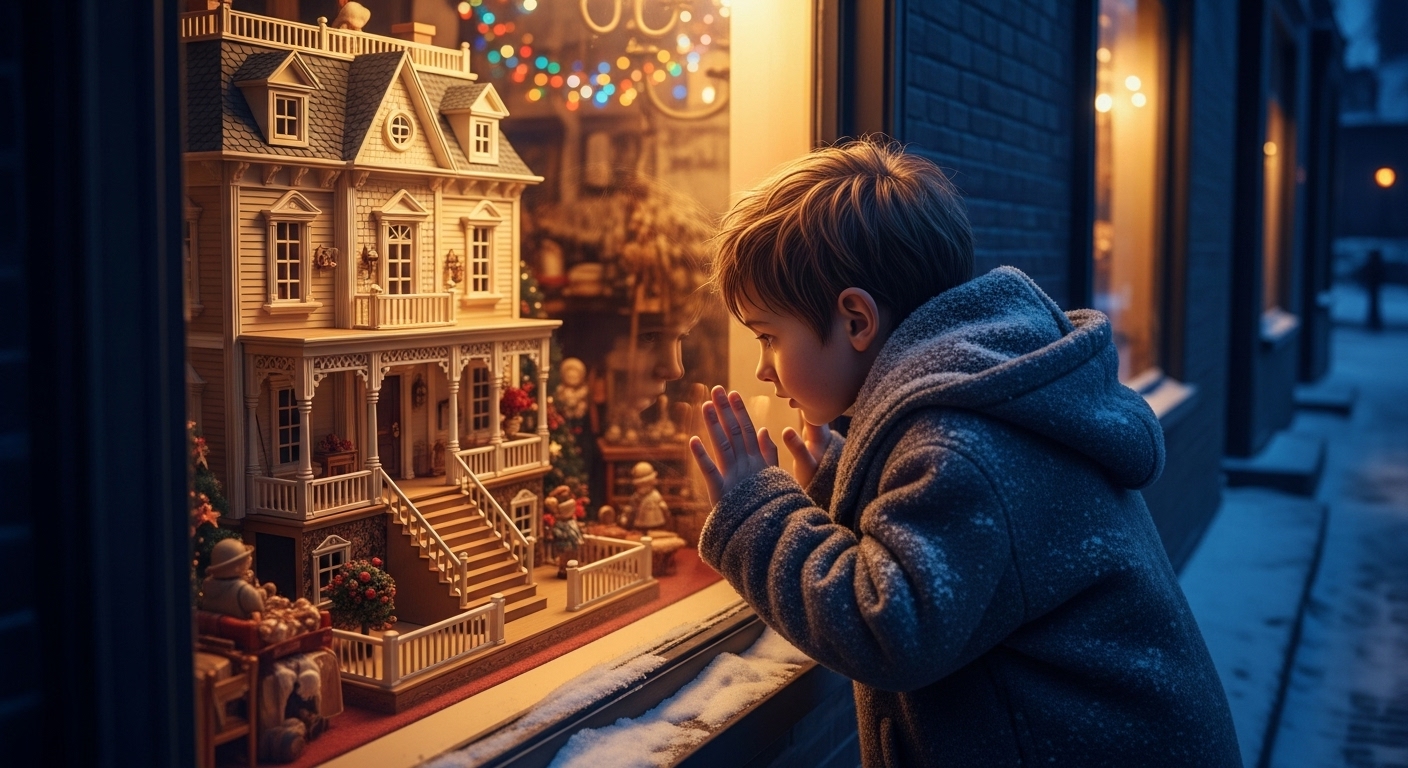
But these weren’t toys for playing. Not really. They were investments. Hand-carved rocking horses with real horsehair manes. Intricate marionettes with hand-painted silk costumes. And the centerpiece, sitting in the front window like a crown jewel: The Melody House.
It was a Victorian dollhouse, standing three feet tall, wired with microscopic LEDs that cast a warm, golden glow through tiny bay windows. Inside, a miniature fireplace flickered. If you wound the key in the back, it played a custom arrangement of Brahms’ Lullaby. It was priced at five hundred dollars, a price tag Arthur had handwritten in elegant calligraphy.
Arthur adjusted his spectacles, glaring out at the street. It was late November, and the sky over the town was the color of a bruised plum, threatening snow. Maple Avenue was festive, draped in garlands and twinkling lights, but Arthur felt none of the cheer. To him, the holidays were simply a season of noise, greedy children, and parents who didn’t understand the value of craftsmanship.
“Don’t touch the glass!” Arthur barked, his voice muffled by the thick pane, though the intention was clear.
Outside, the boy flinched.
It was the same boy. He had been coming for a week now. He looked to be about ten years old, a scrawny thing with hair that hadn’t seen a barber or a bottle of shampoo in months. He wore a navy blue coat that was tragically oversized, the sleeves rolled up three times to reveal pale, shivering wrists. His sneakers were wet canvas, completely unsuited for the slush gathering on the sidewalk.
Arthur despised loiterers. He despised the “takers” of the world—the people who stared but never bought, the ones who wanted the beauty without the labor. This boy was a taker. Arthur could see it in his eyes. Those large, dark eyes weren’t filled with wonder; they were filled with a hunger that made Arthur uncomfortable.
“Go on! Shoo!” Arthur made a sweeping motion with his hand.
The boy didn’t run away immediately. He lingered for a second longer, his gaze fixed intensely on The Melody House. He seemed to be memorizing it, drinking in every detail of the tiny velvet curtains and the miniature grand piano. Then, as Arthur stepped out from behind the counter, the boy turned and vanished into the crowd of evening shoppers.
“Street rats,” Arthur muttered, pulling a handkerchief from his pocket to wipe a microscopic speck of dust from the counter.
The shop was empty. It usually was at this hour. His clientele—doctors, lawyers, old money families from the hills—came by appointment or during the lunch hour. They didn’t browse. They acquired.
Arthur walked to the window to inspect the glass. He let out a groan of disgust. There, right at eye level for a ten-year-old, was a smudge. A nose print. Greasy and undeniably human.
“Disgusting,” he hissed. He grabbed his spray bottle of vinegar solution and a microfiber cloth. He scrubbed the glass with a vigor that bordered on aggressive. “No respect. No discipline. In my day, if you couldn’t afford it, you didn’t torture yourself looking at it.”
But it wasn’t just the lack of discipline that bothered him. It was the reminder.
Every time he saw a boy that age, he saw Michael. His own son. Michael, who had wanted to be a musician, not a toymaker. Michael, whom Arthur had called “impractical” and “soft.” Michael, who had left home at eighteen and never come back. Arthur hadn’t spoken to him in fifteen years. He told himself it was Michael’s loss. Michael would inherit nothing. The business, the money, the legacy—it would die with Arthur. And that was fine. Better to burn it down than give it to someone who didn’t appreciate the work.
Arthur finished cleaning the window and turned back to the shop. He began his closing ritual, a meticulous process of locking cases and dimming lights. He walked past the display of hand-carved soldiers. They were replicas of the Nutcracker guard, rigid and perfect, standing in a straight line.
Arthur paused.
He frowned. He leaned in closer, his heart skipping a beat in his chest.
There were twelve soldiers this morning. He was certain of it. He had dusted them himself.
He counted. One, two, three… ten, eleven.
One was missing.
A gap in the line. A jagged tooth in a perfect smile.
Arthur felt a flush of heat rise up his neck, turning his face a mottled red. Rage, pure and white-hot, flooded his veins. He looked at the door. The bell hadn’t chimed. But the latch… he had been in the back room for five minutes earlier to brew tea. The boy could have slipped in. The bell could have been dampened if someone held the clapper.
“The thief,” Arthur whispered, the word tasting like poison. “That little gutter rat.”
He marched to the security system behind the counter. He punched in the code with trembling fingers. The monitor flickered to life. He rewound the footage to 4:45 PM.
There it was. The door opening slightly. A small figure slipping in while Arthur’s back was turned. The camera angle was blocked by a large display of teddy bears, so he couldn’t see the theft itself. But he saw the boy leave ten seconds later, one hand shoved deep into that oversized pocket.
Arthur slammed his hand on the counter. “I knew it!”
He paced the length of the shop, his expensive leather shoes clicking on the hardwood. It wasn’t about the money. The soldier was worth forty dollars—a pittance. It was the principle. It was the violation. This was his sanctuary. His world. And that boy had violated it.
“He thinks he can just take,” Arthur snarled to the empty room. “He thinks the world owes him. Just like the rest of them.”
He looked out the window. The snow was falling harder now, large flakes swirling in the glow of the streetlamps. The boy was long gone. But he would be back. Arthur knew it. Criminals always returned to the scene, especially when they thought they had gotten away with it. The boy was obsessed with The Melody House. He wouldn’t be able to stay away.
Arthur made a decision then. He wouldn’t call the police. Not yet. The police in this town were soft; they’d give the kid a warning and send him to a shelter. No. Arthur wanted justice. He wanted to catch the boy in the act, grab him by that oversized collar, and see the fear in his eyes. He wanted to shame him. He wanted to teach him that in this life, you reap what you sow.
He turned off the lights, leaving only The Melody House illuminated in the window. It shone like a beacon in the dark store.
“Come back tomorrow,” Arthur whispered to the glass, his reflection looking like a ghost superimposed over the street. “I’ll be waiting.”
Chapter 2: The Stakeout
The next day, time seemed to drag itself through molasses. Arthur was distracted. He was rude to Mrs. Vanderbuild when she asked if the rocking horse came in a darker stain (“It comes in wood, Madam, nature doesn’t take requests”), and he nearly dropped a chisel on his foot while working in the back.
His eyes kept darting to the grandfather clock in the corner.
3:00 PM. 4:00 PM. 4:45 PM.
The sky outside darkened early, a heavy gray blanket suffocating the town. The wind was howling now, rattling the expensive panes of glass. A nor’easter was rolling in. Most shopkeepers were closing early, eager to get home to their fireplaces and families.
Not Arthur. He stood in the shadows near the front of the store, partially concealed by a velvet curtain. He felt ridiculous, like a character in a bad spy novel, but his indignation kept him rooted to the spot.
4:58 PM.
There.
Out of the swirling white chaos of the street, a figure emerged. Small. Bent against the wind. The oversized navy coat flapped violently, making the boy look like a broken bird trying to fly.
He approached the window. He didn’t look around to see if he was being watched. He didn’t look for a way in to steal more. He simply walked up to the glass, right in front of The Melody House, and pressed his face as close as he could without touching it.
Arthur watched, holding his breath.
The boy stood there, freezing. His lips were moving. He wasn’t talking to anyone; he was talking to the air. His eyes were wide, fixed on the tiny furniture inside the dollhouse. He stood there for a full ten minutes. His skin was turning a sickly shade of gray in the cold.
Why doesn’t he come in? Arthur thought, confused. Steal something else. Try the door.
But the boy didn’t move. He just stared, drinking it in, his breath fogging the air in front of him.
Then, abruptly, the boy turned. He didn’t head toward the residential district where the warm houses were. He headed toward the tracks.
“Got you,” Arthur muttered.
He flipped the lock on the front door, grabbed his heavy wool overcoat and his scarf, and stepped out into the biting cold. The wind hit him like a physical blow, stealing the breath from his lungs. Arthur wasn’t a young man. His joints ached in the damp. But anger is a powerful fuel.
He lowered his head and followed the small blue figure disappearing into the snow.
Chapter 3: Crossing the Line
The pursuit took Arthur away from the safety of Maple Avenue. The Christmas lights faded behind him, replaced by flickering streetlamps that buzzed ominously. The pavement turned from smooth brick to cracked asphalt, and then to gravel.
They were crossing the railroad tracks.
This was the dividing line. On one side, the “Makers”—the people with jobs, heated floors, and futures. On the other side, “The Hollows.” It was an industrial graveyard, a collection of shuttered factories and condemned row houses that the city had been promising to demolish for a decade.
Arthur hadn’t been to this side of town in thirty years. It smelled of wet ash and desperation.
The boy was fast, despite his small size. He scrambled over a snowbank and ducked through a hole in a chain-link fence surrounding an abandoned construction site. The project had been halted years ago when the developer went bankrupt. Now, it was just a skeleton of concrete and rebar, open to the sky.
Arthur hesitated at the fence. His Ferragamo shoes were soaked. His toes were numb. Every instinct in his body told him to turn back, to go to his warm apartment, pour a brandy, and forget the thief.
He has my property, Arthur told himself stubbornly. He stole from me.
With a grunt of effort that sent a spasm of pain through his lower back, Arthur squeezed through the gap in the fence.
Inside, the wind was slightly blocked by the concrete walls, but it was still freezing. The ground was littered with broken glass and trash.
Arthur moved silently, stepping carefully over rusted nails. He heard a voice. A soft, melodic voice.
He crept toward a corner of the structure where a partial roof remained, offering a small shelter from the falling snow. He peeked around a concrete pillar.
What he saw froze the blood in his veins faster than the winter wind ever could.
There, huddled in the corner on a filthy, damp mattress, was the boy. But he wasn’t alone.
Curled up next to him, buried under a pile of old newspapers and rags, was a little girl. She couldn’t have been more than five. She was tiny, her face pale and pinched with hunger. Her eyes were open, staring blankly at the ceiling. They were clouded, milky white.
She was blind.
In the center of the concrete floor, inside a rusted metal trash can, a small fire flickered. It was fed by scraps of cardboard. It gave off barely any heat.
Arthur watched, paralyzed. He saw the boy—Leo, he would later learn his name was—take off his oversized navy coat. The boy was left in nothing but a thin, stained t-shirt. He was shivering so violently his teeth chattered, but he draped the heavy coat gently over the little girl, tucking it under her chin.
“Is… is it warm, Leo?” the girl asked. Her voice was a whisper, brittle like dry leaves.
“It’s so warm, Sarah,” the boy said. His voice was steady, masking the tremors in his body. “Can’t you feel it? We are inside the house now.”
Arthur felt a lump form in his throat. The house?
Chapter 4: The Melody of The Heart
Leo sat on the freezing concrete beside his sister and took her small, cold hand in his.
“Tell me again,” Sarah whispered. “Tell me where we are.”
“We’re in the living room,” Leo said, his eyes closing as he summoned the memory. “The walls are painted gold. There are velvet curtains, red like… like cherries. And the fireplace is roaring. It’s huge, Sarah. The fire is so big it makes your toes tingle.”
Sarah smiled, a faint, ghostly expression. She wriggled her feet under the dirty newspapers. “I think I can feel it.”
“And the table,” Leo continued, his voice taking on a rhythmic, storytelling quality. “It’s right in front of us. There’s a turkey. A giant one. And mashed potatoes with a lake of gravy in the middle. And hot cocoa with marshmallows that never melt.”
Arthur gripped the rough concrete of the pillar. His knuckles were white. He recognized the description. The boy was describing The Melody House. He wasn’t stealing the physical object; he was stealing the image, the feeling, to bring back to his sister who could never see it.
“And the music?” Sarah asked. “Does the house sing?”
“Yes,” Leo said. “Listen.”
And then, the boy began to hum. He hummed Brahms’ Lullaby. He hummed it perfectly, every note resonant and clear, mimicking the mechanical tinkering of the music box Arthur had crafted. He must have pressed his ear against the glass for hours to learn that melody so perfectly.
Sarah closed her blind eyes, her breathing settling into a rhythm. She looked peaceful, transported from this frozen hellscape to a warm, golden Victorian parlor.
“Leo,” she murmured sleepily. “I have a present for you too. But I can’t find it.”
“I have it right here,” Leo lied.
Arthur watched as Leo reached into his pocket. He pulled out an object.
Arthur braced himself. The soldier. Here it is. The evidence.
But when Leo held it up to the flickering light of the trash can fire, Arthur didn’t see the perfectly painted, forty-dollar Nutcracker from his shop.
He saw a stick.
It was a piece of fallen tree branch. It had been whittled clumsily with a sharp stone or a piece of glass. It had a round knob for a head and two stick legs. It was crude, ugly, and worthless.
“Here,” Leo said, placing the stick in Sarah’s hand. “It’s a soldier. He’s guarding us. He won’t let the cold get you.”
Sarah clutched the stick to her chest like it was made of solid gold. “He’s brave,” she whispered.
Arthur pulled his head back behind the pillar. He slid down the wall until he hit the ground. The snow soaked into his trousers, but he didn’t care.
He put his hand over his mouth to stifle the sob that was tearing its way up his chest.
He had spent his life judging the world by the quality of its finish. He valued the polish, the varnish, the precision. He judged men by their shoes and children by their manners. He thought he was a “Maker.”
But sitting there in the dirt, Arthur realized he was nothing. He was a hollow man in a fancy suit.
This boy… this starving, freezing boy… he was a Creator. He had created warmth out of cold. He had created a feast out of hunger. He had created a palace inside a ruin. He had carved a protector out of garbage.
And the missing soldier? The one Arthur had been ready to send a child to jail for? It was likely just misplaced. Or maybe it fell behind the cabinet. It didn’t matter. Nothing mattered less than that piece of painted wood.
Arthur looked at his hands. Old, wrinkled, and empty. He thought of Michael. He thought of the grand-daughter he had never met, who would be about Sarah’s age now.
He stood up. His knees cracked, but he felt a surge of energy he hadn’t felt in years. He wiped the tears from his face, leaving streaks of grime.
He stepped out from the shadows.
Chapter 5: The Masterpiece
Leo jumped up, terrified. He put himself between the intruder and his sister, raising his fists. He looked like a cornered animal, ready to fight a giant.
“Don’t touch her!” Leo screamed. “Get away!”
Sarah woke up, whimpering. “Leo? Who is it? Is it the bad men?”
Arthur stopped. He held up his hands in surrender.
“No,” Arthur said, his voice cracking. He cleared his throat and tried to soften the tone that had spent a lifetime hardening. “No bad men. Just… just a neighbor.”
Leo squinted, recognizing him. The fear in his eyes turned to horror. “You… you’re the shop man.”
“I am,” Arthur said. He took a step forward, and Leo flinched.
Arthur stopped. He began to unbutton his coat. It was a cashmere wool blend, lined with silk, worth twelve hundred dollars. He took it off.
He walked over to Leo. The boy was trembling, waiting to be hit.
Arthur knelt down. He was eye-level with the boy. He saw the streaks of dirt, the intelligence, and the overwhelming love in the boy’s eyes.
“I made a mistake,” Arthur said softly. “I thought you were taking things from my window.”
“I didn’t steal nothing!” Leo cried, tears finally spilling over. “I just looked! I promise!”
“I know,” Arthur said. “I know. You were borrowing the magic. And that’s okay. In fact…” Arthur looked at Sarah, who was shivering under the pile of rags. “…I think you need more than just the magic.”
Arthur took his heavy coat and wrapped it around Leo’s shoulders. It engulfed the boy, instantly trapping his body heat.
“My car is just across the tracks,” Arthur said. “It has a heater. And I know a diner that serves turkey. Real turkey. Not the imaginary kind.”
Leo looked at the coat, then at Arthur, then at Sarah. “Why?”
“Because,” Arthur said, his voice thick with emotion, “I need an expert opinion. I have a dollhouse that needs a new owner, and it seems you know more about it than I do.”
Christmas Eve.
Maple Avenue was buried in fresh snow, looking like a scene from a greeting card. “Higgins’ Heirlooms” was closed for the night. The “Closed” sign hung in the door.
But inside, the lights were on.
In the back of the shop, near the woodstove, the air smelled of sawdust and cinnamon tea.
Leo sat on a high stool at the workbench. His face was clean, his cheeks rosy. He was holding a piece of fine sandpaper, carefully smoothing the leg of a new rocking horse.
“Gently,” Arthur instructed, guiding the boy’s hand. “Feel the grain. The wood speaks to you, Leo. You just have to listen.”
“Like this?” Leo asked.
“Perfect,” Arthur smiled. It was a genuine smile, one that reached his eyes.
In the corner, sitting in Arthur’s favorite leather armchair, was Sarah. She was wearing a new red velvet dress. On her lap sat The Melody House. She was running her fingers over the tiny furniture, humming along with the lullaby that tinkled from the music box.
Arthur watched them. He had made calls. He had pulled strings with the city council and social services. He had become a foster parent—temporary at first, but looking to be permanent. He had called his son, Michael. They had spoken for an hour. Michael was coming to visit next week.
Arthur walked to the front window. He looked at the empty space where The Melody House used to sit.
He didn’t put another toy there. Instead, he had placed a simple wooden soldier in the center of the display. It wasn’t one of his masterpieces. It was the crude, stick-figure soldier Leo had carved.
Next to it was a small card, written in Arthur’s elegant calligraphy:
Not for Sale. The most valuable things are made with the heart, not the hands.
Arthur turned off the window light, leaving the shop glowing only from the warmth of the woodstove in the back, where a family—a new, strange, beautiful family—was finally warm.