She Was About To Rip The Orphan’s Award, Then A ‘Dead’ Soldier Grabbed Her Hand
Chapter 1: The Weight of Paper
The hallway of the Sunrise Foster Home always smelled the same: a mixture of industrial-strength lemon bleach and boiled cabbage. It was a scent that stuck to the back of the throat, a constant reminder that this was not a home, but a facility. For eight-year-old Leo, that smell was the perfume of fear.
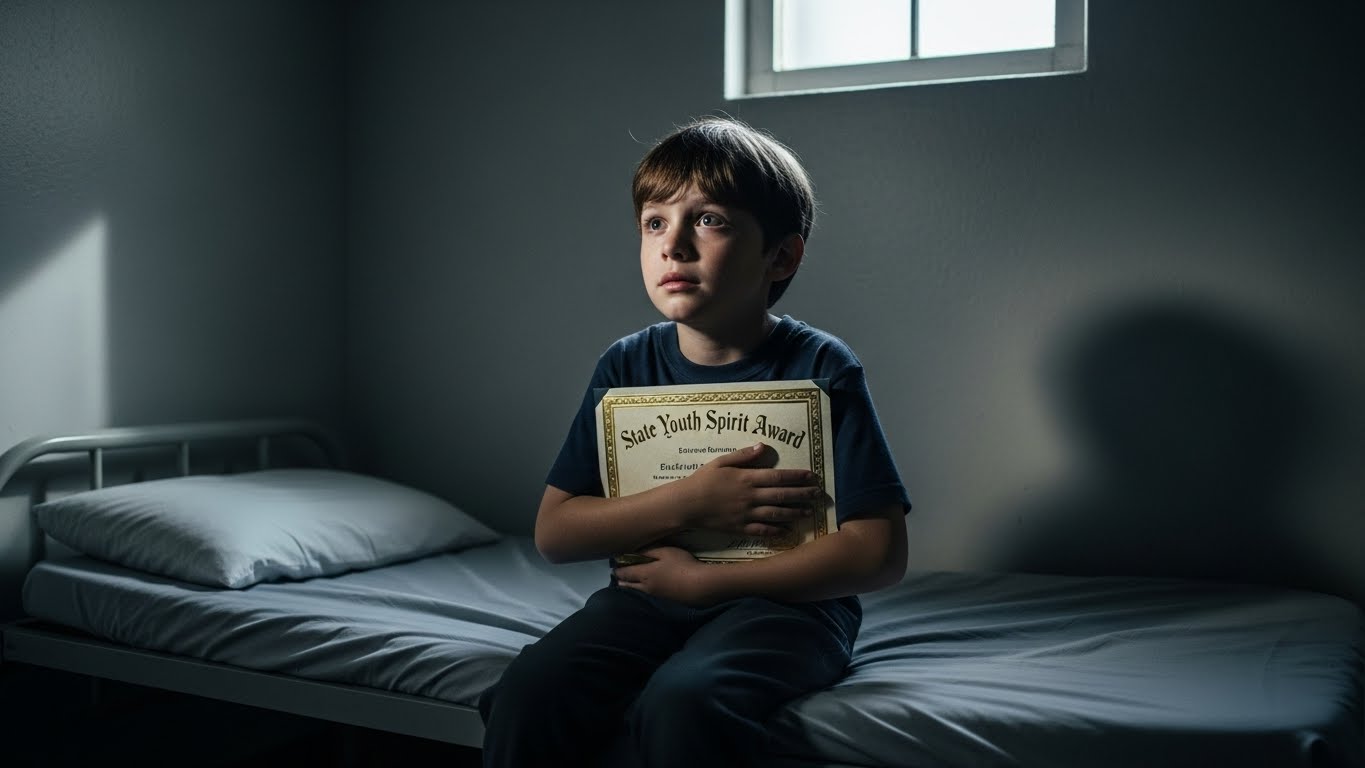
Leo sat on the edge of his cot, his small legs dangling, not quite touching the scuffed linoleum floor. In his hands, he held a piece of paper as if it were made of fragile glass. It was a certificate, heavy cardstock, cream-colored, with a gold embossed seal at the bottom that caught the dim light filtering through the barred window.
State Youth Spirit Award. Presented to: Leo Miller. For Outstanding Courage in Literary Expression.
His thumb traced the letters of his name. Miller. It was the only thing his father had left him, or so he had been told.
Earlier that day, the auditorium at Lincoln Elementary had been loud. Parents were everywhere, flashing cameras, holding flowers, whispering proud encouragements to children who looked well-fed and confident. Leo had stood alone on the stage. When the principal called his name, the applause was polite, thin. There was no father in the second row to stand up and whistle. There was no mother to wipe away a tear.
But Leo hadn’t minded. Not really. Because he had written the truth.
His essay, “The Father I Never Met,” wasn’t about the man Mrs. Agatha Vane described. It wasn’t about the “drunken loser who abandoned his responsibilities,” as the foster home director so often spat during her evening lectures. Leo wrote about a ghost he had constructed in his mind. A hero. A man who was away saving the world, who looked at the moon at the same time Leo did.
“You really think he’s out there?”
Leo looked up. Sammy, a ten-year-old with bruised knees and a cynical stare, was leaning against the doorframe. Sammy had been at Sunrise for four years. He had stopped hoping long ago.
“I don’t think,” Leo whispered, tucking the certificate under his thin pillow. “I know.”
Sammy snorted, kicking at the door jamb. “Better hide that before the Dragon sees it. She hates it when we get special treatment. Reminds her we’re people, not paychecks.”
Mrs. Agatha Vane. The Dragon. The community saw a pious woman in her fifties, always dressed in modest floral dresses, who sang loudest in the church choir and sacrificed her golden years to care for the state’s unwanted children. They didn’t see the woman who watered down the milk. They didn’t see the woman who locked the pantry after 6:00 PM, regardless of whose stomach was growling. They didn’t see the woman who intercepted birthday cards from distant relatives to check for cash before throwing the letters in the incinerator.
Leo felt a cold knot tighten in his stomach. He knew Sammy was right. He should hide the award. He should crumble it up and bury it deep in the trash can outside. That would be the safe thing to do. Mrs. Vane thrived on their misery; their joy was an affront to her authority.
But looking at that gold seal, Leo felt a spark of rebellion he had never felt before. This was his. He had earned it with his words, his feelings. For the first time in his life, the state of Virginia had acknowledged he existed, not as a case number, but as a person with “Spirit.”
“I’m going to show her,” Leo said, sliding off the bed. His voice trembled, but his jaw was set.
Sammy’s eyes went wide. “You have a death wish, kid? She’s in the kitchen doing the books. You know what she’s like when she’s counting money.”
“I don’t care,” Leo said, though his heart hammered against his ribs like a trapped bird. “Maybe… maybe if she sees I did something good, she’ll be proud. Maybe she’ll let me have an extra slice of bread tonight.”
It was a childish hope, fragile and doomed, but Leo clung to it. He smoothed down his shirt—a hand-me-down polo three sizes too big—and picked up the certificate.
He walked down the long, shadowed hallway. The floorboards creaked under his worn-out sneakers. Every step felt heavier than the last. From the kitchen, he could hear the distinct clack-clack-clack of a calculator and the scratching of a pen.
Leo paused at the kitchen door. The room was bathed in the harsh fluorescent light that Mrs. Vane preferred. She sat at the large oak table, surrounded by stacks of receipts and ledgers. A cup of tea steamed beside her, the only warm thing in the house.
She didn’t look up. “Dinner isn’t for an hour, Leo. Get out.”
Her voice was like grinding stones. She knew it was him without looking; she claimed she could smell the “ungratefulness” on them.
“I… I have something, Ma’am,” Leo stammered.
Mrs. Vane stopped writing. She slowly turned her head. Her face was narrow, her eyes small and bead-like behind rimless glasses. She looked at him not with maternal affection, but with the annoyed scrutiny of a manager inspecting defective merchandise.
“You have something?” she repeated, her voice dripping with skepticism. “Unless it’s the ten dollars you owe me for that plate you broke last week, I’m not interested.”
Leo stepped forward, his hands shaking. He held out the certificate with both hands, offering it like a peace treaty.
“I won an award, Ma’am. At school. The State Youth Spirit Award.”
Mrs. Vane stared at the paper. She didn’t take it. She just stared at the gold seal, her eyes narrowing. Silence stretched in the kitchen, thick and suffocating. The refrigerator hummed. A fly buzzed against the windowpane.
“An award,” she said flatly.
“Yes, Ma’am. For my essay. The principal said it was the best in the district.” Leo couldn’t help the tiny smile that tugged at the corner of his mouth.
Mrs. Vane stood up. She was a tall woman, looming over him. She walked around the table, the heels of her sensible shoes clicking on the tile. She snatched the paper from his hands.
Leo flinched, expecting a blow, but she just held the paper up to the light. She read it in silence. Then, she read the title of the essay printed in small italics at the bottom.
“The Father I Never Met.”
A cold, cruel smile spread across her face. It was a smile that didn’t reach her eyes.
“So,” she whispered, “you’re telling lies to strangers now? Telling them sob stories about a father who didn’t want you?”
“He’s a hero,” Leo blurted out, the defense automatic.
“He was a drunk,” Mrs. Vane hissed, lowering the paper and leaning down so her face was inches from Leo’s. Her breath smelled of peppermint and rot. “He was a drunk who ran off because he couldn’t handle the burden of a child. Just like no one wants the burden of you now. You think this piece of paper changes that? You think this gold sticker makes you special?”
“It says I have courage,” Leo whispered, tears welling in his eyes.
“Courage?” Mrs. Vane laughed. It was a dry, hacking sound. “Hope is for children with futures, Leo. You are state property. You are a paycheck that arrives on the first of the month. Nothing more.”
She looked at the certificate again, her fingers curling around the edge.
“This… this is just trash. It gives you false ideas. And false ideas make you difficult to manage.”
Leo’s eyes widened in horror. He saw the tension in her fingers. He saw the intent.
“No,” he breathed. “Please. It’s mine.”
“Nothing is yours,” Mrs. Vane said, her voice rising. “Not the clothes on your back, not the bed you sleep in, and certainly not this lie!”
She raised the certificate high, her hands positioning to tear it right down the center, right through the name Miller.
Leo squeezed his eyes shut, waiting for the sound of the ripping paper, the sound of his only pride being destroyed.
But the sound never came.
Chapter 2: The Stranger in the Doorway
The silence that followed was heavy, sudden, and absolute. It wasn’t the silence of an empty room; it was the silence of a held breath, the kind that happens right before a thunderstorm breaks.
Leo opened his eyes.
Mrs. Vane was still standing there, the certificate held high above her head. But she wasn’t moving. Her face, usually flushed with the exertion of her anger, had drained of color. Her eyes were wide, fixed on something behind Leo, something in the shadows of the hallway leading to the back door.
Her mouth opened and closed, but no sound came out. It was as if the air had been sucked out of her lungs.
Leo turned around slowly.
Standing in the doorway, blocking out the fading evening light, was a mountain of a man.
He was huge. That was Leo’s first thought. The man’s shoulders were broad, stretching the fabric of a dusty, desert-camouflage uniform. He wore heavy combat boots that looked like they had walked a thousand miles of bad road. A large rucksack was slung over one shoulder, but it was the look of the man that froze the blood in Leo’s veins.
He wasn’t clean. He wasn’t polished like the soldiers in the recruitment posters downtown. His face was covered in a thick, unkempt beard, streaked with gray and grit. There was a scar running from his left eyebrow down to his cheekbone, a jagged white line against tan, weathered skin.
But it was his eyes that held the room captive. They were blue, piercing, and terrifyingly calm. They were the eyes of a wolf that had cornered a rabbit.
And right now, those eyes were fixed on Mrs. Agatha Vane’s hand.
“I believe,” the stranger said, his voice a low rumble that vibrated in Leo’s chest, “that belongs to the boy.”
Mrs. Vane took a staggering step back, clutching the certificate to her chest as if it were a shield. “Who… who are you? How did you get in here? This is private property! I’ll call the police!”
The stranger didn’t blink. He took a step into the kitchen. The heavy thud of his boot on the tile sounded like a gavel striking a judge’s bench.
“The back door was unlocked,” the man said. He moved with a strange, fluid grace for someone so large. He ignored Mrs. Vane’s threat completely. He looked down at Leo.
For a moment, the hardness in the man’s face cracked. He looked at Leo’s too-large shirt, his scuffed knees, the terror in his eyes. A muscle in the man’s jaw jumped.
“Leo,” the man said softly. It wasn’t a question. It was a confirmation.
Leo nodded, mute. He should be scared of this stranger. The man looked dangerous. But Leo didn’t feel fear. He felt a strange magnetic pull, a resonance he couldn’t explain.
“I’m talking to you!” Mrs. Vane shrieked, trying to regain her composure. Her authority was slipping, and she hated it. “Get out of my house! You’re trespassing! You look like a vagrant!”
The soldier turned his gaze back to Mrs. Vane. The temperature in the room seemed to drop ten degrees.
“A vagrant,” he repeated. He reached up and slowly pulled a black beret from his shoulder strap, placing it on his head. He adjusted it with practiced precision. “Sergeant First Class Jack Miller. United States Army Rangers.”
Mrs. Vane gasped. The name hit her like a physical blow. The color that had left her face didn’t return; instead, she turned a sickly shade of gray.
“Miller?” she whispered. “No. That’s impossible. You’re… the file said…”
“Missing in Action,” Jack finished for her. He took another step closer. He was now looming over the table, a dark tower of retribution. “Presumed dead. That’s what you told the boy, isn’t it? That’s what you told the state?”
“I… I…” Mrs. Vane stammered, backing up until her back hit the refrigerator.
“Three years,” Jack said. He held up three fingers. His hand was scarred, the knuckles rough. “Three years I was in a hole in the ground. Three years of darkness. Do you know what kept me sane, Ma’am?”
He didn’t wait for an answer.
“Thinking about my son. Thinking about coming back to him.”
Jack reached into the cargo pocket of his pants and pulled out a bundle of letters. They were crumpled, some stained with coffee, others still sealed. He tossed them onto the table. They scattered across Mrs. Vane’s ledgers.
Leo looked at the letters. He recognized the handwriting on the envelopes. It was Mrs. Vane’s handwriting. But the addresses weren’t to the military. They were returned to sender. And mixed in were letters Leo had never seen—letters addressed to him.
“I found these in the trash bin outside,” Jack said, his voice deadly quiet. “Letters I wrote. Letters the Army sent regarding my status updates. You intercepted everything. You knew I was alive six months ago when my status changed to ‘Recovered.’ But you didn’t tell him.”
Mrs. Vane was trembling now. “It… it was a clerical error! I was protecting him! I didn’t want to get his hopes up in case…”
“In case the checks stopped coming?” Jack cut her off. He pointed to the ledger on the table. “I know how the system works. An orphan gets a higher stipend than a child with a living parent. You kept me dead so you could keep getting paid.”
Leo looked from the man—his father—to Mrs. Vane. The world was spinning. His father wasn’t a drunk. He wasn’t a coward. He was here. He was real. And he was angry.
“You called him property,” Jack growled, stepping around the table. Mrs. Vane shrank away, sliding along the cabinets. “I stood in that hallway and heard you call my son state property.”
“I was disciplining him!” Mrs. Vane cried. “He’s unruly! He’s a liar!”
“The only liar in this room,” Jack said, stopping inches from her, “is you.”
He reached out. Mrs. Vane flinched, closing her eyes, expecting violence. But Jack didn’t strike her. Instead, his hand—that large, gloved hand—closed gently but firmly around the edge of the certificate she was still clutching.
“Let go,” Jack said.
Mrs. Vane’s grip tightened reflexively. “You can’t just come in here…”
“I said,” Jack leaned in, his voice a whisper that carried more threat than a scream, “let go. Before I forget that I’m an officer of the peace.”
Mrs. Vane’s fingers opened.
Jack took the certificate. He handled it with reverence, as if it were the Declaration of Independence. He turned his back on Mrs. Vane, dismissing her entirely, and knelt down on one knee in front of Leo.
For the first time, Leo saw his father’s face up close. He saw the tiredness, the lines of pain etched around his eyes, but he also saw a warmth that melted the ice in Leo’s heart.
“Leo,” Jack said, his voice cracking. “I’m sorry I’m late.”
Chapter 3: The Ghost from the Sand
Leo stared at the man kneeling before him. He wanted to speak, to scream, to cry, but his throat was tight. He looked at the certificate in Jack’s hand, then at the letters scattered on the table.
“You… you wrote to me?” Leo whispered.
“Every week,” Jack said, swallowing hard. “Every single week. Even when I didn’t have a pen, I wrote them in my head. When I got out… when I came home, the first thing I did was come here. I saw the mailman. I saw the trash can.”
Jack reached out and placed a large, warm hand on Leo’s shoulder. The touch was grounding. It was real.
“I didn’t run away, Leo. I would never run away from you.”
Behind them, Mrs. Vane had recovered some of her wits. She was edging toward the wall phone mounted near the pantry.
“I’m calling the police,” she announced, her voice shrill. “You broke into my house. You assaulted me. I’ll have you arrested! And the boy… the boy will go to juvenile detention for conspiring with a stranger!”
Jack didn’t even turn around. He stayed kneeling, his eyes locked on Leo.
“Go ahead,” Jack said calmly. “Call them.”
Mrs. Vane paused, her hand hovering over the receiver. She had expected him to panic, to run.
“I said call them,” Jack repeated, standing up slowly. He turned to face her. “In fact, don’t bother. I already did.”
Mrs. Vane froze. “What?”
“I called the State Police from the driveway,” Jack said. “I told them I had probable cause to suspect embezzlement, mail fraud, and child endangerment. I told them I was a witness to an active abuse situation.”
As if on cue, the sound of sirens wailed in the distance, growing louder with every second. Blue and red lights began to flash against the kitchen window, cutting through the gloom.
Mrs. Vane ran to the window. Two cruisers were pulling into the driveway, gravel crunching under their tires.
“No,” she gasped. “No, no, no. You can’t do this. I’m a pillar of this community!”
“You’re a parasite,” Jack said coldly. “And you’re done.”
The front door burst open. “Police! Is everyone alright?”
Two officers entered the kitchen, hands near their holsters. They took in the scene: the weeping woman by the window, the giant soldier standing protectively over a small boy.
One of the officers, a sergeant with graying hair, looked at Jack. His eyes widened slightly as he took in the uniform, the rank, and the ribbons on Jack’s chest.
“Sergeant Miller?” the officer asked.
“Yes, sir,” Jack nodded. “This woman has been intercepting federal mail. She has been embezzling state funds allocated for my son’s care. And…” Jack pointed to the trash can where more envelopes were visible. “I believe you’ll find plenty of evidence if you look through her records.”
Mrs. Vane began to sob, a theatrical, wailing sound. “He’s lying! He’s crazy! He has PTSD! He threatened to kill me!”
The police officer looked at Mrs. Vane, then at the terrified boy, and finally at the calm soldier. He looked at the bruised wrist where Mrs. Vane had grabbed Leo earlier—a mark Jack hadn’t even noticed yet, but the cop did.
“Ma’am,” the officer said, taking out his handcuffs. “I think we need to have a conversation downtown.”
“You can’t take me! Who will watch the children?” she screamed as they turned her around.
“We’ll call Social Services for an emergency placement,” the officer said. “But right now, you’re under arrest.”
As they led Mrs. Vane out, she thrashed and screamed, her mask of piety completely shattered. The other boys in the house—Sammy and the rest—had gathered in the hallway, peeking out with wide, fearful eyes that were slowly turning into awe.
When the door finally closed, the kitchen was quiet again. The remaining officer looked at Jack.
“We’ll need a statement, Sergeant. And we need to sort out the custody paperwork. It might take a few days to process everything legally.”
Jack looked down at Leo. He saw the holes in Leo’s shoes. He saw the thinness of his arms.
“I’m not leaving him here,” Jack said. “Not for one more minute.”
The officer sighed, looking at the boy. He softened. “Technically, I can’t let you take him until the paperwork is signed. But… if you were to take him for a ‘dinner’ while we process the scene… I couldn’t stop you.”
Jack nodded. “Thank you.”
Chapter 4: The Unbroken Salute
Jack turned back to Leo. The adrenaline was fading, leaving Jack feeling the exhaustion of his long journey. But he couldn’t rest yet.
He picked up the certificate from the table where he had set it down. He smoothed out the wrinkles Mrs. Vane’s grip had made.
“Read it to me?” Jack asked softly.
Leo blinked. “What?”
“The essay,” Jack said. “I want to hear it. From you.”
Leo hesitated. He had never read it out loud to anyone. But looking at his father, he felt a surge of that courage he had written about. He took the paper. His voice was small at first, shaky.
“The Father I Never Met,” Leo began. “Some kids have dads who teach them to throw a baseball. Some have dads who drive them to school. My dad is different. My dad is invisible. Mrs. Vane says he ran away. But I know she is wrong. A man who runs away is afraid. But my dad isn’t afraid.”
Leo looked up. Jack was crying. Silent tears were tracking through the dust on his cheeks.
“My dad is fighting,” Leo continued, his voice getting stronger. “He is fighting monsters so that I can sleep safe. He is fighting the dark so that the sun can rise. And even though I can’t see him, I know he salutes me every night, just like I salute him.”
Leo lowered the paper. “I… I made it up. Because I wanted it to be true.”
Jack dropped to his knees again. He pulled Leo into a hug, burying his face in the boy’s small shoulder. Leo smelled the dust, the sweat, and the faint scent of gun oil. It was the best smell in the world. It smelled like safety.
“You didn’t make it up, Leo,” Jack choked out. “You knew. Somehow, you knew.”
Jack pulled back and looked Leo in the eye. “I was in a bad place, Leo. A very bad place. I was captured. For a long time, I didn’t think I’d make it. But every night, I closed my eyes and I pictured you. I pictured you growing up. I pictured this moment. You saved me, Leo. You kept me alive.”
Leo felt a tear roll down his own cheek. “I did?”
“Yes,” Jack said firmly. “You’re the hero, Leo. Not me.”
Jack stood up and wiped his face. He looked around the bleak kitchen.
“Pack your things, Leo. Whatever you want to keep. We’re leaving.”
“Where are we going?” Leo asked. “The officer said…”
“We’re going to get a burger,” Jack smiled. “A big one. With fries. And a milkshake. And then we’re going to a hotel. And tomorrow… tomorrow we’re going to find a real home. A house with a yard. And a dog, if you want one.”
“A dog?” Leo’s eyes widened.
“A big one,” Jack promised.
Leo ran to his room. He didn’t have much. Just a few clothes and a small box of treasures—a polished rock, a plastic soldier, and a photo of his mother who had died when he was a baby. He stuffed them into a plastic bag.
As he walked back out, Sammy was standing there.
“You leaving?” Sammy asked, trying to look tough.
“Yeah,” Leo said. “My dad… he came back.”
Sammy looked at Jack, who was waiting by the door. “He looks tough.”
“He is,” Leo said proudly. Then he stopped. He looked at Sammy, then at Jack. “Dad?”
Jack looked over. “Yeah, bud?”
“Sammy… Sammy doesn’t have anyone either.”
Jack looked at the older boy, saw the defiance masking the loneliness. He sighed, a small smile playing on his lips. “Well, Sammy, you like burgers?”
Sammy’s mouth dropped open. “Yeah.”
“Grab your jacket,” Jack said. “I can’t leave a man behind.”
Chapter 5: Home
Six months later.
The small house on Elm Street had a porch that needed painting, but the grass was freshly cut. In the driveway, a Ford truck was parked next to a bicycle.
Inside, the living room was chaotic. Boxes were still being unpacked. A Golden Retriever puppy was chewing on a slipper in the corner.
Jack stood by the fireplace. He was clean-shaven now, the beard gone, though the scar remained. He wore jeans and a t-shirt, looking younger, lighter.
In his hands, he held a frame.
“Where do you want this one, Leo?” he called out.
Leo ran into the room. He had filled out. His cheeks were rosy, and the shadows under his eyes were gone. He was wearing a baseball jersey.
“Center,” Leo said, pointing to the spot right above the mantelpiece. “Right in the middle.”
Jack smiled and hung the frame. It wasn’t a picture of a general. It wasn’t a medal of honor.
It was a cream-colored certificate with a gold seal. State Youth Spirit Award.
It was wrinkled in the middle, a permanent scar where a cruel woman had almost torn it in half. But the wrinkles had been smoothed out, pressed flat behind the glass.
“Looks good,” Jack said, stepping back.
Leo stood next to him. He looked at the award, then up at his father.
“Dad?”
“Yeah?”
“Did you really listen to the police? That night?”
Jack chuckled. “Which part?”
“The part about not taking me until the papers were signed.”
“Leo,” Jack said, putting an arm around his son. “I’m a Ranger. We improvise. Besides, possession is nine-tenths of the law.”
The front door opened. Sammy walked in, carrying a bag of groceries. “Hey! I got the hot dogs. Are we grilling or what?”
Sammy was technically in foster care still, but Jack had petitioned for guardianship. It was a long process, but Jack Miller didn’t lose fights.
“We’re grilling,” Jack said. “Fire up the charcoal, Sam.”
As the boys ran out the back door into the sunshine, Jack lingered for a moment. He touched the glass of the frame. He traced the name Leo Miller.
He thought about the hole in the ground. He thought about the darkness. And then he looked out the window at his son laughing as the puppy chased him across the yard.
Jack Miller stood at attention. He brought his hand up in a sharp, crisp salute to the boy in the yard.
“Mission accomplished,” he whispered.