The Beggar’s Ledger: A Retired Judge Thought His Son Was a Failure, Until He Found a Box Under the Floorboards That Changed Everything
Chapter 1: The Verdict of Silence
The rain in Seattle didn’t wash things clean; it just made the grime slicker. It was fitting weather for the funeral of Daniel Sterling.
Robert “The Gavel” Sterling stood under a black umbrella that cost more than his son’s car. at sixty-eight, Robert was a man carved from granite and old money. He wore his grief like he wore his judicial robes: stiff, formal, and impenetrable. Around him, a small cluster of people gathered—mostly Robert’s friends, not Daniel’s. They were men in Italian suits and women with pearls who whispered condolences that sounded more like apologies.
“Such a tragedy, Robert,” Judge Harrison murmured, clutching Robert’s arm. “To lose a son… especially one who struggled so much.”
Robert tightened his jaw. Struggled. That was the polite word for it. In Robert’s mind, the words were different: Lazy. Drifting. Wasted.
Daniel had died at thirty-two. No wife, no children, no mortgage, no career. He had died of hypothermia on the banks of the Duwamish River, found by a jogger in the grey light of dawn. The police report suggested he had slipped, likely drunk. To Robert, it was the final, humiliating gavel strike on a life that had failed to launch.
Martha, Robert’s wife, was a ghost beside him. She had wept until she was dry, and now she just stared at the mahogany casket as if waiting for Daniel to knock from the inside. She blamed Robert. She hadn’t said it, but the silence between them was a screaming accusation. Robert had pushed Daniel away with his expectations. Be a lawyer. Be a man. Be successful. Daniel had chosen to be… nothing. A part-time stocker at a grocery store. A resident of a crumbling studio apartment in the worst part of town.
After the service, Robert insisted on going to Daniel’s apartment alone. “I need to settle his affairs,” he told Martha. “You go home and rest.”
He drove his Mercedes into the neighborhood known as Skid Row. The streets here were lined with tents and trash. Robert locked his doors. He parked in front of the peeling brick building where his son had lived for the last five years. He felt a surge of anger. Why, Daniel? You could have had the guest house. You could have had a firm. You chose this filth.
The apartment was on the third floor. It smelled of stale coffee and old paper. It was tiny—a single room with a kitchenette. But it was startlingly clean. The bed was made. There were no empty liquor bottles, which surprised Robert given the police’s theory.
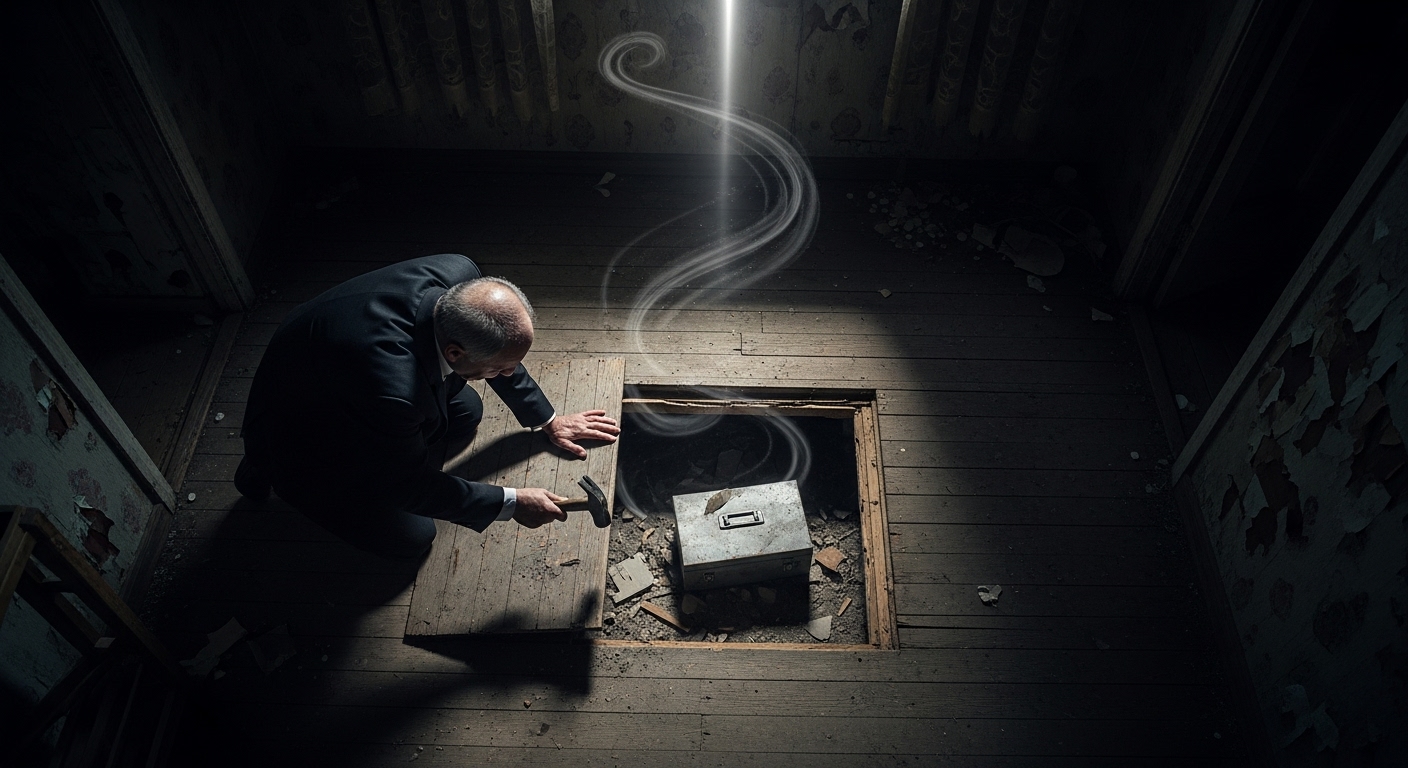
Robert began the grim task of packing. He threw cheap clothes into a black trash bag. He felt like an intruder, judging the artifacts of a life he didn’t understand. He moved the bed to sweep underneath and noticed a loose floorboard. It was prying up slightly.
Curiosity, or perhaps the instinct of a judge looking for evidence, took over. He knelt, ruining the crease in his trousers, and pried the board up.
There, nestled in the dust, was a heavy, grey metal lockbox.
“Drugs,” Robert whispered to the empty room. “Or gambling debts.” He felt a sick sense of validation. This was the secret. This was why Daniel was always broke.
He took the box to the small, scratched dining table. It was locked, but the clasp was rusty. Robert took a screwdriver from his pocket—he had come prepared to dismantle furniture—and forced the lock. It snapped with a loud crack.
He opened the lid, bracing himself for needles or wads of cash owed to dangerous men.
Instead, he found paper.
Hundreds of receipts, crumpled and smoothed out again. A leather-bound journal. A bundle of letters tied with twine. And right on top, a photograph.
Robert picked up the photo. It was a picture of himself, taken ten years ago at his swearing-in ceremony for the appellate court. Daniel had been there, standing in the back, smiling. But the photo had been torn in half, right down the middle, separating father and son. Then, it had been taped back together with clear scotch tape, meticulously aligned.
Robert’s throat tightened. He set the photo down and picked up the journal. It was a simple ledger.
November 12: Sarah – $500. November 14: Mr. Henderson – $200. December 1: Marcus – $150. December 3: The Library Fund – $50.
Page after page. Names and numbers. Robert did a quick calculation of the last month’s entries. It totaled nearly two thousand dollars.
“He was a loan shark?” Robert scoffed, though the numbers seemed too small, too erratic. “Or he was paying off debts.”
He picked up a receipt stapled to a page. It wasn’t a gambling slip. It was a pharmacy receipt for an inhaler and antibiotics. Paid in cash.
He picked up another. A receipt for a winter coat, men’s XL.
Robert sat down on the rickety chair. The narrative in his head—the story of the lazy, drunken son—was hitting a snag. He looked at the first name on the list for this month.
Sarah – $500. (Rent assistance/Meds).
Robert pulled out his phone. He found an address book in the box, a small red one. He looked up “Sarah.” There was an address, not far from here.
The Judge stood up. He needed to know. He needed to prove that his son was reckless, that this was just mismanagement of money. He grabbed the box, tucked it under his arm, and walked out into the rain. The Mercedes looked alien parked on the street.
He was going to hold court one last time.
Chapter 2: The Witness Stand
The address for “Sarah” led Robert to a diner called The Rusty Spoon. It was a greasy spoon establishment with fogged windows and a neon sign that buzzed with an irritating hum.
Robert walked in, his expensive suit drawing stares from the few patrons—mostly truck drivers and locals nursing coffee. He approached the counter. A woman in her thirties, looking exhausted, with dark circles under her eyes and a stained apron, was wiping down the counter.
“Table for one?” she asked, not looking up.
“I’m looking for Sarah,” Robert said, his voice booming slightly, the “courtroom voice” he couldn’t turn off.
The woman froze. She looked up, eyes narrowing. “I’m Sarah. Who’s asking? I don’t buy anything from solicitors.”
“I am Robert Sterling,” he said. “Daniel Sterling’s father.”
The rag dropped from her hand. The noise of the diner seemed to vanish. Sarah’s face went pale, then crumpled. She brought a hand to her mouth.
“Oh my god,” she whispered. “Oh, my god. I heard… I heard he passed. I wanted to come to the funeral, but I couldn’t get the shift covered and I didn’t think… I didn’t think I’d be welcome.”
Robert placed the ledger on the counter, open to her name. “I found this in my son’s apartment. It says here he gave you five hundred dollars last month. I am trying to settle his estate. Did my son owe you money?”
Sarah stared at the ledger, then at Robert. Her eyes flashed with a sudden, fierce protectiveness. “Owe me? Daniel didn’t owe anyone a dime, Mister. He was the only reason my daughter is breathing.”
Robert blinked. “Explain.”
Sarah leaned over the counter, her voice trembling. “My little girl, Emily, she has severe asthma. Last month, my hours got cut. I had to choose between rent and her medication. I was crying in the alley out back on my break. Daniel was walking by—he walked everywhere. He asked me what was wrong.”
She wiped a tear from her cheek with the back of her hand. “I told him to get lost. But he stayed. He listened. Two hours later, he came back with an envelope. Five hundred dollars. He told me he sold his guitar. I told him I couldn’t take it. He said, ‘If you don’t take it, I’m just going to burn it.’ He forced me to take it.”
Robert felt a physical blow to his chest. “He sold his guitar? The Fender Stratocaster?”
“I don’t know what kind it was,” Sarah said. “But he loved music. And he gave it up so my kid wouldn’t wheeze at night. And you… you think he owed me?”
“I…” Robert faltered. “I assumed…”
“You assumed he was a bum,” Sarah said, her voice dropping to a hiss. “He told me about you. He said his dad was a great man, a powerful judge. He said he disappointed you. But let me tell you something, Judge. Your son was a saint. He slept in his car for three weeks after he gave me that money because he couldn’t make his own rent. Did you know that?”
Robert gripped the edge of the counter. The room swayed. Slept in his car? Daniel had told Robert he was “camping” that month when Robert had called to criticize him for missing a family dinner.
“No,” Robert whispered. “I didn’t know.”
“He came in here every Tuesday,” Sarah continued, relentlessly. “He bought coffee for Old Jack. He helped the dishwasher learn English. He never talked about himself. He just… gave. He gave until he was empty.”
Robert looked at the ledger again. The numbers weren’t debts. They were sacrifices.
“I’m sorry for your loss,” Sarah said, turning away to hide her tears. “But mostly, I’m sorry for him. Because he died thinking he wasn’t good enough for you.”
Robert turned and walked out of the diner. The rain hit his face, mixing with the first tear he had shed in twenty years. He got into his car, but he didn’t start the engine. He looked at the next name on the list.
Mr. Henderson – Heating Bill.
He had to go. He had to see the extent of his own blindness.
Chapter 3: The Silent Army
The journey continued. It was a pilgrimage of shame.
Mr. Henderson lived in a small, drafty bungalow three blocks from the train tracks. He was a Vietnam veteran in a wheelchair, surrounded by stacks of old newspapers. When Robert introduced himself, the old man saluted.
“Daniel Sterling,” Henderson rasped, his eyes misty. “Best damn majestic soul I ever met. You know, the VA checks don’t always stretch to cover the oil in winter. Daniel found out I was sleeping in a coat. He didn’t say a word. Next day, the oil truck shows up. Filled the tank. Paid in full. Anonymous.”
“How did you know it was him?” Robert asked, sitting on a plastic-covered sofa.
“Because I saw him walking away from the oil company office when I rolled down there to ask who paid,” Henderson said. “I caught him. He made me promise not to tell. Said, ‘Everyone deserves to be warm, Mr. Henderson.’ That boy… he had a warmth in him that this world tried to snuff out.”
Robert left the bungalow feeling smaller than he ever had in his courtroom. He drove to the local library, following the entry: Marcus – Tutoring.
He found Marcus in the back corner, a young African American man about twenty years old, burying his face in a GED study guide.
“Marcus?”
The young man jumped, defensive. “Yeah?”
“I’m Daniel’s father.”
Marcus’s face softened instantly. He stood up and extended a hand. “Sir. It’s an honor. Your son… man, he was a genius.”
“Genius?” Robert echoed. He had always called Daniel ‘slow’ because he didn’t grasp contract law.
“I was in a gang, sir,” Marcus said quietly. “Did time. Nobody would hire me. I couldn’t read past a third-grade level. Daniel met me at the shelter. He started meeting me here every night. Every single night for six months. He taught me math, history, how to write an essay. I passed my GED last week. I was going to tell him…” Marcus’s voice broke. “I was going to show him the certificate today.”
Marcus pulled a crumpled paper from his backpack. General Educational Development Certificate.
“He told me, ‘Marcus, your past is a chapter, not the whole book.’ He saved my life, sir. Literally. If I hadn’t been here studying with him, I’d have been on the corner the night my crew got shot up.”
Robert looked at the young man, seeing the bright future in his eyes—a future purchased with Daniel’s time and patience.
“He was a good teacher,” Robert managed to say.
“The best,” Marcus said. “He said he learned patience from his dad. Said you were a judge who had to listen to everything before making a decision.”
Robert felt a stab of agony. He hadn’t listened. He had never listened. He had judged before the opening statement was even made.
As the day wore on, the pattern solidified. The ledger wasn’t a record of financial incompetence. It was a record of radical, reckless generosity. Daniel, who made minimum wage stocking shelves, had functioned as a one-man social safety net for the neighborhood. He had starved himself to feed others. He had walked to save gas money to pay for strangers’ medicine.
The Indignation that Robert had felt at the funeral was gone, replaced by a hollow, crushing realization. He had measured his son by the size of his wallet, while Daniel was measuring his life by the weight of his heart.
Robert was the failure. Not Daniel.
Chapter 4: The River’s Truth
The sun was setting, casting long, blood-red shadows across the city. There was one final thing Robert had to understand. The death.
Found in the river. Alcohol suspected.
It didn’t fit. Nothing fit anymore.
In the back of the journal, the very last entry, scrawled in shaky handwriting, read: Check on Old Jack. Riverbank tent. He’s sick.
Robert drove to the industrial district, near the Duwamish waterways. He found the homeless encampment under the overpass. It was a city of blue tarps and shopping carts.
He found Old Jack sitting by a fire in a rusty barrel. The man was coughing, wrapped in a blanket that looked familiar. It was a high-quality wool blanket—one from Robert’s own guest house. Daniel must have stolen it years ago.
“Jack?” Robert asked.
The man looked up. His face was weathered like old leather. “Who’s asking?”
“I’m Daniel’s father.”
Old Jack began to weep openly. He didn’t say a word for a long time, just rocked back and forth.
“The police said he fell in,” Robert said, his voice hard. “They said he was drunk. Tell me the truth.”
“Drunk?” Jack spat into the fire. “Daniel didn’t drink. Not a drop. He was the clearest-headed man here.”
“Then what happened?”
“It was the dog,” Jack whispered. “My dog, Buster. It was freezing that night. The ice was thin near the edge. Buster chased a rat and went through. I screamed. I tried to go in, but my legs… I can’t swim.”
Jack looked at Robert with haunted eyes. “Daniel was bringing me soup. He saw it happen. He didn’t hesitate. He tore off his coat and shoes and dove into that black water. He got the dog out. He pushed Buster up onto the ice.”
Jack paused, shivering. “But the cold… it seizes you. Daniel tried to climb out, but the mud was slick. I tried to pull him, but I was too weak. He… he just looked at me. He wasn’t scared. He just said, ‘Take care of Buster, Jack.’ And then he slipped under.”
Robert closed his eyes. The image burned into his mind. His son, dying in the freezing filth of a river to save a homeless man’s dog.
“He crawled out further down,” Jack sobbed. “But he was too cold. He sat down against a tree to catch his breath and… he never got up. He gave me his coat earlier that week. If he had his coat…”
Robert looked at the shivering man. “He gave you his coat?”
“Yes. That’s why he froze so fast. He was in a t-shirt.”
Robert turned away, walking towards the riverbank. He stood where his son had died. He looked at the dark water. The police saw a drunk. The world saw a loser. Robert saw the truth now.
Daniel died as he lived: giving everything he had to someone who had nothing.
Robert fell to his knees in the mud. The dignity of the Judge, the starch of the suit, the pride of the Sterling name—it all dissolved. He wailed. A guttural, animal sound of regret that echoed under the concrete overpass. He cried for the years he wasted criticizing. He cried for the “I love you” he never said. He cried because he was in the presence of greatness, and he had missed it.
Chapter 5: The Resurrection
A week later.
Robert sat in Daniel’s empty apartment. He had read the letters. They were the final nail in the coffin of his arrogance.
Dear Dad, one read. I know you worry about me. I know you think I’m throwing my life away. But Dad, I’ve found something here. People need me. I can’t explain it in a way that makes sense to your world, but when I help someone, I feel rich. I just wish, for one second, you could look at me with pride instead of pity. I love you, Dad. Always.
Robert folded the letter. He had made a decision.
He drove to a luxury car dealership. He sold the Mercedes. Then he called his broker and liquidated his investment portfolio—the “retirement island” fund.
He had a new verdict to deliver.
Six months later.
The peeling brick building on Skid Row had a new sign above the door. freshly painted in gold letters: The Daniel Sterling Community Center.
Robert stood in the kitchen, wearing a stained apron over a flannel shirt. He was ladling beef stew into bowls. The line of people stretched out the door. Sarah was there, managing the volunteers. Marcus was at a table in the corner, tutoring a new group of kids. Mr. Henderson was by the radiator, warm and reading the paper.
Martha was there too, cutting bread. She looked younger, softer. They had found their son again in the faces of the people he loved.
A man in a suit—one of Robert’s old judge friends—walked in, looking out of place.
“Robert?” the judge asked, looking around at the chaotic, noisy shelter. “What are you doing? You sold the house? The firm says you resigned? You’re serving soup?”
Robert wiped his hands on a towel. He looked at his friend, then looked at the large framed photo on the wall. It was the photo of him and Daniel, taped back together, blown up to poster size. Underneath it was a plaque: Daniel Sterling – The Wealthiest Man We Knew.
“I’m not serving soup, Arthur,” Robert said, a genuine smile breaking across his face—a smile that reached his eyes for the first time in decades.
“Then what are you doing?”
“I’m catching up,” Robert said softly, picking up the ladle. “I’m working off a debt. And for the first time in my life, I’m trying to be like my son.”
Robert turned back to the line. “Next! plenty for everyone. Daniel’s treat.”