I Scanned My Best Friend’s Old Photos For Him. One Detail In The Background Revealed The Monster Who Killed My Daughter.
Chapter 1: The Pixelated Ghost
The rain in Willow Creek always sounded different against the windowpane of a house that was too empty. It was a hollow, rhythmic drumming, a sound that Arthur Penhaligon had grown accustomed to over the last fifteen years since his wife, Martha, had passed. But tonight, the rain felt heavier, pressing against the glass like it was trying to wash away the sins of the town.
Arthur sat in his study, the blue light of his dual monitors casting long, spectral shadows across his wrinkled face. At seventy-two, Arthur was a man composed of sharp angles and soft silences. He was a retired librarian, a man who had spent a lifetime preserving the stories of others while his own story had been ripped apart on a Tuesday afternoon thirty years ago.
On the screen, a cursor blinked within the interface of “Cold Case Web,” a forum where amateur sleuths, retired cops, and insomniacs gathered to pore over digitized police files. To the users online, Arthur was just “TruthSeeker_99,” a meticulous, high-ranking analyst known for spotting inconsistencies in tire tread patterns or timeline errors in witness statements. They didn’t know he was a father who still woke up at 3:00 AM, expecting to hear his daughter, Emily, creeping down the stairs for a glass of water.
Emily. The final victim of the “Willow Creek Killer.” She was sixteen, bright-eyed, with a laugh that could crack the sternest facade. She had vanished on her way home from school. Her body was found three weeks later in the woods. The case went cold. The killer, a ghost.
“Artie? You in there?”
The voice startled Arthur. He spun his chair around, his heart doing a frantic gallop in his chest. Standing in the doorway of the study was Frank Miller.
Frank. His best friend since sophomore year of high school. The former deputy sheriff who had held Arthur upright when they lowered Emily’s casket into the ground. Frank, who now stood with a Tupperware container in his trembling hands, looking slightly confused.
“Frank,” Arthur breathed, adjusting his glasses. “I didn’t hear the doorbell. You have a key, right. I forgot.”
Frank smiled, but it was a fragmented expression. The dementia was in the early stages, but it was aggressive. It stole bits and pieces of Frank—his confidence, his memories, his steady hands. “I brought the pot roast,” Frank said, his voice raspy. “It’s Sunday, Artie. We always do roast on Sunday.”
“Right. Of course.” Arthur stood up, his joints popping. He took the container from Frank. “You sit down. I’ll heat this up. Did you bring the box?”
Frank blinked, looking down at his feet. ” The box?”
“The photos, Frank. We talked about this. You wanted me to digitize your old albums before… well, before the memories get too slippery.”
“Oh. Yes.” Frank pointed toward the hallway. “In the mudroom. Heavy. Lots of dust.”
Arthur guided Frank to the leather recliner in the living room, turning on the TV to a rerun of Gunsmoke. Frank loved Westerns; the morality was simple. Good guys wore white hats, bad guys wore black, and justice was always served by the end of the hour. If only life had been that kind to them.
While Frank settled in, Arthur retrieved the heavy cardboard box from the hallway. It smelled of mildew and Old Spice—the scent of Frank’s life. Arthur hauled it into the study. He had purchased a high-end flatbed scanner recently, specifically for his “Cold Case Web” work, but tonight it would serve a gentler purpose.
Arthur began the process. It was tedious, rhythmic work. Lift lid. Place photo. Scan. Crop. Save.
The photos were a timeline of an ordinary American life. Frank in his uniform, 1978. Frank and his ex-wife at the Grand Canyon, 1982. Frank standing proudly next to his new Ford F-150, 1994.
Arthur paused at that one. 1994. The year Emily died.
He looked at the photo. Frank looked younger, stronger. He was leaning against the truck, a beer in hand, grinning at the camera. He looked like the man Arthur remembered—the man who had patrolled the streets, swearing he would find the monster who took Emily.
“We did everything we could, Artie,” Frank often said during their Sunday dinners. “The devil just got away. Sometimes he just gets away.”
Arthur sighed, placing the photo on the scanner glass. He initiated the scan at the highest resolution: 2400 DPI. He wanted to preserve every detail for his friend.
While the scanner whirred, Arthur opened a new tab on his browser. The “Cold Case Web” developers had recently released a beta tool called “Pattern_Rec_AI.” It was designed to scan background details of crime scene photos—identifying logos, license plates, or unique jewelry patterns that the human eye might miss.
Ideally, Arthur shouldn’t use personal photos on the server, but he was curious. He wanted to test the tool’s accuracy with a control image before he used it on the new batch of digitized police files from the archives.
The scan finished. The image of Frank and his 1994 truck popped up on the screen in crystal clear high-definition.
Arthur dragged the file into the AI upload box. Processing…
He stood up to stretch, intending to go check on the pot roast. The progress bar crawled across the screen. 20%… 50%… 80%…
Ping.
A red notification banner flashed across the top of the screen.
MATCH FOUND: HIGH PROBABILITY. REFERENCE: CASE FILE #94-009 (Willow Creek PD) – Evidence Item #404.
Arthur froze. His blood ran cold, turning to slush in his veins. Case File #94-009. That was Emily’s case number. He had that number tattooed on his brain.
“No,” he whispered. “That’s a glitch.”
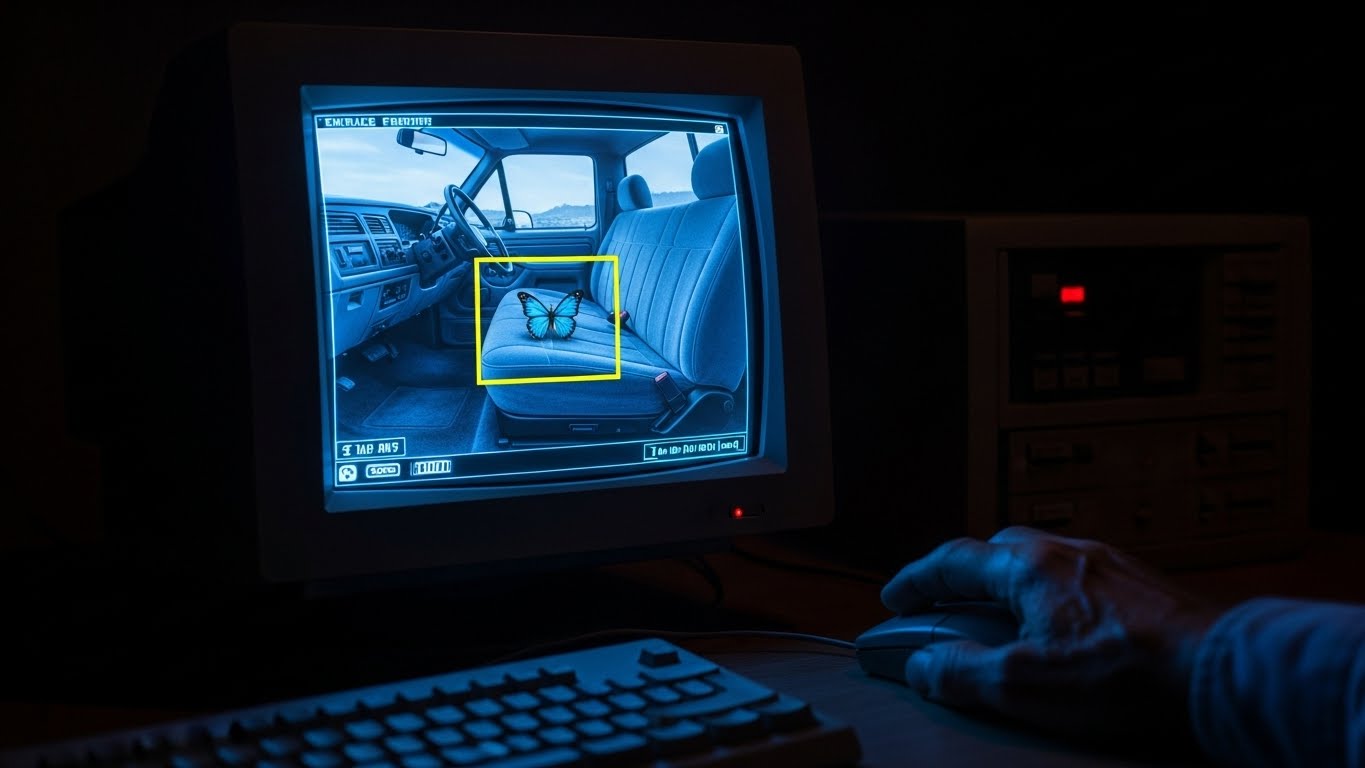
He sat back down, his hand trembling as he reached for the mouse. The AI had drawn a yellow box around a small, shadowed area in the bottom left quadrant of the photo—underneath the passenger seat of Frank’s truck, visible through the open door.
Arthur clicked on the yellow box. The screen zoomed in. The pixels sharpened.
It was dark, partially obscured by a shadow and what looked like a fast-food wrapper. But there, catching a tiny glint of the camera’s flash, was a splash of electric blue.
Arthur zoomed in further. 400%. 800%.
The object resolved itself. It was a hairclip. Not just any hairclip. It was shaped like a butterfly, with wings made of blue stained glass and a small silver body. One of the wings was chipped slightly at the tip.
Arthur stopped breathing. The room seemed to tilt on its axis.
He knew that clip. He didn’t just know it; he had made it. He had spent a weekend in his garage soldering the silver wire and shaping the glass. He had given it to Emily on her sixteenth birthday, three days before she disappeared. She was wearing it when she walked out the door that morning.
The police never found the clip. It wasn’t at the crime scene. It wasn’t on her body. It was listed in the missing items report—Evidence Item #404.
Arthur stared at the screen. He stared at the date stamped on the back of the physical photo he had just scanned. June 14, 1994.
Two days after Emily disappeared. One week before her body was found.
Arthur looked at the man in the photo—Frank. His best friend. The Deputy Sheriff. The man who had sat in Arthur’s kitchen while Martha wept, holding her hand, promising justice.
In the photo, Frank was smiling. And under the seat of his truck, hidden in the dark, lay the trophy he had taken from Arthur’s daughter.
Arthur spun his chair around. Through the open door of the study, he could see the back of Frank’s head in the living room. Frank was chuckling at the TV, a soft, harmless sound.
“Artie?” Frank called out, his voice thin and wavering. “I think the commercial is over. You missin’ the good part.”
Arthur gripped the arms of his chair so hard his knuckles turned white. The silence of the house was no longer empty; it was screaming. The monster wasn’t a ghost. The monster was sitting in his La-Z-Boy, waiting for dinner.
Chapter 2: The Anatomy of Betrayal
For a long time, Arthur didn’t move. He couldn’t. His brain was trying to reject the visual data it had just received. It was a physiological rejection, like a body trying to vomit up poison.
It’s a mistake, a desperate voice in his head pleaded. Maybe Frank found it? Maybe he found it during the investigation and… and forgot to log it? Maybe he put it in his truck to bring it to me and it got lost under the seat?
But Arthur was a librarian. He dealt in facts, in categorization, in the ruthless logic of order.
Frank wasn’t the lead investigator. He was a deputy. He shouldn’t have been collecting evidence alone. And even if he had found it, why was it under the seat? Why didn’t he turn it in? The discovery of that clip would have changed the search radius. It would have proven she was in a vehicle.
Arthur forced himself to breathe. In. Out. He needed to be sure. He couldn’t accuse a man—a man with dementia, a man who was practically his brother—based on one grainy zoom-in from an AI program.
“Artie!” Frank’s voice was more insistent now. “I smell something burning.”
The pot roast.
Arthur stood up. His legs felt like lead pipes. He walked into the kitchen, turned off the oven, and pulled the roast out. He moved like a robot. He plated the food. Carrots. Potatoes. Meat. Gravy.
He carried the plates into the dining room. “Dinner’s ready, Frank,” he called out. His voice sounded surprisingly steady, detached, as if someone else were speaking for him.
Frank shuffled in, smiling. “Smells good. Martha’s recipe?”
“Yes,” Arthur said. “Martha’s recipe.”
As Frank sat down and began to cut his meat with shaking hands, Arthur excused himself. “Forgot my medication. Start without me.”
He went back to the study. He closed the door quietly.
He needed more data. He needed to correlate.
He opened the “Cold Case Web” timeline feature. He pulled up the dates of the three murders attributed to the Willow Creek Killer between 1990 and 1994.
Victim 1: August 12, 1990. Victim 2: July 4, 1992. Emily: June 12, 1994.
Arthur grabbed the box of photos. He began to rifle through them frantically, looking for dates on the back. He found a photo of Frank on a boat, holding a bass. Dated August 13, 1990. Location written in Frank’s handwriting: Lake Erie Trip.
Arthur checked the police file. Victim 1 was found near the highway leading to Lake Erie.
He found another photo. Frank at a campground. July 5, 1992.
The locations matched. The dates aligned perfectly with Frank’s “solo fishing trips.”
Arthur felt bile rise in his throat. He typed furiously, accessing the public records of Frank’s vehicle registration history. The 1994 Ford F-150. He pulled up the forensic report on the tire tracks found near Emily’s body.
Tire Type: Goodyear Wrangler Radials. Common on light trucks.
Frank had Goodyear Wranglers. Arthur remembered because he had helped Frank change a flat tire on that very truck in the driveway.
The pieces were slamming together with the force of a car crash. The proximity. The opportunity. The trust.
Frank was a deputy. He had a uniform. He had a badge. Emily knew him. She wouldn’t have gotten into a stranger’s car. But she would have gotten into “Uncle Frank’s” truck if he offered her a ride home from the rain.
“She wouldn’t stop crying,” Arthur imagined the scene. “I just wanted her to be quiet.”
Arthur looked at the monitor one last time. The blue butterfly clip mocked him. It was the smoking gun, frozen in time for thirty years, waiting for technology to catch up to a killer’s carelessness.
He remembered the funeral. He remembered Frank hugging him, tears streaming down his face. Arthur had thought they were tears of shared grief. Now, he realized they were something else. Were they tears of guilt? Or were they the performance of a psychopath?
Arthur looked at his hands. They were old, spotted with age. They weren’t fighter’s hands. But a rage was building inside him, a cold, nuclear heat that burned away the fear.
He picked up his iPad. He synced the zoomed-in image of the butterfly clip to the tablet.
He walked out of the study. He walked down the hall.
Frank was eating his pot roast, a napkin tucked into his collar. He looked up as Arthur entered, a smear of gravy on his chin.
“You okay, Artie? You look pale. Like you’ve seen a ghost.”
Arthur pulled out his chair and sat down opposite Frank. The table was small. The storm outside was raging now, thunder rattling the silverware.
“I did, Frank,” Arthur said softly. “I did see a ghost.”
Frank chewed slowly. “Who?”
Arthur placed the iPad on the table, face down. He rested his hand on it.
“Frank, do you remember the day Emily died?”
Frank stopped chewing. His eyes, usually cloudy with confusion, sharpened for a split second. A flicker of something primal. “Why you asking that? That’s ancient history.”
“I was scanning your photos,” Arthur said, his voice flat. “From 1994. From your new truck.”
Frank put his fork down. The metal clinked loudly against the china. “Yeah? Nice truck. I miss that truck.”
“I found something in the picture, Frank.”
Arthur flipped the iPad over. The screen glowed bright in the dim dining room. The zoomed-in image of the blue butterfly clip was unmistakable.
“Do you recognize this?” Arthur asked.
Frank squinted at the screen. He leaned in. He looked at the clip. He looked at the truck seat.
The silence stretched for ten seconds. Twenty.
Then, Frank sat back. The confusion that usually masked his face evaporated. His posture changed. He didn’t look like a frail old man anymore. He looked… empty.
“That’s a pretty clip,” Frank said. His voice was different. Deeper. Lacking the tremor.
“It’s Emily’s,” Arthur said, tears finally spilling over his cheeks. “I made it for her. You knew that. You helped me look for her. You sat right here in this chair and told me you’d find the man who hurt her.”
Frank picked up his napkin and wiped his mouth. He looked at Arthur with a terrifying, calm pity.
“I did find him, Artie. I found him every morning in the mirror.”
Arthur gasped, a sound of pure agony. “Why? She was… she was my daughter. She loved you.”
Frank shrugged. It was a casual, monstrous shrug. “She was walking. It was raining. I told her to get in. I just wanted… I don’t know. I wanted to feel something. But then she started asking about where we were going. She wouldn’t stop asking. She got loud. Just like you, Artie. You always had to ask so many questions.”
Frank picked up the steak knife. He tested the edge with his thumb.
“I just wanted some quiet,” Frank whispered.
Chapter 3: The Final Upload
The sight of the knife in Frank’s hand didn’t scare Arthur. It clarified things. The ambiguity of the last thirty years was gone. There was no mystery anymore. Just a father and the man who killed his child.
“Put the knife down, Frank,” Arthur said.
“I can’t go to jail, Artie,” Frank said, his voice trembling again, the dementia bleeding back in with the panic. “I’m old. I’m sick. They don’t have good doctors in there.”
“You should have died in there thirty years ago,” Arthur spat.
Frank lunged.
It wasn’t a graceful fight. It was ugly and desperate. Two old men, burdened by time and gravity, crashing into the table. The pot roast platter shattered. Gravy splattered across the floor like dark blood.
Frank was heavy, a dead weight of muscle and bone. He pinned Arthur against the sideboard. The knife flashed.
Arthur felt a sting across his forearm—a shallow cut, but it woke him up. He grabbed Frank’s wrist. He looked into Frank’s eyes. He didn’t see his friend. He saw the void.
“For Emily,” Arthur gritted out.
He used his knee. A sharp, brutal kick to Frank’s groin. It was a dirty move, a move Frank had taught him in a bar fight in 1975.
Frank groaned and doubled over, his grip loosening. Arthur shoved him. Frank stumbled back, his feet slipping on the gravy. He crashed backward, his head hitting the corner of the heavy oak china cabinet with a sickening thud.
Frank crumpled to the floor. The knife skittered away.
Arthur stood over him, panting, clutching his bleeding arm. The room was spinning.
Frank was conscious, but dazed. He looked up at Arthur, blood trickling from his temple. The clarity was gone. The monster had receded, leaving only the confused, broken shell.
“Artie?” Frank whimpered. “I fell. Help me up.”
Arthur looked down. He saw the vulnerability. He saw the dementia. But he also saw the butterfly clip under the seat. He saw Emily’s empty room.
“No,” Arthur said.
He walked to the landline phone on the wall. He dialed 911.
“911, what is your emergency?”
“My name is Arthur Penhaligon,” he said, his voice ringing with a terrible finality. “I have the Willow Creek Killer in my custody. Send the police. And tell them to bring evidence bag number 404.”
The arrest was a spectacle, though not the kind Arthur would have wanted. Blue and red lights cut through the storm, illuminating the wet pavement. Neighbors stood on their porches, wrapped in robes, watching as the local hero, Deputy Frank Miller, was wheeled out on a stretcher, handcuffed to the rails.
Frank looked small. He was crying, asking for his wife who had been dead for ten years. He didn’t look like a killer.
Arthur stood on his porch. He didn’t watch Frank go. He looked at the tablet in his hand.
He had already uploaded the file. He had sent the image to the Cold Case Web forum, to the police tip line, to the local news station. There would be no cover-up. No “professional courtesy” for a former cop. The digital footprint was permanent.
Epilogue: The Silence
Six months later.
The snow was falling on Willow Creek. It was a soft, quiet snow.
Arthur stood in the cemetery. The headstone for Emily Penhaligon was clean, the moss scraped away. Next to it was Martha’s.
Frank was in a state psychiatric facility. He had confessed, then forgotten the confession, then confessed again. The DNA match from the hairclip—preserved in the vacuum of the truck’s cabin for decades—had sealed his fate. He would die in a cage.
Arthur felt a strange lightness. It wasn’t happiness. You don’t get happiness back after something like that. But it was peace. The noise in his head—the constant what if, who, where—had finally stopped.
He walked back to his car. He drove home to the empty house.
He walked into his study and sat down at the computer. The “Cold Case Web” interface was open.
He typed one final post under the username “TruthSeeker_99.”
Subject: CASE CLOSED – Willow Creek.
Message: The answer is rarely in the shadows where you’re looking. Sometimes, it’s sitting at your dinner table. Trust the data. Trust your gut. But forgive yourselves for the blindness of love. Goodbye.
Arthur hit Enter.
Then, he navigated to the account settings.
DELETE ACCOUNT? > YES.
The screen went black. Arthur turned off the monitor. He swiveled his chair around and looked out the window at the snow.
For the first time in thirty years, Arthur Penhaligon closed his eyes and just slept