“He Said He Was The Law”: A Grandmother Finds Her Missing Granddaughter’s Diary, and the Town’s Hero Is the Monster Inside
Chapter 1: The Black Dahlia
The silence in the house was not peaceful; it was heavy, suffocating, and tasted like dust and old regrets. Margaret stood at her kitchen window, her gnarled hands gripping the edge of the porcelain sink until her knuckles turned the color of parchment. Outside, the town of Oakhaven, Kentucky, looked exactly as it had for the last forty years. The sun was setting behind the rolling hills, casting long, golden shadows across the manicured lawns and the American flags that hung limp in the humid evening air. It was a picture-perfect slice of the American Dream, but to Margaret, it looked like a graveyard.
It had been four days. Four agonizing days since Clara, her seventeen-year-old granddaughter, had walked out that front door in a dress made of blue silk and dreams. She was the Prom Queen. She was the girl who volunteered at the soup kitchen every Tuesday. She was the light of Margaret’s twilight years. And she had vanished into the humid Southern night without a trace.
The coffee in Margaret’s mug had gone cold hours ago. She turned away from the window and looked at the empty spot on the counter where Clara usually tossed her keys. The police, led by Sheriff Brody, had been polite but dismissive. Brody, a man Margaret had known since he was in diapers, had stood in her living room just yesterday, hat in hand, giving her that pitying look men give to hysterical old women.
“Margaret, listen,” Brody had said, his voice smooth like molasses. “Clara is seventeen. The pressure of school, the prom… sometimes kids just need a break. We have a witness who thinks they saw her get into a car with a boy out by the highway. She probably ran off with a secret boyfriend. She’ll call when the money runs out.”
“Clara doesn’t have a secret boyfriend, Jim,” Margaret had snapped, her voice trembling not with age, but with suppressed rage. “She has a scholarship to Duke in the fall. She wouldn’t throw that away.”
“You’d be surprised what girls will do for love,” Brody had replied, putting his hat back on. “Give it a few days.”
A few days. Margaret snorted bitterly in the empty kitchen. She was a retired nurse. She had spent forty years working in the ER. She knew the difference between a teenage rebellion and a trauma. She felt it in her bones—a cold, gnawing sensation that whispered danger.
A sudden thud against the front door made her jump. It wasn’t a knock; it was the sound of something being thrown.
Margaret moved quickly for a woman of seventy. She grabbed the heavy flashlight she kept by the coat rack—a habit from living alone—and unlocked the deadbolt. She swung the door open, the beam of the flashlight cutting through the twilight gloom.
The porch was empty. The street was empty. The only sound was the chirping of crickets and the distant hum of traffic on Main Street.
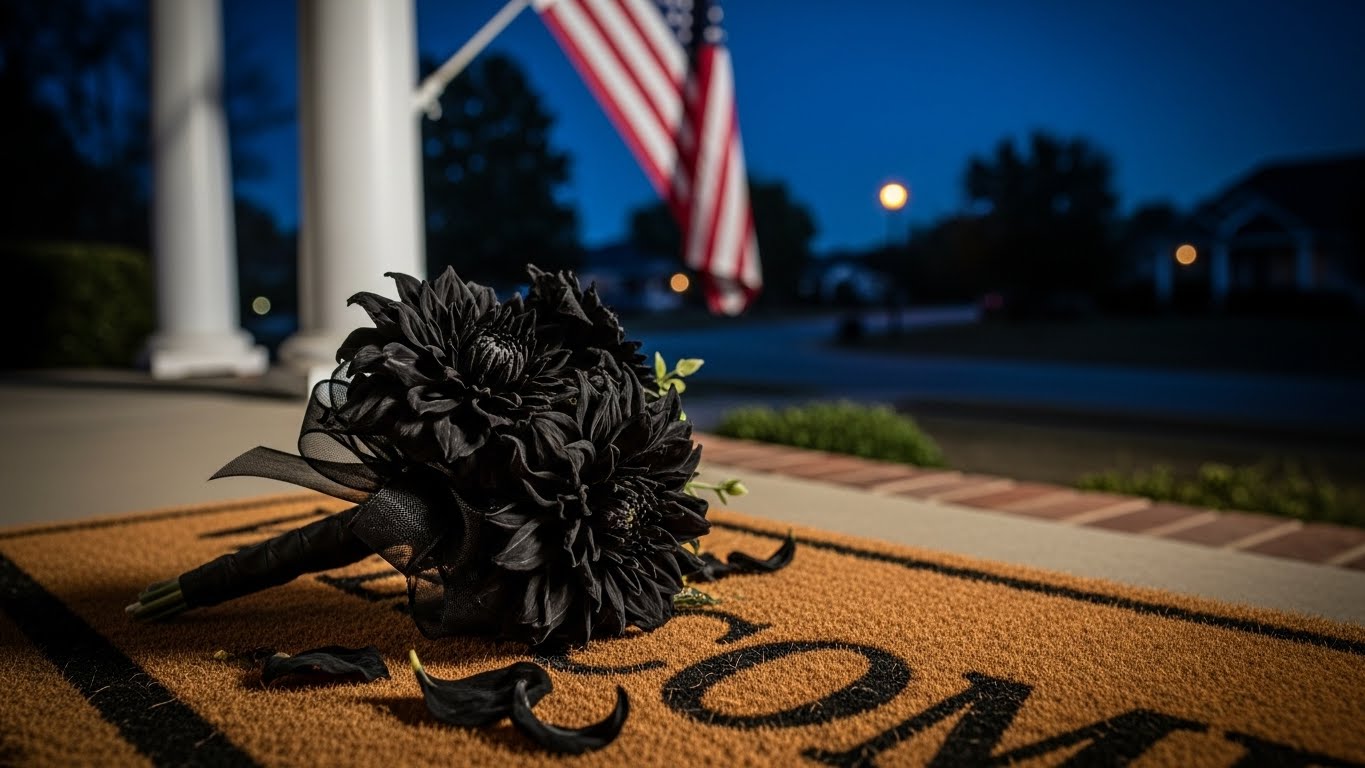
Margaret lowered the light, her heart hammering against her ribs. She was about to step back inside when she saw it. Lying on the welcome mat, right where Clara used to kick off her muddy sneakers, was a corsage.
Margaret’s breath hitched. She knelt down, her knees popping, and reached out with a trembling hand. It was the corsage Clara had worn to prom. Margaret knew it well; she had pinned it to Clara’s dress herself. But something was wrong.
The original corsage had been made of white roses and baby’s breath—symbols of innocence. But the flowers in her hand were not white roses. Someone had meticulously removed the roses and replaced them with black dahlias. They were dead, withered, and tied together with a black ribbon.
Margaret stared at the ominous object, a chill racing up her spine that had nothing to do with the evening breeze. This wasn’t a message from a runaway teenager. This was a taunt.
She scrambled to her feet, clutching the dead flowers, and locked the door behind her. She went straight to the landline in the hallway. Her hands shook so badly she misdialed the Sheriff’s station twice. Finally, it rang.
“Sheriff’s Department, dispatch.”
“This is Margaret Vance,” she said, her voice steel. “I need to speak to Sheriff Brody. Immediately.”
“Sheriff Brody is out for the evening, Mrs. Vance,” the dispatcher said, sounding bored. “Is this an emergency?”
“I found something. On my porch. It’s Clara’s… it’s evidence.”
“We can send a deputy out in the morning, ma’am.”
“In the morning? My granddaughter is missing!”
“Sheriff said to tell you to get some sleep, Mrs. Vance. He said you’re distraught and seeing things.”
The line went dead. Margaret stood there, the receiver humming in her ear. He said to tell you… Brody had anticipated she would call. He was blocking her.
Just as she was about to slam the phone down, it rang in her hand. The shrill sound echoed through the silent hallway like a scream. Margaret gasped and nearly dropped it. She stared at the device. Who was calling her at 9:00 PM?
She lifted it slowly to her ear. “Hello?”
There was no answer. Only static. A heavy, rhythmic static, like someone breathing into a microphone covered in cloth.
“Who is this?” Margaret demanded. “Where is Clara?”
Through the static, a voice emerged. It was distorted, warbling high and low, but the cadence was unmistakable. It was Clara.
“…Grandma…” The voice was a sob, broken and terrified. “I didn’t want to go… I told him no…”
“Clara! Clara, baby, where are you?” Margaret screamed, gripping the phone with both hands.
“He said…” The audio cut out for a second, then returned, clearer, but whispering. “He said he was the law… Grandma, I can’t say no to the law…”
Then, a sharp click. The line went dead again.
Margaret dropped the phone. It clattered against the hardwood floor. She backed away until her back hit the hallway wall, and she slid down it, burying her face in her hands.
He said he was the law.
The realization hit her with the force of a freight train. That was why Brody wasn’t looking. That was why the investigation was stalled. That was why the town was so quiet.
Clara hadn’t run away with a boy. She had been taken by someone she was taught to trust. Someone with a badge. Or someone protected by a badge.
Margaret Vance sat on the floor of her empty house, and for the first time in days, she didn’t cry. The tears dried up, replaced by a cold, burning furnace of fury. She looked at the black dahlias lying on the side table.
“You picked the wrong family,” she whispered to the empty house.
She stood up, her joints aching but her resolve ironclad. If the police wouldn’t look for Clara, she would. And God help the man who stood in her way.
Margaret went to the kitchen and made a fresh pot of coffee, black. She needed to think. She needed to retrace Clara’s steps, not as a grandmother, but as an investigator. She went to Clara’s room. It was a sanctuary of teenage innocence—posters of pop stars, textbooks stacked on the desk, a unmade bed. The police had glanced around in here for five minutes and declared it “normal.”
Margaret began to tear the room apart. She checked under the mattress. She checked inside the pockets of every pair of jeans. She checked the hollow curtain rod. Nothing.
She moved to the porch. The police had searched the yard, they said. But they hadn’t looked with the eyes of someone who knew Clara’s secrets. Margaret remembered when Clara was ten, she used to hide her candy stash from her cousins. Where did she hide it?
The swing.
Margaret walked out onto the dark porch. The old wooden swing creaked as she pushed it. She knelt down on the painted wood planks and felt underneath the seat of the swing. Her fingers brushed against spiderwebs, rough wood, and then… tape.
Her heart leaped. She clawed at the tape, peeling it back. A small, leather-bound notebook fell into her hand.
Clara’s diary.
Margaret rushed back inside, locking the door again. She sat at the kitchen table, put on her reading glasses, and opened the book. The early entries were mundane—complaints about homework, excitement about prom dress shopping, gossip about friends.
But as Margaret flipped toward the entries from two months ago, the tone changed. The handwriting became jagged, hurried.
March 12th: He was parked outside the school again today. The Charger with the blacked-out windows. I know he’s watching me. I saw him smiling when I walked to the bus.
March 20th: Kyle approached me at the diner. He didn’t even order food. He just sat in my booth and stared at me. He said, “You think you’re too good for this town, Clara? You think that scholarship makes you special?” I tried to leave, but he grabbed my wrist. He squeezed so hard it bruised. He said his daddy owns this town.
Margaret froze. Kyle. Kyle Brody. The Sheriff’s son. The town’s “Golden Boy.” The star quarterback who had led the high school team to state championships three years in a row. He was twenty-two now, a college dropout who spent his days driving around in the muscle car his father bought him, living off the town’s adoration.
She continued reading, her stomach churning.
April 5th: I told Sheriff Brody. I went to the station after school. I told him Kyle was following me, that he sends me texts from random numbers. The Sheriff laughed. He actually laughed. He said, “Kyle’s just a passionate boy, Clara. He likes you. You should be flattered. Don’t go making trouble where there isn’t any, or people might start thinking you’re a liar.”
April 15th: I saw the car outside Grandma’s house tonight. The lights were off, but the engine was running. I’m scared. I can’t tell Grandma. She’ll confront them, and they’ll hurt her. The Sheriff is the law. Who do you call when the police are the stalkers?
The final entry was dated the morning of the prom.
May 2nd: He texted me. “I’m coming to get my dance tonight.” I’m terrified. I’m going to try to stay with my friends all night. If something happens to me, look in the woods. The cabin by the old creek. I heard Kyle bragging about it once. He calls it his ‘playhouse.’
Margaret closed the book. Her hands were shaking uncontrollably. The image of Kyle Brody—handsome, charming, sociopathic Kyle—flashed in her mind. And standing behind him, the looming shadow of Sheriff Jim Brody, the man who had sat in her living room and lied to her face.
They had her. They had Clara.
Margaret stood up. She walked to the hallway closet and reached to the very top shelf. She pulled down a shoebox. Inside, wrapped in an oil-stained rag, was a .38 snub-nose revolver. It had belonged to her late husband, a veteran. She hadn’t fired it in twenty years, but she knew it was loaded.
She put the gun in her purse. She put the diary in her oversized coat pocket. She grabbed her car keys.
It was midnight. The town of Oakhaven was sleeping, safe in the lie that they were protected. Margaret Vance was about to wake them up. She wasn’t going to the police station. She wasn’t going to the FBI—that would take too long. She was going to the woods.
Chapter 2: Beneath the Floorboards
The drive to the outskirts of Oakhaven was a blur of high beams cutting through the suffocating darkness of the Kentucky backwoods. Margaret’s 2010 sedan rattled as the pavement turned into gravel, and then eventually, into a dirt path that looked more like a scar on the earth than a road.
She knew the area vaguely. The old Miller Creek hunting grounds. The Brodys had bought up this land a decade ago, supposedly for “conservation,” but mostly so the Sheriff and his buddies could drink whiskey and shoot deer without game wardens bothering them.
Margaret killed the headlights a mile out. She couldn’t risk being seen. She steered by the pale light of the moon, the tires crunching softly over fallen branches and dry leaves. The woods here were ancient and tangled, the trees leaning in like curious giants watching a funeral procession.
She stopped the car behind a dense thicket of briars. The silence was absolute, save for the ticking of her cooling engine. Margaret took a deep breath, the smell of damp earth and pine filling her lungs. She checked the revolver in her purse one last time. Six shots. She hoped she wouldn’t need them, but she feared she would need more.
She stepped out of the car, her orthopedic shoes sinking into the mud. Using a small penlight, she navigated the path. Her arthritis complained with every step, a dull ache in her hips, but the adrenaline coursing through her veins acted as a potent anesthetic. She wasn’t an old woman tonight; she was a hunter.
After twenty minutes of trekking, she saw it. The cabin.
It wasn’t the rustic, cozy log cabin one sees in brochures. It was a sprawling, dark structure made of rough-hewn timber, with windows that looked like blackened eyes. A large, detached garage stood to the side. And there, parked in front of the garage, was the car. A matte black Dodge Charger.
Kyle’s car.
Margaret’s heart slammed against her ribs. She crouched behind a fallen log, watching. There were no lights on in the cabin, but a faint, flickering glow emanated from the basement windows—like a television screen or a candle.
She needed proof. The diary was strong, but the Sheriff could claim it was the fantasies of a troubled teenage girl. He could claim Margaret forged it. She needed to see Clara. Or… God forbid… find what was left of her.
Margaret crept toward the cabin, sticking to the shadows. She bypassed the front door—too obvious, likely locked or trapped. She moved around the side, testing the windows. Locked. She reached the back of the house, where a cellar door slanted against the foundation.
It was padlocked.
“Damn it,” she whispered.
She looked around for a tool. Near the woodpile, she found a rusted crowbar. It was heavy, but Margaret’s desperation gave her strength. She wedged the crowbar into the hasp of the padlock. She didn’t have the strength to snap it, but the wood of the door frame was rotten from years of neglect. With a heave that sent a spasm of pain through her back, she ripped the hasp straight out of the rotting wood.
She froze, waiting for a shout, a dog barking, a gunshot. Silence returned.
She lifted the heavy wooden door. A set of concrete stairs descended into the gloom. The smell hit her instantly—a mix of bleach, stale beer, and something metallic. Copper. Blood.
She pulled her shirt over her nose and descended.
The basement was surprisingly finished. Concrete floors, drywall. It was set up like a rec room. There was a leather couch, a large TV, and a bar. But the walls… the walls were covered in shelves.
Margaret shined her penlight on the shelves. She gasped, her hand flying to her mouth to stifle a scream.
They were trophies.
Rows of driver’s licenses. Hair ribbons. cheap jewelry. Sneakers.
Margaret moved closer, her eyes scanning the horror. She recognized a face on a license. Sarah Jenkins. Sarah had disappeared three years ago. The town said she was a “wild child” who hitchhiked to California. Here was her license, next to a silver necklace Margaret had seen her wear at the grocery store.
Next to it, Emily Tate. A girl from the trailer park who vanished last year. The Sheriff said she was on drugs and probably overdosed in a ditch somewhere. Her glasses were sitting on the shelf.
These weren’t runaways. They were victims. The Sheriff hadn’t just been ignoring Clara’s case; he had been covering up a serial killer’s work for years. His own son.
Margaret reached the end of the shelf. There, sitting freshly placed, was a blue silk sash. Prom Queen.
“No,” Margaret whimpered. “No, no, no.”
She spun around, scanning the room frantically. “Clara!” she hissed. “Clara!”
There was a heavy metal door at the far end of the room. A sound came from behind it. A whimpering.
Margaret rushed to the door. It was bolted from the outside. She threw the bolt back and yanked the door open.
It was a small storage room, cold and damp. In the corner, huddled on a filthy mattress, was a figure.
“Clara?”
The figure looked up. It was a girl, but it wasn’t Clara. It was a young woman with matted blonde hair, her face bruised, her eyes wide with madness and terror. She looked to be in her twenties.
“He’s coming back,” the girl whispered, rocking back and forth. “The Prince is coming back.”
“Where is Clara?” Margaret grabbed the girl’s shoulders, shaking her gently. “The girl in the blue dress. Where is she?”
The girl pointed a shaking finger toward the garage outside. “The party,” she giggled hysterically. “She’s the guest of honor at the party. He took her to the car… said they were going for a ride.”
Margaret’s blood ran cold. The car was still parked outside.
“Stay here,” Margaret commanded the girl. “Do not move.”
Margaret ran back up the stairs, out into the night air. The fresh air felt like a lie now. The world was rot.
She moved toward the garage. The side door was ajar. She slipped inside.
The garage was a workshop. Tools hung on the walls. The black Charger sat in the middle. The trunk was open.
Margaret approached the car slowly. She peered inside the trunk.
It was empty.
Relief washed over her, followed instantly by a wave of terror. If she wasn’t in the trunk, and she wasn’t in the basement…
” looking for something, Mrs. Vance?”
The voice came from the doorway behind her. Smooth, arrogant, youthful.
Margaret spun around, her hand diving into her purse.
Kyle Brody stood in the doorway, silhouetted by the moonlight. He was wearing his varsity jacket, a baseball bat resting casually on his shoulder. He looked like the All-American boy, except for the dead, shark-like look in his eyes.
“You shouldn’t be here, Margaret,” Kyle said, stepping into the light. He wasn’t afraid. He was annoyed. “This is private property.”
“Where is she, Kyle?” Margaret pulled the revolver out. Her hand shook, but she pointed it directly at his chest.
Kyle laughed. A dry, humorless sound. “Whoa, easy there, Annie Oakley. You gonna shoot the star quarterback? My dad won’t like that.”
“I don’t care about your dad,” Margaret spat. “I saw the trophies, Kyle. I saw Sarah. Emily. I know what you are.”
Kyle’s smile faded. His face went blank. “They were trash. Nobody missed them. Just unwanted noise in a nice town. But Clara… Clara was different. She was pure. I wanted to keep her. But she wouldn’t stop screaming.”
“Where is she?” Margaret screamed, cocking the hammer of the gun.
“She’s with Dad,” Kyle said, nodding toward the woods behind the cabin. “Cleaning up my mess. Again.”
Margaret’s heart stopped. With Dad.
At that moment, the sound of a siren wailed in the distance, getting closer rapidly. Blue and red lights began to flash through the trees.
“Ah,” Kyle smirked. “Here comes the cavalry. Put the gun down, Margaret. You’re trespassing, you broke into my home, and you’re waving a weapon. Who do you think they’re going to believe? The crazy old lady who lost her mind with grief? Or the Sheriff and his son?”
Margaret backed up until she hit the workbench. She was trapped. The siren died down as a cruiser crunched up the gravel driveway. Car doors slammed.
Sheriff Brody walked into the garage. He was in uniform, his hand resting on his holster. He looked at Kyle, then at Margaret. He didn’t look angry. He looked tired.
“Margaret,” Brody said, his voice dripping with false sympathy. “Put the gun down. You’re making a mistake.”
“He killed them, Jim!” Margaret yelled, tears streaming down her face. “He killed Sarah and Emily! He has a room full of their things in the basement! And he did something to Clara!”
Brody sighed. He looked at his son. “I told you to burn that stuff, Kyle.”
“I like them,” Kyle shrugged. “They’re mine.”
Brody turned back to Margaret. “Margaret, listen to me. Kyle is sick. We’re getting him help. But this… this can’t get out. It would ruin everything. The town needs hope, not this.”
“You monster,” Margaret whispered. “You’re protecting a serial killer.”
“I’m protecting my son,” Brody said, his face hardening. He drew his service weapon. “Now, put the gun down, Margaret. Or I will be forced to shoot you in self-defense. Intruder on my property, threatening my boy… it’s an open and shut case.”
Margaret looked at the two men. The monster and his creator. She looked at the gun in her hand. She knew she couldn’t shoot them both before Brody dropped her. She was seventy years old. Her reflexes were gone.
But she had something else.
“You’re right, Jim,” Margaret said softly. “It’s your word against mine.”
She slowly lowered the gun to the workbench.
“Smart choice,” Brody said, relaxing slightly. “Now, kick it over here.”
Margaret moved her hand away from the gun. But as she did, her fingers brushed against her smartphone, which she had propped up against a tool rack on the bench behind her when she first backed up. The screen was glowing.
The red “LIVE” icon was pulsing in the corner.
Chapter 3: The Livestream Justice
The garage was silent, save for the hum of the overhead fluorescent lights that Brody had flicked on. The air was thick with the smell of gasoline and impending violence.
“Kick it,” Brody commanded, gesturing to the revolver with his chin.
Margaret nudged the gun across the concrete floor. It spun and came to a rest at Brody’s boots. He holstered his own weapon and bent down to pick it up, tucking it into his belt.
“Kyle, go get the zip ties from the truck,” Brody said, never taking his eyes off Margaret.
“What are we gonna do with her, Dad?” Kyle asked, sounding bored, as if discussing what to do with a stray dog.
“We take her to the quarry,” Brody said flatly. “Car accident. She was distraught, took a turn too fast. Tragically dead. The town will mourn her.”
Margaret felt a cold sweat trickle down her back. “You’re going to kill me? Just like that?”
“I don’t want to, Margaret,” Brody said, stepping closer. “But you saw too much. You should have just believed the story. Clara ran away. It was a clean story.”
“Where is she, Jim?” Margaret asked, her voice steady. She needed him to say it. She needed the phone to hear it. “Where is my granddaughter?”
Brody rubbed his face. “She’s… she’s gone, Margaret. Kyle got too rough. It was an accident. She’s buried out back, near the old oak. I was just about to head out there to… finish covering it up properly.”
A guttural cry escaped Margaret’s throat. Gone. Clara was gone. The hope she had been clinging to shattered like glass. But in its place, a cold, sharp shard of vengeance remained.
“You buried her like a dog?” Margaret sobbed, keeping her body angled so she wasn’t blocking the phone’s camera lens. “You covered up murder for your son?”
“He’s my blood,” Brody snapped. “He has a future. I wasn’t going to let a few mistakes ruin that. I am the law in this county, Margaret. What I say happened, happened.”
“And the others? Sarah? Emily?”
“Mistakes,” Kyle interjected, grinning. “Practice.”
Brody glared at his son. “Shut up, Kyle.”
“It doesn’t matter, Dad,” Kyle laughed. “She’s dead anyway. Who’s she gonna tell?”
Margaret looked at the phone propped against the oil cans. She saw the number in the corner of the screen. 2,403 viewers.
It had started with just her Facebook friends—mostly other grandmothers and church members. But in a small town, gossip travels faster than light. Comments were scrolling up the screen so fast they were a blur.
OMG IS THIS REAL? That’s the Sheriff! Did he just say he buried Clara? CALL THE STATE POLICE! I’m recording this!
Margaret looked back at Brody. A grim smile touched her lips.
“I’m not going to tell anyone, Jim,” she said softly. “I don’t have to.”
She reached back and turned the phone around, holding it up so the screen faced the Sheriff.
Brody squinted. “What is that?”
Then he saw it. The Facebook Live interface. The red “LIVE” box. The thousands of viewers. The endless stream of angry emojis and comments calling him a murderer.
The color drained from Brody’s face so completely he looked like a corpse. “What… what have you done?”
“I’m live, Jim,” Margaret said, her voice ringing with triumph. “On the Oakhaven Community Board. Everyone is watching. The Mayor. The Pastor. Your deputies. The whole damn town.”
“Turn it off!” Brody roared, lunging for her.
Margaret threw the phone behind her, under the heavy workbench where he couldn’t reach it easily. “It’s too late! It’s on the cloud! It’s everywhere!”
Brody froze. He looked at Kyle. Kyle wasn’t smiling anymore. He looked like a child who had just realized the monsters were real.
“Dad?” Kyle whimpered.
The sound of sirens returned. But this time, it wasn’t the lonely wail of a single cruiser. It was a symphony. It was coming from the highway. State Troopers. The FBI field office was only forty minutes away, but the local deputies—the ones who weren’t corrupt, the ones who had daughters of their own—were closer.
Brody backed away, his hands trembling. He looked at the garage door.
“You can’t run, Jim,” Margaret said, her voice breaking with grief but standing tall. “There’s nowhere to go. You’re not the law anymore.”
Brody pulled his gun again. For a second, Margaret thought he would shoot her out of spite. He raised the barrel.
But he didn’t point it at her. He looked at his son, then at the flashing lights reflecting off the trees outside. The weight of his sins, the years of covering up, the inevitable collapse of his empire—it crushed him in an instant.
He dropped the gun. It clattered to the floor.
“It’s over,” Brody whispered. He fell to his knees, putting his hands behind his head.
Kyle, realizing his shield was gone, tried to bolt. He grabbed the baseball bat and ran for the door.
CRACK.
Margaret didn’t hesitate. She had picked up a heavy wrench from the workbench while they were distracted. As Kyle ran past her, she swung it with all the strength of a grandmother avenging her child.
The wrench connected with Kyle’s knee. He screamed—a high, pathetic sound—and collapsed to the concrete, writhing in agony.
Margaret stood over him, the wrench raised. She wanted to finish it. Every fiber of her being wanted to end him right there.
But she heard Clara’s voice in her head. Grandma, you’re the strongest person I know.
She lowered the wrench. She wasn’t him.
The garage filled with uniformed officers. Deputies Margaret knew—men who had eaten her apple pie—rushed in, guns drawn. They looked at Brody with disgust. They cuffed him roughly. Another officer pinned Kyle to the ground.
One young deputy, a boy named Miller, walked up to Margaret. He had tears in his eyes.
“Mrs. Vance,” he said, his voice choking. “We saw the video. My wife showed me. We… we didn’t know.”
Margaret slumped against the workbench, the adrenaline fading, leaving only a hollow, crushing ache. “Go to the oak tree, Miller,” she whispered. “Bring my baby home.”
Epilogue
The funeral was the largest Oakhaven had ever seen. The church overflowed, with people standing in the parking lot, listening to the service on loudspeakers. The story had gone national. The Livestream Justice.
Margaret stood at the gravesite. The casket was closed. Beside it lay a new corsage—white roses and baby’s breath, pure and untainted.
She wasn’t alone. The town stood with her. The fear that Brody had instilled was gone, replaced by a collective shame and a resolve to do better.
Margaret looked at the fresh earth. She touched the tombstone.
Clara Vance. Beloved Granddaughter. She spoke truth to power.
Margaret adjusted her black coat. She felt the weight of the diary in her pocket. She would publish it. She would make sure everyone knew the story of the girl who couldn’t say no to the law, and the grandmother who broke the law to save her memory.
She looked up at the blue sky.
“I got him, Clara,” she whispered. “I got them all.”
She turned and walked back toward the car, her head held high. She was old, she was tired, and her heart was broken. But she was not defeated. She was Margaret Vance, and she had cleaned house.