Thugs Tormented a Boy on the Bus While Passengers Looked Away. They Didn’t Know the Old Man in the Back Row Was a Retired U.S. Marshal.
Chapter 1: The Purgatory Express
The Number 42 bus rattled over the potholes of Chicago’s South Side, its suspension groaning like a dying beast. It was a humid Tuesday in late August, the kind of day where the air felt thick enough to chew, smelling of diesel exhaust, heated asphalt, and the collective perspiration of forty tired souls.
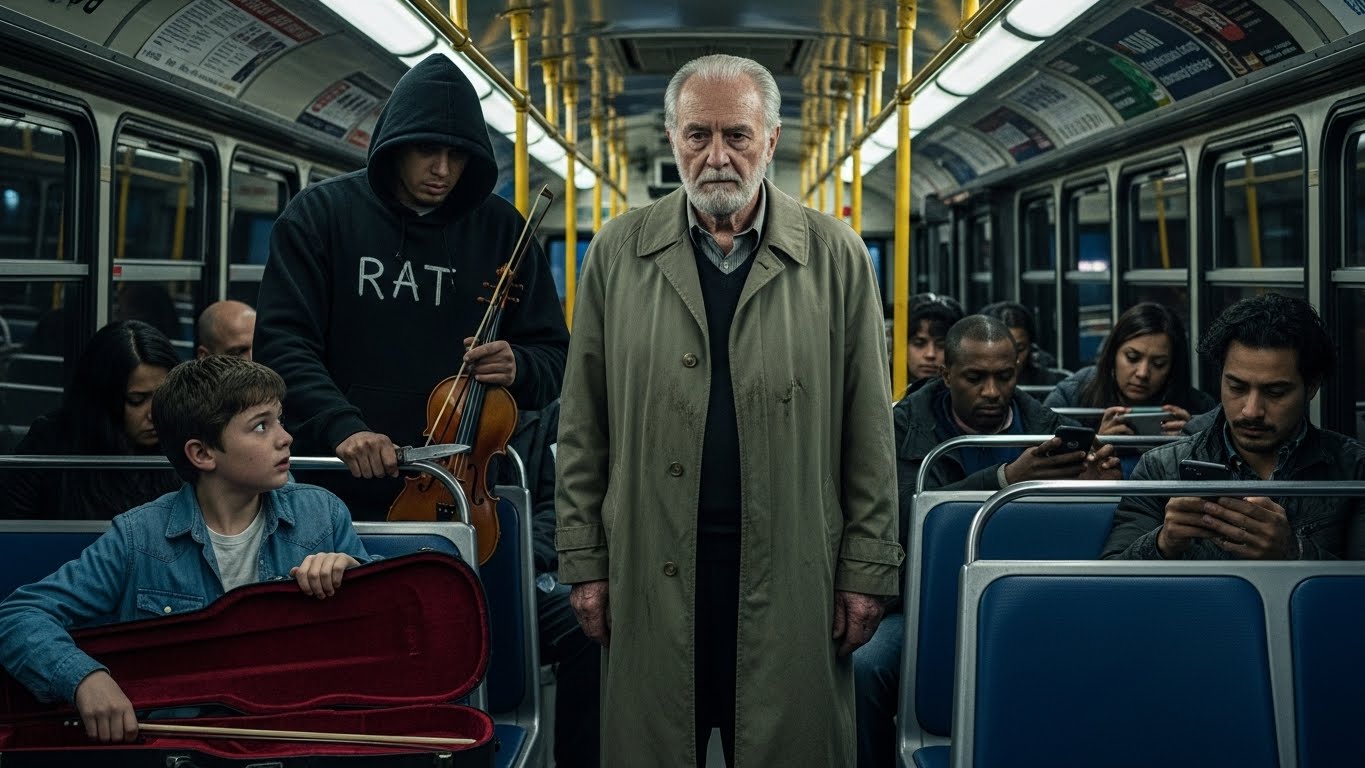
Frank “Sully” Sullivan sat in the very last row, squeezed into the corner seat. At seventy-two, Frank felt every vibration of the bus in his lower lumbar. He wore a beige trench coat despite the heat, a flat cap pulled low over his eyes, and orthopedic shoes that had seen better decades. To the casual observer—if anyone ever bothered to observe him—he was just another piece of the city’s debris. A pensioner. A nobody.
He stared out the window, watching the graffiti-stained brick buildings blur by. His hands, resting on his knees, were spotted with age and shook slightly—not from fear, but from the onset of something he refused to name to his doctor.
Frank rode the 42 every day at 3:00 PM. It was his pilgrimage. His destination was the Whispering Pines Memory Care facility, where his wife, Martha, lived. Or rather, where her body existed. Her mind had wandered off into the fog three years ago, leaving Frank to hold conversations with a woman who looked at him like a polite stranger.
The bus stopped with a screech of brakes.
A young boy climbed on. He was small for his age, maybe twelve, with skin the color of dark roast coffee and wide, nervous eyes. He was dressed in a white button-down shirt that was pressed crisp, contrasting sharply with the sweat-stained t-shirts of the other riders.
He clutched a violin case to his chest. It was old, the black leather scuffed and peeling, but the boy held it like it contained the Crown Jewels.
Frank watched him. He had seen the kid before. Toby. He knew the name because the boy had dropped his bus pass once, and Frank had returned it. Toby Clark. A scholarship kid at the conservatory downtown. A good kid. A quiet kid.
Toby scanned the bus. It was crowded. He moved to the middle section, finding a sliver of space near the window. He sat down, pulling the violin case onto his lap, curling his small body around it protectively. He looked like a turtle retreating into its shell.
Frank shifted his gaze back to the window. He felt a familiar pang of guilt—a cold, heavy stone that had lived in his gut for ten years. It was the guilt of the “one that got away.” Not a fugitive, but a witness. A little girl he was supposed to protect in 2014. He had failed. And seeing boys like Toby—innocent, fragile, trying to survive in a world of wolves—always brought the ghost of that failure to the surface.
Just a bus ride, Frank, he told himself. Just get to Martha.
But the universe had other plans.
The bus hissed to a stop at 47th Street. The doors accordioned open.
Three young men stepped up. They didn’t pay. The driver, a heavyset man who just wanted to make it home to his family, looked at them, looked at the tattoos on their necks, and looked away.
The leader was a wire-thin, jittery kid known on the streets as “Rat.” He was nineteen, with teeth that looked too big for his mouth and eyes that darted around with a drug-fueled manic energy. He wore low-slung jeans and a tank top that showed off a freshly inked tear drop tattoo.
“Back of the bus,” Rat announced loudly, his voice cracking. “VIP section coming through.”
The atmosphere in the bus changed instantly. The humidity seemed to spike. Conversations died. Passengers suddenly found their shoes or their phones incredibly interesting. The “Bystander Effect” settled over the Number 42 like a suffocating blanket.
Frank didn’t look down. He lowered his chin, watching from beneath the brim of his cap. He assessed the threat. Three targets. No visible firearms, but Rat kept tapping his right pocket. Knife.
Don’t get involved, Sully, Frank thought. You’re retired. You’re tired.
But as Rat strutted down the aisle, his eyes landed on the boy in the white shirt.
Chapter 2: The Sound of Breaking
Rat stopped. He grinned, a predatory expression that showed too much gum.
“Well, look at this,” Rat sneered, leaning over Toby. “We got us a little gentleman on the bus. Look at that shirt. You think you better than us, little man?”
Toby shrank against the window. “No, sir.”
“Sir?” Rat laughed, looking at his goons. “He called me sir! You hear that?”
The other two thugs, heavy-set boys who acted as muscle, chuckled dutifully.
Rat poked Toby in the chest. “What you got in the box, Urkel? A machine gun? You going to shoot up the block?”
“It’s… it’s just an instrument,” Toby whispered, gripping the handle tighter.
“An instrument?” Rat reached out and slapped the top of the case. “Let me see. I like music. Maybe I can play a tune.”
“Please,” Toby pleaded, his voice trembling. “It was my grandfather’s. I have a recital. Please don’t.”
Frank watched from the back. He saw the passengers shifting uncomfortably. A woman in a nurse’s scrub looked like she wanted to say something, but Rat’s eyes dared her to move. Fear paralyzed them. It was the law of the jungle: Don’t look, and maybe the predator won’t eat you next.
“Give it here!” Rat snapped. He yanked the case from Toby’s grip.
Toby lunged for it. “No!”
Rat shoved the boy back into his seat hard. Toby’s head bounced off the window glass with a sickening thud.
“Sit down!” Rat screamed. The entire bus flinched.
Rat held the case up like a trophy. He popped the latches. Click. Click.
He opened the lid. Inside lay a beautiful, amber-colored violin, nestled in blue velvet. It was old, well-cared for, a piece of art amidst the grime of the city.
“Fancy,” Rat muttered. He reached in and grabbed the bow.
“That’s horsehair,” Toby sobbed. “Please, don’t touch the hair, the oils will ruin it!”
“Oils?” Rat laughed. “You worried about oils?”
Rat held the bow up. He looked at Toby, enjoying the terror in the boy’s eyes. It was a power trip, a way to feel big in a life that made him feel small.
“Oops,” Rat said.
He brought his knee up and snapped the bow over his thigh.
CRACK.
The sound was sharp, like a bone breaking. The wood splintered. The horsehair hung loose and ragged.
Toby screamed. It wasn’t a scream of pain, but of pure heartbreak. He buried his face in his hands and began to sob uncontrollably, a deep, heaving sorrow that filled the silent bus.
“Garbage,” Rat said, tossing the broken pieces onto the boy’s lap. “Now, what about the fiddle? Maybe I should see if it bounces.”
Rat grabbed the violin by the neck. He held it out the open window of the moving bus.
“Drop it!” Toby shrieked. “Please!”
“Shut up!” Rat pulled a switchblade from his pocket. The blade clicked open, gleaming silver in the afternoon sun. “You keep squealing, little pig, and I’m gonna cut some new strings on your face.”
That was the line.
In the back row, the newspaper folded down.
Chapter 3: The Marshal Wakes Up
Frank Sullivan sighed. It was a heavy, weary exhale that seemed to carry the weight of forty years of federal service.
He stood up.
His knees popped loudly. He groaned slightly as he straightened his back. He didn’t look like a hero. He looked like a grandfather getting up to change the television channel.
But then, he started to walk.
He moved down the aisle. He didn’t rush. He didn’t run. He walked with a terrifying, rhythmic deliberation. His eyes, previously dull and tired, were now focused lasers. The “Old Man” had vanished. The Marshal had clocked in.
He stopped three feet from Rat.
“Son,” Frank said. His voice wasn’t loud, but it cut through the engine noise like a razor blade.
Rat spun around, the knife still in his hand, the violin dangling precariously out the window with his other. “What you want, pops? You want to die today?”
Frank looked at the knife. Then he looked at Rat.
“You broke the boy’s bow,” Frank said calmly. “That was unnecessary. You owe him an apology, and by my estimation, about fifty dollars.”
The bus went deadly silent. The other two thugs stepped forward, looming over Frank.
“You crazy, old man?” Rat laughed, a high-pitched, nervous sound. “Sit your ass down before I carve you like a turkey.”
Rat lunged.
He thrust the knife toward Frank’s stomach—a sloppy, amateur move fueled by arrogance.
Frank didn’t dodge. He stepped into the attack.
In a blur of motion that defied his seventy-two years, Frank’s left hand shot out. He caught Rat’s wrist in mid-air. He didn’t just hold it; he applied a wrist lock—a technique drilled into him at the Federal Law Enforcement Training Center in Glynco, Georgia, four decades ago.
He twisted.
Rat screamed. It was a sound of pure agony as the torque forced his elbow joint against its natural range of motion.
Frank stepped forward, using his hip for leverage, and drove Rat into the floor of the bus.
THUD.
The violin fell from Rat’s hand—landing safely on the seat cushion. The knife clattered to the floor.
Frank didn’t let go. He kept the pressure on the wrist, pinning Rat face-down in the aisle with his knee on the thug’s shoulder.
The other two thugs rushed forward. “Get off him!”
Frank reached into his trench coat with his free hand. He didn’t pull out a phone. He didn’t pull out a wallet.
He pulled out a Smith & Wesson Model 36 snub-nose revolver.
He leveled it at the two advancing men. His hand was rock steady. The shaking was gone.
“I wouldn’t,” Frank said.
He reached into his back pocket and flipped open a leather wallet. A gold badge, worn smooth around the edges but still shining, caught the light.
U.S. MARSHAL – RETIRED.
“I spent forty years hunting men who eat guys like you for breakfast,” Frank’s voice dropped an octave, becoming the voice of absolute command. “I tracked fugitives through swamps in Louisiana and blizzards in Alaska. I have zero patience for bullies.”
He looked at the two thugs standing frozen.
“Sit. Down.”
The authority in his voice was undeniable. It triggered a primal instinct in the thugs—the instinct to submit to the alpha. They sat.
Frank looked down at Rat, who was whimpering on the floor.
“You’re going to stay right there until the police arrive,” Frank whispered. “And if you move, I’m going to break this wrist for real. Do you understand?”
“Yes! Yes!” Rat sobbed.
Suddenly, the bus erupted. The passengers, released from their trance of fear, began to cheer. The nurse was clapping. A construction worker stood up and blocked the back door so the other thugs couldn’t run.
Frank didn’t smile. He just looked tired again.
Chapter 4: The Aftermath
The bus driver had hit the silent alarm. Within three minutes, blue lights flashed through the windows.
Chicago PD stormed the bus, guns drawn. “Drop the weapon!”
Frank slowly placed his revolver on the seat and raised his hands. “Easy, boys. It’s secured.”
A Police Sergeant pushed through the officers. He looked at Frank, squinted, and then his jaw dropped.
“Sully?” the Sergeant asked. “Frank Sullivan? Holy hell, I thought you were dead.”
“Not yet, Miller,” Frank grunted as the officers helped him stand up. “Though my sciatica is killing me.”
The police handcuffed Rat and his friends. They dragged them off the bus to the jeers of the passengers.
Frank didn’t watch them go. He turned to the window seat.
Toby was shaking. He was holding his violin, staring at the broken pieces of the bow on his lap. He looked traumatized.
Frank knelt down. It hurt his knees, a sharp bolt of pain, but he ignored it. He needed to be eye-level with the boy.
“Hey,” Frank said softly.
Toby looked up, tears streaming down his face. “He broke it. He broke Grandpa’s bow.”
“I know, son. I know.” Frank reached out and gently took the broken pieces. “But the violin is safe. The music is safe.”
“I… I was so scared,” Toby whispered. “I didn’t do anything.”
“You held your ground,” Frank said, wiping a tear from the boy’s cheek with a rough thumb. “You protected what mattered. That’s the hardest part. You did good.”
The Sergeant walked over. “Frank, we need a statement. And… well, technically you brandished a firearm on a city bus.”
“I detained a felon in the commission of an assault with a deadly weapon,” Frank corrected, his lawyer voice coming out. “And I have my HR 218 permit. Don’t cite me, Miller, or I’ll tell your wife about that poker game in ’98.”
The Sergeant laughed. “Alright, Marshal. Just… try to keep a lower profile next time?”
“I’m just a commuter,” Frank said, grabbing his cane. “Just a commuter.”
Chapter 5: The Last Melody
Two days later.
Toby Clark stood in the hallway of the Chicago Conservatory. His violin teacher, a strict woman named Madame Vorsky, was waiting for him.
“Toby,” she said sternly. “The recital is in three days. Do you have a bow?”
Toby looked at his shoes. “No, Madame. My mom… she can’t afford a new one until next month.”
“Then you cannot play,” she sighed. “I am sorry, Toby. Rules are rules.”
Toby turned to leave, his heart feeling like lead in his chest.
“Wait,” the school secretary called out. “Toby Clark? A package came for you this morning. By courier.”
She handed him a long, rectangular box. It was wrapped in brown paper.
Toby frowned. He tore the paper. Inside was a black velvet case. He opened it.
Lying inside was a Pernambuco wood violin bow. It was exquisite. Professional grade. The frog was inlaid with mother-of-pearl. It was worth more than Toby’s entire wardrobe.
There was a note tucked under the bow.
“To replace what was taken. The world needs the music more than it needs the silence. Don’t let the bad guys stop you playing. – F.”
Toby stared at the note. He touched the ‘F’. Frank. The old man on the bus.
One week later.
The Whispering Pines Memory Care facility was quiet, smelling of lavender and antiseptic.
Frank sat in the armchair next to Martha’s bed. She was staring at the wall, her eyes vacant. She hadn’t spoken his name in six months.
“It’s me, Martha,” Frank whispered, holding her frail hand. “It’s Sully. I miss you, old girl.”
Silence.
Frank bowed his head. He felt the loneliness crushing him. The adrenaline from the bus was gone, leaving him just an old man again.
Then, he heard it.
Music.
It started soft, drifting down the hallway. A violin. It was playing “Ave Maria”—Martha’s favorite song.
Frank frowned. He stood up and walked to the door.
Standing in the doorway of Room 304 was Toby.
He was wearing a suit that was slightly too big for him. He held the new bow with perfect form. His eyes were closed, lost in the music. The melody poured out of the instrument, pure and heartbreakingly beautiful.
Nurses stopped in the hallway. Residents peeked out of their rooms.
Toby played for the old man who saved him. He played the gratitude he couldn’t put into words.
Frank watched, tears streaming down his face.
“Frank?”
The voice was weak. Frank spun around.
Martha was looking at him. Her eyes were clear. She was smiling. The music had reached through the fog.
“That’s beautiful, Frank,” she whispered.
Frank rushed to her side, clutching her hand. “Yes. Yes, it is, Martha.”
Toby finished the song. He lowered the bow. He looked at Frank and nodded.
Frank nodded back. A silent salute between soldiers of a different kind.
The old Marshal sat back down, holding his wife’s hand, listening as Toby began another song. For the first time in years, Frank Sullivan didn’t feel like a failure. He didn’t feel like a relic.
He realized that even if you retire from the job, you never retire from being a human being. And sometimes, saving one seat on a bus is enough to save the world.