I Saved A Missing Girl In 1999. Last Night She Knocked On My Door To Tell Me The Man I Handed Her To Wasn’t Her Father—And That I Was The One Who Sold Her.
CHAPTER 1: THE HOLLOW BENEATH THE ROOTS
It was the kind of rain that didn’t just wash things away; it tried to erase them. That’s how it felt in Blackwood Ridge, Oregon, back in November of ’99. I was twenty-four, a rookie volunteer for the county Search and Rescue. We had been combing the treeline for fourteen hours straight.
The radio on my shoulder had been silent for the last hour, mostly because the storm was interfering with the signal, but also because hope was dying out. A six-year-old girl named Lily had vanished from her backyard swing set. The golden rule in SAR (Search and Rescue) is that after the first twelve hours in freezing rain, you aren’t looking for a survivor anymore. You’re looking for a body.
I was assigned to Grid 4, a dense patch of old-growth Douglas firs that the locals stayed away from. The terrain was uneven, full of ravines and slick mud that could snap an ankle in a heartbeat. My flashlight beam was cutting through the deluge, looking like a solid bar of light in the mist.
“Base, this is unit Seven. Nothing in the lower ravine. Moving to the ridge line,” I shouted into the mic, shivering inside my heavy poncho.
Static. Just static.
I kept moving. I don’t know what made me stop near the massive oak tree that had been struck by lightning years ago. It was split down the middle, dead and gray. But at the base, beneath the tangle of exposed roots, I saw something that didn’t belong in the woods.
Color. specifically, a bright, synthetic pink.
My heart hammered against my ribs. I scrambled down the muddy embankment, sliding more than walking. I fell to my knees in the mud, clawing at the brush. It was a hair ribbon.
And right beneath it, hidden by a cleverly arranged pile of dead branches and moss, was a piece of plywood.
“Hello?” I screamed over the wind. “Lily?”
I ripped the plywood away. It revealed a hole. Not a natural cave, but a dug-out space, reinforced with crude PVC piping. A hidey-hole. A bunker.
I shined my light down.
Huddled in the corner, wrapped in a dirty woolen blanket that looked decades old, was a pair of eyes wide with a terror so pure it stopped my breath.
“Lily?” I whispered, my voice cracking.
She didn’t move. She was pale, her lips blue, trembling so violently it looked like she was vibrating. She was clutching a dirty doll with one eye missing.
I didn’t wait for backup. I dropped into the hole. It smelled of wet earth and something metallic—like old pennies.
“It’s okay,” I said, reaching out. “I’ve got you. I’m going to take you home.”
She flinched when I touched her shoulder. She looked at the light, then at me, not with relief, but with confusion. She opened her mouth to speak, but her voice was gone, lost to hours of screaming or the cold.
I scooped her up. She was lighter than I expected. Fragile. Like a bird made of glass. I hoisted her out of the hole and climbed out after her, wrapping my heavy raincoat around her small frame.
“I’ve got her!” I screamed into the dead radio, praying someone could hear me through the static. “I have the package! I repeat, I have the child!”
I began the trek back to the access road. Every step was a battle. The mud tried to suck my boots off. The wind tried to push me over. But I felt superhuman. I had done it. I had beaten the clock. I had saved the girl.
I was a hero.
At least, that’s what I told myself for twenty-five years.
CHAPTER 2: THE HANDOFF
By the time I broke through the treeline and saw the flashing red and blue lights of the staging area, my legs were burning.
The scene was chaotic. The Sheriff’s department, the state troopers, and half the town were gathered near the ambulances. The rain was coming down in sheets, blurring everything into a watercolor painting of neon lights and shadows.
“Medic!” I roared, my voice raw. “I have her!”
The cry went up like a flare. Dozens of heads turned. A cheer erupted, ragged and desperate. People started running toward me.
A paramedic team met me halfway, flanked by two deputies. They tried to take her from my arms, but she was clinging to my jacket with a grip that defied her exhaustion.
“It’s okay, honey,” I soothed her, prying her freezing fingers loose. “These are the good guys.”
Then, a man burst through the police line.
He was tall, wearing a long trench coat that was soaked through. His hair was plastered to his skull, and his face was a mask of absolute anguish.
“Lily! Oh god, Lily!” he screamed, shoving past a deputy.
“Sir, stay back!” the deputy shouted, but the man didn’t stop. He collapsed to his knees right in front of me and the medics.
“That’s my baby,” he sobbed, his hands reaching out, shaking. “Is she alive? Please tell me she’s alive!”
I looked at the deputies. They seemed overwhelmed, distracted by the press who were snapping photos from behind the barricade. The Sheriff was nowhere to be seen, likely coordinating the next grid search on the radio, unaware we had found her.
The man looked up at me. His eyes were gray, frantic, and filled with tears. “Thank you,” he choked out. “Oh god, thank you. Give her to me. Please, just let me hold my daughter.”
It was the most natural thing in the world. A father wanting his child. The bond that supersedes protocol.
I looked down at Lily. She was staring at the man. Her eyes were wide. She wasn’t crying. She was frozen.
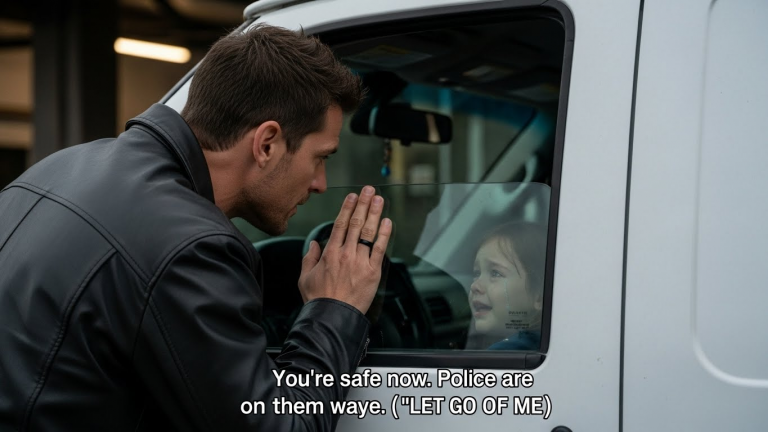
“Go to Daddy,” I said softly, and I gently passed her into the man’s arms.
He grabbed her tight. Too tight. He buried his face in her neck. “I’ve got you now,” he whispered. I heard it because I was close. The tone… it wasn’t just relief. It was possessive. “You’re never leaving my sight again.”
Lily went limp in his arms. She didn’t hug him back.
“Let’s get her to the ambulance,” the medic said, moving in.
“I’ll take her,” the man said, standing up abruptly. He was big. Imposing. “My car is right there. It’s warm. I’m taking her to the hospital myself.”
“Sir, we need to check her vitals,” the medic protested.
“I’m her father!” the man roared, his grief turning to aggression. “Get out of my way!”
He turned and marched toward a black sedan parked just outside the police tape, the engine idling. The deputies, tired and seeing a reunited family, didn’t stop him. They just waved him through, focused on managing the crowd.
I watched him put her in the back seat. I watched him get in the driver’s side. I watched the taillights fade into the rain.
I felt a hand on my shoulder. It was Sheriff Miller.
“Good work, Jack,” Miller said, looking exhausted. “You did a hell of a thing tonight.”
“Thanks, Sheriff,” I said, panting. “Her dad… he was pretty shaken up. He took her to County General.”
Sheriff Miller froze. His hand tightened on my shoulder.
“Her dad?” Miller asked, his voice dropping an octave.
“Yeah. Tall guy. Trench coat. He just drove off with her.”
Miller stared at me. The color drained from his face, making him look like a corpse under the harsh floodlights.
“Jack,” Miller whispered. “Lily’s father died three years ago in a car wreck. Her mother is the only family she has, and she’s sitting in my patrol car right now.”
The world tilted. The sound of the rain vanished, replaced by a high-pitched ringing in my ears.
I looked back at the road where the taillights had disappeared.
“No,” I stammered. “No, he said… he knew her name…”
“Get in the car,” Miller barked, pulling his gun. “EVERY UNITS, BLACK SEDAN, HEADING SOUTH ON ROUTE 9. SUSPECT IS KIDNAPPING THE VICTIM. REPEAT, VICTIM IS NOT SECURE.”
But it was too late. By the time we hit the sirens, the road was empty.
CHAPTER 3: THE MEMORY HOLE
Twenty-five years is a long time to think about a single moment. A long time to replay the sound of a car door slamming.
I stood there in my cabin, rain blowing in through the open door, staring at the woman who used to be the girl I saved. The girl I lost.
“Lily?” I repeated, the name tasting like ash in my mouth.
She stepped inside, pushing past me. She smelled like the woods—wet pine and something sterile, like hospital antiseptic. She was tall now, lean and hard, moving with the wary grace of a stray dog that expects to be kicked.
“Close the door, Jack,” she said. It wasn’t a request.
I closed it. My hands were shaking. I turned to face her. She was standing by my fireplace, the flames casting dancing shadows across her face. The scar on her neck was thick, a keloid rope that twisted when she turned her head.
“I thought you were dead,” I whispered. “We searched for months. The FBI came. We dragged every lake in the county.”
“You stopped searching,” she corrected me, her voice devoid of emotion. “You stopped searching after three weeks because the police found my backpack near the river and assumed I drowned. That was the narrative, wasn’t it?”
I nodded, feeling sick. That had been the official conclusion. The kidnapper had panicked, dumped the car, and thrown her in the river. Body never recovered.
“He didn’t panic,” Lily said, staring into the fire. “He drove me three states over. To a farm in Idaho. He had a basement there, Jack. Bigger than the one you found me in.”
I felt the bile rise in my throat. “I’m so sorry. God, Lily, I’m so sorry. I didn’t know. He acted like… he knew.”
She turned to me then, her eyes hard as flint. She held up the polaroid again.
“You didn’t know?” she asked. “Then explain this.”
I took the photo from her hand. My fingers brushed hers; her skin was ice cold.
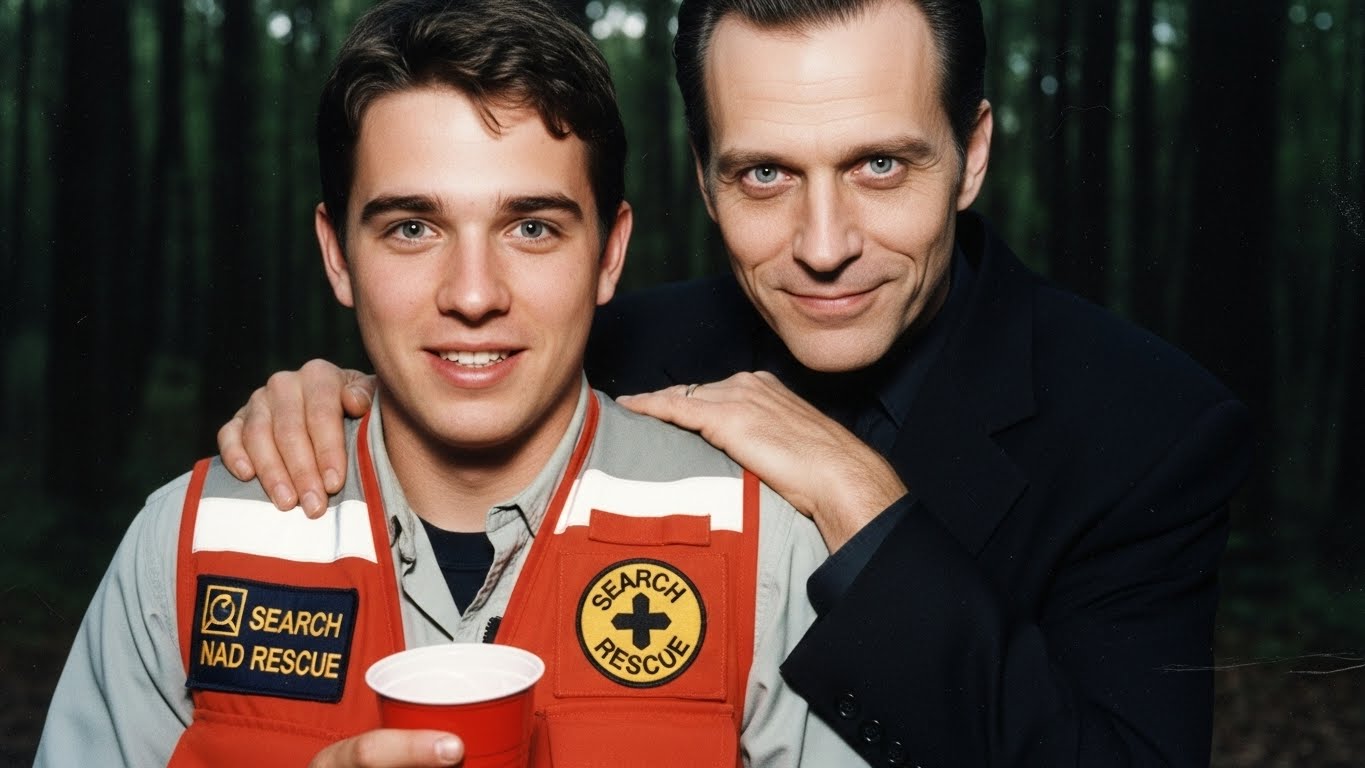
I stared at the image. It was definitely me. Younger. No beard. Wearing my volunteer vest. I was holding a red cup, laughing at something off-camera. And the man… the man in the trench coat… was standing right next to me. His arm was around my shoulders, a camaraderie that looked easy, familiar. He was smiling at the camera, a smile that didn’t reach his dead, gray eyes.
“I… I don’t remember this,” I stammered. “I swear to you. I don’t know who this is.”
“This was taken at the search party mixer,” Lily said. “The night before I went missing. My mother took this picture.”
“Your mother?”
“My mother,” she hissed. “She gave it to me before she died. She told me to find you. She said, ‘Ask Jack why he was friends with the man who took you.'”
My knees gave out. I sank onto the worn sofa. “Friends? I’ve never met him before that night in the rain.”
“Liar,” she said softly. She reached into her pocket again and pulled out a small, folded piece of paper. It was yellowed with age.
“I found this in the basement,” she said. “In his ledger. It’s a receipt.”
She tossed it onto the coffee table. I didn’t want to look, but I couldn’t look away.
It was a handwritten note. Payment for the package: $50,000. Recipient: Jack T. Date: Nov 12, 1999.
November 12th. The day she was taken.
“I didn’t take any money!” I shouted, standing up. Panic was clawing at my chest. “I was a volunteer! I was a kid! I had nothing to do with this!”
“Then why is your signature on it?” she asked.
I looked closer. There, at the bottom, in blue ink, was my signature. The loop of the ‘J’, the sharp cross of the ‘T’. It was my handwriting. Unmistakably.
“I don’t understand,” I whispered. The room felt like it was spinning. “I don’t remember any of this.”
“Maybe,” Lily said, pulling a gun from the waistband of her jeans. A Glock 19. She leveled it at my chest. “Maybe you need a reminder. Sit down, Jack. We’re going to take a trip down memory lane. And if I don’t like what I find, I’m going to put you in a hole you’ll never crawl out of.”
CHAPTER 4: THE HYPNOTIST
“I’m not going to shoot you,” Lily said, though the gun didn’t waver. “Not yet. Not until I know the truth. Because there are gaps in my memory too, Jack. Gaps he put there.”
She gestured to the chair opposite her. “Sit.”
I sat. The rain hammered against the roof, a rhythmic drumming that usually helped me sleep. Now, it sounded like dirt hitting a coffin lid.
“Who are you?” I asked. “I mean… really? You can’t just be Lily.”
“I’m the girl who survived,” she said. “He called me ‘Subject 4.’ He liked to play games with the mind. Brainwashing. Conditioning. He was a psychologist before he lost his license. Before he decided he wanted his own private subjects.”
She leaned forward. “He talked about you, sometimes. When he was drunk. He called you his ‘Sleeping Agent.'”
“Sleeping Agent?” I scoffed, though terror was gripping my gut. “This isn’t a spy movie, Lily. I’m a nobody. I work at a lumber yard.”
“Do you?” she asked. “Where were you between the years of 1997 and 1999?”
“I was…” I started, then stopped.
My mind went blank. I tried to picture it. I tried to picture my apartment, my job, my friends from that time.
Nothing. Just a gray fog.
“I was in college,” I said, but it sounded like a question.
“Which college?”
“State,” I said automatically.
“What was your major?”
“I…” Sweat pricked my forehead. “Business? No, Engineering.”
“You don’t know,” she said. “Just like you don’t remember taking that photo. Just like you don’t remember signing that receipt.”
She reached into her bag and pulled out a metronome. An old-fashioned wooden one. She set it on the table and started it.
Click-clack. Click-clack.
“He used this,” she said. “Every day. To make me forget my mother. To make me forget my name. But I broke the conditioning. It took me twenty years, but I broke it. Now, we’re going to break yours.”
“I’m not doing this,” I said, trying to stand.
She cocked the gun. “Sit down.”
I sat.
“Look at the metronome, Jack,” she commanded. Her voice changed. It became lower, authoritative. It sounded… familiar. “Focus on the sound. You are back in 1999. It is November. It is raining.”
“Stop it,” I muttered, but my eyes were locking onto the swinging arm of the device.
“You are in the woods,” she continued. “But not the woods where you found me. The woods behind the old sanitarium. The one they closed down in ’95. You’re walking there. Who are you meeting?”
“I’m not meeting anyone,” I said, my eyelids feeling heavy. “I’m looking for the girl.”
“No,” she said. “This is before the girl went missing. Two days before. You are walking to the meeting point. Who is there?”
A flash of memory hit me like a physical blow.
The smell of antiseptic. A white room. A man in a lab coat.
“Doctor…” I whispered.
“Doctor who?”
“Doctor… Crowe.”
Lily inhaled sharply. “Arthur Crowe. That’s his name. The man in the trench coat.”
“I know him,” I said, my voice sounding distant, like it was coming from someone else. “He’s my therapist.”
“Why were you seeing a therapist, Jack?”
“Because of the nightmares,” I said. “The nightmares about the fire.”
“What did Doctor Crowe tell you to do about the nightmares?”
“He said…” I gripped the arms of the chair. My knuckles were white. “He said I needed to help him. He said if I helped him with a ‘project’, he could make the bad memories go away. He could erase them.”
“And what was the project?” Lily asked softly.
“He needed a child,” I said. Tears began to stream down my face. “He needed a child who wouldn’t be missed right away. Someone special. He chose her. He chose Lily.”
“And what was your job?”
“My job…” I choked. “My job was to hide her.”
“Hide her where?”
“In the bunker,” I sobbed. “I dug the bunker. I put the supplies there. I knew where it was because I built it.”
The realization crashed into me. I hadn’t found the bunker by luck. I hadn’t stumbled upon the pink ribbon by accident.
I had gone exactly where I knew she would be. Because I had put the ribbon there to mark the spot.
“I didn’t save you,” I whispered, the horror consuming me. “I was retrieving you.”
“Yes,” Lily said. She stopped the metronome. The silence in the room was deafening.
I looked at her. “I’m the monster.”
“No,” she said, her grip on the gun tightening. “You’re the tool. He’s the monster. But a tool can still be dangerous.”
She stood up. “He’s still out there, Jack. He’s old, but he’s alive. And he knows I’ve escaped. He’s coming for me. And since you’re the loose end he thought was tied up… he’s coming for you too.”
As if on cue, the headlights of a car swept across the front window. Tires crunched on the gravel driveway.
Lily killed the lights in the cabin.
“Get down,” she hissed.
We hit the floor just as the front window shattered, blown inward by a shotgun blast.
PART 2
CHAPTER 5: THE HUNT
The cabin exploded into chaos. The second blast took out the doorframe, sending splinters of oak flying like shrapnel. I rolled behind the heavy leather sofa, my heart hammering against my ribs like a trapped bird.
“Stay down!” Lily screamed, crawling toward the kitchen island. She moved with a fluidity that was terrifying—military grade. She didn’t look like a victim anymore. She looked like a soldier.
“Jack! The back door!” she yelled over the roar of the rain and the shouting outside.
I scrambled on my hands and knees, the glass digging into my palms. My mind was fracturing. The hypnosis had opened a door that shouldn’t have been opened, and now, amidst the gunfire, memories were bleeding through.
I remembered a white room. I remembered Dr. Crowe’s voice, smooth like velvet, telling me that ‘obedience is freedom’.
“Focus!” Lily grabbed my collar, jerking me back to reality. “They’re coming in. We need to move. Now.”
We burst through the back door into the mudroom. I grabbed my keys, but Lily slapped them out of my hand.
“They’ll have the road blocked,” she hissed. “We go into the woods. Your territory.”
My territory. The irony tasted like copper. I had spent twenty-five years hiding in these woods, thinking I was doing penance, when really, I had been placed here. A sleeper agent guarding the perimeter of a crime scene I helped create.
We sprinted into the darkness. The rain was a torrent, cold and brutal. It masked our footsteps, but it also blinded us. Behind us, I heard the heavy boots of men kicking in the rest of my door.
“Clear the rooms!” a voice shouted. It was deep, distorted. “Target One is hostile. Target Two is… expendable.”
I was Target Two.
We scrambled up the ridge, the same ridge where I had ‘found’ Lily all those years ago. My lungs burned. I was fifty years old now, not twenty-four. My knees screamed in protest.
“Where are we going?” I gasped, slipping on wet pine needles.
“The Sanitarium,” Lily said, not breaking stride. “The tunnels run under the ridge. That’s how he moved us. That’s how he moved the children.”
We reached the crest of the hill. Below us, through the skeletal branches of the trees, I saw the flashlight beams of the men swarming my cabin. They moved with precision. These weren’t local cops. These were professionals.
“Crowe has a private security firm,” Lily explained, pulling me behind a massive boulder. “The ‘Blackwood Group’. They handle his… logistics.”
“Lily,” I wheezed, “I can’t… I can’t fight an army.”
She turned to me, rain plastering her hair to her face. In the darkness, the scar on her neck looked black.
“You don’t have to fight them, Jack,” she said. “You just have to remember the codes.”
“What codes?”
“The keypad codes to the maintenance tunnels,” she said. “You installed them.”
I stared at her. “I… I don’t know them.”
“Yes, you do,” she said intense desperation in her eyes. “Crowe made you the architect because he knew you’d suppress the memory. Access the file, Jack. November 1999. The renovations. What is the code?”
I closed my eyes. The rain pelted my face. I tried to push past the panic, past the fear.
November. The smell of sawdust. A keypad glowing green in the dark.
“11-12-99,” I whispered. “The date… the date you were taken.”
“He likes his trophies,” Lily said grimly. “Let’s go.”
We slid down the other side of the ridge, toward the looming shadow of the abandoned Blackwood Sanitarium. It had been closed for thirty years, a rotting hulk of brick and ivy. But as we approached the rusted service entrance hidden in the brush, I knew.
I knew exactly which rock to move to find the breaker box. I knew exactly how to shimmy the lock. My hands moved on their own, guided by muscle memory I didn’t know I possessed.
I punched in the code: 1-1-1-2-9-9.
The heavy steel door hissed. Hydraulic seals. This wasn’t an abandoned building. It was a fortress.
The door clicked unlock.
“Welcome home, Jack,” Lily whispered, and she pushed me into the dark.
CHAPTER 6: THE NURSERY
The air inside was stale, recycled. It hummed with the sound of distant generators. We were in a long concrete corridor, lit by flickering strip lights.
“He kept us down here,” Lily said, her voice echoing softly. “For years. He told us the world had ended. That the air outside was poison. He said he was the only one who could save us.”
I walked beside her, my hand trailing along the cold wall. Flashes of memory were hitting me faster now, disjointed and violent.
I saw myself in a jumpsuit, carrying crates of food. I saw myself fixing a generator. I saw myself standing guard outside a metal door, hearing a child crying inside, and feeling… nothing. Just a cold sense of duty.
“I was a guard,” I realized, stopping in my tracks. The horror was a physical weight, crushing my chest. “I wasn’t just the driver. I worked here. God, Lily, I worked here.”
“You were conditioned,” Lily said, checking the magazine of her Glock. “He drugged you. Hypnosis. Sleep deprivation. He turned you into a drone. You’d work a shift here, then go back to your ‘life’ thinking you’d been on a bender or sleeping.”
“That doesn’t make it right,” I spat, tears stinging my eyes. “I helped him steal lives.”
“We can mourn later,” she said. “Right now, we need to get to the Control Room. He keeps the records there. The names. The locations of the others.”
“Others?”
“There were twelve of us,” she said. “I was Number Four. I don’t know how many are left.”
We moved deeper into the facility. The architecture was a nightmare mix of sterile medical bay and underground prison. We passed rooms with observation windows. Inside, I saw small beds, educational toys from the 90s, and cameras mounted in every corner.
“This is the Nursery,” Lily said. She didn’t look through the glass. She couldn’t.
Suddenly, a klaxon blared. Red lights began to strobe.
“Intruder Alert,” a computerized voice announced. “Sector 4. Initiate Lockdown.”
“They know we’re here,” Lily said. “Run.”
We sprinted. Heavy blast doors began to descend from the ceiling. We slid under the first one just as it slammed shut. The second one was closing fast.
“Jack! Move!”
I dove, scraping my boots against the concrete. The door clamped down inches from my heels.
We were trapped in the central corridor. At the far end, standing in front of the elevator bank, was a figure.
He was old now. Withered. He sat in a motorized wheelchair, an oxygen tube running to his nose. But the trench coat was the same. And the eyes—those dead, gray eyes—hadn’t aged a day.
Dr. Arthur Crowe.
Flanked by two heavily armed guards in tactical gear, he smiled. It was the smile of a spider welcoming a fly.
“Jack,” his voice rasped over the intercom system. “And Subject Four. What a delightful family reunion.”
Lily raised her gun. “It’s over, Crowe.”
“Is it?” Crowe chuckled. A dry, hacking sound. “Jack, be a good boy and disarm her.”
I froze.
“Jack, don’t listen to him!” Lily shouted, not taking her eyes off Crowe.
“Jack,” Crowe said, his voice dropping into that melodic, hypnotic rhythm I remembered from my nightmares. “Delta. Oscar. Niner. Sleep.”
My body locked up. My vision blurred. It was like a switch had been flipped in my brain. My hand, acting on its own accord, reached out and grabbed Lily’s wrist.
“Jack!” she screamed, struggling. “Fight it!”
“I… I can’t…” I gritted out through clenched teeth. My other hand moved to grab the gun. I was a passenger in my own body. The programming was deep, woven into my very neurons.
“Bring her to me,” Crowe commanded.
I twisted Lily’s arm. She cried out, dropping the gun. I kicked it away. Then, I grabbed her by the throat.
“I’m sorry,” I gasped, tears streaming down my face as my hands squeezed. “I can’t stop.”
CHAPTER 7: THE RED ROOM
Lily clawed at my hands. Her eyes were bulging, pleading.
“Jack…” she wheezed. “Remember… the rain…”
The rain.
The rain in 1999. The cold. The way she had shivered in my arms. The moment I handed her over.
“Remember… the guilt,” she choked out.
The guilt. The twenty-five years of self-hatred. The bottle. The isolation.
Crowe laughed. “Guilt is a construct, Jack. I removed it. Obey.”
“NO!” I roared.
I didn’t let go of Lily. Instead, I used the momentum. I spun, swinging Lily behind me, and hurled myself forward, tackling the guards.
The surprise broke the conditioning for a split second. The guards, expecting a compliant drone, were slow to react. I slammed into the one on the left, driving my shoulder into his gut. We hit the floor.
“Shoot them!” Crowe shrieked, his calm facade shattering.
Lily dove for her gun. The second guard raised his rifle, but Lily was faster on the draw. Bang. Bang. Two shots to the chest. The guard dropped.
I was wrestling with the first guard. He was younger, stronger. He landed a punch to my jaw that made my vision swim. He reached for his sidearm.
I saw a fire extinguisher mounted on the wall. I grabbed it and swung it with every ounce of rage I had stored up for two decades. It connected with a sickening crunch. The guard stopped moving.
I scrambled up, gasping for air. Lily was already on her feet, the gun trained on Crowe.
The old man looked small now. Pathetic. He was fumbling with the controls of his wheelchair, trying to reverse into the elevator.
“Don’t move,” Lily said. Her voice was ice.
We walked toward him. The hallway was silent except for the hum of the ventilation and Crowe’s wheezing breath.
“You can’t kill me,” Crowe spat, looking at Lily. “I’m your father. I raised you. I made you who you are.”
“You stole me,” Lily said. “You stole my life.”
She pressed the barrel of the gun to his forehead.
“Do it,” Crowe challenged. “Pull the trigger. Prove that you’re my masterpiece. A killer. Just like I trained you to be.”
Lily’s hand trembled. He was inside her head too. He was betting on the fact that she couldn’t kill the man who had been the center of her universe for twenty years, even if he was a monster.
“Lily,” I said softly.
She didn’t look at me.
“Don’t do it for him,” I said. “And don’t do it for revenge.”
I stepped forward. I looked at the man who had turned me into a unwitting kidnapper. The man who had taken my youth and my mind.
“Let me do it,” I said.
Crowe’s eyes widened. He looked at me. “Jack, you don’t have it in you. You’re a rescuer. A hero.”
“I’m not a hero,” I said, taking the gun from Lily’s shaking hand. “I’m the guy who drives the car.”
I didn’t hesitate. I didn’t offer a quip. I just pulled the trigger.
The sound was deafening in the enclosed space. Crowe slumped back in his chair. The reign of the Architect was over.
“It’s done,” I whispered.
Lily let out a sob, collapsing against the wall. I went to hold her, but then, the computer screens on the wall flickered to life.
A countdown appeared. 00:59… 00:58…
“Dead man’s switch,” Lily gasped. “His heart rate monitor. If it stops…”
“The facility self-destructs,” I finished. “He’s burying the evidence.”
“We have to go!”
CHAPTER 8: THE GHOSTS OF BLACKWOOD
We ran.
The red lights were pulsing faster now. Sirens wailed, a banshee scream that signaled the end of the world. The ground beneath us shook as deep charges began to detonate in the lower levels.
We scrambled back through the Nursery. The ceiling was cracking, dust raining down.
“The elevator!” Lily yelled. “It’s too slow! The stairs!”
We hit the stairwell. Five flights up to the surface. My legs felt like lead. Every step was agony.
Boom.
An explosion rocked the building, throwing us against the railing. Heat began to rise from the shaft below. The fire was catching up.
“Jack, come on!” Lily grabbed my hand.
We scrambled up the last flight. The door to the surface was jammed. Debris from the first explosion had blocked it.
“Help me!” I shouted.
We threw our shoulders against the steel. It wouldn’t budge.
“Shoot the hinges!” Lily yelled.
I stepped back, raised the Glock, and fired three rounds into the mechanism. I kicked the door. It groaned and swung open, spilling us out into the cold, wet night air.
We didn’t stop running. We sprinted through the overgrown courtyard of the sanitarium, scrambling over the collapsed fence, diving into the treeline just as the ground behind us erupted.
The Sanitarium imploded. The ground caved in, swallowing the brick and mortar, the labs, the nursery, and the body of Arthur Crowe. A plume of fire shot into the sky, illuminating the rain.
We lay in the mud, panting, watching the inferno.
It was over.
Or so I thought.
Two days later.
I was sitting in a motel room three towns over. The police were calling it a gas main explosion. A tragic accident at the old abandoned hospital. No mention of a bunker. No mention of children.
Lily was sitting on the bed, watching the news. She had showered, washed the mud from her hair, but the scar remained.
“What do we do now?” I asked.
She turned off the TV. She picked up her bag.
“We find the others,” she said. “I have the drive.”
She held up a small USB drive. She had swiped it from the control panel before we ran.
“There are names, Jack. Addresses. He sold some of them. To people in high places.”
She stood up and walked to the door. She looked back at me.
“Are you coming?”
I looked at my hands. The hands that had saved her. The hands that had sold her. The hands that had killed her captor.
I thought about going back to my cabin. Rebuilding. Pretending none of this happened. But I knew I couldn’t. The rain would never wash this away.
“I’m driving,” I said, grabbing my keys.
We walked out into the parking lot. The sun was shining for the first time in a week. But as I unlocked the car, I caught my reflection in the window.
For a split second, I didn’t see myself. I saw Crowe. He was smiling.
I blinked, and he was gone.
I got in the car. Lily was waiting.
“Where to first?” I asked.
“Washington D.C.,” she said, looking at a file on her phone. “Subject Seven. He’s a Senator’s son now.”
I started the engine. The road ahead was long. The past was dead, buried under tons of concrete. But the ghosts? The ghosts were riding shotgun.
And as I pulled onto the highway, I realized something terrifying.
When I shot Crowe… I didn’t feel relief. I didn’t feel justice.
I felt power.
And I wondered, as I gripped the steering wheel, just how much of his mind he had really left inside of mine.