A Billionaire Got Stuck In Traffic And Saw A Homeless Boy Playing Chess With Trash. When He Stepped Out To Play Him, He Found The Heir He Never Had.
Chapter 1: The King in the Iron Tower
The rain in Seattle didn’t wash things clean; it just made the grime slicker. It was a Tuesday afternoon, the kind of grey, oppressive day that seemed to leach the color out of the world. On the I-5 overpass, traffic had come to a complete standstill. A sea of red brake lights stretched as far as the eye could see, blurring through the relentless drizzle.
Inside the back of a stretched phantom-black limousine, Elias Thorne sat in a silence that cost three hundred thousand dollars. The car was soundproof, climate-controlled, and smelled faintly of Italian leather and cedar. But to Elias, it felt like a coffin.
At seventy years old, Elias was a legend. He was the “Oracle of the Pacific,” an investment banker whose cold logic and strategic brilliance had built an empire worth billions. He could look at a failing company and see the one loose thread that, if pulled, would unravel the debt or knit it back together. He was a Grandmaster of finance.
But he was also dying.
He hadn’t told anyone. Not his driver, not his lawyer, and certainly not the vultures sitting on his Board of Directors. The cancer in his pancreas was aggressive, a silent assassin that checked his King before he even knew the game had started. He had six months. Maybe less.
Elias looked out the tinted window, his reflection ghostly against the glass. He saw a tired old man with eyes that had seen too much and a heart that was beating on borrowed time. His greatest fear wasn’t death; he was a logical man, and he accepted that all equations must balance eventually. His fear was his legacy.
He had no children. His wife had passed away twenty years ago. The people waiting to take over Thorne Capital were sharks—men like Sterling Vance, who knew the price of everything and the value of nothing. They would chop up his life’s work, sell it for parts, and buy yachts with the proceeds.
“Gridlock again, sir,” his driver, Maurice, said apologetically over the intercom. “Looks like a wreck up ahead. We might be here a while.”
“It’s fine, Maurice,” Elias murmured. “I’m in no rush.”
He looked down from the elevated highway. Below the overpass, in the muddy, forgotten underbelly of the city, was a tent city. Blue tarps flapped in the wind. Shopping carts were piled high with sodden possessions. It was a place most people in Elias’s tax bracket pretended didn’t exist.
Elias watched idly. He saw a man arguing with a stray dog. He saw a woman huddled over a fire in a barrel.
And then, he saw the boy.
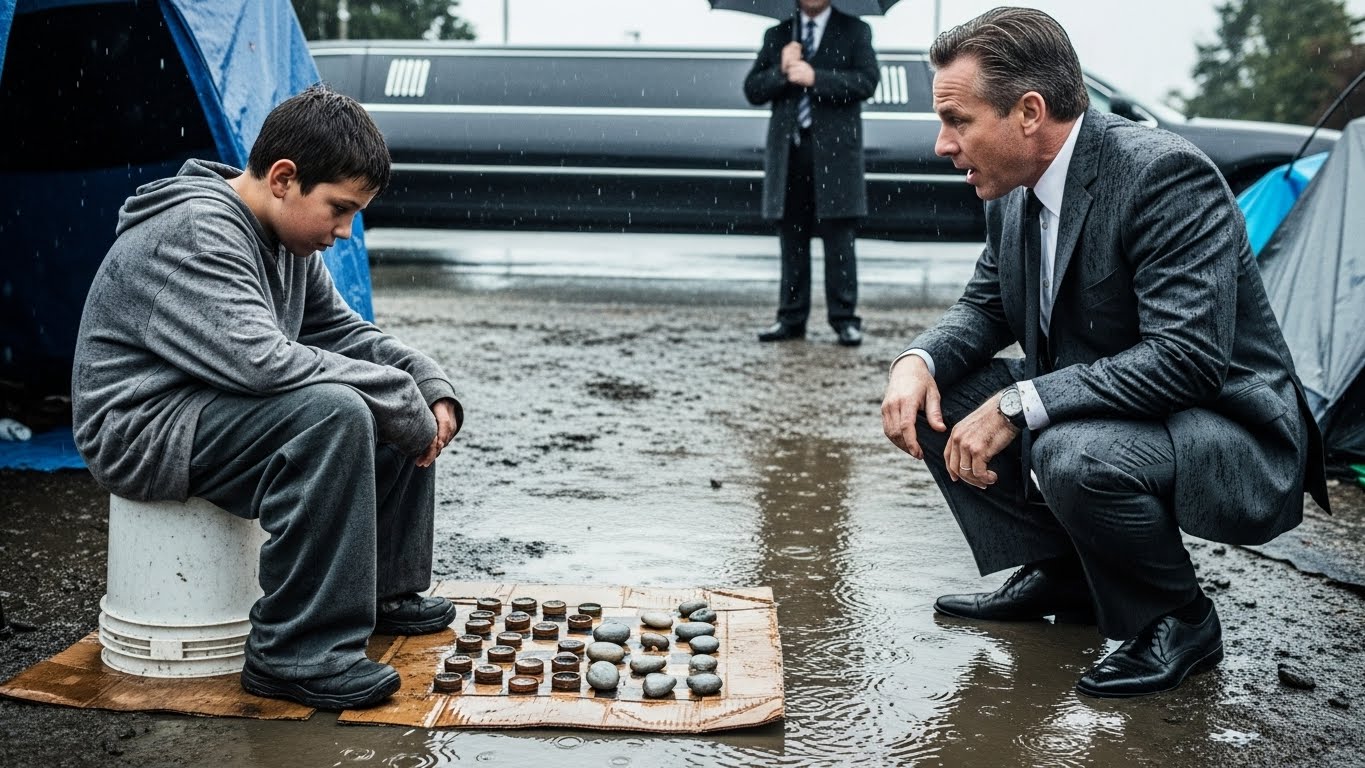
He couldn’t have been more than twelve. He was sitting on an overturned plastic bucket near a concrete pylon, oblivious to the rain soaking his matted brown hair. He wore a coat that was three sizes too big, the sleeves rolled up and held in place with silver duct tape. He was filthy, covered in the soot and mud of the camp.
But he wasn’t begging. He wasn’t looking for handouts.
He was staring intently at an old, water-warped piece of cardboard resting on a wooden crate.
Elias squinted. He reached for the opera glasses he kept in the door pocket—usually for the symphony, now for the slums. He focused the lenses.
The cardboard had a grid drawn on it in black marker. Sixty-four squares.
It was a chessboard.
But there were no pieces. Instead, the boy was using trash. Rusty bottle caps appeared to be the white pieces. Smooth, dark river stones were the black.
The boy was playing against himself.
Elias watched, fascinated. He had been a state chess champion in his twenties before business consumed his soul. He knew the game. He knew the loneliness of it.
The boy reached out with a hand that was red from the cold. He picked up a black stone—a Knight, presumably—and moved it in an L-shape. He didn’t hesitate. He placed it with a decisive thud.
Elias froze. He lowered the glasses, then raised them again.
Knight to F6.
The boy then spun the crate around to play the white side. He immediately moved a bottle cap. Bishop to G5.
“The Tartakower Defense,” Elias whispered.
It wasn’t a random move. It wasn’t a child playing make-believe. That was a sophisticated, aggressive variation of the Queen’s Gambit Declined. It was a move used by masters, by people who understood the geometry of war.
The boy spun the board again. He sat there, chin in hand, rain dripping from his nose, his eyes darting across the board, calculating lines of attack that most adults couldn’t conceive of.
“Maurice,” Elias said, his voice snapping with a sudden, strange energy. “Unlock the door.”
“Sir?”
“I said unlock the door. And pull over to the shoulder.”
“Mr. Thorne, it’s pouring rain. You’re in a three-thousand-dollar suit. Is something wrong?”
“No, Maurice,” Elias said, grabbing his cane and a large black umbrella. “For the first time in twenty years, something is right.”
Chapter 2: The Boy King of the Mud
The descent down the muddy embankment was treacherous. Elias slipped twice, ruining his Italian loafers, mud splattering the hem of his bespoke trousers. The smell of the camp hit him as he got closer—wet wool, woodsmoke, and desperation.
The people of the tent city stopped and stared. It wasn’t every day a man who looked like he owned the bank walked into their living room. A few backed away, eyes wide. Others watched with guarded hostility.
Elias ignored them. He walked straight toward the concrete pylon.
The boy, Sam, didn’t look up. He was deep in the tank, staring at the bottle caps. The world around him—the noise of the highway, the cold rain, the hunger—had faded away. There was only the board.
Elias stopped three feet away. He held the umbrella high, casting a dry circle over the makeshift board.
“That was a bold move with the Knight,” Elias said, his voice cutting through the sound of the rain. “But you left your King exposed on the flank. If White brings the Rook over, you’re pinned.”
Sam flinched. His shoulders went up, a defensive reflex of a child used to being yelled at or chased away. He didn’t look up immediately. He just stared at the board, his brow furrowed.
“No, I’m not,” the boy said. His voice was raspy, unused. “He can’t bring the Rook. If he does, I sacrifice the Bishop on H2. Check. He has to take with the King. Then I fork him with the Knight. Checkmate in three moves. The open file is a trap.”
Elias blinked. He looked at the board again, visualizing the lines the boy had just described without looking.
Bishop sacrifice… King takes… Knight fork…
My God. The kid was right. It was a trap so subtle Elias had missed it.
“May I?” Elias asked, gesturing to the empty milk crate opposite the boy.
Sam finally looked up. His face was streaked with dirt, but his eyes were startlingly clear—a piercing, intelligent grey. He looked at Elias’s suit, his silver hair, the gold watch peeking out from his cuff.
“You’re going to get your pants dirty,” Sam said.
“They’re just pants,” Elias said. He sat down. The wet plastic crate soaked through his trousers instantly. He didn’t care.
“I’m Elias.”
“Sam.”
“Well, Sam. Reset the board. Let’s see if you can beat a real opponent.”
They played.
It was a surreal scene. The billionaire and the beggar, huddled under a black umbrella in the shadow of a highway, pushing trash across a piece of wet cardboard.
Elias didn’t go easy. He played with the same ruthless aggression that had crushed his competitors for decades. He opened with the English Opening. Sam countered with a King’s Indian Defense.
Ten minutes in, a small crowd of homeless residents had gathered, watching in silence. They didn’t understand the game, but they understood the tension.
Sam played fast. His hands moved with a fluidity that betrayed hours, maybe thousands of hours, of practice. He didn’t second-guess himself.
Twenty minutes in, Elias was sweating. He was in trouble. He had lost control of the center. This boy didn’t just know the moves; he understood the flow. He played like a poet.
“Check,” Sam said softly, moving a jagged white rock (a Rook).
Elias looked at the board. He looked for an escape. There was none. His King was cornered.
“Checkmate,” Elias exhaled, a puff of white mist in the cold air. He sat back, stunned. He hadn’t lost a game in ten years. “Who taught you this? Where did you learn to think like that?”
Sam began to reset the pieces, his hands trembling slightly now that the adrenaline of the game was fading. The cold was creeping back in.
“My dad,” Sam said quietly. “He was a math teacher. He loved chess. He said it was the only game where luck doesn’t matter. Only the mind.”
“Where is your father now?” Elias asked gently.
Sam stopped moving the pieces. He gripped a bottle cap so hard its edges dug into his thumb. His eyes filled with sudden, hot tears.
“He’s… he’s gone,” Sam whispered. “We lost our house two years ago. He got sick. Cancer. The insurance wouldn’t pay because it was a ‘pre-existing condition.’ He spent all our savings on doctors, but it didn’t work.”
Sam wiped his nose on his dirty sleeve.
“He died inside that tent right there, three months ago,” Sam pointed to a patchy blue tarp. “He told me to keep playing. He said, ‘As long as you use your brain, Sam, you’re a King, not a bum. Don’t let the world take your mind.'”
Elias felt a lump form in his throat, heavy and painful. “And your mother?”
“Died when I was a baby. It’s just me.”
“Why are you still here, Sam? Why not a foster home?”
“I can’t leave him,” Sam said, looking toward a patch of disturbed earth near the pylon. “The city buried him in a pauper’s grave. Just a number. No name. I’m saving up.”
Sam reached into his pocket and pulled out a small ziplock bag. Inside were a few crumpled dollar bills and some quarters.
“I make a few dollars recycling cans. I’m going to buy him a headstone. A real one. With his name on it. James Miller. Grandmaster.” Sam looked at Elias with a fierce determination. “I’m not leaving until he has his name back.”
Elias looked at the boy—this brilliance, this loyalty, this immense potential wrapped in rags—and felt his heart break. He had spent his life accumulating wealth to leave to… no one. And here was a boy starving himself to buy a stone for a father who had left him nothing but a chess set made of trash.
“Sam,” Elias started, “I think we can—”
He was interrupted by the screech of brakes.
Chapter 3: The Destruction of a Kingdom
A large, orange municipal truck had pulled up onto the muddy verge. The side of the truck read “CITY CLEAN-UP & SANITATION.”
Two men in neon vests jumped out. They didn’t look like they were there to talk. They looked bored and angry. The supervisor, a thick-necked man named Miller, held a clipboard.
“Alright, listen up!” Miller shouted, his voice booming. “We got a complaint about the eyesore. This is an illegal encampment. You have ten minutes to clear out before we bulldoze the lot. Anything left behind goes in the grinder!”
Panic erupted in the camp. People scrambled to grab their sleeping bags and photos.
“Hey!” Elias stood up, using his cane to steady himself. “You can’t just evict people with ten minutes’ notice in the rain!”
Miller sneered at Elias. He didn’t recognize the billionaire covered in mud. He just saw an old man in a dirty suit.
“Watch me, grandpa. It’s city property. Move it or lose it.”
Miller marched toward the concrete pylon. He saw the crate with the chessboard.
“Look at this junk,” Miller grumbled. “Trash everywhere.”
He pulled his leg back and kicked the crate.
It happened in slow motion. The cardboard flew into the air. The bottle caps and the river stones—the white and black armies, the only memories Sam had left of his father—scattered into the thick, brown mud.
“NO!” Sam screamed.
It was a sound of pure agony. Sam didn’t care about the tent. He threw himself into the mud, frantically clawing through the slush, trying to find the bottle caps.
“My pieces! Stop! You’re losing them!” Sam sobbed, his hands plunging into the filth.
“Get out of the way, kid,” Miller barked. He reached down and grabbed Sam by the collar of his taped-up coat, hoisting the small boy into the air like a ragdoll. “You’re interfering with city work. Maybe I should call Child Services and have them lock you up in a cell until you’re eighteen.”
Sam kicked and flailed, terrified.
“UNHAND HIM.”
The voice wasn’t loud, but it carried a frequency that made everyone freeze. It was the voice Elias Thorne used when he was about to hostilely take over a company. It was the voice of absolute authority.
Elias stepped forward. He ignored the mud on his shoes. He stood straight, towering over the supervisor despite his age. His eyes were cold fire.
“Who do you think you are?” Miller scoffed, though he loosened his grip on Sam slightly.
“My name is Elias Thorne,” Elias said calmly. “I own Thorne Capital. I own the building you pay your water bill to. I own the bond debt for this city. And if you do not put that boy down in the next two seconds, I will buy the company you work for just to fire you and ensure you never work in this state again.”
Miller froze. He looked at the old man’s face. He recognized him now. The face from the magazines. The billionaire.
He dropped Sam. Sam fell into the mud, scrambling back to Elias’s legs.
“Mr. Thorne… I… I was just following protocol,” Miller stammered, his face draining of color.
Elias pulled out his phone. He dialed a number.
“Mayor Henderson,” Elias said into the phone, never breaking eye contact with the supervisor. “It’s Elias. Yes, I’m fine. I’m currently standing under the I-5 bridge, watching one of your employees assault a child and destroy the personal property of my… of my grandson.”
The silence on the other end was palpable.
“Yes. Grandson,” Elias lied smoothly. “I want this crew gone. Now. And I want an official apology issued. Or I pull my funding for your reelection campaign tomorrow morning.”
Elias hung up.
Two minutes later, Miller’s phone rang. He answered it, turned pale, and nodded rapidly. “Yes, Mr. Mayor. Yes, sir. Right away, sir.”
Miller signaled his crew. “Pack it up. We’re leaving.”
They retreated to the truck and drove off, leaving the camp silent.
Sam looked up at Elias, shivering, clutching a handful of muddy bottle caps. “You… you said I was your grandson?”
Elias looked down at the boy. He took off his expensive suit jacket and draped it over Sam’s shoulders. It was warm and heavy.
“Go get your things, Sam,” Elias said softly. “You’re done sleeping in the mud.”
Chapter 4: Checkmate
They didn’t go to a hotel. They went to the Thorne Estate, a sprawling mansion overlooking the Puget Sound.
For the first week, Sam barely spoke. He ate like a starving animal, hoarding rolls of bread in his pockets, afraid the food would stop coming. Elias didn’t scold him. He just made sure the pantry was always full.
Elias hired the best private tutors. He bought Sam a real chess set—hand-carved ebony and ivory.
But the real education happened in the library.
Elias was dying, and he had no time to waste. He taught Sam everything. Not just chess, but the game of life. He taught him how to read a balance sheet like a chessboard.
“Business is just strategy, Sam,” Elias would say, coughing into his handkerchief. “Protect your King. Control the center. And never, ever underestimate a pawn.”
Sam soaked it up. The boy was a sponge. His mind, sharpened by survival and math, understood economics instinctively. He saw patterns where others saw chaos.
Three months later, Elias’s health took a turn. He was bedridden.
One rainy afternoon, Sam walked into the bedroom. He was wearing a clean shirt, his hair cut, looking like a different child. He held a piece of paper.
“I found it,” Sam said.
“Found what?” Elias wheezed.
“The cemetery. Where my dad is. I bought the headstone, Elias. With the allowance you gave me.”
Elias smiled weakly. “Good. A King deserves a name.”
“I have something for you, too,” Sam said. He placed the ivory King from the chess set on Elias’s nightstand. “You saved me. You’re my King now.”
Elias closed his eyes, a single tear escaping. “No, Sam. I was just the opening move. You’re the endgame.”
Five years later.
The boardroom of Thorne Capital was a shark tank. Sterling Vance, the greedy executive who had been waiting for Elias to die, sat at the head of the table.
“Elias is gone,” Vance sneered at the shareholders. “It’s time to modernize. We’re breaking up the company. We’re selling the charitable division. We’re here to make money, not friends.”
“Objection.”
The voice came from the back of the room.
A young man stood up. He was seventeen, but he carried himself with an ancient gravity. He wore a black suit that fit perfectly.
“Who are you?” Vance demanded. “Security, get this kid out.”
“My name is Samuel Thorne,” the young man said, walking to the front of the room. He placed a document on the table. “I am Elias’s adopted son. And the sole heir to the Thorne Trust.”
The room gasped.
“Elias left me 51% of the voting shares,” Sam continued, his voice steady. “And he left me specific instructions on how to deal with… pawns who think they are Kings.”
Sam looked at Vance. He had the same grey, piercing eyes that had once stared at bottle caps in the rain.
“I’ve reviewed your proposal, Mr. Vance. It exposes the company to massive liability on the flank. It’s a trap. A novice mistake.”
Sam pointed to the door.
“You’re fired. The board is being restructured. Effective immediately.”
Vance blustered, turned red, and looked for support. He found none. The ghost of Elias Thorne was in the room, standing right behind this boy.
Epilogue
Later that day, Sam drove to a quiet cemetery on the outskirts of Seattle.
He walked through the wet grass until he found a beautiful, polished marble headstone. It read:
JAMES MILLER Father. Teacher. Grandmaster.
Sam knelt down. He didn’t mind the wet grass ruining his suit pants. He reached into his pocket and pulled out an old, rusted bottle cap.
He placed it gently on top of the headstone.
“We did it, Dad,” Sam whispered, the rain mixing with the tears on his face. “We saved the company. And I’m going to build that school you always talked about. No kid is going to sleep in the rain again.”
He stood up, looking at the grey sky. He felt a hand on his shoulder—the weight of a memory, the warmth of a jacket draped over him in the cold.
“Checkmate,” Sam smiled.
He turned and walked back to the car, ready to play the next game.