The Promise I Held, The Daughter I Broke: A Mother’s Addiction and the Silence of a Locked Room
CHAPTER 1: The Weight of an Empty Chair
The air in our apartment, Unit 3B of the crumbling Maplewood complex, was always thick with the smell of stale coffee, cheap disinfectant, and the heavy, metallic scent of unsaid things. I was Eleanor, ten years old, but everyone called me Ellie. I wasn’t like the kids at school who complained about their homework load or their parents’ strict Wi-Fi limits. My whole life was measured by one unbearable metric: the weight of my mother’s absence.
Sarah, my mother, was a home-care nurse—the kind of woman who possessed an almost spiritual calm when tending to a dying stranger, yet who seemed to shatter into a thousand anxious pieces every time I just needed a simple hug. She was 35, her hair pulled back into a severe, professional bun, but the stress lines around her eyes were permanent trenches dug by years of night shifts and a shame she never talked about. Our life was a cycle of her grueling twelve-hour shifts spent tending to the wealthy, fragile old man on Willow Street, Mr. Harrison, and my twelve hours spent waiting for the shaky, tell-tale sound of her key in the lock.
We lived in a cheap rental in the heart of what our landlord, Mr. O’Malley, a man whose smile never reached his eyes, euphemistically called “a vibrant community.” It was really just a community one missed paycheck away from collapse.
Today was supposed to be a reprieve. A day where the absence wouldn’t feel like a physical blow. “No long shift, baby girl,” she’d said that morning, smoothing my messy brown hair with a hand that was already trembling faintly. “I’ll be home by dinner. We’ll make your famous mac and cheese, the one with the extra sharp cheddar.” That promise was all I had left of the secure, loving mother I vaguely remembered—a fragile, precious thread I clung to in the mounting darkness.
But the kitchen table was achingly empty. 4 PM came, bathing the worn linoleum in the weak, late-afternoon sun. 6 PM arrived, and the sun dipped, casting long, hungry shadows that swallowed the corners of the room. The emptiness was a cold, solid presence in the chair meant for her.
Then, I heard it. The sound that always preceded the breaking. The tell-tale rattle and anxious creak of the medicine cabinet door in her small bedroom. It wasn’t the sound of her getting ready for work; it was the sound of her falling apart.
Sarah had started taking “nerve pills,” she’d explained, after her last patient, Mr. Sterling, a kind man who always slipped me a dollar, died unexpectedly on her watch six months ago. The pills were supposed to help her sleep, to dull the sharp edges of guilt. But lately, they just made her eyes glassy, her movements jerky, and her voice thin, like worn-out silk stretched too tight.
I crept down the short, narrow hallway. I should have knocked, but a cold, paralyzing fear—the kind that grips a child when they realize they might lose their primary protector—was a physical hand around my throat. Through the thin, cheap wood of her door, I heard her sharp, ragged inhale. A gasp that sounded less like relief and more like a dive into deep water. Then, the scraping sound of a plastic bottle hitting the cheap carpet. The scent—sweet, chemically cloying, and horrifyingly wrong—seeped through the crack beneath the door. This wasn’t her prescription for anxiety. This was the other thing. The secret she’d been hoarding in a locked tin box. The thing that made the shadows longer and her promises shorter.
I wanted to scream, to pound on the door, to rip it off its hinges, to just see her face—the real, loving one, not the mask hidden behind the chemical fog. But I froze. Because seeing it meant admitting it. And if I admitted it, the fragile, precarious life we had—the one held together by her scrubs and my silence—would finally, irrevocably snap.
CHAPTER 2: The Last Time the Door Locked
She finally emerged at 8:30 PM. The darkness had fully settled, both outside and inside our apartment. Her face was frighteningly pale, stretched tight and translucent, like paper over bone. She wasn’t my Mom; she was a stranger wearing Mom’s clothes. Her energy wasn’t the slow, steady hum of a tired, working woman, but a frantic, desperate, electric buzz.
“Ellie, listen to me,” she whispered, her voice unnaturally loud and strained in the small living room. Her eyes darted wildly around, focusing on everything except my face. “I have to go out. Just for a minute. A quick run to the all-night pharmacy. My… my migraine medication is completely gone.”
It was a blatant, amateurish lie. We both knew the all-night pharmacy was a forty-minute drive away, and her ‘quick run’ always led to the grimy, unlit corner of town, miles from any legal dispensary, where the streetlights hummed and the shadows traded secrets in parking lots.
I grabbed the hem of her scrub top, the fabric smelling faintly of disinfectant and despair. I held on tight, like a sailor gripping the last lifeline in a storm. “No, Mommy. Please. You promised. We were going to make mac and cheese. I’m scared of the dark,” I pleaded, the words thick and catching in my throat. I wasn’t just scared of the dark outside; I was terrified of the vast, crushing dark inside me when she was gone.
She pulled her hand away from me, not roughly, but with a horrifying, detached speed. Her resolve was absolute, driven by a primal, chemical thirst that superseded any maternal instinct. And then, she did it. The act that carved a devastating line through my life, separating before from after.
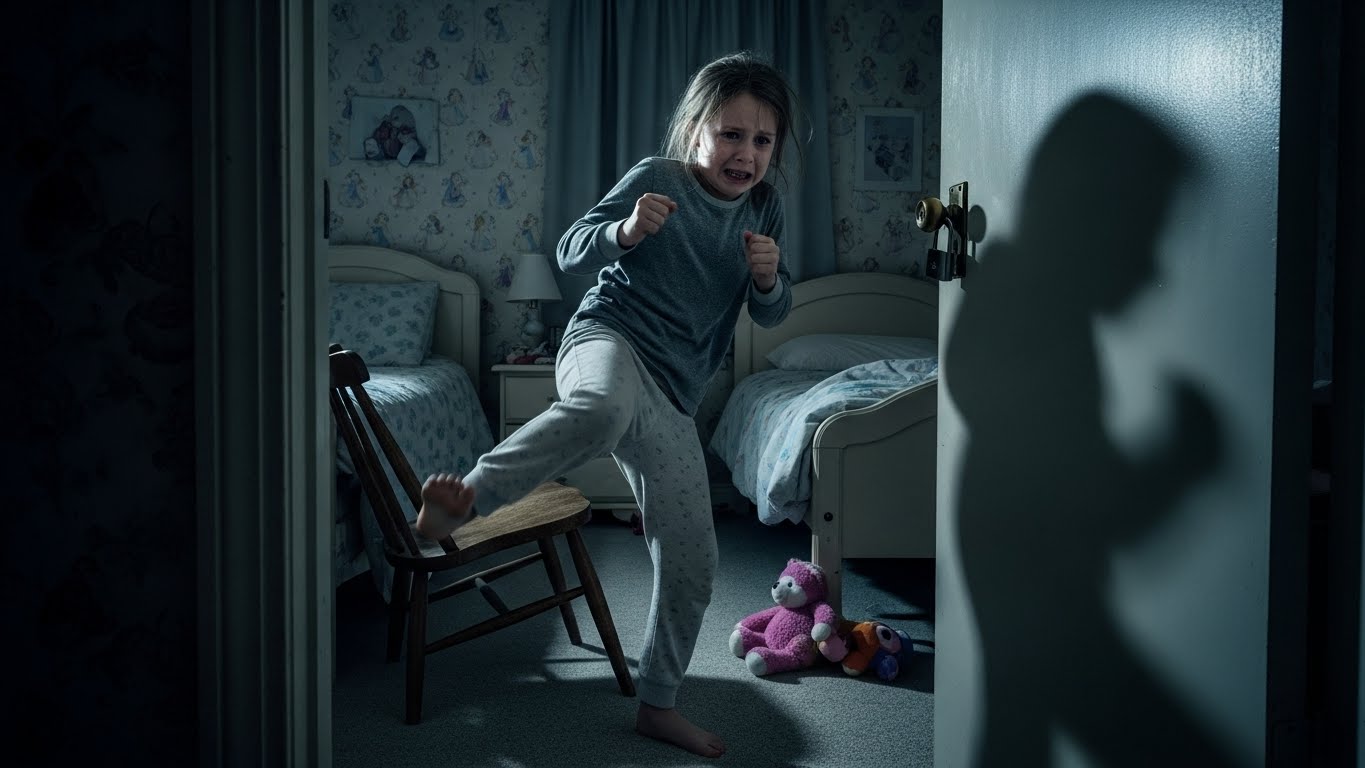
She didn’t argue. She simply steered me, with frightening strength, into my small bedroom—the one with the faded, peeling princess wallpaper and the single twin bed. “You need to be a brave girl, Eleanor,” she said, pushing me gently but firmly inside. It was a cold, non-negotiable command, not a loving request. “Stay here. Don’t open the door for anyone. Not even me, until I knock twice, okay? Twice, like our special secret code. I’ll be back before you can count to a thousand.”
The moment the tumbler on the lock clicked from the outside, the world outside dissolved into a terrifying void. The tiny room, which had always been my fortress against the world, instantly became a cell. I heard the frantic rattle of her keys, the sound of her worn-out minivan sputtering aggressively to life, and then, the silence. A silence so profound and absolute it was physically deafening. The kind of silence that confirms you are utterly and completely alone, abandoned.
I ran to the door, pounding with my small fists until my knuckles hurt. “Mommy! Open the door! Please!” My voice was thin, desperate, swallowed instantly by the thick night air and the plaster walls. There was no answer, only the cold, smooth wood of the door pushing back against my skin, mocking my helplessness.
She hadn’t just left me; she had imprisoned me. In the inky darkness, the only sound was my own ragged, hysterical breathing and the painful, echoing realization: she chose the pills over me. I didn’t cry. Crying was a weakness, reserved for the children whose mothers actually cared. I just stood there, my back pressed against the wall, the weight of the empty kitchen chair and the trauma of the final lock click etching themselves onto my soul. The long, silent hours stretched ahead, filled only with the cold, bitter truth of my mother’s ultimate betrayal.
CHAPTER 3: The Ghost in the Clock
The betrayal wasn’t the locking; it was the lie that came before it. Sarah’s promise. And now, the room was a pitch-black box, the clock ticking the loudest sound in the universe. I didn’t dare turn on the lamp. I was paralyzed by her final, fearful command: Don’t open the door for anyone. Not even me.
My mind, seeking a defense against the paralyzing fear, did what any traumatized child’s mind does: it fixated. Not on Sarah, but on a memory. The first thing I saw when I closed my eyes was the face of Mr. Harrison, Sarah’s current patient. A kind, elderly widower with advanced Parkinson’s, living in a quiet, sprawling mansion ten miles away. He had been a former history professor at Princeton, a man whose life was now confined to a lavish orthopedic bed and the company of a rotating staff of caretakers—Sarah being the one he relied on most.
I knew Mr. Harrison better than any child should know a stranger. Sarah often brought me with her to the big house on her longer shifts before I started school, rationalizing it as “better than leaving you alone.” I would sit in the library, surrounded by leather-bound books and the scent of old paper, drawing pictures while she worked. Mr. Harrison, despite his trembling hands, would tell me stories of ancient wars and forgotten kings. He was the only adult who ever truly looked at me, not through me. He had a deep, resonant laugh, and when he spoke, he never lied. His vulnerability, his complete dependence on Sarah, was the first thing that made me realize how utterly fragile life was.
The irony was a razor blade: Sarah was sworn to protect him, a man of immense wealth and zero self-sufficiency, while she couldn’t even protect her own ten-year-old daughter from the boogeyman of her own addiction.
I started to pace the room. One step. Two steps. The old wooden floorboards of the Maplewood complex creaked like protesting bones. My heart hammered against my ribs, convinced that every creak was the click of the lock, or maybe worse, the footstep of a stranger. My weak point, my greatest fear, was the dark and the unknown figures that inhabited it.
Then, my eye caught the one thing in the room that offered a sliver of hope: a faded photograph tucked into the corner of the small desk. It wasn’t a picture of Sarah. It was a picture of my father, David. A man I knew only through this single, slightly blurry photo. He had been a firefighter, dead in a tragic warehouse blaze when I was only three. Sarah had never remarried, never even dated, consumed by the memory and the subsequent, crushing debt from his sudden loss. His death was Sarah’s original wound, the gaping hole that the pills were now trying to fill.
David’s face, strong and smiling in the picture, held the simple, honest promise Sarah couldn’t keep. He was my anchor. I picked up the frame, the glass cool against my trembling fingers. What would you do, Daddy?
The silence broke at 10:15 PM, not with a knock, but with a muffled, angry shouting from the apartment below us. Mr. Sanchez and his wife, arguing again about money. The sound was a harsh reminder of the surrounding poverty and desperation. This wasn’t the clean, safe world of Mr. Harrison’s mansion; this was survival. And I realized something sharp and cold: If Sarah didn’t come back soon, and she hadn’t given me the secret code knock, I had no way to get out. No one knew I was locked in. The moral dilemma was immediate and brutal: Should I break the one command she gave me, the final thread of obedience, and risk opening the door for a stranger, or should I remain trapped in the darkness, upholding a promise made by a liar?
I leaned against the locked door, the wood cool and unyielding. The silence and the weight of the betrayal were closing in. I could still hear the faint, ghostly echo of the ‘CLICK’—the sound of my mother choosing a chemical oblivion over the beating heart of her child. The fear was turning into something harder, something cold and resolute. It was anger. And that anger gave me a plan. A desperate, dangerous plan to break her rule and find my own way out.
CHAPTER 4: The Calculus of Survival
The temperature in the room was dropping, mirroring the cold dread spreading through my chest. It was past midnight. No headlights. No familiar, sputtering minivan engine. Only the clock on the wall, its luminous hands a cruel beacon of the time Sarah had stolen from me. The silence was now total, Mr. Sanchez having finished his shouting match and the entire Maplewood complex submitting to the deep sleep of the exhausted and the poor.
My anger had solidified into a single, sharp calculus: survival.
I knew the rules of the house—rules Sarah had instilled with almost military precision, fueled by her paranoia about me being alone while she worked the night shifts. Rule Number One: Never open the door unless it’s the double-knock. Rule Number Two: If I ever got scared, I was to call the only number she allowed me to dial: the landline at Mr. Harrison’s mansion.
I scrambled to the small, dusty desk and pulled out the old corded phone. My fingers, still slick with fear, fumbled over the heavy dial pad. The number was imprinted on my memory, a safety beacon I’d never needed to use until this ultimate betrayal.
Ring. Ring. Ring.
After the fifth ring, a voice, deep and gravelly, answered. It wasn’t Sarah. It was Marcus Jenkins, the young, overworked night aide Mr. Harrison employed for the graveyard shift.
“Harrison Residence,” Marcus grunted, his voice thick with sleep deprivation and boredom. He sounded like he was running on fumes and energy drinks.
“Marcus? It’s Ellie,” I whispered, keeping my voice low, terrified of breaking the rule even as I was breaking it. “Sarah… my mom. Is she there?”
Marcus let out a weary sigh. “Ellie, you know your mom doesn’t have the night shift anymore. She left hours ago. Look, I’m busy running meds, kid. You okay?”
The floor dropped out beneath me. She hadn’t gone to the pharmacy. She hadn’t gone to Mr. Harrison’s. She had lied about the only stable anchor I thought she had—her job. The pit in my stomach deepened. This wasn’t just a lapse; it was a total, reckless abandonment driven by the desperate need for her fix.
“I… I can’t open my door, Marcus,” I choked out, the words tearing from my throat. “She locked me in. She didn’t give me the code.”
Marcus was silent for a terrifying beat. Then, his voice snapped into focus, edged with professional alarm. “Wait, what? Locked you in? Ellie, listen to me. Where are the spare keys? Is there a window?”
“No spare keys. The window is stuck. I’m in the dark. Please… I’m scared.” The fear was no longer paralyzing; it was energizing me, fueling a desperate plea.
Marcus’s voice dropped to a conspiratorial whisper. “Okay. Okay, kid. I can’t leave Mr. Harrison—it’s a felony. But I know a guy. He owes me a favor. Just stay quiet. Don’t talk to anyone, you hear me? I’m calling a friend. A real one.”
The moment Marcus hung up, I knew I had crossed a threshold. I had not only broken Sarah’s trust by calling, but I had inserted a stranger—Marcus’s unknown ‘friend’—into my private hell. I was completely dependent on the goodwill of someone who didn’t even know my name. But what choice did I have? The silence of the locked room was more dangerous than any stranger.
CHAPTER 5: The Detective’s Ghost
At 1:45 AM, the silence was broken not by a knock, but by a heavy, authoritative thud against the front door of the apartment, followed by a demanding, male voice.
“Police! Open up! We have a report of a disturbance.”
My heart seized. Police? Marcus must have called 911. My mind, still trapped by Sarah’s paranoia, screamed No! Police meant CPS. Police meant they would take me away. Police meant they would expose Sarah’s shame, her failure, to the entire town.
I pressed my ear against my bedroom door. I heard the muffled shuffling of someone outside, then a smaller, squeaky voice. It was Mrs. Jenkins, the elderly, retired kindergarten teacher from Unit 1A, the neighborhood’s self-appointed sentinel.
“Oh, Officer, thank goodness you’re here! That Sarah Vance has been running around like a ghost tonight. I saw her minivan peel out of the parking lot hours ago, looking like the devil himself was chasing her. Poor child, Ellie, she’s always so quiet. I just knew something wasn’t right.”
A new voice cut through: the voice of authority, calm but edged with professional weariness. “Thank you, ma’am. Detective Hayes, Northfield PD. Do you have a key to the apartment?”
Detective Thomas Hayes (40s, a man whose tailored suit couldn’t hide the perpetual slouch of exhaustion) was the man Marcus had called. Hayes was an unofficial expert in the local opioid crisis, driven by a deep, personal wound: his own teenage daughter, Jenna, was in rehab, a casualty of the very same pills that held Sarah captive. Hayes had seen this script play out a hundred times—the lying, the abandoning, the slow, agonizing erosion of a family. His motivation was simple: find the kid before the addiction spiral claimed another innocent. His greatest weakness was his inability to separate his professional duty from his own fatherly guilt.
“We don’t need a key, Ma’am,” Hayes said to Mrs. Jenkins, who was clearly enjoying the drama. “We just need to check the welfare of the child. Ma’am, you can step back now.”
I heard the loud, insistent hammering on our main door again. “Ellie! This is Detective Hayes. Your friend Marcus called us. I need you to go to your bedroom door, the one that’s locked, and talk to me right now. Can you hear me?”
I pressed my face against the wood, tears finally stinging my eyes. The voice wasn’t the monster I expected. It was tired, steady, and strangely kind. I didn’t answer the main door, but I whispered, my voice barely a squeak, to my locked bedroom door.
“I’m in here. I can’t open it.”
“Okay, Ellie. I hear you. You’re safe,” Hayes said, his voice instantly softening. “Is there a window in your room that you can open? We need to see you.”
“It’s stuck. And Mom said I can’t open the door for anyone unless it’s the double-knock.”
Hayes sighed, the sound loud even through the heavy front door. He understood the desperate game Sarah had forced upon her child—the illusion of protection built on a foundation of betrayal. “Ellie, I am a police detective. Your mother is gone. I promise you, I’m here to help you. But I need to know why your mother locked you in. Did she hurt you?” The question was direct, demanding an ethical choice. Protect the liar, or save myself?
CHAPTER 6: The Unspoken Truth in the Dark
The air was tense, split between the heavy silence of the locked room and the loud, intrusive presence of the police and the nosy Mrs. Jenkins outside.
“She didn’t hurt me,” I whispered, the first defense of my mother flying out instinctively. “She just… she had to go get medicine.” I was parroting Sarah’s lie, even now, still protecting her.
Hayes didn’t argue. He knew the medicine wasn’t for a migraine. “Ellie, listen to me. I need you to be the adult right now. Where is your mother’s secret hiding spot? The key? The box she keeps things in?”
I froze. He knew about the box. The silver tin box she kept tucked deep inside a pair of old, ratty boots in her closet. It held two things: my father’s old, tarnished firefighter badge, and the small, carefully counted stash of her Oxycodone—the ‘nerve pills’ she’d stolen from Mr. Harrison’s meticulously managed supply. That box was the embodiment of her shame and her dependency.
If I told him about the box, I wasn’t just giving away a key; I was exposing her deepest, darkest secret, the reason she abandoned me. It would guarantee her arrest and ensure I was taken away forever.
Hayes must have sensed my hesitation. He dropped the official tone and spoke softly, father-to-daughter. “Ellie, I had a daughter just like you. She was lost, too. Lost to the pills. Your mom is sick, honey. She’s not bad, she’s sick. But she made a choice tonight, and that choice put you in danger. We have to find her before she hurts herself, and before someone else finds her. Do you understand?”
His personal confession—the fact that his own daughter was lost—cracked my hardened shell. He wasn’t just a cop; he was a grieving father, standing on the other side of my own potential future.
“The… the tin box,” I finally whispered, my voice trembling violently. “In her closet. In the brown combat boots. There’s a key taped to the bottom of the box. It opens the spare door in the back.”
The revelation was instantaneous and devastating. I had betrayed my mother, but in doing so, I had chosen survival and the faint hope of finding her before the addiction claimed her entirely.
Hayes immediately radioed his team. I heard the muffled sounds of forced entry at the back of the apartment, followed by a loud, splintering CRACK.
The door to my bedroom finally flew open, not by the lock, but from the gust of wind from the main door swinging wide. The hallway light spilled in, blinding me.
Standing silhouetted in the doorway wasn’t Sarah, but Detective Hayes. His face was grim, his eyes tired and sad. He knelt down to my level, his hand resting gently on my shoulder.
“The key worked, Ellie. But your mother isn’t here. The box is empty. Every single pill is gone.”
The air left my lungs. The weight of the empty chair, the click of the lock, the betrayal—they all culminated in this one horrifying twist. Sarah wasn’t coming back for the night; she was gone, having taken enough to potentially never return at all. And I, her ten-year-old daughter, was now the only witness and the unwitting key to her disappearance. The search for Sarah Vance had just begun.
CHAPTER 7: The Thirty-Minute Head Start
Detective Hayes’s words—”Every single pill is gone”—hit me with the force of a physical blow. It wasn’t just abandonment; it was the chilling, stark possibility of suicide. The frantic urgency in Hayes’s eyes mirrored the cold panic that finally shattered my stoic shell. I burst into tears, the accumulated terror and exhaustion of the night finally overwhelming me.
Hayes scooped me up, holding me with a strong, protective grip that felt strangely unfamiliar yet completely necessary. “It’s okay, Ellie. We’re going to find her. Tell me everything you know. Everything.”
We were quickly moved to the front seat of Hayes’s unmarked cruiser, the silent sentinel of our neighborhood. Mrs. Jenkins was held back by a uniformed officer, her face a mask of disappointment at being excluded from the investigation. The cruiser was warm and smelled faintly of leather and stale coffee.
Hayes, surprisingly gentle, pressed me for details. “Ellie, where would your mom go if she was really scared? Did she ever mention anyone she was meeting? Anyone who supplied her?”
My mind raced through the fractured memories. “She… she used to drive down by the river. Near the old loading docks, by the abandoned paper mill. She said it was ‘quiet’ there.” The memory was vague, tied to a single, unsettling drive weeks ago, but it was the only lead I had.
Hayes’s partner, Officer Miller, was already on the radio, patching in the coordinates of the paper mill. Hayes, however, was focused on one crucial detail, his eyes intensely searching mine.
“Ellie. That tin box you told me about. Did your mother ever say where she got the pills? Be honest. This is the difference.”
I hesitated. This was the true twist, the ultimate secret that protected Sarah’s reputation as a good nurse. “They weren’t hers,” I whispered, the words barely audible. “They were for Mr. Harrison. He has a lockbox for his medication. She… she used to open it with the key. She said he didn’t need them all.”
Hayes closed his eyes briefly, a sigh of profound disappointment escaping him. The bitter irony: Sarah hadn’t bought street drugs; she had systematically stolen from the very patient whose trust and well-being she was paid to protect. This wasn’t just addiction; it was grand larceny and patient endangerment. The revelation was the high point of the mending of my own wound: I finally understood the full, desperate depth of her moral decay.
Hayes radioed Miller, the tone now urgent and grim. “Miller, change of trajectory. Sarah Vance may be involved in the theft of Schedule II narcotics from the Harrison Residence. We’re moving on a thirty-minute head start. Get the choppers up. Paper mill, look for a beat-up blue minivan. And call Mr. Harrison’s team, check his status immediately.”
The cruiser screamed to life, the sirens wailing—a terrifying sound that meant the pretense of our quiet life was officially over. As we sped towards the docks, a frantic call came over the radio.
“Detective Hayes! Harrison Residence confirming unauthorized access to the controlled substance locker. Mr. Harrison’s night aide, Marcus Jenkins, reported that the patient is in severe distress. We have a medical emergency.”
The betrayal had a victim—a kind, old man who had looked at me with genuine care. The consequence of Sarah’s choices wasn’t just my fear; it was potentially the death of her patient.
“Turn around, Miller,” Hayes barked, his face white with fury and professional panic. “The mill can wait. We’re heading to Willow Street. We have a victim who needs saving.”
My small, tear-streaked face was reflected in the glass of the window, watching the familiar streets blur into panicked lines. The moment of highest tension was upon us: my mother’s life hung in the balance, but the consequences of her actions were already claiming an innocent life. I had to choose: help the police find the mother who broke me, or the patient she almost killed.
CHAPTER 8: The Aftermath and the New Promise
The Harrison mansion was a chaotic scene when we arrived. Paramedics were rushing a stretcher out. Mr. Harrison, frail and ghostly pale, was being stabilized. Marcus, the night aide who had called the police, stood on the pristine lawn, his eyes wide with shock.
Hayes jumped out, leaving me safely secured in the back seat. I watched through the window as he spoke furiously to Marcus, his face etched with the exhaustion of dealing with endless, preventable tragedies.
Suddenly, a patrol car pulled up. Not from the search team, but from a side street. An officer rushed to Hayes.
“Detective! We found her. Near the river, five miles out. She drove the minivan straight into the culvert. She’s alive, but unresponsive. Massive overdose. They’re airlifting her to St. Jude’s.”
Sarah was found. But not saved by me or the police; saved by the randomness of hitting a culvert, which forced an immediate medical response. The immediate pressure valve released, but the true emotional consequence remained.
Hayes returned to the cruiser, his demeanor deflated. He looked at me, his eyes softening from the professional detective back to the grieving father.
“Ellie, your mother is alive. But she’s very, very sick. She needs help, the kind I can’t give her.” He paused, taking a deep breath. “Because of the theft, she’s going to face some serious charges when she recovers. This is going to be a long road.”
The ultimate sacrifice had been made. Sarah’s secret was exposed, her crime confirmed. My father’s picture, the symbol of honest service, contrasted brutally with Sarah’s betrayal.
I didn’t cry. I had no tears left. “I told you where the key was,” I said quietly, the weight of the night settling on my shoulders. “Did I do the right thing?”
Hayes leaned in, his voice firm and sincere. “You did the only thing, Ellie. You chose truth over a dangerous lie. You saved two lives tonight: Mr. Harrison, and maybe, eventually, your mother. That’s a hero’s choice.”
He didn’t make a promise about her recovery, or about our future. He made a promise about me.
“You’re coming with me, Ellie,” he said, turning off the flashing lights. “We’re going to get you a warm meal and a clean bed. And tomorrow, we’re going to figure out a new home for you. A safe home. I’ll make sure of it.”
I looked out at the Harrison mansion, at the expensive, manicured lawn where my mother had spent years pretending to be a savior while she was secretly a thief, all to feed the darkness inside her. I thought of the locked room, the fear, and the final click. That lock was the end of my childhood and the beginning of my painful awareness.
As the sun began to slowly tint the horizon—the first light I had seen since the betrayal—I nodded. I had lost my mother to her addiction and the legal system, but I had found my own voice and the courage to break a dangerous silence.
The car started moving, away from the wealthy estates and the cheap apartment. The past was behind the lock, but the future was finally open.
The last thing I did before we left the neighborhood was look down at my hands, which still felt the phantom ache of pounding on a locked door. I whispered the truth that the night had taught me, a truth that no ten-year-old should ever have to learn: “The only promise I will ever hold now is the one I make to myself.”