A Stranger Handed Me a Baby in a Storm and Whispered ‘Hide Him.’ When Soldiers Kicked Down My Door the Next Morning, I Realized That Bundle of Blankets Was Worth More Than My Life.
Part 1: The Prince in the Basket
Chapter 1: The Burden of Kings
The silence of the Weald was usually a comfort, but tonight, it felt like a predator holding its breath.
My name is Amalia. I am a woman of no consequence, living in a time when life is cheap and winter is cruel. My hut sits on the jagged edge of the forest, a place where the King’s law fades into the shadows of the old trees. I am a widow. My husband died of a fever two winters ago, leaving me with a leaking roof, a patch of stubborn turnips, and two children, Thomas and Helen, who are the only reason I still draw breath.
Night was descending over the fields of Wessex with a heavy, smothering stillness. Inside, I finished banking the last glowing embers of the fire. Every stick of wood was precious; I had to make sure they survived until dawn. In the corner, under a worn, scratchy blanket, my children slept. They were curled together like little animals, seeking warmth in the damp chill.
Outside, the wind picked up, carrying the scent of approaching rain. I wiped my hands on my apron and prepared to blow out the tallow candle.
Then it came.
Thud.
A single knock against the door. Sharp. Sudden. Wrong.
I froze. My hand hovered over the flame.
No one came to a hut like mine at this hour. Not unless it was trouble. Tax collectors came at noon. Neighbors came at supper. Monsters came at midnight.
I reached for the iron fire poker, my knuckles white as I gripped the cold metal. I approached the door slowly, my heart hammering a frantic rhythm against my ribs.
Thud. Thud.
Softer this time. Almost pleading.
“Who is it?” I whispered. My voice sounded thin, terrified.
There was no answer. Only the wind whistling through the gaps in the wattle-and-daub walls. But something—some ancient instinct buried deep in my blood—told me to open it.
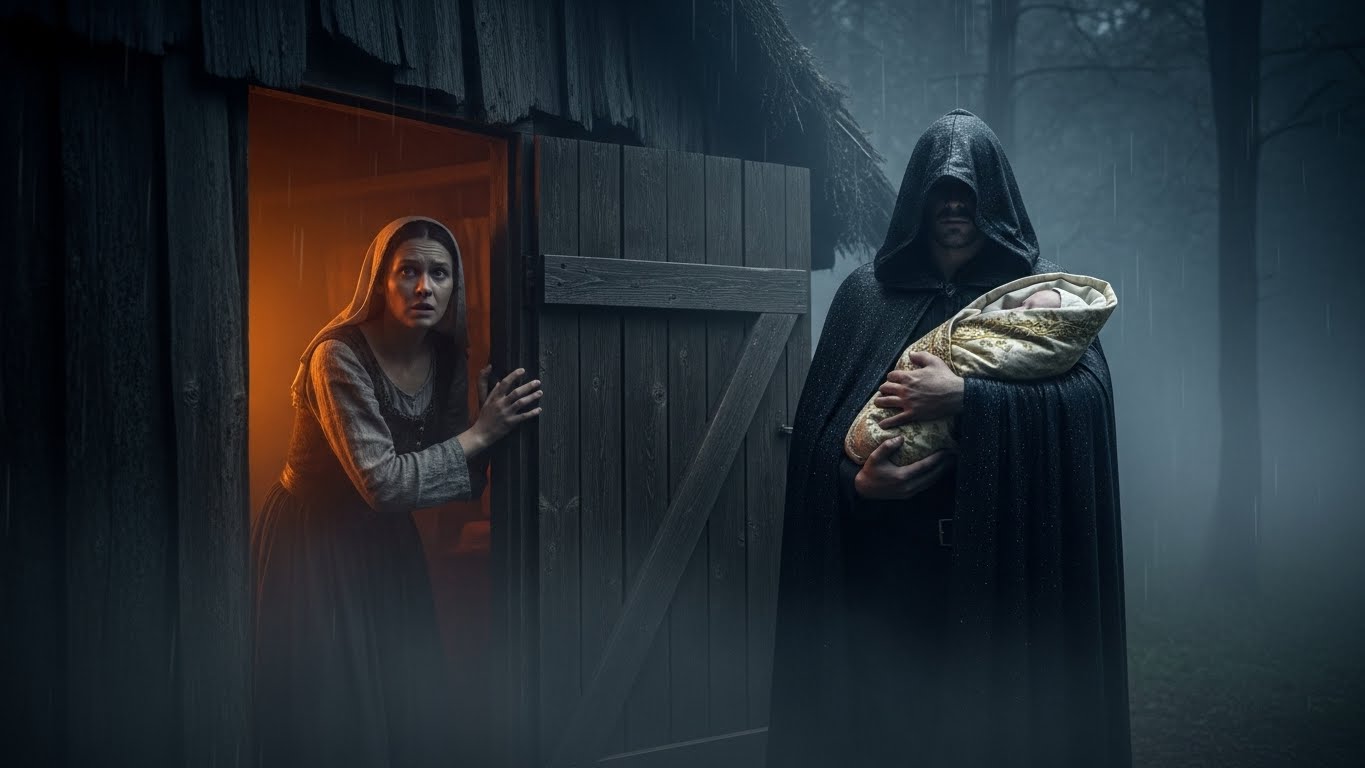
I lifted the heavy wooden bar and cracked the door open.
A wave of fog slipped inside, curling around my ankles like a cold breath. Standing in the middle of the mist was a shadow.
A man. Cloaked in black, bent forward, cradling something against his chest. As the candlelight hit him, I saw his face. His beard was wet with rain, his skin pale as milk, and his eyes were wide with a terror that made my own stomach turn.
“For the love of God,” he rasped, his voice sounding like it was scraped over gravel. “Hide him.”
I stepped back, raising the poker. “Who? Who are you?”
He didn’t answer. He shoved his way inside, kicking the door shut behind him with a wet thud. He wasn’t attacking me; he was collapsing.
He shifted the bundle in his arms. He pulled back a fold of the heavy wool cloak.
I gasped.
It was a baby.
But this was no village child. The swaddling cloth was white silk, embroidered with golden thread that shimmered even in the dim light. It was clean. It smelled of lavender and rosewater, scents that had no business in a hut that smelled of smoke and earth.
“There’s no time,” the stranger said, his urgency cutting through my shock. “Hide him well. That child is the future King.”
The world seemed to stop spinning. The fog outside, the sleeping children, the cold—it all faded.
“What are you saying?” I stammered. “I can’t… I’m nobody.”
“You are the only one left,” he interrupted. “They’ve burned the village to the south. They are searching every house. If anyone asks, you saw no one. You heard nothing. Do you understand?”
He laid the child on my rough table. The contrast was heartbreaking—the golden prince on the scarred, stained wood.
“Who is looking for him?” I asked, my voice trembling.
“The Duke,” he spat the word like a curse. “And anyone else who would kill a babe to steal a crown.”
The baby let out a soft whimper. I moved without thinking, scooping him up. He was warm, solid. His heart beat against my chest, fast and frightened.
“What is his name?”
The man hesitated, his hand on the door latch. “Edward. But speak it to no one. Not even to the wind.”
“And you?” I asked. “Who are you?”
He looked at me, and for a second, the terror in his eyes was replaced by a deep, crushing sorrow. “A man who failed once. I cannot fail again.”
He opened the door. “If I am caught, I will lead them away from here. If I die… he is yours.”
Then the fog swallowed him whole.
I was alone.
I stood there for a long time, rocking the future King of England in my arms, listening to the rain begin to fall. I looked at my own sleeping children. I had just invited death into our home.
I didn’t sleep. I couldn’t.
I stripped the baby of his fine golden clothes. I couldn’t burn them—the fire was too low—so I buried them deep in the dirt floor under my own bed, packing the earth down hard. I wrapped Edward in old rags, rubbing a little soot on his face to hide that milky, noble complexion.
I placed him in a laundry basket, covering him with a layer of kindling and dirty linens.
“Hush,” I whispered, rocking the basket. “You are not a king tonight. You are a secret.”
Dawn crept through the cracks in the roof, gray and sickly. I forced myself to move. I boiled water. I woke Thomas and Helen.
“Eat,” I told them, my voice sharp. “And listen to me. No matter what happens today, no matter who comes to the door, you say nothing. Do you hear me?”
Thomas, eight years old and sharp for his age, looked at the basket in the corner. He nodded, his eyes wide.
Then, the ground began to shake.
Not an earthquake. Horses.
I rushed to the narrow window. Through the morning mist, I saw them. Four soldiers riding down the muddy lane. Their armor gleamed like cold mirrors. Behind them rode a man in a crimson cloak, his face hidden by a helm.
They stopped at the neighbor’s hut. I heard a shout. The crash of a door being kicked in. A scream.
They were here.
“Back to the table,” I ordered the children. “Now.”
I stood in the center of the room, wiping my hands on my apron, trying to stop them from shaking.
Thud. Thud. Thud.
Three heavy knocks that shook the dust from the ceiling.
“BY ORDER OF THE CROWN,” a deep voice roared. “OPEN UP.”
I took a breath that felt like inhaling broken glass. I walked to the door.
The game had begun.
Chapter 2: The Red Cloak
I opened the door, and the smell hit me first—metal, wet leather, and horse.
The man standing there was huge. He wore a padded leather jack under a steel breastplate, and a red cloak that hung heavy with rain. His helmet was off, tucked under his arm, revealing a face that looked like it had been carved from granite. A jagged scar ran from his ear to his chin.
His eyes were cold. They were eyes that had seen death and decided it was boring.
“We seek a traveler,” he said. No greeting. No pleasantries. “A knight in dark clothing. Traitor to the crown. Carrying a bundle. Has anyone passed this way?”
I forced myself to meet his gaze. If I looked away, I was guilty. If I looked too long, I was defiant.
“No, sir,” I said, keeping my voice steady by sheer force of will. “No one comes here. We are the last house. The road ends here.”
He surveyed me, his gaze traveling down my patched dress to my muddy boots. “You’re up early.”
“The children need feeding,” I said. “And the fire won’t tend itself.”
He pushed past me without a word.
My heart slammed against my ribs. “Sir, you cannot—”
“I can do whatever I please,” he said, stepping into the small room.
The hut felt instantly crowded. Two other soldiers squeezed in behind him. They were big, loud, and careless. One of them knocked over a stool.
“Search it,” the Red Cloak commanded.
The soldiers began tearing my home apart. They threw the pots off the shelf. They stabbed their swords into my straw mattress.
One soldier marched over to the table where Thomas and Helen sat, frozen over their bowls of watery porridge.
He grabbed the blanket off the cot behind them. “Any rats hiding in here?” he laughed.
Thomas whimpered, reaching for his sister.
“Only my children, sir,” I said, my voice rising. “Thomas and little Helen. Please, they are frightened.”
The Red Cloak ignored me. He picked up a crust of bread from the table, examined it with disgust, and dropped it on the floor.
“Peasant rations,” he muttered. “No knight would seek shelter in a hovel like this. There’s nothing of value here.”
He turned to leave.
Relief, hot and dizzying, washed over me. They’re leaving. We made it.
Then, from the corner of the room, near the oven… a sound.
Mew.
It was tiny. A muffled, soft cry. Like a kitten. Or a baby waking up.
Amalia’s blood ran cold. The silence in the room was sudden and absolute.
The Red Cloak stopped. He slowly turned his head back toward the corner. toward the laundry basket piled high with firewood.
“What was that?” he asked softly.
My mind raced. I couldn’t say it was a cat; we didn’t have one.
“My… my nephew,” I blurted out. The lie tasted like ash. “My sister’s child. I’m watching him while she’s ill with the pox.”
The soldiers took a step back at the word pox. Fear of disease was the one thing stronger than their orders.
But the Red Cloak didn’t flinch. He narrowed his eyes. “The pox, you say?”
“Yes, sir,” I lied, stepping between him and the basket. “He is feverish. If you wake him, he will scream all day, and the sickness… it spreads easily.”
He stared at me. He was weighing my soul. He looked at my trembling hands, my pale face. He looked at the basket.
He took a step toward me. His hand rested on the pommel of his sword.
“I have had the pox,” he said quietly. “Show me the child.”
I couldn’t move. If I showed him Edward, even with the soot on his face, he would see. He would see the bone structure, the eyes. Or he would simply kill the child because he was ordered to kill all male infants.
“Sir, please,” I begged, dropping to my knees. “He is sleeping. He has been crying for hours. Have mercy on a mother.”
It was the only weapon I had left. Submission.
He looked down at me with contempt. He looked at the basket again. The baby was silent now.
For a long, agonizing second, the only sound was the rain drumming on the thatch.
“Waste of time,” he finally grunted. “Let’s go. The trail leads to the river.”
He turned on his heel. “If you see a man in a dark cloak, report it. The Duke rewards loyalty. He punishes silence with fire.”
I nodded, my forehead touching the dirt floor. “Yes, sir. Thank you, sir.”
They marched out. I heard them mount their horses. I heard them ride away, the mud squelching under their hooves.
I didn’t move until the sound was gone completely.
Then I scrambled to the basket. I tore away the firewood and the rags.
Edward was wide awake. His eyes—a startling, piercing blue like the winter sky—stared up at me. He wasn’t crying anymore. He looked calm. Too calm for a baby.
I pulled him against my chest, burying my face in his neck. I was shaking so hard my teeth chattered.
“You’re safe,” I whispered, sobbing dry, terrified tears. “You’re safe.”
But as I looked out the open door at the gray, weeping sky, I knew it was a lie.
We weren’t safe. The Duke was hunting. The village was burning. And I was alone with a secret that could destroy a kingdom.
The rumors started that afternoon. I went to the village well, Edward strapped to my chest in a sling, hidden under my shawl.
“The King is dead,” old Miller John whispered, his eyes darting around. “Poisoned, they say.”
“And the Prince?” asked Margaret, the baker.
“Vanished,” John said. “Stolen in the night. The Duke of Northwell claims the throne. He says the Prince is dead. But his soldiers… they are tearing the countryside apart looking for a corpse.”
“Or a living child,” Margaret whispered.
I filled my bucket, keeping my head down. My heart felt like it was bruising my ribs.
I walked home fast, my head down. Every shadow looked like a soldier. Every snapping twig sounded like a sword being drawn.
That night, the real terror set in.
I was secure in the hut, the door barred. Edward was asleep. But then came the sound that changed everything.
Not a knock.
A scrape.
Something heavy being dragged against the wall of the hut.
Then, a voice. Low. Pained. Familiar.
“Open… please.”
I rushed to the door. It was the stranger. The man who had brought the baby.
He collapsed across the threshold as I opened it. His black cloak was shredded. Blood, dark and slick, covered his side.
He looked up at me, his face gray as ash.
“They are coming back,” he wheezed. “They found my tracks. We have to leave.”
He tried to stand and failed.
“We?” I whispered.
“You,” he said, gripping my wrist with a bloody hand. “You, the boy, and me. If we stay here, we all die by sunrise.”
I looked at my sleeping children. I looked at the fragile walls of my home. I looked at the future King.
I realized then that my life—my small, quiet, peasant life—was over.
“Get up,” I told the knight. “Get up.”
I wasn’t a hero. I was a mother. And tonight, I had three children to save.
Part 2: The Fugitives
Chapter 3: The Death of a Life
“Get up,” I had told him. “Get up.”
The words felt foreign in my mouth. They were the words of a soldier, not a widow who spent her days mending socks and tending turnips. But the man bleeding on my floor—Rowan, he called himself—was our only chance, and we were his.
The hut, which had been my sanctuary, suddenly felt like a cage. The mud walls that kept out the wind would not stop a sword. The roof that sheltered my children would burn just as easily as the kindling in the corner.
“We have ten minutes,” Rowan grit out, using the table to pull himself upright. His face was a mask of pain, sweat beading on his forehead despite the chill. “Pack only what you can carry. Food first. Warmth second. Memories last.”
I moved like a whirlwind. I grabbed a burlap sack and shoved in the last loaf of bread, a wedge of hard cheese, and the dried apples I had been saving for winter. I filled a waterskin. I took the heavy wool blankets from the children’s bed.
“Thomas,” I said, my voice sharp and low. “Wake up. Put on your boots. Now.”
Thomas sat up, rubbing sleep from his eyes. “Mama? Is it morning?”
“No,” I said. “We are going on a trip. Put your coat on your sister. Don’t ask questions.”
He saw the man. He saw the blood pooling on the dirt floor. His eyes went wide, but he didn’t scream. He was a child of the Weald; he knew that silence was survival. He scrambled out of bed and began dressing Helen, who was limp with sleep.
I turned back to Rowan. He was binding his side with a strip of cloth he’d torn from his ruined cloak. The blood was dark, almost black in the candlelight.
“Can you walk?” I asked.
“I have to,” he muttered. He looked at the basket where Edward lay. “Give him to me.”
“No,” I said, snatching the baby up and tying him securely against my chest with my shawl. “You can barely stand. If you fall, you drop the King. I will carry him.”
Rowan looked at me, a flicker of surprise in his pained eyes. Then he nodded. “You have fire in you, Amalia. Good. You’ll need it.”
We blew out the candle. The darkness was absolute.
Opening the door felt like stepping off a cliff. The rain had turned to a freezing drizzle. The fog was thicker now, a white soup that hid everything more than three feet away.
“Which way?” I whispered.
“The woods,” Rowan said. “The soldiers stick to the roads. Their horses hate the dense trees. We go where they cannot follow.”
We walked.
Leaving the hut was physically painful. I didn’t look back. I couldn’t. If I looked back at the garden I had planted, the chimney I had repaired with my own hands, the only home my children had ever known, I would crumble.
We moved into the tree line just as the sound of hoofbeats returned to the road.
We froze.
Through the mist, I saw the dull orange glow of torches bobbing in the distance. They were heading toward my hut.
“Down,” Rowan hissed.
We crouched in the wet bracken, the mud seeping instantly into my skirts. Thomas held Helen’s hand so tight his knuckles were white.
We watched.
The torches stopped at my door. We heard shouting. Then, a crash.
I squeezed my eyes shut. I could hear the sounds of things breaking—my pottery, the chairs, the life I had built.
Then, a new light flickered. Brighter. Wilder.
“They’re burning it,” Thomas whispered, his voice trembling.
I opened my eyes. Flames were licking up the thatch roof. The fire spread with terrifying speed, consuming the dry straw. My home—my children’s safe harbor—was being erased.
“Why?” I choked out.
“Because they didn’t find us,” Rowan said, his voice cold and hard. “Scorched earth. They want to flush us out. If we have no shelter, we must move. If we move, they can hunt us.”
The flames roared, sending sparks spiraling up into the foggy night. It was a beacon. Everyone for miles would see it.
“We have to move,” Rowan urged, pulling on my arm. “The fire will draw the villagers. And more soldiers.”
We turned away from the burning ruin of my life and walked into the black throat of the forest.
The first hour was a nightmare of stumbling over roots and getting whipped by unseen branches. Helen cried quietly, confused and cold. Edward slept against my chest, miraculously silent, as if he knew his life depended on it.
Rowan led us with an uncanny sense of direction. He didn’t use a compass; he watched the moss, the wind, the slope of the land. But he was slowing down. I could hear his breathing—ragged, wet gasps.
“Stop,” I said, grabbing his shoulder after we had walked for what felt like miles. “You’re bleeding through the bandage.”
“Keep moving,” he growled.
“No,” I snapped. “If you die, we don’t know where we’re going. We rest for five minutes.”
We huddled under the roots of a massive oak tree that offered some shelter from the rain. I checked Thomas and Helen. They were shivering violently.
“Here,” I said, breaking off a piece of the bread. “Eat.”
Rowan leaned against the tree trunk, eyes closed, his face ghostly pale.
“Why you?” I asked him in the dark. “Why is a knight alone with a baby? Where is the King’s guard? Where is the army?”
He opened one eye. “Betrayal, Amalia. The worst kind. The Duke didn’t just attack; he bought the loyalty of the men who were supposed to protect the King. The poisoning was the signal. Within an hour, half the palace guard had turned their cloaks from gold to red.”
He looked at the baby sleeping against me.
“I was the only one who didn’t take the coin,” he said softly. “I took the child and ran. I’ve been running for three days.”
“You said you failed once,” I remembered.
A shadow passed over his face, darker than the night around us. “I failed his father. I didn’t see the poison. I didn’t see the knife in the hand of his brother.”
He pushed himself off the tree, his jaw set.
“I will not fail the son.”
He looked at me, and for the first time, I didn’t see a stranger. I saw a man crushed by guilt, driving himself toward death to make it right.
“Let’s go,” I said, standing up and hoisting Helen onto my hip, though my own legs were screaming. “The dawn is coming.”
And with the dawn, the hunt would truly begin.
Chapter 4: The Wolf and the Rabbit
The forest by day was no less terrifying than the forest by night. The fog lifted, leaving behind a world of gray trunks, brown mud, and dripping leaves. We were cold, we were wet, and we were leaving a trail a blind man could follow.
Helen was too tired to walk. I carried her on one hip, Edward strapped to my chest. Thomas carried the sack, stumbling every few hundred yards.
Rowan took up the rear. He had drawn his sword—a long, grim blade that looked too heavy for his injured arm. He walked backward half the time, sweeping his eyes over the path behind us, wiping away our footprints with a pine branch where he could.
“We need to cross the river,” he said around midday. “The dogs lose the scent in the water.”
“Dogs?” I asked, a fresh spike of panic hitting me.
“The Duke keeps hunting hounds,” Rowan said grimly. “If they bring them, we are finished.”
We reached the riverbank an hour later. The water was swollen from the rain, rushing fast and angry. It was gray and freezing.
“We can’t swim this,” I said, hugging the children closer.
“There’s a ford upstream,” Rowan said. “A mile. Maybe two.”
We trudged along the muddy bank. My boots were soaked through. My feet were numb blocks of ice. Hunger was a gnawing rat in my stomach, but we couldn’t stop.
Then, Rowan froze. He held up a hand, fist clenched.
Stop.
He dropped to a crouch, signaling us to do the same. I pulled Thomas and Helen down behind a fallen log.
The sound of snapping twigs. Voices.
Not behind us. Ahead of us.
Two men stepped out of the tree line about fifty yards upriver. They weren’t wearing the red cloaks of the soldiers. They wore leather vests and fur hats. They carried crossbows.
“Bounty hunters,” Rowan whispered, his voice barely audible. “Locals looking for the reward.”
They were scanning the mud. One of them pointed at the ground. They had found the path to the ford. They were blocking our only way across.
Rowan looked at me. His face was gray, sweat dripping from his nose, but his eyes were clear.
“Stay here,” he whispered. “Cover the baby’s mouth. Do not move until I call for you.”
“Rowan, no,” I hissed. “You can’t fight them. You’re hurt.”
“I don’t have to fight them,” he said. “I just have to remove them.”
He slipped into the brush, moving with a silence that seemed impossible for a man in armor. He disappeared.
I pressed my hand gently over Edward’s mouth. I pulled Thomas and Helen down into the mud, whispering, “Statues. Be statues.”
I watched through the gaps in the rotting wood of the log. The two hunters were laughing, talking about the gold they would spend.
“Duke says a thousand crowns for the head,” one said, spitting tobacco into the river. “Don’t matter if it’s the knight or the brat.”
“I heard he wants the woman too,” the other said. “Anyone who helped them.”
My breath hitched. They knew about me.
Suddenly, the brush behind the second man rustled. He turned, raising his crossbow.
It was a distraction. Rowan lunged from the other side.
It wasn’t a duel. It was an execution. Rowan’s sword flashed once. The first man dropped without a sound.
The second man fired his crossbow in panic. The bolt flew wide, thumping into a tree. He fumbled for a knife, but Rowan was already on him. He slammed the hilt of his sword into the man’s temple. The hunter crumbled.
It was over in seconds.
I stared, horrified. I had never seen violence like that. It was fast, brutal, and efficient.
Rowan stood over the bodies, swaying. He dropped to one knee, using his sword to prop himself up.
I ran to him. “Rowan!”
He looked up. There was no triumph in his eyes. Only exhaustion.
“Don’t let the children see,” he rasped.
But Thomas had seen. He was staring at the bodies, his face pale.
“Are they dead?” Thomas asked, his voice small.
“Yes,” Rowan said, struggling to his feet. He didn’t lie to the boy. “They were going to kill us, Thomas. They were going to kill your mother and your sister.”
He looked at me. “Take their cloaks. Take their food. Leave the weapons; we can’t carry them.”
I stripped the fur cloaks from the dead men, my hands shaking uncontrollably. I tried not to look at their faces. These were men from the next valley. I might have bought grain from their cousins. Now they were corpses in the mud.
“We are not victims anymore, Amalia,” Rowan said, seeing my trembling hands. He placed a heavy hand on my shoulder. “We are wolves. If we are not wolves, the lambs die.”
He took the baby from me, cradling Edward awkwardly in his armored arm to give me a break.
“Cross the river,” he ordered. “Now.”
We waded into the freezing water. The current tugged at my skirts, trying to drag me down. Thomas slipped, splashing under, and I grabbed his collar, hauling him up, choking and sputtering.
We made it to the other side, shivering, soaked, and traumatized.
But we were alive.
As we climbed the opposite bank, I looked back. The two bodies lay still in the mud.
I realized then that the woman who had lived in the hut—the gentle, fearful widow—died back there, too. I wrapped the dead man’s fur cloak tighter around my daughter.
“Keep walking,” I told my children. “Don’t look back.”
Chapter 5: The Weight of the Crown
We walked for three days.
We avoided the roads. We slept in hollows beneath trees, huddled together like a pack of dogs for warmth. The bounty hunters’ dried meat kept us alive, but barely.
Edward was the miracle. He cried, yes, but mostly when we were moving. When we stopped, he would stare up at the canopy of leaves with those piercing blue eyes, calm and observant. It was unnerving.
“He knows,” Thomas whispered one night as we sat around a tiny, smokeless fire we’d risked making in a cave. “He looks like he knows he’s important.”
Rowan was cleaning his sword. The wound in his side was festering. I could smell it—a sickly sweet odor beneath the metallic tang of rain. He was burning with fever, his movements slower every hour.
“He is a King,” Rowan said, his voice raspy. “Kings are different.”
“He’s a baby,” I snapped, wringing out a wet cloth to put on Rowan’s forehead. “He needs milk, not a crown. He needs a dry bed.”
I was angry. Angry at the situation, angry at the danger, angry at this man for dragging us into his doom.
“Why?” I asked Rowan, pressing the cloth to his burning skin. He hissed in pain. “Why does the Duke want the throne so badly that he would kill a baby? He is rich. He has lands. Why isn’t it enough?”
Rowan laughed, a dry, bitter sound. “Power is not about having enough, Amalia. It is about having all. The Duke believes he is the savior of England. He thinks the old King was weak. He thinks a child King will mean chaos. He believes that by killing Edward, he is saving the country from ruin.”
“He is a monster,” I said.
“Most men who make history are,” Rowan murmured. “History is written in blood, not ink.”
He looked at Edward, sleeping in the basket I had woven from reeds.
“But this child… his father was a good man. He wanted peace. If Edward lives, that hope lives. If he dies, the Duke rules with fear for fifty years.”
He grabbed my wrist. His grip was weak, his hand burning hot.
“If I die, Amalia…”
“You’re not going to die,” I said, though I wasn’t sure.
“Listen to me,” he insisted. “If I die, you must take him to the Monastery of Saint Aldwin. It is in the north, past the Stone Hills. The Abbot there is loyal. He will hide him.”
“I don’t know the way,” I whispered. “I’ve never left the Weald.”
“You will find it,” he said, his eyes closing. “Follow the North Star. Do not trust anyone. Not priests. Not knights. Only the Abbot.”
He slipped into a restless sleep.
I sat there, watching the fire die. I was a peasant woman. I couldn’t read. I couldn’t fight. And yet, the fate of England was sleeping in a basket at my feet, guarded by a dying man and a widow with a sharp tongue.
The next morning, the crisis broke.
We were moving through a dense thicket when we heard the sound. Not horses. Not men.
Dogs.
Baying. A low, mournful sound that carried for miles.
Rowan stopped. He went rigid.
“They’ve found the scent,” he said.
“The river?” I asked, panic rising in my throat.
“They must have found where we crossed,” he said. “They are tracking us. They are close.”
He looked at the terrain. We were in a valley. Steep slopes on either side. No cover.
“We can’t outrun hounds,” he said. “Not with the children.”
He looked at me. His face was pale, but his eyes were clear, the fever seemingly burned away by adrenaline.
“Take the children,” he said. “Go up that ridge. There are caves up there. Hide.”
“What are you going to do?” I asked, though I knew.
“I am going to draw them away,” he said. “I will head down the valley, toward the open ground. I will make sure they see me.”
“No,” I said. “You’ll be killed.”
“I am a dead man walking, Amalia,” he said gently. “My wound is poisoned. I have maybe a day left. Let me make it count.”
He reached into his tunic and pulled out a small dagger. He pressed it into my hand.
“Protect him,” he said. “Protect them all.”
He didn’t wait for an answer. He turned and began to run—a clumsy, loping run—down the valley floor, shouting, banging his sword against his shield. He was making noise. He was making himself a target.
“Run!” he yelled back at me. “GO!”
I grabbed Thomas and Helen. “Climb!” I screamed.
We scrambled up the rocky slope. The shale cut my hands. Helen was crying. Thomas was pushing her from behind.
We reached a small cleft in the rocks, hidden by overgrown ivy. We squeezed inside. It was dark, damp, and smelled of bat guano.
I huddled the children in the back. We held our breath.
Below us, the baying of the hounds got louder. Frenzied.
I peeked through the ivy.
I saw Rowan running in the clearing below. He was limping, but he was moving fast.
Then, the hounds burst from the trees. Three massive mastiffs, snarling, straining at their leashes. Behind them, five horsemen.
The dogs saw Rowan. They roared.
The soldiers kicked their horses into a gallop. They ignored the ridge where we were hiding. They saw the knight. They saw the prize.
They chased him around the bend of the valley.
I heard shouting. I heard the clash of steel. I heard a scream—I didn’t know whose.
Then, silence.
I sat in the dark cave, clutching the dagger he had given me. I waited for the soldiers to come back. I waited for them to smell us.
Minutes turned into hours. The sun began to set.
No one came.
Thomas looked at me, his face streaked with dirt and tears. “Is Rowan coming back?”
I looked at the empty valley below.
“I don’t know,” I whispered.
But in my heart, I knew. He had bought us time with his blood.
I looked at Edward. He was awake, chewing on his fist. He didn’t know that a man had just died for him.
“We have to move,” I said, my voice hardening. “We have to go North.”
I was no longer following a knight. I was leading.
I crawled out of the cave. The valley was empty.
But as I stood up, I saw something near the treeline where the soldiers had come from.
A figure.
Not a soldier.
It was Rowan.
He was dragging himself through the mud. He had fallen, gotten up, and fallen again. He was moving toward the slope where we were.
He was alive.
I scrambled down the rocks, heedless of the noise. I reached him just as he collapsed.
He was a ruin. His armor was dented. A fresh cut ran across his forehead. But he was breathing.
“You…” I gasped, dropping to my knees. “How?”
He opened one eye. It was swollen shut, purple and black.
“I fell… into a ravine,” he wheezed. “They… they think I went down the river. The dogs… lost the scent.”
He tried to smile, but it was a grimace of pain.
“I told you,” he whispered. “I cannot fail again.”
I pulled his heavy arm over my shoulder. “Get up, you stubborn fool. Get up.”
I dragged him, inch by inch, back up the slope. I wasn’t leaving him. Not this time. Not ever.
We were a family now. A broken, bloody, desperate family. And we were going to survive.
Part 3: The Queen of the Weald
Chapter 6: The Mountain of Bones
We were no longer running; we were crawling.
The Stone Hills were not hills. They were jagged teeth of gray rock jutting into a sky that had turned a bruised, angry purple. The wind here didn’t just blow; it bit. It chewed through our clothes, through the stolen fur cloaks, through our skin, settling deep in our marrow.
Rowan was a dead man walking. I had bound his wounds with strips of my own petticoats, but the fever was a fire consuming him from the inside out. He leaned heavily on me, his breathing a wet rattle. Every step he took was an act of defiance against biology.
“Leave me,” he murmured for the hundredth time as we stumbled over a patch of scree. “I am… an anchor. You will move faster… without me.”
“Shut up,” I said, adjusting his weight on my shoulder. “You don’t get to die yet. You promised to get us there. A knight keeps his word.”
My children, Thomas and Helen, were silent ghosts behind us. They had stopped complaining days ago. They moved with the grim, mechanical plodding of soldiers. They had aged ten years in ten days.
Edward, the impossible child, was the only source of heat. Strapped to my chest, his small body was a furnace. He rarely cried now. It was as if the cold had frozen his tears, or perhaps he understood, with that strange, ancient wisdom in his blue eyes, that noise meant death.
We had run out of food two days ago. We were eating snow to hydrate. My stomach had twisted into a tight, cramping knot, but I ignored it. Hunger was just another pain, and I had plenty of those.
“How far?” I asked Rowan, my voice cracking.
He squinted at the horizon, where the peaks disappeared into swirling clouds. “The pass… is there. Saint Aldwin… sits in the valley beyond.”
“A day?”
“Two,” he whispered. “Maybe three.”
Three days. We wouldn’t last three days.
That night, the snow began. It wasn’t a gentle dusting; it was a blizzard. We found shelter in a shallow cave, barely deep enough to keep the wind off us.
We huddled together in a pile—me, the knight, the children, the King. We shared body heat, a tangle of limbs and desperate breaths.
I fell into a fitful sleep and dreamed of my hut. I dreamed of the fire, the smell of baking bread, the safety I had taken for granted.
I woke to a hand over my mouth.
It was Rowan. His eyes were wide, fever-bright in the dark.
“Listen,” he hissed.
I strained my ears against the howling wind.
At first, nothing. Then, beneath the gale… a rhythmic clinking. Metal on stone.
“Soldiers?” I whispered, terror spiking my heart.
“No,” he said, shifting to grab his sword hilt. “Too quiet for soldiers. Scouts. Or…”
He didn’t finish. A shadow detached itself from the storm outside the cave.
A wolf.
Not the Duke’s hounds. A wild, gray wolf, gaunt with hunger, its eyes reflecting the faint moonlight. Behind it, another. And another.
A pack. They had smelled the blood from Rowan’s wound. They had smelled the weakness.
Rowan tried to stand, but his legs gave out. He collapsed, cursing.
“Stay back!” I screamed at the children, shoving them behind me.
I didn’t have a sword. I had the small dagger Rowan had given me, and a heavy rock I had grabbed from the cave floor.
The alpha wolf snarled, stepping closer. It looked at the baby. It looked at me.
I felt a surge of rage so pure it burned hotter than the fire I had lost. I had lost my home. I had walked through hell. I was starving. I was freezing.
I am not feeding a King to a dog.
“Come on!” I screamed at the wolf, raising the rock. “Come and take it!”
The sheer volume of my voice, the raw, feral aggression, startled the beast. It hesitated.
In that second, a hiss cut through the air.
Thwip.
An arrow sprouted from the alpha’s neck. The wolf yelped, spun, and collapsed.
The pack scattered, vanishing into the snow as quickly as they had appeared.
I stood there, heaving, rock raised, staring into the storm.
“Who’s there?” I yelled. “Show yourself!”
A figure emerged from the whiteout. A man in a rough, brown wool habit, holding a longbow. He had a hood pulled low, and his face was weathered like old leather.
A monk.
He looked at the dead wolf. He looked at Rowan bleeding on the ground. He looked at me, wild-eyed and holding a rock.
“Peace, daughter,” he said, his voice calm and deep. “The storm brings out all manner of beasts.”
I lowered the rock, my knees trembling. “Who are you?”
“I am Brother Thomas,” he said. “Of Saint Aldwin. I was checking the snares.”
He walked over to Rowan, kneeling beside him with no fear. He touched the knight’s forehead.
“He is burning,” the monk said. “And you are freezing.”
“We seek sanctuary,” I croaked. “We seek the Abbot.”
The monk looked at the bundle on my chest. He looked at the baby’s face, barely visible beneath the rags.
“Many seek sanctuary,” he said softly. “But few cross the Stone Hills in winter to find it.”
He stood up. “Can he walk?”
“No,” I said.
“Then we shall carry him.”
The monk signaled, and two other figures appeared from the snow—younger novices. They made a litter from their cloaks and branches.
They lifted Rowan. I took Thomas and Helen by the hands.
“You are safe now,” Brother Thomas said.
I wanted to believe him. But I remembered the Duke’s soldiers. I remembered the Red Cloak.
“Safety is a myth,” I muttered, stepping into the snow. “Just take us to the walls.”
Chapter 7: The Gates of God
The Monastery of Saint Aldwin was a fortress of stone clinging to the side of the mountain like a barnacle. It was stark, gray, and imposing, built to withstand armies and avalanches alike.
We arrived at dawn. The great iron-bound gates groaned open, and we were ushered into a courtyard that smelled of incense and roasting meat.
They took Rowan to the infirmary. They took Thomas and Helen to the kitchens.
I refused to let go of Edward.
“I need to see the Abbot,” I told Brother Thomas. “Now.”
“The Abbot is at prayer,” he said gently. “Rest. Eat.”
“I will not eat until I see him,” I said, clutching the baby tighter. “It is a matter of life and death. For England.”
The monk paused. He looked at me—really looked at me. He saw the desperation, but also the steel.
“Come,” he said.
He led me through cold stone corridors to a high-ceilinged room lined with books. A man stood by the window, looking out at the snowy valley. He wore simple robes, but the cross around his neck was gold.
Abbot O’Malley turned. He was older than I expected, with sharp eyes and a face lined with worry.
“Brother Thomas tells me you claim to carry the fate of England,” the Abbot said. His voice was skeptical, tired.
I stepped forward. I didn’t bow. I was too tired for protocols.
“I carry a child,” I said. “His name is Edward.”
The Abbot stiffened. “That is a dangerous name to speak.”
“A knight named Rowan brought him to me,” I continued. “He said the King was poisoned. He said the Duke hunts him.”
I walked to the heavy oak desk and laid the bundle down. I peeled back the dirty rags, revealing the face of the boy.
The baby opened his eyes. Those startling, impossible blue eyes.
The Abbot gasped. He leaned forward, his hand trembling as he reached out. He didn’t touch the child; he traced the air above him.
“The eyes of the Plantagenets,” he whispered. “And the chin…”
He looked up at me. “You have brought a firestorm to my gates, woman.”
“I brought you a King,” I said. “Will you hide him?”
Before he could answer, a bell began to toll. Not the call to prayer.
The alarm bell. Fast. Frantic.
The heavy door burst open. A young monk rushed in, his face pale.
“Father Abbot! Soldiers! In the valley!”
I ran to the window.
Far below, winding up the snowy path like a snake of blood, was a column of men. Red cloaks against the white snow.
They had found us.
“The Red Cloak,” I whispered, ice flooding my veins. “He never stopped tracking us.”
The Abbot looked at the soldiers, then at the baby. He closed his eyes for a second, a silent prayer moving his lips.
When he opened them, the fear was gone.
“Bar the gates,” the Abbot ordered the young monk. “Arm the brothers. No one enters.”
“But Father,” the monk stammered, “they are the Duke’s men. They will burn us.”
“Let them try,” the Abbot said, his voice ringing with power. “This is God’s house. And today, it is the King’s fortress.”
He turned to me. “Take the child to the crypts. It is the safest place.”
“No,” I said.
The Abbot blinked. “No?”
“I am done hiding in holes,” I said, surprised by the steadiness of my own voice. “If they break that gate, they will find the crypts eventually. I want to stand. I want to testify.”
“You will die,” he said.
“I died the night they burned my home,” I said. “This… this is what I have left.”
An hour later, the pounding began.
“OPEN IN THE NAME OF THE DUKE OF NORTHWELL!”
The voice boomed through the wooden gates. It was him. The Red Cloak.
I stood in the courtyard, Edward in my arms. Behind me stood fifty monks, armed with staffs, axes, and hunting bows.
The gate shook. Splinters flew.
Then, with a deafening crack, the timber gave way.
The soldiers poured in, swords drawn. At their head rode the man with the scar.
He pulled his horse up, his eyes scanning the courtyard. They landed on me.
He smiled. A terrible, knowing smile.
“The peasant woman,” he sneered. “I knew you were lying.”
“Get out of this holy place,” Abbot O’Malley thundered, stepping forward.
“I will leave when I have the bastard,” the Red Cloak spat, pointing his sword at the baby. “Hand him over, and I will spare your miserable lives.”
The soldiers stepped forward. The monks raised their staffs. The air crackled with violence.
“He is not a bastard!” I shouted, stepping in front of the Abbot. “He is your King!”
The Red Cloak laughed. “He is a corpse.”
He kicked his horse forward, charging at me.
I didn’t flinch. I didn’t run. I stood my ground, clutching the child.
Just as the horse bore down on me, a figure lunged from the shadows of the infirmary door.
It was Rowan.
He was pale as a sheet, bandaged, barely able to stand. But he held a sword.
He swung with a roar, striking the horse’s leg. The beast reared, throwing the Red Cloak to the muddy cobblestones.
Rowan collapsed, his strength spent.
The Red Cloak scrambled up, enraged. He raised his sword to strike Rowan down.
“NO!” I screamed.
I did the only thing I could. I pulled the gold-threaded cloth—the one I had saved, the one I had hidden in my dress—and I held it up high.
It bore the Royal Crest. The three lions. Unmistakable.
“LOOK!” I screamed at the soldiers behind the Red Cloak. “LOOK AT WHAT YOU ARE ATTACKING!”
The soldiers froze. They knew that crest. They knew the penalty for treason.
“It is a trick!” the Red Cloak screamed, desperate now. “Kill them!”
But the soldiers didn’t move. They looked at the baby. They looked at the crest. They looked at the holy men defending them.
“I said kill them!” the Red Cloak roared, charging at me himself.
The Abbot moved. He didn’t use a weapon. He simply stepped into the path, raising his heavy wooden cross.
The Red Cloak’s sword struck the cross with a dull thud, splintering the wood but stopping the blow.
In that moment of hesitation, a arrow flew from the balcony above. Brother Thomas.
The shaft took the Red Cloak in the shoulder. He dropped his sword, staggering back.
“This is over,” the Abbot said, his voice like iron. “Lay down your arms. Or be damned forever.”
The soldiers looked at their fallen leader. They looked at the resolute monks. They looked at the baby prince, who had begun to cry—a loud, defiant wail that echoed off the stone walls.
One by one, the soldiers lowered their swords. They dropped to their knees. Not to the Red Cloak.
To the baby.
The siege was over.
Chapter 8: The Return of the Sun
The aftermath of the siege was a blur of activity. The Red Cloak was imprisoned in the very dungeon he had threatened to throw us in. His soldiers, realizing the tide had turned, swore fealty to the Abbot and the child.
Rowan did not die.
He slept for three days, the fever breaking on the second night. When he finally woke, I was sitting by his bed, mending his ruined cloak.
He looked at me, his eyes clear for the first time in weeks.
“You shouted at a wolf,” he rasped.
I smiled, biting off a thread. “I did.”
“You stood in front of a charging horse.”
“I did.”
He tried to sit up, wincing. “Remind me never to make you angry, Amalia.”
“Rest, knight,” I said softly, pushing him back down. “Your war is over for now.”
But the war for England was just beginning.
We stayed at the monastery for the winter. It became the secret heart of the resistance. Messengers were sent out—quietly, carefully—to lords who were still loyal to the old King.
Edward grew. He learned to crawl on the stone floors of the chapel. He laughed at the monks’ chants.
I became his nurse, his mother in all but blood. But I was also Amalia. I worked in the kitchens. I taught the monks how to grow herbs in the frost. I raised Thomas and Helen, who had forgotten fear and learned to run through the cloisters with joy.
And Rowan… Rowan healed.
He taught Thomas how to hold a wooden sword. He sat with me in the evenings, watching the snow fall. We didn’t speak of love. We didn’t have words for it yet. It was forged in mud and blood and terror. It was a bond stronger than romance. It was survival.
Five years passed.
The Duke’s rule crumbled. He was a tyrant, and tyrants eventually eat themselves. The lords of the North rose up, united by the secret knowledge that the true King lived.
When the time came to march South, Rowan rode at the head of the army. He was fully healed, a commander now, gleaming in armor that bore the crest of the monastery.
He asked me to stay.
“It is dangerous,” he said.
“I am coming,” I told him. “I carried him into the woods. I will see him home.”
The war was short. The people were ready. When they saw the boy—now six years old, riding a white pony, with the eyes of his father—the gates of London opened without a siege.
The coronation was a blur of gold and noise. I stood in the back, wearing a fine dress that felt strange against my skin. Thomas and Helen stood beside me, tall and proud.
I watched the Archbishop place the heavy crown on Edward’s small head.
I felt a hand take mine.
Rowan was there. He wasn’t looking at the King. He was looking at me.
“It’s done,” he whispered.
“Yes,” I said, feeling a strange emptiness. “My job is done.”
“No,” he said. “Your job as protector is done. Your life is just starting.”
That evening, the King summoned us.
The Great Hall was empty, save for the guards. Edward sat on the throne, his legs barely reaching the edge. When he saw me, he jumped down. He forgot the crown. He forgot the protocol.
He ran to me.
“Mama Amalia!”
I caught him, swinging him up as I had done a thousand times in the hut, in the woods, in the snow.
“Your Majesty,” I whispered, tears streaming down my face.
“You saved me,” he said, pulling back to look at me. “Rowan told me everything. You saved me when everyone else ran.”
“I just did what a mother does,” I said.
He looked at Rowan. “Sir Rowan. Step forward.”
Rowan knelt.
“You are no longer a fugitive,” the boy King said, his voice ringing clear. “You are the Lord Commander of my Guard. And…”
He looked at me, a mischievous glint in his eye.
“And I grant you the lands of the Weald. All of them. And the title of Earl.”
Rowan looked up, shocked. “Your Grace, I am but a soldier.”
“And you need a home,” Edward said. “And a wife to keep you from fighting wolves with your bare hands.”
Rowan stood. He turned to me. The scars on his face softened.
“Amalia,” he said. “I have no hut. I have no turnips. But I have a castle now. And I have a heart that belongs to you.”
“I don’t need a castle,” I said, taking his hand. “I just need you.”
We returned to the Weald not as peasants, but as protectors. We rebuilt the hut—not to live in, but as a reminder. We built a home where the door was always open to strangers in the fog.
Years later, I would stand on the battlements of our home, watching the sun set over the forest. Thomas was a knight now. Helen was a scholar.
And England was at peace.
Rowan came up behind me, wrapping his cloak around my shoulders against the chill.
“What are you thinking about?” he asked.
“The knock,” I said. “The knock in the night.”
He kissed my hair. “The knock that saved us.”
“No,” I smiled, leaning into him. “The knock that woke us up.”
We stood there, the Queen of the Weald and her Knight, watching the stars come out, knowing that the darkness would never scare us again.
Because we had carried the light through the storm, and we had won.