THEY MISTOOK HIS SILENCE FOR WEAKNESS UNTIL HIS FATHER WALKED IN
Chapter 1: The Sound of a Tray Dropping
The cafeteria at Oak Creek High School was a biological experiment in hierarchy. To the untrained eye, it was just lunch. To fifteen-year-old Leo Hayes, it was a minefield where one wrong step could detonate his entire day.
Leo moved through the noise—a cacophony of shouting teenagers, clattering plastic, and the industrial hum of refrigerators—with the practiced invisibility of a ghost. He kept his head down, his chin buried in the collar of a thrift-store flannel shirt that had seen better decades. Tucked under his arm, tighter than a football, was his sketchbook. It was his shield, his world, the only place where things made sense.
He sat at “Table 9″—the unofficial designated zone for the socially exiled. It was located near the trash cans, smelling faintly of sour milk and floor cleaner. Leo didn’t mind the smell. He minded the exposure.
He opened his sketchbook. Charcoal dust stained his fingertips. He was working on a portrait of his mother, drawn from memory. The curve of her jaw was fading from his mind, and that terrified him more than any bully ever could. He shaded the eyes, trying to capture that specific warmth she had before the chemo took the light out of them.
“Oops. My bad, Picasso.”
The voice dripped with synthetic apology. Leo froze. He didn’t need to look up to know who it was. The scent of expensive, overpowering cologne arrived before the person did.
Braden Miller. The quarterback. The golden boy of Oak Creek, with a smile that could sell toothpaste and a soul that was rotting from the inside out.
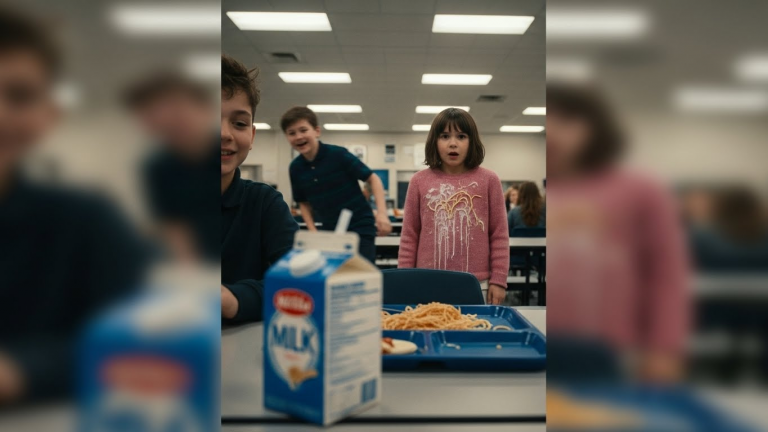
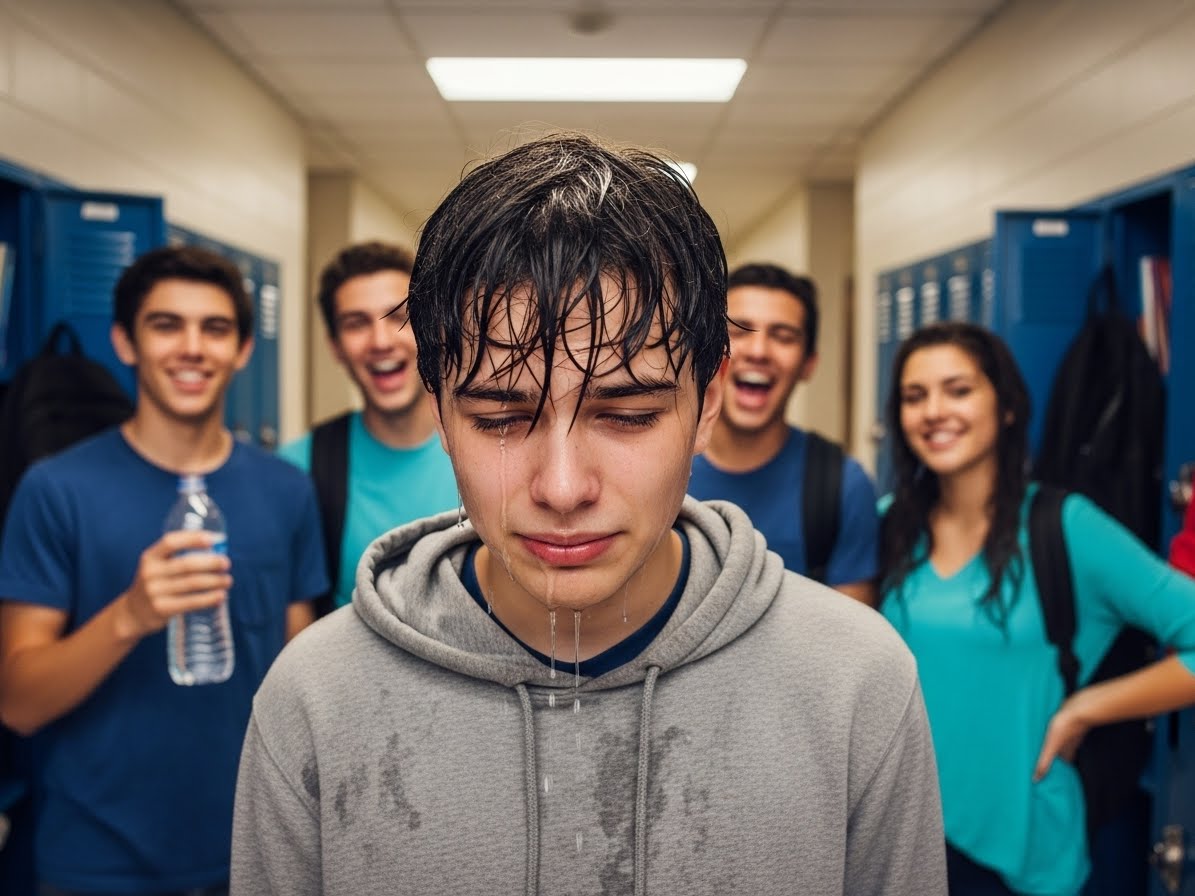
Leo felt the cold shock of liquid hitting his chest before he registered the impact. Chocolate milk. It splashed against his collarbone, soaking into the flannel, ruining the page of the sketchbook he had left exposed.
The drawing. Her eyes.
The tray hit the floor a second later. CLANG-clatter-spin.
The sound was like a gunshot in a library. The roar of the cafeteria was severed instantly. Three hundred heads turned. The silence that followed was heavy, suffocating, and cruel.
“Look at that,” Braden sneered, looming over Leo. He was flanked by Kyle and massive defensive lineman named Tank. They grinned like hyenas waiting for the scraps. “Made a mess of your little goodwill shirt, didn’t I? Or is that just how you people dress?”
Leo didn’t move. He stared at the brown liquid seeping into the charcoal drawing of his mother’s face. The paper warped. Her eye dissolved into a muddy smear.
A sharp, hot spike of rage drove itself into Leo’s chest. His heart hammered against his ribs like a trapped bird. He knew how to fight. His father had taught him the basics of Krav Maga when he was ten, before the “deployment years” created the chasm between them. Leo knew that if he drove his heel into Braden’s knee and followed with a palm strike to the nose, the quarterback would go down.
But then he heard her voice. It was a memory, three years old, echoing from a sterile hospital room filled with the beep of monitors.
“Leo, look at me. Promise me. Your father… he knows war. He carries it. You have to be the peace. Promise me you won’t let the anger take you like it took him. Be better than the fight.”
Leo exhaled. He unclenched the fist he hadn’t realized he’d made. Inhale. Hold. Exhale. Control.
“It’s fine, Braden,” Leo said. His voice was steady, though it lacked volume. He bent down to pick up the plastic tray.
Braden’s smile faltered. He wanted resistance. He wanted a reason. “Don’t you walk away from me!”
Braden kicked the tray. It skittered across the linoleum, crashing into the vending machine. “I heard your dad missed Parent’s Night again. Probably too busy polishing his boots to care about a loser like you, huh? Or maybe he just realized you aren’t worth coming home to.”
That was the trigger. The air in the room seemed to vibrate. Phones were out now, a forest of black rectangles recording in anticipation of violence. They wanted the breakdown. They wanted the viral clip of the weird art kid snapping.
Leo stood up slowly. He was three inches shorter than Braden and fifty pounds lighter. “Leave my dad out of this.”
“Or what?” Braden stepped closer, invading Leo’s personal space. “You gonna cry? You gonna paint a sad picture about it? You’re weak, Hayes. Just like your mom was.”
The mention of her was a violation. Leo’s vision blurred at the edges. The adrenaline was screaming at him to strike. Just one hit. Just one.
But the promise held him in a chokehold.
“I’m not fighting you,” Leo said, turning his back. It was an act of supreme will, mistaken by everyone in the room for cowardice.
Braden grabbed Leo’s shoulder—the one soaked in milk—and spun him around, slamming him hard against the glass front of the snack machine. Bags of chips shook. A collective gasp swept through the room.
“You’re pathetic,” Braden hissed, raising a fist. “You’re a disgrace to that last name.”
Leo closed his eyes, bracing for the impact. He accepted it. He would take the bruise. He would keep the promise.
Chapter 2: The Heavy Boots
The first punch didn’t come.
Instead, the double doors at the far end of the cafeteria swung open.
It wasn’t a slam. It wasn’t a dramatic kick. It was a controlled, forceful entrance that commanded the physics of the room to change. The bright midday sunlight from the faculty parking lot poured in behind the figure, creating a silhouette that looked less like a man and more like a statue carved from granite and regret.
The noise in the cafeteria didn’t just taper off; it was strangled.
First came the sound. Click-clack. Click-clack. The rhythmic, terrifying precision of Corcoran dress shoes on cheap linoleum. It was a sound that announced authority not by volume, but by consistency.
Then came the visual clarity as the doors closed and the silhouette became a man. Master Gunnery Sergeant Marcus Hayes.
He wasn’t in fatigues. He wasn’t in civilian clothes. He was in full Dress Blues. The midnight blue coat, the high collar, the blood stripe running down the trouser leg, and the ribbons on his chest—a colorful mosaic of campaigns, survival, and loss—catching the overhead fluorescent lights.
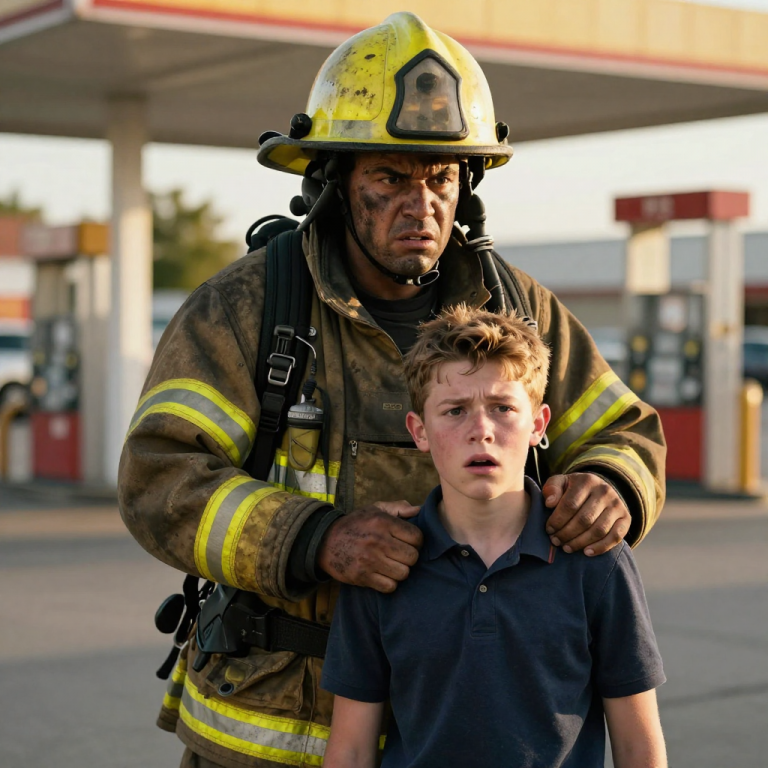
He stood six-foot-three, a wall of disciplined muscle. He took off his white cover slowly, tucking it under his left arm with a movement so fluid it looked robotic. His shaved head gleamed. His eyes were hidden behind aviator sunglasses, though everyone felt the weight of his gaze scanning the room like a targeting system acquiring a lock.
Principal Vance, a sweating, nervous man in an ill-fitting beige suit, rushed forward from the teachers’ monitoring station. He looked like a golden retriever trying to stop a tank. “S-Sergeant Hayes! We weren’t expecting—I mean, you can’t just—”
Marcus didn’t even look at him. He didn’t break stride. He walked right past the principal, the wind of his movement fluttering Vance’s tie. Marcus’s path was a straight line to the vending machines.
The sea of students parted. The cheerleaders, the jocks, the skaters, the academics—they all scrambled back, pressing themselves against the lunch tables. No one breathed. The air felt heavy, charged with static electricity.
Braden, who had been moments away from smashing Leo’s face, froze. His fist was still raised, hovering in the air like a grotesque statue. He looked up, and for the first time since kindergarten, the golden boy looked small.
Marcus stopped exactly three feet from them. He didn’t yell. He didn’t posture. He just stood there, radiating a kind of lethal calm that made the high school drama feel incredibly dangerous.
“Step away from my son,” Marcus said. His voice was low, a rumble of thunder from miles away, but it carried to every corner of the room. It was a voice that had given orders over the sound of mortar fire. It did not ask for compliance; it assumed it.
Braden’s hand dropped from Leo’s shirt as if he had touched a hot stove. He took a stumbling step back, his sneakers squeaking on the spilled milk. “I… We were just…”
Marcus slowly removed his sunglasses. He folded them and placed them in his pocket. His eyes were grey, cold, and tired. They weren’t the eyes of a parent scolding a child; they were the eyes of a man who had seen the worst humanity had to offer and was now looking at a suburban bully.
“Just what?” Marcus asked, tilting his head slightly. “Educating him?”
“It was a joke,” Braden stammered, his bravado dissolving into pure panic. “Just a joke, sir. We were messing around.”
Marcus looked at Leo. He didn’t smile. He didn’t offer comfort yet. He assessed the damage with a soldier’s efficiency. He saw the chocolate milk stained on the thrift-store shirt. He saw the red mark on Leo’s shoulder where he’d been shoved. He saw the ruined sketchbook on the floor, the charcoal drawing of his late wife smeared into oblivion.
For a second, a flicker of pain crossed the Sergeant’s face—a micro-expression of heartbreak that vanished as quickly as it appeared. He saw the clenched fist Leo was desperately trying to relax. He realized Leo hadn’t fought back. Not because he couldn’t, but because he wouldn’t.
Marcus turned his gaze back to Braden. The temperature in the room seemed to drop ten degrees.
“Pick it up,” Marcus said.
Braden blinked, confused. “What?”
Marcus pointed a gloved finger at the tray on the floor. “The mess you made. Pick. It. Up.”
“I don’t work here,” Braden tried to laugh, a nervous, high-pitched sound. He looked around for support from his friends. Kyle was inspecting the ceiling. Tank was tying his shoe. Braden was alone.
Marcus took one step forward. Just one. The medals on his chest clinked softly. “I am not asking you, son. I am giving you an order. You humiliated a young man who has more discipline in his pinky finger than you have in your entire body. Now, pick up the tray.”
The silence stretched, agonizing and long. The only sound was the hum of the vending machine and the terrified breathing of three hundred teenagers. Braden looked at the Sergeant, then at the tray, then back at the Sergeant. He saw no exit. He saw only inevitable consequence.
Slowly, shakily, the football captain bent down. His knees hit the floor. He gathered the plastic tray. He picked up the milk carton. He even used a napkin to wipe the spot on the floor.
When he stood up, face burning with a shame that would last until graduation, he tried to hand the tray to a lunch lady.
“Trash can,” Marcus corrected him. “And apologize.”
Braden walked to the bin, dumped the tray, and turned back to Leo. He couldn’t look him in the eye. “Sorry, Leo.”
Marcus turned his back on Braden, dismissing him as a threat, dismissing him as a person. He looked at his son. “Grab your gear, Leo. We’re leaving.”
Chapter 3: The Long Way Home
The walk to the parking lot was a blur. Leo felt like he was floating outside of his own body. He could feel the eyes of the entire school on his back—burning, whispering, reassessing. He kept his head down, clutching the ruined sketchbook to his chest.
Marcus walked a half-step ahead, breaking the wind, clearing the path. He didn’t say a word. He marched with a cadence that suggested they were on patrol, not leaving a high school in the suburbs of Ohio.
They reached the truck—a restored 1978 Ford F-150, painted a matte black that absorbed the sunlight. It was a beast of a machine, loud and unapologetic, much like its owner. Marcus unlocked the door, and Leo climbed into the passenger seat.
The cabin smelled of old leather, peppermint, and gun oil. It was a smell that used to comfort Leo when he was a child, before the tours of duty stretched from months into years, turning his father into a stranger who visited on holidays.
Marcus climbed in, the suspension groaning under his weight. He placed his cover on the dashboard, perfectly centered. He started the engine, and the V8 roared to life, shaking the frame.
They pulled out of the school lot, leaving the confused faces of Principal Vance and the students in the rearview mirror.
For the first ten minutes, there was only silence. It wasn’t a peaceful silence. It was thick, filled with unsaid words and jagged emotions. Leo stared out the window at the passing strip malls and manicured lawns. He felt a knot of shame tightening in his stomach.
He thinks I’m weak, Leo thought. He had to come save me. I’m fifteen years old and my dad had to rescue me like a toddler.
Leo looked down at his stained shirt. “I could have handled it,” he whispered.
Marcus didn’t take his eyes off the road. His hands were at ten and two on the steering wheel, gripping it so hard the leather creaked. “I know.”
“I didn’t ask you to come.”
“I know that too.”
“Then why did you?” Leo snapped, the frustration finally bubbling over. He turned to face his father. “Why did you show up in your Dress Blues? Why did you make a scene? Now I’m not just the weird kid, I’m the weird kid with the scary dad. You think that helps?”
Marcus signaled and pulled the truck over onto the shoulder of the road. It was a quiet stretch near the reservoir, where the water reflected the gray sky. He put the truck in park and killed the engine. The sudden silence was deafening.
Marcus took a deep breath, his chest expanding against the stiff fabric of his uniform. He turned in his seat to look at Leo. The sunglasses were off. The harsh lines of his face—etched by desert sun and difficult decisions—seemed to soften slightly.
“I didn’t come to the school because you were in trouble, Leo,” Marcus said, his voice rough. “I came because I forgot.”
Leo frowned. “Forgot what?”
Marcus reached into his breast pocket and pulled out a small, folded piece of paper. It was old, creased a hundred times. He held it out, but he didn’t hand it over. He just looked at it.
“Three years ago today,” Marcus said quietly. “0900 hours. The doctor called me out of the room to sign the papers. The Do Not Resuscitate order.”
Leo felt the air leave his lungs. Mom.
He had been so wrapped up in the misery of high school, in the daily survival of avoiding Braden, that he had blocked out the date. October 14th.
“I was at the recruitment center this morning,” Marcus continued, looking out the windshield at the water. “Processing paperwork for new recruits. Kids only a few years older than you. And I looked at the calendar, and it hit me. I was so busy being a Sergeant that I almost forgot to be a husband. Or a father.”
He looked back at Leo. “I didn’t go to the school to fight your battle, Leo. I went to pick you up so we could go to the cemetery together. I put on the Blues because… because she liked them. She said I looked like a gentleman in them.”
Leo looked down at his sketchbook. The charcoal smear on the page wasn’t just a ruined drawing anymore; it was a symbol of everything they were losing.
“I didn’t fight him,” Leo whispered, his voice trembling. “Braden. I wanted to. God, I wanted to smash his face in. But I promised her. She made me promise not to be… like the war.”
Marcus’s jaw tightened. He reached out, his large, calloused hand hovering for a moment before landing awkwardly but gently on Leo’s shoulder.
“She made me promise something too, Leo.”
Leo looked up, his eyes swimming with tears. “What?”
“To protect the parts of you that I lost in myself,” Marcus said. “Your kindness. Your art. Your ability to take a hit and not let it turn you into a monster.”
Marcus squeezed Leo’s shoulder. “You showing restraint in that cafeteria? That wasn’t weakness, son. That was the hardest thing a man can do. You have more courage in your silence than that boy had in his entire loud, pathetic existence.”
A tear escaped Leo’s eye and tracked through the charcoal dust on his cheek.
“But,” Marcus added, a dark edge returning to his voice, “that doesn’t mean I’m going to let anyone treat you like trash. You keep your promise to your mother. And I’ll keep my promise to protect you. Deal?”
Leo nodded, wiping his face with his sleeve. “Deal.”
Marcus started the engine again. “Good. Now, reach under your seat.”
Leo reached down and felt a hard, rectangular object. He pulled it out. It was a brand new, leather-bound artist’s sketchbook. Expensive paper. The kind Leo always looked at in the store but never asked for.
“Happy… whatever today is,” Marcus grunted, shifting gears. “We’re going to visit her. Then we’re getting steaks. And you’re going to tell me exactly why a quarterback is threatened by a kid who draws pictures.”
As the truck merged back onto the road, Leo opened the new sketchbook. The page was white, clean, and waiting. For the first time in a long time, he didn’t feel like he was alone in the trench. He had backup.
But neither of them knew that the video of the cafeteria confrontation was already sweeping through the town, and by the time they finished their steaks, the war wouldn’t be over—it would just be shifting to a new front.
Chapter 4: The Digital War
The war didn’t end in the parking lot. In the twenty-first century, wars don’t end; they just get uploaded.
By the time Leo walked into Oak Creek High the next morning, the video titled “Marine Dad HUMBLES Football Bully” had racked up 1.2 million views on TikTok.
It was edited for maximum impact. It had dramatic music added. It zoomed in on Braden’s terrified face as he picked up the milk carton. It had slow-motion replays of Marcus removing his sunglasses.
Leo adjusted his backpack straps, keeping his eyes on the linoleum. The dynamic in the hallway had shifted tectonically. Yesterday, he was invisible prey. Today, he was a radioactive artifact. People didn’t shove him, but they didn’t talk to him either. They stared. They whispered behind cupped hands. They gave him a wide berth, looking around as if expecting a sniper team to be rappelling from the ceiling tiles.
“Dude,” a voice whispered. It was Sam, a kid from Leo’s chemistry class who had never spoken to him before. “Is your dad really Recon? I heard he killed a guy with a spoon.”
Leo didn’t answer. He just kept walking. He hated this. He didn’t want fear. He wanted anonymity.
But if Leo was radioactive, Braden Miller was nuclear fallout.
The hierarchy of high school is brutal, but it is also fragile. Braden had built his throne on fear and the illusion of invincibility. Marcus Hayes had shattered that illusion in under three minutes without throwing a single punch.
Leo saw Braden by the trophy case. The quarterback wasn’t surrounded by his usual entourage. Kyle and Tank were standing a few feet away, scrolling through their phones, laughing at something that—judging by the way they stopped when Braden looked up—was definitely about him.
Braden looked like he hadn’t slept. His eyes were rimmed with red. His jaw was set in a tight, vibrating line. When he saw Leo, the shame in his eyes instantly curdled into something much darker. Pure, distilled hatred.
It wasn’t the bullying hatred of “I can take your lunch money.” It was the desperate hatred of a cornered animal.
Leo stopped. For a second, they locked eyes across the crowded hallway. Inhale. Exhale.
Leo broke contact first and turned into the art wing. He thought the humiliation would make Braden back down. He was wrong. Humiliation doesn’t teach a bully a lesson; it just gives them a new target.
Chapter 5: Red Paint on a White Canvas
The Art Wing was Leo’s sanctuary. It smelled of linseed oil, clay dust, and safety. Mr. Gallaway, the art teacher, was an old hippie who let Leo eat lunch in the back studio to avoid the cafeteria chaos.
Leo had been working on his final project for the District Showcase for three months. It wasn’t just a painting. It was a large-scale canvas, an acrylic realism piece depicting his mother’s hands holding a folded American flag. It was titled “The Weight of Cloth.”
It was the best thing Leo had ever created. It was his grief poured out in color.
Leo walked into the back studio, dropping his bag. “Hey, Mr. G, I’m just gonna—”
He stopped.
The easel in the corner was toppled over. The canvas was face up on the floor.
It wasn’t just knocked over. It was executed.
A jagged slash ran diagonally through the painting, severing the painted hands. But that wasn’t enough. Someone had taken a tube of crimson red oil paint—the thick, impossible-to-clean kind—and squeezed it all over the flag, smearing it into a grotesque parody of blood.
Leo stood there, his breath catching in his throat. The world tilted on its axis. The sound of the school faded into a high-pitched ringing.
He fell to his knees beside the canvas. He reached out, his fingers hovering over the ruined image, trembling. He couldn’t fix this. Oil over acrylic. The canvas was cut. It was gone. Three months of work. Three years of grief. Gone.
“Oh, Leo…” Mr. Gallaway came rushing in from the pottery room, his face pale. “I was only gone for five minutes to get coffee. I left the door unlocked. I… oh my god.”
Leo didn’t speak. He stared at the red smear. A piece of paper was stuck to the back of the easel with masking tape. A note.
“Your daddy can’t save you everywhere.”
Something inside Leo snapped. It wasn’t a loud snap. It was the quiet, terrifying sound of a cable parting under too much tension.
The promise to his mother felt very far away right now. The peace she wanted him to keep felt like a lie. Peace didn’t protect this painting. Peace didn’t stop Braden.
Leo stood up. He grabbed the note. He crumbled it in his fist until his nails cut into his palm.
“Leo, wait,” Mr. Gallaway said, reaching for him. “We have to report this to Principal Vance. We have to call your father.”
“No,” Leo said. His voice sounded strange to his own ears—cold, detached, frighteningly similar to Marcus’s. “Don’t call my father.”
“Leo, you can’t go after him.”
“I’m not going to fight him,” Leo lied. He walked out of the art room. He wasn’t going to fight. He was going to finish it.
Chapter 6: The Glass House
Leo didn’t find Braden in the hallway. He didn’t find him in the locker room. The final bell rang. The school emptied out.
Leo walked out to the student parking lot. He knew Braden’s car—a flashy, brand new silver BMW that cost more than Marcus’s annual pension. It was parked in the front row.
Leo stood by the hood of the car, waiting. He didn’t have a weapon. He didn’t have a plan. He just had a ball of fire in his chest where his heart used to be.
Ten minutes later, Braden appeared. He was walking alone, his varsity jacket slung over one shoulder. When he saw Leo standing by his car, he stopped. A smirk tugged at the corner of his mouth—the smirk was back.
“Like the art critique?” Braden called out, tossing his keys in the air and catching them. “I thought it added some necessary color. A bit too… patriotic for my taste.”
Leo didn’t move. “You slashed my mother’s hands.”
Braden laughed, but it was a hollow sound. He walked closer, checking to make sure Marcus wasn’t lurking behind a tree. “It’s just paint, weirdo. Cry about it to your GI Joe daddy. Oh wait, is he here? Or is he off having PTSD somewhere?”
Leo took a step forward. He was ready. He didn’t care if he got beaten to a pulp. He was going to take Braden’s eye out.
But before Leo could swing, a black Mercedes SUV screeched to a halt right behind Braden’s BMW. The horn honked—a long, aggressive blast that made both boys jump.
The window of the Mercedes rolled down. A man sat in the driver’s seat. He was wearing a suit that cost two thousand dollars and a scowl that looked permanent. He was on a Bluetooth headset.
“Get in the car, Braden,” the man barked. He didn’t look at Leo. He didn’t look at the school. He looked at his Rolex. “You’re wasting my time. I have a shareholders meeting in twenty minutes.”
Braden’s smirk vanished instantly. His shoulders hunched. The arrogance drained out of him, replaced by a sudden, flinching terror that Leo recognized.
“I… I have my car, Dad,” Braden said, his voice small.
“I’m taking the BMW. I’m trading it in,” the father said, his voice like a whip. “I saw the video, Braden. A million views? You letting some charity-case nobody make you kneel on the floor? You made the family name look weak.”
“Dad, I didn’t—”
“Shut up!” the man shouted, slamming his hand on the steering wheel. “You’re pathetic. Get in the car. We’re going to discuss your ‘image problem’ at home. And don’t expect to be starting on Friday.”
Braden stood there, paralyzed. The bully, the monster, the golden boy—he was trembling. He looked at Leo. For a fleeting second, Leo saw it. The bruise on Braden’s neck, partially hidden by the collar of his shirt. It wasn’t a hickey. It was the shape of a finger.
Braden wasn’t the predator. In this parking lot, with this man, he was the prey.
Braden opened the door of the Mercedes and slid in, keeping his head down. The car peeled away, leaving the smell of burnt rubber and expensive exhaust.
Leo stood alone in the parking lot. His fist was still clenched, but the fire in his chest had turned into ice.
“He’s not fighting you, Leo.”
Leo spun around. The black Ford truck was idling three rows back. Marcus was leaning against the fender, arms crossed. He had been there the whole time.
Marcus walked over, his boots crunching on the gravel. He looked at the spot where the Mercedes had been.
“You saw that?” Leo asked quietly.
“I saw it,” Marcus said. His expression was grim. “Rich suit. Angry eyes. Loves control more than he loves his kid.”
“He destroyed my painting, Dad,” Leo said, the tears finally spilling over. “Braden. He destroyed the one of Mom. He cut it.”
Marcus’s face darkened. A muscle in his jaw jumped. The protective instinct flared up—the urge to hunt down the Mercedes and tear the driver’s door off its hinges. But then he looked at Leo. He looked at the confusion and the pain in his son’s face.
“I know you want blood,” Marcus said softly. “I do too. God, I do. But you just saw the truth, didn’t you?”
“That his dad is a jerk?”
“That Braden is a recruit in a war he didn’t choose,” Marcus corrected. “That boy is getting beaten down at home every single day. He comes here and beats you down because it’s the only time he feels like he has any power.”
Marcus placed a hand on Leo’s shoulder. “We can go to the police about the painting. We can get him suspended. We can ruin him. But that man in the Mercedes? He’ll just beat Braden harder for it.”
Leo wiped his eyes. “So we do nothing? He just gets away with it?”
“No,” Marcus shook his head. “We don’t do nothing. But we don’t use fists. And we don’t use silence anymore either.”
Marcus walked to the passenger door of his truck and opened it for his son. “Get in. We have a lot of work to do before the game on Friday.”
“What are we going to do?” Leo asked.
Marcus smiled, a rare, dangerous smile that didn’t reach his eyes. “We’re going to change the rules of engagement.”
Chapter 7: The Real Enemy
Friday night under the stadium lights. In America, this is church. The bleachers were packed, vibrating with the stomping of feet and the blare of the marching band. But down on the field, Oak Creek was falling apart.
Braden Miller was playing the worst game of his life.
He had thrown two interceptions in the first quarter. He looked jittery, his eyes darting to the VIP section of the stands after every play.
Sitting right there, on the fifty-yard line, was his father. Mr. Miller wasn’t cheering. He was standing, his face purple with rage, screaming things that cut through the chilly October air like a knife.
“Get your head in the game!” “You’re embarrassing me!” “Pathetic! absolutely pathetic!”
The other parents shifted uncomfortably, looking away. They knew Mr. Miller was a wealthy donor. They knew his temper. They chose silence.
Leo and Marcus stood near the end zone, away from the crowds. Leo had his sketchbook, but he wasn’t drawing. He was watching Braden.
“He’s falling apart,” Leo said.
“He’s terrified,” Marcus corrected. “Look at his hands. Shaking.”
On the next play, the pocket collapsed. Braden scrambled, tripped over his own lineman’s feet, and went down. The ball popped loose. Fumble. Turnover.
The crowd groaned. But over the collective disappointment, one voice roared.
“You are worthless!” Mr. Miller screamed, slamming his program against the railing. “Get off the field! Don’t even bother coming home!”
The stadium went dead silent. Braden lay on the turf, face down. He didn’t get up. He just curled into a ball.
Leo felt a familiar tightening in his chest. He hated Braden. He hated what Braden had done to his mother’s painting. But looking at that boy on the grass, crushed by the weight of his own father’s disappointment, Leo didn’t see a monster. He saw a mirror. He saw who he might have become if Marcus hadn’t been a good man.
“Dad,” Leo said, looking up at Marcus.
Marcus didn’t need to be asked. He was already moving.
He didn’t walk onto the field. He walked up the bleachers.
The crowd parted for the man in the leather jacket and the Marine Corps cap. Marcus moved with the same terrifying purpose he had in the cafeteria. He stopped one row below Mr. Miller.
Mr. Miller looked down, sneering. “Can I help you, Sergeant? This is the donor section.”
“You’re done,” Marcus said. His voice wasn’t a scream. It was a command.
“Excuse me?”
“You’re done screaming at that boy,” Marcus said, loud enough for the surrounding rows to hear. “You are breaking him. And I’m not going to watch it happen.”
“That’s my son,” Miller spat. “I’ll discipline him however I—”
“That is a soldier on a field,” Marcus cut him off, his eyes hard as flint. “And you are failing him as a commanding officer. You want to be tough? You want to scream? Scream at me. Come down here and tell me I’m worthless.”
Miller blinked. He looked at Marcus—the size of him, the calm violence in his stance. Then he looked around. The other parents, emboldened by Marcus, were finally glaring at Miller. The silence of the crowd had turned into judgment.
Miller turned red. He grabbed his coat. “This is ridiculous.” He turned and stormed out of the stadium, leaving an empty seat and a lingering sense of shame.
Down on the field, Braden had pushed himself up. He had seen it. He had seen the father of the kid he bullied stand up to the father who bullied him.
Braden looked toward the end zone. He saw Leo standing there. Leo didn’t flip him off. He didn’t laugh.
Leo simply nodded. Play the game.
Chapter 8: Gold in the Cracks
The locker room was empty. The team had left an hour ago.
Leo sat on a bench near the exit, waiting. On his lap was the painting. “The Weight of Cloth.”
The door to the showers opened, and Braden walked out. He looked exhausted. He had a black eye from a sack in the fourth quarter. When he saw Leo, he stopped dead. He tensed up, waiting for the ambush.
“My dad’s waiting in the truck,” Leo said calmly. “Just me.”
Braden slumped against a locker. “Here to gloat? My dad took the car. I’m walking home.”
“No,” Leo said. “I’m here to show you this.”
He turned the canvas around.
Braden flinched. He expected to see the slashed ruins of his vandalism.
But the painting was different.
Leo had fixed it. But he hadn’t tried to hide the slash. Instead, he had mixed gold powder into the epoxy resin he used to seal the cut. The jagged line running through the mother’s hands and the flag was now a brilliant, shining vein of gold. It didn’t ruin the image; it made it look stronger, more ancient, more valuable.
“It’s called Kintsugi,” Leo said. “It’s a Japanese art. You repair broken pottery with gold. The idea is that the break doesn’t make it ugly. The break becomes part of the history. It makes it beautiful.”
Braden stared at the gold scar on the canvas. His throat worked. His eyes filled with tears that he had been holding back for years.
“Why?” Braden whispered. “I destroyed it. I treated you like garbage.”
“Because my mom made me promise,” Leo said, standing up. “She said war makes monsters. I didn’t want to be one. And I didn’t want you to be one either.”
Leo walked over and placed a small piece of paper on the bench next to Braden. It was a card with a phone number.
“My dad runs a boxing gym on weekends,” Leo said. “For vets and… anyone who needs to hit something without hurting people. He said if you want to learn how to actually fight—and not just bully people because you’re scared—you can come by. No charge.”
Braden looked at the card. Then he looked at Leo. The hierarchy was gone. The hate was gone. There were just two boys, trying to survive the expectations of the men who raised them.
“Thanks, Leo,” Braden choked out.
“Don’t thank me,” Leo said, heading for the door. “Just show up.”
Leo walked out into the cool night air. The parking lot was dark, save for the idling black Ford truck.
Leo climbed into the passenger seat. Marcus looked over at him.
“You give it to him?”
“Yeah,” Leo said. “I showed him the painting.”
“And?”
“I think he liked the gold,” Leo smiled tiredly.
Marcus put the truck in gear. He reached over and ruffled Leo’s hair—something he hadn’t done in years.
“You did good, kid,” Marcus said, his voice thick with emotion. “You kept the peace. Your mother… she would have been proud. Hell, I’m proud.”
Leo looked out the window as they drove away. He touched the cover of his new sketchbook. He realized his father was right. He wasn’t weak. Silence wasn’t empty. It was a space where you could choose who you wanted to be.
And for the first time since she died, the silence didn’t feel heavy. It felt like gold.
(The End)