The Principal Was About to Suspend the Boy for His “Trashy” Shoes—Until He Looked Inside the Boot and Saw a Name That Made Him Weep.
Chapter 1: The March of the Broken
The alarm clock on the bedside table didn’t buzz; it rattled. It was an old wind-up piece, one of the few things in the house that didn’t require electricity, which was good because the power had been flickering on and off all week.
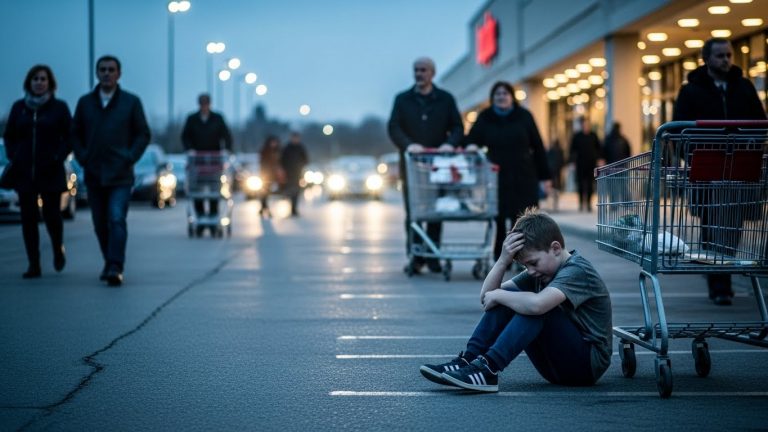
Danny sat up, the springs of his mattress groaning in protest. At ten years old, Danny had the eyes of someone much older—eyes that were perpetually scanning for danger, or disappointment. The room was cold, a damp chill that seeped through the thin walls of the trailer they called home. He shivered, rubbing his arms, and swung his legs over the side of the bed.
His feet hit the linoleum floor, and instinctively, he curled his toes. He looked at them—pale, bony, with a callous forming on the side of his big toe that looked angry and red. He dreaded what came next.
Sitting by the door, like two slumbering beasts, were the boots.
They were monstrous things for a ten-year-old. Heavy, black combat leather that had turned a shade of charcoal gray from years of sun and dust. The leather was cracked in a spiderweb pattern across the toe box. The laces were a patchwork disaster—original black nylon knotted together with brown twine and even a piece of white fishing line near the top eyelets. But the worst part was the soles. On the right boot, the rubber sole had separated from the leather at the toe, creating a flapping “mouth” that gaped open with every step.
Danny sighed, a sound too heavy for his small chest. He reached for his socks. He had two pairs on today—a thin gray pair with a hole in the heel, and a thicker white athletic sock over it to cushion the blow. He slid his feet into the boots. They felt like cement blocks. He tied them tight, wincing as he pulled the twine. He had to wrap the laces around his ankles twice just to keep the boots from slipping off his heels.
“Danny? You up, baby?”
His mother’s voice drifted from the kitchen. She sounded tired. She always sounded tired. She had worked the double shift at the diner again, coming home only three hours ago.
“Yes, Mama,” Danny called back, his voice steady. He didn’t want her to worry.
He walked into the kitchen, the boots making a heavy clomp-clack, clomp-clack sound on the floor. The clack was the loose sole hitting the ground a fraction of a second after the heel.
“Here,” she said, sliding a bowl of oatmeal toward him. It was watery, but it was warm. She looked at his feet, and her face fell. “Danny… I get paid on Friday. Maybe… maybe we can go to Goodwill. See if they have something.”
Danny smiled, trying to reach his eyes. “It’s okay, Mama. These are fine. They’re strong. They keep the water out.”
That was a lie. They didn’t keep the water out. But Danny saw the dark circles under her eyes, the way her hands shook as she held her coffee cup. He couldn’t ask for shoes. Not when the “Past Due” notice for the electric bill was currently functioning as a coaster for her mug.
“You’re a good boy, Danny,” she whispered, kissing his forehead. “Run along now. Don’t miss the bus.”
The bus ride was the first circle of hell. Danny sat in the front, right behind the driver, Mrs. Gable. She was a kind woman who pretended not to notice when Danny had to use safety pins to hold his backpack strap together. But she couldn’t protect him from what was happening in the back rows.
“Hey, Trash-Can Dan!”
The voice belonged to Braden. Braden was everything Danny was not. He was loud, confident, and draped in brand-name athletic gear that cost more than Danny’s mother made in a month. Braden’s father owned the largest car dealership in the county, and his mother was on the school board. Braden had never heard the word “no” in his life.
Danny stared straight ahead, focusing on the back of Mrs. Gable’s head.
“What’s that smell?” Braden yelled, laughing as his friends—the “Legacy Club,” they called themselves—joined in. “Smells like roadkill. Oh wait, it’s just Danny’s boots!”
A wad of paper hit the back of Danny’s head. He didn’t flinch. He had learned that flinching made it worse. If you were a statue, eventually they got bored. Or so he hoped.
When the bus hissed to a halt in front of Lincoln Elementary, Danny waited. He let everyone else off first. He wanted to minimize the audience for his walk.
He stepped off the bus, the clomp-clack echoing on the pavement. He tried to alter his gait, lifting his knees higher to stop the sole from dragging, but the boots were too heavy. He looked like a soldier marching through mud, except he was walking on dry concrete.
Recess was the second circle of hell.
Danny usually hid in the library, but today Mrs. Pringle had closed it for inventory. He was forced out onto the blacktop. He tried to blend into the brick wall near the cafeteria, making himself small.
It didn’t work. Predators have a sense for prey that is trying to hide.
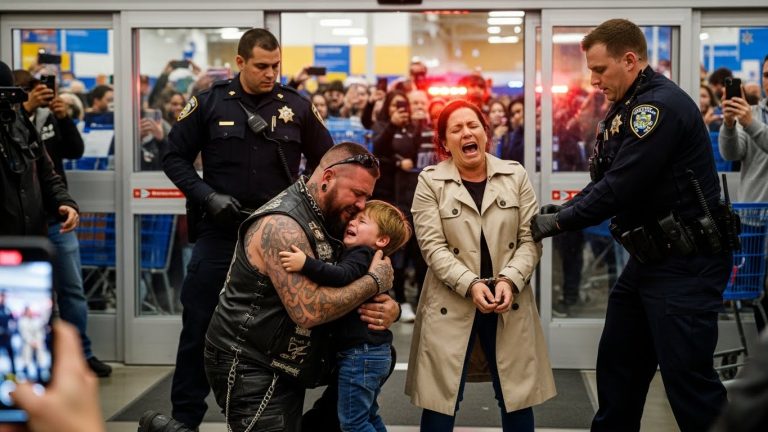
“Check it out, guys,” Braden’s voice cut through the playground chatter. He was holding his phone up, recording. “Live on TikTok. We’re here with the school mascot. The hobo.”
Danny pressed his back against the bricks. “Leave me alone, Braden.”
“Look at those kicks!” Braden zoomed the camera in on Danny’s feet. “What are those? Are those from the Civil War? My dog chews on better leather than that.”
The crowd gathered. It was the way of the playground; people didn’t necessarily want to be cruel, but they were terrified of being the next target, so they laughed along. It was safer to be part of the mob than to stand in front of it.
“I bet you can’t even run in those,” Braden sneered. He was wearing pristine, white high-top basketball sneakers. Not a scuff on them. They were air-cushioned, ergonomic, and cost $200.
“I don’t want to run,” Danny said quietly.
“Let’s play a game,” Braden announced to the camera. “It’s called Kick the Trash.”
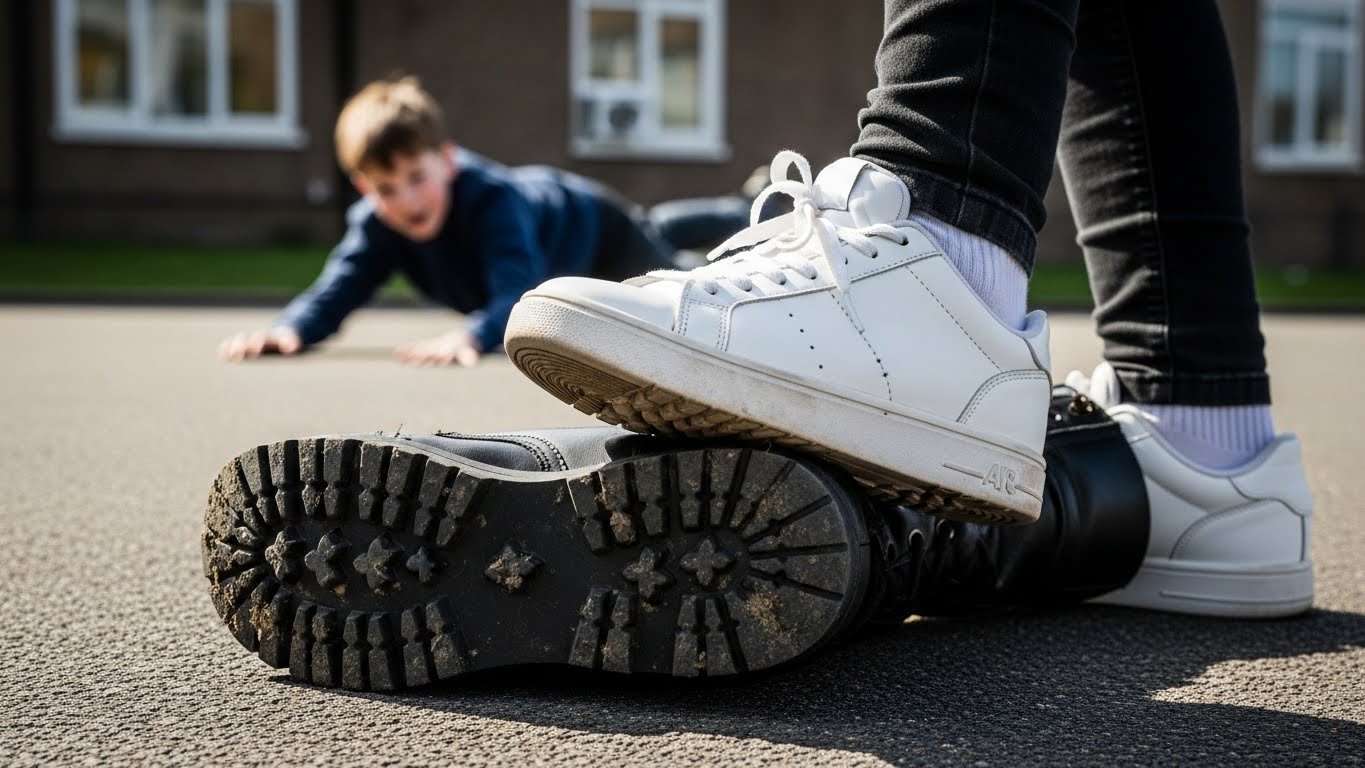
Before Danny could react, Braden lunged forward. He wasn’t trying to kick Danny’s body; he was aiming for the loose flap of the boot sole. He stepped hard on the back of Danny’s heel.
Danny tried to step forward, but his boot was pinned. The momentum carried his upper body forward, but his feet stayed planted.
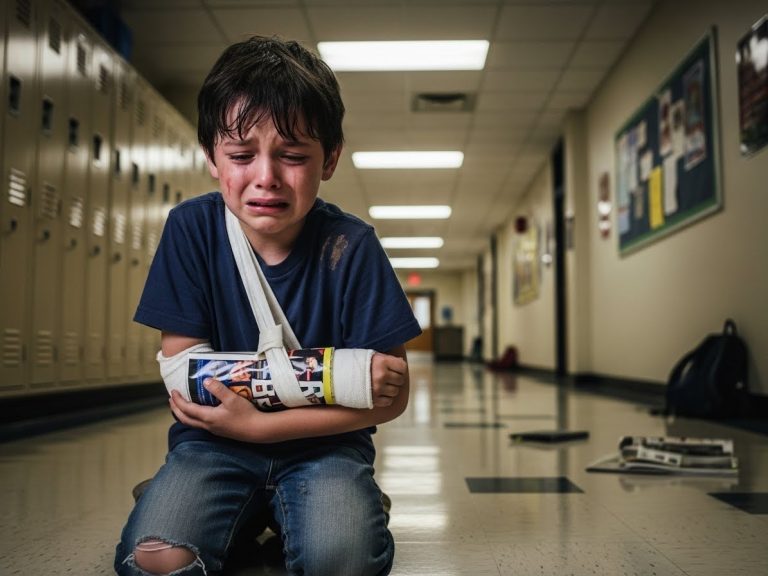
He went down hard.
His palms scraped against the unforgiving asphalt, tearing the skin. His knees took the brunt of the impact, ripping through his thin jeans. A sharp pain shot up his wrist.
The playground erupted in laughter.
“Look at him!” Braden howled, zooming in on Danny’s face. “He tripped over his own clown shoes!”
Danny lay there for a second, the wind knocked out of him. He felt the sting of tears in his eyes, but he bit the inside of his cheek until he tasted copper. Don’t cry. Do not cry. If you cry, they win.
He sat up slowly. The fall had made the condition of the boots worse. The sole of the right boot was now hanging by a mere thread of glue at the heel. His gray sock was fully visible through the gap, wet from a puddle on the blacktop.
“Oops,” Braden mocked, feigning concern. “Did I break your antiques? Maybe you can glue them back together with some mud.”
“That’s enough!”
The voice boomed across the playground like thunder. The laughter died instantly. Even Braden lowered his phone.
Principal Miller was standing at the top of the cafeteria steps. He was a large man, balding, with a thick gray mustache and a posture that suggested he had spent years standing at attention. He wasn’t wearing a suit; he wore a dress shirt with the sleeves rolled up, revealing forearms that were still thick with muscle despite his age.
Miller didn’t run. He walked with a terrifying, deliberate slowness down the stairs. The sea of students parted for him.
He stopped in front of Danny. He didn’t look at Braden yet. He looked at the boy on the ground. He saw the bleeding palms. He saw the torn jeans. And he saw the boots.
Miller’s jaw tightened. A muscle in his cheek twitched.
“Get up, son,” Miller said, his voice surprisingly gentle. He extended a hand.
Danny hesitated, then took the principal’s hand. Miller pulled him up effortlessly.
“Braden,” Miller said, his voice dropping an octave. It wasn’t a question.
“He tripped, Mr. Miller!” Braden said quickly, the practiced lie rolling off his tongue. “I was just filming a video for my project, and he just… fell. His shoes are broken. It’s a safety hazard, really.”
Miller looked at Braden. He looked at the phone in Braden’s hand.
“Both of you,” Miller said, his voice like grinding stones. “My office. Now.”
Danny’s heart sank. He was going to the office. His mom would be called. She would have to leave work. She would lose wages. The shame burned hotter than the scrapes on his hands. He limped after the principal, the flap-clack of his broken boot echoing like a drumbeat of his humiliation.
Chapter 2: The Silent Inscription
The outer office of the administration wing smelled of copier toner and floor wax. It was a smell that usually induced anxiety in students, and today was no exception. The secretary, Mrs. Higgins, peered over her glasses as the trio entered. She saw Danny’s bleeding knees and reached for the first-aid kit, but Principal Miller raised a hand.
“I’ve got it, Martha. Just hold my calls. Even the Superintendent.”
“Yes, sir,” she murmured, sensing the gravity of the situation.
Miller ushered them into his office and closed the door. It was a heavy wooden door that sealed with a solid thud, cutting off the noise of the outside world. The office was lined with bookshelves filled with educational law binders and history books. Behind the desk hung a framed flag, folded into a triangle, and several certificates of service that most students never bothered to read.
Miller sat behind his desk. He didn’t yell. He gestured for the boys to sit. Braden sat in the leather chair, crossing his legs, looking bored. Danny sat on the edge of the other chair, trying to hide his feet beneath the seat.
“Braden,” Miller started, leaning forward, clasping his hands. “I saw the video.”
Braden blinked. “What? No, I stopped recording before—”
“I saw the making of the video,” Miller corrected, his eyes hard. “I saw you step on his heel. I saw you laugh.”
Braden shrugged, a gesture of pure entitlement. “It was a joke, Principal Miller. Everyone was laughing. Even Danny… well, he wasn’t laughing, but he gets it. It’s just a prank.”
“A prank,” Miller repeated, tasting the word like it was sour milk. “Humiliating a classmate because he doesn’t have your budget for footwear. That’s a prank to you?”
“My dad says competition builds character,” Braden retorted, parroting a phrase he had likely heard over dinner. “If he wants better stuff, his parents should work harder. That’s how America works, right?”
Miller stared at the boy. For a moment, the silence was deafening. Miller had heard this rhetoric before, usually from the parents who parked their luxury SUVs in the fire lane because the rules didn’t apply to them.
He turned his gaze to Danny. The boy was staring at the floor, his face burning red.
“Danny,” Miller said softly.
“Yes, sir?”
“Those boots,” Miller said. “Braden is right about one thing. They are a safety hazard. I can’t let you walk around the school with a sole that’s flapping like that. You could trip on the stairs. You could get seriously hurt.”
Danny nodded, swallowing the lump in his throat. “I know, sir. I… I try to be careful.”
“Why haven’t you replaced them?” Miller asked. It wasn’t an accusation; it was a genuine inquiry. “I know things might be tight, but surely a pair of sneakers from the discount store…”
“We can’t,” Danny whispered. “Not this month. The car broke down, and…” He trailed off. He wasn’t going to beg. He had his pride.
Miller sighed. He rubbed his temples. The school board, led by Braden’s mother, had been pressuring him to crack down on the dress code. Uniformity creates discipline, they said. Technically, Danny’s tattered boots were a violation of the dress code policy regarding “footwear in good repair.”
“Danny,” Miller said, reaching into his drawer and pulling out a roll of duct tape. “I can patch them up for today. But I need you to take them off. Let me see if the leather is salvageable.”
Danny froze. “No, sir. It’s okay. I can do it.”
“Take them off, son,” Miller ordered, firmly but kind. “Let me help.”
Danny hesitated for a long agonizing minute. Then, with shaking hands, he untied the twine. He unwound the fishing line. He loosened the laces. He slid his left foot out, then his right. The smell of sweat and old leather filled the small space between the desk and the chairs.
Braden crinkled his nose and made a show of waving his hand in front of his face. “Gross.”
Miller ignored him. He reached over the desk and picked up the right boot—the one with the flapping sole.
He held it up. It was heavy. Much heavier than a child’s shoe should be. It was steel-toed. The leather was high quality, though ancient. Miller turned it over in his hands. He felt the texture of the heel. He knew this texture. He knew the specific pattern of the tread, even though it was worn almost smooth.
His heart skipped a beat.
Miller pulled the tongue of the boot forward. The lining was frayed, but there, stamped in faded black ink against the tan interior leather, was a sequence of numbers.
NSN 8430-01-XXX-XXXX SIZE 9R PROP. U.S. GOVT.
And below that, handwritten in permanent marker that had bled into the fabric over years, was a name: SGT. D. HARRISON
Principal Miller stopped breathing for a second. The room seemed to tilt. He looked at the serial number again. He looked at the name. He looked at the style of the stitching.
These were standard-issue combat boots. Specifically, the Jungle Boots issued during the early 2000s conflicts.
Miller looked up at Danny. The boy was wiggling his toes in his mismatching socks, looking terrified that he was in trouble for the broken dress code.
“Danny,” Miller’s voice trembled. It wasn’t the voice of a principal anymore. It was the voice of a man who had once worn a uniform himself. “Whose boots are these?”
Danny looked up, surprised by the tone. “They’re my dad’s, sir.”
Miller swallowed hard. “Where is your dad, Danny?”
The room went silent. Even Braden, sensing a shift in the atmosphere, stopped fidgeting.
“He died,” Danny said simply. The words were practiced, worn smooth like a stone in a river. “In Afghanistan. Before I was born. Mom got a box with his stuff. These were in it.”
Miller felt a punch to his gut that was harder than any he had taken in his youth. He looked at the oversized boots. Size 9. Danny was a size 4, maybe 5.
“They are too big for you, son,” Miller whispered.
“I know,” Danny said, his eyes shining. “I wear three pairs of socks usually. I stuffed the toes with newspaper. Mom says I shouldn’t wear them, that they hurt my feet. But…”
“But what?” Miller urged.
“But when I wear them,” Danny’s voice cracked, and a single tear escaped, tracking through the dirt on his cheek. “When I wear them, I feel like he’s walking with me. Like he’s holding me up. If I take them off, I’m just… I’m just small. But in these… I’m strong.”
Danny pointed to the flapping sole.
“And they aren’t broken because I’m clumsy,” Danny added defensively, looking at Braden. “They’re broken because I walk to the cemetery every day after school. It’s four miles round trip. The road is gravel. It ate the rubber up.”
Miller stared at the boot in his hand. He realized why the sole was separated. It wasn’t cheap glue. It was miles and miles of pilgrimage. A ten-year-old boy, walking four miles a day on gravel, dragging heavy steel-toed combat boots that didn’t fit, just to sit next to a stone slab of a father he never met.
Miller looked at Danny’s feet. He saw the blisters. He saw the angry red marks where the leather collar rubbed against his shins.
The Principal closed his eyes. He felt a wave of shame so hot it nearly burned him. He had been worried about dress code. He had been worried about the school board.
He opened his eyes. The softness was gone. In its place was a cold, hard resolve.
He turned to Braden.
Braden was looking at the boots, then at Danny. The smirk was gone, replaced by a look of confusion, perhaps the first stirrings of discomfort.
“Braden,” Miller said. His voice was quiet, but it filled the room. “Do you know what these are?”
“Old shoes?” Braden squeaked.
Miller slammed the boot down on the desk. The THUD made Braden jump.
“These are not shoes,” Miller growled. “These are instruments of war. These are what a man wore when he marched into hell so that you could sit in your air-conditioned house and play on your iPhone.”
Miller stood up, looming over the desk.
“You laughed at the holes?” Miller pointed a shaking finger at the separated sole. “Those holes weren’t made by neglect. They were made by loyalty. They were made by a son trying to be close to a hero. You have $200 sneakers, Braden. But you have never walked a single step in your life with the dignity this boy has in his little toe.”
Braden shrank back into the leather chair. “I… I didn’t know.”
“Ignorance is not an excuse for cruelty,” Miller snapped. “You wanted to make a viral video? You wanted attention?”
Miller picked up his phone. He dialed a number.
“Yes, get me Mrs. Van Doren,” Miller said into the receiver, his eyes locked on Braden. “And get Danny’s mother, Mrs. Harrison, on the line too. Immediately.”
He hung up and looked at the two boys.
“Danny, I’m going to tape these up for you so you can get home,” Miller said, his voice softening again as he turned to the impoverished boy. “But things are going to change. Today.”
“Am I suspended?” Danny asked, his voice trembling.
Miller walked around the desk and placed a hand on Danny’s shoulder.
“No, son. You’re not suspended. You’re the finest student in this building. But I am going to teach this school—and Mr. Van Doren here—a lesson they will never forget.”
Chapter 3: The Long Walk of Atonement
The meeting with the parents was volatile. Mrs. Van Doren, Braden’s mother, arrived in a whirlwind of expensive perfume and indignation. She wore a tailored suit and carried a designer bag that cost more than Danny’s trailer.
Danny’s mother, Sarah, arrived ten minutes later, still in her diner uniform, smelling of grease and old coffee. She looked terrified, clutching her purse as if it were a shield.
Principal Miller sat them all down. He placed the combat boot in the center of the conference table.
“My son is being harassed?” Mrs. Van Doren started, glaring at Miller. “He called me and said you yelled at him.”
“I did,” Miller said calmly. “And I’m about to do more than that.”
Miller explained the situation. He played the video Braden had taken—the cruel laughter, the zoom-in on the boots, the tripping. Then, he told them the story of the boots. He told them about the four miles. He told them about Sergeant Harrison.
As Miller spoke, Sarah Harrison began to weep silently, her hand covering her mouth. “I told him not to wear them,” she sobbed. “I told him I’d buy him sneakers next week.”
“It’s not about the sneakers, Mrs. Harrison,” Miller said gently. “It’s about what they represent.”
He turned to Mrs. Van Doren. The wealthy woman was silent. She looked at the dirty, broken boot on the table. She looked at Sarah crying. She looked at her son, who was staring at his own expensive Nikes, unable to lift his head. The color had drained from her face.
“I… I had no idea,” Mrs. Van Doren whispered. She wasn’t a monster; she was just disconnected. The bubble she lived in had been pierced.
“Braden is suspended for three days,” Miller announced.
“Three days?” Mrs. Van Doren bristled, her instincts kicking back in. “That will go on his permanent record. Surely we can—”
“I’m not finished,” Miller cut her off. “The suspension is administrative. But if you want him back in this school, there is a condition. An alternative restorative justice program, if you will.”
“What is it?” Braden asked, his voice small.
“For the next two weeks,” Miller said, locking eyes with the bully, “the school bus is off-limits for you, Braden. Your mother’s car is off-limits.”
“How am I supposed to get to school?” Braden asked.
“You’re going to walk,” Miller said. “But not to school. Every day after school, for two weeks, you are going to accompany Danny to the cemetery. You will walk the four miles. You will not listen to music. You will not check your phone. You will walk, and you will carry Danny’s backpack for him.”
“That’s… that’s absurd,” Mrs. Van Doren sputtered. “It’s dangerous. It’s too far.”
“Danny does it every day,” Miller said coldly. “Unless you’re saying your son is weaker than Danny?”
The room went silent. Mrs. Van Doren looked at Danny—small, frail, poor Danny—and then at her husky, well-fed son.
“He’ll do it,” Mrs. Van Doren said tight-lipped. She turned to Braden. “You heard him. You wanted to make fun of his walk? Now you’re going to learn it.”
The first walk began that afternoon.
It was a gray, overcast day. The wind was biting. Miller watched from the school steps as the two boys set off. Braden looked miserable. He was carrying two backpacks. Danny walked beside him, his boots now held together with heavy-duty black gorilla tape that Miller had applied himself.
For the first mile, Braden complained. “My feet hurt. This is stupid. It’s going to rain.”
Danny didn’t say anything. He just kept marching. Clomp-clack. Clomp-clack.
By the second mile, Braden stopped complaining. He was breathing hard. Sweat was dripping down his face despite the cold. His expensive sneakers were getting dusted with gray gravel dust. A car drove by and splashed a puddle onto them. Braden yelped, but Danny didn’t even flinch.
“How… how do you do this?” Braden panted, stopping to catch his breath. “Every day?”
Danny stopped. He looked back at Braden. “I just think about him. Waiting for me.”
“Who?”
“My dad.”
Braden looked at Danny. Really looked at him. For the first time, he didn’t see a “hobo.” He saw a kid who was carrying a weight Braden couldn’t even imagine.
They reached the cemetery. It was a quiet place, rolling hills of green dotted with white stones. Danny led the way to a modest plot in the veteran’s section.
SGT DANIEL HARRISON BELOVED HUSBAND AND FATHER
Danny knelt down. He pulled a rag from his pocket and began to wipe the dirt off the headstone. He didn’t say anything to Braden. He just started talking to the stone.
“Hey, Dad. I got an A on my math test today. Well, an A-minus. I missed the one about fractions. Mom’s okay. Her back hurts, but she’s okay.”
Braden stood a few feet away, holding the backpacks. He felt like an intruder. He felt small. He looked at his own shoes, then at the grave. He realized that while he was playing video games and making TikToks, Danny was here, talking to a ghost.
Braden felt a lump in his throat. He carefully set the backpacks down on the grass. He didn’t know what to do, so he just stood at attention, like he had seen in movies. He waited until Danny was done.
The walk back was silent. But it wasn’t a hostile silence anymore. When they got to the fork in the road where Danny turned toward the trailer park and Braden’s mother was waiting in her SUV, Braden hesitated.
“Hey, Danny,” Braden said.
Danny turned.
“I’m… I’m sorry about the video. And the game.”
Danny looked at him. He nodded once. “It’s okay.”
“No,” Braden said, shaking his head. “It wasn’t okay. See you tomorrow.”
Chapter 4: Steps Toward the Future
Two weeks passed.
The change in Braden was subtle but noticeable. He stopped sitting with the “Legacy Club” at lunch. He stopped filming people. He started carrying his own tray.
On the final day of the punishment, Braden didn’t complain about the walk. He kept pace with Danny. They talked a little this time. About baseball. About Minecraft. Normal kid stuff.
When they returned to the school the next morning, Principal Miller was waiting by Danny’s locker.
“Morning, gentlemen,” Miller said.
“Morning, Mr. Miller,” they said in unison.
“Danny, could you open your locker, please?”
Danny dialed the combination. The metal door swung open.
Inside, sitting on the metal shelf, was a box. It was a shoe box. But next to it was a smaller, wooden box.
Danny looked at Miller. “What is this?”
“Open the shoe box first,” Miller said.
Danny lifted the lid. Inside was a pair of brand-new running shoes. They weren’t flashy. They were sturdy, high-quality, dark blue sneakers with excellent arch support.
“Those are for Gym class,” Miller said. “And for the walk home when the weather is bad.”
Danny touched them. They were beautiful. “Thank you, sir. But I can’t pay for these.”
“They’re paid for,” Miller said. He glanced at Braden. Braden looked at the floor, his ears turning red. It was clear who had funded this purchase.
“Now, the wooden box,” Miller said.
Danny opened the smaller box. Inside was a professional leather repair kit: polish, conditioning oil, new heavy-duty laces, and a pair of custom-molded orthopedic insoles designed to fit into combat boots to make them fit a smaller foot securely.
There was a note on top. Danny picked it up.
Danny, A soldier takes care of his gear so his gear can take care of him. Use these to keep his boots strong. Use the sneakers to run your own race. We are proud of you. – Principal Miller & The Staff
(And scribbled at the bottom in messy handwriting: Sorry about the sole. – B)
Danny felt the tears coming, but this time, he didn’t fight them. He looked at Miller. He looked at Braden.
“Thank you,” he choked out.
Miller placed a hand on Danny’s shoulder. “Put the new insoles in the boots, Danny. Try them on.”
Danny sat on the floor of the hallway. He removed the duct tape. He placed the new, soft insoles into the combat boots. He laced them up with the new, strong laces. He stood up.
They fit. They didn’t wobble. The insoles filled the empty space. They felt solid. Secure.
He took a step. Clomp.
No clack. No flapping. Just the solid, authoritative sound of a boot hitting the ground with purpose.
“How do they feel?” Miller asked.
Danny looked down at his father’s boots, now polished and repaired. He looked up, his back straighter, his chin higher.
“They feel like he’s holding me up,” Danny smiled. “But now… I can walk on my own too.”
The bell rang. Students began to flood the hallway.
“Go on to class,” Miller said.
Danny turned and walked down the hall. He didn’t shuffle. He didn’t hide. He walked with a stride that was confident and strong. Beside him, Braden walked. Not ahead, not behind, but alongside him.
Principal Miller watched them go. He took a deep breath, adjusting his tie. He pulled his phone out and deleted the draft of his resignation letter he had started writing two weeks ago.
“Martha,” he called out to his secretary as he walked back into the office.
“Yes, sir?”
“Order a new flag for the front of the school. The old one is looking a bit tattered. It’s time we showed a little more respect around here.”