The Billionaire’s Daughter Hadn’t Spoken in 7 Years. Doctors Said She Was Broken. Then My 6-Year-Old Son Did The Unthinkable.
Chapter 1: The Silence in the East Wing
The Bradford estate sat on the hill overlooking the harbor like a monument to old money and cold secrets. I’d been working on high-end homes for fifteen years—fixing crown molding for bankers and restoring staircases for senators—but this place was different.
It wasn’t just quiet. It was silent.
The kind of silence that feels heavy, like the air pressure before a tornado touches down.
“Restore the mahogany staircase in the East Wing,” the housekeeper, Miranda, had told me that first morning. She was a stiff woman, efficient, with eyes that looked tired. “Repair the water damage in the library. Refinish the shelving. You have three weeks.”
Simple enough.
What Miranda hadn’t mentioned was the ghost.
I’d been working for maybe two hours, the rhythmic shh-shh-shh of my sandpaper against the banister filling the empty hall, when I felt it. That prickle on the back of your neck that tells you you’re being hunted.
I stopped. I turned slowly.
Standing in the doorway was a girl. She couldn’t have been more than seven years old. She wore a white dress that looked too stiff, too expensive for a Tuesday morning. Her dark hair fell past her shoulders in a curtain, hiding half her face.
But it was what she was holding that caught my eye.
A stuffed rabbit. Or, what used to be a rabbit. One ear was hanging by a literal thread. The fur was worn away in patches, revealing the grey mesh underneath. It was dirty, matted, and loved to the point of destruction.
She clutched it to her chest like it was the only oxygen in the room.
“Hey there,” I said, keeping my voice low. I didn’t want to spook her. “I’m Trevor.”
She didn’t blink. She didn’t move. She just stared at my hands. Specifically, she was staring at the chisel I’d set down on the drop cloth.
“You live here?” I asked.
Nothing. Not a shy giggle, not a retreat. Just a flat, intense stare.
I waited for a moment, then shrugged. I turned back to the wood. “Alright then. I’m just gonna clean up this mahogany. It’s got a few scars, see? But the wood underneath is still good.”
I worked for another hour. She stood there the entire time. She didn’t sit. She didn’t lean against the doorframe. She just stood, watching every movement of my hands with a focus that was almost unnerving.
At noon, Miranda appeared to bring me a glass of water. When she saw the girl, she flinched.
“Violet,” she said, her voice sharp but hushed. “Your mother is looking for you. The speech therapist is here.”
The girl, Violet, didn’t acknowledge Miranda. She looked at me one last time—a long, calculating look—and then turned and walked away. Her footsteps made zero sound on the floor.
“I’m sorry about that,” Miranda whispered, watching the girl leave. “She’s… particular.”
“She’s quiet,” I noted.
Miranda let out a short, bitter laugh. “She’s not just quiet, Mr. Hayes. Violet hasn’t spoken a word since she was born. Seven years. Not a sound.”
I paused, the water glass halfway to my mouth. “Deaf?”
“No. Hearing is perfect. Intelligence is off the charts. She just… won’t. Mrs. Bradford has flown in specialists from everywhere. They say it’s selective mutism, but extreme. She’s locked inside herself.”
Miranda leaned in closer. “Seven years of silence. It’s like a curse on this house. And her mother… well, her mother is running out of patience.”
That evening, I was packing up my truck when Miranda came running out.
“Mrs. Bradford wants a word. Now.”
I followed her into the main house, into an office that smelled of lemon polish and old paper. Carolyn Bradford sat behind a desk that probably cost more than my truck.
She was younger than I expected—maybe early forties—but she looked brittle. Like if you tapped her too hard, she’d shatter into a million diamond-sharp pieces. Her blonde hair was pulled back so tight it looked painful.
“Mr. Hayes,” she said. She didn’t offer me a seat. “Miranda tells me my daughter spent the morning watching you work.”
“She stood in the doorway, yes ma’am.”
“Violet doesn’t do that,” Carolyn said. She stood up and walked to the window, looking out at the manicured lawn. “She doesn’t engage with anyone outside of her therapists and Miranda. Even then, she barely acknowledges them. I need to know what you did.”
I shifted my weight. I felt dirty in my work clothes in this pristine room. “I didn’t do anything, Mrs. Bradford. I was sanding the banister. I said hello. She didn’t answer. I kept working.”
She spun around. Her eyes were wide, desperate. “Did you bribe her? Did you have candy? Did you have a screen?”
“No.”
“Then why?” She slammed her hand on the desk. “Why would she stand there for two hours? I pay people five hundred dollars an hour to get her to look at them, and she ignores them. You’re sanding wood and she’s fascinated? Why?”
I looked at this woman. I didn’t see a billionaire. I saw a mom who was terrified.
“Because I didn’t want anything from her,” I said.
Carolyn blinked. “Excuse me?”
“Everyone who walks in that room wants her to talk,” I said, my voice steady. “They want her to perform. They want to fix her. I just let her be.”
Carolyn stiffened. “You think you understand my daughter better than the experts?”
“No. But I understand silence.”
I took a step forward. “My wife died two years ago. Car accident. My son, Raymond… he was in the backseat. He saw it happen.”
The room went dead quiet.
“He didn’t speak for eight months,” I told her. “Not a word. The school counselor told me to force him. To withhold food until he asked for it. To take away his toys.”
Carolyn’s hand went to her throat.
“I tried it their way for a week,” I said, the memory still making me sick. “It almost broke him. So I stopped. I brought him to the shop with me. I put a block of wood in his hands and some sandpaper. I told him, ‘You don’t have to talk, Ray. You just have to build.’”
Carolyn was staring at me now, her defenses slightly lowered. “And?”
“And he started talking when he was ready. Because he had something to talk about.”
Carolyn looked down at her desk. She traced the grain of the wood with a manicured fingernail. “Violet’s father died before she was born. I’ve been… I’ve been trying to be both parents. I’ve been trying to make her perfect. To make her safe.”
She looked up, tears brimming in her eyes but refusing to fall. “If she watches you, let her watch. But do not try to make her speak. If you pressure her, she will retreat, and I will fire you. Do we understand each other?”
“Yes, ma’am.”
“Good. Tomorrow, you can continue.”
I walked out to my truck, my heart hammering. I needed a plan. Because I knew something Carolyn Bradford didn’t.
Violet wasn’t watching me because she wanted to be left alone. She was watching me because she was looking for a way out.
Chapter 2: The Boy with the Wooden Horse
The next morning, the stakes were higher. I felt it the moment I drove through the iron gates.
I had cleared it with the school—a “family emergency” day for Raymond.
He sat in the passenger seat of my beat-up Ford, clutching his backpack. He was small for six, with messy brown hair and eyes that saw too much.
“Now remember,” I told him as I parked. “This is a fancy house. We don’t run inside. We don’t touch things unless I say so. And there’s a little girl here. Her name is Violet.”
Raymond looked at me, solemn. “Does she like Legos?”
“I don’t think she has Legos, bud. And she doesn’t talk. Like you used to not talk.”
Raymond’s eyes widened. He touched his own throat reflexively. He remembered. The silence wasn’t a choice for him back then; it was a wall he couldn’t climb over.
“Is she sad?” he asked.
“I think she might be lonely,” I said. “You just… be you. You work on your horse. Okay?”
He nodded.
We walked into the East Wing. Miranda met us at the door, her lips pursed when she saw Raymond.
“Mrs. Bradford didn’t authorize a child,” she hissed.
“He’s my apprentice today,” I said, breezing past her. “He won’t be a problem. If Mrs. Bradford asks, tell her he’s cheaper than a therapist.”
Miranda looked like she was about to argue, but then she looked at Raymond’s wide, innocent eyes and sighed. “Keep him out of the main gallery. If he breaks a vase, you own it.”
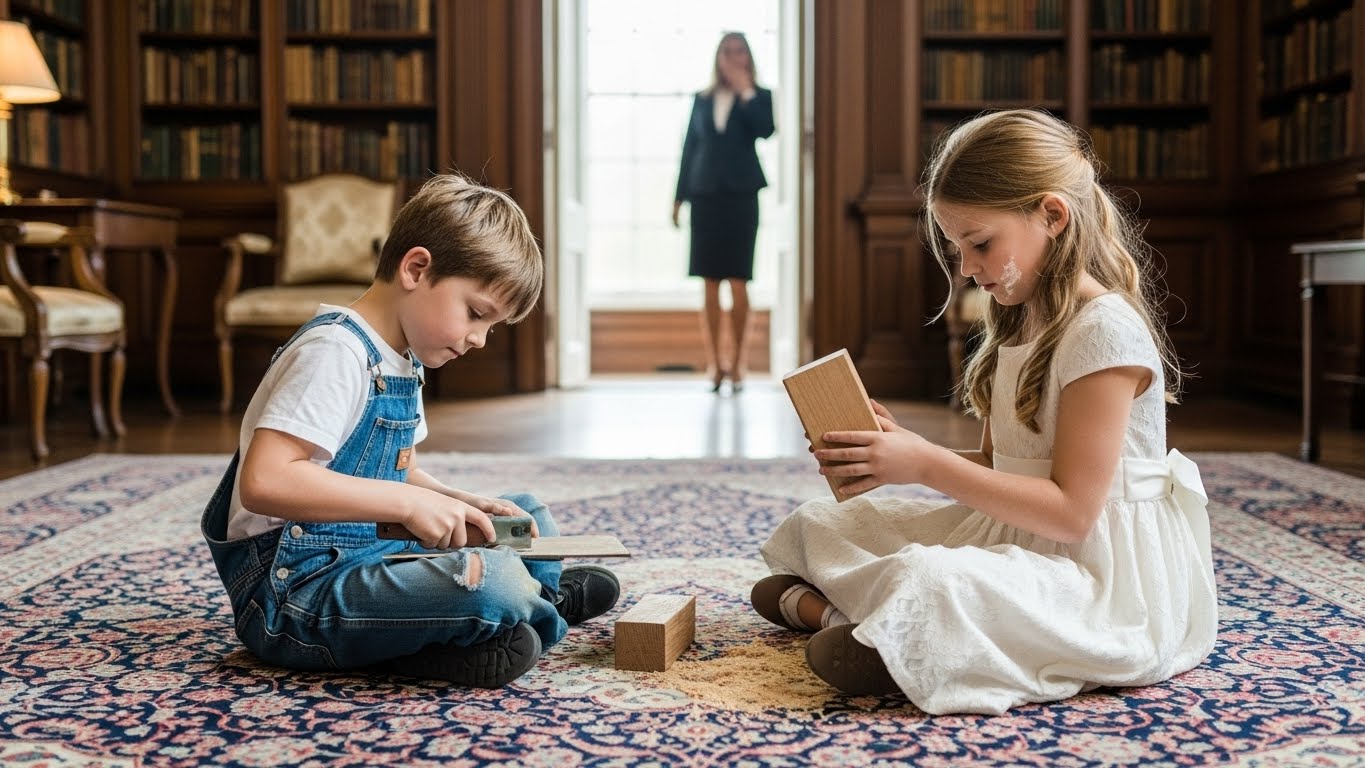
We set up in the hallway. I gave Raymond his spot—a small drop cloth in the corner, a safe distance from the power tools. He sat down cross-legged and pulled his project out of his bag.
It was a wooden horse. I’d cut the shape for him on the bandsaw, but he was doing all the sanding. It was rough, blocky, and looked more like a dog than a horse, but he was proud of it.
Ten minutes later, I felt the shift in the air.
I didn’t turn around. I just watched Raymond.
He stopped sanding. He looked up.
Violet was there.
She was wearing a blue dress today, with a stiff collar. The tattered rabbit was dangling from her left hand. She stood about ten feet away, just inside the shadow of the library door.
She was staring at Raymond.
Most kids would have said “Hi” or “What’s your name?”
But Raymond knew. He knew the rules of the Quiet Place.
He didn’t say a word. He just held up the wooden horse. He turned it slowly in the light, showing her the side he had smoothed down and the side that was still splintery.
Violet took a step. Then another.
She came until she was standing right in front of him. She towered over him while he sat, but she crouched down, her white dress pooling on the dusty floor.
She reached out a hand.
I held my breath. My grip on my hammer was so tight my knuckles turned white.
She didn’t touch the horse. She touched the sandpaper in Raymond’s hand.
Raymond smiled—not a big grin, but a small, knowing quirk of the mouth. He handed her the paper.
Then, he picked up a scrap piece of pine I’d left on the floor. He mimed rubbing it. Swish, swish.
Violet looked at the sandpaper. She looked at the horse. She looked at the rabbit in her other hand.
She placed the rabbit gently on the floor.
That was the first shock. Miranda had told me she never put the rabbit down. Ever.
She took the wooden horse in one hand and the sandpaper in the other. And she started to rub.
Scrape. Scrape. Scrape.
The sound was small, rhythmic, and incredibly loud in the silent hallway.
“That’s it,” I whispered to myself.
Suddenly, a shadow fell over us.
I looked up to the landing of the staircase above. Carolyn Bradford was standing there. She was gripping the railing, her knuckles white. She was staring down at her daughter—her mute, untouchable daughter—sitting on the floor with a carpenter’s son, covered in sawdust.
I braced myself. I expected her to scream. I expected her to kick us out.
But when I looked at her face, I didn’t see anger.
I saw a woman who was forgetting to breathe.
Carolyn watched as Raymond reached over and gently adjusted Violet’s hand, showing her how to go with the grain, not against it. Violet didn’t pull away. She leaned in.
For the first time in seven years, she wasn’t retreating. She was building.
“Mr. Hayes,” Carolyn’s voice drifted down from the balcony. It was weak, unrecognizable.
“Yes, ma’am?”
“Don’t stop,” she whispered. “Whatever you’re doing… don’t stop.”
I looked back at the kids. They were in their own world now. A world where words didn’t matter, where broken things could be fixed, and where silence wasn’t a cage—it was just a quiet room waiting to be filled.
But I knew this was just the beginning. The hard part wasn’t getting her to pick up the sandpaper.
The hard part would be what happened when the specialists found out we were breaking their rules. And what would happen when Violet finally decided to use her voice.
Because when you bottle something up for seven years, it doesn’t come out as a whisper. It comes out as an explosion.
And the Bradford estate was filled with things that could easily break.
Chapter 3: The War of Words
The truce lasted for exactly four days.
Four days of sawdust, silence, and the kind of peace that feels too fragile to hold.
Every afternoon, I’d pick Raymond up from school and drive the truck up that winding driveway. The security guard at the gate had stopped asking for ID; he just waved us through with a confused look, likely wondering why a billionaire’s estate needed a six-year-old apprentice every single day.
We fell into a rhythm. I worked on the library shelves. Raymond sanded scraps. And Violet… Violet existed.
She was no longer the ghost in the doorway. She was a presence. She sat on the drop cloth, her white dresses permanently dusted with fine pine powder. She didn’t smile, and she certainly didn’t speak, but she was there.
She had started organizing my tools. It was a small thing, but it was obsessive. When I set down a chisel, she would nudge it until it was perfectly parallel with the hammer. If I dropped a screw, she found it before it stopped rolling.
But on Friday, the real world came crashing back in.
I was up on a ladder, installing the upper molding, when the double doors swung open. It wasn’t Miranda.
It was a man in a suit that cost more than my house, followed by two assistants carrying clipboards and a video camera.
Dr. Sterling. I knew the name because Miranda had warned me. He was the “closer.” The specialist you called when everyone else failed. He charged a fortune and promised results.
“Mrs. Bradford,” Sterling boomed, his voice echoing unpleasantly in the high-ceilinged room. Carolyn followed him in, looking pale and nervous. “This environment is… counter-productive.”
He pointed a manicured finger at Raymond, who was showing Violet how to stack wood blocks.
“She is retreating into non-verbal play,” Sterling announced, walking over to the kids. “She is finding comfort in the silence. That is the opposite of what we want. We need to create a necessity for speech.”
I climbed down the ladder slowly. I didn’t like the way he was looming over them.
“Dr. Sterling,” Carolyn said, twisting her diamond ring. “Since she’s been down here, she’s been… calmer. More alert.”
“Calm is not the goal,” Sterling snapped. “Compliance is the goal. Vocalization is the goal.”
He crouched down next to Violet. She froze. The rabbit was tucked under her arm. She was holding a block of cedar in both hands, smelling it—something I’d taught Raymond to do to identify the wood.
“Violet,” Sterling said, his voice dropping to a sickly sweet tone. “That looks fun. Can you tell me what you’re holding?”
Violet didn’t move. She stared at the floor.
“I need you to say ‘wood’,” Sterling said. He held out his hand. “Give me the block, Violet.”
She gripped it tighter. Her knuckles turned white.
“Give it to me,” he commanded, his voice hardening. “You can have it back when you say ‘wood’.”
Violet began to tremble. It started in her shoulders and moved down to her hands. She looked at Raymond, panic flaring in her eyes. Raymond looked at me, terrified.
“Sir,” I said, stepping forward. “She’s working. Maybe let her finish?”
Sterling stood up and glared at me. “I was told there was a contractor here. I was not told he was offering clinical advice. Step back.”
He turned back to Violet. “This is exactly the problem. She has crutches.” He reached down. “Violet, give me the block.”
She pulled it against her chest.
“Fine,” Sterling said. “Then I’ll take the rabbit.”
The air left the room.
Even Carolyn gasped. “Dr. Sterling, the rabbit is—”
“The rabbit is a security blanket that allows her to remain an infant,” Sterling declared. He reached out and grabbed the tattered ear of the stuffed animal.
Violet’s reaction was instantaneous and violent. She didn’t scream. She didn’t cry out. She launched herself backward, scrambling across the floor like a trapped animal, her mouth open in a silent wail that was more haunting than any scream I’d ever heard.
She crashed into the leg of my ladder. Tools rattled.
“Violet!” Carolyn screamed, rushing forward.
But Sterling didn’t back off. “She needs to break through!” he yelled, moving toward her. “Don’t coddle her! She has to ask for it back!”
Violet was cornered against the wall. She was shaking so hard her teeth were chattering. Her eyes were rolled back in terror.
I didn’t think. I just moved.
I stepped between the billionaire specialist and the seven-year-old girl. I’m six-foot-two, and I’ve spent my life hauling lumber. I occupy a lot of space when I want to.
“Back off,” I said. My voice was low, dangerous.
Sterling stopped, blinking. “Excuse me? You are an employee. Get out of my way.”
“You touch her again,” I said, “and you’ll be leaving this room through the window.”
“Mrs. Bradford!” Sterling sputtered, turning to Carolyn. “Are you going to let a handyman threaten a medical professional?”
Carolyn was on her knees on the floor. She wasn’t looking at us. She was looking at her daughter.
Violet had curled into a ball, clutching the rabbit and the block of wood, rocking back and forth. Her face was buried in her knees.
Carolyn reached out a hand but didn’t touch her. She just hovered there, tears streaming down her face. She looked at the expensive doctor, then at her terrified child, and finally at me.
She saw Raymond standing next to Violet, his hand resting gently on her shoulder, not trying to fix her, just standing guard.
Something in Carolyn Bradford’s face hardened. The brittle glass turned into steel.
“Get out,” she said.
Sterling straightened his tie. “I understand this is emotional, but the protocol—”
“I said get out!” Carolyn screamed. It was a primal sound, stripping away all the polish and manners of her social standing. “Get out of my house! You’re firing her terrified! You’re not helping her!”
“You are making a mistake,” Sterling sneered. “She will never speak. You are enabling a cripple.”
“Get. Out.”
Sterling stormed out, his assistants scrambling behind him. The heavy doors slammed shut.
The silence that followed was different. It wasn’t peaceful. It was heavy with adrenaline and grief.
Carolyn slumped against the wall, sobbing into her hands. “I failed her,” she choked out. “I just keep failing her.”
I knelt down. Not to her, but to the kids.
“Ray,” I said softly. “Why don’t you show Violet how we put the tools away? It’s quitting time.”
Raymond nodded. He sat down next to the rocking girl. He didn’t say everything was okay. He didn’t tell her to stop crying.
He just picked up a screwdriver. “Phillips head,” he whispered. “Yellow handle.”
He placed it on the floor.
“Flat head,” he whispered. “Red handle.”
He placed it next to the first one.
Violet’s rocking slowed. She sniffled. She peeked out from her knees. Her eyes were red and swollen.
She watched Raymond place a third tool.
Slowly, shakily, she reached out one hand. She picked up the block of cedar she had fought so hard to keep. She placed it next to the screwdrivers.
Perfectly parallel.
I looked at Carolyn. She was watching them, her makeup ruined, her chest heaving.
“He didn’t make her talk,” I told her gently. “But he didn’t make her afraid, either.”
Carolyn looked at me, her eyes hollow. “I don’t know what to do anymore, Mr. Hayes. I fired the expert. I have no plan. I have nothing.”
“You have a daughter,” I said. “And she likes cedar. That’s a start.”
Chapter 4: The Language of Hands
The following Monday, I expected to be fired. Or at least, told not to bring Raymond.
Instead, when we arrived, there was a brand new, professional-grade workbench set up in the corner of the library. It was lowered, perfectly sized for children.
Miranda was waiting. She looked flustered. “Mrs. Bradford ordered it overnight. She… she wants you to teach them.”
“Teach them what?”
“Carpentry. Woodworking. Whatever it is you do that keeps her from screaming.”
I walked over to the bench. It was stocked with safety goggles, kid-sized aprons, and high-quality wood.
“She’s watching,” Miranda whispered, nodding toward the security camera in the corner of the ceiling. “Be careful.”
Violet appeared ten minutes later. She looked tired, pale, but when she saw the workbench, her step hitched. She walked over to it and ran her hand over the smooth surface.
Raymond threw his backpack down. “Whoa! Dad, look! A vise!”
For the next two weeks, the East Wing became a school. But not the kind Violet was used to.
There were no tests. No demands.
I taught them about grain. I taught them that wood is alive—it expands in the heat and shrinks in the cold. I taught them that you can’t force a knot to be smooth; you have to work around it.
Violet was a natural. She had a surgeon’s hands—steady and precise. While Raymond hacked away with enthusiasm, Violet sanded with meditation.
But the real shift happened on a rainy Wednesday.
I had brought the components for a small keepsake box. It was a puzzle box—you had to slide a panel to unlock it. It required precision.
I showed them how to glue the mitered corners. “You need just enough glue,” I explained. “Too much, and it’s messy. Too little, and it falls apart.”
I gave them each a set of clamps.
Raymond struggled immediately. “Dad, it keeps slipping!”
I helped him tight it.
Then I looked at Violet.
She had the four sides of the box arranged. She was trying to hold two corners together with one hand while tightening the clamp with the other. It was physically impossible for her small hands.
The wood slipped. It fell flat.
She picked it up again. She tried to balance it. It fell again.
I stayed where I was. “You got it,” I said, leaning against the wall. “Take your time.”
She tried a third time. Her frustration was mounting. I could see the tension in her jaw. She let out a huff of air through her nose—a sharp, annoyed sound.
It was the first sound she’d made that wasn’t a cry of terror.
She looked at the clamp. She looked at her hand. She looked at me.
She wanted help. But she knew the rules of the world—people help you when you ask. And she couldn’t ask.
She looked at Raymond. He was busy wiping glue off his pants.
She looked back at me. Her eyes were pleading.
I didn’t move. “I can’t read your mind, Violet. I don’t know what you need.”
It was a gamble. A cruel one, maybe. But I needed her to cross the bridge.
She stared at me, furious. She picked up the clamp and banged it on the table. Bang.
“I see you’re mad,” I said calmly. “But I still don’t know what you need.”
She glared at me. She opened her mouth. Her lips moved.
Nothing came out.
She squeezed her eyes shut. She took a deep breath, her chest rising and falling rapidly.
She opened her eyes and looked right at me. She held up the two pieces of wood. She pointed to the clamp.
And then, she tapped her chest.
Me.
Then she pointed to the clamp again.
It wasn’t a word. But it was language. It was a direct, intentional communication.
I walked over immediately. “You want me to hold it?”
She nodded. Once. Sharp.
I held the wood. She tightened the clamp.
When it was secure, she stepped back and looked at the box. It was square. It was solid.
She looked up at me, and the corner of her mouth lifted. Just a millimeter. But it was there.
“Nice work,” I said.
That evening, the library doors opened, and Carolyn Bradford walked in. She had traded her business suit for jeans and a cashmere sweater. She looked uncomfortable, like she was wearing a costume.
“Miranda said you were staining today,” she said, her voice tight.
“Yes, ma’am. Finishing the boxes.”
She looked at Violet, who was dipping a rag into a tin of dark walnut stain.
“Can I…” Carolyn hesitated. She looked terrified of rejection. “Can I try?”
Violet froze. She looked at her mother.
Usually, when Carolyn entered the room, Violet stiffened. She expected the questions. How was your day? Did you use your words?
But Carolyn didn’t ask a question. She just stood there, hands at her sides, looking vulnerable.
Violet looked at the stain, then at the extra rag on the bench.
She picked up the rag and held it out to her mother.
Carolyn’s breath hitched. She took the rag as if it were made of glass. She knelt down on the drop cloth—on her five-thousand-dollar jeans—beside her daughter.
“Show me,” Carolyn whispered.
Violet took her mother’s hand. She guided it to the can. She showed her how to dip just the tip of the cloth.
Then, she guided her mother’s hand to the wood.
They worked in silence for an hour. The billionaire and the mute girl, shoulder to shoulder, rubbing dark oil into pine.
When they were done, Carolyn’s hands were stained brown. She looked at them, mesmerized.
“It smells… earthy,” Carolyn said softly.
Violet looked at her mother’s dirty hands, then at her own. She reached out and touched Carolyn’s fingers.
Carolyn froze.
Violet traced the stain on her mother’s thumb. Then, she looked up.
She opened her mouth.
“Mmm,” she hummed.
It was a low, vibrational sound. Mmm.
Carolyn’s eyes widened. She looked at me, panic and hope warring in her face.
“Mmm,” Violet said again, louder this time. She pointed to the box.
“Mom,” Raymond said from the other side of the table. “She says it looks like mud.”
Carolyn let out a wet, choked laugh. Tears spilled over, tracking through the sawdust on her face. “It does,” she whispered. “It looks exactly like mud, baby.”
Violet didn’t smile, but her eyes crinkled at the corners. She leaned her head against her mother’s shoulder for one second. Just one. Then she pulled back and went to get more stain.
Carolyn sat there on the floor, covered in grime, weeping silently.
I started packing up my tools. I knew, right then, that we had turned a corner. The wall had a crack in it.
But cracks can be dangerous. If you push too hard, the whole thing collapses. And we were about to hit the hardest part of the project: The Clubhouse.
Because outside the safe walls of the library, the world was still loud, and cruel, and waiting to tell Violet she was broken. And I had a feeling the next test wouldn’t come from a doctor, but from something much closer to home.Chapter 5: The Fortress of Solitude
The library had become too small.
We had built boxes, birdhouses, and picture frames. The room was cluttered with sawdust and the smell of varnish. But more importantly, Violet was growing.
Not physically—though she did seem taller, less hunched—but her presence was expanding. She wasn’t just existing in the corners anymore. She was taking up space.
It was a Tuesday in July when Carolyn Bradford met me at the truck. She looked different. Her hair was in a loose ponytail, and she was wearing practical boots.
“I want to build something real,” she said, skipping the pleasantries. “Violet has been drawing. She spends all night drawing.”
She handed me a sketchbook.
I wiped my hands on my jeans and opened it. The drawings were incredible. They were architectural sketches—rough, but detailed.
It was a house. A small one. Raised on stilts.
“A treehouse?” I asked.
“A sanctuary,” Carolyn corrected. “She pointed to the old oak tree in the garden. She wants to build this. Can we do it?”
I looked at the sketch again. It wasn’t just a playhouse. It was a fortress. High walls, a retractable ladder, narrow windows. It was a place designed to keep the world out.
“It’s ambitious,” I said. “It’ll take weeks. And it’s outside. Violet doesn’t go outside.”
Carolyn looked toward the house. “She walked to the porch this morning. She stood there for ten minutes. She wants this, Trevor. She wants it enough to be brave.”
So, we started the Clubhouse Project.
The first day outside was brutal. Not because of the heat, but because of the exposure.
When Violet stepped onto the grass, she looked like a deer in the middle of a highway. She clutched the rabbit so tight I thought its head would pop off. She scanned the treeline, the sky, the distant fence.
Every bird chirp made her flinch.
Raymond, bless his heart, didn’t look at her. He marched straight to the oak tree with a tape measure.
“Dad!” he yelled. “This tree is fat! I can’t measure it!”
Violet watched him. She took a breath. Then another. She didn’t run back inside.
She walked over to the tree. She took the end of the tape measure from Raymond’s hand and walked around the trunk until they met on the other side.
They looked at the number together.
We broke ground that afternoon.
For the next month, the Bradford estate turned into a construction zone. But it was the quietest construction zone in history.
We didn’t use power tools when Violet was close—the noise was too much for her sensory issues. We used hand saws. Hammers. Screwdrivers.
It was slow, sweating work.
Carolyn was out there every single day. The billionaire heiress was hauling lumber. She hit her thumb with a hammer on day three, swore loudly, and then looked terrified that she’d upset Violet.
But Violet didn’t get upset. She looked at her mother’s throbbing thumb, went to the cooler, got an ice pack, and handed it to her.
It was a small gesture, but it nearly brought Carolyn to her knees.
By August, the structure was up. It was beautiful. Cedar siding, a shingled roof, a solid floor.
But as the walls went up, I noticed something concerning.
Violet insisted on closing it in.
The plans had small windows, but as we framed them, Violet would find scrap wood and cover them up. She wanted it dark. She wanted it sealed.
I tried to explain. “Violet, honey, you need light. If we board up the windows, it’s going to be a hot box in there.”
She shook her head violently. She grabbed a piece of plywood and held it over the window frame, her eyes wide and panicked.
She was building a coffin, not a clubhouse.
I looked at Raymond. He was frowning.
“It’s too dark,” Raymond said. “Monsters live in the dark.”
Violet froze. She looked at Raymond. She respected him.
She grabbed her sketchbook and flipped to a new page. She drew a jagged line. A monster? No.
She drew eyes. Dozens of them. Outside the house, looking in.
She was afraid of being seen.
I knelt down. “Violet. What if we put the windows high up? Skylights. So you can see the sky and the trees, but nobody can look in at you. Would that be safe?”
She thought about it. She looked at the roof. She looked at the sky.
She nodded.
We spent the next week installing skylights. When we were done, the clubhouse was flooded with light from above, but completely private from the ground.
On the day we finished, a summer storm rolled in. The sky turned bruised purple, and the wind whipped the oak branches.
We were cleaning up. Thunder cracked—a massive, ground-shaking boom.
Violet dropped to the grass, hands over her ears, screaming.
It was a silent scream—mouth open, face contorted, but no sound. It was terrifying to watch.
Carolyn rushed to her, wrapping her arms around her. “It’s okay! It’s just thunder! We need to go inside!”
But Violet wouldn’t move. She was paralyzed.
Then, the rain started. A torrential downpour.
We were getting soaked. I grabbed the tarp to cover the tools.
Suddenly, Violet broke free from her mother. She didn’t run to the mansion. She didn’t run to safety.
She ran to the clubhouse ladder.
“Violet!” Carolyn screamed.
Violet scrambled up the ladder, slippery with rain. She disappeared inside the fort.
“Go!” I yelled to Carolyn. “Go up there!”
Carolyn climbed up. I followed with Raymond.
We tumbled into the clubhouse, dripping wet.
Inside, it was dry. The skylights drummed with the sound of the rain—a deafening, chaotic noise.
I expected to find Violet in the corner, catatonic.
Instead, she was standing in the middle of the room, looking up at the skylights. She was watching the rain hit the glass. She was smiling.
She was safe. She had built a place where the storm couldn’t touch her.
She looked at us—three dripping intruders—and then pointed to the dry floor. Sit.
We sat. We waited out the storm in the house that silence built.
And as the thunder rolled away, leaving just the soft patter of rain, I realized that Violet wasn’t broken. She was just fortifying. And she had finally let us inside the walls.
Chapter 6: The Unthinkable Revelation
The clubhouse changed everything.
It became their territory. Adults were allowed by invitation only.
Violet began to spend hours in there. She brought in rugs, pillows, and her books. She even brought a battery-powered lantern.
But the silence remained.
She hummed. She laughed—a rusty, quiet sound that startled everyone the first time it happened. She clicked her tongue. But no words.
The experts—the ones Carolyn still consulted secretly over the phone—said that was it. That was the ceiling. She’s comfortable, but the neural pathways for speech are atrophied. Accept the non-verbal communication.
I didn’t buy it. And neither did Raymond.
It happened on a humid Saturday in late August. The air was thick and heavy.
We were in the clubhouse. Violet was drawing. Raymond was whittling a stick. I was fixing a loose hinge on the trapdoor.
Raymond stopped whittling. He looked at Violet.
“Why don’t you talk?” he asked.
It was the question nobody was allowed to ask. Carolyn would have had a heart attack if she heard it.
Violet didn’t look up. She kept drawing.
“I know you can,” Raymond pressed. “I heard you hum. Your throat works. So why no words?”
Violet’s hand stopped moving. She gripped the pencil so hard it snapped.
She looked at Raymond. Her eyes were dark, filled with a sudden, sharp anger.
Raymond didn’t back down. “I stopped talking because I thought if I spoke, I’d forget my mom’s voice. I thought if I let new words out, the old memories would fall out.”
I stopped working on the hinge. I stared at my son. He had never told me that.
“That’s why I was quiet,” Raymond said softly. “I was holding her in.”
Violet turned her body fully toward him. The anger in her eyes melted into something much more painful. Recognition.
She reached for a fresh sheet of paper.
She drew frantically. The scratching of the charcoal pencil was loud in the small space.
She drew a car. But it wasn’t like a kid’s drawing. It was twisted. Smashed.
She drew jagged lines coming out of the car. Not fire. Sound.
She drew a little stick figure in the back seat. And she drew a big mouth on the stick figure. Screaming.
She shoved the paper at Raymond.
Raymond looked at it. He traced the jagged lines.
“It was loud?” he asked.
Violet nodded. Tears started to track through the dust on her cheeks.
“You were screaming?” Raymond asked.
Violet shook her head. She pointed to the mouth again. Then she pointed to the smashed car.
She grabbed the pencil again. She drew a speech bubble coming from the little girl’s mouth. Inside the bubble, she drew a jagged lightning bolt hitting the driver.
I felt a chill run down my spine.
“You think…” Raymond whispered. “You think you did it?”
Violet froze. She looked at me, then back at Raymond.
She nodded.
She thought her voice had caused the accident. She thought that by screaming, or talking, or distracting her father, she had killed him.
“Oh, honey,” I whispered, my heart breaking.
“That’s why you don’t talk,” Raymond said, his voice matter-of-fact. “You think words are weapons. You think if you speak, you’ll break something else.”
Violet wrapped her arms around herself, rocking back and forth. The secret was out. The monster wasn’t under the bed; the monster was in her throat.
Raymond moved closer. He took her hands. She tried to pull away, but he held on.
“You’re wrong,” Raymond said.
Violet glared at him.
“My dad breaks things all the time,” Raymond said. “And he fixes them. But words don’t break cars, Violet. Cars break cars.”
He looked at me. “Tell her, Dad.”
I moved across the floor on my knees. I didn’t touch her. I just looked her in the eye.
“Violet,” I said, my voice thick. “Your mom told me about the accident. It was ice. Black ice on a bridge. The car spun. It wasn’t noise. It wasn’t a distraction. It was just… ice.”
She looked at me, searching for the lie.
“You could have been screaming at the top of your lungs,” I said. “Or you could have been sleeping. It would have happened anyway. Your voice isn’t a bomb.”
She began to cry. Not the silent, tear-streaked crying she usually did. This was different. Her chest was heaving. Her mouth was open. She was gasping for air.
She was hyperventilating.
“Breathe,” Raymond said. “Just breathe.”
She grabbed Raymond’s shirt. She buried her face in his shoulder.
And then, I heard it.
A sound.
It started as a whimper. A low, guttural croak. It sounded painful, like a rusty gate being forced open after years of being welded shut.
“Ssss…”
I froze.
She pulled back from Raymond. She looked at him, her face wet, her eyes red. She fought the air. She fought the muscles in her throat that had been tight for seven years.
“Ssss… ca…”
She squeezed her eyes shut. She punched her own leg in frustration.
“Take your time,” I whispered.
She took a massive, shuddering breath. She looked right at Raymond.
“Scared,” she rasped.
The word was barely a whisper. It was cracked and dry. But it was a word.
Scared.
“I know,” Raymond whispered back. “I know you’re scared.”
“Scared,” she said again, louder this time. The sound of her own voice seemed to shock her. She put her hand to her throat to feel the vibration.
“Scared… I… scared.”
The trapdoor pushed open. Carolyn’s head popped up. “I brought lemonade, I—”
She stopped. She saw Violet’s face. She saw the tears.
“What happened?” Carolyn asked, panic rising in her voice. “ is she hurt?”
Violet turned to her mother.
She didn’t run to her. She stayed seated, grounding herself with her hands on the wooden floor she had built.
She looked at the woman who had spent millions of dollars trying to fix her. The woman who had loved her through the silence.
Violet took a breath.
“Mom,” she croaked.
Carolyn dropped the pitcher. Lemonade and ice crashed onto the grass below.
She didn’t move. She couldn’t. She looked like she had been shot.
“Mom,” Violet said again. It was stronger now. “Scared.”
Carolyn scrambled up into the clubhouse. She crawled across the floor and collapsed in front of her daughter. She didn’t grab her. She just bowed her head to the floor and sobbed.
“I know, baby,” Carolyn wept. “I know. I’m here.”
Violet reached out and placed her hand on her mother’s head.
“Not… broken,” Violet whispered.
Carolyn looked up, her face a mask of awe. “No. No, you’re not broken. You never were.”
I sat back against the wall and watched them. Raymond leaned against me, exhausted.
“I told you she could talk,” Raymond whispered to me.
“You did, kid,” I said, kissing the top of his head. “You did.”
The silence was broken. Not by a doctor, not by a pill, and not by a miracle.
It was broken by a boy who knew that sometimes, the only way to get someone to speak is to stop asking them to, and just sit with them in the dark until they’re ready to turn on the light.
But as I watched them, I knew the story wasn’t over. Because finding your voice is one thing. Using it to face the world—that’s a whole different battle. And Violet had seven years of things to say.