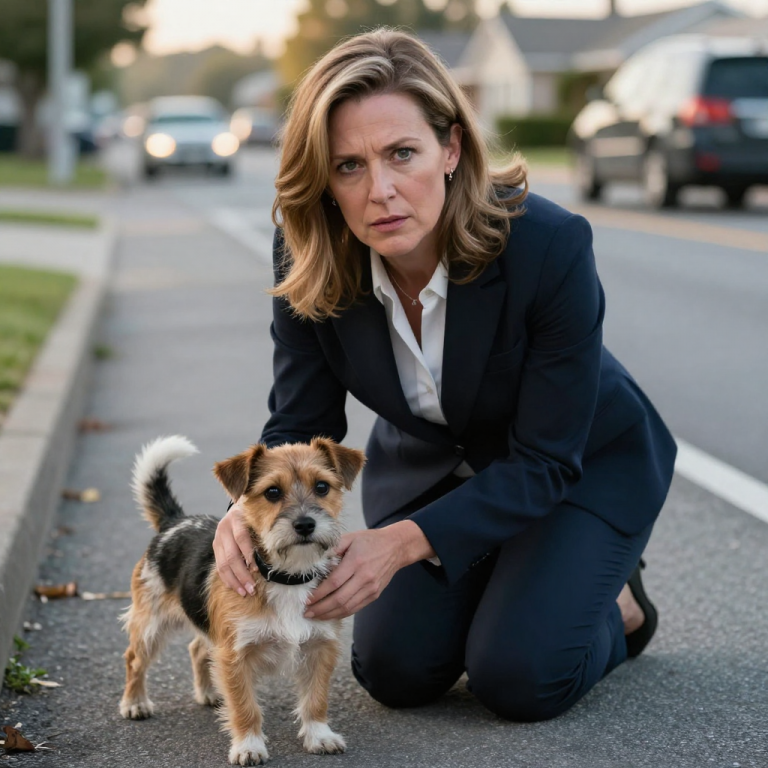
The Pilot Was Dead. The Gear Was Destroyed. The Enemy Was Closing In. So She Climbed a 3,000-Foot Vertical Cliff With Her Bare Hands.
PART 1
Chapter 1: The Burning Snow
The smell of JP-8 jet fuel is distinct. It’s oily, heavy, and once it gets in your nose, it tastes like cancer. That was the first thing I registered as I regained consciousness. The second was the cold. It was the kind of Balkan cold that doesn’t just freeze your skin; it hunts for your bones.
I tried to sit up and immediately screamed. My left side felt like it had been hit by a sledgehammer. Broken ribs. At least two. I did a quick tactical assessment, forcing the pain into a mental box and locking the lid.
“Sound off!” I rasped into the dark.
Silence. Just the howling wind and the crackle of the burning fuselage fifty yards down the slope.
I crawled toward the wreckage. Pilot? Dead. Co-pilot? Gone. The fuselage had split open like a ripe melon. My gear bag—the one with the ropes, the ascenders, the pitons—was gone, likely tumbling into the ravine below.
I grabbed the radio handset hanging from the twisted metal. “Command, this is Sierra-One. Bird is down. Crew is KIA. Equipment lost.”
The static hissed, then the voice of Colonel Banks came through, sounding tinny and distant. “Sierra-One, copy. We have heat signatures converging on your location. Enemy patrols are moving up from the valley floor. Estimated contact: twenty minutes. We cannot get a bird in there. The weather has zeroed out. You are on your own for twelve hours.”
“What about the objective?” I asked, looking up at the towering peak above me. The radar station was up there, sitting on the “Devil’s Crown,” a plateau at 14,000 feet.
There was a pause. “Mission is scrubbed, Parker. Evasion and survival are your priorities. Find cover.”
I looked down the mountain. I saw them. Pinpricks of light moving in a tactical line. They were hunting. If I stayed here, or if I tried to go down, I’d be outnumbered fifty to one in deep snow.
I looked up.
The north face of the mountain loomed above me. It was a vertical slab of granite, slick with verglas—a thin coating of ice. It was a 3,000-foot technical climb. Climbers train years to do routes like this with ropes and support.
I had tactical gloves and a knife.
“Negative, Command,” I whispered. “Going up.”
Chapter 2: The Impossible Route
“Parker, repeat?” The radio squawked. “Do not attempt the ascent. You have no gear.”
I turned the radio off. Arguing would just waste battery and give away my position.
I stood up, the pain in my ribs flaring white-hot. I tightened the straps of my plate carrier. It was heavy, but it would keep me warm. I checked my weapon. My rifle was bent, useless. I unholstered my Sig Sauer P320. Two mags. That was it.
I walked to the base of the rock face. It looked even worse up close. It was smooth, cold, and unforgiving.
The enemy patrols were getting closer. I could hear their voices now, shouting in Serbian. They had dogs. I could hear the barking echoing off the canyon walls. Dogs could track me in the snow. They couldn’t track me up a cliff.
I found a small fissure in the rock, about the width of my fingers. I took a breath. The air at 11,000 feet is thin. My lungs burned.
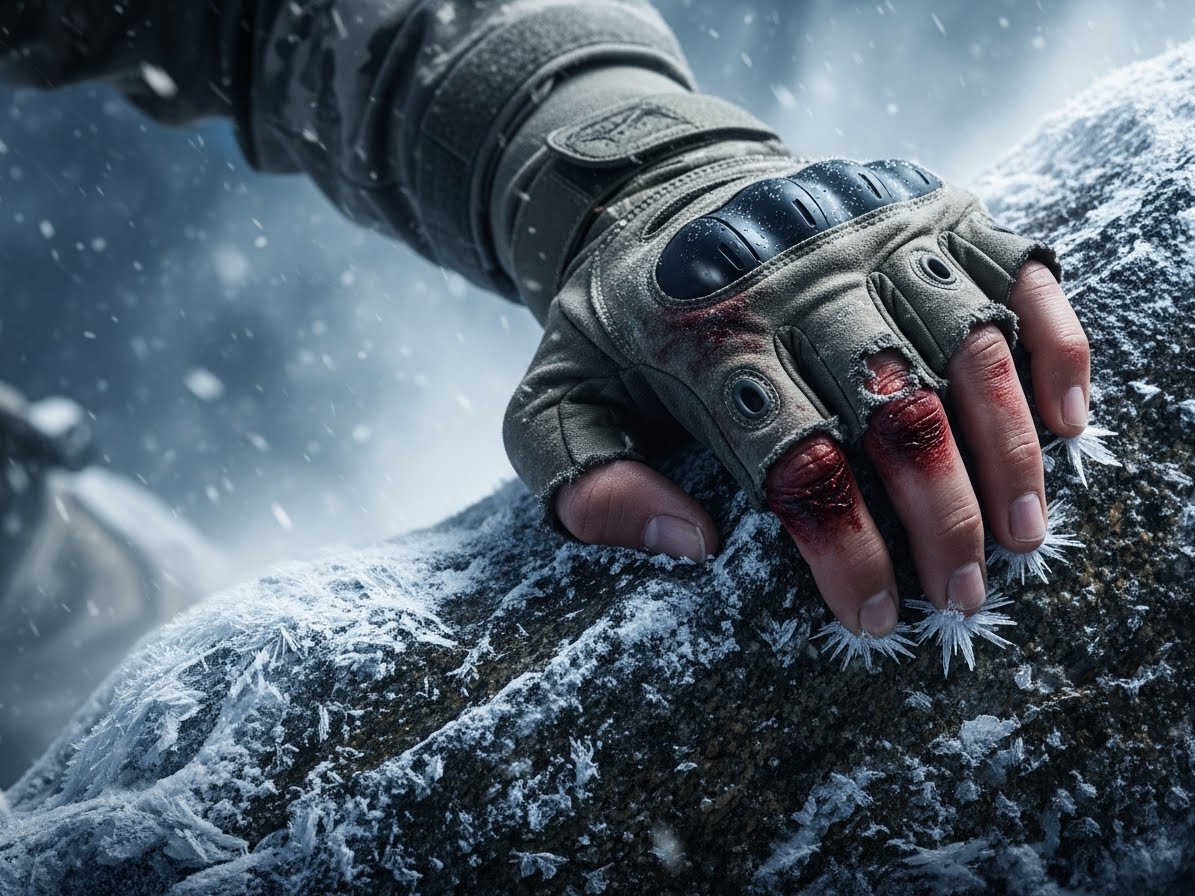
I jammed my gloved fingers into the crack. I pulled.
Pain shot through my shoulder, but I lifted my feet off the ground. I found a toehold—a tiny nub of rock barely an inch wide. I stepped up.
I was three feet off the ground. Then six. Then ten.
The wind picked up, trying to peel me off the wall. I focused on the rock. It was a puzzle. Left hand to the crimp. Right foot to the smear. Don’t look down. Don’t think about the ribs.
Thirty minutes later, I was a hundred feet up. I paused on a small ledge, pressing my cheek against the freezing stone to catch my breath.
Below me, the crash site was swarming with soldiers. I watched them circle the wreckage. One of them pointed a flashlight up the cliff face. The beam swept over the rock, missing me by inches. I held my breath, becoming part of the mountain.
He lowered the light. They assumed I had fled downhill or died in the ravine. They didn’t think anyone was crazy enough to climb the North Face at night.
They were wrong.
PART 2
Chapter 3: The Dead Zone
At 12,000 feet, the rules of biology start to change. The air gets so thin that your brain starts to starve. It’s called hypoxia. It starts with a headache, then confusion, then you just drift away.
I was two hours into the climb. My hands were numb claws. I couldn’t feel the rock anymore; I just had to trust that my muscles were doing what I told them to.
The route had turned into a nightmare. I was in a chimney—a narrow vertical crack where I had to wedge my back against one wall and my feet against the other, shimmying up inch by inch.
My broken ribs screamed with every movement. The pressure of expanding my chest to breathe was agony. I was hallucinating. I kept seeing movement in my peripheral vision. I thought I saw my dad, sitting on a ledge, smoking his pipe, telling me I was holding the flashlight wrong.
“Focus, Adeline,” I muttered to myself. The wind snatched the words away.
I reached a section of black ice. Water had trickled down during the day and frozen solid at night. It was a sheet of glass. Without ice axes or crampons, it was impassable.
I looked down. The crash site was a tiny orange dot now. If I fell, I wouldn’t even feel the impact. I’d have ten seconds of freefall to regret my life choices.
I pulled out my combat knife. It was a Ka-Bar, strong steel.
I slammed the knife into the ice above my head. It chipped, but didn’t stick.
I slammed it again. Harder. It bit in about half an inch.
I grabbed the handle with both hands and pulled. The knife held. I kicked my boot into the ice, smashing the toe against the wall until I made a tiny dent.
I climbed the ice sheet like that—stabbing the knife, kicking the wall, pulling up. Stab. Kick. Pull.
Twenty feet of ice. It took me an hour.
Chapter 4: The Crux
I hit the crux of the climb at 0400 hours. The crux is the hardest part of a route.
It was an overhang. The rock jutted out over open air. To get past it, I had to hang by my fingertips, swing my legs out over the void, and pull myself up and over a lip of rock I couldn’t even see.
I hung there, my arms shaking uncontrollably. My energy was gone. I had burned every calorie I had.
“I can’t,” I whispered. Tears froze on my cheeks. “I can’t do it.”
I looked at the drop. It was seductive. It would be so easy to just let go. The pain would stop.
Then I remembered the mission. The radar jammer. If I didn’t disable it, the morning air raid would be flying blind. My platoon, coming in on the second wave, would be shot out of the sky.
It wasn’t about me. It never was.
I screamed—a primal, guttural roar that echoed off the rocks. I channeled every ounce of rage and fear into my shoulders.
I lunged.
My left hand slapped the rock above the overhang. My fingers found a grip. My feet swung out, dangling over 2,000 feet of nothing. I pulled. I gritted my teeth so hard a molar cracked.
I hauled my chest over the lip. I rolled onto a flat ledge, gasping like a fish out of water.
I lay there for ten minutes, watching the stars spin. I had done it. I was through the hard part.
Chapter 5: The Wolf’s Den
I crested the summit ridge at dawn. The sun was painting the sky in violent shades of red and orange.
The plateau was flat and wind-scoured. And there, five hundred yards away, was the objective.
It was a small concrete bunker with a massive rotating radar dish on top. There were guards—two patrolling the perimeter, smoking cigarettes, looking down into the valley. They were watching the roads, the trails. They weren’t watching the cliff edge.
I was a ghost. I was covered in grey dust and ice. I blended perfectly with the terrain.
I crawled forward, low-crawling through the snow. My ribs were on fire, but the adrenaline was back.
I reached the perimeter fence. It was chain-link, topped with razor wire. I used my multitool to cut a hole near the ground.
I slipped inside.
I didn’t have C4. I didn’t have grenades. How was I going to destroy a military-grade radar system with a knife and a pistol?
I made my way to the generator shed behind the bunker. It was humming loudly.
I opened the door. Empty.
I looked at the massive diesel generator powering the site. I looked at the fuel lines.
I took my knife and slashed the fuel line. Diesel sprayed out onto the hot engine block.
Then, I took the flare gun from my survival vest. I had saved it.
I stepped back out the door. I aimed the flare gun into the shed, right at the pooling fuel.
Chapter 6: The Signal
KA-WOOM.
The explosion was satisfying. The generator shed went up in a ball of flame. The radar dish on the bunker stopped spinning instantly. The lights in the compound died.
Panic.
The guards were shouting, running toward the fire.
I wasn’t done. I moved to the comms tower. I cut the cables at the base.
Then I heard it. The sound of a helicopter. Not the enemy. Ours.
The air raid.
Without the radar jamming them, the Apaches were inbound.
“Sierra-One to Airwolf,” I clicked my radio back on. “Objective neutralized. Radar is down. I repeat, radar is down.”
“Sierra-One!” The pilot’s voice was incredulous. “We thought you were KIA! We see the explosion. Good effect on target. Where are you?”
“I’m on the roof,” I said. “North side of the plateau.”
“We can’t land there, Parker. It’s too hot. We can drop a rope, but you have to hold that position for five minutes while we clear the AAA (Anti-Aircraft Artillery).”
Five minutes.
The guards had spotted me. They realized the sabotage came from inside the wire. They were turning away from the fire and running toward me.
Chapter 7: The Last Stand
I took cover behind a concrete barrier near the cliff edge.
I had fourteen rounds in my pistol. There were six guards charging me with AK-47s.
I took a deep breath. The hypoxia made everything feel dreamlike.
Pop-pop.
The first guard dropped.
The others dove for cover. They started suppressing me. Bullets chipped the concrete inches from my head.
“Come on!” I yelled, firing blindly over the barrier.
I checked my mag. Empty.
I reloaded. Seven rounds left.
A guard tried to flank me. I waited until he was ten feet away.
Pop.
He fell.
Five rounds left.
An RPG hit the ground twenty feet away. The concussion threw me back toward the cliff edge. My ears were bleeding.
I looked up. The Apache was there. It was a beautiful, ugly beast of war hovering fifty feet above me.
The chaingun under the nose spun up.
BRRRRRRRRRRT.
The ground in front of me erupted as 30mm rounds turned the remaining guards into mist.
A rope dropped from the side of the helicopter.
“Grab the line!” the crew chief screamed over the PA.
I holstered my weapon. I grabbed the rope. I didn’t have a harness. I just wrapped my arms and legs around it in a death grip.
The helicopter pulled up, banking hard.
Chapter 8: The Parker Route
I swung out over the valley. I looked down.
I saw the cliff face I had climbed. From the air, it looked impossible. It looked like a wall of glass.
I saw the burning wreckage of my original helicopter, miles below.
I held onto that rope until my muscles seized. They dragged me into the cabin and I collapsed on the floor.
The crew chief looked at me. He looked at my bloody hands, my torn uniform, the wild look in my eyes.
“Where the hell did you come from?” he yelled over the rotor noise.
I pointed at the mountain. “The basement,” I wheezed.
I spent three weeks in the hospital. Two broken ribs, a fractured clavicle, severe frostbite on three fingers, and exhaustion.
When I got out, Colonel Banks called me into his office.
“The intelligence you enabled us to gather from that site saved the entire offensive,” he said. “But the climbers… the mountain warfare guys… they want to know something.”
“Sir?”
“They went back to survey the site. They looked at the North Face. They said it’s a 5.12d grade climb. They said nobody climbs that free-solo. Especially not at night. Especially not injured.”
I looked at my scarred hands. I couldn’t feel the tips of my fingers anymore.
“I didn’t have a choice, Sir,” I said. ” Gravity doesn’t negotiate.”
They named the route after me. “The Parker Route.” To this day, nobody has repeated it. They say it’s suicidal.
They’re right. But sometimes, when the fire is at your back and the enemy is at your door, suicidal is the only option you have left.
The End.