I Found A Bag With $50,000 And A Hitman’s Photo In A Chicago Alley. I Called The Number Inside, And The Voice That Answered Told Me I Was Already A Dead Man Walking.
PART 1
Chapter 1: The Gold in the Garbage
If you’ve never felt the Chicago wind cut through three layers of thrift-store flannel at 2:00 AM, you don’t know what cold is. It’s a physical weight. It pushes you down, compressing your lungs until every breath feels like inhaling shattered glass. I was huddled behind a dumpster in an alleyway off Michigan Avenue, trying to stay out of sight of the late-night patrol cars.
I wasn’t looking for trouble. I was looking for leftovers. The high-end steakhouses in this district usually threw out perfectly good rolls, bruised vegetables, or half-eaten cuts of meat if you timed it right. It’s a humiliating ritual, digging through the excess of the wealthy just to stop the gnawing ache in your stomach, but pride doesn’t keep you warm.
But that night, I didn’t find food.
I found a bag.
It wasn’t a trash bag. It wasn’t a discarded grocery sack. It was a thick, heavy, cognac-colored leather clutch. It sat perched on top of a heap of black garbage bags, looking violently out of place among the grime and the slush—pristine, expensive, polished. It looked like something that fell out of a Bentley and didn’t belong in my world.
I should have walked away. That’s the first rule of the street: If it looks too good, it’s a trap. If it looks expensive, someone is looking for it. But hunger makes you stupid. Hunger bypasses the logic centers of your brain and hotwires your desperation.
I reached out, my fingerless gloves gripping the cold leather, and pulled it toward me.
It was heavy. Heavier than a bag that size should be. It felt dense, solid.
I scuttled deeper into the shadows, wedging myself behind a stack of broken wooden pallets to block the wind. I unzipped it. The streetlamp at the end of the alley flickered, buzzing like an angry hornet, casting just enough yellow light for me to see inside.
My heart actually stopped. I swear, for a second, the blood just sat still in my veins.
Stacks. Bricks. Whatever you want to call them. Rows of hundred-dollar bills, banded tightly in purple wrappers. I’d never seen that much money in real life. I’d never even seen that much money in movies. It had to be fifty grand. Maybe a hundred.
My hands started to shake, and not from the cold. My vision blurred.
My first instinct was panic. Pure, unadulterated terror. You don’t find this kind of money. You steal it, or you inherit it, or you earn it through illicit means. You don’t find it behind a dumpster unless someone hid it there. And if someone hid it, they were coming back.
I went to zip it back up, my breath coming in short, terrified clouds, when something hard clattered against the other contents. I paused. Curiosity is a dangerous thing, but I couldn’t help it.
I reached in past the cash and pulled out a heavy, matte-black hard drive. It was military-grade, rubberized and rugged. And underneath that, a single photograph.
It was a printed surveillance shot, grainy and black-and-white. It showed a man getting into a car—a politician, maybe? A CEO? He looked important. But across the man’s face, someone had drawn a thick, violent red ‘X’ in marker.
I shoved the photo back in as if it had burned my fingers. My stomach twisted into knots. This wasn’t just lost property. This was a hitman’s payout. Or a bribe. Or blackmail. This was something way above my pay grade.
I needed to leave. Now. But my legs wouldn’t move. I was starving. I had three dollars and forty cents in my pocket. This bag was a ticket to Florida, to a warm bed, to food that wasn’t scavenged. It was a life where I didn’t have to sleep with one eye open.
“Hey!” a voice boomed from the mouth of the alley.
I froze. A silhouette stood there, backlit by the harsh streetlights. Tall. Broad. Wearing a long coat. He was holding something in his hand that definitely wasn’t a flashlight.
Chapter 2: The Devil’s Number
I didn’t wait to see who it was. I didn’t wait to see the gun or the knife or whatever was in his hand. Adrenaline, that ancient survival drug, kicked my legs into gear.
I scrambled up the fire escape ladder to my left, the rusty metal screaming and groaning against the silence of the night.
“Stop!” the voice roared. It wasn’t a request. It was a guttural bark. Footsteps pounded against the wet pavement below. Heavy boots. Fast. He was running toward the ladder.
I hauled myself onto the first landing, the leather bag clutched to my chest like a shield. I didn’t look down. I climbed. Second floor. Third floor. The wind whipped my face, stinging my eyes, bringing tears that instantly froze on my cheeks. I vaulted over the parapet onto the roof and sprinted.
I knew these roofs. Being homeless in Chicago teaches you the geography of the invisible city—the steam tunnels, the underpasses, and the rooftops where the cops rarely look. I knew where the gaps were, where the maintenance bridges connected the old brick buildings.
I ran until my lungs burned and my legs felt like jelly. I didn’t stop until I was four blocks away, collapsing behind a massive industrial HVAC unit on top of an old warehouse.
I gasped for air, hugging the bag, listening.
Silence returned to the city. No footsteps. No shouting. Just the rhythmic hum of the ventilation fan and the distant, mournful wail of a siren heading toward the South Side.
I sat there for an hour, shivering violently. The adrenaline was fading, leaving behind the cold and the fear. Finally, when I was sure I hadn’t been followed, I opened the bag again.
I ignored the money this time. The cash felt cursed now. I looked for an ID. Anything to tell me who I had just stolen from.
There was no wallet inside. No driver’s license. Just the cash, the drive, the photo with the red X, and a single, heavy card stock rectangle tucked into a side pocket.
I pulled it out. It was black with gold embossing. No name. No address. Just a logo—a stylized hawk gripping a lightning bolt—and a phone number handwritten in silver ink on the back.
My hands trembled as I pulled out my burner phone. It was a cracked Android with a battery that barely held a charge. I had maybe ten minutes of airtime left on my prepaid plan.
Don’t do it, Jax, a voice in my head warned. It was the voice of survival. Take a few bills, ditch the bag in a sewer, and run. Disappear.
But the photo with the red X haunted me. If this was blood money, and I spent it, I was part of it. And if they had surveillance photos of that guy, they probably had surveillance of the alley. They’d find me. A kid in a distinct green beanie and an army surplus jacket isn’t hard to spot in this neighborhood.
The only way out was to give it back and pray for mercy. Or maybe… maybe there was a reward. A legitimate reward for being an “honest citizen.”
I dialed the number.
It rang once.
“Speak,” a voice answered.
It wasn’t a question. It was a command. The voice was deep, calm, and terrified me more than the shouting man in the alley. It sounded like money. It sounded like power.
“I… I found your bag,” I stammered. My voice sounded tiny, pathetic against the wind.
Silence on the other end. It stretched for five seconds, ten seconds. I could hear typing in the background.
“Describe the bag,” the man said.
“Leather. Cognac. Heavy,” I whispered. “There’s… there’s a lot of cash inside. And a photo. And a drive.”
“Who is this?”
“Just a kid. I’m nobody. I’m homeless. I just want to give it back. I don’t want any trouble.”
“You have no idea what trouble is, son,” the voice said, the tone shifting from cold to something darker, almost amused. “But you’re about to find out. Listen to me very carefully. You are currently holding the detonator to a bomb that will level this city’s administration. Do not open the drive. Do not spend a dollar.”
“I won’t,” I said, tears pricking my eyes. “I just want to give it to you.”
“There is a coffee shop on Wacker Drive. The ‘Midnight Grind’. It’s closed, but the side door is unlocked. Be there in twenty minutes. Alone.”
“And if I don’t come?”
“Then the man in the photo won’t be the only one with an X on his face.”
The line went dead.
I looked at the phone, then at the bag. Twenty minutes. Wacker Drive was a mile away.
I stood up. My knees cracked. I was walking into a trap. I knew it. Every instinct screamed at me to run the other way. But running felt like a guarantee of death. The man on the phone sounded like he had eyes everywhere. At least the meeting gave me a chance to explain, to show I hadn’t taken anything.
I tucked the bag inside my jacket, zipped it up to my chin to hide the bulge, and started climbing down the fire escape.
I didn’t know it then, but I wasn’t just walking to a coffee shop. I was walking into the middle of a war between the most dangerous men in Chicago. And I was the only witness.
PART 2
Chapter 3: The Lion’s Den
The walk to Wacker Drive felt like a funeral procession of one. The wind off the Chicago River was vicious, whipping sleet into my eyes, but I barely felt it. My entire body was numb, vibrating with a cocktail of terror and adrenaline. I kept my hand inside my jacket, clutching the bag, my knuckles white.
Every car that passed seemed to slow down. Every shadow stretched out to grab me. Paranoia isn’t just a feeling when you live on the streets; it’s a survival mechanism. But tonight, the dial was turned up to eleven.
I saw the sign for “The Midnight Grind” flickering about half a block down. It was tucked into the base of a massive glass skyscraper, a dark little hole in the wall surrounded by corporate giants. True to the voice on the phone, the main lights were off, but a faint amber glow spilled from the back.
I hesitated at the corner. This was it. The point of no return. I could still turn around, toss the bag in the river, and disappear into the Lower Wacker tunnels. I knew guys down there who hadn’t seen the sun in years. I could be one of them.
But the image of the red ‘X’ on the photo flashed in my mind. If these people could mark a man in a suit for death, they could find a homeless kid in a tunnel.
I walked to the side door. It was heavy steel, painted black. I reached out, my hand trembling, and pushed.
It swung open silently.
The smell hit me first—roasted coffee beans, stale cinnamon, and something sharp, like antiseptic or gun oil. The shop was empty, chairs stacked upside down on tables. The only light came from a single bulb hanging over a corner booth in the back.
And sitting there was the man.
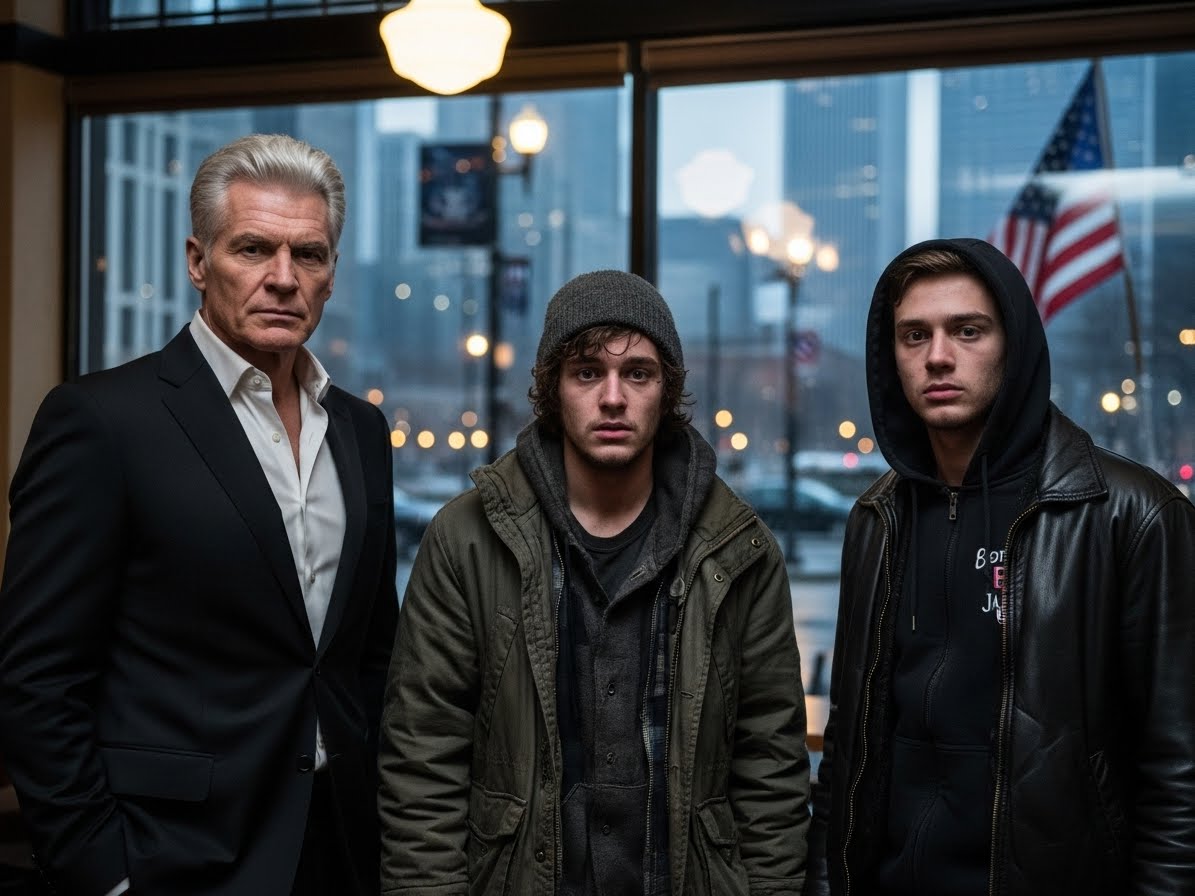
He didn’t look like a thug. He didn’t look like a gangster. He looked like he owned the bank that owned the building. He was older, maybe mid-fifties, with silver hair swept back immaculately. He wore a black suit that cost more than everything I had ever touched in my life combined. His hands were folded on the table, calm, still.
“Close the door, Jax,” he said.
I froze. “How do you know my name?”
“I know a lot of things,” he replied, his voice smooth and deep, resonating in the empty room. “I know you were arrested for shoplifting a sandwich two years ago. I know you dropped out of high school three months before graduation because your foster father started drinking again. I know you’ve been sleeping behind the library on State Street.”
My blood ran cold. “Who are you?”
“Sit.” He gestured to the empty chair opposite him.
I walked forward slowly, my boots squeaking on the polished concrete floor. I didn’t sit. I stood by the table, keeping the table between us. I pulled the bag out of my jacket and placed it on the wood.
“Here,” I said, my voice cracking. “It’s all there. I didn’t take a dime.”
He looked at the bag, then up at me. His eyes were gray, like the winter sky, and completely unreadable. He reached out and unzipped the bag. He didn’t count the money. He didn’t check the drive. He just rested his hand on the leather.
“You looked inside,” he stated. It wasn’t a question.
“I… the zipper was loose,” I lied.
“Don’t lie to me, Jax. It insults us both. You saw the money. You saw the drive. And you saw the photograph.”
I swallowed hard. “I saw a picture. I don’t know who it is. I don’t care.”
“You should care,” he said softly. “Because the man in that photograph is the District Attorney. And the man who wants him dead is currently tearing apart the alleyway where you found this.”
He stood up then, towering over me. He picked up the bag and walked behind the counter. He pulled out a tablet and connected a cable from the bag’s lining to the device.
“You think you did the right thing coming here,” he said, tapping the screen. “You think this is the part where the nice rich man gives you a reward and sends you on your way to a warm hotel.”
“I just want to leave,” I whispered.
He looked up, and for the first time, I saw something like pity in his eyes.
“I know you do, son. But you can’t. Because five minutes ago, while you were walking here, I scanned the RFID chip embedded in this bag. It’s been activated.”
“Activated?”
“Someone else is tracking this bag,” he said, his voice dropping to a lethal whisper. “And they followed the signal right to this door.”
Chapter 4: The Hunter at the Door
The silence that followed was heavy enough to crush me. Outside, a car door slammed.
Mr. Vane—that’s what I decided to call him, because he looked like a blade—didn’t panic. He moved with a terrifying efficiency. He unplugged the tablet, shoved it into his inner suit pocket, and zipped the bag shut.
“Who followed me?” I asked, backing away toward the kitchen door.
“The man you ran from in the alley,” Vane said. He reached under the counter and pulled out a suppressed pistol. It looked sleek, foreign, and very real. “His name is Kael. He’s a ‘cleaner’. He cleans up messes. And right now, Jax, you are a loose end.”
“I didn’t do anything!” I shouted, panic finally breaking through. “I just returned your stuff!”
“And in doing so, you proved you know it exists. Innocence is not a shield in my world. It’s a liability.”
He walked around the counter, checking the front window through the reflection of a coffee machine. “There are two of them. One at the front, one circling to the back.”
“Let me go,” I pleaded. “I can run. I’m fast.”
“You’re fast,” Vane agreed. “But Kael is professional. If you run out that back door, you’ll have a bullet in your brain stem before your feet hit the pavement. Your only chance of surviving the night is to do exactly what I say.”
I looked at the gun, then at the door. I was trapped. Caught between a hitman and a hard place.
“What do I do?” I asked, my voice trembling.
“Hide,” Vane commanded, pointing to a large industrial cabinet under the espresso machine. “Get in there. Don’t make a sound. If they come in, I handle it. If I die… well, then it won’t matter what you do.”
I scrambled into the cabinet. It was cramped, smelling of cleaning chemicals and old coffee grounds. I pulled the doors shut, leaving a tiny crack to see through.
The bell above the front door jingled. A cheerful, innocent sound that felt grotesque in the moment.
“We’re closed,” Vane called out calmly. He was leaning against the counter, cleaning a glass with a rag. The gun was nowhere to be seen.
A man stepped in. It was the silhouette from the alley. He was huge. He wore a long trench coat soaked in rain. His face was scarred, pockmarked, and his eyes were dead. Like a shark’s eyes.
“Coffee,” the man grunted.
“Machine is off,” Vane replied, not looking up. “Try Starbucks.”
“I’m not looking for Starbucks,” the man said. He walked closer, his heavy boots thudding on the floor. He stopped three feet from the counter. “I’m looking for a bag. Leather. Cognac. And the rat who stole it.”
“Rats are common in this city,” Vane said, finally making eye contact. “But I haven’t seen any here. Just me.”
The man, Kael, smiled. It was a jagged, ugly thing. “The tracker says the bag is here, Vane. Did you think we wouldn’t check the frequency?”
Vane sighed, setting the glass down. “I expected better tradecraft from you, Kael. Relying on technology makes you lazy.”
“Give me the drive,” Kael said, his hand drifting toward his coat pocket. “And maybe I leave you alive to explain to the Boss why you lost it.”
“And the boy?” Vane asked.
My heart hammered against my ribs so hard I thought they would hear it.
“The boy is a witness,” Kael shrugged. “He expires tonight.”
Vane chuckled. It was a dry, cold sound. “You always were messy. That’s why you’re a cleaner, not an architect.”
“Enough talk,” Kael snarled. He drew a weapon—a massive, silver revolver.
But Vane was faster.
The movement was a blur. Vane didn’t draw the gun I saw earlier. He grabbed the pot of boiling hot water from the tea station and flung the contents into Kael’s face.
Kael screamed, a guttural, wet sound, and fired blindly. The gunshot was deafening in the small space. The mirror behind the bar shattered, showering the floor in glass.
“Jax! Move!” Vane roared.
Chapter 5: Fire and Glass
I kicked the cabinet doors open and scrambled out on my hands and knees. The air was filled with steam and the acrid smell of gunpowder.
Kael was clawing at his face, stumbling back. Vane had vaulted over the counter, moving with the agility of a man half his age. He tackled Kael, slamming him into a table. Wood splintered.
“Run to the car!” Vane shouted, grappling for Kael’s gun arm. “Black Audi! Alley! Go!”
I stood up, slipping on the wet floor. Another shot rang out, punching a hole in the ceiling.
I didn’t want to leave him, but I was useless here. I was a street kid, not a soldier. I sprinted toward the side door.
As I grabbed the handle, the back door—the one leading to the alley—burst open.
The second man.
He was smaller than Kael but held a submachine gun. He saw me instantly.
“Target acquired,” he said into a radio on his shoulder.
I didn’t think. Instinct took over. I grabbed a heavy metal napkin dispenser from the nearest table and hurled it with everything I had.
It wasn’t a precision throw, but it was desperate. The metal block smashed into the gunman’s face just as he pulled the trigger. The burst of bullets went wide, tearing up the espresso machine in a shower of sparks and hot water.
The gunman stumbled back, clutching his nose.
“Down!” Vane yelled.
I hit the deck. Two precise shots—phut, phut—rang out. The gunman in the doorway crumpled.
I looked back. Vane was standing over Kael’s unconscious body, his suppressed pistol smoking. He had a cut on his forehead, blood streaming down his face, but he looked composed.
“I said run to the car,” Vane panted, walking over to me. He grabbed my arm, hauling me up. “You don’t listen well.”
“I… I hit him,” I stammered, looking at the man in the doorway. “Is he…?”
“He’s out of the equation,” Vane said grimly. “But the gunshot was loud. Police will be here in three minutes. Kael’s backup in two.”
He shoved the leather bag into my chest. “Hold this. Don’t drop it.”
He dragged me out the back door, stepping over the fallen gunman without looking down. We burst into the alley rain.
A sleek black Audi A8 was idling ten yards away. Vane clicked a fob, and the lights flashed.
“Get in,” he ordered.
I dove into the passenger seat. The interior smelled like expensive leather and mints. It was warm. Vane slid into the driver’s seat, threw the car into gear, and floored it.
The tires squealed against the wet asphalt as we shot out of the alley, drifting onto Wacker Drive just as a black SUV came screeching around the corner behind us.
“Are they following?” I asked, twisting around to look.
“They are always following,” Vane said, his eyes glued to the rearview mirror. He wove through traffic with surgical precision, running a red light and cutting across three lanes.
“Where are we going?” I asked, clutching the bag like a lifeline.
“To a safe house,” Vane said. “You’re not a homeless kid anymore, Jax. As of tonight, you’re a fugitive. You just assaulted a mercenary and stole from the most powerful crime syndicate in Chicago.”
I stared at him, the reality sinking in. “I just wanted to return the wallet.”
Vane glanced at me, a grim smile touching his lips. “No good deed goes unpunished, kid. Welcome to the life.”
He hit a button on the dashboard, and the GPS screen changed to a map of the underground tunnel system.
“Now,” he said, “tell me exactly what you saw on that hard drive. Because if we don’t know what we’re holding, we’re already dead.”
I looked down at the bag. The money didn’t matter anymore. The only currency that mattered now was information.
“I didn’t open the drive,” I said softly. “But I saw the file name on the label.”
Vane’s eyes widened slightly. “And?”
“It said ‘Project Lazarus’.”
The car swerved slightly as Vane’s hands tightened on the wheel. His face went pale.
“God help us,” he whispered. “We need to get off the grid. Now.”
PART 2 (Continued)
Chapter 6: The Ghost in the Machine
The Audi tore through the lower levels of Chicago’s streets, diving into the labyrinth of service tunnels that run beneath the skyscrapers. Vane drove in silence, his face illuminated only by the dashboard lights. The bleeding from his forehead had stopped, but he looked pale.
“What is Project Lazarus?” I asked, breaking the silence. The leather bag sat on my lap, heavy and warm.
Vane glanced at me. “You know how sometimes people in this city disappear? Witnesses, rivals, inconvenient journalists?”
“Yeah,” I said. “They end up in the river.”
“That’s the story,” Vane corrected. “Project Lazarus is the truth. They aren’t dead. They’re held. It’s a black-site program run by the Syndicate to keep leverage over the city’s elite. If a judge stops cooperating, they threaten to release a video of his ‘dead’ mistress. If a politician grows a conscience, they threaten to return his ‘dead’ son.”
My stomach turned. “And this drive?”
“It’s the registry,” Vane said, steering the car into a dark, abandoned maintenance bay. “Names, locations, videos. It proves everything. It proves the Mayor, the DA, and half the police force are complicit in human trafficking and kidnapping.”
He killed the engine. The silence of the underground tunnel was deafening.
“I was their accountant, Jax,” Vane confessed, turning to me. “I managed the payoffs. I built the system. And yesterday, I decided I was done. I stole the drive and the operational cash. I was going to disappear.”
“But you lost the bag,” I whispered.
“And you found it,” he said. “Fate has a twisted sense of humor.”
He opened the door. “We’re here. My safe house. We need to decrypt the drive and upload it to the FBI servers in Quantico before Kael’s team finds us.”
“Why the FBI?”
“Because the local cops are the ones hunting us.”
We exited the car. The safe house was a converted electrical substation, hidden behind a rusted iron door. Inside, it was a high-tech fortress. Monitors covered one wall, servers hummed in the corner, and a cot sat in the other.
Vane moved to the desk, plugging the drive into a massive computer tower. Fingers flying across the keyboard, he brought up a decryption program.
“This will take twenty minutes,” Vane said, pulling a fresh magazine for his pistol from a drawer. “In twenty minutes, the files go public. The government falls. And we are free.”
“And if they find us before then?” I asked, looking at the heavy steel door we just bolted.
Vane looked at the security monitors. On the screen, a black SUV was rolling slowly down the service tunnel we just drove through.
“Then we make them pay for every inch,” Vane said grimly. “Jax, have you ever fired a gun?”
“No.”
“Today is a day of firsts.” He slid a heavy Glock across the table toward me. “Safety is on the trigger. Point. Squeeze. Don’t hesitate.”
Chapter 7: The Siege
The first explosion rocked the room, knocking dust from the ceiling. They didn’t knock. They blew the hinges off the outer door with C4.
“Get behind the servers!” Vane yelled, flipping the heavy oak desk onto its side for cover.
I scrambled behind the racks of humming machinery, clutching the gun with sweaty palms. The air filled with smoke and the deafening roar of automatic gunfire. Bullets sparked off the metal cabinets, shredding the drywall behind us.
Kael walked in through the smoke. He looked like a nightmare. Half his face was blistered red from the boiling water, his skin peeling. He wasn’t wearing the trench coat anymore; he was in full tactical gear. Four men were with him.
“Vane!” Kael screamed, his voice raspy and broken. “Give me the drive, and I’ll make it quick! Make me come get it, and I’ll peel you apart!”
“Come and get it!” Vane shouted back, firing two shots over the desk. One of the mercenaries dropped.
The room erupted into chaos. I pressed my back against the server, covering my ears. It was loud—so much louder than in the movies. It felt like the air itself was punching me.
“Jax! Flank them!” Vane roared.
I didn’t want to move. I wanted to curl into a ball and disappear. But I saw Vane take a hit. A bullet caught him in the shoulder, spinning him around. He slumped against the overturned desk, blood dark against his white shirt.
If I did nothing, he died. And then I died.
I crawled to the edge of the server rack. I could see Kael advancing, his weapon raised. He didn’t know I was there. He was focused on Vane.
I raised the gun. My hands shook so hard I thought I’d drop it. I remembered Vane’s voice. Point. Squeeze.
I aimed for Kael’s leg. I couldn’t bring myself to shoot for the head.
I pulled the trigger.
The gun kicked like a mule. Kael buckled, roaring in surprise as the bullet grazed his thigh. He spun toward me, eyes wide with rage.
“You little rat!” he snarled, raising his rifle.
Vane didn’t miss the opening. While Kael was distracted by me, Vane surged up, switching his pistol to his uninjured hand. He fired three times. Center mass.
Kael dropped to his knees, a look of genuine shock on his burned face. He toppled forward, face down on the concrete.
The other mercenaries hesitated. Their leader was down.
“The upload!” Vane yelled, coughing blood. “Check the screen!”
I scrambled to the monitor. A green bar was filling up. 98%… 99%…
“Upload Complete,” the computer chirped. A cheerful, robotic voice that sounded absurd in the middle of a slaughter.
“It’s done,” I shouted. “It’s gone!”
The mercenaries heard it. They looked at each other, then at the door. The job was botched. The data was out. Killing us now wouldn’t save them; it would just add murder charges to a federal indictment.
They turned and ran.
I dropped the gun and rushed to Vane. He was pale, his breathing shallow. The shoulder wound was bad, but he was alive.
“We did it,” I said, pressing a rag to his wound.
Vane smiled, teeth stained with blood. “You did it, kid. You held the line.”
Sirens began to wail in the distance. Not the police sirens I was used to. These were different. Heavier.
“FBI,” Vane wheezed. “They track the upload source.”
He reached into his pocket and pulled out a small, silver key. He pressed it into my hand.
“Listen to me. The back wall… there’s a drainage grate. It leads to the subway. Go.”
“I’m not leaving you,” I said.
“You have to,” Vane insisted. “I’m the criminal here, Jax. I have to answer for what I did. But you… you’re just a hero who got caught in the rain.”
He pointed to the leather bag on the floor. “Take it. The money is yours. Consider it a consultancy fee.”
“Vane—”
“Go!” he shouted, summoning the last of his strength. “Live a life, Jax. A real one. Don’t waste this.”
I looked at him, then at the bag. I grabbed the leather strap, squeezed Vane’s hand one last time, and ran for the grate.
Chapter 8: The Sunrise
I emerged from the subway station at 6:00 AM. The storm had passed. The sky over Lake Michigan was a bruising purple, turning into a brilliant gold.
I walked to a newsstand. The TVs in the window were already flashing ‘BREAKING NEWS’.
PROJECT LAZARUS EXPOSED. MAYOR IMPLICATED. MASS ARRESTS UNDERWAY.
They were showing footage of the safe house. They showed Vane being loaded into an ambulance, handcuffed but alive. He looked at the camera for a split second and gave a nearly imperceptible nod.
I walked down Michigan Avenue. I was dirty, covered in soot and dried blood, but nobody looked at me. To them, I was just another invisible homeless kid.
But I felt the weight of the bag against my hip.
I walked into a hotel. Not a shelter. The Peninsula Hotel. The doorman moved to stop me, his nose wrinkling at the smell.
“Sir, you can’t be here,” he said sternly.
I stopped. I didn’t look down. I looked him in the eye. I unzipped the bag just enough for him to see the stacks of purple-banded bills.
“I’d like a room,” I said, my voice steady. “The suite. And I need a tailor.”
The doorman’s eyes widened. He stepped back, holding the door open. “Right this way, sir.”
I took a shower that lasted an hour. I watched the black water swirl down the drain, taking the grime of the alley with it. I ordered room service—steak, eggs, pancakes, everything on the menu.
As I sat by the window, looking out over the city that had tried to kill me, I pulled the silver key Vane had given me out of my pocket.
There was a note wrapped around it in tight handwriting.
Jax, The money in the bag is for now. The key is for later. It opens a locker at Union Station. Inside is a passport and a deed to a house in Montana. Get out of Chicago. The cold doesn’t suit you. – V.
I took a bite of the steak. It was the best thing I had ever tasted.
I wasn’t Jax the homeless kid anymore. I was the guy who took down the city.
I looked at the key, then at the sunrise.
“Montana,” I whispered.
It sounded warm.
THE END.