I Caught A 6-Year-Old Stealing The Most Expensive Bread. I Was About To Arrest Her, But Then She Offered To Pay With Three Buttons And A Pebble… And Told Me Who The Bread Was Really For.
Chapter 1: The Watchman of Oakhaven
November in the city is a mean season. The wind comes off the lake like a razor blade, slicing through coats and settling deep in your bones. It’s the kind of cold that makes you angry.
My name is Frank. I’m sixty-two years old, and my knees ache every time the barometric pressure drops. I spent thirty years wearing a badge for the city police department, chasing bad guys down alleys that smelled of garbage and despair. Now? Now I wear a polyester uniform that’s too tight in the shoulders, and I guard the sliding glass doors of “Oakhaven Market.”
Oakhaven isn’t just a grocery store. It’s a cathedral of consumption. It’s the kind of place where they play classical music over the speakers and the tomatoes are polished until they shine like sports cars. It’s located in a neighborhood that used to be working-class but is now overrun with luxury condos and coffee shops that charge seven bucks for a latte.
I stand there, eight hours a day, watching the rich come and go. I watch them complain about the price of organic kale. I watch them park their Teslas in the fire lane. I watch, and I judge. I can’t help it. It’s the cop in me. Once you see the dark side of the world, you never really stop looking for it.
Tonight, the wind was howling against the automatic doors, rattling the glass in its frame. It was a slow Tuesday. Mr. Henderson, the store manager, was pacing the aisles like a nervous cat.
Henderson is twenty-eight, has an MBA, and looks at people like they are walking wallets. He calls me “The Asset Protection Specialist.” I call myself a rent-a-cop. We tolerate each other.
“Keep an eye on the liquor aisle, Frank,” Henderson muttered as he walked by, tapping on his tablet. “Inventory counts are off. I bet it’s those teenagers from the high school again.”
“I’m watching,” I grunted.
But I wasn’t watching the liquor aisle. I was watching the front door.
She had been there for forty-five minutes.
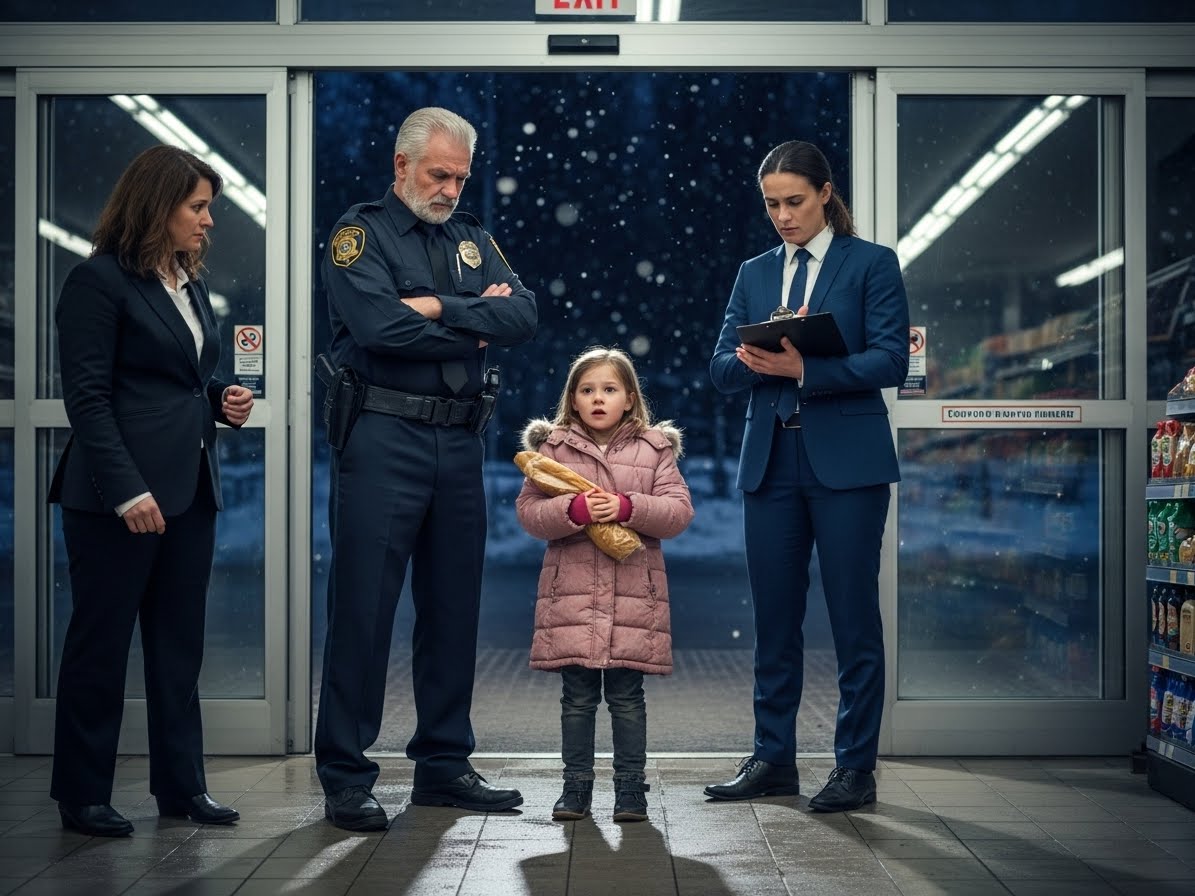
She was just a slip of a thing, maybe six years old. She was standing outside on the sidewalk, right where the heat from the store vents blew out. She was wearing a pink puffy coat that had lost most of its puffiness a long time ago. It was stained with grease on the sleeve and was a size too big. Her hair was a tangled mess of blonde curls that hadn’t seen a brush in days.
She wasn’t begging. She wasn’t holding a cup. She wasn’t asking people for money.
She was just staring.
She stood with her nose almost touching the glass, looking into the warmth of the store. specifically, she was looking at the bakery display that faced the window.
“Go home, kid,” I whispered to myself, shifting my weight from one aching leg to the other. “Your parents are probably worried sick.”
But I knew better. I’ve seen that look before. That’s the look of a kid who doesn’t have anyone waiting for them. That’s the look of a kid who is raising herself.
My hand drifted to the radio on my belt. I should go out there and tell her to move along. Loitering is bad for business. That’s what Henderson would say. It makes the customers uncomfortable, Frank.
But I stayed put. Maybe it was the cold. Maybe it was the fact that my own wife, Martha, had been gone for five years now, and the silence of my empty house was louder than this wind. I just watched her.
Suddenly, a group of young professionals—loud, laughing, smelling of expensive perfume and wine—pushed through the doors. The sensors triggered. Whoosh.
The girl moved.
She didn’t walk in like a customer. She shadowed them. She made herself small, tucking behind a tall man in a gray wool coat, using his body to block my line of sight.
She slipped inside.
“Okay,” I said, straightening up. “Game on.”
I stepped out of my booth. I didn’t rush. I knew the routine. She was inside now. She was going to steal something. They always do. It’s usually candy. Sometimes chips. If they’re really hungry, a sandwich from the deli.
I started my slow walk across the front of the store, keeping my eyes on the pink coat bobbing through the aisles.
Chapter 2: The Interception
The store was warm. It smelled of roasting chicken and cinnamon. For a kid coming in from the freezing street, it must have felt like heaven.
I expected her to dart for the candy aisle, row 4. That’s the usual target. I positioned myself to cut her off.
But she didn’t go to row 4.
She walked right past the chocolate bars. She walked past the chips. She kept her head down, her hands shoved deep into her pockets, moving with a singular, intense purpose.
She headed straight for the artisan bakery in the corner.
This is the high-rent district of the store. This is where they sell bread that costs more than minimum wage. Sourdough, rye, ciabatta.
She stopped in front of the rustic wooden rack. She looked up. Her eyes were wide, scanning the shelves. She wasn’t looking for the cheapest loaf. She was looking for something specific.
She went on her tiptoes. She reached for the top shelf.
Her small, red fingers wrapped around a loaf of “Golden Honey Wheat.” It was wrapped in thick, brown paper with a gold sticker. Price tag: $8.99.
“What are you doing?” I muttered, watching from behind a stack of soda cases. “That’s not exactly a snack, kid.”
She held the bread for a second, looking at it like it was made of solid gold. She hugged it to her chest. Then, she did the “look.” The quick glance left. The quick glance right.
The coast was clear.
She unzipped her pink jacket. She shoved the large loaf inside. It was too big; it made a massive lump against her chest. She struggled to zip the coat back up, biting her lip in concentration.
She turned around and started walking fast toward the exit.
She kept her head down. She was vibrating with nervous energy.
I moved.
I stepped out from the aisle and planted myself directly in front of the sliding doors. I crossed my arms over my chest. I’m a big guy. Six-foot-two, two hundred and forty pounds. When I stand in a doorway, the doorway is closed.
She didn’t see me until she was three feet away.
She slammed on the brakes, her sneakers squeaking on the polished floor. She looked up. Her face went pale.
“Going somewhere?” I asked. My voice wasn’t loud, but it carried. It was the voice I used to use on muggers.
She froze. She looked like a deer in the headlights, if the deer was wearing a dirty pink coat and hiding a loaf of bread.
“I… I…” she stammered.
“The bread,” I said, holding out my hand. “Let’s have it.”
She took a step back. She clutched her chest, protecting the lump. “No,” she whispered.
“Don’t make this hard,” I said, stepping forward and taking hold of her arm. I grabbed her coat sleeve. “You’re caught. Game over.”
“Well, well, well.”
The voice came from behind me. It was Henderson. He had materialized out of nowhere, smelling blood in the water.
“Good catch, Frank,” Henderson said, walking up and looking down at the girl with a sneer. “I saw her on the cameras. Shoplifting. brazen.”
“She’s just a kid, Mr. Henderson,” I said, feeling the girl trembling under my hand. The shaking was violent. She was terrified.
“She’s a thief,” Henderson corrected. “And I have zero tolerance for thieves. Look at her. Probably stealing it to sell it. Or for her parents to trade for drugs.”
Henderson pulled out his phone. “Hold her tight, Frank. I’m calling the police. We’re going to press full charges. I’m sick of this element ruining our store’s reputation.”
The girl’s eyes went wide. The word “police” hit her like a physical blow.
“No!” she screamed.
It was a piercing, jagged sound. She started to fight. She twisted and kicked, trying to break my grip.
“Let me go!” she shrieked. “Please! I have to go! I’m late!”
“You’re not going anywhere,” Henderson snapped, reaching out to grab her other arm. “Give me the merchandise!”
He yanked at her zipper. The coat popped open. The loaf of Honey Wheat bread tumbled out and hit the floor.
The girl didn’t run for the door. She dove for the bread.
She fell to her knees, wrapping her arms around the loaf on the dirty floor, curling into a ball around it.
“It’s mine!” she sobbed. “I need it! Please don’t take it!”
“Why?” Henderson yelled, losing his temper. “Why do you need expensive bread? Why didn’t you steal a candy bar like a normal brat?”
The girl looked up. Her face was a mask of tragedy, tears cutting clean lines through the dirt on her cheeks. She reached into her pocket with one hand, while holding the bread with the other.
She held out her hand to me.
Inside her small, dirty palm sat three plastic buttons—one red, two blue—a shiny gray rock, and a crumpled piece of paper with a drawing of a flower on it.
“I can pay!” she wailed. “I brought my treasures! I’m buying it! I’m not stealing!”
“You’re crazy,” Henderson scoffed. “Get her up, Frank.”
“I’m buying it for my Mom!” the girl screamed, her voice breaking into a thousand pieces. “It’s her birthday! And she’s in heaven! And the angels only have clouds to eat and Mom hates plain food! She needs the honey bread! Please!”
The words hung in the air like smoke.
She’s in heaven.
My grip on her arm vanished. I took a step back. The noise of the store—the registers, the music, the chatter—seemed to drop away into silence.
I looked at the girl. I looked at the buttons in her hand. And suddenly, I wasn’t a security guard anymore. I was a husband who stood by a grave five years ago, wishing I could send just one more message to the woman I loved.
I looked at Henderson. He had stopped shouting. He looked confused, uncomfortable.
“Did you say…” my voice came out as a croak. I cleared my throat. “Did you say your mom is in heaven?”
The girl nodded, sniffling loudly. “My daddy said she went there last week. He said she can’t come back. But it’s her birthday today. And I have to send her the bread. I was going to tie it to a balloon. But I didn’t have enough buttons for the balloon too.”
She looked at me, her eyes pleading. “Do you think she’ll be mad if I just throw it really high?”
I felt a crack in my chest. A deep, painful fracture in the armor I had built around myself for years.
“No, sweetheart,” I whispered, falling to my knees despite the pain in my joints. I needed to be on her level. “No, she won’t be mad.”
Chapter 3: The Transaction
The silence in Oakhaven Market was deafening. Even the classical music seemed to stop.
“She’s lying, Frank,” Henderson scoffed, breaking the spell. He adjusted his glasses, looking down at Daisy with disdain. “Kids make up stories. It’s a defense mechanism. She’s probably taking it to a homeless camp.”
Daisy looked up at him, her lip trembling. “I’m not lying! My daddy cried all week! He said she’s with the stars!”
Henderson rolled his eyes. “Look, I have a store to run. Take the bread, put it back on the shelf—it’s damaged now, we’ll have to mark it out—and kick her out. If she comes back, call the precinct.”
He reached down to snatch the loaf from Daisy’s arms.
“Don’t touch her,” I growled.
The sound came from deep in my chest. It wasn’t my security guard voice. It was my human voice.
Henderson froze, his hand inches from the girl. “Excuse me?”
I stood up. My knees popped loudly, but I didn’t care. I towered over Henderson. I saw the fear flicker in his eyes.
“I said, don’t touch her,” I repeated, calmly. I reached into my back pocket and pulled out my worn leather wallet.
I opened it. I didn’t have much. A few twenties, a photo of Martha from 1985, and my driver’s license. I pulled out a twenty-dollar bill.
“Ring it up,” I said, shoving the bill into Henderson’s chest.
“Frank, you can’t be serious,” Henderson stammered. “You’re encouraging this behavior. It’s against policy to—”
“Ring. It. Up,” I said, stepping closer. “And throw in a balloon. The biggest silver one you have. The helium kind.”
Henderson looked at the money, then at me, then at the watching customers who were starting to whisper. He realized he was losing the room. He snatched the bill.
“Fine,” he spat. “But you’re writing the incident report. And if she steals again, it’s coming out of your pension.”
He walked away to the register, fuming.
I looked down at Daisy. She was still on the floor, clutching her buttons and her pebble. She looked confused.
“Are you… are you a policeman?” she whispered.
I shook my head. I crouched down again. “No, sweetheart. I’m just Frank. And I think your mom would love that bread.”
I held out my hand. “But you have to pay. Fair is fair.”
Daisy’s eyes widened. She slowly placed the three buttons, the gray pebble, and the drawing of the flower into my massive, calloused palm.
I closed my fingers over them. To anyone else, it was trash. To me, it was more valuable than the twenty bucks I just spent. It was her dignity.
“Payment accepted,” I said solemnly. “Now, let’s get that balloon.”
Chapter 4: The Flight of the Honey Wheat
Ten minutes later, we were standing on the sidewalk. The wind had picked up, turning the snowflakes into stinging needles.
Daisy was holding the string of a massive silver star-shaped balloon. Tied securely to the neck of the balloon, inside a lightweight plastic bag I had double-knotted, was the loaf of Honey Wheat bread.
It was heavy, but the balloon was industrial strength. It bobbed in the wind, fighting to go up.
“Frank!”
I turned to hear a frantic shout. A young man was sprinting down the block, sliding on the ice, his face pale with terror. He was wearing a thin windbreaker that wasn’t nearly warm enough. He looked exhausted—dark circles under his eyes, hands red from the cold.
“Daisy!” he screamed, dropping to his knees and grabbing her. “Oh my god, Daisy! I told you to stay on the bench! I turned around for one second!”
He buried his face in her hair, sobbing. This was a man at the end of his rope. A man trying to hold a crumbling world together.
Daisy patted his head. “It’s okay, Daddy. Mr. Frank helped me. We got the bread for Mommy.”
The father looked up at me, bewildered. He saw my uniform. He saw the badge. He flinched, pulling Daisy closer.
“I’m sorry, Officer,” he stammered. “She didn’t mean any harm. She’s… we’re having a hard time. Her mom passed away last Tuesday. We’re just… we’re confused.”
“I know, son,” I said softly. “I know.”
I didn’t lecture him about leaving her alone. I didn’t tell him to be a better parent. I saw the grief in his eyes. It was the same grief I saw in the mirror every morning.
“She wanted to send a birthday package,” I said, pointing to the balloon. “We were just about to launch it.”
The father looked at the bread tied to the silver star. His eyes filled with fresh tears. He stood up and shook my hand. He didn’t say anything. He couldn’t. The grip was enough.
“Ready, Daisy?” I asked.
She nodded. She stepped out to the curb, away from the awning. The snow swirled around her.
She looked up at the dark, gray sky. The clouds were low and heavy.
“Happy Birthday, Mommy!” she yelled against the wind. “I got the honey kind! Catch it!”
She let go.
We watched. The father, the old security guard, and the little girl.
The silver star shot up. The wind caught it, batting it around, but it climbed. It rose past the streetlights, past the second-story windows of the condos, past the bare branches of the oak trees.
The bread swayed underneath it, a golden offering defying gravity.
We craned our necks. It got smaller and smaller. A tiny silver speck against the gloom. And then, just as it reached the cloud layer, a gap seemed to open up. A beam of city light caught it, making it sparkle for one second before it vanished into the heavens.
“She got it!” Daisy clapped her hands, jumping in the snow. “Did you see? She grabbed it!”
I felt a lump in my throat the size of a grapefruit. I reached into my pocket and touched the cold, smooth surface of the gray pebble she had given me.
“She definitely got it,” I said, my voice thick. “She’s eating it right now. Probably making a sandwich.”
Daisy smiled. It was the first time I’d seen her smile. It lit up the dark street better than any lamp.
Chapter 5: The Cookie
That night, I went home to my empty house. Usually, I eat a frozen dinner and watch TV until I fall asleep in my chair.
Tonight, I didn’t turn on the TV.
I went to the mantelpiece where Martha’s urn sat. I reached into my pocket and pulled out the payment. The three buttons. The gray pebble. The drawing of the flower.
I placed them next to Martha’s photo.
“You would have liked her, Martha,” I whispered to the silence. “She’s a fighter. Just like you.”
For the first time in five years, the house didn’t feel quite so empty.
Chapter 6: A New Season
A month passed. The gray slush of November turned into the festive white snow of December. The store was playing Christmas carols now. “Jingle Bells” on repeat.
I was still standing by the door. But I was different.
I wasn’t just watching anymore. I was greeting.
“Morning, Mrs. Gable. Watch that ice on the step.”
“Hello, young man. Nice hat.”
Henderson noticed. He didn’t say anything, but he stopped hovering over me. Maybe he realized that a guard who smiles catches more flies than one who growls. Or maybe he just didn’t want to bring up the bread incident again.
Two days before Christmas, the automatic doors opened.
I straightened up, ready to give my usual nod.
But it wasn’t a usual customer.
It was Daisy. And her dad.
They looked different. The dad was wearing a warmer coat. He looked shaved, rested. Daisy’s hair was brushed into pigtails with red ribbons.
“Mr. Frank!”
She didn’t run this time. She walked, skipping a little.
“Hello, trouble,” I smiled, my face cracking into a grin that felt rusty but good. “Here to raid the bakery again?”
“No,” she giggled. “Daddy got a job!”
I looked at the father. He beamed. “Warehouse,” he said, pointing his thumb back. “Not here. At the distribution center downtown. Benefits. steady hours. We got an apartment last week. No more sleeping at the cousin’s place.”
“That’s good news,” I said. “The best news.”
“We wanted to come by,” the father said, looking at his shoes shyly. “To say thank you. For… you know. For the balloon.”
“Forget it,” I waved my hand. “Just doing my job. Protecting the inventory from high-altitude theft.”
Daisy stepped forward. She was holding something wrapped in a napkin.
“Mom sent something back,” she whispered conspiratorially.
She handed me the napkin.
I opened it. Inside was a cookie. A homemade, slightly burnt, sugar cookie with way too much red frosting and sprinkles. It looked like a disaster. It looked delicious.
“We made them last night,” Daisy said. “But I know Mom helped. She whispered the recipe in my ear while I was sleeping.”
I looked at the cookie. I blinked back the moisture in my eyes.
“She has good taste,” I said.
I took a bite. It was sweet, crunchy, and tasted like hope.
“Merry Christmas, Frank,” the dad said.
“Merry Christmas,” I replied.
As they walked away, heading toward the milk aisle to buy groceries with actual money, Henderson walked by. He stopped and looked at me holding the half-eaten cookie.
“Eating on the job, Frank?” he raised an eyebrow. “That’s a violation of code 4.”
I looked at Henderson. I took another bite of the cookie, crumbs falling on my uniform.
“Write me up, Henderson,” I said, chewing happily. “Write me up.”
I turned back to the window. The snow was falling gently now. Somewhere up above the clouds, I liked to think there was a woman named Martha sharing a slice of honey wheat bread with a stranger, watching us, and smiling.
[END OF STORY]