“THEY’RE JUST ANIMALS,” HE YELLED AS THE WATER ROSE, BUT I KNEW I WOULD RATHER GO TO JAIL THAN LET THEM DROWN IN THAT DRAIN.
The rain wasn’t just falling; it was punishing the earth. It was the kind of November downpour that strips the leaves off the trees and turns the Carolina clay into a thick, suffocating paste. I shouldn’t have been out in it, but I’d heard the sound from my porch—a high-pitched, rhythmic yelping that cut through the noise of the wind. It sounded like a child crying, or something desperate enough to sound human.
I followed the noise to the edge of the new development, ‘Oak Creek Estates,’ a half-finished sprawl of luxury condos that sat where the old woods used to be. The construction site was a mess of mud and machinery, deserted for the weekend. Except for the storm drain.
Water was rushing into the grate with terrifying speed, swirling black and oily. And the sound was coming from underneath it.
I was on my knees, my fingers hooked into the iron lattice of the grate, pulling until my shoulders screamed. It wouldn’t budge. The crying below was getting frantic, gargled now, interrupted by the splash of rising water.
“Hey! You! Get away from there!”
A white pickup truck skidded to a halt on the gravel access road. The door flew open, and a man stepped out under a massive black umbrella. It was Mr. Henderson, the site manager. I knew him from the town council meetings. He was a man who talked a lot about ‘property values’ and ‘curb appeal’ and very little about the people who actually lived here.
“There are puppies down here!” I screamed over the roar of the rain. “Help me lift this!”
Henderson didn’t move to help. He walked over slowly, his boots crunching on the gravel, keeping his suit dry under the umbrella. He looked at the grate, then at me, soaked to the bone, mud on my jeans.
“That’s city property, and this is a private construction site,” he said, his voice flat. “You’re trespassing.”
“Did you hear me?” I wiped the rain from my eyes. “There are living things drowning in there. Help me lift the damn grate!”
Henderson looked down at the dark water swirling into the abyss. He grimaced, not with sympathy, but with annoyance. “Probably just the stray that hangs around the dumpster. Look, lady, if you open that grate and fall in, or if you damage the drainage, that’s a lawsuit. I’m not having it.”
“They’re going to die!” I shouted, grabbing the iron bars again. I could hear the whimpering fading. The water was rising fast.
“They’re just animals,” he yelled, his voice cutting through the storm. “They’re pests. Leave it alone. Nature takes its course.”
Something inside me snapped. It wasn’t a heroic feeling. It was a cold, hard knot of rage. I didn’t care about his lawsuit. I didn’t care about the ‘No Trespassing’ sign. I stood up, adrenaline flooding my system, and looked around. A discarded rebar pole lay near a stack of bricks. I grabbed it.
“Don’t you dare,” Henderson warned, stepping forward to block me. He put a hand out, intending to physically stop me. “I’m calling the police.”
“Call them,” I said.
He grabbed my arm as I tried to wedge the bar under the grate. His grip was tight, painful. “I said stop! You’re acting crazy!”
I shoved him. I didn’t think; I just threw my weight against him. He wasn’t expecting it. He slipped on the wet clay and went down hard, his umbrella tumbling away into the mud. He shouted something obscene, but I was already leveraging the bar.
With a groan of metal on concrete, the heavy grate popped up. I shoved it aside, skinning my knuckles, and the sound of the water became a roar.
I didn’t hesitate. I lay on my stomach in the mud, lowering my head and shoulders into the dark, smelling the gasoline and rot of the storm drain. It was freezing.
“I’m dialing 911!” Henderson was screaming from behind me, scrambling to his feet. “You’re done! You’re going to jail for assault!”
I tuned him out. I reached down. The water was up to my elbows. My hand brushed against something wet and trembling. I grabbed it—scruff, loose skin. I pulled.
The first puppy was a shivering ball of black fur, barely breathing. I set him on the grass away from the edge. He coughed up water and let out a tiny mewl.
I went back in. Henderson was shouting into his phone now, giving the operator my description. “Crazy woman… attacked me… destroying property…”
My hand found a second one. This one was fighting, paddling against the current. I hauled her out. Two.
The third one was further down. I had to slide my torso in deeper, until the edge of the concrete scraped my ribs. The water was rushing over my head now. I held my breath, reaching blindly into the dark pipe.
My fingers touched a nose, then a paw. I clamped down and pulled. The suction of the mud fought back. I kicked my legs, finding traction in the grass above, and yanked.
We tumbled backward onto the wet earth—me and the third puppy. This one wasn’t moving. I scrambled up, wiping mud from its nose, rubbing its tiny chest.
“Come on,” I whispered. “Come on.”
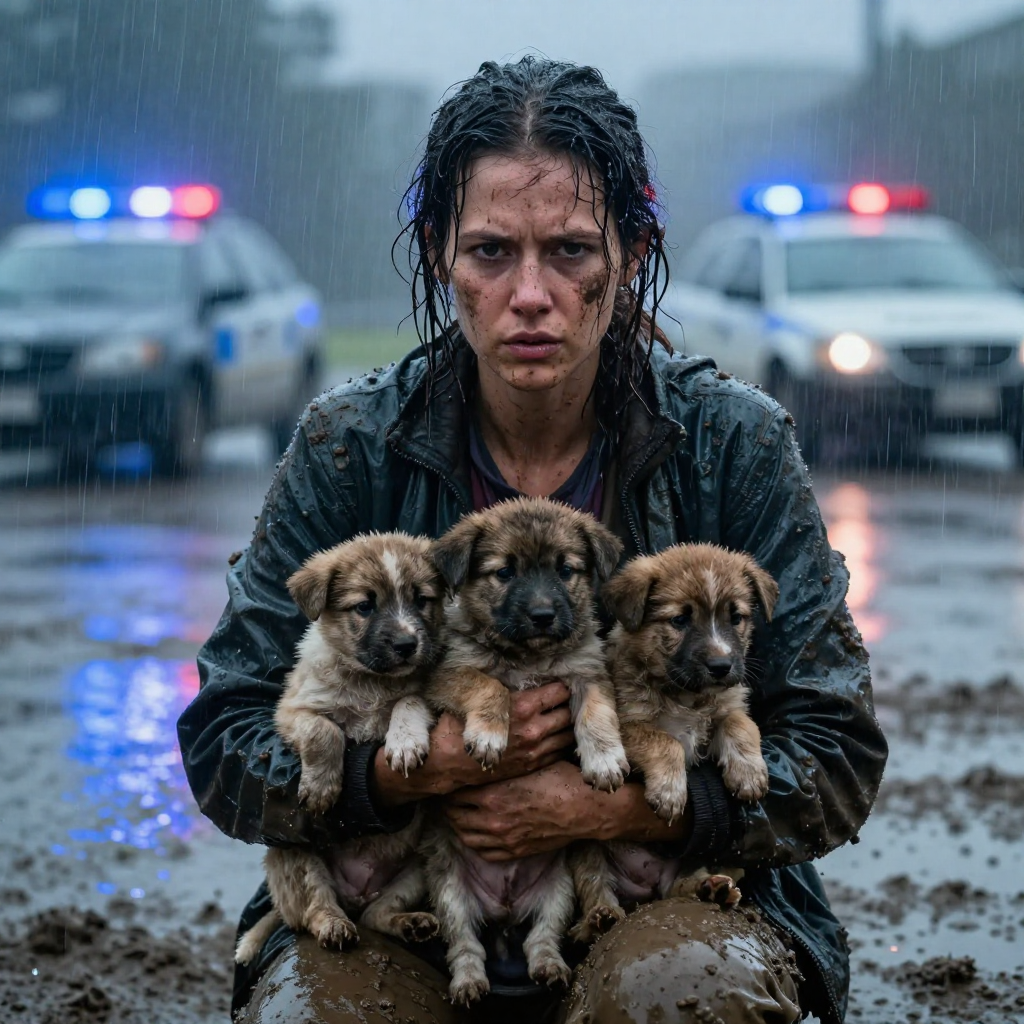
The puppy coughed, a violent spasm, and inhaled. I slumped back, clutching the three muddy bundles against my chest to share warmth. I was shaking so hard my teeth rattled.
Blue and red lights flashed against the rain. A cruiser pulled up behind Henderson’s truck. Two officers stepped out, hands resting near their belts.
Henderson was already walking toward them, pointing a shaking finger at me. “That’s her! She assaulted me! She broke into the site! I want her arrested right now!”
I sat in the mud, the freezing rain mixing with the tears I hadn’t realized I was crying. I looked at the three lives in my lap—dirty, unwanted, ‘just animals’—and then I looked at the handcuffs on the officer’s belt.
I didn’t try to run. I just held them tighter.
CHAPTER II
The rain didn’t stop when the sirens arrived. If anything, it seemed to thicken, turning the world into a blur of blue and red strobes against the gray sheets of the storm. I stayed where I was, sitting in the sludge of the Oak Creek Estates construction site, the three small, shivering lives tucked against my chest inside my jacket. They were so small. I could feel their hearts racing like hummingbird wings against my ribs, a frantic, rhythmic plea for survival that made my own fear feel secondary.
Officer Miller was the first one to reach me. I knew him, or rather, I knew the look of men like him—tired, overworked, and currently very annoyed to be standing in a foot of construction-site muck. He didn’t pull his gun. He didn’t even reach for his cuffs at first. He just looked at me, then at the man standing five yards away, screaming about lawsuits and physical assault.
“She’s a lunatic! She hit me! Look at my shoulder!” Henderson was shouting, his voice cracking with a high-pitched indignation that cut through the sound of the downpour. He was pointing a trembling finger at me, his face a mask of purple-tinged rage. “I want her in handcuffs, Miller! I want her off my property now!”
I didn’t look at Henderson. I looked at the mud on Miller’s boots. “They were drowning,” I said. My voice sounded hollow, even to me. “The drain was backing up. He was going to let them drown.”
Miller sighed, a long, weary sound. He knelt down, the plastic of his raincoat crinkling loudly. “Sarah, right? I’ve seen you around town. Look, Henderson’s claiming you shoved him. Hard. He’s saying you trespassed and interfered with a commercial site. Is that true?”
“I shoved him,” I admitted. There was no point in lying. My palms still burned from the impact of his chest, the memory of his solid, unyielding resistance. “He was blocking the grate. He wouldn’t move, and the water was rising. I had to.”
“You see?” Henderson yelled, moving closer, though Miller put up a hand to stop him. “She confessed! It’s on the record!”
Miller ignored him for a second, his eyes softening as they landed on the bundle in my arms. One of the puppies let out a tiny, high-pitched whimper—a sound so thin it barely existed. It was the sound of a life slipping away. “They look bad,” Miller whispered.
“They need a vet,” I said, my voice finally cracking. “Please. Take me to the station if you have to, but get them to a vet. They’re freezing.”
That was the first phase of the collapse: the realization that the law is a blunt instrument. Miller didn’t have a choice. Henderson was the complainant, a man of standing in this town, the face of a multi-million dollar development project. I was just a woman with mud under her fingernails and a history of being ‘difficult.’ Miller called for a transport, but he did something Henderson didn’t expect. He called Dr. Elena Aris, the only vet within twenty miles who answered her phone on a Sunday evening during a deluge.
I was placed in the back of the cruiser, not in cuffs yet, but with the doors locked from the outside. The puppies were taken from me—gently, by Miller’s partner—and placed in a warm carrier that Dr. Aris brought to the edge of the site. Watching them go was like losing a piece of my own skin. I watched the taillights of the vet’s truck disappear into the gray, and for a moment, the silence in the back of the patrol car was heavier than the rain.
As we drove away from the site, I saw a small crowd had gathered at the perimeter fence. Neighbors from the older houses across the creek, people who had been complaining about the runoff and the noise for months. One of them had a phone out, the screen a bright, glowing rectangle in the dark. I didn’t think much of it then. I was too busy thinking about the weight of my own silence.
We didn’t go straight to the station. Miller parked in the lot of the local clinic, waiting for his supervisor to figure out how to handle a ‘rescuer’ who was also an ‘attacker.’ Sitting there, I felt the cold finally seep into my bones. It triggered something I had spent years trying to bury—a memory of another time I had tried to stand in the way of something much bigger than me.
Years ago, before I moved back to this town, I worked for a firm in the city. Not just any firm, but the one that originally designed the drainage systems for projects like Oak Creek. I had seen the shortcuts. I had seen how the ‘stormwater management’ was little more than a suggestion on a blueprint, ignored to save six figures on concrete. I had spoken up then, too. I had tried to be the hero. But back then, there were no puppies. There was only a nondisclosure agreement and a severance package that felt like blood money. I had taken the money because I was scared. I had signed the papers because I wanted to survive. That was my old wound: the knowledge that I had been bought, that my silence had helped build the very world I was now trying to fight.
“Sarah?” Miller’s voice broke through my thoughts. He was looking at me through the rearview mirror. “Henderson is serious. He’s already called his lawyer. He’s pushing for a felony assault charge because he’s claiming he has a pre-existing back injury you aggravated.”
“I barely touched him,” I whispered. “He’s lying.”
“It doesn’t matter,” Miller said. “He’s got the property rights, and you’ve got the mud on your hands. But that’s not your biggest problem.”
He handed me his phone. On the screen was a social media feed. The video from the perimeter fence had already been uploaded. It was grainy, shot through the rain, but the angle was devastating. It showed me lunging at Henderson. It showed him falling back, looking shocked and vulnerable, while I looked like a feral creature, screaming and clawing at the earth. The caption read: *‘Local Activist Attacks Site Manager at Oak Creek. Is this what environmentalism looks like?’*
It was public. It was sudden. And looking at the comments—people calling for my arrest, people defending the development, people who didn’t even know the puppies existed—I knew it was irreversible. My reputation, the quiet life I had tried to rebuild here, was gone in thirty seconds of shaky footage.
We eventually moved to the station for processing. The fluorescent lights were blinding, a harsh contrast to the natural gloom of the storm. I was fingerprinted and photographed. The coldness of the ink felt like a permanent mark. While I sat in the holding cell, a small room that smelled of industrial cleaner and old sweat, Dr. Aris came in.
She looked exhausted. Her green scrubs were stained with water and what I hoped wasn’t blood. She sat on the bench across from me, her presence the only thing keeping me from a total breakdown.
“Two of them are stable,” she said, her voice low. “The third… the smallest one… he’s still on oxygen. His lungs were full of silt. It’s going to be touch and go for the next forty-eight hours.”
“Thank you,” I said. “For coming out there.”
“Don’t thank me yet,” she replied, leaning in. “Henderson called the clinic. He’s claiming the dogs are ‘nuisance animals’ from his property and that he has the right to determine their disposition. Sarah, he wants them euthanized. He’s saying they’re a biohazard and a liability.”
I felt a surge of nausea. “He can’t do that. They’re living things.”
“Legally? On a construction site? He can make a very strong case that they’re pests, not pets. Unless someone claims ownership and assumes all legal liability—including the liability for whatever happened at that site tonight.”
This was the secret I was keeping, the one that made my throat tighten until I couldn’t breathe. To claim those puppies, to truly save them, I would have to go to court. I would have to fight Henderson. And if I fought him, he would dig. He would find out why I really left the city. He would find the NDA. He would find out that I knew the drainage system at Oak Creek was faulty before the first shovel even hit the ground, and that I had stayed silent for three years while I cashed those severance checks.
If that came out, the developer—a company far larger and more ruthless than Henderson—would sue me for everything I had. They would ruin me financially, and I would likely lose my professional license. My silence was the only thing keeping me afloat, but it was also the thing that was drowning those puppies.
“There’s more,” Aris said, her eyes searching mine. “The community is splitting down the middle. There’s a group of people outside the station right now. Some are there for you, carrying signs about animal rights. But others… others are there for Henderson. They’re saying you’re stalling a project that brings jobs to this town. They’re calling you a saboteur.”
I could hear them now. Not the words, but the dull roar of voices through the brick walls of the station. It was a terrifying sound. It was the sound of a mob, and I was the center of it.
Miller came back in, looking more conflicted than ever. He held a piece of paper in his hand. “I just got off the phone with the DA’s office. Henderson is offering a deal. It’s… it’s unconventional.”
I looked at the paper. It was a typed statement.
*‘I, Sarah Miller, admit to trespassing on the Oak Creek Estates property and initiating a physical altercation with the site manager. I acknowledge that my actions were unwarranted and that no animals were in immediate danger. I agree to pay for all property damages and to refrain from any further contact with the development project or its employees. In exchange, all criminal charges will be dropped.’*
“And the puppies?” I asked, my voice a whisper.
“The statement says there were no animals in danger,” Miller said, his voice flat. “If you sign this, you’re agreeing they weren’t there. Henderson gets to ‘dispose’ of the situation however he sees fit. He wants the whole thing wiped from the record. No puppies, no rescue, no negligence.”
“He’ll kill them,” I said.
“He’ll ‘handle’ them,” Miller corrected, though the look in his eyes said the same thing I did.
This was the moral dilemma, the choice with no clean exit.
If I signed the paper, I would walk out of this station a free woman. My secret would stay safe. My NDA would remain intact. I could go back to my quiet life, my small apartment, and my job at the local library. I would be safe. But those three small heartbeats I had felt against my chest would be silenced forever. I would be a coward again, just like I was three years ago when I took the money and ran.
If I didn’t sign, I was going to trial for felony assault. I would be the villain in a viral video. Henderson would tear my life apart to protect the project’s reputation. I would lose my house, my savings, and my future. But I would have the chance to tell the truth. I could claim the puppies. I could bring in Dr. Aris as a witness. I could stand up and say that the water was rising because the pipes were too small, and that I knew it because I was the one who was paid to stay quiet about it.
“Sarah?” Dr. Aris touched my arm. “The smallest one… he just stopped breathing. My assistant is bagging him now. I need to get back. I need to know what we’re doing.”
I looked at the statement on the table. The ink seemed to shimmer under the harsh lights, like the surface of the floodwater in the storm drain. I thought about the feeling of that tiny body in my hands, the way it had clung to life with a ferocity that I had lacked for years.
I thought about my mother. She had stayed quiet when our landlord was skimming from the heating oil funds. She had stayed quiet when the neighbors’ kids were being evicted. She had always told me that the only way to survive was to be invisible, to let the world go by and keep your head down. I had spent my whole life keeping my head down, and all it had gotten me was a heavy heart and a bank account full of regret.
“I can’t sign this,” I said. My voice was stronger now, though my hands were still shaking.
“Sarah, think about this,” Miller urged. “This is a felony. This follows you forever. You have a career. You have a life.”
“I don’t have a life if I let them die,” I said. “I already tried that. It doesn’t work.”
I pushed the paper back toward Miller. “I want to claim the dogs. All three of them. I’m the owner. Any liability, any costs—put them on me.”
“You’re choosing the hard way,” Miller said, but I thought I saw a flicker of something like respect in his eyes. Or maybe it was just pity.
“It’s the only way,” I replied.
As Miller led me back toward the processing desk to officially book me, I caught a glimpse of the television in the breakroom. The local news was already running the story. They had a photo of Henderson—looking professional in a hardhat—next to a screen-grab of me from the video, hair plastered to my face, mouth open in a scream. The headline read: *VIOLENCE AT OAK CREEK: RESCUE OR RAGE?*
I realized then that the truth was going to be a lot more expensive than I ever imagined. Henderson wasn’t just defending his back; he was defending a billion-dollar investment. And he knew about my past. I saw it in the way his lawyer was already waiting in the hallway, clutching a briefcase and looking at me with the predatory grin of a man who smells blood in the water.
He knew I had signed that NDA. He knew that by claiming those dogs and accusing him of negligence, I was opening the door to my own destruction. He wasn’t trying to make me sign the statement to be kind; he was trying to give me one last chance to stay in my hole before he buried me in it.
I sat back down on the hard plastic chair, the weight of the handcuffs finally clicking around my wrists. The metal was cold, biting into my skin, but for the first time in years, I didn’t feel like a ghost. I felt solid. I felt present.
The storm was still raging outside, the thunder shaking the very foundation of the station. I closed my eyes and pictured the smallest puppy, the one struggling for breath. *Hold on,* I thought. *Just hold on. I’m not running this time.*
But as the door to the holding cell clicked shut again, I knew that the real fight hadn’t even begun. The community was divided, the law was against me, and the secret I had kept for three years was about to become the weapon that would either set us all free or destroy everything I had left.
CHAPTER III
The fluorescent lights in the preliminary hearing room hummed with a low-frequency buzz that felt like it was drilling directly into the base of my skull. It was a cold, sterile sound, the kind of sound that accompanies the end of a life or the beginning of a sentence. I sat at a scratched wooden table, my hands folded to hide the way my fingers wouldn’t stop twitching. Across from me, Marcus Thorne, the developer’s lead counsel, was shuffling papers with a rhythmic, aggressive precision. He didn’t look at me. To him, I wasn’t a person; I was a liability to be liquidated. Mr. Henderson sat beside him, his face flushed with a triumphant, righteous anger. He had traded his mud-stained work boots for polished oxfords, but the man underneath was still the same one who had watched three puppies drown without blinking.
The room was small, packed with a few local reporters and a handful of curious residents who had seen the viral video. I could feel their eyes on my back—hot, judgmental, and heavy. To them, I was the ‘Assaulting Architect,’ the woman who had lost her mind over some stray dogs. They didn’t see the mud under my fingernails that wouldn’t wash out. They didn’t see the three small lives currently shivering in a cage at Dr. Aris’s clinic, waiting for a verdict that had nothing to do with their health and everything to do with a developer’s ego.
“Your Honor,” Thorne began, his voice a smooth, practiced baritone. “We are not just talking about a simple disagreement. Ms. Sarah Vance has a history of erratic behavior. She was terminated from her previous firm for ‘internal conflicts’—a polite way of saying she couldn’t follow protocol. Now, she returns to a site she once worked on, physically assaults a site manager, and claims to be a hero. This isn’t about animals. This is about a personal vendetta against my client, Oak Creek Estates.”
I looked down at my hands. The ‘internal conflict’ he mentioned was the very thing I had spent three years trying to bury. I had signed the Non-Disclosure Agreement because I was broke, exhausted, and told that no one would listen. I had traded my silence for a severance package that barely covered my rent. But hearing Thorne turn my integrity into a weapon of instability made the air in the room feel thin. I glanced at Officer Miller, who was standing by the door. He wasn’t looking at Thorne; he was looking at the window.
Outside, the sky had turned a bruised, sickly purple. The rain wasn’t just falling anymore; it was Hammering. It was the kind of rain that changed the landscape, the kind I had modeled in a hundred simulations before the developers told me to lower the safety margins to save on costs. I knew what that rain was doing to the red clay of Oak Creek. I knew exactly where the water was going, and it wasn’t into the drainage pipes.
“Ms. Vance?” the judge prompted, her voice sharp. “Do you have anything to say regarding the restraining order and the felony charges before we proceed?”
I stood up. My knees felt like they were made of glass. I looked at Henderson. He gave me a small, mocking smile—the smile of a man who thought he had already won. I thought about the puppies. I thought about the way the smallest one, the runt with the white patch on its ear, had licked my hand while I was covered in the filth of the drain.
“The drainage system at Oak Creek is going to fail,” I said. My voice was quiet, but it cut through the room. “In about twenty minutes, the retaining wall on the north side of the slope is going to collapse. It’s not a theory. I designed the original specifications for that wall three years ago. I was told to reduce the steel reinforcement by forty percent. I refused to sign off on it, which is why I was fired. Which is why I signed an NDA.”
A collective gasp rippled through the room. Thorne jumped to his feet, his face turning a dark shade of mottled red. “Your Honor, this is a blatant violation of a legally binding contract! This testimony is inadmissible and frankly, defamatory!”
“It’s not defamation if it’s true,” I countered, my voice growing stronger. I didn’t care about the jail time anymore. I didn’t care about the lawsuits. “Mr. Henderson knows this. He was the one who oversaw the installation of the sub-standard culverts. The puppies weren’t trapped because of a fluke of nature. They were trapped because the bypass valves were never installed. The water has nowhere to go. And right now, it’s building up behind that wall.”
Just as Thorne began to shout another objection, the lights in the courtroom flickered and died. For a heartbeat, there was total silence. Then, a low, rhythmic thudding began to vibrate through the floorboards. It wasn’t thunder. It was the sound of earth moving. A cell phone chimed, then another, then a dozen at once. The emergency broadcast system’s shrill, digital scream filled the small room.
“Flash flood warning,” someone yelled. “The Oak Creek slope is sliding!”
Henderson’s face went from triumph to a chalky, bloodless grey. He looked at the window, then at me. For the first time, I saw fear in him—not the fear of a man who cared about the people living in those houses, but the fear of a man who realized the paper trail was about to be unearthed by a landslide.
“We need to move,” I said, looking directly at the judge. “The lower parking lot of the courthouse is in the path of the runoff. If that wall goes, the surge will hit the clinic next door. The puppies are in there. People are in there.”
The room erupted into chaos. The judge didn’t even bother to bang her gavel. She was already on her feet, grabbing her robes. Officer Miller moved toward me, but he wasn’t reaching for his handcuffs. He grabbed my arm and pulled me toward the exit. “Show us where the pressure points are, Sarah. Now!”
We burst out of the courthouse into a wall of water. It felt like standing under a waterfall. The street was already a river of brown, churning foam. In the distance, a sound like a freight train echoed through the valley—the sound of the hillside giving way. We ran toward the construction site, the wind whipping my hair into my eyes. Miller was on his radio, screaming for evacuations.
When we reached the perimeter of Oak Creek, the sight was nightmarish. The massive retaining wall, a structure that should have stood for a century, was bowing outward like a bloated stomach. Water was geysering out of the cracks where the rebar had snapped. Henderson had followed us in his SUV, and he climbed out, staring at the destruction.
“Fix it!” he screamed at his crew, who were huddled under a temporary shed. “Get the pumps!”
“Pumps won’t do anything!” I yelled over the roar of the rain. “You need to breach the secondary levee! If you don’t let the water out toward the empty fields, it’s going to take out the whole foundation of the apartments down-slope!”
“I can’t do that!” Henderson shrieked. “That’s unpermitted land! It’ll cost millions in fines!”
“It’ll cost lives if you don’t!” I grabbed a shovel from the back of a nearby truck, not to use as a weapon, but as a lever. I ran toward the emergency spillway—the one I knew was blocked with construction debris to hide the fact that it didn’t meet code.
I started digging, my fingers raw, pulling out chunks of concrete and illegally dumped drywall. Miller joined me, his uniform soaking and heavy. We worked in a feverish, desperate blur. Every second felt like a minute; every minute felt like an hour. I could see the clinic across the street. I could see Dr. Aris through the window, moving crates to the upper floor. She saw me. She pressed a hand against the glass.
Suddenly, a black sedan screeched to a halt at the edge of the site. A man in a high-visibility jacket with ‘STATE SAFETY COMMISSION’ emblazoned on the back stepped out. It was Director Vance—no relation, but a man known for being the most terrifying bureaucratic force in the state. He didn’t look at the rain. He looked at the wall, then at the blueprints I had dropped in the mud, then at Henderson.
“Who authorized this drainage layout?” Director Vance’s voice wasn’t loud, but it carried a weight that silenced even the storm.
Henderson stammered, pointing at me. “She did! She’s the architect! She’s the one we’re suing!”
I stopped digging and stood up, chest heaving. I pulled a crumpled, water-logged envelope from my inner pocket. I had kept it for three years. It was the original design, the one with my ‘REJECTED’ stamp and the developer’s forged approval signature over the top of it. I handed it to the Director.
He looked at the document, then back at the cracking wall. He looked at Henderson with a cold, clinical disgust. “Mr. Henderson, you are under immediate administrative detention. This site is being seized under emergency public safety protocols.”
Turning to Miller, the Director barked, “Officer, help Ms. Vance clear that spillway. If that wall holds for ten more minutes, we can vent the pressure. Move!”
The power had shifted in a single heartbeat. Henderson was being ushered toward a patrol car, his hands finally in the cuffs that were meant for me. I didn’t feel joy. I didn’t feel vindicated. I just felt a cold, hard clarity. I shoved the shovel into the debris one last time and felt the blockage give way.
A roar of water erupted, redirected away from the houses and the clinic, surging into the overflow fields. The pressure on the wall eased. The groaning of the concrete subsided into a dull, rhythmic drip.
I slumped against the mud, the rain washing the salt of my tears away before they could even form. I looked across at the clinic. Dr. Aris was at the door now. She held up a small, wet bundle—the runt of the litter. He was squirming. He was alive.
I had broken my NDA. I had destroyed my chances of ever working in this state again. I was an outcast, a whistleblower with a criminal record for assault that might still stick. But as I watched the water flow safely into the dark fields, I knew I had finally finished the job I started three years ago. The secret was out. The earth had spoken, and for once, the truth hadn’t been buried.
CHAPTER IV
The silence was deafening. Not the kind that followed a shout, but the heavy, expectant quiet of a town holding its breath. The storm had passed, the floodwaters had receded, and Henderson was in custody. The puppies were safe, at least for now. But the air was thick with the unspoken, the unreckoned. My phone vibrated non-stop – missed calls from numbers I didn’t recognize, texts ranging from cautious congratulations to outright condemnation. I ignored them all.
The first real blow came in the form of a certified letter. My lawyer, a weary-eyed woman named Ms. Davies, called me with the news before I even had a chance to open it. The developer, even from behind bars, was suing me for breach of contract. The NDA I’d broken in court was ironclad, she explained. My testimony, while instrumental in exposing Henderson’s crimes, had directly violated its terms. The penalty? Financial ruin. Ms. Davies didn’t sugarcoat it. “Sarah,” she said, her voice low, “they want to make an example of you.”
I stared at the unopened letter, the crisp paper suddenly feeling like a lead weight in my hands. It wasn’t just the money, though the prospect of losing everything I owned was terrifying. It was the principle. I’d risked everything to expose the truth, to save those animals, and now I was being punished for it. Again.
Then came the media frenzy. It started subtly – a local news crew parked across the street, a reporter trying to catch me as I walked to my car. But it quickly escalated. My face was plastered across every news outlet, the headline oscillating between “Hero” and “Vigilante.” The online comments were even worse – vicious, personal attacks mixed with the occasional word of support. I became a symbol, a pawn in a larger game I didn’t even understand. People I hadn’t spoken to in years crawled out of the woodwork, offering their opinions, their judgments, their unsolicited advice. My social media accounts became a cesspool of hate and vitriol. I shut them down.
Even the support felt tainted. People lauded my bravery, called me a champion for justice. But they didn’t know the full story. They didn’t see the years of internal conflict, the sleepless nights haunted by the memory of that forged signature. They only saw the dramatic climax, the floodwaters, the puppies. They didn’t see the quiet desperation that had driven me to that point.
The hardest part was the reaction from my parents. My father, ever the pragmatist, was furious. He couldn’t understand why I’d thrown away my career, my reputation, for a “handful of mutts.” He saw me as reckless, irresponsible. My mother, though more sympathetic, was deeply worried. She feared for my future, for my safety. “Sarah,” she pleaded, “why couldn’t you just let it go?”
The only person who seemed to truly understand was Elena. She called me every day, offering a listening ear, a shoulder to cry on. She didn’t try to minimize the situation or offer empty platitudes. She simply acknowledged the pain, the anger, the fear. “You did the right thing, Sarah,” she said, her voice firm. “Don’t let anyone tell you otherwise.” But even her support couldn’t erase the gnawing feeling that I’d made a terrible mistake.
Officer Miller stopped by my apartment a few days later. He looked exhausted, his face etched with worry. “I wanted to thank you,” he said, his voice low. “What you did… it made a difference.” He told me that the State Safety Commission was conducting a full investigation into the Oak Creek Estates development. Henderson was facing multiple charges, including fraud, forgery, and endangerment. But he also confirmed what I already knew: the assault charge against me was still pending. Henderson was pressing charges, and the video of me shoving him was damning. “I’m doing what I can,” Miller said, “but it’s not looking good.”
I knew he was right. The video painted a clear picture, regardless of the circumstances. I had put my hands on him, and that was enough.
The new event happened a week later. Another certified letter, this one from the state licensing board for architects. They were launching a formal inquiry into my conduct, based on the evidence presented in court. My license, my entire professional identity, was at risk. I felt like I was drowning all over again.
The moral residue clung to everything. Henderson was going to jail, but I was facing financial ruin and the potential loss of my professional license. The puppies were safe, but I was ostracized, branded as a troublemaker. Justice, if it existed at all, felt incomplete, tainted. The town was rebuilding, but I was still picking up the pieces of my shattered life. There was no victory, only survival.
The days that followed were a blur of legal consultations, media interviews (which I mostly declined), and whispered conversations with friends and family. Ms. Davies was working tirelessly to defend me, but the odds were stacked against us. The developer had deep pockets and a team of high-powered lawyers. They were determined to crush me.
I started having nightmares. I dreamt of floodwaters, of screaming puppies, of Henderson’s smug face leering at me from behind bars. I woke up in a cold sweat, my heart pounding in my chest. Sleep became a luxury I could no longer afford.
I tried to find solace in routine. I walked the dogs, I cooked simple meals, I read books. But nothing seemed to fill the void. The silence in my apartment was suffocating, broken only by the occasional phone call or the persistent hum of the refrigerator. I felt utterly alone, adrift in a sea of uncertainty.
One evening, as I was walking the dogs in the park, I saw a young girl struggling to control a large, rambunctious golden retriever. The dog was pulling on the leash, barking excitedly, and the girl was clearly overwhelmed. I hesitated for a moment, then approached them.
“Do you need some help?” I asked gently.
The girl looked up, her face flushed with frustration. “Yes, please!” she said. “He’s so strong, I can’t handle him.”
I took the leash from her and spoke to the dog in a calm, soothing voice. He immediately responded, his tail wagging tentatively. I showed the girl how to hold the leash properly, how to use her voice to control the dog’s energy. Within minutes, she was walking him with confidence.
“Thank you so much!” she said, her eyes shining with gratitude. “You’re really good with dogs.”
“I’ve had some practice,” I replied with a smile.
As I walked away, I realized something. Despite everything that had happened, despite the legal battles and the media scrutiny, I still had something to offer. I still had a skill, a passion. And maybe, just maybe, that was enough to build a new life on.
The adoption of the runt, who I named Hope, was a turning point. It wasn’t a grand, dramatic gesture, but a quiet, personal act of defiance. Hope was a constant reminder of what I had fought for, of the truth I had risked everything to expose. She was a symbol of resilience, of the power of hope in the face of adversity.
The legal battles dragged on for months. The developer eventually offered a settlement, a fraction of what they had initially demanded. Ms. Davies advised me to take it. “It’s the best you can hope for,” she said. “You’ll still be in debt, but it’s manageable.” I hesitated. Accepting the settlement felt like admitting defeat. But I also knew that I couldn’t afford to keep fighting. The emotional and financial toll was too great.
I signed the agreement, my hand trembling slightly. It wasn’t a victory, but it was a step forward. I was still scarred, still wounded, but I was alive. And I had Hope.
The inquiry from the state licensing board was less forgiving. They suspended my license for two years, citing my breach of contract and my “unprofessional conduct.” It was a devastating blow, but I refused to let it break me. I decided to use the time to explore other options. I volunteered at a local animal shelter, helping to care for abandoned and neglected animals. I started offering my expertise as a safety consultant, advising small businesses on how to prevent accidents and protect their employees.
It wasn’t the life I had imagined for myself. It wasn’t the career I had spent years building. But it was a life of purpose, a life of meaning. And in the end, that was all that mattered.
I often think about Oak Creek Estates, about the floodwaters and the puppies and the choices I made. I don’t regret what I did. I know I did the right thing, even if it came at a great cost. But I also know that the scars will always be there, a constant reminder of the price of truth.
And yet, as I look at Hope, sleeping peacefully at my feet, I can’t help but feel a sense of… well, hope. A quiet, fragile belief that even in the darkest of times, there is always the possibility of redemption, of renewal. That even after the flood, the sun will eventually shine again.
I started small, offering my services as a consultant to local businesses. My reputation as a “troublemaker” preceded me, but some were willing to take a chance. They saw the value in my expertise, in my unwavering commitment to safety. I helped them identify potential hazards, implement preventative measures, and train their employees. It wasn’t glamorous work, but it was meaningful. I was making a difference, one small business at a time.
I also continued to volunteer at the animal shelter. I found solace in caring for the animals, in giving them the love and attention they deserved. I became particularly attached to a scruffy terrier mix named Lucky. He had been abandoned, abused, and left for dead. But he was resilient, full of life. I spent hours with him, teaching him tricks, taking him for walks. He became my shadow, my constant companion.
One day, as I was walking Lucky in the park, I ran into Officer Miller. He looked different, lighter. “I heard you’re doing safety consulting,” he said, a hint of a smile playing on his lips. “That’s great.”
“Yeah,” I replied. “It’s not architecture, but it’s honest work.”
He nodded. “Henderson was sentenced last week,” he said. “Five years.”
I felt a surge of relief, a sense of closure. It wasn’t a victory, but it was a step in the right direction. “Good,” I said. “He deserves it.”
Miller paused, then looked at me intently. “You know,” he said, “you changed things around here. People are paying attention now. They’re asking questions. You made a difference, Sarah.”
His words meant more than he could possibly know. They were a validation, a recognition of the sacrifices I had made. I smiled. “Thanks, Miller,” I said. “That means a lot.”
As I walked away, I realized that I had found my new path. It wasn’t the path I had planned, but it was the path I was meant to take. A path built on truth, on integrity, on a unwavering commitment to doing what was right. And as I looked at Hope, trotting happily beside me, I knew that I was finally home. And I was ready for the rest of my life.
It wasn’t easy. There were days when I doubted myself, when I questioned my choices. But I kept going, driven by a sense of purpose, a belief that I could make a difference. And slowly, gradually, I began to heal. The scars remained, but they no longer defined me. They were simply a part of my story, a reminder of the battles I had fought and the lessons I had learned.
The thing about truth is that it’s never easy. It’s messy, complicated, and often painful. But it’s also liberating. It sets you free from the shackles of silence, from the burden of lies. And in the end, that’s all that really matters.
CHAPTER V
The calendar had flipped again, seasons turning with a speed that both comforted and unnerved me. A year. It had been a year since the flood, a year since Oak Creek Estates almost crumbled into the river, a year since my old life had washed away completely. Sometimes, I still woke up sweating, the image of the churning water vivid in my mind. But now, Hope’s warm little body was pressed against my side, her soft puppy snores a grounding rhythm.
The consulting work had blossomed, as improbable as that seemed. My forced exile from the grand architectural firms had, ironically, led me to a more fulfilling purpose. Small towns, the kind that often got overlooked, needed someone to look at their infrastructure with a critical, ethical eye. I wasn’t designing towering skyscrapers anymore, but I was ensuring that playgrounds were safe, that bridges wouldn’t collapse, and that community centers wouldn’t flood. The work was…honest.
One afternoon, I found myself poring over the blueprints for a new storm drainage system for the town’s elementary school. It was a modest project, but the details mattered. Ms. Davies had helped me navigate the legal tightrope, ensuring my past wouldn’t be held against me every time I tried to submit a proposal. “You’re not Sarah Vance, disgraced architect,” she’d said, her voice firm. “You’re Sarah Vance, the woman who saved Oak Creek. Own it.”
I was at my kitchen table, the scent of Elena’s lavender soap still clinging faintly to the air – she’d stopped by that morning with a basket of homemade muffins – when the phone rang. It was a number I didn’t recognize. I almost didn’t answer.
“Sarah Vance?” The voice was crisp, professional.
“Speaking.”
“This is Evelyn Reed from Maxwell Architects in Chicago. We’d like to offer you a position.”
My breath hitched. Maxwell Architects. It was one of the most prestigious firms in the country. Before Oak Creek, before the NDA, before everything fell apart, a job offer from Maxwell would have been my ultimate dream.
“I…I’m not sure I understand,” I stammered.
“We’ve been following your work, Ms. Vance. Not just the Oak Creek situation, but your subsequent consulting. We admire your…integrity. We have a senior position open, overseeing sustainable development projects. We believe your expertise would be invaluable.”
My mind raced. This was it. Redemption. A chance to reclaim everything I’d lost.
“There are…stipulations,” Ms. Reed continued, her tone shifting slightly. “Given your history, the firm requires a…statement. A public acknowledgement that your actions at Oak Creek Estates were…regrettable. That you understand the importance of discretion and adherence to contractual obligations.”
My stomach dropped. It wasn’t a clean offer. It was a gilded cage. They wanted my talent, but they also wanted to neuter my conscience. They wanted me to publicly disavow everything I’d fought for, everything I believed in. All for a paycheck, all for the prestige.
The silence stretched. I could hear the hum of the city in the background, the distant sirens, the relentless pulse of ambition. And then I looked down at Hope, asleep at my feet, her tiny body rising and falling with each breath. I thought of the floodwaters, of Henderson’s smug face, of the forged documents, of the families who could have lost everything. I thought of my parents, finally proud of the path I was on.
“I appreciate the offer, Ms. Reed,” I said, my voice surprisingly steady. “But I’m afraid I must decline.”
“Ms. Vance, I urge you to reconsider. This is a significant opportunity.”
“I understand that. But my…regrets are not for sale.”
The line went dead. I sat there for a long moment, the phone still in my hand, the weight of the decision settling upon me. It wasn’t a triumphant feeling. There was no soaring music, no sense of vindication. Just a quiet, resolute calm.
Later that week, I met Officer Miller at the park. He was off-duty, dressed in jeans and a worn baseball cap, pushing his young daughter on the swing set. He looked…lighter. The tension that had clung to him like a second skin was gone.
“Heard you turned down Maxwell,” he said, a hint of a smile playing on his lips.
“Word travels fast,” I replied, watching his daughter giggle as she soared through the air.
“Some things are worth more than a corner office,” he said, his gaze meeting mine. There was an understanding there, a shared knowledge of the price of integrity. He didn’t need to say more. I knew that he had a chance to transfer to a different precinct, one far away from Oak Creek. A chance to start over. He didn’t take it.
We sat in comfortable silence for a while, watching the children play. The little girl from the park, Lily, ran up to me.
“Miss Sarah! Look what I made!” She held up a drawing, a colorful depiction of a woman standing in front of a house, with a bright blue river flowing nearby. “That’s you,” she said, pointing to the figure. “You saved our houses!”
My throat tightened. It wasn’t about the accolades, the recognition, or the redemption. It was about this. About the tangible impact I could have on the lives of ordinary people. About being a force for good, however small.
The days turned into weeks, the weeks into months. My consulting business thrived, not because I was chasing prestige, but because I was genuinely committed to making a difference. I helped the town rewrite its safety regulations, incorporating stricter guidelines for developers. I volunteered at the local animal shelter, walking dogs and cleaning kennels. I even started teaching a night class at the community college, sharing my knowledge of sustainable design with a new generation of architects. People saw how my integrity helped the town; it made them trust me.
Elena remained a constant presence in my life, a source of unwavering support and gentle wisdom. We spent hours discussing everything and nothing, sharing meals, and laughing until our sides ached. Our friendship had deepened, becoming a lifeline in a world that often felt precarious.
One evening, as we were sitting on my porch, watching the sunset paint the sky in fiery hues, Elena turned to me, her eyes filled with affection.
“You know, Sarah,” she said, “I always admired your talent, but I admire your courage even more. You’ve found your true calling.”
I smiled, feeling a sense of peace settle over me. It wasn’t the life I had imagined for myself, but it was a good life. A meaningful life. A life lived on my own terms.
But the past wasn’t done with me yet. One rainy afternoon, Ms. Davies called. Her voice was somber.
“Sarah, I have news about Henderson.” My stomach clenched. “He tried to appeal. It was denied. But during the proceedings, something else came to light.”
She paused, and I could hear her taking a deep breath. “He named you. Claimed you were part of the scheme, that you deliberately sabotaged the drainage to…to extort the developers.”
I felt a cold dread creep over me. “But that’s insane!”
“I know. But he’s desperate, and he’s trying to drag you down with him. The DA is considering whether to reopen the investigation.”
My hard-won peace shattered. It felt like I was back at square one, the accusations swirling around me, threatening to drown me once again. I spent sleepless nights going over every detail, every conversation, every interaction with Henderson. I knew I was innocent, but that didn’t guarantee anything.
Ms. Davies prepared for the worst, gathering evidence, interviewing witnesses, and building a case to defend me. The stress was immense. I started having nightmares again, the floodwaters rising, Henderson’s face leering at me from the crest of the wave.
The investigation dragged on for weeks, each day an exercise in anxiety and uncertainty. I tried to focus on my work, on my friends, on Hope’s unwavering affection, but the shadow of Henderson’s accusation loomed large.
Then, one morning, Ms. Davies called, her voice filled with relief.
“It’s over, Sarah. The DA has dropped the case. Henderson’s claims were deemed baseless. In fact, they’ve added another charge against him: obstruction of justice.”
I sank into a chair, the tension draining from my body. It was finally over. Henderson’s final attempt to destroy me had failed. But the relief was bittersweet. He was still out there, a toxic presence in the world.
A few weeks later, I received a letter from Officer Miller. He wrote that Henderson had been transferred to a maximum-security prison, far from Oak Creek, far from any chance of causing further harm. He also wrote that he was proud of me, of the strength and resilience I had shown throughout the ordeal.
I realized then that Henderson would always be a part of my story, a reminder of the darkness that exists in the world. But he wouldn’t define me. I had survived. I had grown. And I had found a purpose that was stronger than any fear or resentment.
Time continued its steady march. Hope grew from a tiny runt into a playful, energetic companion. My consulting business flourished, and I found myself traveling to other small towns, helping them build safer, more sustainable communities. The scars of Oak Creek remained, but they had faded, replaced by a quiet confidence and a deep sense of gratitude.
One sunny afternoon, I was working in my garden, planting a row of sunflowers, when I noticed a familiar figure walking up the path. It was Director Vance, my father.
We hadn’t spoken much since the Oak Creek investigation. There had been an unspoken awkwardness between us, a sense of regret and unspoken words. But as he stood there, his eyes filled with a warmth I hadn’t seen in years, I knew that things had changed.
“Sarah,” he said, his voice soft. “I wanted to tell you…I’m proud of you. More proud than I can say.”
Tears welled up in my eyes. It was the validation I had longed for, the acceptance I had craved. And it meant more than any award or recognition.
We spent the afternoon talking, sharing stories, and rebuilding the bridge that had been damaged by years of unspoken expectations and professional pressures. It wasn’t a perfect reconciliation, but it was a start. And it was enough.
As he was leaving, he turned to me, his eyes twinkling.
“You know,” he said, “your mother always said you were the stubborn one. But sometimes, stubbornness is a virtue.”
I smiled, watching him walk away, feeling a sense of closure I hadn’t thought possible.
Standing there in my garden, surrounded by the vibrant colors of the flowers, I realized that I had finally found my place in the world. It wasn’t the place I had expected, but it was the place I was meant to be. A place where I could use my talents to make a difference, a place where I could live with integrity, a place where I could be true to myself.
I looked down at Hope, who was nudging my hand with her wet nose, her tail wagging furiously. She was a symbol of hope, a reminder that even in the darkest of times, there is always light to be found.
And as I knelt down to scratch her behind the ears, I knew that I was finally home.
It wasn’t the ending I would have written, but it was mine.
Sometimes, the greatest architecture is the life you build after the walls have crumbled.