They Laughed as They Locked the Door: The “Senior Prank” That Turned a High School Locker Into a Steel Coffin
Chapter 1: The Friday Afternoon Ritual
The hallways of Oak Creek High School smelled of floor wax, stale pepperoni pizza from the cafeteria, and the electric, buzzing anxiety of a Friday afternoon in late May. It was that specific time of year when the humidity in the Midwest began to cling to your skin like a wet sheet, and the seniors, drunk on the proximity of graduation, began to prowl the corridors like apex predators who had run out of prey.
Leo Sterling adjusted the strap of his backpack until his knuckles turned white as he gripped the canvas. He kept his head down, eyes fixed on the scuffed linoleum tiles, counting the specks of blue in the gray pattern. One, two, three. Just get to the exit. Just get to the bus.
Leo was a ghost in the machinery of Oak Creek High. He was the kid who sat in the middle row, answered questions correctly when called upon but never volunteered, and spent his lunch breaks in the library reading historical biographies. He wasn’t bullied because he was weird; he was targeted because he was fragile.
Everyone knew about the asthma. Everyone knew about the panic attacks. In the ruthless ecosystem of an American public high school, showing weakness was akin to bleeding in a shark tank. It attracted the sharks.
“Hey, Sterling!”
The voice boomed off the metal lockers, deep and mocking. It was Braden Colt. Varsity quarterback. Homecoming King. The kind of guy whose smile was too wide and whose eyes were too empty—a predator camouflaged as a golden boy.
Leo’s heart hammered against his ribs, a frantic bird trapped in a cage. He didn’t stop. He didn’t look up. He just walked faster, his breath hitching slightly. He reached into his pocket, his fingers brushing the cool plastic of his rescue inhaler. Just knowing it was there usually helped. Today, it felt insufficient.
“Don’t be rude, Leo. We just want to say have a good weekend,” another voice chimed in. That was Mitch, Braden’s shadow—a linebacker with a neck thicker than Leo’s thigh.
They flanked him just as he reached the intersection of Hallway B and the darker, less trafficked Senior Wing. The Senior Wing was lined with the old, tall lockers—steel monoliths from the 1970s that had been painted over so many times the gray paint looked like rippled skin.
“I have to catch the bus, Braden,” Leo said, his voice trembling despite his best efforts to keep it steady. He tried to maneuver around them, but they were a wall of muscle and malice.
“The bus can wait,” Braden said, stepping in front of Leo and blocking his path completely. The hallway was clearing out rapidly. Most students had already surged toward the parking lot, eager for freedom. The few who remained saw what was happening and did what high school students do best: they looked away, pretending to check their phones or tie their shoes.
“We heard you’ve been stressed, Leo,” Mitch sneered, grabbing the top handle of Leo’s backpack and yanking him backward. Leo stumbled, his sneakers squeaking sharply on the floor. “We thought you needed a little… alone time. A little meditation pod.”
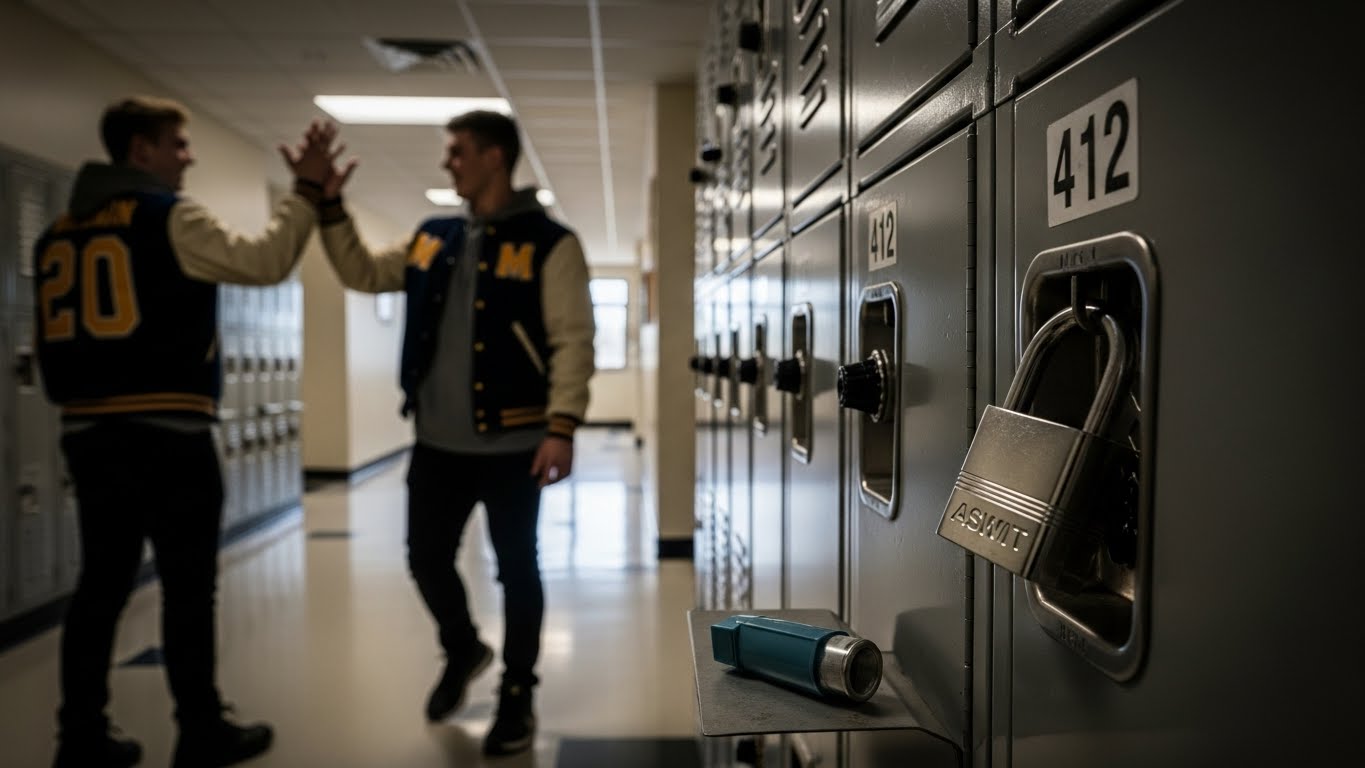
Leo’s eyes widened in horror. He looked at the open locker behind Mitch. Locker 412. It was one of the broken ones, assigned to a dropout who hadn’t shown up since Christmas. It was narrow, dark, and smelled of rust and decaying gym clothes.
“No,” Leo whispered, the word barely escaping his throat. “Please, Braden. I’m claustrophobic. You know I am. I can’t breathe in tight spaces.”
“Claustrophobic?” Braden laughed, a harsh, barking sound that echoed down the empty corridor. “That’s just a word for pussies who are afraid of the dark. We’re helping you, Sterling. Exposure therapy. That’s a thing, right?”
“Please,” Leo begged, stepping back, but he bumped into Mitch’s chest. It was like backing into a brick wall.
“In you go, little man,” Mitch grunted.
The violence was sudden and overwhelming. Mitch grabbed Leo by the back of his neck and the waistband of his jeans. Leo flailed, dropping his backpack. His hand scrabbled for his pocket, trying to pull out his inhaler, but Braden slapped his hand away with a cruel precision.
The plastic device clattered across the floor, sliding under a trophy case five feet away.
“No! My inhaler!” Leo screamed, panic instantly seizing his lungs.
“You won’t need it. You’re just going to chill,” Braden said.
They shoved him. Leo folded into the narrow metal space, his knees banging against the back wall, his shoulder scraping against a rusty hook. The space was impossibly small. It was designed for coats and books, not a living, breathing human being.
“Wait! Don’t!” Leo shrieked, twisting his body, trying to get a hand out to stop the door.
Braden’s face appeared in the rectangular slit of the locker door, grinning. “See you on Monday, Sterling.”
Slam.
The sound was like a gunshot. The darkness was instantaneous and absolute.
Then came the sound that sealed his fate. The distinct click-snap of a heavy-duty padlock being forced through the latch.
“Have a good weekend!” Mitch yelled, pounding his fist against the metal door. The sound vibrated through Leo’s skull, loud and terrifying.
“Let me out! I can’t breathe!” Leo screamed, pounding on the door with both fists. “Braden! Mitch! This isn’t funny! I have asthma! Let me out!”
Outside, he heard laughter. High-fives. Then, footsteps walking away. The heavy thud of boots fading down the corridor.
“Please!” Leo sobbed, his voice cracking. “Is anybody there? Help!”
Silence descended on the Senior Wing. The heavy, suffocating silence of an empty school on a Friday afternoon.
Leo was alone. The locker was twelve inches wide and twelve inches deep. He couldn’t turn around. He could barely shift his weight. The air inside was already hot, smelling of old gym socks, oxidation, and the metallic tang of his own terror.
He tried to inhale, but his throat felt like it was closing up. The panic attack wasn’t coming; it was already here.
Chapter 2: The Longest Hour
Time distorted in the dark.
Leo didn’t know how long it had been. Five minutes? Twenty? An hour? The darkness was a physical weight, pressing against his eyelids even when they were open. The only light came from the three horizontal ventilation slats at the very top of the door, far above his eye level. They let in three thin, dusty beams of dim light that illuminated nothing but the floating dust motes in the stagnant air.
He was twisted at an awkward angle. His left leg was cramped, bent beneath him, while his right was jammed against the door. His arms were pinned to his sides. If he wanted to wipe the sweat that was now pouring into his eyes, he had to wriggle his entire torso, a movement that consumed precious oxygen.
Don’t panic. Panic kills you faster.
His father’s voice echoed in his head. His dad was an engineer, a man of logic who believed every problem had a schematic solution. Assess the situation, Leo. Find the variable you can control.
But there were no variables here. Only constants. Steel. Darkness. Heat.
Leo tried to slow his breathing, but his lungs were betraying him. The air in the locker felt thick, like he was breathing soup. Every inhalation required conscious effort. He could hear the wheeze in his chest—a high-pitched whistle that signaled his bronchial tubes were constricting.
My inhaler. It’s on the floor. Just outside.
The thought was torture. Salvation was six feet away, separated by a sheet of 16-gauge steel. If he strained his ears, he imagined he could hear the plastic casing of the inhaler settling into the dust under the trophy case.
He started to hallucinate. The darkness began to swirl with purple and green shapes. He remembered the time his grandfather took him spelunking when he was ten. He had gotten stuck in a narrow passage, the rock crushing his chest. That was the day the claustrophobia started. The feeling of the earth trying to swallow him whole.
This was worse. Rock was nature. This was man-made malice. This was personal.
He tried to scream again, but it came out as a pathetic croak. “Help…”
He began to scratch at the door. It was an instinctual, animalistic reaction. His fingernails scraped against the painted metal inside the door. Scritch. Scritch. Scritch. The sound was deafening in the enclosed space. He clawed until his fingertips went numb, then raw, then wet. He didn’t feel the pain. He only felt the need to claw his way out, to dig through the steel like a mole through dirt.
Outside, the school was settling into its weekend slumber. The HVAC system hummed—a low, distant drone that mocked him with its circulation of fresh, cool air that he couldn’t access. The silence was heavy, broken only by the settling of the building’s foundation and the thunderous beat of his own heart.
Somewhere down the hall, a door opened.
Leo froze. His heart slammed against his ribs so hard it hurt.
Footsteps. Soft, rhythmic. The squeak of rubber soles on wax.
“Help,” Leo wheezed. He banged his head against the door because his hands were pinned. Thud. Thud.
The footsteps stopped.
“Hello?” A voice. Female. Hesitant.
It was Sarah. Sarah Jenkins. She was in his AP English class. Quiet, smart, wore glasses that were too big for her face. She was the kind of girl who stayed late to finish projects because going home was worse than staying at school.
“Sarah!” Leo gasped, pressing his lips to the cold gap between the door and the frame. “Sarah, help me! It’s Leo!”
“Leo?” Her voice was close now. He could hear the fear in it. “Where are you? Your voice sounds… wrong.”
“Locker… 412. I’m… locked in. Can’t… breathe.”
He heard her gasp. Then her hands were on the locker door. She tugged at the handle. The padlock rattled against the metal plate.
“Oh my god, Leo. Who did this? It’s locked tight.”
“Braden… Mitch…” Leo felt the edges of his vision going black. The lack of oxygen was making his thoughts fuzzy. “Inhaler… floor… trophy case.”
“Okay, hold on. Hold on.”
He heard her scrambling. Then, “I found it! I have it!”
“Pass… through… vents…”
There was a pause. He heard the plastic clicking against the metal above him.
“The vents are too high, Leo. And they’re angled down. I can’t fit it through. I can’t get it to you.”
A sob broke from Leo’s throat. “Break… the lock.”
“I can’t! It’s a Master Lock. I don’t have the combination or a cutter.” Sarah’s voice was rising in panic. “I need to get help. I need to find a teacher.”
“Don’t leave me!” Leo screamed, the terror absolute. If she left, she might not come back. The darkness would eat him.
“I have to, Leo! There’s nobody in this wing. I have to go to the main office. Mr. Henderson is usually cleaning the gym now. Just hang on. Breathe slow. I’m running. I promise I’m running.”
The squeak of her sneakers faded rapidly as she sprinted away.
Leo was alone again. But now, the hope made the despair heavier. He slumped against the door. The heat was unbearable. It was like being inside an oven. His sweat made his clothes stick to his skin like a second layer of flesh.
He closed his eyes. He pictured his bedroom. The window open. The breeze blowing the curtains. The vast, open sky.
Just sleep, a seductive voice whispered in his mind. Just go to sleep and the fear will stop.
His chin dropped to his chest. The scratching stopped. The wheezing slowed, becoming shallow and erratic. The purple shapes in the darkness faded to a dull, consuming gray.
Chapter 3: The Sound of Salvation
Sarah Jenkins ran.
She wasn’t an athlete. She was the girl who faked stomach cramps during the mile run in P.E. so she could walk the last two laps. But right now, adrenaline was pumping a chemical super-fuel through her veins, overriding the burn in her calves and the stitch forming in her side.
The school, usually a place of suffocating rules and social hierarchies, had transformed into a labyrinth of terror. The hallway stretched out before her, an endless tunnel of beige lockers and motivational posters that felt like a cruel joke.
“Success is a journey, not a destination,” read a poster featuring a kitten hanging from a branch.
Sarah tore past it, her breath coming in ragged gasps.
She needed an adult. But on a Friday at 3:15 PM, adults were a scarce resource. The teachers had bolted for their cars the moment the bell rang, desperate to start their own weekends. The administration office was on the other side of the building—a five-minute run.
Leo didn’t have five minutes.
She banked around a corner, her sneakers screeching on the wax, and nearly wiped out. She regained her balance, using the wall to push off, leaving a sweaty handprint on the painted cinder block.
The gymnasium. Mr. Henderson.
Arthur Henderson was a fixture at Oak Creek High. He was the head custodian, a man who looked like he was carved out of granite and old leather. Rumor had it he was a Vietnam vet, a “tunnel rat” who had seen things that made high school drama look like a cartoon. He was usually in the gym at this hour, prepping the bleachers for whatever sporting event was happening that weekend.
Sarah burst through the double doors of the gym. The air inside was cool and smelled of rubber and sweat. The vast space was empty, save for a lone figure pushing a wide dust mop across the center court logo.
“Mr. Henderson!”
Her scream tore through the cavernous room, echoing off the high rafters.
The old man stopped. He didn’t jump. He didn’t startle. He simply stopped moving, his head snapping up with the precision of a soldier hearing a twig snap in the jungle.
He saw the girl—disheveled, pale, tears streaming down her face—and dropped the mop handle.
“What’s the fire, missy?” his voice rumbled, deep and calm, attempting to anchor her hysteria.
“It’s Leo!” Sarah choked out, doubling over, hands on her knees, gasping for air. “Leo Sterling! Senior Wing! They… they locked him in!”
Henderson took a step forward, his brow furrowing. “Locked him in? A classroom?”
“No!” Sarah shrieked, standing up and pointing frantically back toward the door. “A locker! Locker 412! The broken one! He can’t breathe, Mr. Henderson! He has asthma and he’s not answering me anymore!”
The change in the old man was instantaneous.
The sleepy, retirement-age janitor vanished. In his place stood a man of action. His eyes, previously soft and tired, hardened into flint. He didn’t ask who did it. He didn’t ask for details. He heard “can’t breathe” and he moved.
He reached to his belt, grabbing a heavy ring of keys that jingled like wind chimes.
“Move,” he barked.
He didn’t run like a sixty-year-old man with bad knees. He ran with a terrifying, efficient speed, his heavy work boots thudding against the floorboards. Sarah struggled to keep up with him as they exited the gym and surged back into the hallway.
“How long?” Henderson demanded as they ran, not looking back at her.
“I don’t know!” Sarah sobbed, running beside him. “Maybe twenty minutes? Thirty? I found him by accident! He was screaming but then… then he stopped.”
“He stopped screaming?” Henderson asked, his voice tight.
“Yes! He said he was dizzy. He said the shapes were turning gray.”
Henderson cursed under his breath. A string of words Sarah had never heard a school staff member use.
They tore through the cafeteria, overturning a plastic chair in their haste. The school was a ghost town, the silence amplifying the sound of their desperate rescue mission.
As they approached the entrance to the Senior Wing, the atmosphere changed. The air felt heavier here. Stagnant.
Henderson slowed down just as they reached the intersection. He held up a hand, signaling Sarah to stop.
“Quiet,” he commanded.
He stood perfectly still, his head cocked to the side. He was listening for the wheeze. The scratch. The thump of a fist.
The hallway was dead silent. The only sound was the hum of the vending machine lights buzzing overhead.
“Show me,” Henderson whispered.
Sarah pointed a trembling finger at the gray metal coffin halfway down the hall.
Mr. Henderson approached Locker 412. He didn’t rush now; he moved with deliberate, terrifying focus. He placed his large, calloused palm flat against the metal door.
It was warm.
Body heat in a confined space.
“Leo?” Henderson called out, his voice booming. “Leo, son. Can you hear me? Tap twice if you can hear me.”
They waited. Sarah held her breath, praying for a sound. Any sound.
Nothing.
Henderson pressed his ear against the thin gap between the door and the frame. He closed his eyes, straining to hear the faintest intake of breath.
He pulled back, his face grim.
“He’s unconscious,” Henderson stated flatly. “We have to breach. Now.”
Chapter 4: The Siege on the Steel
Mr. Henderson grabbed the padlock. He inspected it for less than a second. It wasn’t a school-issued lock. It was a blackened steel Master Lock, the kind used for storage units and industrial gates.
“Damn it,” he hissed. He fumbled with his key ring, flipping through dozens of keys, but he knew it was futile. This wasn’t a lock he had a master key for. This was foreign hardware.
“Can’t you open it?” Sarah cried, her hands gripping her hair. “He’s dying in there!”
“I don’t have the key, and this shackle is hardened steel,” Henderson growled. He looked around wildly. “I need bolt cutters. They’re in the maintenance shed behind the football field.”
“That’s too far!” Sarah screamed. “That’s ten minutes!”
“I know!” Henderson roared back, the stress finally cracking his stoic veneer. “We don’t have ten minutes!”
He grabbed the handle of the locker and pulled with all his strength. The metal groaned, the door flexing outward, but the padlock held firm. The hasp—the metal loop the lock went through—was rusted, but it was still 16-gauge steel. It wasn’t going to snap from human strength alone.
Henderson looked at the door hinges. They were internal, welded shut. There were no screws to undo. The locker was a fortress.
He needed a battering ram.
His eyes scanned the hallway. Nothing but linoleum and posters. No chairs. No heavy equipment.
Then, his gaze landed on the wall opposite the lockers.
The fire extinguisher.
It was a heavy-duty ABC dry chemical extinguisher, encased in a glass cabinet.
“Step back!” Henderson ordered.
He didn’t bother looking for the little hammer to break the glass. He balled his fist, wrapping his work shirt around his knuckles, and punched through the safety glass.
Crash.
Shards rained down onto the floor. Sarah flinched but didn’t look away.
Henderson reached in, ignoring the small cuts on his wrist, and hauled the heavy red cylinder out of the bracket. It weighed about twenty pounds. Solid steel bottom.
“This is going to be loud,” he warned, shifting his grip on the canister, holding it like a medieval mace.
He turned back to Locker 412. He looked at the padlock. He looked at the rusted hasp holding it.
“Come on, you son of a bitch,” Henderson muttered.
He swung.
CLANG!
The sound was horrific—a deafening, ringing impact that vibrated through the entire hallway. The base of the extinguisher collided with the padlock. Sparks flew.
The locker door dented inward, but the lock held.
“Leo! Hang on!” Sarah screamed at the metal, as if her voice could give him oxygen.
Henderson grunted, stepping back and swinging again.
CLANG!
This time, the sound was different. A crunching noise. The metal plate around the handle was starting to warp. The rust was giving way.
“Hit it again!” Sarah yelled. “It’s bending!”
Henderson was breathing hard now, sweat beading on his forehead. He was channeling twenty years of buffing floors, twenty years of being invisible, twenty years of suppressed rage at bullies like Braden Colt.
He wasn’t just hitting a lock. He was hitting every injustice he had ever witnessed in these halls.
He adjusted his stance, widening his feet. He raised the extinguisher high over his head.
“NOT! ON! MY! WATCH!” he roared.
He brought the cylinder down with a primal, earth-shattering force, aiming not at the lock itself, but at the weakened hasp attached to the locker frame.
CRACK-PING!
The sound of shearing metal was sharper than a gunshot. The hasp snapped clean off. The padlock, still locked, fell to the floor with a heavy, dull thud, taking the broken metal loop with it.
The door popped open an inch, released from its tension.
Henderson dropped the extinguisher, which rolled away with a clatter. He ripped the locker door wide open.
For a second, nothing happened.
Then, gravity took over.
Leo didn’t step out. He didn’t walk out.
He tumbled out.
Like a sack of laundry, or a forgotten mannequin, Leo’s body fell forward. He hit the hard linoleum face down, his arms trapped awkwardly beneath him.
He was motionless.
“Leo!” Sarah shrieked, dropping to her knees so hard she bruised them.
Mr. Henderson was already there. He rolled the boy over.
Leo looked terrible. His skin was a translucent gray, slick with a cold, clammy sweat. His lips were a terrifying shade of violent blue. His eyes were half-open, showing only the whites.
“Is he…?” Sarah couldn’t finish the sentence.
Henderson put his cheek to Leo’s mouth. He placed two fingers on the boy’s carotid artery.
Silence. No breath. No pulse.
“No, no, no,” Henderson whispered.
He ripped Leo’s shirt open, buttons flying across the floor.
“Call 911!” Henderson barked at Sarah. “Now! Tell them cardiac arrest. Respiratory failure. Tell them to bring the paddles!”
“I… I…” Sarah fumbled with her phone, her hands shaking so bad she dropped it.
“DO IT!” Henderson yelled, his voice commanding absolute obedience.
He interlaced his fingers. He placed the heel of his hand on the center of Leo’s fragile chest.
“Come on, kid,” Henderson gritted his teeth. “You don’t get to check out. Not today. Not here.”
He pushed down.
Crack.
A rib popped. Henderson didn’t stop. He couldn’t stop.
One, two, three, four.
He began the rhythm of life and death, pumping the boy’s chest, trying to force the heart to remember its job.
“Stay with me!” Henderson shouted with every compression. “Stay with me!”
The hallway, once a place of lockers and learning, was now a battlefield. And Mr. Henderson was fighting the only enemy that mattered.
Death had come to Oak Creek High, and Arthur Henderson was punching it in the face.
Chapter 5: The Breath of Life
One and two and three and four.
Mr. Henderson counted aloud, his voice a metronome of desperation in the silent hallway. Sweat dripped from the tip of his nose, landing on Leo’s unmoving chest.
CPR on a dummy in a certification class was tiring. CPR on a dying teenager was exhausting in a way that defied physics. It was a drain on the soul.
“Breathe, damn you,” Henderson grunted.
He pinched Leo’s nose shut. He took a deep breath, sealed his mouth over the boy’s blue lips, and blew.
He watched the chest rise. Artificial life.
He pulled back. He waited for the exhale. The passive recoil of the lungs pushed the air out, but there was no follow-up. No gasp. No cough.
“He’s not coming back,” Sarah wailed, clutching the phone to her ear. “The operator says the ambulance is two minutes away! Is he breathing?”
“Not yet!” Henderson yelled, going back to compressions.
His arms burned. His old shoulders screamed in protest. But he didn’t slow down. He pictured the boy’s heart—a stopped clock—and tried to force the gears to turn with the sheer power of his will.
Thirty compressions. Two breaths.
Thirty compressions. Two breaths.
On the third cycle, something changed.
As Henderson leaned back to deliver a breath, Leo’s body convulsed. A spasm shot through his limbs.
Then, a sound.
It was hideous and beautiful all at once. A wet, ragged, guttural suck of air. It sounded like a drain unclogging.
GAAAAASP.
Leo’s eyes flew wide open, staring blindly at the ceiling tiles. He arched his back, his hands clawing at the air, trying to grab something, anything.
“He’s back!” Henderson shouted, tears suddenly blurring his vision. “Turn him! Recovery position! Now!”
He grabbed Leo’s shoulder and hip, rolling him onto his side just as the boy began to retch.
Leo coughed—violent, body-shaking hacks that expelled the stale air and panic from his system. He was gasping, but the wheeze was there, tight and high-pitched. The asthma was still strangling him.
“The inhaler!” Henderson barked at Sarah. “Where is it?”
Sarah scrambled on the floor, grabbing the blue plastic device she had retrieved earlier. She shoved it into Henderson’s hand.
“Leo, listen to me,” Henderson said, his voice dropping to a soothing, commanding baritone. He brought the inhaler to the boy’s mouth. “I need you to take a puff. On three. One, two, three.”
He pressed the canister.
Leo, driven by muscle memory and survival instinct, sucked the medicine in.
“Hold it,” Henderson instructed, rubbing Leo’s back. “Hold it… okay, let it out.”
Leo exhaled, a long, trembling shudder.
“Again.”
Another puff. Another hold.
The blue tint began to fade from Leo’s lips, replaced by a flushed, feverish red. The panicked, blind staring in his eyes began to focus. He looked up, his vision swimming, and saw the wrinkled, sweaty face of the janitor hovering over him like a guardian angel.
“Mr… Henderson?” Leo croaked. His voice sounded like it had been dragged over gravel.
“I got you, kid,” Henderson said, collapsing back onto his heels, his own heart racing. “I got you. You’re out.”
Chapter 6: Blue Lights and Sirens
The silence of the hallway was shattered by the crackle of radios and the heavy tread of boots.
The double doors at the end of the wing burst open. Paramedics in navy blue uniforms swarmed in, pushing a yellow gurney. Police officers followed close behind, hands resting on their belts.
“Over here!” Sarah waved them down, her voice hoarse from screaming.
The paramedics took over with efficient, practiced chaos. An oxygen mask was strapped over Leo’s face. Leads were attached to his chest. An IV line was punched into his arm.
“Oxygen saturation is 82, climbing,” one medic called out. “Tachycardic. BP is low. Let’s load and go.”
Mr. Henderson stood up slowly, his knees popping. He wiped his hands on his work pants. They were shaking.
As they lifted Leo onto the stretcher, the Principal, Mrs. Vance, came running down the hall. Her heels clicked sharply, a stark contrast to the heavy boots of the first responders. She looked at the destroyed locker, the shattered glass of the fire extinguisher case, and the boy on the stretcher.
Her face went pale.
“What happened?” she demanded, looking from Henderson to the police. “Was this a fight? A prank gone wrong?”
Mr. Henderson stepped in front of her. He towered over the administrator, smelling of sweat and floor wax.
“A prank?” Henderson repeated, the word tasting like bile in his mouth.
He pointed a trembling finger at the twisted metal of Locker 412.
“That wasn’t a prank, Mrs. Vance. They shoved an asthmatic kid into a steel box, padlocked it, and walked away laughing while he screamed that he couldn’t breathe.”
The hallway went quiet. The police officers stopped writing in their notebooks.
“Who?” Mrs. Vance whispered.
“Braden Colt and Mitch Rourke,” Sarah spoke up, her voice trembling but loud. “I saw them leaving. And I have the recording.”
Mrs. Vance looked like she might be sick. Braden Colt. The star quarterback. The face of the school website.
“Are you sure, Sarah?” Mrs. Vance asked, her eyes darting around. “These are serious accusations.”
Henderson stepped closer, his voice dropping to a dangerous whisper.
“If those boys step foot in this school on Monday,” he said, staring directly into the principal’s eyes, “I walk. And before I walk, I call every news station in the state. This wasn’t bullying. This was attempted murder.”
One of the police officers stepped forward, closing his notebook. “Ma’am, we’re going to need access to the security footage from this wing. Immediately.”
Mrs. Vance nodded, defeated. “Of course. Right this way.”
As they wheeled Leo out, he turned his head on the pillow. The oxygen mask fogged up with his breath. He found Mr. Henderson in the crowd.
He didn’t have the strength to speak. He just lifted one hand, a weak thumbs-up.
Henderson nodded, a tight smile breaking through his grim expression.
Chapter 7: The Digital Witness
By Saturday morning, the video hadn’t leaked, but the audio had.
Sarah had been recording a voice memo for her AP English project—a monologue practice—when she had walked into the hallway. The phone in her pocket had captured everything.
The muffled pleas.
“I can’t breathe in tight spaces!”
The cruel laughter.
“Exposure therapy.”
The snap of the lock.
And the silence that followed.
It went viral on TikTok within hours. The hashtag #JusticeForLeo started trending locally, then nationally.
The police didn’t need the TikTok trend, though. They had the security footage.
It was grainy, but undeniable. At 3:10 PM, Braden and Mitch intercepted Leo. At 3:12 PM, they forced him into the locker. At 3:13 PM, Braden produced a lock from his pocket—proving premeditation—and sealed the door.
They were seen high-fiving as they exited the building.
The fallout was nuclear.
Braden Colt was arrested at his home on Saturday night. The local news captured the footage of the Golden Boy being led out in handcuffs, his varsity jacket draped over his head to hide his face.
His scholarship to State University was revoked via a tweet from the university’s athletic director on Sunday morning.
Mitch Rourke turned himself in an hour later. His lawyer immediately offered a plea deal: testimony against Braden in exchange for leniency.
The community of Oak Creek, usually so protective of its football stars, turned on them overnight. The horror of the details—the inhaler kicked away, the knowledge of Leo’s asthma—made it impossible to defend.
It wasn’t a “boys will be boys” moment. It was a glimpse into pure, unfiltered cruelty.
Leo spent three days in the hospital. His lungs were inflamed, and the trauma had triggered severe acute stress reaction. He didn’t speak much. He mostly stared out the window, watching the clouds move, grateful that they were far away and the sky was open.
He didn’t return to school for the rest of the year. The school board approved him to finish his finals from home. They offered him counseling, tuition reimbursement, anything to avoid a lawsuit.
Leo didn’t care about the lawsuit. He just wanted to breathe.
Chapter 8: The Ghost Returns
Graduation day was hot. The sun beat down on the football field where the ceremony was held—the same field where Braden Colt was supposed to have been the hero.
Braden wasn’t there. He was sitting in a juvenile detention center, awaiting a trial that would likely see him charged as an adult given his age.
Leo sat in the back row of the folding chairs. He wore his cap and gown, but he felt disconnected from the sea of blue and gold around him.
When his name was called—”Leo Sterling”—the applause was polite, perhaps a bit louder than usual. People craned their necks to see the boy who had survived the locker.
Leo walked across the stage, took his diploma, and didn’t look at the audience. He just kept walking.
He didn’t stop at his seat. He kept walking toward the exit gate of the stadium.
He needed to get away from the noise.
Near the maintenance shed, away from the cheering crowds and the weeping parents, a man was leaning against a golf cart. He was wearing a grey work uniform, smoking a cigarette that he quickly hid when he saw a student approaching.
“Mr. Henderson,” Leo said.
The old janitor straightened up. He looked tired. The incident had aged him.
“Leo,” Henderson nodded. “Congratulations. You made it.”
“We made it,” Leo corrected him.
Leo reached into his pocket. He pulled out a small, rectangular box. It was a gift.
“I… I didn’t know what to get you,” Leo stammered. “My dad helped me pick it out.”
Henderson hesitated, then took the box. He opened it. Inside was a heavy, silver Zippo lighter. Engraved on the side were three words: The Breath of Life.
Henderson chuckled, a dry, raspy sound. “You trying to encourage my bad habits, kid?”
“I’m trying to say thank you,” Leo said, his voice steady. “For the air. For fighting for me when I couldn’t.”
Henderson snapped the lighter shut and put it in his pocket. He reached out and placed a heavy hand on Leo’s shoulder.
“You fought too, Leo. You held on. That’s the hardest part.”
They stood there for a moment, an awkward pair—the invisible student and the invisible janitor—united by a terrifying secret that the rest of the world treated as a headline.
“What now?” Henderson asked.
“College,” Leo said. “Engineering. I want to design things.”
“Good,” Henderson nodded. “Design things that open from the inside.”
Leo smiled. It was the first real, genuine smile he had smiled in weeks.
“Deal.”
Leo turned and walked away, heading toward the parking lot where his parents were waiting. He took off his graduation cap and threw it into the air, not for celebration, but just to watch it fall against the vast, limitless blue sky.
He took a deep breath. The air smelled of cut grass and diesel fumes.
It was the sweetest thing he had ever tasted.