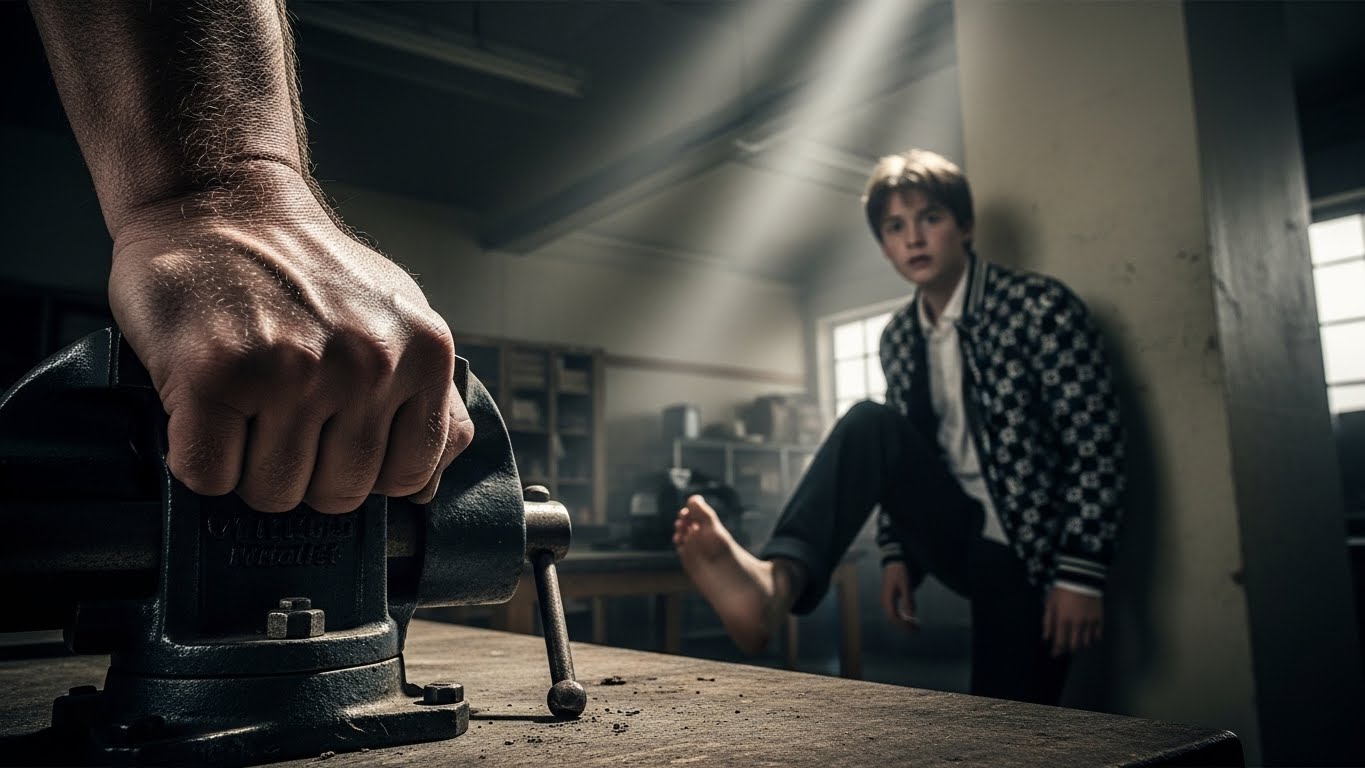
The Mechanic’s Justice: What a Blue-Collar Dad Did When Bullies Used His Son’s Shop Tools Against Him
Chapter 1: The Weight of Steel and Grease
Frank Miller didn’t have soft hands. They were the kind of hands that told a story without Frank having to utter a single word—a story of thirty years spent coaxing life back into broken engines, a story etched in scars, burns, and calluses thick as river stones.
They were hands that smelled perpetually of diesel and 10W-40, hands that could disassemble a carburetor blindfolded or, as his wife Eleanor often joked, crush a soda can into a metallic puck with a casual squeeze.
To the world, Frank was just a simple, blue-collar man, a fixture at Miller’s Auto & Repair on the less glamorous side of town. But to his son, Ethan, those hands were the safest place in the world.
Ethan Miller, at sixteen, was built less like his sturdy father and more like a slender sapling, all nervous energy and high-strung intellect. He was a good kid, quiet, prone to burying his nose in advanced physics textbooks. He was the kind of kid who saw the elegance in mathematics rather than the rough-and-tumble of the shop floor.
He was taking Shop Class at Northwood High purely for the required credit, a fish out of water in a world of grinders, lathes, and the pervasive metallic dust that settled on everything. Frank had tried to bond with him over the class, showing him how to true a wheel or properly use a torque wrench, but Ethan’s heart wasn’t in it. His heart was set on MIT, a world away from the greasy comfort of his father’s garage.
The trouble, as it often does, began subtly. It was a slight shift in the air pressure around Ethan.
It started with whispered names—”Gearhead,” “Grease Monkey”—that escalated to minor vandalism: a textbook drenched in cutting oil, a locker door jammed with a stray bolt.
The ringleader was Troy Henderson. Troy was a kid who looked like he belonged on a college football recruitment poster, all aggressive muscle and entitled swagger. He was fueled by his father’s wealth and a misplaced sense of superiority. Troy wasn’t smart, but he was observant. He knew Ethan wouldn’t fight back, and he knew how to exploit the boy’s quiet nature.
Frank had noticed the signs, of course. The strained silence at dinner. The way Ethan flinched when a car backfired. The new, almost imperceptible tremor in his son’s hands when he was holding a pencil.
Frank was a man of few words, preferring to observe and act, but he knew when something was fundamentally wrong with his boy. He’d gently pressed Ethan, but the answers were always evasive, mumbled excuses about a difficult geometry assignment or a cold. Frank knew how to fix engines; he was still learning how to fix a teenage heart.
One Thursday, the trouble stopped being subtle.
It was three-thirty in the afternoon, half an hour before the end of the school day. Frank had wrapped up a particularly nasty transmission replacement earlier than expected. The truck’s owner, a local farmer named Gus, had offered to pay him immediately in cash. Frank, feeling the rare, pleasant sting of being ahead of schedule, decided to surprise Ethan.
He knew Ethan’s shop class let out at four, and he figured he could save his son the long, cold walk home. He didn’t even bother to change out of his jumpsuit. It was heavy, dark blue canvas coveralls that were practically a second skin, stained with the indelible proofs of his profession. He just wiped his hands on a rag, the thick, fibrous cloth barely making a dent in the deeply ingrained filth, grabbed his battered thermos, and headed toward Northwood High.
The shop classroom was a separate annex building, a concrete bunker smelling of ozone, hot metal, and stale sweat. Frank didn’t see the usual bustle of students or hear the loud, abrasive whine of the belt sander he expected.
Instead, a chilling, unnatural quiet hung over the place.
The main double doors, usually propped open with a block of wood, were ajar just enough to invite a curious peek. Frank pushed the door open, the old hinges groaning a metallic protest that thankfully went unheard inside.
The sight that greeted him wasn’t the organized chaos of a working classroom; it was a tableau of malice.
His son, Ethan, was backed up against a heavy workbench. His eyes were wide and vacant, the color draining from his face like water through a sieve.
Two other boys, Troy Henderson’s predictable lackeys, were blocking the exits, their faces smirking with the ugly confidence of petty dictators.
Troy himself was standing directly in front of Ethan. He was holding a heavy, chrome-plated adjustable wrench—a tool that was meant for precision, not pain.
Troy wasn’t hitting him; he was applying pressure. The curve of the wrench head was pressed hard against the delicate, inner skin of Ethan’s forearm, just above the wrist. Troy wasn’t swinging; he was twisting the wrench slowly, deliberately. The knurled adjustment screw dug into the soft tissue, threatening to pop a vein or shatter a bone.
“You tell anyone about the cutting oil, Miller,” Troy hissed. His voice was low and menacing, the sound amplified by the hollow acoustic of the empty workshop. “And this wrench finds your kneecap. Understand?”
Ethan could only manage a strangled, whimpering sound. It was a noise that tore through Frank’s heart like shrapnel.
The sheer cowardice of the act—using the weight and cold indifference of a tool, an object of work, as an instrument of slow torture—ignited something primal in Frank Miller.
His world, which usually moved at the methodical, measured pace of an engine’s stroke, compressed into a single, blinding moment of pure, protective rage.
He didn’t yell. He didn’t even drop his thermos. He just moved.
The heavy work boots, thick-soled and steel-toed, made no sound on the concrete floor. The grease-stained jumpsuit, usually a symbol of hard work and honesty, suddenly felt like the combat armor of a man who had nothing left to lose.
The two lackeys saw him first. Their eyes widened in sudden, panicked alarm, but before they could utter a warning, Frank had closed the distance.
Troy Henderson, still focused on his victim, didn’t see him until Frank’s hand was on him.
This was where the thirty years of manual labor paid its dividends. Frank’s hands weren’t just strong; they were precise instruments of enormous, leveraged power. He didn’t use a fist. He used the Vulcan Grip.
He clamped his left hand not on Troy’s shoulder, but lower, directly onto the trapezius muscle, the thick, triangular rope of flesh that runs from the neck down the spine. Frank knew, from lifting engine blocks and pulling on rusted axle nuts, exactly where the nerves ran closest to the surface.
He tightened his grip. The hard, unyielding mass of his palm and fingers sank deep into the muscle, not with a sudden, painful jab, but with a slow, grinding pressure.
It was an immediately devastating kind of pain. It wasn’t the blunt force trauma of a punch; it was the sharp, electrical agony of nerve compression.
Troy’s menacing posture crumbled instantly. The chrome wrench clattered to the floor with a pathetic sound. A high-pitched, involuntary cry of pain—a sound so undignified it was barely recognizable—escaped his lips.
His expensive sneakers scraped against the concrete as his knees buckled. The arrogant, entitled look on his face dissolved into pure, infantile terror. He was paralyzed, suspended between the fear of falling and the crushing power of the man holding him up.
“Let him go.”
Frank’s voice was a low, guttural rasp, far more terrifying than a shout. It didn’t sound like the voice of a man; it sounded like the grinding of gears on an improperly timed engine.
The two lackeys, frozen in shock, finally scattered, stumbling over themselves as they fled the shop, leaving Troy to face the music alone.
Ethan watched, tears starting to leak down his face. Not from the pain of the wrench, but from the sudden, overwhelming relief and the terrifying spectacle of his father’s controlled fury.
Frank didn’t look at Ethan. His entire focus was a burning laser beam aimed at the miserable boy suspended in his grip.
“You thought you were tough, didn’t you, son?” Frank whispered, his face close to Troy’s ear. The smell of grease and honest sweat filled the bully’s nostrils. “You thought this was your playground because your daddy buys you fancy tools. You thought the metal made you strong.”
With a swift, brutal economy of motion, Frank dragged the whimpering, paralyzed Troy across the floor. He didn’t let go of the Vulcan Grip until they reached the heaviest, most ancient piece of machinery in the room: the steel bench vise.
It was bolted immovably to a workbench that had survived fifty years of teenage abuse. It was a massive, antiquated vise, its jaws scarred from countless projects, its heavy crank handle a testament to leveraged power.
Troy, now completely distraught, was crying openly, big, messy sobs that ruined his expensive, pristine North Face jacket. Frank forced him to stand directly in front of the vise.
“This,” Frank said, his voice dropping to an almost inaudible, venomous murmur. “Is what real strength looks like. Not a pretty tool in a rich kid’s hand. This is the truth of steel.”
Frank’s eyes fell to Troy’s feet. The boy was wearing a brand-new pair of pristine, white-and-red Air Jordans—a ridiculous status symbol in a shop where any sensible student wore heavy, durable boots.
Frank’s face, which had been a mask of rage, twisted into a look of cold, calculating pity.
He knelt down, his powerful legs effortlessly absorbing the weight of his body. He lifted Troy’s foot and placed the toe of the immaculate, expensive shoe inside the massive jaws of the bench vice.
Troy immediately sensed the intent. His cries turned into frantic, desperate pleas. “No, please! Don’t! I’ll never do it again!”
Frank ignored the wailing. He took hold of the heavy, cast-iron handle of the vise. With a slow, deliberate movement that took all the controlled, practiced strength of his thirty years in mechanics, he began to turn the handle.
The heavy thread of the screw engaged, and the vise jaws began to close. Not on Troy’s foot, not yet, but on the hard, unyielding plastic and rubber of the shoe.
The pristine white leather began to buckle. The air, which had been thick with tension, was now pierced by the sickening, cracking sounds of stressed materials.
Frank tightened the vise just enough for Troy to feel the enormous, crushing pressure beginning to transfer through the shoe’s thick sole and into the delicate bones of his toes.
It wasn’t enough to break anything, but it was enough to deliver a searing, unholy promise of pain. The kind of pressure that makes a man realize just how fragile his body is against the indifferent might of an industrial tool.
He leaned in close one last time, his voice a dry, rasping whisper that cut through the boy’s hysteria.
“My son’s fingers, Troy. They’re like glass compared to this steel. Your fingers? Even more so. Now you listen to me, and you listen well. You ever lay a single, grease-free finger on my boy again, I won’t use a wrench. I won’t even use this vice. I’ll take those delicate little fingers of yours, one by one, and I’ll tap them against an engine block until they snap like dried twigs. You think about that next time you feel tough.”
Frank gave the vice handle one final, minute turn.
CRACK.
It was a sickening, final sound—the sound of the shoe’s internal structural integrity collapsing.
The pressure was immediately released. Frank stepped back, his chest heaving, his face still a cold, unreadable mask.
Troy Henderson yanked his now-ruined, warped sneaker out of the jaws of the vise. He scrambled backward across the floor until his back hit the safety of the wall, his tears and snot staining his expensive jacket.
He didn’t look at Frank, or Ethan, or the door. He just stared at the crushed, utterly destroyed shape of his $200 shoe. The symbol of his status was now rendered useless and grotesque by the truth of Frank Miller’s world.
The lesson wasn’t about pain; it was about power, and where the real power resided.
Frank finally turned. His gaze softened immediately when it fell upon his son. Ethan was trembling, but there was a new, complex emotion in his eyes. A strange mix of horror, awe, and complete, unadulterated relief.
“Let’s go, Ethan.”
Frank’s voice was back to its normal, low rumble, the storm having passed. He reached out his scarred, grease-stained hand.
Ethan didn’t hesitate. He took his father’s hand, the familiar, rough texture a sudden, overwhelming anchor in the middle of the storm.
They walked out of the shop class, leaving Troy Henderson a sobbing, defeated mess on the floor. The smell of burnt rubber and fear hung heavy in the air. The wrench, the symbol of the bully’s small power, lay abandoned on the concrete.
Chapter 2: The Aftermath and the Quiet Conversation
The drive home was silent, but it wasn’t the strained, evasive silence of the past few weeks. It was a heavy, meaningful silence, a vacuum created by the explosive release of tension.
Ethan sat in the passenger seat of his father’s battered Ford F-150. The truck smelled reliably of oil and stale coffee, the very smell he usually found oppressive. Now, it was a scent of sanctuary. His arm, where the wrench had pressed, ached faintly, but the invisible bruise on his spirit was already beginning to heal.
Frank kept his eyes on the road. His hands—the hands that had just delivered a raw, primal form of justice—gripped the steering wheel with casual ease.
The sheer, terrifying efficiency of his actions kept replaying in Ethan’s mind. The Vulcan Grip. The way Troy’s arrogant world had imploded. The calculated, devastating pressure of the bench vise.
It was violence, yes. But a violence so controlled, so precise, it felt more like a surgical lesson than a brawl. It was the language of the shop floor, translated into the language of consequence.
“He won’t bother you again.”
Frank’s voice was flat. Not a question, but a statement of absolute certainty.
“I… I know, Dad,” Ethan whispered, the words catching in his throat. “But… you crushed his shoe. And that grip… what was that?”
Frank chuckled. It was a dry, rough sound that sounded like sand slipping through a funnel.
“That’s leverage, son. That’s knowing how things work. Engines, tools, people. You find the weak point, you apply pressure where it hurts the most, and you don’t stop until the problem is fixed. And the shoe? It’s called a visual aid. He valued that piece of garbage more than your peace of mind. Now he knows what happens when a piece of garbage meets real steel. He loses his expensive status symbol.”
They arrived home. The modest, two-story house on Maple Street looked like an island of normalcy in the wake of the afternoon’s storm.
Eleanor, Ethan’s mother, was setting the table. She was a woman of gentle strength, a school librarian who valued patience and dialogue. Frank knew he had a conversation coming with her that would be far more challenging than confronting Troy Henderson.
Eleanor took one look at her husband’s grim, grease-smeared face. Then she looked at her son’s slightly pale but resolutely upright posture. Her eyes went straight to the faint, purple-red pressure mark on Ethan’s arm.
“Frank Miller,” she said, her voice dangerously calm. It was the kind of quiet authority that could silence a cafeteria full of unruly teenagers. “What happened at that school?”
Frank didn’t flinch. He sat Ethan down on the kitchen stool, then pulled out his own chair, taking the heavy silence upon himself.
He recounted the event. He didn’t sensationalize the details. He simply laid out the facts like a meticulous mechanic diagnosing a fault: the wrench, the threat, the grip, the vice. He didn’t ask for approval; he stated his actions as a necessity.
Eleanor listened, her hands clutching the edges of the apron. Her face was a shifting landscape of horror and profound, weary understanding. When Frank finished, she didn’t explode in anger. She deflated into a sigh.
“Frank, you could have been arrested. You could have been charged with assault. He’s a child.”
“He was using a tool as a weapon on my child,” Frank countered, his gaze steady and unyielding. “I used a tool to teach him a lesson he won’t forget. It’s not assault if no bones are broken, Eleanor. It’s a demonstration of applied physics. I didn’t hit him. I just showed him what his $200 shoe means to a hundred-year-old vise. I showed him the difference between privilege and consequence.”
Eleanor knew better than to try and win a philosophical argument with Frank when his protective instincts were engaged. But her concern was for the moral compass of her son.
“And what does this teach Ethan, Frank?” she asked, her voice softer now, pleading. “Does it teach him that violence is the answer? Does it teach him that the only way to beat a bully is to become a bigger one?”
Ethan, who had been listening intently, finally spoke up, surprising them both.
“No, Mom. It didn’t teach me that.”
Ethan looked from his mother to his father.
“Troy was using the wrench to make me feel weak. Dad showed him that he wasn’t the strongest thing in the room. That there’s a power that comes from knowing how the world works, not from having money or being a jerk. It was… terrifying, but it was fair. He didn’t hurt Troy. He just destroyed his illusion of power.”
Frank just watched his son, a small, almost imperceptible nod of satisfaction tightening the corner of his mouth.
The phone rang twenty minutes later.
It was Mr. Alcott, the Shop Class teacher, sounding nervous and apologetic. Troy’s father, Mr. Henderson—a man Frank knew by reputation as a high-powered real estate developer who treated people like faulty appliances—had called the school. He was threatening lawsuits and disciplinary action against Frank.
“Mr. Miller, I saw the security footage, what little we have,” Mr. Alcott stammered. “I should have been there, I went to the main office for a minute… Look, Troy’s father is ballistic. He’s demanding you be banned from school property. He’s claiming assault and destruction of property. He’s pulling Troy out of Shop Class and threatening to get the police involved.”
Frank took the phone off the hook. He held the receiver loosely, the distant sound of Mr. Alcott’s frantic voice a faint buzz against his ear.
“You tell Mr. Henderson a few things for me, Alcott,” Frank said, his voice calm and steely.
“First, I want to see the police report for the destruction of my son’s private property—his textbook—with corrosive cutting oil. Second, Troy was using an industrial tool to inflict injury on a minor; that’s a felony. Third, if he wants to talk about the destruction of property, he can send me a bill for the shoe. And I’ll send him a bill for an hour of my time, plus the cost of my stress.”
Frank paused, letting the words sink in.
“I’ll also remind him that I have a clean record. His son has a pattern of documented behavioral issues that I can introduce as evidence when I press charges for assault with a deadly weapon. I took his picture with my phone before I left. I think the bruise from the Vulcan Grip will look fantastic on a police report.”
Frank didn’t wait for a reply. He hung up the phone with a definitive clack, the sound echoing in the kitchen.
“That,” he said to his wife and son, a man who had fixed the engine and was now simply adjusting the timing. “Is the sound of leverage being applied to the establishment.”
The incident, though over quickly, had a profound, lasting effect on Ethan. He didn’t become a fighter, but he became more grounded, more confident. He saw that true strength wasn’t about aggression; it was about the applied knowledge of physics and psychology.
His father, the grease-stained mechanic, was a master strategist, a protector who understood the delicate balance of fear and respect.
Over the next few days, Ethan started spending more time in the garage. Not to repair cars, but to understand the tools.
He studied the bench vise, marveling at the sheer mechanical advantage of the screw thread. He held the wrench that Troy had used, feeling its cold, simple weight.
He began to see the logic in the metallic world, the pure, unadorned truth of cause and effect. He realized that the same principle that allowed a jack to lift a two-ton truck could also be used to move mountains in his own life.
Frank, sensing this subtle, encouraging shift, began to teach him. Not about engines, but about the lessons the tools contained. He showed him how to choose the right wrench, how to apply torque smoothly, how to respect the power in his hands.
“This,” Frank said one evening, holding up a heavy, old crescent wrench, its edges worn smooth by decades of use. “This isn’t just metal, son. This is leverage. This is the truth of work. You learn to respect this, you learn to respect yourself. And nobody, ever, gets to use it against you.”
Chapter 3: The Invisible Vise
The peace that followed the incident in the school shop was the kind of peace that hangs heavy in the air before a thunderstorm. It was too quiet. Too still.
Frank Miller went back to work. His routine was his anchor. The 5:00 AM coffee, black and bitter. The drive to the shop as the sun bled into the grey sky. The sound of the roller door rattling up, revealing the sanctuary of concrete and steel.
For a week, it seemed like the Hendersons had retreated to their gated community on the hill, licking their wounds. Ethan was walking taller, his shoulders squared, the shadow of fear lifting from his eyes. He was even eating more, the knot in his stomach finally loosening.
But Frank knew better. Men like Robert Henderson didn’t retreat. They just changed weapons.
It started on a Tuesday, a day that should have been marked only by a scheduled brake job on a Honda Civic and a timing belt on an old Ford Ranger.
Instead, at 9:00 AM sharp, a white city sedan pulled into the gravel lot of Miller’s Auto & Repair. It wasn’t a customer.
Two men in crisp, button-down shirts stepped out. They held clipboards like shields. They didn’t look at Frank; they looked at the building. They looked at the oil drums. They looked at the drainage grate in the corner of the lot.
Frank wiped his hands on a rag, the grease streaking across the red fabric, and walked out to meet them. He didn’t smile. He didn’t frown. He just stood there, a monolith in blue coveralls.
“Can I help you gentlemen?” Frank asked. His voice was polite, but it carried the low rumble of a warning.
“Zoning and Environmental Compliance,” the taller one said, not making eye contact. He flashed a badge that looked too shiny to have seen any real work. “We received an anonymous tip regarding improper disposal of hazardous fluids and structural code violations. We’re here for an immediate audit.”
Frank narrowed his eyes. “I’ve been here twenty years. I pass every inspection. My fluids are picked up by a certified service every Thursday. You can check the logs.”
“We’ll check everything, Mr. Miller,” the short one said, finally looking up. His eyes were cold, bureaucratic beads. “Every. Single. Thing.”
They spent four hours. They crawled under the lifts. They measured the distance between the fire extinguishers. They inspected the electrical panel with a magnifying glass. They were looking for a crack, a loose wire, a single drop of oil in the wrong place.
It was a squeeze. Just like the vise.
They weren’t there to find a problem; they were there to create one. By noon, they had slapped him with three citations. One for a “faded” exit sign. One for an extension cord that was “permanently affixed” (it was zip-tied to a leg of a workbench). And one, the heavy hitter, for “potential groundwater contamination” due to a hairline crack in the concrete floor near the waste oil drum.
“We’re going to have to issue a cease-and-desist on all heavy repair work until the concrete is resurfaced and certified by an engineer,” the tall inspector said, handing Frank a pink slip of paper. “Standard procedure.”
Frank took the paper. His hand didn’t shake, but his jaw tightened until his teeth ached.
Resurfacing the floor meant clearing the shop. It meant shutting down for a week, maybe two. It meant thousands of dollars he didn’t have, and lost revenue he couldn’t afford to lose.
“Who sent the tip?” Frank asked, his voice deadly quiet.
“Anonymous, sir,” the man said, turning back to his sedan.
Frank watched them leave. He stood in the silence of his shop, the pink slip heavy in his hand. He knew who sent them. Robert Henderson was twisting the handle. He was applying leverage.
He didn’t tell Eleanor. He didn’t want to worry her. She was already picking up extra shifts at the library to help with Ethan’s college fund.
Frank worked late that night. He didn’t do “heavy repair.” He cleaned. He scrubbed the floor until his knees were raw. He fixed the exit sign. He cut the zip ties on the extension cord.
He was a mechanic. When something broke, you fixed it. If the system was broken, you found a workaround.
But the pressure didn’t stop there.
Two days later, the bank called. It was Mr. Jenkins, a man Frank had known for fifteen years, a man who had approved his mortgage with a handshake.
“Frank,” Jenkins sounded pained, his voice cracking over the phone line. “I… I don’t know how to tell you this. The bank has been bought out by a larger regional conglomerate. They’re auditing all small business loans.”
“I’ve never missed a payment, Bill,” Frank said, holding the phone with a greasy hand, staring at the “Closed for Repairs” sign he’d had to tape to the front door.
“I know. I know you haven’t. But there’s a clause in the commercial agreement. The ‘Risk Assessment’ clause. They’ve flagged your property value as… volatile. They’re calling in the note, Frank. They want the remaining balance on the shop’s mortgage renegotiated or paid within sixty days.”
Frank felt the blood drain from his face. This wasn’t just a squeeze anymore. This was an attempt to crush him.
Robert Henderson was a developer. He had friends in the city council. He had friends in banking. He was using the weight of the world to crush a single man’s hand.
Frank hung up the phone. He looked around his shop. The tools hung silently on the pegboards. The smell of oil, usually so comforting, now smelled like stagnation.
For the first time in his life, Frank Miller felt small.
He wasn’t fighting a rusty bolt or a seized piston. He was fighting invisible ink on paper. He was fighting money. And he didn’t have a tool in his box for that.
Or so he thought.
Ethan walked in then. School was out. He had his backpack slung over one shoulder, a thick calculus textbook in his hand.
He stopped in the doorway. He saw the “Closed” sign. He saw the clean floor. He saw his father sitting on a stack of tires, his head in his hands.
Ethan didn’t say anything at first. He walked over and sat on a tire next to his dad.
“It’s Henderson, isn’t it?” Ethan asked softly.
Frank looked up. He tried to put on his brave face, the mask of the protector, but it slipped. “It’s complicated, son. Business stuff.”
“No,” Ethan said, his voice surprisingly firm. “It’s physics. For every action, there is an equal and opposite reaction. You humiliated Troy. Now his dad is trying to humiliate you. He’s applying force.”
Frank sighed, a heavy, rattling sound. “He’s got more leverage, Ethan. He’s got the city. He’s got the bank. I’m just a guy with a wrench.”
Ethan looked around the shop. He looked at the citations on the desk. He looked at the letter from the bank. His eyes, usually so gentle, sharpened. He looked at the papers the way he looked at a complex equation on a chalkboard.
He didn’t see a tragedy. He saw a variable he could solve.
“Dad,” Ethan said, standing up. “You taught me about the vise. You said if you find the weak point, you can move anything.”
“Yeah,” Frank muttered.
“Well,” Ethan said, pulling out his laptop from his backpack. “Mr. Henderson thinks he’s the vise. But he’s not. He’s just a machine. And every machine has a design flaw.”
Chapter 4: The Face-Off
Friday brought the storm.
It wasn’t rain. It was a black Mercedes S-Class rolling into the lot, crunching the gravel with the arrogance of a tank invading a village.
Frank was sweeping the already spotless floor. He knew this moment was coming. He had been waiting for it.
The car door opened, and Robert Henderson stepped out. He was a tall man, impeccably dressed in a charcoal suit that cost more than Frank’s truck. He had silver hair, a tan that came from a bottle or a yacht, and a smile that didn’t reach his predatory eyes.
He didn’t come with inspectors this time. He came alone.
Frank leaned his broom against the wall. He wiped his hands, not because they were dirty, but out of habit. He walked out to the edge of the bay door, standing on the threshold between his world and Henderson’s.
“Mr. Miller,” Henderson said. His voice was smooth, cultured, the kind of voice that sold swampland as paradise. “We haven’t had the pleasure of a formal introduction. I’m Robert Henderson.”
“I know who you are,” Frank said. He didn’t offer a hand. He stood with his arms crossed over his chest, his biceps straining against the blue fabric.
Henderson chuckled softly, looking around the empty lot. “Rough week, I hear. City inspectors can be such a nuisance. And the banks… terrible timing with the economy the way it is.”
“Cut the crap,” Frank said. “What do you want?”
Henderson’s smile faded, replaced by a look of bored disdain. He took a step closer, invading Frank’s personal space. He smelled of expensive cologne and mints.
“I want you to understand your position, Frank. Can I call you Frank? You’re a relic. This shop? It’s an eyesore. I’m developing the parcel of land adjacent to the high school. Luxury condos. Retail space. And this…” He gestured vaguely at Frank’s life’s work. “…this grease pit doesn’t fit the aesthetic.”
“This is my land,” Frank said. “Paid for.”
“Is it?” Henderson raised an eyebrow. “I heard the bank called the note. And with the EPA violations the city just found… fixing that floor is going to cost you, what? Twenty thousand? Thirty? You don’t have it, Frank.”
Frank stayed silent. The man had done his homework.
“So, here’s the offer,” Henderson said, pulling a sleek leather checkbook from his jacket pocket. “I’ll buy you out. Today. I’ll pay off the bank note. I’ll give you enough cash to move somewhere… appropriate. Maybe a nice trailer park two counties over. You take your boy, you take your toolbox, and you disappear.”
“And if I don’t?”
Henderson stepped in closer, his voice dropping to a whisper. “Then I bury you. I’ll have the city condemn this building. I’ll have the bank foreclose. I’ll drag you through so much litigation you’ll be begging for bankruptcy just to make it stop. You humiliated my son, Frank. You touched him. You scared him. Now, I’m going to take everything you have.”
Frank looked at the man. He saw the soft hands. He saw the arrogance. He felt the rage building in his chest, the urge to use the Vulcan Grip on this man’s expensive suit collar.
But he knew that was exactly what Henderson wanted. Assault charges. A reason to call the police.
“Get off my property,” Frank said. His voice was low, shaking with restrained violence.
“Think about it,” Henderson said, turning back to his car. “You have untill Monday. Then the real pressure starts.”
Henderson got into his Mercedes, the engine purring to life, and drove away, leaving a cloud of dust that settled on Frank’s boots.
Frank stood there for a long time. He felt the weight of the building behind him. He felt the weight of thirty years of sweat. He felt the crushing reality that he might lose it all because he stood up for his son.
He turned to go back inside, defeated.
But when he walked into the office, he found Ethan.
Ethan wasn’t at school. He had skipped. He was sitting at Frank’s cluttered desk, surrounded by stacks of paper. The shop’s old filing cabinet was open.
“Ethan, what are you doing here?” Frank asked, his voice weary.
Ethan spun around in the chair. His face was lit up by the glow of the laptop screen. He didn’t look scared. He looked exhilaratingly, terrifyingly focused.
“He offered to buy you out, didn’t he?” Ethan asked.
“Yeah,” Frank grunted, sinking onto the customer waiting bench. “He wants to build condos.”
“I know,” Ethan said. “I’ve been doing some research. While you were cleaning the floor last night, I was digging.”
Ethan turned the laptop around so Frank could see. It was a map of the town, overlaid with colorful lines and grids.
“Dad, Mr. Henderson is a developer, right? He pushes boundaries. He leverages zoning laws.”
“So?”
“So,” Ethan pointed to a line on the map that ran directly behind the shop, cutting through the woods where Henderson planned his luxury condos. “I checked the county surveyor’s records. not the digital ones. The old ones. The ones from the 1950s that haven’t been digitized yet. Mom helped me access the archives at the library.”
Frank leaned in, squinting at the screen. “What is that?”
“That,” Ethan said, a slow smile spreading across his face—a smile that looked remarkably like Frank’s when he solved an engine knock that no one else could fix—“is a protected wetlands drainage easement. And this…” He pointed to another line. “…is the historical bedrock survey.”
Ethan looked up at his father, his eyes shining.
“Dad, the inspectors cited you for a crack in the floor, claiming groundwater contamination risk, right?”
“Yeah.”
“Well, according to these maps, the water table under our shop sits on a granite shelf. It’s impermeable. But the land Henderson wants to build on? It’s a sinkhole waiting to happen. If he digs a foundation there, he’ll destabilize the entire drainage for the north side of town.”
Ethan tapped a key, bringing up a PDF document.
“And this,” Ethan said, “is the Environmental Impact Study Henderson filed with the city to get his permits. He claims the land is Grade A stable soil.”
Frank looked at his son. He looked at the map. He began to understand.
“He lied,” Frank whispered.
“He forged it,” Ethan corrected. “Or he paid someone to ignore the data. Either way, it’s fraud. And if this comes out, not only does his condo project die, but his construction license gets suspended pending a state investigation. The bank financing his project? They’d pull the plug instantly.”
Ethan stood up. He picked up a printout of the forged report and held it next to the old surveyor’s map.
“He came here to squeeze us, Dad. He used the city to find a crack in your floor.”
Ethan slammed the papers down on the desk. It wasn’t a violent slam, but a decisive one.
“But he built his entire empire on a crack in the earth. That’s his weak point. That’s his leverage.”
Frank stared at the boy. The skinny kid who liked physics. The kid who wouldn’t fight back with fists. He had just disassembled the enemy’s engine without getting a drop of grease on his hands.
“What do we do?” Frank asked, realizing for the first time that he was no longer the only protector in the family.
Ethan looked at the phone. Then he looked at his dad.
“We don’t call the police. Not yet. We do what you did to Troy.”
“We hurt him?”
“No,” Ethan said coldly. “We put him in the vise. And we turn the handle.”
Ethan handed Frank the phone.
“Call him back. Tell him you’ve reconsidered the meeting. Tell him to come back. And tell him to bring his checkbook. But not for the reason he thinks.”
Frank took the phone. He looked at the number on the business card Henderson had left. He felt a smile tugging at his lips, the first real smile in weeks.
He wasn’t just a mechanic anymore. He was the operator of a very large, very powerful machine. And his son had just handed him the manual.
Chapter 5: The Counter-Squeeze
The air in Miller’s Auto & Repair on Monday morning was thick with ozone and anticipation. Frank had opened the shop, but the “Closed for Repairs” sign remained taped to the door. No tools were laid out for work. Everything was meticulously clean, waiting.
Frank stood behind his counter, wearing a fresh, clean pair of overalls—a subtle shift from his usual stained armor. He was nervous, but it was a cold, energized nervousness. He wasn’t waiting for a fight; he was waiting for the final diagnosis.
At 10:00 AM, the black Mercedes S-Class returned. Robert Henderson looked precisely the same: impeccable suit, expensive watch, and a face molded by entitlement.
He strode into the shop, pausing just inside the bay door, his polished shoes on Frank’s spotless concrete. He carried a leather briefcase, the kind that whispered of settlements and lawsuits.
“I appreciate you thinking this through, Miller,” Henderson said, his voice clipped and efficient. “You’ve made the smart choice. My offer stands—a generous severance package. Now, where do I sign the papers to get this eyesore off my future property?”
Frank leaned against the counter, casual but utterly unmoving. “We’re not talking about my property, Mr. Henderson. We’re talking about yours.”
Henderson paused, his brow furrowing slightly. He disliked unpredictability. “I don’t follow.”
“Sit down,” Frank instructed, gesturing to the uncomfortable plastic waiting chair. “This isn’t going to be a quick deal.”
Henderson’s jaw tightened. He didn’t sit. He stood stiffly. “I don’t sit in public waiting rooms, Miller. Just tell me your price. I assume the threat of foreclosure has clarified the situation for you.”
“The threat was clear,” Frank acknowledged, his voice neutral. “But your vision wasn’t. You see, I spent a lot of time this weekend reviewing your plans for the Northwood Commons development. Very ambitious.”
Frank reached under the counter and pulled out two sets of documents. One was the pristine, glossy Environmental Impact Statement filed by Henderson’s company. The other was a stack of yellowed, brittle, faxed copies of historical county topographical and geological surveys.
“I’m just a mechanic,” Frank continued, maintaining a conversational, almost bored tone. “But I know about foundations. I know about leverage. And I know about lies.”
Henderson’s eyes narrowed, flickering from Frank to the papers. He recognized the county seals on the old surveys.
“This is nonsense,” Henderson scoffed, but his voice lacked conviction. The first crack in his foundation. “These archaic records are meaningless. We filed a modern, certified Environmental Impact Assessment.”
Frank tapped the glossy EIA report. “Yeah, you did. Section 4, ‘Subsurface Integrity.’ You report Grade A stable soil, seven feet down to bedrock. Perfect for a multi-story foundation. Very clean.”
Frank then slid the old county surveys across the counter. Ethan had strategically highlighted the critical lines in bright yellow marker.
“My son, Ethan, he’s a brilliant kid. He’s going to MIT. He likes physics, but he loves the truth of data. He dug up the original survey from 1958. It shows a protected wetlands drainage easement running right through your proposed retention pond. More importantly, it shows the geological profile here, twenty feet below your proposed foundation level, where the topsoil is thin, there’s an unstable layer of fractured shale, and then, a massive limestone shelf.”
Frank paused, letting the silence expand.
“Now, in this town, we’ve got hard winters. Freeze, thaw. Freeze, thaw. If you pour a foundation on fractured shale and you hit that limestone shelf, what happens, Mr. Henderson?”
Henderson tried to interrupt, a flush of crimson creeping up his neck. “I don’t have to listen to this blue-collar fantasy—”
“The question isn’t about fantasy, it’s about applied physics,” Frank cut him off, his voice rising just enough to assert dominance. “You pour twenty million dollars of concrete into that area, and the first major thaw, you don’t get luxury condos. You get a sinkhole.”
Frank pointed to the highlighted sections. “Your official EIA says the site is dry and stable. But these archived documents, which I’ve already emailed to two very concerned reporters at the local Gazette, show that the ground water contamination risk isn’t here in my shop, but there, in your development, because your foundation plan destabilizes the water table.”
Henderson finally sat down, collapsing onto the plastic chair. His perfectly tailored suit wrinkled, a sign of severe, internal distress. The smooth, cultured voice was gone.
“You’re bluffing,” he hissed, running a hand through his silver hair.
“Am I?” Frank pulled up the contact list on his office phone. “I have Mr. Alcott, the Shop Teacher, on speed dial. He remembers how easy it was for me to apply pressure when I had the moral high ground. And right now, Mr. Henderson, I have the moral high ground, the geological data, the Environmental Protection Agency’s attention, and two hungry journalists who love stories about rich developers lying to the City Council.”
“You leak that, Miller, and I lose everything,” Henderson whispered, the realization dawning, cold and absolute. His entire empire—his leverage, his power—was based on a piece of paper that was now worthless.
Frank nodded slowly. “That’s what happens when you build a foundation on fraud. It collapses.”
“What do you want?” Henderson asked, defeated, his voice suddenly sounding very small in the vast, oily space of the garage. “Money? Name your price. I’ll make you rich. You can buy the biggest shop in three counties.”
Frank shook his head, a look of genuine disgust on his face. “You still don’t get it.”
Chapter 6: The Mechanic’s Terms
Frank walked out from behind the counter, moving toward Henderson. He wasn’t threatening physical violence, but his sheer, physical presence was overwhelming. He stood over the defeated man, the smell of clean overalls and honest work clashing violently with the expensive cologne.
“I didn’t do this for money, Henderson,” Frank said, his voice dropping to the cold, measured tone he’d used when crushing the sneaker. “I did this because you mistook my son’s quiet intelligence for weakness. You touched my family. And then, when you saw that my strength wasn’t something you could buy or threaten, you decided to use your money to try and destroy my livelihood. You tried to starve me out of this town.”
Henderson looked up, his face pale. “So what is it then? You want revenge? I’ll apologize to the boy. I’ll apologize to the school.”
“Apologies are cheap, Robert. They cost you nothing. I want leverage. I want a contract written by your lawyers that gives me the power to ensure my son, and my family, are never touched by your toxic influence again.”
Frank laid out his terms, dictating them slowly, making sure every word was heard and understood.
“First, you will drop all lawsuits and complaints against the City, the school, and Frank Miller, effective immediately. You will contact the bank, and you will personally guarantee the shop’s existing loan at the original terms. You will pay for the resurfacing and engineering certification of my shop floor, to the tune of exactly $20,000, and you will pay every single city fine you levied against me.”
Henderson nodded frantically. “Done. Done. That’s just cash. Easy.”
“Second,” Frank continued, ignoring the interruption. “You will issue a public statement to the Northwood Gazette—the one I haven’t sent the files to yet—retracting all claims against me and my shop. That statement must specifically include an apology to my son, Ethan Miller, for the stress and harassment he endured, and acknowledge that you acted based on ‘misinformation’ concerning his character.”
This demand hit harder. Henderson’s reputation was his currency. “A public statement? Frank, that will tank my stock price! It’s professional suicide!”
“Good,” Frank said simply. “Suicide by integrity. It’s the only decent thing you’ve ever done. And you will specifically note that the funds for the shop’s repairs are a donation to the Miller Family Trust for ‘Community Integrity and Ethical Business Practices.’ Make it look like a settlement, but make it public.”
“And the development?”
“The development,” Frank said, picking up the stack of geological surveys. “You stop it. Immediately. You withdraw the permit application, citing ‘unexpected geological challenges’ that make the site unsafe for your clients. You save your own neck from jail time, and you save this town from a construction disaster.”
Henderson looked completely broken. The fight was gone. The vise had closed, and the pressure was absolute. He wasn’t fighting a mechanic; he was fighting the truth of geology, and the applied math of his own fraud.
“Why aren’t you taking more?” Henderson choked out. “You could take everything. The house. The car. Why just the shop repairs and the apology?”
Frank looked him dead in the eye, the grease-stained wisdom of thirty years burning in his gaze.
“Because, Robert, that’s the difference between you and me. You measure worth in dollars. I measure worth in peace. My son’s peace, and the dignity of my work. The fact that I could crush your entire life with a single phone call, and I chose not to, is a far more powerful lesson for Troy than crushing his sneaker ever was. You will live with the knowledge that you owe everything to the man you tried to destroy.”
Henderson finally slumped. “Fine. Get the papers drawn up. I want this over.”
Frank nodded. “Ethan has already drafted the non-disclosure and the terms of settlement, including the legal consequences of non-compliance. You bring your lawyers here, to my shop, tomorrow at noon. And, Mr. Henderson, for your own sake, tell them not to wear expensive shoes.”
Chapter 7: The Final Turn
The next day, Frank’s office—a tiny, cluttered space usually reserved for invoices and parts catalogs—hosted a very unusual meeting.
Two nervous, sharply dressed lawyers from Henderson’s firm sat on the plastic chairs, clutching briefcases. They were dwarfed by the massive shadow of Frank Miller, who sat calmly behind his desk, flanked by Ethan, who looked like a young, quiet assassin in a simple Northwood High sweatshirt.
Ethan had meticulously researched every clause of the settlement, protecting his father from future litigation and sealing the geological data behind layers of confidentiality, to be released only upon Henderson’s breach of contract. It wasn’t about revenge; it was about ensuring future security. It was perfect leverage.
The lawyers tried to argue the terms, claiming the public apology was “unprecedented” and the trust fund donation was “unwarranted.”
Frank listened patiently until the senior lawyer, a man named Marcus who looked like he hadn’t slept in days, started sweating profusely.
“Listen, Marcus,” Frank interrupted, placing his hands flat on the desk. “Your client is here because he is a criminal whose ambition outran his ethics. My son has a copy of the fraudulent EIA and the county documents in a safety deposit box. The only reason we are not speaking to the District Attorney right now is because Mr. Henderson has chosen to prioritize his temporary freedom over his fragile reputation.”
Frank looked at Henderson, who was watching the scene from the bay door, his face grey.
“Sign the papers, or I dial the DA. The time for negotiating leverage is over. This is the application of force.”
Marcus looked at Henderson, who gave a nearly imperceptible nod of surrender. The lawyers signed, their pens scratching furiously on the legal pads.
The moment the ink was dry, the pressure lifted.
Frank stood up, walked to the main bay door, and ripped the “Closed for Repairs” sign off the glass. He crumpled it and tossed it into the nearest waste bin.
Over the next few weeks, the town watched. The Northwood Gazette ran a prominent story about Robert Henderson withdrawing his huge development project due to “previously overlooked geological instability.” They also ran the apology and the $20,000 “Community Integrity” donation to Miller’s Auto & Repair. The article was vague, but the message was universally clear: Frank Miller had won.
The quiet, blue-collar mechanic had taken on the richest man in the area and, using his own rules, had dismantled him.
Troy Henderson disappeared from Northwood High altogether. He transferred to a private academy out of state. The two lackeys who had blocked the doors were suddenly model students, walking wide circles around Ethan Miller in the hallways.
The moral victory was sweet, but the real reward was the profound shift in the Miller family.
Eleanor was initially furious about the skipped classes and the high-risk gamble. But she looked at the $20,000 wire transfer for “Community Integrity,” and she saw not a victory over a bully, but a triumph of moral force.
“You didn’t just protect him, Frank,” she told her husband one night, watching Ethan work late on an abstract physics problem at the kitchen table. “You taught him that his brain is a weapon, too. That true leverage isn’t about being rich or mean. It’s about knowing the mechanisms of the world better than your opponent.”
Chapter 8: The Enduring Truth of Steel
Four years after the incident, Frank Miller stood in the newly paved, professionally certified concrete floor of his shop. He was fitting new rubber grips onto a set of expensive tools Ethan had gifted him for Christmas.
Ethan Miller, now twenty-one, was home from MIT for the holidays. He hadn’t changed much—still tall, still lean, still preferring books to grease. But his eyes were different. They held the steady, uncompromising confidence of a man who understood the fundamental laws of consequence.
He was standing next to the ancient bench vise, the one that had witnessed the ultimate act of blue-collar justice. He wasn’t looking at the jaws; he was looking at the shear pin on the handle.
“The greatest lesson you ever taught me, Dad, wasn’t about the engine,” Ethan said, running his hand over the cold, rough iron. “It was about the relationship between input and output.”
“Math, huh?” Frank chuckled.
“It’s more than math. It’s moral physics. Troy’s input was petty cruelty. The wrench. Your output was devastating, precise, leveraged consequence. You didn’t waste energy on emotion. You used the tool best suited for the job: knowledge against fraud. Iron against ego.”
Ethan had graduated top of his class and had multiple offers from major engineering firms, all looking for the meticulous, uncompromising intellect that had solved the Northwood Commons problem. He chose a firm specializing in structural integrity and ethical building practices, constantly auditing designs for hidden, potentially disastrous flaws—the sinkholes Henderson had tried to hide.
That Christmas, Ethan brought his father the miniature brass bench vise paperweight, its jaws slightly open, a silent nod to their shared history. He also brought a framed photograph. It was a picture of the bench vise, focused tight on the scarring of the jaws, the marks left by fifty years of work and one specific, unforgettable encounter with a white Air Jordan sneaker.
“I hung this in my dorm room,” Ethan explained. “It reminds me that every problem has a solution, and that true strength is quiet, precise, and uncompromising.”
Frank took the paperweight and held it, the weight of the brass miniature feeling heavier than any wrench. He looked at his son, the successful man who had built his future not on entitlement or aggression, but on the enduring truth of leverage, integrity, and applied knowledge.
Frank Miller remained a mechanic, fixing engines, his hands still smelling of diesel and 10W-40. His hands were still tools, but they were now also a symbol. He had taught his son that the grease on your hands doesn’t diminish your worth; it proves your value.
The rich bully and his father had learned their lesson the hard way: that the real power in America wasn’t always held by the men in suits with the biggest bank accounts, but often by the quiet man in the overalls, the man who understood exactly how much force it takes to crush an illusion of power.
Justice, Frank knew, wasn’t just found in a courthouse. Sometimes, it was delivered with a controlled squeeze, a piece of old iron, and the hard-won wisdom of a blue-collar father protecting his own.