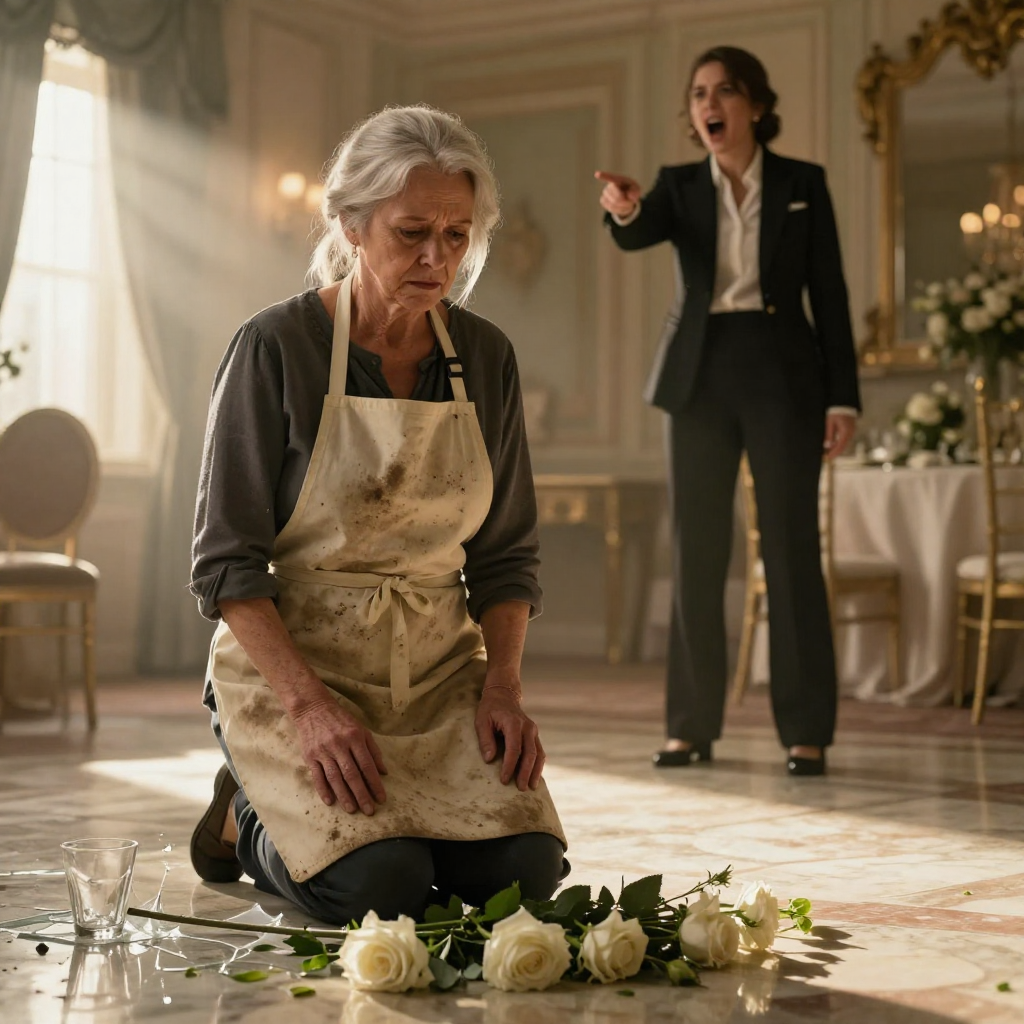
SHE RIPPED THE VINTAGE LILACS FROM MY HANDS AND SCREAMED THAT MY “TRAILER PARK TASTE” WAS RUINING THE RECEPTION, UNAWARE THAT THE BRIDE’S MOTHER HAD BEGGED ME TO COME OUT OF RETIREMENT JUST FOR THIS DAY.
The sound of a hyacinth stem snapping is distinct. It is a wet, crisp sound, like a small bone breaking. I heard it three times in rapid succession before I even felt the spray of water hit my apron.
“No, no, absolutely not,” the voice hissed behind me. It wasn’t a shout, not yet. It was that tight, vibrating whisper that managers use when they are trying not to cause a scene but want you to know they are furious. “I said elegant. I said timeless. This looks like something you picked from a ditch on the side of the highway.”
I didn’t turn around immediately. My hands were deep in the cool water of the massive crystal urn, anchoring a branch of wild pear blossom. It was heavy, awkward work, and my shoulders were already aching. I am sixty-two years old, and while my hands are steady, my back remembers every wedding season since 1985.
“Excuse me?” I asked, keeping my voice level. I wiped my hands on my canvas apron—a stained, worn thing I’ve had for twenty years. It had pockets full of wire cutters, floral tape, and thorns. To the uninitiated eye, I probably looked like the cleaning crew. I certainly didn’t look like a guest.
Jessica, the wedding planner, stepped into my line of sight. She was young, perhaps twenty-eight, vibrating with the frantic energy of someone who believes that perfection is a matter of force. She wore a headset that blinked incessantly and a black suit that looked expensive but fit poorly around the shoulders. She was stressed. I could smell it on her—a mix of acrid perfume and cold coffee.
“Are you deaf?” she snapped, reaching out and grabbing a handful of the white lilacs I had just positioned. “I told the agency I wanted their best freelancers. Instead, they sent me someone who thinks… weeds… are appropriate for a six-figure wedding.”
She yanked. The mechanics of the arrangement—the chicken wire grid I had carefully secured inside the vase—groaned. The lilacs didn’t come out easily. They tore. Leaves stripped off, falling onto the pristine white tablecloth like green confetti. The delicate blooms, which I had spent three hours conditioning in a cooler to ensure they wouldn’t wilt, were crushed in her manicured fist.
“Please don’t touch the mechanics,” I said, my voice hardening. “These are structured to look organic, but they are tightly secured. If you pull them, you’ll destabilize the entire centerpiece.”
“I don’t care about the mechanics!” she raised her voice now, abandoning the whisper. Heads turned. A few waiters setting the cutlery froze. “I care that this looks cheap. Look at this! It’s messy. It’s asymmetrical. The bride wants luxury. She wants tight, round, perfect spheres of roses. Not this… wild mess.”
I looked at the arrangement. It was a masterpiece of restraint. It was ‘wabi-sabi’—the Japanese aesthetic of imperfection and transience. It used locally sourced wildflowers, heirloom lilacs, and twisting branches of pear blossom. It cost more to source these specific, perfect “weeds” than it would have cost to buy a thousand generic hot-house roses. It was exactly what the bride, Sarah, had asked for.
But Jessica didn’t know Sarah. Not really. She knew the budget, she knew the timeline, and she knew her own ego.
“The bride requested an English garden aesthetic,” I said calmly, stepping between her and the next vase. “She specifically asked for movement and air in the designs.”
Jessica laughed. It was a cruel, sharp sound. “The bride doesn’t know what she wants. That’s why she hired me. And I am telling you, as your boss, to fix this. Strip this garbage out. Go to the van. Get the white hydrangeas and the roses. Make it round. Make it look like we actually spent money here.”
She moved to grab the pear blossom branch. That was the line.
I caught her wrist. I didn’t squeeze, but I held it firm. My hands are strong. You cannot work with woody stems and heavy ceramics for forty years without developing a grip like iron.
“Let go of me,” she gasped, her eyes widening in shock. She couldn’t believe the ‘hired help’ was touching her.
“You are not going to ruin this,” I said quietly. “I have known Sarah since she was in diapers. I did the flowers for her christening. I did the flowers for her debutante ball. And I am doing them for her wedding, exactly the way she dreamed of them.”
Jessica yanked her arm back, stumbling slightly in her heels. Her face flushed a deep, blotchy red. Humiliation is a dangerous fuel for people like her. She didn’t retreat; she doubled down.
“You’re fired,” she shrieked. It echoed through the ballroom. The string quartet, who had just started warming up in the corner, stopped playing. The silence that followed was heavy and suffocating.
“You. Out. Now,” Jessica pointed a trembling finger at the exit. “I don’t care who you think you know. I am the planner. I am in charge. You are just a temp with a bad attitude and low-class taste. Take your rags and your weeds and get out of my venue before I call security.”
I stood my ground. I didn’t shout. I didn’t argue. I just looked at her with a profound sense of pity. I remembered being young and terrified of failure. I remembered thinking that controlling everything was the only way to succeed. But I had never been cruel.
“I’m not leaving, Jessica,” I said.
She looked around, realizing she had an audience. She had to win this now. She grabbed the vase—the heavy, crystal urn filled with water and carefully balanced branches—and shoved it.
It happened in slow motion. The balance tipped. The water sloshed over the rim. The pear branch caught the air. The vase slid across the silk tablecloth and crashed onto the marble floor.
*Crash.*
Glass shattered. Water pooled rapidly, soaking the hem of my trousers and splashing onto Jessica’s shoes. The flowers—the beautiful, delicate lilacs and the stoic pear branch—lay broken in the wreckage.
“Look what you made me do!” Jessica screamed, her voice cracking. “Look at this mess! You are going to pay for this! Do you know how much that vase cost? That’s coming out of your paycheck!”
I looked down at the ruined flowers. I felt a stinging in my eyes, not of tears, but of anger. Pure, cold anger. Those lilacs were from my own garden. I had nurtured that bush for ten years. I had cut them this morning with the dew still on them, specifically for Sarah.
“That vase,” I said, my voice dropping an octave, “was a Baccarat crystal antique. It belongs to the estate. And you just broke it because you couldn’t handle being told ‘no’.”
“Security!” Jessica yelled, waving at a confused guard standing by the doors. “Get this woman out of here! She’s destroying the property!”
The guard took a hesitant step forward. Jessica was the authority figure here. I was just an old woman in a dirty apron.
But before the guard could reach us, the double doors at the far end of the ballroom swung open. The sound of heavy footsteps clicked on the marble. Not the frantic clicking of Jessica’s heels, but the slow, rhythmic, authoritative stride of someone who owns the ground they walk on.
“What on earth is happening in here?”
The voice was unmistakable. Margaret. The mother of the bride. The matriarch of one of the most powerful families in the state. And my oldest friend.
Jessica spun around, her face instantly transforming from rage to a sickly sweet mask of professional concern. She smoothed her jacket, though her hands were shaking.
“Margaret! Oh, thank god you’re here,” Jessica rushed forward, stepping over the puddle of water and broken glass. “I am so terribly sorry you have to see this. We had… an incident with one of the freelancers. She’s completely incompetent. She refused to follow the design brief, she was rude, and then she knocked over this vase in a fit of temper when I tried to correct her.”
Jessica pointed at me, accusingly. “I was just having security remove her. Don’t worry, I have a team coming to clean this up, and I’ll have the proper roses brought in within the hour. It will be perfect.”
Margaret stopped. She looked at Jessica. Then she looked at the shattered glass. Then she looked at the flowers on the floor—the specific, unique combination of lilacs and pear blossoms.
Finally, she looked at me.
I saw the recognition in her eyes, followed immediately by horror. She saw the water on my shoes. She saw the stripped leaves in my hand. She saw the way I was standing, tired and defensive, surrounded by the wreckage of my work.
Margaret didn’t look at Jessica. She walked straight past her, her silk dress rustling softy. She came right up to me, ignoring the water on the floor that threatened her expensive shoes.
“Elena?” she whispered, reaching out to touch my arm. “My god, Elena. What happened?”
Jessica froze. The air left the room. The way Margaret said my name wasn’t the way you speak to a freelancer. It was the way you speak to a sister.
“I tried to tell her, Margaret,” I said softly, gesturing to the mess. “I tried to explain the wabi-sabi concept. She wanted round balls of roses.”
Margaret turned slowly to face Jessica. The temperature in the room seemed to drop ten degrees. Margaret was a woman who sat on the boards of museums. She was a woman who didn’t raise her voice because she never had to.
“Jessica,” Margaret said. Her voice was ice.
“I… I didn’t know…” Jessica stammered, backing away. “She didn’t say… she just looked like…”
“Like what?” Margaret asked. “Like a worker?”
“She was arguing with me,” Jessica tried to rally, but her voice was thin. “She was refusing to follow the design.”
“The design?” Margaret laughed, a short, sharp sound. “Do you know who this is?”
Jessica shook her head, her eyes darting between us.
“This is Elena Valles,” Margaret said, enunciating every syllable. “She retired five years ago, but before that, she was the lead floral designer for the White House. She has designed for royalty. She is the only reason the Botanical Society even exists in this city.”
Jessica’s mouth opened, but no sound came out.
“I begged her,” Margaret continued, her voice trembling with suppressed rage. “I begged her for six months to come out of retirement for Sarah’s wedding. Because Sarah wouldn’t have anyone else. She is doing this as a gift. A gift worth more than your entire fee.”
Margaret looked down at the broken Baccarat crystal, then back at Jessica.
“And you just screamed at her? You broke her work? You called her… what did you call her? Incompetent?”
I watched Jessica shrink. Physically, she seemed to get smaller. The reality of her mistake was crashing down on her. It wasn’t just a professional error; it was a social suicide. In this circle, insulting Elena Valles was like insulting the Pope in the Vatican.
“I… I made a mistake,” Jessica whispered.
“Yes,” I said, speaking for the first time since Margaret arrived. I stepped forward, crushing a piece of wet lilac under my boot. “You did. But not because of who I am.”
I looked her dead in the eye.
“You made a mistake because you treated a human being like garbage because you thought they were beneath you. You thought I was a nobody, so you thought it was okay to abuse me. That is the mistake, Jessica.”
Margaret put a hand on my shoulder. “Get out,” she said to Jessica. “Leave. Now.”
“But… the wedding…” Jessica started.
“We will manage,” Margaret said. “I would rather have bare tables than have you in this room for one more second.”
As Jessica fled the room, the sound of her heels retreating much faster than they had arrived, I looked at the pile of broken flowers. I felt a deep exhaustion settle into my bones.
“I’m sorry about the vase, Maggie,” I said.
Margaret waved her hand dismissively, but her eyes were sad. “I don’t care about the vase. I care about your hands. Are you hurt?”
I looked down at my hands. They were shaking slightly. “No. I’m fine. But we have three hours until the guests arrive, and I just lost my centerpieces.”
Margaret smiled, a grim, determined smile. She kicked off her heels. She reached down and picked up a surviving stem of pear blossom.
“Well then,” she said, holding it out to me. “Tell me what to do. I haven’t arranged flowers since college, but I take direction better than she did.”
I took the stem. The wedding was in three hours. The vision was ruined. The planner was gone. But looking at Margaret, barefoot on the wet marble, ready to work, I felt a spark of the old fire.
“Grab a bucket,” I said. “We’re going to need more lilacs.”
CHAPTER II
The silence that follows a storm is never truly quiet; it’s a heavy, vibrating thing. When the door finally clicked shut behind Jessica, the air in the conservatory didn’t lighten. Instead, it felt as though the oxygen had been sucked out with her. I stood there, my boots pressing into the damp remains of the hydrangeas she’d trampled, and for a moment, I wasn’t an elite florist with a history in the East Room. I was just an old woman with aching knees, standing in a room full of dying things.
Margaret was the first to move. She didn’t go for the door or the phone. She walked toward the center table, her expensive silk dress brushing against the metal legs, and she looked at the centerpiece Jessica had crushed. It was a ruin of Peperomia and rare white orchids. Margaret’s face, usually so composed and polished by years of social navigation, looked suddenly translucent, like fine porcelain that had developed a spiderweb of cracks.
“Elena,” she whispered, not looking at me. “I am so sorry. I had no idea she was… I had no idea it had gone this far.”
I didn’t answer immediately. I couldn’t. I was looking at my hands. They were shaking. It’s the curse of being sixty-two—the spirit remembers the stamina of youth, but the nerves have their own agenda. I tucked my hands into the pockets of my apron, feeling the familiar grit of floral tape and wire. I had to ground myself. If I collapsed into the emotion of the insult, the wedding was dead. And in this industry, a dead wedding is a ghost that haunts you forever.
“The apology can wait, Margaret,” I said, my voice sounding raspier than I intended. “We have two hours and forty minutes until the first round of family photos. We have twelve centerpieces to rebuild and an entire floral arch that looks like it’s weeping for the wrong reasons. Do you still have the keys to the cold storage?”
She nodded sharply, pulling herself together. That was the Margaret I knew—the woman who could manage a crisis as long as she had a general to follow. She handed me the ring of keys, her fingers cold against mine. “What do we do?”
“We work,” I said. “Strip your jewelry. Find a pair of shears. We’re going back to the basics.”
As we began the grueling process of salvaging what we could, the physical labor acted as a slow-release valve for the tension. We worked in a rhythmic, desperate silence at first. I showed her how to re-cut the stems at a sharp angle under water to force a quick drink into the wilting blooms. We moved through the wreckage, separating the bruised petals from the survivors.
But as the minutes ticked by, the silence became fertile ground for memory. Working with Margaret always did that. It took me back to 2012, to the humid DC summers where the pressure was so high you could feel it in your teeth. We had a history that went deeper than flowers. It was a history built on a shared silence that had cost me more than I ever let her know.
“You shouldn’t have been here as a ‘favor’, Elena,” Margaret said, her voice muffled as she reached into a bucket of eucalyptus. “I should have hired you properly. I should have insisted. I let Jessica convince me that you were ‘out of touch’ with the current trends. I let her talk about you like you were a relic.”
I felt the old wound throb—not a physical pain, but the phantom itch of a career cut short. I hadn’t retired because I was tired of flowers. I had retired because, ten years ago, when a scandal involving Margaret’s husband threatened to break wide, I was the one who had been in the room. I was the one who had seen the exchange of envelopes during a private gala. To protect Margaret—to protect this very daughter, Sofia, who was getting married today—I had stayed silent. I had allowed myself to be pushed out of the elite circles under the guise of ‘exhaustion’ rather than risk being subpoenaed and forced to destroy my friend’s life.
I had carried that sacrifice like a stone in my shoe for a decade. And now, seeing Margaret’s guilt, I realized she knew. She had always known what it cost me.
“I chose to come,” I said, my voice tight. “I wanted to see Sofia get married. I’ve known that girl since she was in pigtails.”
“But you’re broke, Elena,” Margaret said suddenly.
The words hit me harder than any of Jessica’s insults. I stopped mid-clipping. The secret I had been guarding—the fact that my ‘quiet retirement’ was actually a desperate struggle against a mounting pile of medical bills and a pension that had been bled dry by bad investments and legal fees from that decade-old scandal—was out. I had been careful. I wore the same high-quality coats from ten years ago. I kept my hair done. I maintained the facade of the ‘refined florist emerita.’
“I’m fine,” I lied, the word tasting like copper in my mouth.
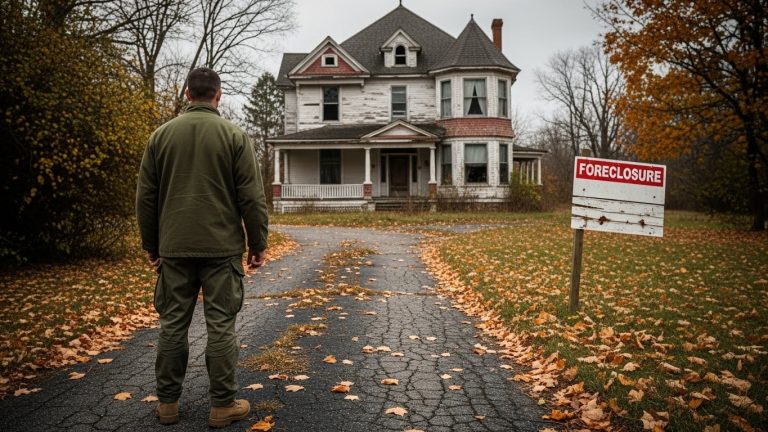
“You’re not. I saw the notice in your bag when we were looking for the inventory list earlier. A foreclosure warning, Elena? Why didn’t you tell me?”
I felt a heat crawl up my neck. Pride is a terrible thing; it stays with you long after your money and your beauty have faded. “I didn’t come here for a handout, Margaret. I came to do a job.”
“And you’re doing it. But we both know you’re here because you need the fee I promised you. And I feel like a monster for making you work for it like this.”
Before I could respond, the heavy double doors of the conservatory swung open. It wasn’t a staff member. It was the first wave of ‘early’ guests—the inner circle of the wedding party, including Sofia’s future mother-in-law, a woman named Beverly who had the social grace of a shark and the memory of an elephant. Behind her were three other women, all dressed in high-octane morning suits, their eyes immediately darting to the mess on the floor and my sweat-stained face.
And then, the nightmare truly began.
Jessica walked in right behind them. She wasn’t leaving. She had a security guard with her and a look of hysterical triumph on her face.
“There she is,” Jessica announced, her voice ringing out through the glass-walled room, drawing the attention of every server and early arrival. “That’s the woman. I told you, Margaret, I couldn’t have a thief on my staff.”
The room went dead still. Margaret stood up, her hands covered in green sap. “Jessica, get out of here. I fired you. You are trespassing.”
“I’m not trespassing until I get my personal property back,” Jessica spat, pointing at the vintage leather tool kit I had used for forty years. “And I’m certainly not leaving until I tell these people who they’re trusting with this wedding. I did a background check after our little ‘disagreement’ this morning, Elena. Or should I call you by your legal designation from the DC ethics probe?”
This was the triggering event. It was public. It was sudden. And it was irreversible. The guests began to whisper. I saw Beverly’s eyes widen as she recognized my name. The scandal from a decade ago—the one I had buried to protect Margaret’s family—was being dragged into the light of a sunny afternoon in a room full of people who fed on reputation.
“That’s enough!” Margaret shouted, but it was too late.
Jessica held up a tablet, showing a grainy digital clipping of a newspaper headline from years ago. “She didn’t ‘retire’. She was forced out for ‘financial irregularities’. And look at her now, hovering around a high-society wedding, probably looking for something else to skim off the top. I found her personal financial records in the office—she’s tens of thousands in debt. She’s desperate.”
I felt the floor tilt. My secret—my poverty—was being used to validate a lie about my character. The moral dilemma slammed into me with the force of a physical blow.
I could stop this. I could open my mouth right now and tell the truth. I could tell everyone in this room that the ‘financial irregularities’ were a cover for Margaret’s husband, who had used my business account to move money he shouldn’t have had. I could prove that my debt was a result of the legal fees I paid to keep the FBI away from Margaret’s front door. If I spoke, I would be the victim, the martyr, the hero. Jessica would be humiliated. My reputation would be restored.
But if I spoke, the wedding was over. Not just the ceremony, but the family. Sofia would learn that her father was a criminal and her mother was an accomplice. The marriage contract with the prestigious family across the room would likely dissolve before the first toast.
I looked at Margaret. She was pale, her mouth slightly open, looking at me with a plea in her eyes that was so naked it was painful. She knew I had the power to burn it all down to save myself.
I looked at the guests. They were waiting for my defense. They were waiting for me to scream, to deny, to fight back.
Instead, I reached down and picked up a single, perfect white rose that had fallen during the commotion. I took my shears and cleanly snipped the thorns off the stem. My hands had stopped shaking. The clarity of the disaster had given me a strange, cold strength.
“Jessica,” I said, my voice low and steady, carrying through the room. “You are a very young woman. You think that because you can see my bank balance, you can see my soul. You think that because you found a headline, you know the story.”
I walked toward her, and the security guard actually took a step back. I didn’t look like a disgraced florist; I looked like the woman who had handled the bouquets for three First Ladies. I had an authority that wasn’t bought.
“I am here because I am the only person in this state who can make sure Sofia walks down an aisle that is worthy of her,” I continued. “Now, you can continue this performance, or you can leave. But if you stay, you will be the reason this wedding becomes a circus. Is that the legacy you want?”
Jessica’s lip curled, but she saw the guests shifting. They didn’t necessarily believe me, but they were uncomfortable with the ‘spectacle.’ The socialites in the room hated a scene more than they hated a scandal.
“You’re pathetic,” Jessica hissed, but she backed toward the door. She looked at the guests. “Enjoy your ‘organic’ wedding. Don’t be surprised if your jewelry goes missing by the reception.”
She turned and stormed out, the security guard following awkwardly behind her.
But the damage was done. The atmosphere was poisoned. The whispers didn’t stop; they just grew more discreet, tucked behind manicured hands. Beverly and her group turned their backs on us, moving toward the far end of the conservatory, their body language radiating judgment.
Margaret collapsed into a chair, her face buried in her hands. “I have to tell them, Elena. I have to tell Sofia. I can’t let you take this. Not again.”
I stood over her, the weight of the day finally beginning to crush my spine. My body hurt in places I didn’t know could ache. I had saved the moment, but I had lost the war for my own dignity.
“If you tell them now, Margaret, you ruin her day,” I said. “You ruin everything we’ve worked for. You want to be honest? Fine. Be honest tomorrow. But today, we have flowers to finish.”
This was the choice I had made. It was a choice between my own survival and the preservation of a lie that kept a young girl happy. It was the same choice I had made ten years ago, and the bitterness of it was like ash in my mouth.
We went back to work, but the joy was gone. The ‘organic’ style Jessica had mocked now felt like a metaphor—we were just trying to cover up the rot with enough greenery to make it look alive.
As I wired a bunch of delicate lilies, I realized that the secret wasn’t just about money or the past anymore. The secret was that I was starting to hate the person I had become for the sake of this friendship. I was a sixty-two-year-old woman with no home, no career, and now, no reputation. And all I had to show for it was a half-finished floral arch and the gratitude of a woman who couldn’t even look me in the eye.
The guests continued to trickle in, their eyes scanning me like I was a curiosity in a zoo. Every time the door opened, I felt a fresh wave of humiliation. I was the ‘thief.’ I was the ‘fraud.’
And then, the final blow fell.
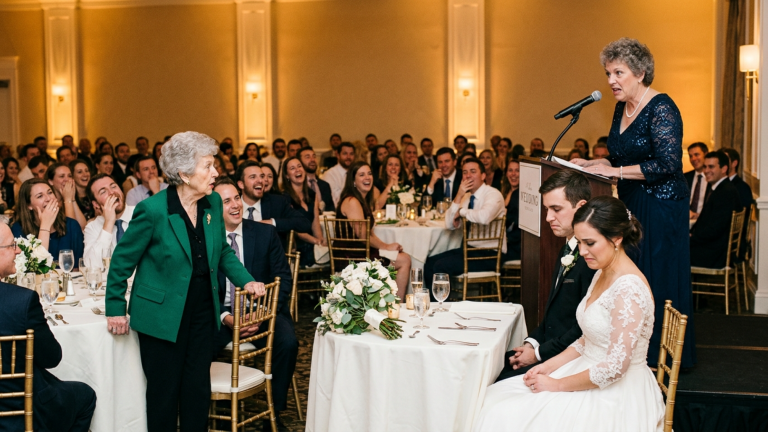
Sofia, the bride, entered. She was already in her gown, a cloud of white lace and tulle. She looked like an angel, but her face was set in a mask of confusion and hurt. She had clearly heard the rumors in the hallway. She walked straight past her mother and stood in front of me.
“Elena?” she asked, her voice trembling. “Is it true? Did you… did you do those things in DC?”
I looked at Margaret. Margaret was silent. She was paralyzed. The moral dilemma was no longer a theoretical thing; it was standing right in front of me in a wedding dress.
If I lied, I protected the family. If I told the truth, I saved myself and destroyed the girl’s world.
I looked at Sofia—the girl I had taught to press flowers when she was six. I saw the trust in her eyes, even through the doubt. And I realized that no matter what I chose, something was going to die today.
“Sofia,” I began, my heart hammering against my ribs. “There are things about the past that are complicated. But right now, your only job is to be a bride.”
“That’s not an answer, Elena,” Sofia said, a tear tracing a path through her makeup. “I need to know if the woman I’ve looked up to my whole life is who I thought she was. Or is my mother’s best friend a liar?”
The silence that followed was the loudest thing I had ever heard. In the background, I could hear the catering staff setting out the champagne, the clink of glass against glass, the sound of a world that was moving on while mine was collapsing.
I looked at Margaret. She still hadn’t spoken. She was going to let me take the fall. She was going to let me be the villain in her daughter’s story to keep her own hands clean.
The old wound didn’t just throb now; it tore wide open. I realized that the friendship I had sacrificed my life for was a one-way street. I was the help. I had always been the help.
“You want the truth, Sofia?” I asked, my voice cracking.
Margaret finally looked up, her eyes wide with terror. “Elena, please.”
But I was tired. I was so incredibly tired of carrying other people’s ghosts. I looked at the beautiful, expensive flowers, the beautiful, expensive room, and the beautiful, expensive lies that held it all together.
And I realized that sometimes, for something new to grow, you have to let the old structure burn to the ground.
“The truth is,” I said, looking Sofia straight in the eye, “that your mother and I have been keeping a secret for ten years. And it’s time you knew exactly why I left Washington.”
As the words left my lips, I felt a strange sense of vertigo. I had just crossed the point of no return. The wedding wasn’t just in jeopardy anymore. The lives of everyone in that room were about to change forever, and I was the one holding the match.
CHAPTER III
There is a specific kind of silence that follows the detonation of a life. It isn’t the absence of sound. It is a thick, pressurized void that rings in the ears and tastes like ozone. I stood in the center of that grand, over-decorated foyer, my hands still stained with the sap of a thousand crushed hydrangeas, and I watched the world I had curated for Margaret begin to liquefy. Jessica was still there, her mouth hanging open in a jagged little ‘O’ of triumph, waiting for me to crumble, waiting for the police or the security guards to haul the ‘thief’ away. She had no idea that she hadn’t just pulled a thread; she had triggered a landslide.
I looked at Margaret. My old friend. The woman whose secrets I had carried like stones in my pockets for ten years until my coat was tattered and my back was bent. She was pale, her expensive foundation looking like ash against her skin. She wasn’t looking at me. She was looking at Sofia, her daughter, who stood in her ivory Vera Wang, clutching a bouquet I had stayed up until four in the morning to perfect. Sofia’s eyes were darting between us, searching for the lie, but she was finding only the terrible, cold weight of the truth.
“Say it, Margaret,” I said. My voice was surprisingly steady. It was the voice I used when I had to tell a bride that the peonies had been killed by a frost and we were going to have to pivot. It was the voice of a woman who had nothing left to lose. “Tell her why I really left D.C. Tell her why the foundation’s books were thirty thousand dollars short. Tell her why I took the blame and disappeared into the weeds while you and Richard kept the townhouse and the invitations to the gala.”
“Elena, please,” Margaret whispered. It was a pathetic sound. It was the sound of a woman watching her pedestal crack. “This isn’t the place. Not now. Think of the wedding.”
“I have thought of nothing but this wedding for three weeks,” I replied, stepping closer. I didn’t care about the guests peering over the mezzanine. I didn’t care about the catering staff frozen with their silver trays. “I thought of it while I was scrubbing your floors for free because you knew I couldn’t pay my rent. I thought of it while you let this girl,” I gestured to a now-trembling Jessica, “mock me and call me a fraud. I stayed silent to protect Sofia’s memory of her father. But Richard didn’t just steal from the foundation, Margaret. He stole ten years of my life. And you let him.”
The air in the room seemed to vanish. Sofia took a step back, her heavy skirts rustling like dry leaves. “Mom?” she asked. It was a small, fragile word. “What is she talking about? Dad… Dad didn’t… he wouldn’t.”
Margaret reached out, her fingers clawing at the air, but Sofia recoiled. That was the first break. The image of the perfect family, the pillar of the community, was dissolving. Jessica, realizing the tide had turned, tried to slink away into the shadows of the hallway, but she was stopped by a figure that commanded more gravity than anyone else in the room.
Beverly entered the foyer. The mother of the groom. The woman they called the ‘Shark of State Street.’ She was wrapped in navy silk, her pearls looking like teeth. She didn’t look shocked. She looked disgusted. She had been listening from the staircase, and in high society, a scandal is only a problem if you’re on the losing side of it.
“So,” Beverly said, her voice cutting through the tension like a florist’s knife. “The Valles scandal wasn’t a lapse in judgment by the help. It was a shell game played by the hosts. My son is marrying into a family of embezzlers and cowards.”
“Beverly, it’s not what it sounds like,” Margaret began, her voice rising in a frantic, socialite trill. “Elena is confused. She’s been under a lot of stress. She’s… she’s unwell.”
“Stop lying, Margaret,” I said. It wasn’t a shout. It was a command. I reached into my apron pocket and pulled out my phone. My fingers were shaking, but I found the file. I had kept it for a decade. Not as blackmail, but as a reminder of why I could never go back. It was a scan of the original ledger—the one Richard thought he’d burned. I had found it in the bottom of a flower crate the night I was fired. “I have the receipts. I’ve always had them. I just loved you too much to use them. Until today.”
I handed the phone to Sofia. I didn’t give it to Beverly. I didn’t give it to the guests. I gave it to the girl who deserved to know who had paid for her private schools and her summer camps. Sofia looked at the screen, her eyes scanning the neat columns of numbers, the signatures, the dates. I watched her heart break in real-time. It is a terrible thing to watch a child realize their parents are monsters, even if that child is twenty-four and wearing a ten-thousand-dollar dress.
“You knew,” Sofia whispered, looking at her mother. “You let her live like this? You let her work for us as a servant while you spent the money Dad took?”
Margaret broke then. She didn’t scream. She simply collapsed onto the velvet settee, burying her face in her hands. The silence that followed was different now. It was final. The social hierarchy of the room had been inverted. Jessica was a non-entity. Margaret was a pariah. And I? I was just a woman standing in the ruins.
Beverly stepped forward. She looked at me, not with pity, but with a cold, newfound respect. “The wedding is cancelled,” she announced, her voice carrying into the ballroom where the orchestra had just begun to play. “There will be no merger of families today. My son will not be tied to this rot.”
“No!” Sofia cried, but it wasn’t a plea for the marriage. It was a cry of pure, unadulterated shame. She turned and ran up the stairs, the train of her dress snagging on a floral arrangement, pulling a spray of white lilies down with her. They scattered across the marble floor like broken bones.
Chaos erupted. The guests began to murmur, then talk, then flee. The spectacle was over, and the scavenging had begun. But I didn’t move. I looked at the mess on the floor. I looked at the half-finished floral arch that was supposed to be the center of the ceremony. It looked skeletal, ugly, unfinished.
I realized then that I couldn’t leave it like this. Not because I owed Margaret anything. I owed her nothing but my contempt. I did it for the flowers. I did it because for forty years, this was the only way I knew how to speak the truth.
I walked past Margaret, who was sobbing into her silk cushions. I walked past the caterers who were already packing up the champagne. I walked to the center of the ballroom, under the massive crystal chandelier, and I picked up my shears.
I began to work.
I worked with a ferocity I hadn’t felt since I was thirty years old, designing for heads of state. I didn’t use the plan Jessica had laid out. I tore down her pastel, insipid roses. I ripped away the cheap tulle and the plastic supports. I reached for the deep, blood-red dahlias I had hidden in the back of the cooler. I grabbed the twisted willow branches, the dark, architectural greens, the flowers that had thorns and weight and history.
I wasn’t making a wedding arch anymore. I was making a monument to the end of a lie.
I felt the stems snap under my blades. I felt the cold water from the buckets splash against my shins. My hands bled where the thorns caught me, but I didn’t stop. I wove the willow into a jagged, reaching spire. I clustered the dahlias in bruised, beautiful heaps. I added the white lilies Sofia had dropped, but I stripped their leaves, leaving only the stark, pale heads.
It was the most beautiful thing I had ever created. It was violent and honest and temporary. It was my swan song.
As I worked, the house emptied. I heard car doors slamming in the driveway. I heard Beverly’s sharp commands as she marched her son out of the building. I heard Margaret’s muffled cries from the other room. But in the ballroom, there was only the sound of my breathing and the rhythmic ‘snip, snip’ of the shears.
When I was finished, I stepped back. The arch stood eight feet tall, a dark, pulsing heart of color in the middle of the empty, echoing room. It looked like a wound. It looked like a victory.
I looked down at my hands. They were stained green and brown and red. They were the hands of a worker, not a socialite. They were the hands of a woman who was finally, after a decade of debt and shame, debt-free. Not because Margaret had paid me—she never would now—but because the secret was no longer mine to carry. The weight had been transferred back to its rightful owners.
I walked into the kitchen. I found my old canvas bag. I didn’t take the leftover food. I didn’t take the expensive vases. I took my shears, my twine, and a single, perfect dahlia from the arch.
I walked out the back entrance, the one the staff used. The air outside was cool and smelled of impending rain. The driveway was empty of Ferraris and limousines. It was just the gravel and the trees and the quiet.
I reached the end of the long, winding drive and looked back at the house. It was a beautiful prison, and I had finally picked the lock. I had no money in my bank account. I had no job waiting for me. I had no friend in Margaret. I was sixty-two years old, and I was starting from the absolute bottom.
I felt a strange, light sensation in my chest. It took me a moment to recognize it. It was the feeling of being able to breathe all the way down to my lungs.
I didn’t wait for a bus or call a cab. I just started walking. The road was long, and the sun was beginning to set, casting long, distorted shadows across the pavement. I looked at the flower in my hand. Its petals were velvet, its color a deep, defiant crimson. It would wilt by morning, but that didn’t matter.
For the first time in ten years, I wasn’t a secret. I wasn’t a mistake. I was Elena Valles. And I was going home.
Behind me, in the hollowed-out shell of a mansion, the truth was still echoing off the walls. Margaret would have to explain the empty chairs. Sofia would have to decide who she was going to be without the lie of her father. Jessica would have to find a new person to bully.
I didn’t care. I turned the corner, the weight of the city feeling like nothing at all. I had lost everything, and in doing so, I had finally found the one thing I had been missing since the day I left D.C.
I had found my dignity.
As the first drops of rain began to fall, washing the sap and the dirt from my skin, I didn’t hurry. I took my time. Every step away from that house was a step toward a life that belonged only to me. I had spent my career making things look perfect for people who were anything but. Now, I was done with the polish. I was done with the masks.
I was just Elena. And that was more than enough.
I reached the bus stop at the edge of the estate. A few people were standing there, huddled under the small plastic roof to avoid the rain. They looked tired, worn out by their day. They didn’t see an elite florist or a disgraced exile. They just saw an old woman with a flower in her hand and a strange, quiet smile on her face.
I sat down on the cold metal bench. The bus would be here soon. It would take me back to my cramped apartment with the peeling wallpaper and the leaking sink. It would take me back to the reality of being poor in a world that hates the poor.
But as I looked at my hands, I realized they were still strong. They still knew how to create beauty out of the dirt. And as long as I had those, I wasn’t really broke.
I closed my eyes and listened to the rain. It sounded like applause. It sounded like a beginning. It sounded like the truth, finally set free.
CHAPTER IV
The silence was the loudest thing. Louder than Beverly’s screaming, louder than Sofia’s sobbing, even louder than the dull thud of the caterer dropping an entire tray of champagne flutes. The silence that followed the storm. Months had passed, blurring one day into another, each weighted down by the echo of what happened at that wedding.
I hadn’t expected a ticker-tape parade, but neither did I anticipate being erased. Most of my old contacts vanished. The society pages, once filled with mentions of Elena Valles’ floral artistry, became conspicuously empty. It was as if I’d never existed. The phone calls stopped. The invitations dried up. Even the flower market seemed to offer me wilting blooms, seconds past their prime.
It wasn’t just the social death, but the quiet judgment in the eyes of strangers. A woman recognizing me at the grocery store, her smile freezing mid-air. A muttered comment overheard at the bus stop: “That’s her, isn’t it? The one from the scandal?” The world hadn’t forgotten; it had simply filed me away under ‘Cautionary Tales’.
The small community garden, tucked away behind the library, became my sanctuary. Mrs. Henderson, bless her heart, had advocated for me. “Give her a chance,” she’d said to the Parks Committee, her voice firm against the whispers. “Elena has a gift, and this community needs beauty.”
So, I planted. I coaxed life from the tired soil, my hands rough and stained with earth. Roses, yes, but also herbs, vegetables, and wildflowers. Nothing extravagant, nothing sculpted or artificial, just… real. The kind of beauty that came from struggle, from patience, from the honest labor of living. The kind of beauty I had forgotten existed.
PHASE 1: PUBLIC SHUNNING
Margaret’s world imploded, though at a distance. I heard snippets from the periphery. Richard, facing investigations, had retreated further into his shell, his power base crumbling. Sofia had broken off all contact with her mother, disappearing to some artists’ colony in Europe. The grand estate felt hollow, haunted by the ghosts of its own lies.
Jessica, surprisingly, was thriving. She’d rebranded herself as a ‘crisis management’ consultant, specializing in repairing damaged reputations. The irony wasn’t lost on me, or, apparently, on anyone else. But she was good, ruthlessly efficient, and ambitious. She used the scandal as a stepping stone, a dark asterisk in her already impressive resume.
One afternoon, tending to my struggling tomatoes, I saw her. Margaret, emerging from a black SUV, her face pale and drawn. The designer clothes hung loosely on her frame, her usual air of confidence replaced by a desperate vulnerability. She looked smaller, somehow.
She walked towards me, her heels sinking into the soft earth. The garden was quiet, the only sound the buzzing of bees among the lavender. I kept my hands buried in the soil, waiting.
“Elena,” she said, her voice barely a whisper.
I looked up, meeting her gaze. The arrogance was gone, replaced by something I hadn’t seen in decades: fear.
“I… I don’t know what to do,” she confessed. The words were raw, unvarnished. “Everything is gone. Richard… Sofia… everything.”
I said nothing, letting the silence hang between us.
“Can you… can you help me?” she pleaded. “You always knew how to fix things.”
That stung. Fix things? I’d spent my life cleaning up her messes, sacrificing my own happiness for her family’s image. And where had it gotten me? Ruined, alone, and forgotten.
I shook my head slowly. “I can’t, Margaret,” I said, my voice firm. “I won’t.”
Her face crumpled. “But… but what am I supposed to do?”
I looked back at the garden, at the small green shoots pushing their way through the earth. “Grow something,” I said, turning away. “For once in your life, grow something real.”
She stood there for a long moment, her silhouette stark against the setting sun. Then, without another word, she turned and walked back to the car.
PHASE 2: PERSONAL COST
The garden flourished, a small oasis of normalcy in a world still reeling. People came, not for elaborate displays, but for simple bouquets, for herbs to flavor their meals, for a quiet moment of peace among the flowers. I taught children how to plant seeds, showed elderly women how to prune roses, and listened to the stories of lonely hearts.
My hands ached, my back protested, but there was a quiet satisfaction in the work. It wasn’t the fame, the fortune, or the accolades I once craved. It was something deeper, something more meaningful.
But the past wasn’t done with me yet. One drizzly morning, a different car pulled up to the garden. A small, battered Honda, driven by Sofia.
She looked different, too. Her designer clothes were gone, replaced by simple jeans and a worn sweater. Her eyes, once bright with privilege, were now shadowed with a sadness that mirrored my own.
“Elena,” she said, her voice hesitant.
I nodded, waiting.
“I wanted to… to thank you,” she said. “For telling the truth. For… for everything.”
“There’s nothing to thank me for,” I said, my voice flat. “I did what I had to do.”
“No,” she insisted. “You saved me. You showed me what my mother… what my family really was. It wasn’t easy, but… but I’m free now.”
I looked at her, at the fragile hope in her eyes. Maybe, just maybe, something good had come out of all this. Maybe the truth, however painful, could set people free.
“What are you going to do?” I asked.
“I don’t know yet,” she admitted. “But I’m going to find something real. Something that matters.”
She reached out and took my hand, her grip surprisingly firm. “Thank you, Elena,” she said again. “Thank you for giving me a chance.”
Then, she smiled, a small, genuine smile that reached her eyes. And drove away.
The cost of truth, I was learning, was not just the destruction of the old, but the difficult, messy work of building something new. For myself, and perhaps, for others too.
PHASE 3: A NEW EVENT
Several weeks later, a letter arrived. It was thick, official-looking, with a D.C. postmark. I almost threw it away, assuming it was another bill, another reminder of my past failures. But something made me open it.
It was from a law firm. Richard Sterling had died. A heart attack, sudden and unexpected. The letter informed me that he had left me something in his will.
I stared at the letter, my mind reeling. After all these years, after all the pain and betrayal, he had still thought of me. But why?
The will stipulated that I was to receive a substantial sum of money – enough to buy a proper greenhouse, expand the garden, maybe even start a small floral shop.
The money was tainted, stained with the guilt and corruption of his life. I couldn’t accept it. It would be like accepting a bribe, a way of silencing the truth that I had fought so hard to reveal.
But then, I thought of the garden. Of the children I taught, the elderly women I comforted, the lonely hearts who found solace among the flowers. The money could help them. It could transform the garden into something truly special, a place of healing and beauty for the entire community.
I decided to accept the money, but with a condition. It would be used to establish a foundation, named after my parents, dedicated to supporting community gardens and horticultural education for underprivileged children. It would be a way of turning his guilt into something good, of transforming his darkness into light.
PHASE 4: MORAL RESIDUES
The foundation was established. The garden flourished. Life went on.
But the scars remained. The memory of my past, the pain of betrayal, the weight of the choices I had made – they would always be a part of me. I had found peace, but not absolution. I had built a new life, but I could never completely escape the shadow of the old.
One evening, as I was locking up the garden gate, I saw a young boy, no more than ten years old, standing by the fence. He was thin, ragged, and his eyes were filled with a hunger that I recognized all too well.
“What are you doing here?” I asked gently.
“I was just looking at the flowers,” he said shyly. “They’re… they’re beautiful.”
I smiled. “Would you like to come in? I can show you how to plant a seed.”
His face lit up. “Really?”
I unlocked the gate and led him inside. As I showed him how to prepare the soil, how to water the plants, I saw a spark of hope ignite in his eyes. A spark that reminded me of myself, so many years ago.
Maybe, I thought, that was the true meaning of it all. Not the destruction of the lie, but the planting of a new seed. Not the absolution of the past, but the hope for the future. Not the end of the story, but the beginning of a new one. The cycle continues. A garden, not of perfection, but survival. A garden for the broken.
The silence was still there, but it was different now. It was the silence of peace, of acceptance, of hope. The silence of a garden, growing in the quiet of the night.
CHAPTER V
The roses. They always bring me back. Even now, years later, standing in the heart of the Valles Foundation Community Garden, the scent of ‘Sterling Silver’ roses cuts through everything else. Not a pleasant memory, certainly. More like a phantom limb, aching with a past that refuses to stay buried. Ironic, isn’t it, that something so beautiful could be so…bitter?
Richard’s money – our money, really, tainted by secrets and lies – had become this. A green lung in a city choked with concrete. A place where kids learned that dirt wasn’t just something to be washed off, but something that could give life. I see them now, a group of them clustered around Mrs. Rodriguez, their small faces alight with concentration as she shows them how to prune tomatoes.
Mrs. Rodriguez. I hired her myself, after seeing her coax life from a barren patch of land behind her apartment building. She has a way with plants, a gentle authority that even the most unruly kids seem to respect. She is the heart of this place, the soil it grows from.
The money Richard had left me felt like blood money at first. I almost refused it. But something stopped me. It wasn’t forgiveness, not exactly. More like a grim acceptance that the past couldn’t be erased, only…transformed. It was Sofia who helped me see that, actually. She came to me, hesitantly, a few months after the…the wedding. She was lost, adrift, unsure of everything she thought she knew. She was looking for something to believe in and I wanted to show her that things are not as black and white as they might seem, that it is possible to carve out a place for good even when things are rotten.
Sofia had quietly become one of the garden’s most generous benefactors, her contributions invisible to the public, but vital. She never spoke of her mother, and neither did I. Some wounds are too deep for words. But there was a sense of…understanding between us. A shared knowledge of the wreckage left behind, and a quiet determination to build something new from the ashes.
My office overlooks the garden. It’s a simple space, filled with the scent of dried herbs and the gentle hum of the city beyond. But it’s here, surrounded by the life that I helped create, that I feel…peace. Not happiness, not exactly. Peace.
PHASE 1
That’s when I saw Mateo. He was different from the other kids. Smaller, quieter, with a shadow in his eyes that seemed too old for his age. He lingered at the edges of the group, never quite participating, never quite disappearing. He reminded me of myself, back then. Before the Sterling’s, before everything. A lonely child, searching for a place to belong.
I watched him for weeks, noticing the way he carefully avoided touching the plants, the way he flinched at loud noises. He was like a feral creature, wary and untrusting. I knew that reaching him would be a challenge. But something about him resonated with me, a deep understanding of his pain. I needed to find out what made him so different.
One afternoon, I found him sitting alone on a bench, staring at a wilting sunflower. The other children were busy harvesting vegetables, their laughter echoing through the garden. But Mateo remained isolated, lost in his own world.
I sat down beside him, careful not to startle him. We sat in silence for a long time, the only sound the gentle rustling of leaves. Finally, I spoke.
“It’s sad, isn’t it?” I said, gesturing towards the sunflower. “To see something so beautiful fade away.”
He looked at me, his eyes guarded. “It’s going to die,” he said, his voice barely a whisper.
“Yes,” I said. “But it also gave something beautiful to the world. And its seeds will grow into new sunflowers next year.”
He didn’t say anything, but I saw a flicker of something in his eyes. A spark of understanding.
“Do you like sunflowers?” I asked.
He shrugged. “They’re okay.”
“I think they’re amazing,” I said. “They always turn their faces towards the sun, even when it’s hidden behind the clouds.”
He looked at the sunflower again, his expression thoughtful. “I wish I could do that,” he said.
“Do what?” I asked.
“Turn towards the sun,” he said. “I always feel like there’s a cloud over me.”
I knew, in that moment, that I had to help him. I didn’t know how, but I knew that I couldn’t leave him to wither in the shadows.
PHASE 2
I started spending more time in the garden, making a point of being near Mateo. I didn’t push him, didn’t try to force him to talk. I just offered him small gestures of kindness: a smile, a shared piece of fruit, a quiet word of encouragement.
Slowly, he began to open up. I learned that his father was gone, that his mother worked long hours to make ends meet, that he was often left alone. He was bullied at school, called names, made to feel like he didn’t belong. The shadows in his eyes were the shadows of loneliness and neglect.
One day, I asked him if he wanted to help me with a special project. I was planning to create a small sensory garden for children with disabilities, and I needed someone to help me choose the plants.
He hesitated for a moment, then nodded. “Okay,” he said.
We spent hours poring over books and catalogs, discussing the different textures and scents of various plants. I showed him how to feel the velvety leaves of lamb’s ear, how to crush lavender between his fingers to release its fragrance. I explained how some plants could soothe, others could energize, others could evoke memories.
As he learned, he began to transform. The shadows in his eyes began to fade, replaced by a spark of curiosity and enthusiasm. He started to smile more, to laugh, to participate in the activities with the other children.
He discovered a particular affinity for herbs. He loved the way they smelled, the way they tasted, the way they could heal. He started growing his own herbs in small pots on his windowsill, experimenting with different combinations and flavors. He even started bringing them to school, sharing them with his classmates.
The bullying stopped. The other children, impressed by his knowledge and his generosity, began to accept him. He was no longer the lonely outcast. He was Mateo, the herb expert, the kid with the green thumb.
I watched him blossom, like a flower turning towards the sun. And I realized that my own healing was intertwined with his. That by helping him find his place in the world, I was also finding my own.
PHASE 3
One afternoon, Sofia came to visit the garden. She hadn’t been there in months, not since she started her new life, her own path. I saw her standing near the rose bushes, gazing at them with a wistful expression.
I walked over to her. “They’re still beautiful, aren’t they?” I said.
She nodded. “Yes,” she said. “But they also remind me of…everything.”
“I know,” I said. “But they’re not the only flowers in the garden. There’s so much more to see.”
I led her through the garden, showing her the sensory garden that Mateo had helped me create. I introduced her to Mrs. Rodriguez, who told her about the positive impact the garden was having on the community.
Then I introduced her to Mateo.
He was shy at first, but he quickly warmed up to Sofia. He showed her his herb garden, explaining the different properties of each plant. He even gave her a small bouquet of lavender, telling her that it would help her sleep.
Sofia was visibly moved. “Thank you, Mateo,” she said. “This is…this is wonderful.”
As we walked back to my office, Sofia turned to me. “You’ve done something amazing here, Elena,” she said. “You’ve taken something broken and turned it into something beautiful.”
“We all have,” I said. “It takes a village, you know.”
She smiled. “Yes,” she said. “It does.”
Before she left, she handed me a check. “For the garden,” she said. “Keep doing what you’re doing.”
I looked at the check, then at Sofia. “Thank you,” I said. “From the bottom of my heart.”
She hugged me, a quick, unexpected gesture. Then she turned and walked away, leaving me standing in the garden, surrounded by the scent of flowers and the sound of children’s laughter. Sofia had found her peace, I thought. It’s all I ever wanted for her.
PHASE 4
A few weeks later, I received a letter. It was from Margaret.
I hesitated before opening it. I hadn’t spoken to her since the wedding. I wasn’t sure I ever wanted to speak to her again.
But curiosity got the better of me. I opened the letter and began to read.
It was a short letter, filled with regret. She wrote about her loneliness, her isolation, her shame. She admitted that she had made mistakes, that she had allowed Richard to manipulate her, that she had hurt me deeply.
She didn’t ask for forgiveness. She didn’t expect it. She simply wanted me to know that she was aware of the consequences of her actions. That she was living with them every day.
She also wrote about the garden. She had driven by it several times, she said. She had seen the children playing, the flowers blooming, the community thriving. She admitted that she felt a pang of…something. Envy, perhaps. Or maybe just a deep sense of loss.
She ended the letter with a single sentence: “You have created something beautiful, Elena. Something that I could never do.”
I sat there for a long time, staring at the letter. I didn’t feel any satisfaction, any triumph. Just a profound sense of sadness.
I realized that true revenge wasn’t about punishment. It was about inspiration. It was about creating something positive, something lasting, something that would make the world a better place. It was about turning the darkness into light.
I thought of Mateo, of Sofia, of Mrs. Rodriguez, of all the people whose lives had been touched by the garden. And I knew that I had succeeded.
That evening, as the sun set over the city, I walked through the garden one last time. Mateo was there, watering his herbs. I sat down beside him, and we watched the sun go down in silence.
“It’s beautiful, isn’t it?” I said.
He nodded. “Yeah,” he said. “It is.”
I smiled. “You know, Mateo,” I said, “you remind me of a sunflower.”
He looked at me, surprised. “Why?” he asked.
“Because you always turn your face towards the sun,” I said. “Even when it’s hidden behind the clouds.”
He smiled, a genuine, heartfelt smile. And in that moment, I knew that everything was going to be okay. The garden would grow, the community would thrive, and Mateo would continue to blossom, turning towards the sun.
My scars remain, a roadmap of my past. But now, they are a reminder of what I have overcome, not what has overcome me.
I stood up, ready to go home. I took one last look at the garden, at the flowers, at the children, at the setting sun. And I whispered a silent thank you to Richard, to Margaret, to all the people who had hurt me, who had betrayed me, who had made me who I am today.
Because without them, there would be no garden. There would be no Mateo. There would be no me.
And maybe, just maybe, that’s the greatest revenge of all.
The scent of roses hung heavy in the air as I walked away, leaving the garden to its dreams.
It was not about who was punished, but who was inspired.
END.