I Went To Pick Up My Son From Detention And Found Him Bleeding. That Was The Moment The “Civilized Father” Mask Slipped Off.
Chapter 1: The Saturday Morning Routine
I’m forty-two years old. I drive a Toyota Camry with a baby seat base in the back for a nephew I rarely see. I pay my taxes early. I have a credit score of 780. In my entire adult life, the most aggressive thing I’ve done is send a strongly worded email to my HOA regarding the placement of trash cans on pickup days. I am not a violent man. I am a boring man. I am a safe man.
At least, that’s what I told myself until last Saturday.
My son, Leo, is fifteen. He’s the kind of kid who apologizes to the table when he bumps into it. He’s slight, wiry, with thick-rimmed glasses that are constantly sliding down his nose. He’s never been in a fight. He’s never even had a detention until this week. And it wasn’t even his fault. It was a clerical error—a mix-up with attendance during a chaotic pep rally where half the student body ended up in the wrong bleachers. But the Vice Principal at Lincoln High runs a “Zero Tolerance” ship, so Leo was sentenced to four hours of Saturday detention.
“It’s the principle of the thing,” the Vice Principal had told me over the phone.
I wanted to argue. I wanted to scream. But I’m Robert. Robert doesn’t scream. Robert sighs and says, “I understand.”
I remember dropping Leo off that morning. The sky was that bruised shade of gray you only get in the Midwest in late November. The wind was biting, whipping dead leaves across the asphalt. Leo looked small standing in front of the imposing brick facade of the high school.
“It’s fine, Dad,” he said, pulling his hoodie up over his messy brown hair. “I’ll just read. It’s only four hours. I brought that sci-fi book you gave me.”
“I’ll pick you up at noon sharp,” I promised, leaning over the passenger seat to look at him. “Maybe we’ll grab pizza after. Wash the taste of injustice out of our mouths.”
He smiled—that shy, lopsided smile of his that still reminds me of his mother—and walked toward the double doors. I watched him go until the heavy metal clanked shut behind him. I felt a weird pang in my chest, a heaviness I couldn’t explain. It was a physical weight, pressing down on my sternum. I shook it off. It was just detention. It was a school. It was the safest place in the world.
I drove toward the local Starbucks, intending to kill a few hours with a complex Excel spreadsheet I needed to finish for the quarterly audit. I liked the hum of the coffee shop; it helped me focus. I got all the way to the counter, ordered my venti black coffee, and reached into my back pocket.
Empty.
My stomach dropped. I patted my jacket. Nothing. I realized I’d left my wallet on the kitchen island, right next to the bowl of keys. I felt like an idiot. Heat flushed up my neck. I canceled the order, mumbled an apology to the barista who clearly didn’t care, and walked back to my car.
I had to go all the way home, grab the wallet, and come back. It was a twenty-minute drive each way. By the time I grabbed my leather wallet from the counter and got back into the car, a nagging feeling started to itch at the back of my neck.
It wasn’t logic. It was instinct. It was the same feeling you get when you leave the stove on, but amplified by a factor of ten. A primal alarm bell ringing in the lizard part of my brain.
Go back. Go back now.
I drove back to the school faster than usual, pushing the Camry to 50 in a 35 zone. I told myself I just wanted to be close by in case Leo needed anything. Maybe I’d sit in the parking lot and listen to a history podcast. Just to be near.
Chapter 2: The Silence
When I pulled into the Lincoln High lot, something was wrong.
There was only one other car there.
It wasn’t a teacher’s car. It was a beat-up, black Chevy Silverado with a lift kit and mud-caked tires. It had a bumper sticker that was peeled and faded, something aggressive about guns or freedom. It was parked diagonally across two handicapped spots right near the entrance.
Mr. Henderson, the teacher assigned to proctor detention, drove a beige Prius. I knew this because I’d seen him park it a dozen times during pick-up. He was a stickler for rules. He would never park in a handicapped spot.
Where was the Prius?
I parked my Camry three spots away from the truck. I turned off the engine.
Silence.
The school looked abandoned. Saturday schools are usually quiet, but this felt… dead. The windows looked like hollow eyes staring back at me.
I got out of the car. The wind had died down, leaving an eerie stillness. I walked toward the main entrance. Locked. Obviously. I cupped my hands against the glass and peered in. The main lobby was empty. The trophy case gleamed in the dim emergency lighting.
I walked around to the side entrance, the one near the gymnasium, which usually stays cracked open for the janitorial staff or the sports teams practicing.
It was propped open with a brick.
A red flag went up in my mind. A massive, waving red flag.
I stepped inside. The hallway smelled of floor wax, old lockers, and stale locker room sweat.
“Hello?” I called out.
My voice echoed down the long, linoleum corridor, bouncing off the metal lockers. No answer. No squeak of sneakers on the gym floor. No janitor’s cart rattling.
I checked my watch. 9:45 AM. They should be in the library or the main lecture hall on the second floor.
I started walking. My footsteps squeaked on the floor, sounding gunshot-loud in the quiet.
As I reached the stairwell that led to the academic wing, I heard a sound.
It wasn’t a voice. It was a thud. Like a heavy bag of flour being dropped onto a table.
Then, laughter.
Not the happy laughter of teenagers goofing off. This was a low, wet, cruel sound. It was the sound of a predator playing with food. It was a sound that made the hair on my arms stand straight up.
My heart started hammering against my ribs like a trapped bird. I took the stairs two at a time, my hand gripping the railing so hard my knuckles turned white.
“Leo?” I yelled, louder this time. “Mr. Henderson?”
The laughter stopped abruptly.
I reached the second-floor landing. The hallway was long and dim, only half the fluorescent lights were on to save energy.
Down at the far end, in Room 302—the old English lit room—I saw the door was closed. But the narrow rectangular window in the door was blocked. Someone had taped a piece of construction paper over it from the inside.
Why would a proctor cover the window?
I started running. I didn’t mean to. My legs just decided that walking wasn’t fast enough. The distance between me and that door felt like miles.
I reached the door. I didn’t knock. I didn’t ask for permission. I grabbed the handle and shoved.
It was locked.
From inside, I heard a gasp. A sharp, terrified inhale that sucked the air out of the room.
“Dad?”
It was a whisper. But it was Leo. And the way he said it broke something inside me. He sounded like he was drowning. He sounded small.
“Open this door!” I screamed, rattling the handle violently.
“Go away, old man!” a voice shouted from inside. It was deep, scratchy. A smoker’s voice. “Detention is in session. Come back in two hours.”
“I swear to God, if you don’t open this door…”
I heard the sound of fabric tearing. Then, a sharp, stifled cry of pain.
That was the moment.
That was the moment Robert the Accountant died. That was the moment the man who worries about credit scores and lawn maintenance evaporated into thin air.
I stepped back. I looked at the door. It was solid wood, old construction. Heavy. But the lock was a standard school mechanism.
I didn’t think about the structural integrity of the door. I didn’t think about the bones in my foot or the cost of property damage.
I kicked the door right next to the handle. I put every ounce of my fear, my anxiety, my repressed rage, and my desperate love for my son into that kick.
Wood splintered. The metal latch gave way with a sickening crunch. The door flew open, banging violently against the interior wall.
I stumbled into the room.
The scene froze for a microsecond, burned onto my retina forever.
There was no teacher. Mr. Henderson was nowhere to be found.
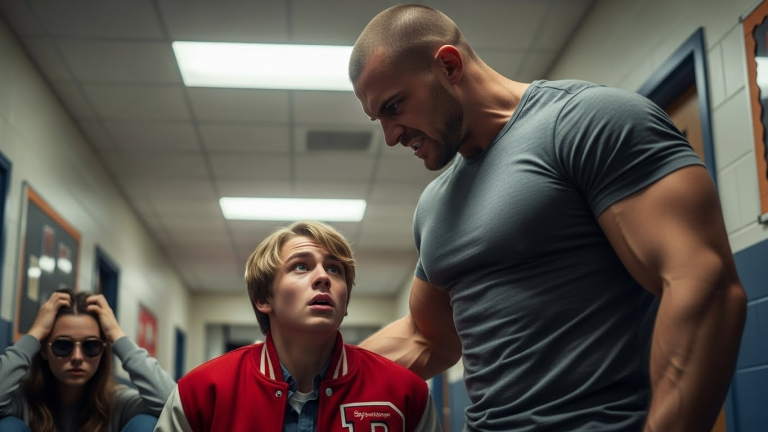
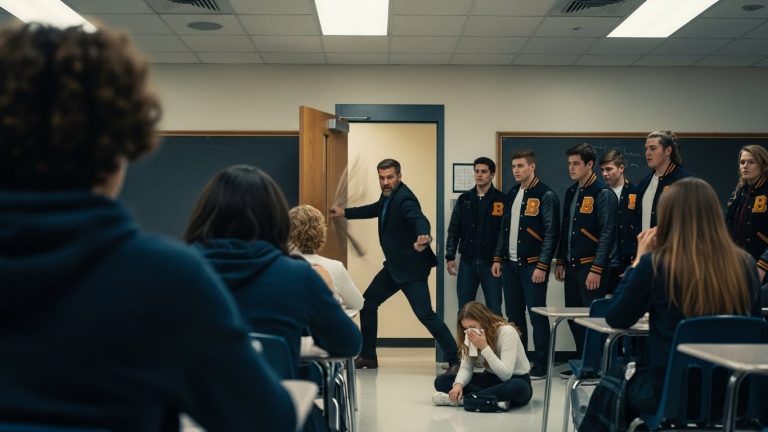
Three boys. They were seniors, easily. Big. Wearing varsity jackets that looked too tight on their bulky frames. One had a shaved head. One had long, greasy hair tied back. The third, the biggest one, a linebacker type with dead eyes, was holding something silver.
And there was Leo.
He was on top of the teacher’s desk. They had him pinned. His glasses were gone, crushed on the floor. His shirt—his favorite vintage band t-shirt—was sliced open down the middle.
There was blood.
A thin, red line tracing from his collarbone down to his sternum. It wasn’t deep, but it was bright red against his pale skin.
The big kid was holding a yellow box cutter. He was smiling. A sick, twisted grin.
Leo looked at me. His eyes were wide, white circles of terror. Tears were streaming down his face, mixing with the snot running from his nose. He was shaking so hard his teeth were chattering.
“Well, look who it is,” the big kid said, flipping the box cutter in his hand like a toy. “Daddy’s home to save the wimp.”
I looked at the blood on my son’s chest.
I looked at the blade.
I felt a coldness wash over me. It started at the base of my spine and shot up into my brain, turning everything crystal clear. The fear vanished. The panic vanished. The hesitation vanished.
There was only the mission.
“Get away from him,” I said. My voice didn’t sound like mine. It sounded like grinding stones.
“Or what?” the skinhead laughed, stepping toward me, cracking his knuckles. “You gonna do our taxes aggressively? Get lost, pops, before we cut you too.”
He shoved me. Hard.
I didn’t stumble. I didn’t move backward.
I looked at a heavy oak chair sitting by the front row. Solid wood. Iron legs.
I grabbed it.
Chapter 3: The Fugue State
I grabbed the chair. It was heavy, classroom-grade oak—meant to withstand years of restless teenagers. But in my hands, it felt weightless. It was no longer furniture. It was a weapon.
The skinhead, the one who had shoved me, was still sneering. His name, I would later learn, was Tyler. He was looking at me like I was a pathetic inconvenience, a grown-up who didn’t understand the rules of the jungle.
“Put that down, old man,” Tyler warned, taking another step forward, confident that my suburban programming would kick in, that I would retreat and call 911 like a good citizen.
He was wrong. So deeply, violently wrong.
I didn’t utter another word. The civilized voice in my head—the one that worried about insurance liability and police reports—was dead. All that remained was a roaring silence, a white-hot furnace of protection.
I swung the chair.
It wasn’t a warning shot. It was a full, unhesitating assault driven by the image of that thin, bright line of blood on my son’s chest. I didn’t aim for the shoulder or the arm. I aimed for the center mass, the point that would cause maximum impact.
The chair leg connected with Tyler’s upper back.
The sound was hideous. Not a dull thud, but a sharp, awful crack—the sound of dense wood splintering against bone. The force of the blow was so immense that the oak cracked and broke on impact, sending shrapnel of cheap varnish and wood flying into the air.
Tyler didn’t scream. He collapsed instantly, not like a person falling, but like a puppet whose strings had been cut. He hit the floor, dropping a switchblade I hadn’t even seen, and curled into a fetal position, letting out a thick, gargling noise.
The other two bullies froze.
The one holding the box cutter, the biggest kid named Marcus, the one who had actually cut Leo, still stood over the desk, his hand hovering over my son’s terrified body. The third kid, the one with greasy hair, Jordan, just stared at the wreckage of the chair and the twitching lump on the floor.
They had expected a confrontation. They had expected an argument. They had expected a call to authority. They had not expected this feral rage.
“You broke it,” Marcus said, his voice flat with shock, looking at the broken chair in my hand as if I had merely damaged school property.
I didn’t respond. I dropped the remains of the chair, which felt useless now, and stepped toward Leo. I needed to get him off the desk. I needed to know the cut wasn’t deep. I needed him behind me.
As I reached the desk, Marcus finally snapped out of his shock. He lunged at me, his face contorted in a snarl of panicked violence. The box cutter flashed.
He was fast, but he was clumsy. He was fighting out of ego and anger. I was fighting out of instinct.
I sidestepped his charge. I grabbed his wrist—the one holding the blade—and twisted hard. There was another sound, a wet pop, and the box cutter dropped harmlessly to the floor.
He screamed this time. A high-pitched, childish sound that didn’t match his massive frame.
I didn’t let go. I didn’t stop to admire the pain I’d inflicted. I was in the red zone. I used the momentum of his scream to pull him down and slam his forehead into the corner of the teacher’s heavy oak desk.
The impact was sickening.
Marcus dropped like a sack of concrete. He didn’t move. A thin stream of dark blood immediately began to snake out of his hairline and down his cheek. He was out cold.
I turned. Only one left.
Jordan, the greasy-haired kid, was already backing away, scrambling toward the door, his eyes darting frantically between his two collapsed friends and me. He was wearing an old baseball jacket, and his face was pale, his bravado gone.
He was running, but not fast enough.
I covered the distance between us in two strides. He didn’t even try to fight. He just put his arms up in a weak attempt to block.
I hit him with my right fist. A clean, desperate shot right to the nose. The feeling was terrible—like punching through soft cartilage and something wet.
Jordan gasped, his eyes watering instantly, and he stumbled back into the blackboard. He slid down the wall, clutching his face. Blood poured over his hands, staining the yellow and white stripes of his jacket.
It wasn’t enough. They had cut my son. They had terrified my child. The rage didn’t subside. It felt like a seizure, like an electrical storm inside my skull, demanding more.
I walked over to the whimpering lump that was Jordan, ignoring the pain blooming in my knuckles. I grabbed him by the front of his jacket and lifted him halfway off the floor.
“You lay a finger on my boy,” I hissed, leaning in so close my breath ruffled his greasy hair. “You look at him wrong. You breathe near him, and I will find you.”
I threw him back down.
The room was silent again, save for the labored breathing of the three boys on the floor and the faint, hitching sobs coming from the desk.
I finally turned and looked at Leo.
He was still huddled where he’d been, pressed into the wall, tears streaming.
I walked up to the desk, stepped over the knife and the remains of the chair, and gently lifted him.
“It’s okay, Leo,” I whispered, pulling him into my chest. “It’s over. I’m here.”
He wrapped his skinny arms around my neck and buried his face in my shoulder. He was shaking violently.
It was only then, holding him, feeling his small, frail body clinging to me, that the red haze started to retreat. The sound came back. The pounding silence of the empty school was replaced by the sound of sirens, faint but unmistakable, growing louder in the distance.
Someone, perhaps a staff member who had heard the commotion, or maybe a terrified student hiding somewhere else in the wing, had finally called 911.
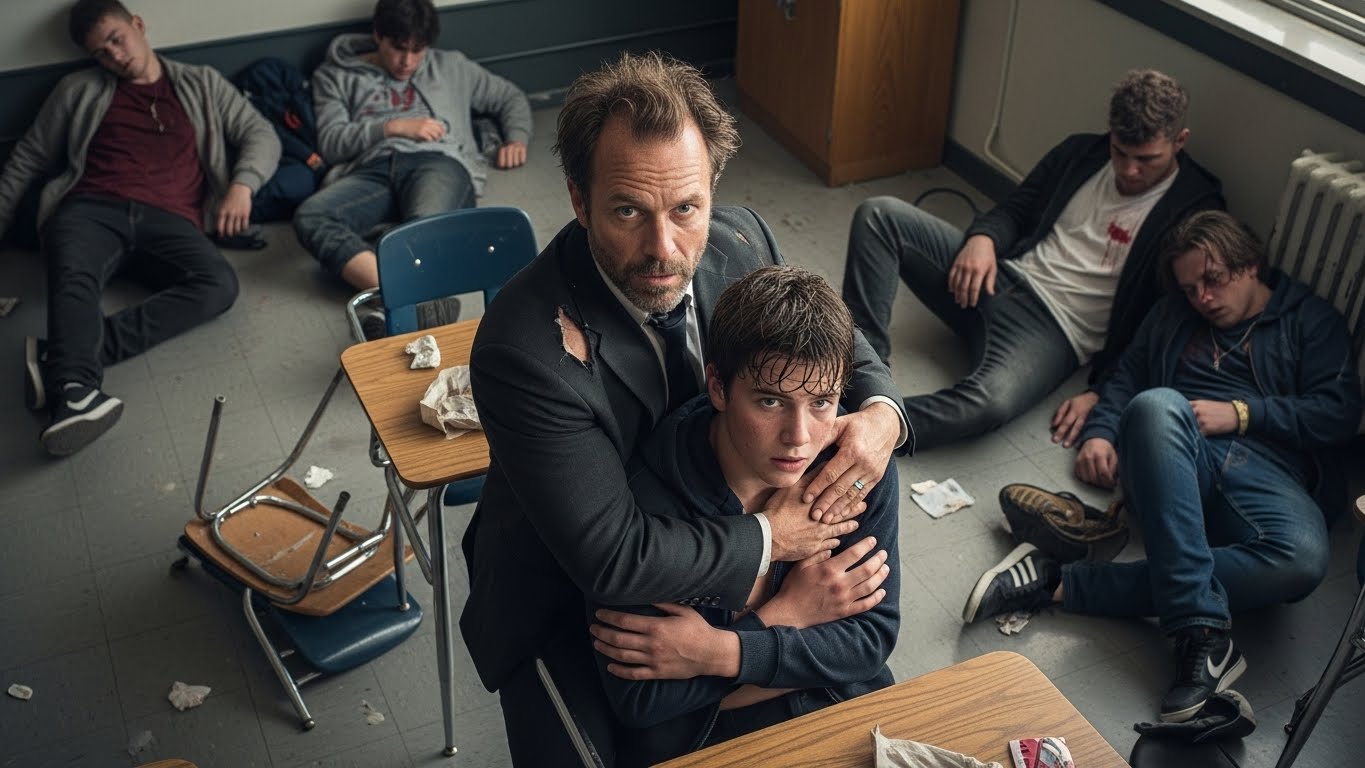
I looked down at the trauma ward I had created. Three large, cruel boys—boys who had moments earlier terrified my son—were now broken and bleeding on the floor of a Saturday detention classroom.
I had done this.
Chapter 4: The Sound of Sirens
The fury was gone, replaced instantly by a crippling wave of nausea and disbelief. I was standing in a high school classroom, holding my traumatized son, surrounded by bodies.
My hand was throbbing. I looked down. The skin over my knuckles was split open, slick with blood—Marcus’s blood, Jordan’s blood, or maybe just my own.
“Dad, your hand,” Leo whimpered, pulling back slightly.
“My hand is fine,” I choked out, running my other, cleaner hand over his scalp. “Are you hurt? Show me the cut.”
The cut was superficial, thank God. It was long, but shallow. A nasty scratch. The terrifying sight of the blood had been worse than the injury itself.
“The chair… did you… did you kill them?” Leo whispered, his voice catching.
The question was honest, raw, and it yanked me back to reality faster than any slap. I looked at the three lumps on the floor.
Marcus was still unconscious by the desk. Jordan was sobbing hysterically against the wall, his nose clearly shattered, making wet, horrible sounds as he tried to breathe. Tyler, the one I hit with the chair, was moaning on the floor, trying futilely to sit up, holding his back.
“No, Leo. They’re just… hurt. Very hurt,” I said, my voice shaking now. The fear was returning, but it wasn’t fear for Leo anymore. It was fear for me. Fear of the consequences.
The sirens were deafening now. They were right outside. Red and blue lights began flashing through the classroom windows, bathing the scene in a strobe of panicked color.
I gently placed Leo down and quickly peeled off my jacket, wrapping it around his shoulders. “Stay right here, Leo. Don’t move.”
I walked over to the open door, the splintered wood a testament to my temporary madness.
A second later, two enormous men in security uniforms burst through, followed closely by an older woman in a faded school polo—the school nurse, perhaps, or a janitor.
They stopped dead in the doorway, their jaws slack. The security guards, both veterans, had seen fights. They hadn’t seen this.
The room looked like a battlefield. The overturned desks, the broken chair, the blood on the floor, the three large boys incapacitated, and me—the mild-mannered man in the button-down shirt—standing over the wreckage, breathing heavily, blood covering my hand and spotting the collar of my shirt.
“What in God’s name…?” one of the guards, a man named Henderson (not the same Henderson, thankfully) finally stammered.
I held up my hands, palms out. The bloody one and the clean one. I was shaking, but I tried to sound calm.
“They were assaulting my son,” I stated, nodding toward Leo, who was staring blankly, wrapped in my jacket. “I found them cutting him with a box cutter. I defended him.”
The older woman saw Leo and rushed immediately toward him, ignoring the carnage on the floor. “Oh, honey. Are you alright? Let me see.”
The security guards exchanged a look. Their primary duty was to restore order, but the sight of the injuries they were seeing—the unconscious face, the broken nose—was beyond their scope. They heard the approaching footsteps of the police, who must have been called simultaneously with the school’s internal security.
“Sir,” the other guard said, pulling out his radio, his voice strained. “You need to step away from the scene and sit down. Now.”
I nodded, feeling the adrenaline drain out of my system, leaving me hollow and cold. I walked over to the back of the room, far from the blood, and sat down at one of the tiny student desks. The plastic was cold beneath me.
I looked down at my hands. They didn’t feel like mine. They felt like tools used for destruction.
Leo was being checked over by the nurse. He was safe. That was all that mattered.
Then the actual police arrived. A flurry of uniforms, flashing lights, and clipped, official voices filled the room. The questions started immediately. The police officers, professional but grim, looked from the broken boys to me, the quiet man sitting in the back, and the story they pieced together was simple, yet unbelievable: The father, the avenger, the moment the mask of civility shattered.
I was cuffed shortly after. Not aggressively, but with professional certainty. They had to take me in. Three major assaults, school property damage, and the confession that I had willingly swung the first blow. The sight of Tyler’s broken back—the paramedics confirmed the possibility of multiple fractures—guaranteed that I wasn’t just walking out with a warning.
As they led me out of the classroom, past the paramedics attending to the three bullies, I glanced back at Leo. He was sitting on a bench in the hallway, clutching my jacket, being gently questioned by a young officer. He looked better. He looked safe.
I was led out of Lincoln High, the same school where I had watched my son’s first-grade play, in handcuffs. I was walked right past the black Chevy Silverado, still parked crookedly in the handicapped spots.
And as I was put into the back of the police cruiser, I looked up at the American flag hanging from the pole over the school entrance, snapping smartly in the cold wind. It was a perfect, patriotic Saturday morning.
And I felt no regret. Only the exhausted, hollow certainty of a man who had successfully defended his cub. I had lost my freedom, but I had saved my son.