I CAME HOME TO FIND MY HUSBAND GONE AND MY BABIES ON THE CURB WITH THE “MONSTER” NEXT DOOR.
Chapter 1
My hands were shaking so hard I could barely shift the gear stick into park.
It was 10:15 PM on a Tuesday. I had just pulled a double shift at St. Mary’s General—fourteen hours of changing bedpans, checking vitals, and getting yelled at by patients’ families who thought Google knew more about medicine than the doctors. My feet were throbbing inside my cheap sneakers, a dull, rhythmic ache that shot all the way up my shins. My eyes felt like they were packed with sand. All I wanted was to walk through my front door, kiss my sleeping kids, and collapse face-first onto the mattress.
But as my headlights swept across our driveway, the exhaustion vanished, replaced instantly by a cold, jagged spike of adrenaline.
The house was dark. Not the “everyone is asleep” kind of dark. The “nobody is home” kind of dark. No porch light. No glow from the living room TV where Mark usually passed out with a half-empty can of Miller Lite. Just a black, gaping mouth of a house.
And then I saw them.
Two small figures sitting on the concrete curb, huddled together under the flickering orange buzz of the streetlamp.
“No,” I whispered, the word strangling in my throat. My heart hammered against my ribs like a trapped bird.
I threw the door open before the engine even died. The humid Georgia air hit me like a wet towel, thick with the smell of exhaust, asphalt, and cut grass.
“Leo? Mia?” I screamed.
They looked up. My eight-year-old, Leo, looked small. Too small. He was hugging his knees to his chest. And Mia… my five-year-old baby girl was sitting right on the dirty asphalt, her legs splayed out in her pink pajama bottoms.
But they weren’t alone.
And that’s when the terror truly hit me. Cold, sharp, and violent.
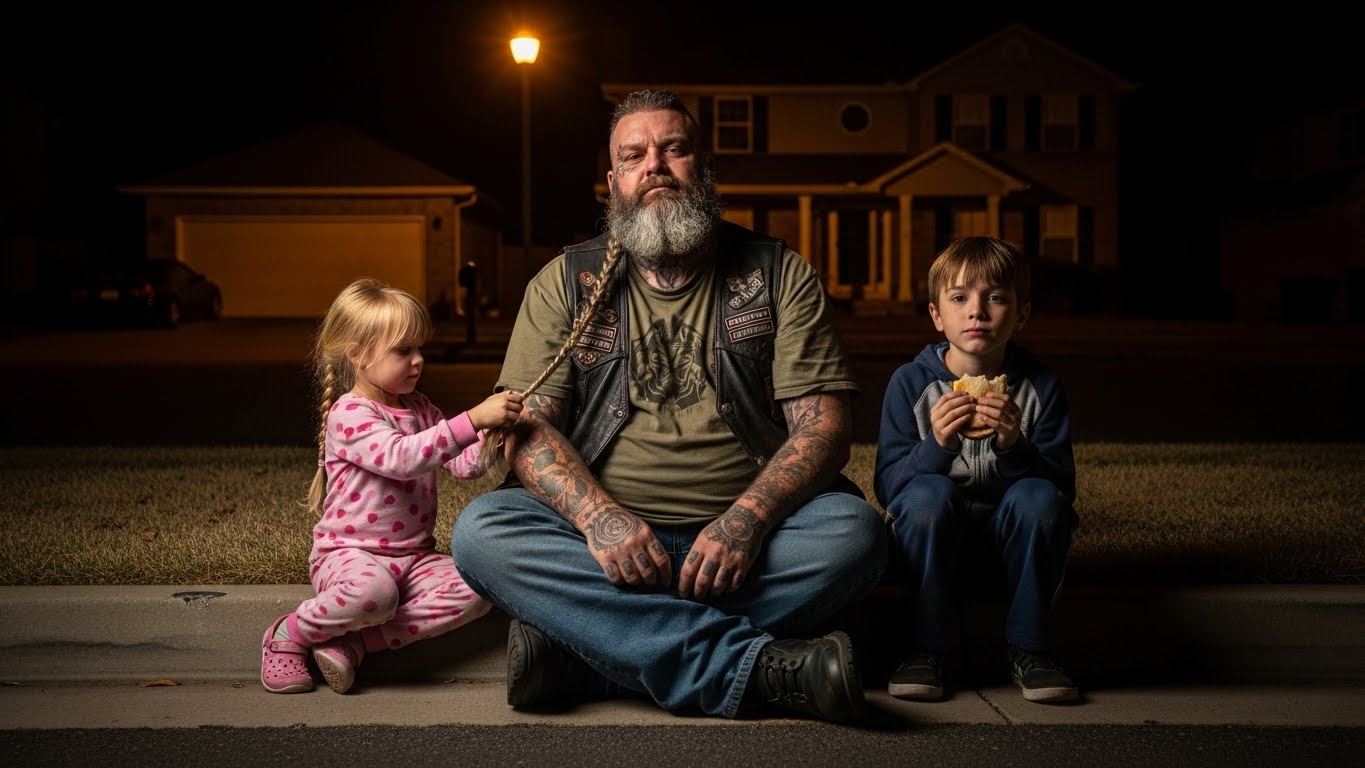
Sitting next to them, taking up half the sidewalk with his massive frame, was him.
The neighbor. The one everyone in the HOA Facebook group warned about. The guy who moved into the rental property three months ago and never spoke to anyone. He was huge—at least six-four, with arms like tree trunks covered in faded, aggressive ink. He wore a dirty denim vest with patches I couldn’t read, and he had a spiderweb tattoo that crawled right up his neck to his jawline.
We called him “The Biker.” We told our kids to never look at him. We crossed the street when we saw him coming. Rumors flew around him like flies on rotting fruit—ex-con, drug dealer, violent offender.
And now, he was sitting six inches away from my daughter.
My mother’s instinct overrode my exhaustion. I didn’t think; I just reacted. I reached into my purse, my fingers curling around my heavy keychain, wrapping the jagged metal keys between my knuckles like claws.
“Get away from them!” I shrieked, sprinting across the lawn, my scrubs flapping in the wind. “Get the hell away from my kids!”
The man didn’t flinch. He didn’t jump up or reach for a weapon. He didn’t even look surprised. He just slowly turned his head.
In the harsh, unforgiving light of the streetlamp, his face looked like a topographic map of hard living. Scars, deep lines carved by sun and wind, a beard that looked like steel wool. His eyes were dark pits under a heavy, prehistoric brow.
I was ready to kill him. I was ready to tear him apart with my bare hands if he had touched a hair on their heads. The adrenaline made my vision tunnel. I was ten feet away, ready to swing.
But then I stopped. Skidding to a halt on the pavement, my breath hitching in my chest.
Because I saw what my daughter was doing.
Mia wasn’t crying. She wasn’t shaking. She was holding three strands of the man’s wiry, grey-streaked beard in her tiny, pink fingers.
She was braiding it.
And Leo? My shy, anxious Leo who hid behind my legs when the pizza delivery guy came? He was holding half of a wrapped deli sandwich, chewing thoughtfully, looking at the man with something that wasn’t fear. It was… comfort.
The man looked up at me. His face was unreadable, stony.
“You the mom?” his voice was a low rumble, like gravel tumbling in a dryer.
I stood there, panting, my keys still clutched in my fist, my heart hammering a frantic rhythm against my ribs. “Yes,” I choked out, my voice sounding shrill and hysterical in the quiet night. “I’m the mom. What are you doing? Where is my husband?”
The man didn’t answer immediately. He looked down at Mia, who had just finished tying a clumsy knot at the end of his beard. He didn’t pull away. He sat perfectly still, like a statue, letting her work.
Then he looked back at me, and I saw something in those dark eyes I didn’t expect. It wasn’t malice. It was a deep, simmering anger. But it wasn’t directed at me.
“Door was locked,” he grunted. He jerked his chin toward my dark house. “Found ’em sitting here an hour ago. Boy said Daddy went to the store. Daddy never came back.”
Chapter 2
The silence that followed his words was louder than the cicadas buzzing in the trees. It was a heavy, suffocating silence that pressed down on my shoulders.
Daddy never came back.
My knees gave out. I didn’t fall, but I sank, squatting down on the pavement just to keep the world from spinning. Mark was supposed to be watching them. I had texted him at 6 PM to check in. I had texted him at 8 PM to say I was heading into my last rounds. He had replied with a single thumbs-up emoji.
Thumbs up.
And now my children were on the street with a man the neighborhood watch described as a “potential felon.”
“Mark… isn’t inside?” I asked, my voice trembling.
“Nope,” the man said. He shifted his weight, wincing slightly as he adjusted his legs, his heavy leather boots scraping the concrete. “Knocked. Rang the bell. Nobody home. Just the dog barking his head off.”
I looked at Leo. “Leo, baby, when did Daddy leave?”
Leo swallowed the bite of sandwich, his eyes wide and fearful. “He said he needed cigarettes, Mom. He said… he said to watch TV and he’d be right back. That was right after SpongeBob ended.”
My stomach turned over. SpongeBob ends at 7:30.
It was 10:15.
Mark had left an eight-year-old and a five-year-old alone for nearly three hours. And then, somehow, they had gotten locked out.
“We went outside to look for his car,” Leo whispered, looking down at his sneakers. “We thought we heard the truck. And the door shut. It locked, Mom. We couldn’t get back in. It got dark.”
Tears welled in Leo’s eyes, the brave facade finally cracking now that I was here to take the burden. “I was scared, Mom. The streetlights made noises. And the bugs were loud.”
“I wasn’t scared,” Mia piped up, though her voice was small. She patted the biker’s knee with a familiarity that made my head spin. “Mr. Silas waited with us. He has a cool sandwich. It has pickles.”
Silas. His name was Silas.
I looked at him again. Really looked at him. Up close, the terrifying tattoos seemed less like threats and more like armor. The spiderweb on his neck faded into the collar of a faded black t-shirt that read Harley-Davidson Sturgis 1998. His hands, huge and calloused, were resting on his knees, palms open. A non-threatening posture. He was making himself smaller for them.
“You… you sat with them?” I asked stupidly.
Silas grunted again. He reached into a brown paper bag by his side and pulled out a bottle of water. He cracked the plastic seal—a sharp crack in the quiet night—and handed it to Leo without looking at him.
“Street ain’t safe at night,” Silas said. His gaze drifted down the road, scanning the shadows as if he was on guard duty. “People drive too fast. Weirdos walk around. Saw ’em sitting here shivering.”
He paused, and his jaw tightened. A muscle jumped in his cheek.
“Didn’t want ’em waiting in the dark alone. Kids shouldn’t be in the dark.”
The way he said it—heavy, final, resonating with some old pain—sent a shiver through me. It sounded personal. Like he knew exactly what the dark felt like.
I slowly unclenched my hand. The keys bit into my palm, leaving red indentations that would bruise later. I felt a wave of shame wash over me so hot it burned my cheeks. I had come charging out here ready to treat this man like a monster, judging him by the ink on his skin and the roar of his motorcycle, while the real monster—the man I married—was God knows where.
“Thank you,” I whispered. The words felt inadequate, like trying to put out a forest fire with a water pistol. “I… I’m sorry I yelled. I just saw them and…”
Silas shrugged one massive shoulder. “You’re a mom. Lions roar when the cubs are threatened. Ain’t no offense taken.”
He slowly got to his feet. He rose up and up, unfolding like a collapsible ladder until he towered over me. He dusted off his jeans with rough, sweeping motions. Mia looked up at him, her little braid still dangling from his beard, a tiny chaotic masterpiece in a sea of grey wire.
“Nice braid, Tiny,” he rumbled down at her.
Mia giggled.
“Come on inside,” I said to the kids, my voice shaking with a mix of exhaustion and rage at Mark. “Let’s get you into bed.”
“Mom?” Leo asked, clutching the water bottle Silas had given him. “Is Daddy coming back?”
I froze. I looked at the dark house, then at the empty driveway where Mark’s Ford F-150 should have been. I thought about the text messages. I thought about the bank account I hadn’t checked in a week because I was too afraid to see the balance.
“I don’t know, baby,” I said, and for the first time in my life, I didn’t try to sugarcoat it.
Silas was watching me. He saw the panic I was trying to hide. He saw the realization dawning on me that I didn’t have my house keys—Mark had the only spare set, and mine were locked in the house because I used the garage opener in the car.
I walked to the garage keypad. I punched in the code. 4-4-9-9.
Nothing. No whir of the motor. No light.
“The power,” I muttered, panic rising in my throat like bile. “The power is out.”
“Whole block’s got lights but you,” Silas observed quietly.
I looked around. He was right. The Johnson’s across the street had their porch light on. The streetlights were humming. It was just us. Just my house.
A cold stone dropped into the pit of my stomach. Mark paid the utilities. Or said he did.
“I can’t get in,” I whispered, fighting back tears. “I’m locked out. My phone is at 4%. My husband is gone.”
Silas sighed, a sound like a tire deflating. He hooked his thumbs into his belt loops.
“Got a generator running round back of my place,” he said. “Got A/C. Got a couch. You and the youngins can sit tight while I pop your back door. I used to be a… locksmith. Of sorts.”
He looked at me, waiting for the judgment. Waiting for me to say No, I won’t go into the house of a strange biker.
I looked at my shivering kids. I looked at my dark, dead home. And then I looked at the man who had shared his sandwich with my son.
“Okay,” I said. “Okay, Silas. Thank you.”
Chapter 3
Walking into Silas’s house felt like stepping onto a different planet.
I braced myself for the smell of stale beer, cigarettes, or something worse. I expected dirty dishes piled high, motorcycle parts on the coffee table, the chaos of a man living on the fringe.
Instead, the air inside was cool and smelled faintly of cedarwood and lemon furniture polish.
The living room was sparse but aggressively clean. There was a worn brown leather sofa that looked comfortable, a large braided rug, and a bookshelf made of industrial piping and reclaimed wood that was filled not with biker magazines, but with hardcovers. History. Engineering. Classic literature.
“Sit,” Silas commanded gently, pointing to the couch.
Leo and Mia didn’t hesitate. They climbed onto the leather, looking small against the oversized furniture. Silas disappeared into the kitchen and returned a moment later with two juice boxes—organic apple juice—and a cold can of soda for me.
“Where did you get juice boxes?” I asked, bewildered, cracking the tab on the soda. My hands were still trembling.
“Grandkids,” Silas said shortly. “They visit on Sundays.”
Grandkids. The monster next door was a grandfather. The shame hit me again, a fresh wave.
“I’m going to go pop that lock,” Silas said, grabbing a small leather tool roll from a side table. “Stay here. Lock the deadbolt behind me. Don’t open it unless you hear my voice.”
“Silas,” I said, standing up. “I’m coming with you. They’re okay here for five minutes. I need to see… I need to see the house.”
He looked at me for a long second, assessing my stability. Then he nodded. “Suit yourself. Kids, stay put. The TV works if you want to watch something.”
We walked back across the strip of lawn that separated our worlds. The grass on his side was neatly trimmed; ours was getting shaggy. Another thing Mark promised to do last weekend.
At my back door, Silas knelt down. He pulled a tension wrench and a rake pick from his kit. His hands, so large and rough, moved with surgical precision.
“Standard deadbolt,” he muttered. “Cheap. You oughta upgrade this.”
Click.
In less than thirty seconds, the door swung open.
The air inside the house was stale, hot, and suffocating. It felt lifeless.
I fumbled for the light switch out of habit, but of course, nothing happened. Silas clicked on a small tactical flashlight, cutting a beam through the gloom.
“I’ll check the breaker box,” Silas said. “Maybe it just tripped.”
“It didn’t trip,” I said, my voice hollow. I walked into the kitchen. The silence of the house was terrifying. No hum of the refrigerator. No ticking clock.
I moved toward the kitchen island, the beam of Silas’s flashlight following me.
The counter was usually cluttered with mail. Mark always said he handled the bills. He said he had a system.
There was a stack of envelopes on the counter, but they weren’t in their usual chaotic pile. They were stacked neatly, deliberately. And right on top, weighted down by his wedding ring, was a piece of notebook paper.
My breath hitched.
Silas saw it too. He respectfully angled the light away, giving me a semblance of privacy, but keeping the room illuminated.
I reached out, my fingers brushing the cold gold band. I didn’t pick it up. I picked up the paper.
Sarah,
I can’t do this anymore. The pressure is too much. I lost the job three months ago. I didn’t tell you. I tried to fix it at the casino, but I dug the hole deeper. The house is in foreclosure. They’re cutting the power today. I took the truck and whatever cash was in the emergency tin.
Don’t look for me. I’m sorry.
– M
I read it twice. The words swam before my eyes.
Lost the job three months ago.
Every morning, he had put on his work boots, grabbed his lunch box, and kissed me goodbye. He had left for eight hours a day.
Casino.
Foreclosure.
I dropped the note. It fluttered to the floor like a dead leaf.
“He’s gone,” I whispered. The reality of it crashed into me with the force of a freight train. “He’s gone, Silas. He took the money. He lost the house. He left us with nothing.”
I looked around the dark kitchen. The refrigerator was warm. The food inside—hundreds of dollars of groceries I had just bought—was spoiling. The air conditioner was dead.
I sank onto the kitchen floor, pulling my knees to my chest. The tears finally came, hot and ugly. I wasn’t just crying for the marriage. I was crying for the betrayal. For the fact that he had left our babies on the curb while he ran away like a coward.
I felt a heavy presence beside me. Silas knelt down, his knees cracking. He didn’t try to hug me. He didn’t offer empty platitudes like “It’ll be okay.”
He just sat there in the dark with me, aiming his flashlight at the ceiling so the room was filled with a soft, diffused glow.
“We got a problem, Sarah,” he said softly.
I looked at him, wiping my nose on my scrub top. “Yeah. I know. I’m homeless and broke.”
“No,” Silas said firmly. “That’s a problem for tomorrow. Tonight’s problem is the heat. It’s eighty-five degrees in here. You can’t keep the kids in this house tonight.”
He stood up and offered me a hand.
“Pack a bag,” he said. “Get clothes for school tomorrow. Get their toothbrushes. You’re staying at my place tonight.”
“I can’t,” I sobbed. “I can’t impose on you. I don’t even know you.”
“You know I got juice boxes,” he said, a ghost of a smile touching his lips under that thick beard. “And you know I didn’t leave your kids in the dark.”
He reached down and picked up Mark’s wedding ring from the counter. He held it up, inspecting it in the light, then tossed it into the trash can with a decisive clunk.
“Pack the bag, Sarah.”
Chapter 4
The guest room in Silas’s house was a ghost story, but the kind that breaks your heart instead of scaring you.
I laid Mia down on the twin bed. The sheets were crisp, white, and smelled of lavender. The room was painted a soft, pale yellow. There were shelves lined with horse figurines and a corkboard covered in faded ribbons—Second Place, County Fair, 1999.
It was a little girl’s room, frozen in time.
“My daughter, Emily,” Silas said from the doorway. He was leaning against the frame, holding a fresh pile of towels. “She loved horses. Moved out ten years ago. Married a Marine. Lives in Okinawa now. That’s where the grandkids are.”
I took the towels, my fingers brushing his rough knuckles. “You kept it exactly the same.”
“Kept it ready,” he corrected. “In case they ever need to come home. People always need a place to come home to.”
The weight of his words hit me like a physical blow. I didn’t have a home anymore. I had a foreclosed shell across the yard with spoiling milk in the fridge and a liar’s ghost in the hallway.
After the kids were asleep—exhaustion finally claiming them—I walked out into the living room. Silas was sitting on the leather couch, nursing a tumbler of amber liquid. The only light came from a small lamp on the desk and the blue glow of his police scanner.
“Whiskey?” he offered.
“Please.”
He poured. I drank. It burned going down, a welcome fire in my cold, empty stomach.
“I have to call the police,” I said, staring into the glass. “I have to report him missing. Or… or report the theft. The truck. The money.”
“You can,” Silas said. He took a slow sip. “But if he’s gambling, he’s probably across state lines by now. Biloxi. Maybe Cherokee. Cops won’t prioritize a domestic runaway husband unless he took the kids.”
“He left the kids on the curb,” I spat, the anger flaring up again. “He left them like garbage.”
Silas turned to look at me. The shadows cast deep pools in his eyes. “He didn’t leave ’em like garbage, Sarah. He left ’em because he knew he was garbage. There’s a difference. cowardice ain’t malice, but it hurts just the same.”
“How do you know so much about it?” I asked, looking at the tattoos on his arms. The skulls. The daggers.
Silas rubbed his neck, right over the spiderweb ink. “I spent ten years in the state penitentiary, Sarah. Aggravated assault. Guy hurt my sister. I hurt him back. Worse.”
My breath hitched. The neighborhood rumors were true. I was sitting in the dark with a violent ex-con.
But then he continued, his voice soft. “Prison teaches you two things. One: everybody has a breaking point. Two: the scariest thing in the world isn’t a man with a knife. It’s a man who has run out of options. Your husband… he ran out of options. And he broke.”
He leaned forward, placing his elbows on his knees.
“You ain’t broken, though. I watched you tonight. You came at me like a banshee to protect your cubs. You’re bent, Sarah. But iron bends before it breaks.”
I looked at this man—this stranger who had fed my son and sheltered my daughter—and I felt the first tear slide down my cheek. “I don’t know what to do, Silas. I have twelve dollars in my wallet.”
“Sleep,” he commanded gently. “We figure out the rest when the sun comes up.”
Chapter 5
Morning brought the sun, but it didn’t bring any mercy.
I woke up to the smell of coffee and bacon. For a split second, I forgot. I reached across the bed for Mark. My hand hit empty mattress. Then the unfamiliar yellow walls of Silas’s guest room swam into focus, and the reality crashed down on me all over again.
I dragged myself to the kitchen. Leo and Mia were already at the table, devouring scrambled eggs. Silas was at the stove, wearing a black apron that looked ridiculous over his Harley shirt.
“Eat,” he said, sliding a plate toward me. “You look like hell.”
“Thanks,” I muttered, taking a piece of bacon. “I need to make calls.”
I spent the next two hours on Silas’s back porch, crying quietly into the phone while the kids watched cartoons inside.
It was worse than the note said.
The mortgage hadn’t been paid in six months. The foreclosure notice had been sent three weeks ago—Mark must have intercepted the mail. The bank account was overdrawn by $400. The credit cards—cards I didn’t even know existed, opened in my name—were maxed out.
He had stolen everything. My credit. My home. My safety.
I hung up with the bank, feeling like I was going to vomit. I walked through the house, needing air, and stepped out onto Silas’s front porch.
“Well, look who it is.”
I froze. Standing on the sidewalk, walking her grotesque little poodle, was Brenda. The HOA president. The woman who measured grass height with a ruler.
She peered over her sunglasses, her eyes darting from me to Silas’s front door, then to my car parked in his driveway.
“Sarah?” she asked, her voice dripping with faux-concern. “I saw the lights out at your place last night. And then I saw… well, I saw you coming out of here this morning.”
She lowered her voice to a whisper. “Is everything okay? You know, we have rules against… unregistered guests. And with his background…”
She gestured vaguely at Silas’s house.
The rage that surged through me was blinding. I was homeless. My husband was a thief. And this woman was worried about HOA bylaws.
“Brenda,” I started, my voice shaking.
The screen door creaked open behind me. Silas stepped out. He didn’t say a word. He just stood there, crossing his massive arms, his biceps straining against his shirt. He stared at Brenda with the intensity of a wolf watching a rabbit.
Brenda swallowed audibly. She took a step back.
“Just… checking in,” she squeaked. She yanked the poodle’s leash. “Have a nice day.”
She scurried away.
Silas spat over the railing into a bush. “Vultures,” he grunted. “Smell blood from a mile away.”
He turned to me. “Pack up the kids. I’m driving you to work.”
“I can drive,” I protested. “I have my car.”
“You’re shaking like a leaf,” he said. “And you got no gas. I checked. You’re on E. Save the money. I’ll take you.”
“What about the kids?”
“I took the day off,” Silas said simply. “Me and the little man have some repairs to do on the porch. Mia can supervise. They’re safe with me, Sarah. Safer than they are out there.”
I looked at him. I should say no. I should be terrified. But I remembered Leo sharing his sandwich. I remembered the braid in the beard.
“Okay,” I whispered. “Thank you.”
Chapter 6
The shift at the hospital was a blur. I moved on autopilot, cleaning wounds, taking temperatures, nodding when doctors barked orders. Every time my phone buzzed, I jumped, hoping it was Mark saying it was a mistake, or dreading it was the bank saying they were coming for the car.
When I clocked out at 7 PM, Silas was waiting at the curb in his beat-up Chevy truck. Leo and Mia were in the back seat, eating ice cream.
“They good?” I asked, climbing in.
“Good kids,” Silas said. “Leo knows how to sand wood. Mia talks a lot. She asked why you were sad.”
“What did you tell her?”
“Told her Mommy is fighting a dragon,” Silas said, staring straight ahead. “And dragons take a lot of energy to kill.”
We pulled into the driveway—his driveway. My house stood dark and silent next door, a tombstone of my marriage.
As we got out of the truck, another vehicle pulled up. A sleek, white tow truck with flashing yellow lights.
My stomach dropped.
A man in a neon vest hopped out, holding a clipboard. He checked the VIN number on my Honda Pilot—the car I relied on to get to work, to get the kids to school.
“Hey!” I screamed, running toward him. “What are you doing? That’s my car!”
The man didn’t even look up. ” repossession order. Bank of America vs. Mark and Sarah Miller. 90 days past due.”
“No,” I pleaded, grabbing his arm. “No, please. I didn’t know. Mark pays the notes. I have to go to work tomorrow. Please, I have kids!”
“Lady, let go of my arm,” the man said, his voice bored. He’d heard it a thousand times. He began hooking the chains to the bumper.
“Stop!” I sobbed. I was making a scene. Brenda was probably watching from her window. “Please, give me a day. I can get the money. I just need a day!”
“Can’t do it,” the man said. He started the winch. The cable tightened. My car groaned as it was dragged backward.
It was the final straw. The dam broke. I collapsed onto the driveway, my knees hitting the asphalt, wailing. It was a guttural, ugly sound. Everything was gone. I was trapped.
Then, a shadow fell over me.
Silas walked past me. He didn’t run. He walked with a heavy, terrifying purpose. He walked right up to the tow truck driver.
The driver, a big guy himself, looked up—and shrank. Silas had three inches and fifty pounds on him, and an aura of violence that vibrated in the air.
Silas placed a hand on the winch cable.
“Unhook it,” Silas rumbled.
“Look, buddy, I’m just doing my job,” the driver stammered, stepping back. “I got a court order.”
“I don’t care what you got,” Silas said. His voice wasn’t loud. It was deadly quiet. “That woman there is having the worst week of her life. You take this car, she loses her job. She loses her job, those kids don’t eat.”
“Not my problem,” the driver said, though his voice wavered.
Silas reached into his back pocket. I thought he was reaching for a weapon. I stopped breathing.
Instead, he pulled out a thick, leather wallet. He opened it and pulled out a stack of cash. Hundreds. A thick stack.
“How much to drop the hook?” Silas asked.
“I… I can’t just…”
“The arrears,” Silas interrupted. “To get the bank off her back for thirty days. How much?”
The driver looked at the cash, then at Silas’s face. “Two grand brings it current. Plus a drop fee of two hundred.”
Silas counted out the bills. Twenty-two hundred dollars. He shoved them into the driver’s chest.
“Count it. Unhook it. And get off my driveway.”
The driver scrambled. He unhooked the chains, grabbed the cash, and jumped back into his truck. Tires squealed as he peeled away, leaving the Honda sitting crookedly on the asphalt.
I stared at the car. Then I stared at Silas.
He was standing there, breathing hard, his fists clenched. He turned to me.
“Silas,” I whispered, pulling myself up. “Where did you get that money? That was… that was thousands of dollars.”
He looked at me, and for the first time, looked ashamed. He looked away, toward the dark woods behind the subdivision.
“I told you I was a locksmith, Sarah,” he said, his voice rough. “I didn’t say that’s all I do.”
He turned back to me, his eyes pleading for me to understand something he hadn’t said yet.
“And I know Mark,” he said.
The air left the sudden vacuum of the night.
“What?” I asked.
“I know Mark,” Silas repeated. “We go to the same… meetings. Gamblers Anonymous. I’ve known him for six months. I knew he was slipping. I tried to warn him. And last night…”
He took a step toward me.
“I saw him leave, Sarah. I saw him packing the truck. I stood right there in my driveway and I watched him do it.”
“You watched him?” My voice was a whisper, trembling with betrayal. “You watched him leave us?”
“I tried to stop him,” Silas said, his voice cracking. “I told him to go back inside. He told me to stay the hell out of his business or he’d call the cops on ‘the ex-con next door.’ He knew I couldn’t risk the police showing up. He knew I’m on parole.”
He looked down at his boots.
“I let him go to save my own skin, Sarah. And then I saw the kids on the curb.”
Chapter 7
The silence in the driveway was heavy, broken only by the distant hum of traffic on the highway and the chirping of crickets.
“You let him go,” I repeated, the words tasting like ash in my mouth.
For a moment, the anger flared hot and bright. I wanted to scream at him. I wanted to hit his chest. I wanted to blame him because he was standing there and Mark wasn’t.
Silas didn’t back away. He stood there, his massive shoulders slumped, accepting my judgment.
“I had a choice, Sarah,” he said quietly. “If the cops came… with my record… and a white guy from the suburbs saying I was threatening him? I go back inside. No questions asked. I lose my freedom. I lose my grandkids. I die in a cage.”
He looked at the house where my children were sleeping safely in his guest room.
“So I stepped back,” he rasped. “I let a coward walk away because I was too scared to stop him. And I’ve been hating myself for it every minute since.”
I looked at his face. The “monster” next door. The man everyone was terrified of. I saw the fear in his eyes—not fear of me, but fear of the system that had defined his life for a decade. Mark knew that. Mark, the man who promised to love and cherish me, had weaponized this man’s past to cover his own escape.
Mark was the villain. Not Silas.
I looked at the Honda Pilot, sitting safe in the driveway because Silas had just handed over two thousand dollars in cash.
“Where did you get the money, Silas?” I asked, my voice softening. “If you’re a locksmith… and you have parole fees…”
Silas rubbed the back of his neck, looking embarrassed. “Been saving for three years. Was gonna buy a new bike. A Harley Softail. Take a trip up the coast to see my daughter.”
My hand flew to my mouth. “Silas… that was your motorcycle money?”
“It’s just metal and rubber,” he shrugged, though his voice was thick. “A car gets you to work. Work feeds those kids. It wasn’t a hard choice.”
The tears came then, but they weren’t the angry, hysterical tears of the night before. They were tears of relief. Tears of gratitude so profound it made my knees weak.
I stepped forward. This man, this stranger with the neck tattoos and the violent history, had sacrificed his dream to save my reality.
I wrapped my arms around his waist. I buried my face in his leather vest, which smelled of tobacco and rain. I felt him stiffen in surprise, his arms hovering uncertainly for a moment before he gently, awkwardly patted my back.
“You didn’t let him go, Silas,” I whispered into his chest. “You stayed. You stayed when it mattered.”
I pulled back and looked up at him.
“You aren’t the monster, Silas. You never were.”
Chapter 8
Six Months Later
The Georgia heat had finally broken, giving way to a crisp, golden autumn.
I stood on the front porch of my house—my house. The foreclosure had been halted. It took three jobs, a loan modification, and selling every piece of jewelry Mark had ever given me, including the wedding ring, but we kept the roof over our heads.
The divorce papers had come through last week. Mark was in Nevada, apparently. I didn’t care. He was a ghost. A bad memory that was fading a little more every day.
“Mom! He’s here!” Leo yelled from the living room.
I smiled and wiped my hands on a dish towel.
A low, thunderous rumble shook the window panes. It grew louder and louder until it cut off abruptly in the driveway.
I opened the front door just as Silas was walking up the path. He wasn’t wearing his vest today. He was wearing a flannel shirt with the sleeves rolled up, revealing the ink on his forearms. He was carrying a large box of donuts and a bag of specialized mulch for the flower beds he was helping me restore.
“Morning, Sarah,” he grunted.
“Morning, Silas,” I beamed. “You’re late. Pancakes are getting cold.”
“Had to stop,” he said, stepping inside. “Leo needed that specific glue for his science project. The heavy-duty stuff.”
Leo and Mia came charging down the hallway.
“Silas!” Mia screamed, launching herself at him.
He caught her with one arm, swinging her up onto his hip with an ease that still made my heart squeeze. She immediately reached for his beard, checking to make sure the braid she had put in yesterday was still there.
“Easy, Tiny,” he chuckled. “Hey, little man. Got your glue.”
“Thanks, Silas!” Leo grabbed the bag and ran back to the table, eager to show Silas his bridge design.
We sat down at the kitchen table. The sunlight poured in, hitting the mismatched plates and the stack of pancakes. It was chaotic. It was loud. It was perfect.
I looked at Leo, who was explaining the physics of truss bridges to an ex-convict who listened with the intensity of a university professor. I looked at Mia, who was eating a donut hole while sitting on Silas’s knee.
The neighborhood still whispered. Brenda still stared when she walked her poodle. People still crossed the street when they saw Silas coming.
Let them walk. Let them whisper.
They saw a convict. They saw a thug. They saw a cautionary tale.
I took a sip of my coffee and watched the “scary biker” wipe syrup off my daughter’s chin with a napkin as tenderly as if she were made of glass.
I didn’t see a monster.
I saw the man who sat on the curb in the dark so my babies wouldn’t be alone. I saw the man who gave up his freedom machine to save my job. I saw the only father figure my children had ever truly known.
Mark had left us in the dark. But Silas? Silas had brought the light.
“Pass the syrup, Sarah?” Silas asked, his dark eyes crinkling at the corners.
“Here you go,” I said, handing it to him. “Welcome home, Silas.”
He smiled, and for the first time, the shadows in his eyes were completely gone.
“Good to be here,” he said.
And he meant it.
THE END