They Broke Her Spirit and Threw Her Dreams in the Dirt. They Didn’t See the Marine Standing Behind Them Until It Was Too Late.
PART 1
CHAPTER 1: The Ghost at the Dinner Table
I didn’t survive eighteen months in the sandbox, dodging IEDs and sleeping with one eye open, just to come home and watch my little sister die inside. But that’s exactly what was happening.
I’d been back in Ohio for exactly three days. The “Welcome Home” banner my mom had painted was still sagging on the front porch, half-deflated from the humidity. The house smelled like pot roast and lemon polish, that specific scent of “home” I used to hallucinate about when I was digging a foxhole in the middle of nowhere. My parents were treating me like a fragile piece of glass, filling my plate with seconds and asking safe, sanitized questions about my deployment. Did you like the food? Did you get our packages? How was the flight?
They never asked about the noise. They never asked why I checked the perimeter of the backyard three times before sunset.
But I wasn’t the one they needed to be worrying about.
Lily was a ghost.
My baby sister used to be a firecracker. She was the kid who climbed trees higher than the boys and scraped her knees without crying. I remembered her as a whirlwind of energy, always talking, always drawing, always demanding to tag along with me and my friends.
Now, at sixteen, she was vanishing.
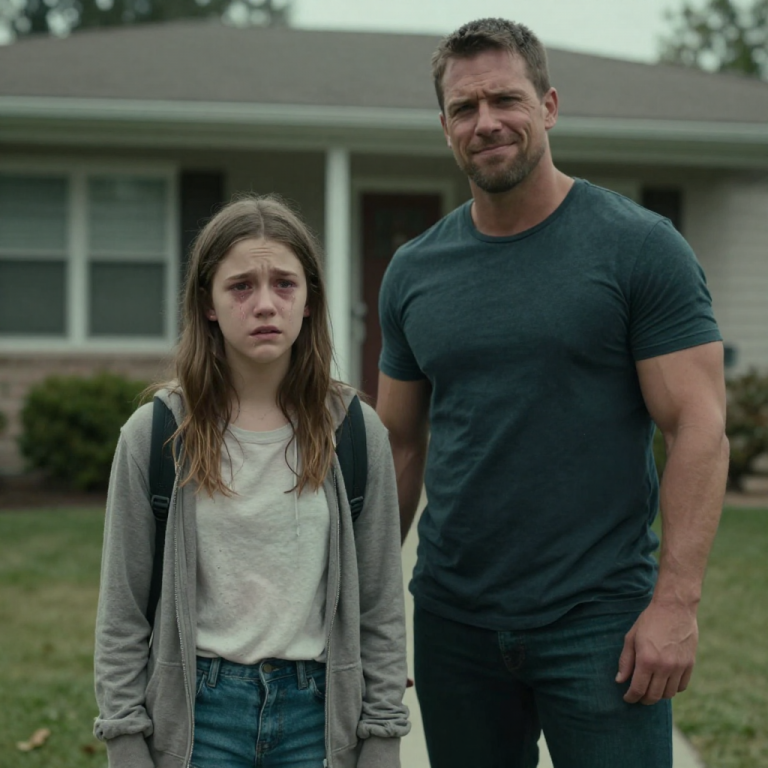
She sat across from me at the dinner table, pushing peas around her plate, her shoulders hunched forward like she was trying to collapse into her own chest. She wore a baggy, dark grey hoodie with the hood halfway up.
“Lily, honey, aren’t you hot?” Mom asked, wiping the table. “It’s eighty degrees out. Jackson, tell her she’s going to get heat stroke.”
“I’m fine,” Lily whispered. Her voice was brittle. Dry. She didn’t look up. She didn’t look at me.
That was the first red flag. The silence.
The second was the phone.
It sat next to her water glass, screen down. Every time it vibrated against the wood table—bzzzt, bzzzt—she flinched. Not a startling jump, but a micro-flinch. A tightening of the jaw. A blink. The kind of reaction I saw on guys in my unit when a car backfired two streets over. It was the autonomic response of someone living in a constant state of threat assessment.
“Who’s blowing up your phone?” I asked, trying to keep my tone light. “Boyfriend?”
Lily froze. Her hand shot out and covered the phone. “No one. Just spam.”
She stood up abruptly, her chair scraping loudly against the floor. “I’m not hungry. I have homework.”
“Lily, you barely touched your—” Dad started, but she was already gone. I heard her bedroom door click shut upstairs. Then, the distinct sound of the lock turning.
I looked at my parents. “What’s going on with her?”
Mom sighed, a tired, defeated sound. “She’s just… going through a phase, Jackson. You know how teenage girls are. Moody. She doesn’t talk much anymore. Her grades are slipping a little, but the counselor says it’s just adolescent anxiety.”
Adolescent anxiety.
I chewed on a piece of roast beef, but it tasted like cardboard. I knew anxiety. I knew fear. And I knew the difference between being “moody” and being hunted.
Later that night, I couldn’t sleep. The silence of the suburbs was too loud. I went downstairs to get a glass of water. As I passed the living room, I saw a sliver of light from the hallway. Lily’s door was cracked open just a hair—she must have unlocked it to use the bathroom.
I heard crying.
Not the loud, dramatic sobbing of a teenager who didn’t get tickets to a concert. This was the muffled, suffocating sound of someone crying into a pillow so no one would hear them. It was a sound of despair.
I stood there in the dark, my hand hovering over the doorframe. I wanted to burst in. I wanted to demand names. I wanted to fix it. That’s what big brothers do. That’s what Marines do. We neutralize threats.
But I didn’t have intel yet. I was operating blind. If I kicked down the door now, she’d clam up. She’d deny it. She’d push me away.
I pulled my hand back. I went back to my room, but I didn’t sleep. I sat on the edge of the bed, cleaning my boots until they shone like mirrors.
I needed to see the battlefield.
CHAPTER 2: The Kill Zone
The next morning, I decided to conduct a little reconnaissance.
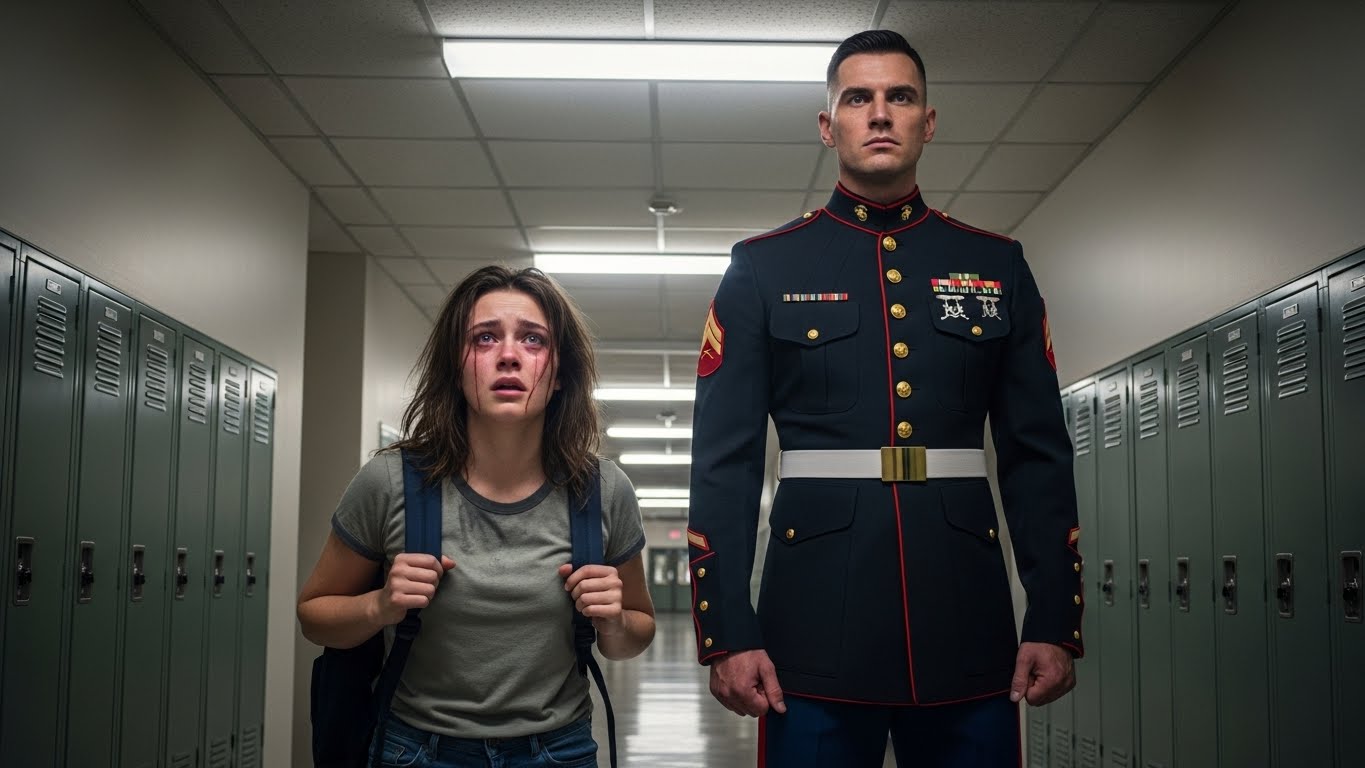
I told Mom I had a recruitment meeting at the local office in town, which was technically true, but not until 1400 hours. That gave me the whole morning. I put on my Dress Blues. I didn’t strictly need to wear them for a simple visit, but uniforms have a psychological effect. They command space. People move out of your way. They answer your questions faster.
I pulled my truck into the student lot of Crestview High around 11:30 AM. Lunch period.
The school hadn’t changed much since I graduated four years ago, but it felt smaller. Or maybe I was just bigger. The brick building looked tired. I walked toward the main entrance, adjusting my cover.
I checked in at the front office. The secretary, a woman named Mrs. Gable who used to give me detention slips for being late, swooned a little.
“Jackson? Oh my god, look at you!” she squealed, fanning herself. “You look so handsome! How long are you home for?”
“Just a few weeks, Mrs. Gable,” I gave her the polite smile I reserved for civilians. “I was hoping to surprise Lily for lunch. Buy her a pizza or something. Is that allowed?”
“For our local hero? Of course,” she winked and printed me a visitor pass. “She’s in the B-wing lockers. She usually stops there before the cafeteria.”
“Thanks.”
I walked out into the hallway. The smell hit me first—floor wax, stale french fries, and that thick, humid scent of hundreds of bodies packed into a confined space. The noise was deafening. Lockers slamming, sneakers squeaking, kids shouting.
I moved through the crowd. Students parted for me. Some stared. Some whispered. Is that a soldier? Look at the medals. I ignored them. I was scanning for a specific target.
I turned the corner into the B-wing. It was less crowded here.
I saw her almost immediately.
She was walking against the flow of traffic. She looked small. Too small. She was clutching a heavy textbook and a large black sketchbook against her chest like a shield. Her head was down, chin tucked into her chest. She was hugging the wall, trying to occupy the least amount of space possible.
Then I saw the bogies.
Three males. Seniors, judging by the size. Two of them were wearing varsity jackets—football, probably. The third was in a designer hoodie. They were walking in a wedge formation, taking up the entire width of the hall. They weren’t just walking; they were hunting.
I stopped moving. I stepped into the recessed alcove of a classroom doorway, just out of their line of sight. I needed to see the engagement. I needed to verify the hostility.
“Hey, Mute,” the tall one in the center said. He had a blond buzzcut and the arrogant jawline of a kid who knew his dad could sue the school if he got in trouble. “Where you going?”
Lily didn’t answer. She walked faster, her knuckles white on her books.
“We’re talking to you,” the second one said, stepping sideways. He blocked her path smoothly. It was practiced. They had done this before.
Lily stopped. I saw her shoulders shake.
“Please,” she whispered. I could barely hear her over the ambient noise of the school, but her voice was trembling. “Just let me go to lunch. I don’t have any money today.”
“Toll booth is open,” the tall one—let’s call him Brock—laughed. “We don’t want your lunch money. We want to see the art.”
He reached out. It wasn’t a playful grab. It was violent. He snatched the black sketchbook from her arms.
“No!” Lily cried out. It was a raw, desperate sound that cut through me. “Give it back! Please! That’s my final project!”
“Let’s see what the freak writes about,” Brock sneered. He held it up high, mocking her height. Lily jumped for it, humiliating herself, her fingers brushing the binding.
“Look at this,” Brock opened the book. “Pictures of… what is this? Sad trees? Dead birds? You are such a weirdo, Lily.”
“Give it to me!” tears were streaming down her face now.
“Trash,” Brock said.
He didn’t just drop it. He spiked it.
He threw the sketchbook hard onto the dirty linoleum floor. The spine cracked with a sickening pop that sounded like a bone breaking. Pages tore loose. Charcoal drawings scattered across the floor—months of work, months of her pouring her soul onto paper, now lying in the dust.
The three of them laughed. It was a cruel, barking sound.
Lily dropped to her knees. She didn’t look at them. She just frantically started gathering the pages, trying to salvage the wreckage.
“Oops,” Brock grinned, looking at his friends. “Going to step on your masterpiece.”
He lifted his heavy basketball sneaker and hovered it over a detailed drawing of a wolf she had spent weeks on. He was going to grind his heel into it. He was going to destroy the last bit of dignity she had left.
The rage that hit me wasn’t hot. It was cold. Absolute zero. It was the calm, calculated focus of a sniper adjusting for windage.
I stepped out of the shadows.
My boots hit the floor with a heavy, rhythmic thud that cut through the laughter. Clack. Clack. Clack.
The hallway went silent. The kids watching from the lockers stopped talking.
Brock froze, his foot still hovering. He sensed the shift in the atmosphere. He looked up.
He didn’t see a student. He didn’t see a teacher.
He saw the polished black shoes. The blood stripe running down the leg. The medals glinting under the fluorescent lights. And he saw my face.
I wasn’t smiling.
“You put that foot down,” I said, my voice low, projecting from the diaphragm the way my Drill Instructor had taught me, “and I promise you, son, it will be the last time you walk on it.”
PART 2
CHAPTER 3: Rules of Engagement
The hallway at Crestview High was dead silent. You could hear the hum of the vending machine down the hall.
Brock, the varsity giant who had been moments away from crushing my sister’s art, stood frozen. His foot was still hovering in the air, caught between gravity and fear. He looked at me, then down at his sneaker, then back at me.
He slowly lowered his foot. He placed it on the floor, inches away from the drawing of the wolf. He didn’t step on it.
Smart kid.
“Who are you?” Brock asked. His voice cracked. He tried to puff out his chest, to summon that alpha-dog bravado that usually worked on freshmen and math teachers, but it faltered against a six-foot-two Marine in full dress uniform.
I didn’t answer him. I didn’t yell. In the Corps, you learn that the loudest man in the room isn’t always the most dangerous. The most dangerous man is the one who is calm when he shouldn’t be.
I walked toward him.
Every step was measured. I kept my eyes locked on his. I entered his personal space, breaching the intimate zone. I stood so close I could smell the cheap body spray and the stale fear coming off him. I towered over him, not just in height, but in presence.
“I asked you a question,” I said softly. “I told you to pick it up.”
Brock glanced at his two friends. They had backed up against the lockers, suddenly finding the floor tiles very interesting. He was alone.
“It… it was a joke,” Brock stammered, a nervous smile flickering on his face. “We were just messing around. Right, Lily?”
He looked down at my sister. Lily was still on her knees, clutching a handful of torn paper, looking up at me with wide, wet eyes. She looked terrified—not of me, but of what would happen when I left.
“Does she look like she’s laughing?” I asked.
I leaned in. “Do I look like I’m laughing?”
Brock swallowed hard. His Adam’s apple bobbed. “Look, man, you can’t touch me. My dad is on the school board. If you lay a hand on me—”
“I don’t need to touch you to break you,” I interrupted. My voice dropped an octave, turning into the gravelly growl I’d used to clear checkpoints in Fallujah. “I’ve spent the last two years hunting men who would eat you for breakfast. Do you really think a phone call to your daddy scares me?”
I took one more step. He flinched back, hitting the lockers with a clang.
“Now. Pick. Up. The. Book.”
The command wasn’t a request. It was an order.
Brock stared at me for one second longer, trying to find a way out, trying to save face in front of the crowd that had gathered. But he saw nothing in my eyes but a promise of pain.
He crumbled.
Slowly, his face burning bright red, the star quarterback bent his knees. He crouched down next to my sister.
“Help her,” I barked at the other two. “Now!”
The two sidekicks jumped like they’d been tased. They scrambled to the floor, frantically grabbing pages that had drifted toward the wall.
It was a pathetic sight. Three bullies on their hands and knees, doing the work they felt was beneath them. The hallway murmured. Phones were out. I knew this was going on Snapchat, TikTok, Instagram. Good. Let the world see.
Brock gathered a stack of drawings. He held them out to Lily. His hands were shaking.
“Here,” he mumbled, refusing to make eye contact.
“Apologize,” I said.
Brock stiffened.
“I said, apologize. Look her in the eye.”
He took a ragged breath. He looked at Lily. For the first time, he actually looked at her, not through her.
“I’m sorry,” he gritted out.
“Louder,” I said. “So the people in the back can hear you.”
“I’m sorry!” he snapped, his humiliation complete. He shoved the papers into her hands and scrambled to his feet.
“We done here?” he spat at me, trying to regain a shred of dignity.
“For now,” I said. “But listen to me closely. If I ever hear that you looked at her wrong, if I hear you breathed in her direction… I won’t come back in a uniform. I’ll come back in the dark. Do we understand each other?”
Brock didn’t answer. He just turned and shoved his way through the crowd, his friends trailing behind him like beaten dogs.
I turned to Lily.
I offered her a hand. She looked at it for a second, then reached up. Her hand was so small in mine. I pulled her up.
“You okay?” I asked, my voice softening, returning to the brother she knew.
She nodded, wiping her face with her sleeve. She tried to smile, but her lip quivered.
“Come on,” I said, taking her heavy backpack from her shoulder and slinging it over my own. “We’re leaving.”
“I have Biology,” she whispered.
“Not today,” I said. “Today, you have lunch with your brother.”
CHAPTER 4: The Chain of Command
I drove my truck to a diner three towns over. I wanted to get her away from the blast radius. I wanted her to breathe air that didn’t smell like that high school.
We sat in a corner booth. I ordered her a milkshake and a burger. She drank the shake, but she picked at the fries.
“How long?” I asked.
Lily looked out the window. “Freshman year.”
Two years. My fists clenched under the table. I forced them to relax.
“Why didn’t you tell us?”
“Tell you?” She gave a bitter, hollow laugh. “Jackson, you were in a war zone. Mom and Dad are… they live in their own world. And besides, what would they do? Brock’s dad is Mr. Thorne. He owns the car dealerships. He donated the new scoreboard. The Principal loves him.”
“Thorne,” I memorized the name. “So the school does nothing?”
“I went to the counselor once,” Lily said, tracing the condensation on her glass. “She told me I needed to ‘work on my resilience.’ She said boys tease girls they like.”
She looked up at me, eyes blazing with a sudden, rare anger. “He put gum in my hair last month, Jackson. I had to cut it out. That’s why I wear the hoodie. To hide the choppy parts. Is that how boys show they like you?”
My heart broke. Then it hardened into stone.
“No,” I said. “That’s how cowards show they’re weak.”
I drove her home after lunch. I made sure she was settled on the couch with the TV on and the doors locked.
“Where are you going?” she asked as I grabbed my keys.
“I have to finish some paperwork,” I lied. “I’ll be back for dinner.”
I didn’t go to the recruitment office. I went back to Crestview High.
School was out. The buses were gone. But the parking lot near the stadium was full. Football practice.
I walked into the administrative building. The secretary, Mrs. Gable, looked surprised to see me again.
“Jackson? Did you forget something?”
“I need to see Principal Henderson,” I said.
“Oh, he’s in a meeting with—”
“I don’t care.”
I walked past her desk. I didn’t run, but I moved with purpose. I opened the heavy oak door to the principal’s office without knocking.
Principal Henderson was a round, balding man who looked like he sweated mayonnaise. He was sitting behind a large mahogany desk, laughing at something another man was saying.
The other man was tall, wearing a tailored suit and a gold watch that cost more than my truck. He looked like an older, slicker version of Brock.
Mr. Thorne.
They both looked up as I entered. Henderson frowned.
“Excuse me? You can’t just barge in here. Who are you?”
“Staff Sergeant Jackson Miller,” I said, closing the door behind me. “I’m Lily Miller’s brother.”
Recognition flashed in Henderson’s eyes. He sighed, leaning back in his chair.
“Ah. The incident in the hallway today. I heard about that.” He gestured vaguely. “Look, son, we appreciate your service, truly. But you can’t come onto campus and intimidate students. We have a zero-tolerance policy for bullying, but that applies to adults threatening minors, too.”
I stared at him. The audacity was breathtaking.
“Zero tolerance?” I repeated. “My sister has been tormented for two years. You told her to work on her resilience.”
“Lily is a sensitive girl,” Henderson said dismissively. “And Brock… well, Brock is a high-spirited young man. He’s under a lot of pressure with the playoffs coming up. Sometimes things get rowdy.”
Mr. Thorne chuckled. He stood up, buttoning his suit jacket. He walked over to me, looking me up and down with a sneer.
“Look, soldier boy,” Thorne said. “I heard you made a scene. Scared my boy. Now, I’m going to let it slide this time because you’re fresh back from… wherever. PTSD and all that. But if you ever approach my son again, I won’t call the Principal. I’ll call the cops. And I’ll have your rank stripped before you can salute.”
He poked a finger into my chest. right onto my ribbon rack.
“Do we understand each other?”
I looked at his finger. Then I looked at his face.
I didn’t yell. I smiled. It was the smile of a predator who just realized the prey has trapped itself.
“Mr. Thorne,” I said calmly. “You think your money protects you. You think this town is your kingdom.”
I brushed his finger off my chest as if it were a speck of dust.
“But you’re forgetting one thing. I don’t answer to your school board. And I don’t answer to your police chief.”
I took a step back, encompassing both of them in my glare.
“You have failed to protect my sister. That means the chain of command is broken. And when the chain of command is broken, I take over.”
“Is that a threat?” Henderson sputtered.
“No,” I said, turning to the door. “It’s a promise.”
I walked out. My heart was hammering, not from fear, but from adrenaline. They thought this was over. They thought they had cowed me with threats of police and lawsuits.
They had no idea.
I walked out to the parking lot. The football team was on the field, running drills. I saw Brock in his red jersey, throwing passes, laughing, acting like he hadn’t just been on his knees three hours ago.
He saw me. He stopped throwing. He pointed me out to his teammates. They all turned to look. A wall of forty teenaged athletes, armored in pads and helmets, staring me down.
Brock made a gesture. He drew his thumb across his throat.
I stopped at my truck. I leaned against the hood and lit a cigarette, watching them.
You want a war? Okay.
I pulled out my phone. I dialed a number I hadn’t called in six months.
“O’Malley,” a voice answered on the second ring. “I thought you were dead.”
“Not yet,” I said. “I need a favor. You remember that favor you owe me from Kandahar?”
“I remember,” O’Malley said. The tone of his voice shifted instantly from joking to serious. “What do you need? A body moved?”
“No,” I said, watching Brock laugh on the field. “I need the boys. All of them. And I need them here by Friday night.”
“Friday night?” O’Malley asked. “What’s Friday night?”
“Homecoming game,” I said. “We’re going to have a little recruitment drive.”