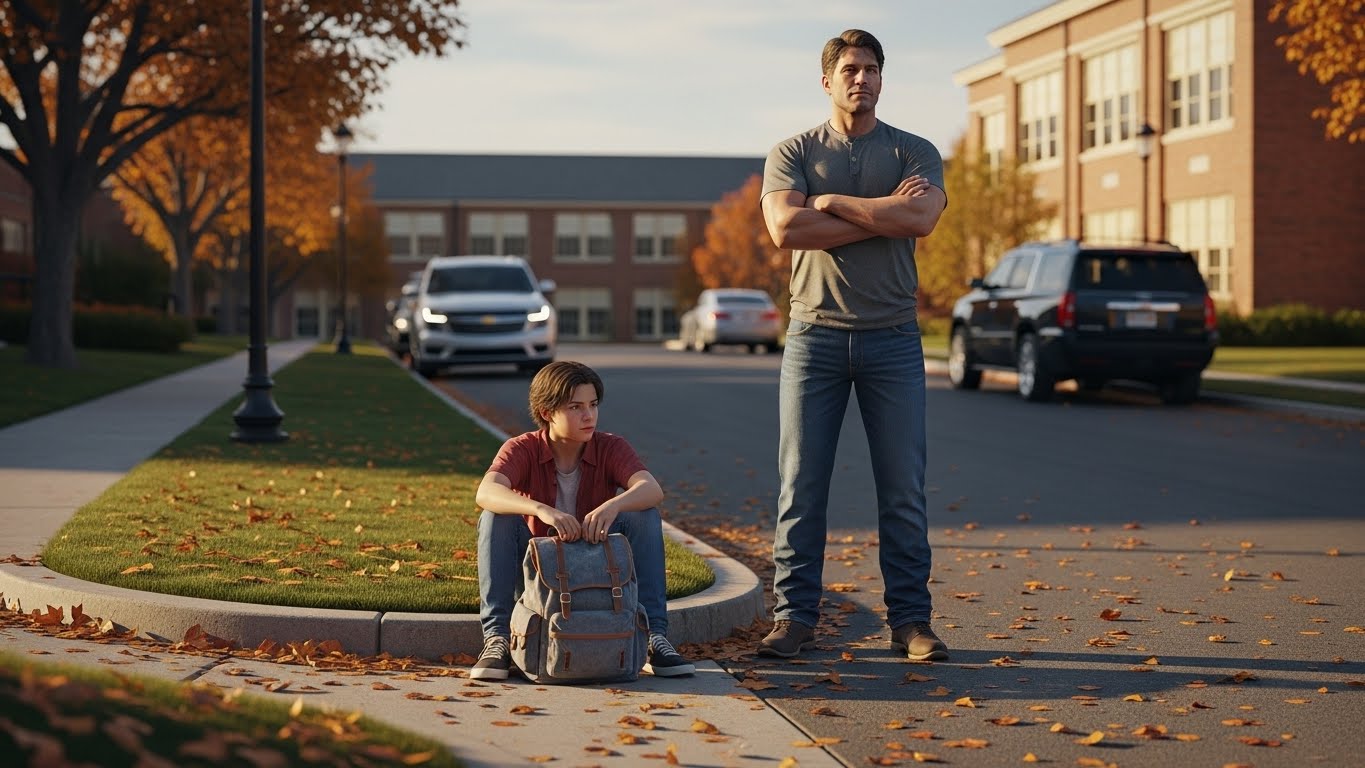
They laughed as my face hit the concrete, kicking my thrift-store backpack while the teachers looked away. I thought I was alone until a scarred man in a faded army jacket knelt beside me, wiped the blood from my cheek, and whispered a secret that would shatter the entire town’s silence. I never knew that the moment I hit rock bottom was the exact moment the hunt for the truth began.
PART 1
CHAPTER 1: The Taste of Asphalt
The dismissal bell at St. Jude’s Preparatory Academy didn’t sound like freedom to me. It sounded like a dinner bell for wolves.
I packed my things slowly, trying to run out the clock. If I timed it right, the “Varsity Elite”—the group of five seniors who essentially ran the school—would be busy admiring their lifted trucks in the student lot, and I could slip out the side gate toward the bus stop.
My name is Leo. I’m seventeen, and I am the statistical anomaly of St. Jude’s. I am the “charity case.” The scholarship kid. The boy whose tuition is paid for by the “benevolent fund” just so the board of directors can pat themselves on the back for diversity.
I swung my backpack over my shoulder. It was heavy, not just with textbooks, but with history. It was an olive drab military rucksack, canvas thick and rough, with a leather bottom that was wearing thin. It had been my dad’s. Before he disappeared three years ago, leaving my mom and me with a mountain of debt and a house that grew quieter every day, he used to take this bag on his “camping trips.” He never told us where he went. He just said he was scouting.
When he vanished, the police called it “abandonment.” They said the debts got too high, the pressure too much, and he split. They found his truck at the state line. No note. No body. Just gone.
I never believed it. Not for a second. The man who taught me how to tie a clinch knot and look a man in the eye when shaking hands didn’t just run. But at St. Jude’s, having a runaway dad was just another reason I didn’t belong.
I pushed open the heavy oak doors of the side exit. The cool autumn air hit my face, crisp and smelling of dry leaves. I kept my head down, hoodie up, eyes on the pavement.
Almost there.
“Hey! Discount aisle!”
My stomach dropped. I knew that voice. Trent Miller. His father owned half the real estate in town and, coincidentally, was the head of the PTA.
I didn’t stop. I walked faster, my grip tightening on the shoulder strap of my dad’s bag.
“Don’t ignore me, Leo,” Trent said, his voice closer now. I could hear the heavy thud of boots behind me.
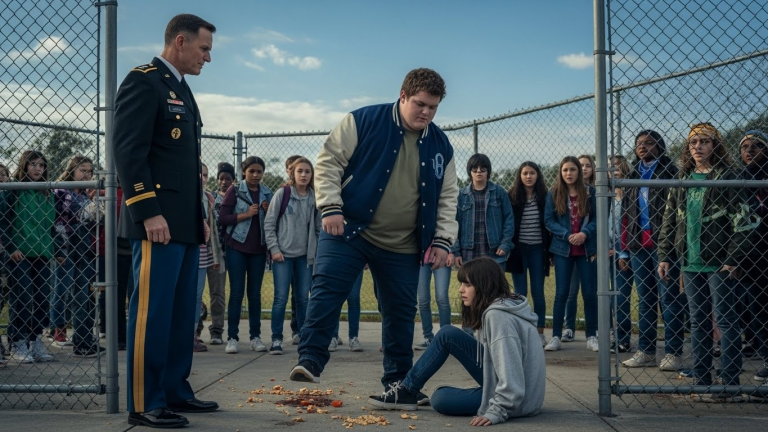
I turned the corner toward the gate, and my heart sank. They weren’t behind me anymore; they were surrounding me. Three of them. Trent, leaning against the brick pillar of the gate, and his two shadows, massive linemen who looked like they’d been fed nothing but steak and steroids since birth.
“What do you want, Trent?” I asked, my voice steady, though my hands were shaking in my pockets.
“We’re taking up a collection,” Trent smirked, stepping off the wall. He was wearing a varsity jacket that cost more than my mom’s car. “For a new backpack. Seriously, man, that thing is an eyesore. It smells like mildew and poverty.”
“Leave it alone,” I said, stepping to the side.
One of the linemen, a guy named Brock, stuck his foot out. It was lazy, predictable, and effective.
I tripped. My sneakers caught on the uneven concrete, and gravity took over. I slammed into the ground hard, my palms scraping against the asphalt. The breath left my lungs in a sharp whoosh.
Laughter erupted above me. It wasn’t just them. A few other students walking by giggled, phones already out, recording the show.
“Look at him,” Trent sneered. “Face down in the dirt. Right where you belong.”
I scrambled to my knees, reaching for my bag. It had slid a few feet away.
Trent got there first. He placed a designer boot right in the center of the bag.
“Give it back,” I warned, adrenaline starting to burn through the shame.
“Or what?” Trent laughed. He ground his heel into the fabric. “What are you gonna do? Call your daddy?”
The mention of him snapped something inside me. I lunged. It was a mistake.
Brock caught me by the back of my hoodie and yanked me back, throwing me onto the ground like a ragdoll. My head bounced off the pavement. Stars exploded in my vision.
“Stay down, trash,” Brock grunted.
Trent kicked the bag. I heard the sound of old, dry canvas tearing. A rip. My books spilled out, sliding across the dirty ground.
“Oops,” Trent said, mocking innocence. “Guess it was cheaper than I thought.”
I lay there, cheek pressed against the cold grit. The humiliation was a physical weight, heavier than Brock’s shove. I wanted to disappear. I wanted the ground to open up and swallow me whole. I closed my eyes, waiting for the final insult, the spit, or the last kick.
CHAPTER 2: The Ghost from the Past
The kick didn’t come.
The laughter, which had been a cacophony of cruelty just seconds ago, was suddenly sliced off. Silence rushed in to fill the void, sudden and absolute.
I heard the engine first. It wasn’t the smooth purr of a BMW or the roar of a Mustang. It was a rhythmic, chugging rattle. A diesel engine that sounded like it was coughing up a lung.
I opened my eyes.
An old, rusted-out pickup truck had pulled up onto the curb, blocking the exit. The engine died with a violent shudder. The door creaked open, metal grinding on metal.
Boots hit the pavement. Heavy, steel-toed work boots, caked in dried mud.
“You boys having fun?”
The voice was low, vibrating through the air like a cello string played with a hacksaw. It wasn’t loud, but it carried a weight that made the hair on the back of my neck stand up.
I pushed myself up on my elbows.
The man walking toward us looked like a walking natural disaster. He was tall, broad-shouldered, wearing a pair of grease-stained Carhartt jeans and an army jacket that was faded to a pale grey-green. He had a beard that was more salt than pepper, unkempt and wild. But it was the scar that held your attention. A thick, jagged line of raised flesh ran from his left ear, down his jaw, and disappeared into the collar of his shirt.
Trent, usually the master of the universe, looked confused. “Who the hell are you?”
The man didn’t answer. He walked right past me, stepping over my spilled textbooks as if they were leaves. He stopped two feet from Trent.
The size difference was comical. Trent was a big kid, an athlete. This man was a predator.
“I asked you a question,” the man said. His eyes were hidden behind dark aviator sunglasses, but I could feel the intensity of his stare boring into Trent.
“We… we’re just messing around,” Trent stammered, his confidence evaporating. “It’s school property. You can’t be here.”
The man reached up and slowly took off his sunglasses. His eyes were pale blue, almost white, surrounded by a web of wrinkles from squinting into the sun. They were eyes that had seen things Trent couldn’t even imagine in his worst nightmares.
“Pick it up,” the man said.
“What?” Trent blinked.
“The bag,” the stranger pointed a calloused finger at my torn backpack. “You kicked it. You broke it. Pick. It. Up.”
Trent looked at his friends for backup, but Brock and the others were studying their shoes, terrified to make eye contact.
“I’m not picking up his trash,” Trent tried to muster some bravado. “Do you know who my father is? He’s the Mayor of this town. One phone call and you’re in a cell.”
The stranger smiled. It was a terrifying expression. It didn’t reach his eyes.
“The Mayor,” the man repeated, tasting the word. “Miller, right? Big house on the hill? Tell you what, kid. You call your daddy. Tell him Silas is back. Tell him Silas saw you kicking a boy while he was down. Ask him if that’s the kind of attention he wants right now.”
The name Silas seemed to suck the oxygen out of the air. I didn’t know it, but Trent’s reaction told me everything. His face went from pale to chalk-white. His mouth opened, but no sound came out.
“I… I…” Trent stuttered.
“Pick. It. Up.” Silas’s voice dropped an octave. It wasn’t a request anymore. It was a command.
With trembling hands, Trent Miller—the untouchable king of St. Jude’s—bent his knees. He reached down, gathered my books, shoved them back into the torn bag, and set it upright on the concrete.
“Now walk away,” Silas said softly. “Before I lose my temper.”
Trent didn’t need to be told twice. He scrambled backward, nearly tripping over his own feet, and signaled his friends. They practically ran to their cars, tires screeching as they peeled out of the lot.
I was left alone with him.
I sat up, wiping the grit from my palms. My heart was hammering against my ribs like a trapped bird.
The man named Silas turned to me. He looked scary. Dangerous. The kind of guy my mom told me to cross the street to avoid.
He knelt down on one knee. His knees popped loudly. up close, he smelled of diesel fuel, peppermint, and old tobacco.
“You okay, kid?”
I nodded, unable to find my voice.
He reached out. I flinched, pulling back.
He paused, his hand hovering in the air. “I’m not gonna hit you.”
He reached into his pocket and pulled out a clean, albeit wrinkled, handkerchief. He reached out and gently dabbed my cheek. I winced. The cloth came away red.
“You got a cut,” he muttered. He looked at me, really looked at me. His gaze shifted from my eyes to my nose, then to the backpack beside me.
He reached for the bag. I grabbed the strap instinctively. “It’s mine.”
“I know,” Silas said. He ran a thumb over the peeling patch on the front. It was a unit patch. The 101st Airborne. “I haven’t seen this bag in three years.”
My breath hitched. “You… you knew my dad?”
Silas stood up, his joints groaning again. He put his sunglasses back on, masking those intense eyes. He looked toward the horizon, where the sun was beginning to dip, casting long shadows across the empty schoolyard.
“Knew him?” Silas let out a short, dry chuckle. “Kid, I was the one sitting next to him in the Humvee when he bought this bag.”
He looked back down at me, his expression hardening.
“Go home, Leo. Lock your doors. Tell your mom that the package arrived.”
“What?” I scrambled to my feet, clutching the torn bag. “Wait! Everyone says he ran away. They say he stole money and ran.”
Silas opened the door to his rusted truck. He paused with one foot on the running board. He looked back at me, and for a second, I saw something like sadness in his face.
“Your father was the bravest man I ever knew,” Silas whispered, his voice carried away by the wind. “He didn’t run, Leo. He was taken. And the people who took him? You just met their children.”
He slammed the door, the truck roared to life, and he drove off, leaving me standing alone in the cloud of black exhaust, my world tilting on its axis.
PART 2
CHAPTER 3: The Code Word
The run home was a blur. My lungs burned, not just from the exertion, but from the cold air I was sucking in. Every car that passed me made me jump, expecting Trent’s SUV or that rusted truck to reappear.
We lived in the “The Hollows,” the part of town the real estate brochures conveniently forgot to mention. It was a grid of small, siding-clad houses that had seen better decades. Our porch light was already flickering, a bulb I’d been meaning to change for weeks.
I burst through the front door, slamming it behind me and throwing the deadbolt.
“Leo?”
My mom, Sarah, was in the kitchen. She looked exhausted. She was wearing her nurse’s scrubs, her hair pulled back in a messy bun. There were dark circles under her eyes that never seemed to fade. She was stirring a pot of mac and cheese, the universal dinner of the overworked single parent.
She turned, a smile forming, but it died the second she saw my face.
“Oh my god,” she dropped the wooden spoon. “Leo, your cheek. What happened? Was it that Miller boy again?”
She rushed over, her hands smelling of antiseptic and cheese powder, tilting my face to the light. “I’m calling the school. I don’t care if his father is the Pope, I’m calling—”
“Mom, stop,” I said, pulling away gently. My heart was still racing. “It doesn’t matter. Someone stopped them.”
“Who? A teacher?”
“No,” I said, watching her eyes closely. “A man. He was… scary. Big guy. Old army jacket. A scar running down his neck.”
My mom went still. Her hands froze in the air. The color drained from her face faster than it had from Trent’s.
“What did you say?” she whispered.
“He had a scar,” I repeated, my voice trembling. “He knew Dad. He knew about the bag. He said he was with Dad when he bought it.”
Mom stumbled back, gripping the edge of the laminate counter for support. She looked like she’d seen a ghost.
“Did he…” she swallowed hard. “Did he say his name?”
“Silas,” I said.
The reaction was immediate. My mom let out a small, strangled sob and covered her mouth. Tears welled up in her eyes instantly. It wasn’t confusion; it was terrifying recognition.
“He told me to tell you something,” I pressed, sensing that the wall of secrets she’d built for three years was finally cracking. “He said, ‘Tell your mom the package has arrived.'”
Crash.
My mom’s elbow knocked a glass of water off the counter. It shattered on the linoleum, shards scattering everywhere. She didn’t even look at it.
“Lock the back door,” she commanded. Her voice had changed. The exhaustion was gone, replaced by a sharp, military-grade panic.
“Mom, what’s going on?”
“Leo, lock the door! Now!” she screamed.
I scrambled to the back door, engaging the lock. When I came back, she was already in the living room, tearing the cushions off the sofa.
“Mom!” I grabbed her shoulders. “You’re scaring me! Who is Silas? Is Dad really… did he really run away?”
She stopped, looking at me with wild eyes. She reached out and cupped my face.
“Your father didn’t run, Leo. He was a patriot. He stumbled onto something he wasn’t supposed to see. Something happening right here in this town.”
She moved to the bookshelf, pulling out a heavy encyclopedia volume. It was hollowed out. Inside was a stack of cash and a burner phone.
“Silas was your father’s commanding officer in the Rangers,” she said, her hands shaking as she shoved the cash into her purse. “They promised me… they promised that if Silas ever showed up, it meant the cover was blown. It meant they were coming for us.”
“Who is coming?”
“The people who run this town,” she hissed. “The Mayor. The Sheriff. The people who made your father disappear.”
She grabbed my arm, her grip bruising. “Go upstairs. Pack a bag. Only essentials. We have five minutes before this house becomes a kill zone.”
CHAPTER 4: The Secret in the Lining
I ran up the stairs, my mind reeling. My entire life—the poverty, the shame of being the “abandoned” kid—was a lie. My dad wasn’t a coward. He was a target.
I burst into my room and grabbed the olive green backpack. It was still on the floor where I’d dropped it, the tear from Trent’s boot gaping open like a wound.
I started shoving clothes into it—jeans, t-shirts, a flashlight. But as I stuffed a hoodie in, my fingers grazed the tear in the canvas.
The rip had gone deep, cutting through the outer fabric and exposing the foam padding that protected the back.
But there was something else in there.
I felt something hard. Cold. Flat.
I stopped packing. With trembling fingers, I dug into the foam, widening the hole Trent had made.
“Leo! Let’s go!” Mom screamed from downstairs.
“One second!” I yelled back.
I pulled it out.
It wasn’t a drive. It wasn’t money. It was a key.
It was black, heavy, and old-fashioned. An iron skeleton key, but with modern grooves cut into the shaft. Wrapped around the head of the key was a piece of masking tape. On it, in my father’s distinct, blocky handwriting, was a series of numbers: 42-19-8.
My breath hitched. I remembered this handwriting. I remembered him sitting at the kitchen table, teaching me math with that same penmanship.
He had hidden this here. All this time, for three years, I had been carrying the answer on my back. I had been walking through the halls of St. Jude’s, getting shoved and mocked by the sons of the men who killed him, carrying the very thing that could destroy them.
I shoved the key into my pocket, deep down, terrified I’d lose it.
Suddenly, the house went dark.
The power didn’t just flicker; it cut. The hum of the refrigerator died. The streetlights outside were the only illumination, casting long, skeletal shadows through my window.
Then, I saw the lights.
Blue and red. Flashing silently.
They hadn’t used a siren. They had just rolled up.
I crawled to the window and peeked through the blinds. Two Sheriff’s cruisers were parked on the lawn—not the driveway, the lawn. Four deputies were stepping out. They weren’t holding ticket books. They were holding shotguns.
“Mom!” I whispered-screamed, rushing to the landing.
She was at the bottom of the stairs, the burner phone in her hand glowing in the darkness. She looked up at me, terror etched into her features.
“They’re here,” she whispered.
Bam. Bam. Bam.
A fist pounded on the front door. It shook the entire frame.
“Sarah! Open up! We know he’s in there!”
It was Sheriff Miller. Trent’s uncle.
“Leo, go to the attic,” Mom hissed, pointing up. “Do not come down. No matter what you hear.”
“I’m not leaving you!”
“Go!” she pushed me toward the pull-down cord of the attic hatch.
“Police! Open the door or we kick it in!”
I heard the wood splinter. They weren’t waiting.
I scrambled up the attic ladder, pulling it up behind me just as the front door exploded inward with a deafening crash.
I lay on the dusty insulation, pressing my eye to a crack in the floorboards. Below, flashlights swept through our living room. Heavy boots stomped on the floor—the same sound I heard at school, but multiplied.
“Clear the rooms!” a voice barked.
“Where is it, Sarah?” Sheriff Miller’s voice was smooth, mocking. “Where did your husband hide the ledger?”
“I don’t know what you’re talking about,” my mom said. Her voice was strong, defiant.
“Don’t play games. Silas is back. We know he made contact. Tell us where the boy is.”
“He’s not here,” she lied. “He’s at a friend’s.”
“We’ll see about that.”
I heard footsteps coming up the stairs. Slow. Deliberate. They were coming for me. I gripped the key in my pocket so hard the metal bit into my skin. I was trapped.
Then, from outside, a new sound cut through the tension.
Cr-crack.
Glass shattering.
“Deputy down!” someone screamed from the front lawn.
“What the hell?” Miller yelled from the living room.
Outside, the darkness erupted into chaos. I heard the distinct, rhythmic chugging of a diesel engine roaring to life, followed by the screech of tires.
A voice, amplified by a megaphone, boomed through the thin walls of the house. It wasn’t the police.
“Miller! You have ten seconds to walk out, or I level this house with you inside!”
It was Silas.
PART 3
CHAPTER 5: Smoke and Mirrors
The silence that followed Silas’s threat was heavier than the lead in the deputies’ shotguns. For a heartbeat, the only sound was the wind whistling through the shattered front door and the jagged breathing of Sheriff Miller downstairs.
“He’s bluffing,” Miller snarled, though his voice cracked just enough to betray him. He grabbed my mother’s arm, hauling her up from the floor. “Get to the window. If he fires, he hits her first.”
“Don’t you dare!” Mom screamed, thrashing against his grip.
I watched through the crack in the floorboards, paralyzed. My mother was being used as a human shield by the man who was supposed to protect our town. The rage that had started in the schoolyard flared white-hot, burning away the fear.
“Last warning, Miller!” Silas’s voice boomed again, distorted by the megaphone but unmistakable.
“Come and get me, you washed-up grunt!” Miller yelled back, pressing the barrel of his sidearm against my mother’s temple.
The response was immediate. It wasn’t a bullet. It was a sound like a compressed air canister popping, followed by the shattering of the living room window.
Two metal canisters clattered onto the hardwood floor, spinning and hissing.
“Gas!” one of the deputies shouted, scrambling backward.
Thick, white smoke exploded from the canisters, filling the room instantly. It wasn’t lethal, but it was aggressive. The deputies started coughing violently, their flashlight beams cutting erratically through the expanding cloud.
“Hold her! Don’t let her go!” Miller choked out, but the chaos was total.
This was my chance.
I didn’t think. I didn’t calculate. I yanked the attic cord, and the ladder slid down with a screech of rusty springs. I didn’t bother climbing; I jumped.
I landed in the upstairs hallway, the shock jarring my ankles. The smoke was already drifting up the stairs, stinging my eyes and tasting like burnt pepper.
“Leo! Run!” Mom’s voice came from the swirling gray fog below.
I didn’t run away. I ran down.
I took the stairs two at a time, plunging into the smoke. I couldn’t see anything, but I knew the layout of my own house. I knew exactly where the banister ended.
I collided with a body. Hard armor. A deputy.
“What the—” he grunted.
I remembered what my dad taught me about center of gravity. I lowered my shoulder and drove into him. He was off-balance, coughing, and he went down with a heavy thud, his shotgun clattering away.
“Mom!” I screamed.
“Here!”
A shadow loomed in the smoke near the door. It wasn’t Mom. It was Miller. He was rubbing his eyes with one hand, his gun waving blindly in the other.
Suddenly, the front door frame disintegrated.
Silas didn’t walk in; he charged. He was a blur of violence in the smoke. He slammed into Miller like a freight train. The Sheriff went flying, crashing into the bookshelf where Dad used to keep his encyclopedias.
Silas didn’t stop to check on him. He grabbed my mom with one hand and reached out into the fog with the other.
“Kid! On me!”
I lunged toward his voice. His hand, rough as sandpaper, clamped onto my shoulder.
“Move! breathe through your nose!”
We stumbled out onto the porch. The fresh night air hit us like a physical blow. My eyes were streaming tears, my throat burning.
The front lawn was a war zone. The Sheriff’s cruisers were blocking the driveway, but Silas’s truck—a monstrous, lifted beast of rusted iron—was idling on the lawn, its headlights cutting through the darkness.
“Get in the truck!” Silas roared, shoving us toward the passenger side.
“Stop them!” Miller screamed from the doorway, stumbling out, gun raised.
Pow.
A bullet whizzed past my ear and shattered the side mirror of the truck.
“Get down!” Silas yelled. He didn’t return fire. He vaulted over the hood of the truck, sliding across the metal, and ripped the driver’s side door open.
I shoved Mom into the middle seat and scrambled in after her, slamming the heavy door just as another shot pinged off the frame.
Silas threw the truck into gear. He didn’t reverse. He floored it.
The massive tires tore up the grass, throwing clumps of dirt into the air. We surged forward, aiming straight for the gap between the two police cruisers.
“Hold on!” Silas gritted out.
Metal screamed against metal. The truck, built like a tank, clipped the back of one cruiser, spinning it around like a toy car. We fishtailed onto the asphalt, the engine roaring like a dragon.
As we sped away, leaving the chaos of my childhood home behind, I looked back. Sheriff Miller was standing in the middle of the street, illuminated by the flashing red and blue lights, watching us go.
He wasn’t chasing us. Not yet.
“Why aren’t they following?” I asked, my voice trembling.
Silas glanced at the rearview mirror, his face grim.
“Because they know where we have to go,” he said darkly. “And they’re going to be waiting.”
CHAPTER 6: The Dead Man’s Map
The adrenaline began to fade, replaced by a cold, shivering shock. The truck rattled and groaned as we sped down the dark backroads, heading away from town and toward the dense pine forests that bordered the state line.
Inside the cab, the smell of old tobacco and gun oil was overwhelming. The dash was illuminated by a single, flickering green light.
“Are you hurt?” Silas asked, his voice low, lacking the aggression from earlier.
“No,” Mom whispered. She was trembling, her hands clasped tightly in her lap. “Silas… I thought you were dead. We heard… the unit said…”
“They said a lot of things, Sarah,” Silas cut her off gently. “Most of it was a lie to keep you safe. If they thought I was alive, they would have watched you even closer.”
He shifted gears, the truck lurching as we turned onto a gravel logging road. The trees closed in around us, blocking out the moonlight.
“Why now?” I asked. “Why come back today?”
Silas looked at me. In the dim light of the dashboard, the scar on his neck looked like a canyon.
“Because the timeline ran out,” he said. “Your father set a failsafe. Three years. If he didn’t clear his name by then, certain… information… was set to be deleted. Or released. Depending on who got to it first.”
He tapped the steering wheel. “The Sheriff knows that. Miller isn’t just a corrupt cop, Leo. He’s the cleanup crew. He works for the people who really run this county. The Syndicate.”
“The Syndicate?” I asked. “It sounds like a bad movie.”
“It’s real enough to kill a man,” Silas said grimly. “They use the town as a hub. drugs, trafficking, money laundering. St. Jude’s isn’t just a school; it’s where they groom the next generation of managers. Your dad found out. He tried to build a case.”
“And they killed him for it,” I said, the bitterness rising in my throat.
Silas slammed on the brakes. The truck skidded to a halt in the middle of the dark forest road. The silence of the woods rushed back in.
He turned in his seat to face me fully.
“Listen to me, Leo. Listen close. They didn’t kill him. Not then.”
My heart stopped. “What?”
“They took him,” Silas said. “They needed the encryption key. Your dad was an intelligence officer. He locked the evidence away in a digital vault that only he could open. Or…”
He looked at my backpack, which was squeezed between my knees.
“Or someone with the physical override.”
My hand went to my pocket. The cold iron of the key burned against my leg.
“The bag,” Silas said. “He told me, ‘If I go dark, the boy gets the bag.’ I thought he just meant sentimental value. But when I saw you today… when I saw Miller’s kid trying to destroy it… I knew.”
I slowly pulled the key out of my pocket. The masking tape was yellowed with age. 42-19-8.
Silas’s eyes widened. He let out a long, shaky breath.
“I’ll be damned,” he whispered. “He actually did it.”
“What is it?” Mom asked, leaning in.
“It’s a coordinates key,” Silas said, taking it from me gently. He held it up to the dashboard light. “But not for a map. For a location inside the bank.”
“The First National?” Mom asked. “Silas, that place is a fortress. It’s owned by the Mayor’s family.”
“Exactly,” Silas said, a dangerous grin spreading across his face. “The safest place to hide evidence against the devil is in the devil’s own pocket.”
He handed the key back to me.
“That key opens a safe deposit box. Box 42. Row 19. Vault 8. Inside is the evidence your father gathered. The names, the dates, the bank transfers. Everything needed to send the Mayor, the Sheriff, and half the school board to federal prison for life.”
“And bring Dad home?” I asked, my voice barely a whisper.
Silas’s expression softened. “If he’s still alive… this is the only leverage we have to trade for him.”
He put the truck back in gear.
“But there’s a problem,” he said, turning the headlights off and driving by the light of the moon.
“What problem?”
“We’re not the only ones who know the timeline is up. Miller knows. The Mayor knows. By sunrise, that bank is going to be surrounded by every dirty cop and hired gun in the state. They won’t let us near that vault.”
“So what do we do?” I asked. I felt a strange calm settling over me. The fear was gone. I had a mission now. I had the key to saving my father.
Silas looked at me in the rearview mirror. “We don’t go to the bank when it opens, Leo. We go now.”
“Now?” Mom asked. “It’s midnight. The bank is locked. It has alarms. Guards.”
Silas reached under his seat and pulled out a heavy canvas roll. He unrolled it on the dashboard. Inside were lock picks, wire cutters, and a schematic map of a building.
“Good thing I didn’t spend the last three years just fishing,” Silas said. “We’re not going to make a withdrawal, Sarah. We’re going to rob the bank.”
He looked at me.
“You ready to be a felon, kid?”
I gripped the key tight. I thought of Trent Miller laughing as he kicked my ribs. I thought of my dad, somewhere in the dark, waiting for me.
“Let’s do it,” I said.
PART 4
CHAPTER 7: The Devil’s Vault
The First National Bank of St. Jude stood like a tombstone in the center of town. It was a massive slab of marble and granite, illuminated by floodlights that cut through the foggy night.
We weren’t going through the front door.
Silas parked the truck three blocks away in an alley behind a diner. We moved on foot, sticking to the shadows. Silas moved with a silence that shouldn’t have been possible for a man of his size. Mom and I followed, trying to mimic his steps.
“Roof access,” Silas whispered, pointing to a fire escape on the building adjacent to the bank. “We jump the gap.”
My stomach turned. “Jump?”
“Trust me.”
Ten minutes later, we were on the roof of the bank. My legs were shaking, not from the cold, but from the terrifying leap we had just made. Silas knelt by a large ventilation unit. He pulled a specialized screwdriver from his tool roll and went to work on the grate.
“The alarm sensors are on the doors and windows,” he explained quietly, his hands moving in a blur. “The roof vents are older. They rely on motion detectors in the ducts. But if your dad was right, he looped the security feed on the HVAC system three years ago.”
He pulled the grate free. A dark, gaping hole stared back at us.
“Ladies first,” Silas said, winking at me. “Just kidding. I go first. Leo, you’re next. Sarah, you bring up the rear.”
We lowered ourselves into the belly of the beast. It was tight, smelling of dust and recycled air. We crawled for what felt like miles until Silas stopped over a grate looking down into a hallway.
“Executive floor,” he whispered. “The private elevator to the vault is twenty feet that way.”
We dropped down. The hallway was silent. The carpet was plush, muffling our footsteps. We reached the elevator. It required a key card.
Silas didn’t have a card. He had a small electronic device with wires sticking out. He jammed the wires into the card reader’s casing. The device flashed red, then green. The doors chimed softly and slid open.
“We have five minutes before the system resets and realizes it’s been hacked,” Silas said, checking his watch. “Move.”
The ride down was agonizingly slow. When the doors opened, we were facing a massive circular steel door. The main vault.
“This is it,” I whispered.
Silas walked up to the keypad. He didn’t use a tool this time. He looked at me.
“The numbers on the key,” he said. “42-19-8. That’s not just the box number. It’s the override code.”
I felt a chill. My dad had planned this down to the second.
Silas punched in the code: 4-2-1-9-0-8.
The massive wheel on the door spun with a heavy, mechanical thunk. The hiss of pneumatic seals releasing filled the air. Silas pulled the heavy door open.
Inside, walls of safety deposit boxes lined the room from floor to ceiling. It was a library of secrets.
“Row 19,” Mom said, her voice trembling. She pointed to the section on the left.
I ran my fingers along the cold metal boxes. 15… 16… 17… 18…
Box 19.
I pulled the iron skeleton key from my pocket. My hand was shaking so badly I could barely aim for the lock.
“Breathe, Leo,” Silas murmured, standing guard at the vault door, his eyes scanning the hallway.
I took a deep breath, steadied my hand, and slid the key in. It fit perfectly. I turned it. Click.
I pulled the long metal box out.
“Open it,” Mom whispered.
I flipped the lid.
Inside wasn’t stacks of cash. It wasn’t gold.
It was a single, black hard drive and a folded piece of paper.
I unfolded the paper. It was a map. A map of the county, with a specific location circled in red ink: The Old Sawmill.
And below the map, a single sentence in my dad’s handwriting:
“If you are reading this, I am alive. Bring the drive to the FBI Field Office in Chicago. Do not trust the locals.”
“He’s alive,” Mom sobbed, covering her mouth. “Leo, he’s alive!”
“We have to go,” Silas said urgently. “Grab the drive.”
I reached for the black box.
Suddenly, the lights in the vault room blazed to 100% brightness, blinding us. The elevator doors dinged.
“Well, well,” a voice echoed off the steel walls. “I knew the rat left cheese behind.”
Sheriff Miller stood in the elevator doorway. He wasn’t alone. Six deputies, weapons drawn, fanned out into the room.
“Put the box down, Leo,” Miller smiled, cocking his pistol. “Or Silas dies first.”
CHAPTER 8: The Truth Goes Viral
We were trapped. A wall of steel behind us, a wall of guns in front of us.
Silas stepped in front of me and Mom, his hands held out to the sides, empty.
“You really want to do this here, Miller?” Silas growled. “In the bank? On camera?”
Miller laughed. “The cameras are off, Silas. We own the feed. Nobody sees what happens down here. We’ll say you broke in, triggered the silent alarm, and my brave deputies had to put down an armed robbery suspect. Collateral damage included.”
He aimed the gun at my chest.
“Give me the drive, Leo.”
I clutched the hard drive. If I gave it to him, my dad was dead. If I didn’t, we were dead.
My thumb brushed against the screen of my phone in my other pocket.
Nobody sees what happens down here.
That was his mistake.
“Silas,” I whispered, barely moving my lips. “Stall him.”
Silas didn’t nod, but I saw his back muscles tense.
“You really think you can kill a Ranger and walk away?” Silas stepped forward. “You’re a fat, corrupt politician with a badge, Miller. You’re not a killer.”
“Try me,” Miller snarled, his eyes narrowing.
While they focused on the hulking threat of Silas, I slowly pulled my phone out, keeping it behind my leg. I opened my social media app. I didn’t have many followers—mostly kids from school.
But I hit “GO LIVE.”
Then, I did something Trent Miller had taught me. I tagged the school page. I tagged the local news page. I tagged everyone.
“Hey!” Miller shouted, noticing the movement. “Drop the phone!”
I held it up, chest high, turning the screen so he could see himself.
“It’s too late!” I yelled, my voice cracking but loud. “We’re live! Facebook, Instagram, everything! There are three hundred people watching right now!”
Miller froze. The deputies glanced at each other, their guns wavering.
“He’s lying,” Miller shouted.
“Look at the screen!” I screamed. “Say hello to the internet, Sheriff! Tell them why you’re pointing a gun at a kid in a bank vault!”
On the screen, the comments were flooding in. WTF is that the Sheriff? Is that a gun? Omg is that Leo? Someone call the state police!
“Put it down!” Miller roared, lunging forward.
Silas moved.
He didn’t use a weapon. He used pure kinetic energy. He slammed into Miller, tackling him to the ground. The gun skittered across the floor.
“Don’t shoot!” one of the deputies yelled. “We’re on camera!”
The deputies were paralyzed. They knew that if they fired a shot while thousands of people were watching a livestream, their lives were over. The digital witness was more powerful than any badge.
Silas had Miller in a chokehold. “Tell them to back off!” Silas roared at the camera, his face pressed against the struggling Sheriff’s ear.
“Back off!” Miller wheezed. “Stand down!”
“Leo, the drive!” Silas shouted. “Upload it!”
I ran to the bank’s terminal on the desk in the corner. I jammed the USB drive in. My dad’s encryption key program popped up. I typed in 42-19-8.
A progress bar appeared. UPLOADING TO DOJ SERVER.
“Stop him!” Miller screamed, thrashing under Silas.
But nobody moved. The deputies looked at the phone in my hand, still broadcasting, still recording every second of their corruption.
Ding.
UPLOAD COMPLETE.
“It’s done!” I yelled. “The FBI has it! It’s over!”
Just then, sirens wailed. Not the local Sheriff sirens. These were different. Deeper.
Heavy boots pounded down the stairs—they hadn’t waited for the elevator.
“FBI! DROP YOUR WEAPONS!”
Men in windbreakers with “FBI” in bold yellow letters swarmed the room. They weren’t Miller’s men. They were the cavalry.
One of the agents walked up to me. He looked at the phone, then at the hard drive.
“Leo?” he asked.
I nodded, my knees finally giving out. “My dad… he’s at the sawmill.”
Two Days Later
The news vans were still parked outside our house, but for the first time in years, I didn’t care.
The front door opened. Silas stood there, leaning against the frame, smiling. He looked cleaner, though he still wore that old army jacket.
“Ready, kid?”
I grabbed my backpack—the new one Silas had bought me to replace the one Trent destroyed. But inside, I kept the old 101st Airborne patch.
We drove to the edge of town, to the airfield.
A small private plane had just landed.
I stood on the tarmac, my mom gripping my hand so tight her knuckles were white.
The door of the plane opened.
A man stepped out. He was thinner than I remembered. His hair was gray now, and he walked with a limp. But when he looked up and saw us, his eyes—the same eyes Silas had recognized in me—lit up with a light that outshined the sun.
He didn’t run; he couldn’t. But he opened his arms.
I didn’t care about being cool. I didn’t care about being tough. I dropped my bag and ran. I hit him hard, wrapping my arms around him, burying my face in his chest.
“I knew you’d figure it out,” Dad whispered into my hair, tears choking his voice. “I knew you were strong enough to carry the weight.”
I looked back at Silas. He was leaning against his truck, watching us. He gave me a slow, two-finger salute, then tipped his head toward the horizon.
I looked at my dad, then at the scar-faced angel who had saved my life.
I realized then that the backpack wasn’t just old canvas. It was armor. And I had finally earned the right to wear it.