I Was Burying My Wife When a Child Appeared in the Rain and Whispered: “She’s Not in That Grave, She’s Waiting for You.”
Chapter 1: The Hollow Earth
The priest’s voice was a drone, a monotonous buzz competing with the sound of the rain hitting the black umbrellas. It was a cold, typically miserable November afternoon in Washington State. The kind of day where the dampness doesn’t just sit on your skin; it works its way into your marrow and stays there.
I stood at the edge of the freshly dug hole, though there was no casket to lower into it. Just a small urn. A symbolic gesture. The authorities had never found a body, but after twelve months of searching the jagged coastline and the deep, unforgiving currents of the Puget Sound, the coroner had finally signed the paper. Death in absentia.
Elena was gone. That was the official story.
I looked at the faces around me. Elena’s mother, sobbing into a lace handkerchief that was already soaked through. My brother, Jack, checking his watch, probably worrying about beating the traffic back to Seattle. Neighbors, coworkers, people who had stopped asking “How are you?” months ago because the answer made them uncomfortable.
They were all here to close the book. To put a period at the end of the sentence.
But I felt like I was floating above them, tethered to the ground only by the weight of the grief in my chest. It felt physical, like a stone swallowed whole.
“Thomas?”
I blinked, snapping back to the gray reality. Jack was touching my elbow. The service was over. The crowd was dispersing, a sea of black coats moving toward the line of parked cars on the gravel path.
“You coming?” Jack asked gently. “Mom made a spread back at the house.”
“In a minute,” I said, my voice sounding foreign to my own ears. “I just… I need a minute.”
Jack hesitated, looking at me with that pitying expression I had grown to hate. “Don’t stay too long, Tom. You’ll catch your death out here.”
“Go,” I said.
He patted my shoulder and walked away. I listened to the car doors slamming shut. Thud. Thud. Thud. The sound of finality.
I was alone.
I turned back to the marker. Elena Vance.
I traced the letters with my eyes. I remembered the last time I saw her. She was loading the kayak onto the roof of her Subaru, laughing because I had spilled coffee on my shirt. She had kissed me—a quick, casual peck on the cheek—and said, “Don’t wait up, I might catch the sunset.”
She never came home. They found the kayak three days later, battered against the rocks at Cape Flattery. They found her life jacket a week after that.
“I’m sorry,” I whispered to the wet grass. “I’m so sorry I wasn’t there.”
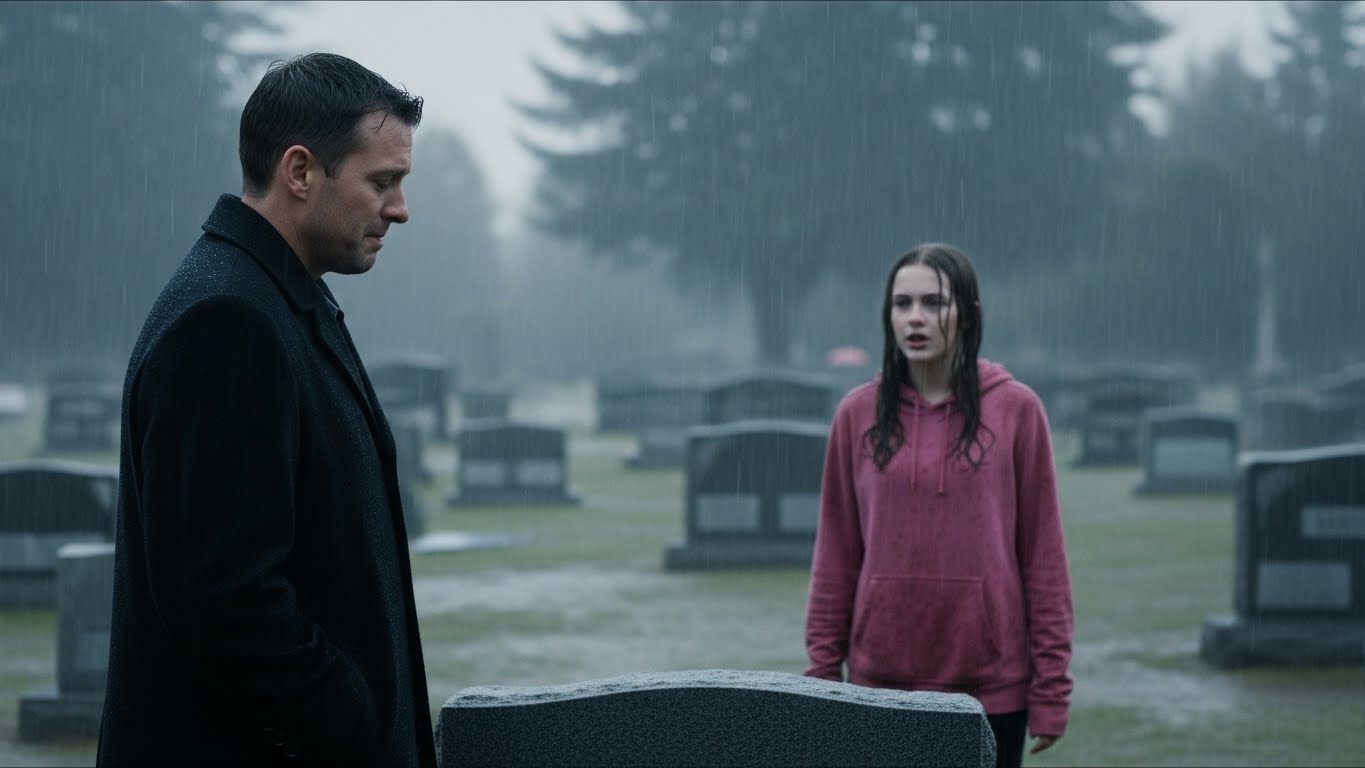
The rain intensified, drumming against the granite. It washed away the tears I didn’t realize were falling. I stood there for what felt like hours, letting the cold numb the pain. I wanted the earth to open up and swallow me, too. If she was in the dark, I wanted to be in the dark with her.
That’s when I heard it. A splash. Not a raindrop, but a footstep in a puddle.
Chapter 2: The Messenger
I stiffened. The cemetery was supposed to be empty. The caretaker had already left for the day.
I stayed still, listening. Another step. Squelch. Then the snap of a dry twig.
I turned around slowly, expecting a deer, or maybe a stray dog seeking shelter under the weeping willows.
Instead, I saw a child.
She was standing about ten yards away, framed by the dark, skeletal branches of an old oak tree. She was small, maybe ten or eleven. She wore no coat, just a thin, faded pink hoodie that was visibly heavy with water. Her jeans were torn at the knee, and her sneakers were caked in mud.
She looked like a drowned rat. But she wasn’t shivering.
She was staring right at me.
“Are you lost?” I called out. My voice cracked.
She didn’t answer. She just took a step closer. Her hair, dark and matted, hung in strings across her face. But her eyes—they were unnervingly clear. Blue, sharp, and entirely focused.
“You should go home,” I said, wiping rain from my face. “It’s not safe out here.”
“She’s not in the box,” the girl said.
Her voice was soft, but it carried through the wind effortlessly.
I froze. “What?”
The girl raised a hand and pointed a dirty finger at the urn sitting on the small pedestal by the headstone.
“The lady,” she said. “She’s not in there.”
A flash of anger sparked in my chest. This was some sick prank. Some neighborhood kid trying to spook the grieving widower.
“Go home,” I snapped, turning back to the grave. “Have some respect.”
“She has a scar,” the girl continued, her voice rising slightly. “On her right shoulder. Like a star. She told me she got it when she fell off a bike when she was seven.”
The breath left my lungs in a rush.
I spun around, slipping on the wet grass, barely catching my balance.
“What did you say?”
The girl didn’t flinch at my sudden movement.
“The star scar,” she repeated. “And she hums when she’s scared. She hums ‘You Are My Sunshine’ really quietly.”
My knees gave out. I hit the ground hard, mud soaking instantly into my suit trousers.
Nobody knew that.
The scar was faint, barely visible unless you were looking for it. And the humming… she only did that when she was having a panic attack. I was the only person who knew that. I was the only one who had held her through the night terrors.
“Who are you?” I gasped, crawling toward her. “How do you know that?”
“My name is Lily,” she said.
“Lily, how do you know about Elena?” I demanded. I reached out and grabbed her arm. She felt frail, cold as ice.
“I saw her,” Lily whispered, leaning in close, as if the tombstones were listening. “I saw her come out of the ocean.”
“That’s impossible,” I shook my head, tears mixing with the rain. “She drowned. A year ago.”
“No,” Lily shook her head vigorously. “Not a year ago. She’s been there a long time. But I saw her face. She was crying. The bad men took her.”
“What men?” My grip on her arm tightened. “Lily, you have to tell me exactly what you saw.”
“The men in the van,” she said, looking around fearfully. “The grey van with no windows. They keep her in the cottage. The one past the lighthouse. The one with the boarded-up windows.”
She paused, her lower lip trembling.
“I saw her two nights ago,” Lily said. “I snuck up to the window. She saw me. She put her hand on the glass. She mouthed a name.”
I stopped breathing. “What name?”
“Thomas,” Lily said. “She said Thomas.”
The world sharpened. The gray haze of grief vanished, replaced by a crystalline, burning focus. If this girl was telling the truth—and there was no way she could know about the scar or the humming if she wasn’t—then Elena wasn’t just alive.
She was being held captive.
I stood up, pulling Lily with me.
“Show me,” I said. “Show me where she is.”
“We have to be quiet,” Lily whispered. “The men have guns.”
“I don’t care,” I growled. I looked at the urn one last time. It meant nothing to me now. It was dust. My wife was out there, alive, scared, and waiting for me.
“Get in the truck,” I told the girl.
And just like that, the funeral was over. The hunt had begun.
Chapter 3: The Highway of Ghosts
My truck, a battered Ford F-150 that had seen better days, roared onto Highway 101. The wipers were slapping frantically against the windshield, fighting a losing battle against the deluge. I gripped the steering wheel so hard my knuckles turned white, the leather creaking under the pressure.
Beside me, in the passenger seat, Lily was shivering. I had cranked the heater up to full blast, but the cold seemed to be coming from inside her.
“There’s a blanket in the back,” I said, my eyes glued to the slick asphalt. “Grab it.”
She reached behind the seat and pulled out an old wool blanket that smelled of motor oil and wet dog. She wrapped it around herself, looking tinier than ever.
“Where are we going, exactly?” I asked. I needed specifics. The adrenaline was starting to mix with a cold, hard dread. “You said a cottage past the lighthouse. Which lighthouse, Lily? There are three in this county.”
“The old one,” she said, her voice muffled by the wool. “Cape Disappointment. The one they closed down.”
Cape Disappointment. The name felt like a cruel joke. It was about forty miles north, a desolate stretch of coastline defined by jagged cliffs and treacherous waters. It was where the locals went to drink underage or where tourists went to get lost.
“Why there?” I asked, glancing at her. “Why would they take her there?”
“It’s quiet,” Lily whispered. “Nobody goes down the service road anymore. The gate is locked, but the men… they have a key.”
“Who are these men, Lily?”
She hesitated, looking out the window at the blurring trees. “I don’t know their names. I call them the Shadows. There are three of them. One is big, bald. He has a tattoo of a snake on his neck. He’s the meanest.”
A snake tattoo.
My mind raced. I was an architect, not a detective. I designed sustainable homes; I didn’t hunt criminals. But as I pressed the accelerator, pushing the truck past eighty miles per hour, a memory flickered.
The search.
A week after Elena vanished, a man had come to the house. He claimed to be a private investigator offering help. He was big, bald. I hadn’t hired him, and the police had dismissed him as a scammer preying on grief. I hadn’t seen a tattoo, but he had worn a turtleneck.
“Did you see a van?” I asked. “A grey van?”
“Yes,” Lily nodded. “It’s always parked round the back. Under the tarp.”
“Why didn’t you tell the police, Lily?” I asked the question that had been gnawing at me. “Why did you come to me at the funeral?”
Lily turned to me, her eyes dark and serious.
“I went to the Sheriff’s station,” she said flatly. “Two days ago. After I saw her in the window.”
“And?”
“The Deputy told me to stop making up stories. He said I was a lying little brat.” She paused, picking at a loose thread on the blanket. “But then… I saw the Deputy talking to the bald man. In the parking lot. They were laughing.”
I felt a chill that had nothing to do with the rain.
Corruption. Or maybe just incompetence. Either way, I was on my own. If I called 911 now, who would show up? The very people who might be protecting the monsters holding my wife?
I reached into the center console and pulled out my phone. I hesitated, then powered it off. I couldn’t risk being tracked. Not if what Lily said was true.
“We’re almost there,” I said, more to myself than to her.
The landscape was changing. The dense fir trees were giving way to scrub brush and rocky outcrops. The smell of the ocean—salt and rotting kelp—began to seep into the cabin.
“Thomas?” Lily asked softly.
“Yeah?”
“Do you have a gun?”
The question hung in the air.
“No,” I said. “I have a tire iron and a flare gun in the emergency kit.”
“The bald man has a big gun,” she said matter-of-factly. “Like the ones in the army movies.”
“Great,” I muttered.
I pulled the truck off the main highway onto the gravel access road leading toward the Cape. The sign said NO TRESPASSING – STATE PROPERTY, but the chain across the entrance had been cut and loosely draped back over the hook.
I killed the headlights.
“We walk from here,” I said. “I’m not announcing our arrival.”
Chapter 4: The House on the Edge of the World
The rain had softened to a drizzle, but the wind was howling, whipping off the ocean and tearing through our clothes. The roar of the surf crashing against the cliffs below was deafening.
We walked in silence for twenty minutes. The path was overgrown, choked with blackberry brambles that snagged my suit pants. Lily moved like a cat, silent and sure-footed, guiding me through the gloom.
Then, the lighthouse loomed out of the fog. It was a skeletal, decaying structure, its light long extinguished.
“Down there,” Lily pointed.
Below the lighthouse, nestled in a small depression on the cliff edge, was a cottage. It looked like it was sliding into the sea. The roof was sagging, the shingles stripped by years of storms. The windows were boarded up with plywood.
Except for one.
On the second floor, a small dormer window had a sliver of light escaping from the edge of a heavy curtain.
“That’s where she is,” Lily whispered. “The attic room.”
My heart hammered against my ribs like a trapped bird. Elena was down there. My Elena.
“Stay here,” I told Lily, crouching behind a large boulder. “If I don’t come back in twenty minutes, you run. You run back to the highway and you flag down a car. You understand?”
“No,” she said stubbornly. “I’m coming. I know the way in. The basement door has a broken hinge.”
I looked at her. She was terrified, but her jaw was set. She had more guts than half the men I knew.
“Fine. But you stay behind me. Close.”
We crept down the hillside, sliding on the wet mud. The roar of the ocean covered the sound of our approach.
As we got closer, I saw the van. A grey Ford Econoline, rust eating at the wheel wells, parked under a camouflage tarp near the back of the house.
There were no lights on the ground floor.
We reached the back of the house. The smell of mildew and damp wood was overwhelming. Lily pointed to a low wooden door, half-rotted, leading into the foundation.
She was right. The top hinge was rusted through. With a gentle pull, the door creaked open enough for a child to slip through. I had to squeeze, tearing my coat, scraping my back against the rough concrete.
We were in.
The basement was pitch black. I fumbled for my phone, remembering I had turned it off, then decided against the light. I let my eyes adjust. It smelled of earth and something metallic.
“Stairs are over there,” Lily breathed.
We crept up the wooden steps. They groaned under my weight. Every sound felt like a gunshot.
We reached the door to the kitchen. I pressed my ear against it.
Silence.
I pushed the door open a crack. The kitchen was dim, lit only by the faint glow of a streetlight from way up on the main road filtering through the cracks in the boards. Dirty dishes were piled in the sink. Beer bottles cluttered the table.
Then, I heard it.
A laugh. Deep, guttural. Coming from the living room.
“…told you, she’s worth more if we wait until the insurance settles,” a voice grumbled. “The husband cashes out, then we make the call for the ransom.”
My blood froze.
They weren’t just kidnappers. They were waiting for the life insurance payout. They had been watching me. They knew I was at the funeral today. They expected me to be grieving, weak, and eventually, rich.
“She’s getting sick, though,” another voice said. Higher, scratchier. “She hasn’t eaten in three days. If she dies, we get nothing.”
“She won’t die,” the deep voice said. “She’s tough. Go check on her.”
Footsteps. Heavy boots on hardwood.
They were coming toward the stairs that led up to the second floor.
I looked at Lily. Her eyes were wide.
I scanned the kitchen. A knife block sat on the counter. I lunged for it, grabbing the largest chef’s knife. It felt foreign and heavy in my hand.
I motioned for Lily to hide under the table.
The footsteps passed the kitchen door and started up the main staircase.
I waited five seconds, then I followed.
Chapter 5: The Reunion
I moved like a shadow. The adrenaline had sharpened my senses to a razor’s edge. I crept up the stairs, skipping the step that looked like it would squeak.
The hallway upstairs was narrow. At the end of it, a door stood slightly ajar. The light I had seen from outside was coming from there.
The man with the scratchy voice was standing in the doorway, his back to me. He was leaning against the frame, looking into the room.
“Here,” he said, tossing something into the room. “Eat it. Boss says you gotta keep your strength up.”
I heard a sound that broke me.
It was a soft, weak whimper. A sound of pure defeat.
It was Elena.
A red haze clouded my vision. I didn’t think. I didn’t plan. I just reacted.
I closed the distance in three long strides.
The man started to turn, sensing the movement behind him.
“What the—”
He didn’t finish. I slammed the handle of the heavy knife into the side of his head. It wasn’t a graceful movie move; it was a desperate, clumsy strike fueled by a year of agony.
He grunted and crumpled to his knees. I didn’t stop. I kicked him hard in the ribs, sending him sprawling into the hallway wall. He slid down, unconscious or dazed, I didn’t care.
I stepped over him and pushed into the room.
The smell hit me first. Sickness. Unwashed bodies. Fear.
It was a small room, probably a nursery once. There was a mattress on the floor in the corner.
And there she was.
She was huddled against the wall, her knees pulled to her chest. Her hair, once her pride and joy, was chopped short and matted. She was wearing a dirty, oversized t-shirt. Her face was gaunt, her cheekbones protruding sharply under bruised skin.
She flinched when I entered, shielding her face with her arms.
“I’ll eat it,” she sobbed, her voice a cracked whisper. “Please, I’ll eat it. Don’t hit me.”
“Elena,” I choked out. The knife clattered to the floor from my shaking hand.
She froze. Slowly, she lowered her arms.
Her eyes, huge and terrified, met mine. For a second, there was no recognition. Just the blank stare of a hunted animal.
Then, a flicker.
“Tom?” she whispered.
I fell to my knees beside the mattress. “I’m here, El. I’m here.”
She reached out a trembling hand. Her fingers touched my face, tracing the tears running down my cheeks. She needed to know I was real.
“You’re dead,” she said, shaking her head. “They told me you were dead. They said you killed yourself.”
“They lied,” I said, pulling her into my arms. She was so light. So fragile. It felt like holding a bird skeleton. “I’m here. I’m going to get you out.”
She buried her face in my neck and let out a wail—a sound of released torture that vibrated through my own chest.
“We have to go,” I said, pulling back. “Now.”
I heard a groan from the hallway. The man I had hit was waking up.
And downstairs, the heavy footsteps of the “Boss”—the bald man—were moving.
“What was that noise?” the deep voice boomed from the living room. “Mick? You drop something?”
Elena’s eyes went wide with panic. She grabbed my shirt. “That’s Cain. He… he’s the one who hurts me.”
“He won’t hurt you ever again,” I promised.
I stood up, pulling her with me. She could barely stand. Her ankle was swollen, purple and yellow.
“Lean on me,” I said.
We made it to the doorway. Mick, the man on the floor, was trying to stand up, blood trickling from his ear.
I kicked him in the face. Hard. He went down again and stayed down.
“Tom!” Lily’s voice came from the top of the stairs. She had followed me up.
“Lily, go back down!” I hissed.
“No!” she pointed to the window at the end of the hall. “The fire escape! The stairs are blocked!”
She was right. The heavy thudding of boots was already halfway up the main stairs. Cain was coming. And he was racking the slide of a pistol.
“Who the hell is up there?” Cain roared.
I grabbed Elena around the waist and looked at Lily.
“The window,” I ordered. “Go!”
We ran toward the end of the hall. I smashed the glass with my elbow, ignoring the pain. The wind and rain blasted in, cold and violent.
Outside, a rusty iron fire escape clung to the side of the house.
“Go, Lily!” I shouted, lifting the girl through the jagged frame.
She scrambled out.
I helped Elena through. She winced in pain as her bad ankle hit the metal grate.
As I climbed out after them, the bedroom door behind us exploded. Wood splinters flew everywhere.
Cain stood in the hallway, a massive silhouette filling the frame. He held a silver handgun.
He saw us. He smiled. It was a jagged, cruel smile.
“Well, well,” he said, raising the gun. “The grieving husband. You saved me a trip.”
I didn’t wait. I grabbed the metal railing and swung myself onto the platform just as the first shot rang out.
Ping!
The bullet sparked off the metal inches from my head.
“Run!” I screamed to Elena and Lily.
We scrambled down the rusted metal stairs, the structure swaying dangerously in the wind. Above us, Cain stepped onto the platform, aiming down.
We were fish in a barrel.
Chapter 6: The Descent into Darkness
The bullet struck the metal railing with a sound like a cracking whip. Sparks showered down onto my neck, burning like insect stings.
“Jump!” I roared.
We were ten feet from the ground. The rusty ladder at the bottom of the fire escape had broken off years ago.
I lowered Elena as far as I could, holding her by her wrists. She looked up at me, her face a pale blur in the rain, terror etched into every feature.
“Let go!” I shouted over the wind.
She dropped. She hit the muddy ground with a wet thud and a cry of pain as her injured ankle buckled. Lily followed, landing lightly like a gymnast, immediately grabbing Elena’s arm to help her up.
I swung over the railing just as another shot rang out. This time, the bullet punched through the metal grating right where my foot had been a second before.
I let go. The fall knocked the wind out of me, jarring my teeth together. I rolled in the mud, scrambling to my feet.
“Toward the trees,” I gasped, hauling Elena up. “We can’t go back to the truck. He’ll see us on the road.”
We stumbled into the dense thicket of spruce and brush surrounding the lighthouse. The thorns tore at our clothes and skin, but we didn’t stop.
Behind us, I heard the heavy clang of boots on the metal stairs. Cain was coming down.
“You can’t run forever!” his voice boomed, carried by the wind. “She can’t walk, Vance! I’ll find you!”
He was right. Elena was limping heavily, her breath coming in ragged, shallow gasps. She had been starved and kept in a room for a year; she had no strength left.
“Tom,” she wheezed, clutching my side. “Leave me. You and the girl… you can make it.”
“Shut up,” I said fiercely, gripping her tighter. “I lost you once. I am not losing you again.”
We pushed deeper into the woods. The ground was treacherous—slick mud over jagged rocks. We were heading down toward the cove, away from the road, hoping the noise of the ocean would mask our movements.
“There’s a cave,” Lily whispered. She was leading us again, her night vision seemingly better than mine. “Down by the tide pools. If the tide is out, we can hide.”
“Lead the way,” I said.
We slid down a steep embankment. I had to carry Elena on my back for this part, my boots digging into the slime to keep us from tumbling into the black abyss below.
Every shadow looked like a man with a gun. Every snapping branch sounded like a footstep.
We reached the bottom. The roar of the Pacific was deafening here. White foam crashed against the black rocks, spraying us with freezing salt water.
“Where is the cave?” I yelled into Lily’s ear.
“Around the point!” she pointed to a jagged outcropping of rock that jutted into the surf.
We began to scramble over the slick, barnacle-encrusted rocks.
Then, a beam of light cut through the darkness.
It swept over the trees above us, then slashed down across the beach.
He had a high-powered flashlight.
“Get down!” I shoved Elena and Lily behind a large piece of driftwood.
The beam swept over the log we were hiding behind. It paused. Then it moved on.
But then I heard it. The crunch of gravel. He wasn’t on the cliff anymore. He was on the beach. He had taken the service stairs.
He was cutting us off.
Chapter 7: The Stand at Dead Man’s Cove
We were trapped.
Behind us was the sheer cliff face. In front of us was the raging ocean. To our left, the path we had come from. To our right, the rocky point—and Cain.
He walked slowly, the flashlight beam sweeping methodically. He wasn’t running. He knew he had us. He was enjoying it.
“I know you’re there,” Cain called out. His voice was calm, terrifyingly conversational. “I can see the footprints in the sand, Thomas. You’re not very good at this.”
I looked at Elena. She was shivering violently, her eyes squeezed shut.
I looked at Lily. She was holding a fist-sized rock, her knuckles white.
I looked around for a weapon. Nothing but driftwood and kelp.
“Stay here,” I whispered to them.
“No,” Elena grabbed my hand. Her grip was weak, but her nails dug into my palm. “Don’t.”
“He’s going to kill us all if I don’t do something,” I said. “I’m going to distract him. You two run for the cave.”
“Thomas—”
I kissed her forehead. “I love you. Now be ready.”
I stood up, stepping out from behind the log. I raised my hands.
“Alright!” I screamed. “That’s enough!”
The flashlight beam snapped onto me, blinding me instantly. I squinted, shielding my eyes.
“Smart move,” Cain sneered from behind the light. I couldn’t see him, just the blinding glare and the silhouette of the gun. “Where are the girls?”
“They ran,” I lied. “They’re halfway up the cliff by now. It’s just me.”
“Liar,” Cain chuckled. He took a step closer. “I can hear her crying.”
He lowered the light slightly, and I saw his face. He was smiling. The snake tattoo on his neck seemed to writhe as he moved.
“Why?” I asked, stalling for time. I needed him closer. “Why did you keep her? Why not just kill her?”
“Greed, Thomas,” he said, shrugging. “Found her washed up on the beach. Half dead. Amnesia. Figured she was a nobody. Then we saw the missing posters. Saw the rich husband. Figured we’d let you marinate in the grief for a while, collect the insurance, and then we’d sell her back to you. Or just kill her. Whichever was easier.”
He raised the gun, aiming at my chest.
“I think killing is easier.”
At that moment, a small, dark shape launched itself from the shadows.
It was Lily.
She didn’t run for the cave. She ran at him.
“Leave him alone!” she shrieked.
She slammed the rock into Cain’s kneecap with a sickening crack.
Cain roared in pain and surprise, his gun hand wavering.
It was the opening I needed.
I tackled him.
We hit the wet sand hard. The gun flew from his hand, skittering away into the darkness.
Cain was bigger than me, stronger, and trained. He drove a knee into my stomach, knocking the air out of me. I gasped, tasting bile.
He wrapped his massive hands around my throat.
“I’m going to snap your neck,” he spat, his face inches from mine, spittle hitting my cheek.
His thumbs dug into my windpipe. Black spots danced in my vision. I clawed at his face, his eyes, but he didn’t budge. The world started to fade. The sound of the ocean became a distant hum.
I failed, I thought. I found her, and I failed.
Then, a sudden, dull thud.
Cain’s eyes widened. His grip loosened slightly.
Another thud. Whack.
I sucked in a desperate gulp of air.
I looked up.
Elena was standing over us. She was holding a heavy piece of driftwood, swinging it like a baseball bat. She was screaming—a primal, wordless sound of rage.
She brought the wood down again, smashing it across Cain’s face.
“Get… off… my… husband!”
Cain rolled off me, groaning, blood pouring from his nose.
I didn’t hesitate. I scrambled to my feet, grabbed a heavy rock from the sand, and stood over him.
“Stay down,” I panted. “Stay down or I swear to God…”
Cain looked up at us—the battered wife, the grieving husband, and the fearless child. He saw the look in my eyes. He saw that I had crossed a line. I wasn’t an architect anymore. I was a man who had nothing left to lose.
He slumped back into the sand, raising a shaking hand in surrender.
“Okay,” he gurgled. “Okay.”
I kicked him in the jaw, just to be sure. He went limp.
I dropped the rock and turned to Elena. She dropped the wood and collapsed into my arms. We fell to the sand together, tangling in a mess of limbs and tears, the rain washing the blood from our skin.
Lily walked over and sat down beside us, resting her head on my shoulder.
We sat there in the rain, listening to the ocean, until the sirens began to wail in the distance.
Chapter 8: The Morning After
The next few hours were a blur of flashing red and blue lights, thermal blankets, and questions I didn’t have the energy to answer.
It turned out Jack had called the police when I didn’t show up at the house. He knew something was wrong. When the state troopers found my truck at the trailhead, they called in the cavalry.
They found Mick in the house, still unconscious. They found Cain on the beach. And they found the corrupt deputy, whose text messages on Cain’s phone sealed his fate.
Elena was airlifted to a trauma center in Seattle. I rode in the helicopter with her, holding her hand the entire way. She didn’t let go, not even for a second.
Lily was taken by Child Protective Services, but only temporarily. I made sure of that. I told the officers, “She’s with us. She saved our lives.”
Two weeks later.
The headline on the Seattle Times lay on the kitchen table: “MIRACLE AT THE LIGHTHOUSE: MISSING WOMAN FOUND ALIVE AFTER YEAR-LONG ORDEAL.”
I didn’t read it. I didn’t need to read the story; I had lived it.
I walked to the window of our living room. The sun was shining. It was one of those crisp, rare beautiful autumn days in the Northwest.
In the backyard, Elena was sitting in a garden chair. Her leg was in a cast, and she was still too thin, her hair short and jagged. But she was smiling.
She was watching a little girl chase our golden retriever around the lawn.
We had fought the bureaucracy, pulled every string, hired the best lawyers. It turned out Lily was a runaway from a foster home three counties over. No parents. No family.
She had been living in the woods, surviving on scraps, watching the lighthouse. She was a ghost who decided to become a guardian angel.
And now, she was ours.
I opened the patio door and walked out with two mugs of coffee and a hot chocolate.
Elena looked up at me. The shadows under her eyes were fading. The fear was still there, deep down, and I knew it would take years to fully wash away. We had therapy, nightmares, and a long road ahead.
But she was here.
“Hey,” she said softly.
“Hey,” I handed her the mug.
Lily ran over, breathless, her cheeks flushed pink. She looked different in clean clothes, with her hair brushed and a bright yellow coat. She looked like a child.
“Thomas!” she grinned. “The dog ate a bug!”
I laughed. It was the first time I had genuinely laughed in over a year.
“Dogs do that, kiddo,” I said, ruffling her hair.
I sat down on the grass beside Elena’s chair. She reached down and threaded her fingers through mine.
“Thank you,” she whispered.
“For what?”
“For listening,” she said, looking at Lily. “For believing the impossible.”
I looked at the girl who had walked out of the rain and into my graveyard, the girl who had whispered seven words that changed the universe.
“I didn’t believe the impossible,” I said, squeezing my wife’s hand. “I just refused to accept the ending.”
I looked at the sun filtering through the trees. The dark was gone. We had left the hall light on, and she had come home.