I Watched A Bully Snap My Little Brother’s Arm For A Purple Heart. I Didn’t Wait For The Teacher To Stop Him. I Kicked The Door Off Its Hinges And Did What Every Big Brother Is Born To Do.
PART 1
Chapter 1: The Artifact
I’m not what you’d call a role model. Let’s get that out of the way first. I dropped out of high school my junior year. I work at a body shop on the south side of Pittsburgh. My hands are permanently stained with grease, black crescents under my fingernails that no amount of Lava soap can scrub away. I’ve got a temper that most people in this town learn to walk around, like a pothole in the road.
But my little brother, Toby? He’s different.
He’s ten years old, soft-spoken, and has a heart so big it actually worries me. He’s the kind of kid who moves worms off the sidewalk after a rainstorm so they don’t get stepped on. He apologizes to furniture when he bumps into it. He is everything I am not: innocent, hopeful, and unbroken.
Last Tuesday was “Show and Tell” at his elementary school. It’s a big deal in the fifth grade, apparently. He had been talking about it for weeks. Most kids were bringing video games, or signed baseballs, or some new gadget their parents bought them to shut them up.
Toby didn’t want to bring a toy. He wanted to bring the shadow box.
The one with Grandpa’s Purple Heart.
Our Grandfather died in Vietnam. He stepped on a landmine outside of Da Nang. That medal, resting on a bed of faded purple velvet inside a dark cherry-wood frame, was the only thing my dad had left of him. It sat on the mantle like a religious artifact. We weren’t allowed to touch it. We barely breathed on it.
Toby begged for three days. He wore Dad down with that relentless, quiet persistence only kids have.
“I just want to show them what a hero looks like, Dad,” Toby had said, his voice trembling with sincerity.
Finally, Dad caved. He took the box down, dusted it off with his flannel shirt, and handed it to Toby like he was passing off the nuclear launch codes.
“You guard that with your life, T-Bone,” Dad said, his voice gruff to hide the emotion. “That’s blood and honor in that box. You don’t let it out of your sight. You hear me?”
Toby nodded, his eyes wide. He looked like a soldier accepting a mission. He packed it into his backpack, wrapping it in his favorite hoodie for extra padding.
Since Mom and Dad were working double shifts—Mom at the diner, Dad at the plant—I was the one doing the pickup that afternoon.
I got to the school early. I always do. I don’t like waiting in the car; it makes me feel restless. So I parked my beat-up Chevy truck in the fire lane (because who’s going to tell me to move?) and walked inside.
The smell of an elementary school never changes. It’s a mix of floor wax, wet paper towels, stale milk, and that weird sawdust stuff they throw on vomit. It hit me the second I walked through the double doors.
I walked down the hall, my heavy steel-toe work boots clacking too loud on the linoleum. Clack. Clack. Clack.
I felt out of place. I always do in places of “higher learning.” A dropout in a leather jacket walking past cut-outs of turkeys and pilgrims constructed from construction paper. Parents gave me side-eyes. Teachers clutched their clipboards a little tighter. I ignored them. I was just there for Toby.
I got to Toby’s classroom door. Room 302. It was closed.
I leaned against the cinderblock wall, checking my phone, scrolling through nothing, waiting for the bell to ring at 3:00 PM. It was 2:55 PM.
But then I heard it.
The silence.
You know that specific kind of silence in a room full of kids? It’s not peaceful. It’s not the silence of reading time or test-taking. It’s predatory. It’s the silence of a pack circling something wounded. It’s the silence that happens right before the violence starts.
My stomach turned over. I know that silence. I grew up in that silence.
I stood up straight, pocketed my phone, and looked through the little wire-mesh window in the door.
Chapter 2: The Snap
The classroom was arranged in clusters of desks, but everyone was focused on the front of the room.
Toby was standing by the teacher’s desk. He was shaking. Visibly shaking.
Standing next to him was a kid who was way too big for fifth grade. You know the type. He had the build of a linebacker and the dead eyes of a future inmate. Let’s call him Tank. He was wearing a striped polo shirt that was tight around the arms. This was the class tyrant. I could tell just by the way he stood—weight on one leg, chin up, smirking.
The teacher, Mrs. Halloway, was sitting at her desk. She was an older woman, exhausted, buried under a mountain of paperwork. She wasn’t even looking up. She was totally checked out, probably counting down the minutes to her pension.
Through the glass, I saw Tank snatch the velvet box out of Toby’s hands.
My chest tightened. My breath hitched.
Toby tried to grab it back. I saw his lips move. “Please.” I knew he was saying please. “That’s my Grandpa’s.”
Tank laughed. It was a cruel, performative laugh meant for the audience of twenty other kids. He opened the box. He took out the medal.
He held the Purple Heart by the ribbon, dangling it like a dead mouse.
Then, he looked at Toby, grinned, and made a motion like he was going to swallow it. He opened his mouth wide, hovering the medal over his tongue.
Toby lunged. He didn’t hit the kid; he just reached for the medal. Desperation makes you brave.
That’s when it happened.
Tank was faster. And stronger. He dropped the medal on the floor and grabbed Toby’s right arm. He twisted it behind his back in a hammerlock.
It wasn’t a playground twist. It wasn’t a “say uncle” twist. It was a torque. He cranked Toby’s arm up towards his shoulder blades with a leverage and violence that made my stomach drop.
Toby’s face went white. He screamed. I heard it muffled through the heavy fire door. It was a high, thin sound of pure terror.
Mrs. Halloway finally looked up. She adjusted her glasses, looking annoyed rather than alarmed. She didn’t stand up. She just pointed a finger, her mouth moving in a scold. Settle down. Be quiet.
She didn’t see what I saw. She didn’t see the malice in Tank’s eyes.
She didn’t see Tank shove Toby’s wrist higher, past the point of resistance, past the point where the joint locks naturally.
Then, I heard it.
Through the solid wood door. Through the wire-mesh glass. Over the hum of the HVAC system.
Pop.
It was a wet, sickening snap. Like a dry branch being stepped on, but louder. Denser.
Toby’s knees buckled immediately. He didn’t scream this time. He just gasped, a horrible sucking sound as all the air left his little lungs. He slumped forward, dangling by his broken arm that Tank was still holding.
Tank didn’t let go. He yanked up again, seemingly confused why Toby wasn’t fighting back, grinding the broken bones together.
The red mist descended.
I didn’t think. I didn’t calculate consequences. I didn’t care about the terrifying “Zero Tolerance” policies, or the lawsuits, or the fact that I was a twenty-year-old man about to enter a fifth-grade classroom.
The rational part of my brain shut off. The brother part took over.
I stepped back one pace.
I raised my steel-toed boot.
I kicked the door right next to the handle.
The wood around the lock splintered with a sound like a gunshot. The door flew open, slamming against the inside wall so hard it cracked the plaster.
Every head in the room snapped toward me. Mrs. Halloway screamed.
I didn’t look at her. I didn’t look at the kids.
I marched into the room. The air was filled with dust from the doorframe. I crossed the distance in three strides.
Tank looked up, still holding my brother’s limp arm. For the first time, the smirk vanished. He looked at me, and he saw something in my face that made him realize he had made a catastrophic error.
I didn’t say a word.
I reached out, grabbed Tank by the collar of his polo shirt with one hand, and lifted him off his feet.
PART 2
Chapter 3: The Reckoning
I reached out, grabbed Tank by the collar of his polo shirt with one hand, and lifted him off his feet.
He was a big kid, heavy, probably 140 pounds of poorly distributed mass, but the sheer, blinding rage surging through me gave me an impossible strength. I’ve lifted engine blocks at work. This felt lighter than a tire iron.
His sneakers dangled six inches above the linoleum.
For a split second, his face was a portrait of pure, unadulterated shock. The bully’s mask of cruelty shattered, revealing the soft, terrified kid underneath. He looked directly into my eyes, and he must have seen something feral there—the part of me that Pittsburgh had forged in scrap metal and broken promises.
I didn’t shake him. I didn’t wind up a punch. That would have been too deliberate.
Instead, I used his inertia and my fury. I pivoted on my heel and threw him.
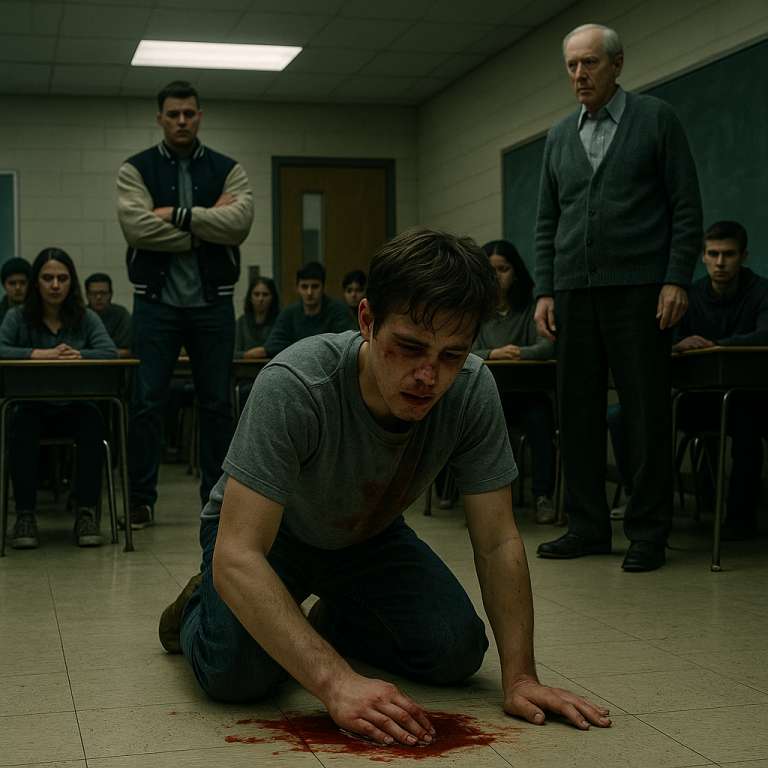
I threw him, hard, bodily, like a sack of cement, toward the nearest solid object. The massive green chalkboard that ran along the front of the classroom.
His body hit the board with a sickening thud-CRACK.
It wasn’t a clean strike. He impacted shoulder-first, and the entire wooden frame of the chalkboard—which must have been bolted to the cinderblock wall for fifty years—shook violently. A perfect cloud of fine, white chalk dust exploded into the air around him.
He slid down the board, leaving a long, smeary streak, and landed in a crumpled, wheezing heap on the floor, coughing the acrid powder out of his lungs. He was stunned, maybe concussed, but definitely finished.
The room was silent. Absolutely, terrifyingly silent.
Twenty fifth-graders sat frozen at their desks, tiny statues of fear. Their eyes were wide, reflecting the dust-filled air and the raw, adult aggression that had just invaded their safe space. They had never seen anything like it. They had just watched their classroom tyrant be utterly, violently dethroned by a ghost from the hallway.
Mrs. Halloway’s initial scream had died in her throat. She stood beside her desk, her hands pressed over her mouth, her face pale and slack. Her glasses were crooked. She wasn’t a teacher anymore; she was just a witness.
I ignored her. I ignored Tank, who was whimpering in the corner, holding his shoulder.
My world narrowed down to one thing: Toby.
My little brother was still standing where he had been dropped, curled inward, his face pressed against his left shoulder. He wasn’t crying. He was making that sound—a broken, high-pitched whimper-gasp—the sound of an animal in shock.
He was holding his injured right arm gently with his left hand. The arm hung wrong. It was the angle. The bend just above the elbow was unnatural, like a hinge that had failed. The sleeve of his little blue t-shirt was bunched up, and the swelling was already starting, a dark, bruised bloom spreading beneath the skin.
“Toby,” I said. My voice was a gravelly whisper, rough from the adrenaline.
I dropped to my knees in front of him, careful not to touch him.
“Hey, T-Bone. Hey. Look at me.”
His eyes, dark brown like Dad’s, flickered up to meet mine. They were glazed over with pain and shock. He didn’t cry. He just looked betrayed by the universe.
“D-Drew,” he choked out, calling me by my full name, which he only does when he’s really hurt or scared.
“I got you, buddy. I got you. It’s okay. We’re going to the hospital right now. It’s okay.”
I gently reached out and used my thumb to wipe a smudge of chalk dust from his cheek.
I looked down at the floor. Right next to his foot, half-hidden by a discarded worksheet, was the Purple Heart. It was face-up, its deep purple ribbon slightly twisted, reflecting the harsh fluorescent light. Grandpa’s blood and honor, lying on a dirty classroom floor.
I didn’t touch it yet. My hands were shaking too badly, and I didn’t want to transfer any of my violence onto the symbol of real sacrifice.
I looked up at Mrs. Halloway. She was finally moving, reaching for the wall-mounted phone, her hand trembling so much she missed the receiver twice.
“I’m calling the principal,” she squeaked, her voice high and unstable. “And the police. You can’t—”
“Call who you need to call,” I cut her off, my voice flat, without inflection. “I broke his arm. He broke my brother’s. That’s math. Now, you call 911 for my brother. You call them first, and you tell them a ten-year-old has a potential broken humerus. You do that, now.”
The authority in my voice, the raw, unapologetic certainty, stopped her cold. She stared at me, then at Toby’s dangling arm, and finally, she punched the number on the phone, her hands suddenly firm.
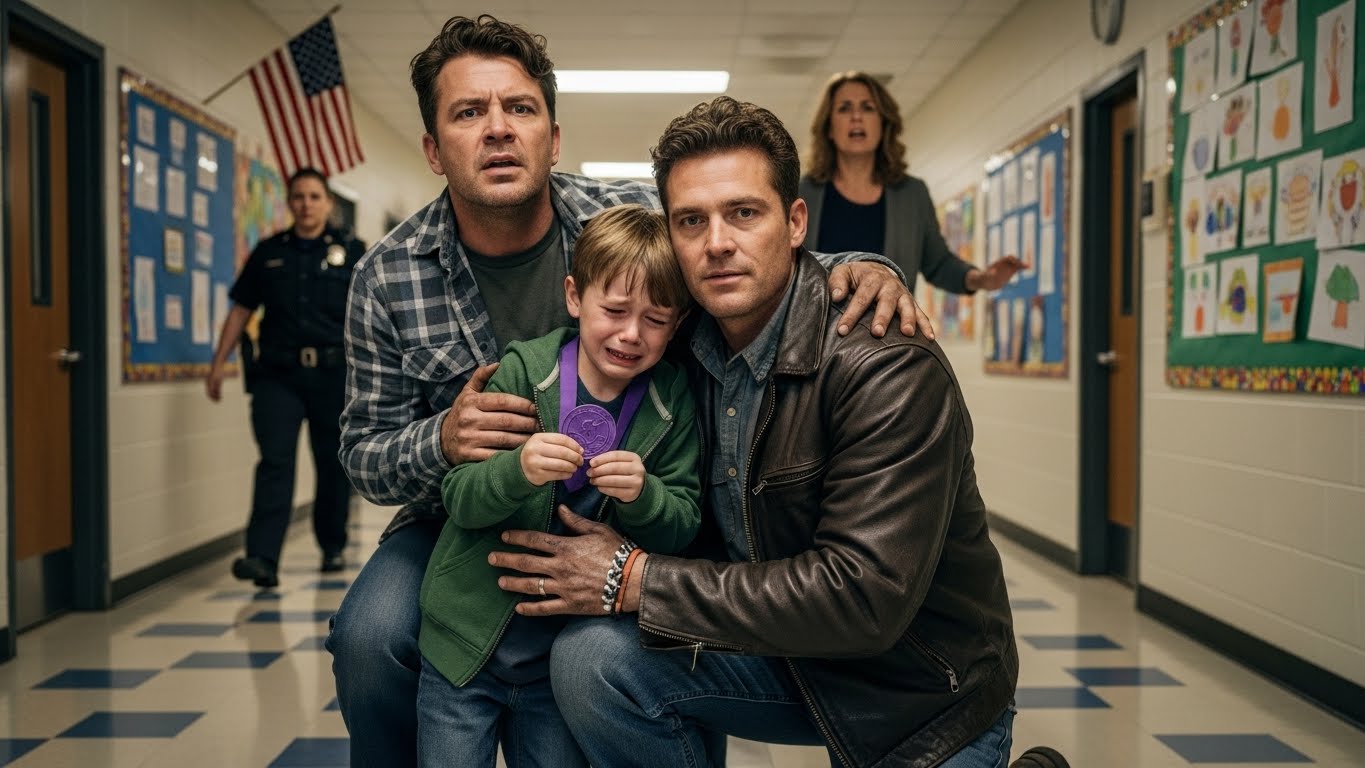
While she was talking, I carefully, gently, scooped Toby up. He was light, too light. I held him to my chest, supporting his spine with my free hand. He let out a low moan, and I walked slowly, deliberately, toward the door.
I looked back at Tank one last time. He was sitting up now, leaning against the chalkboard, tears carving clean trails through the white dust on his face. He was staring at the floor.
As I reached the splintered doorway, I paused. I saw the Purple Heart again.
I bent my neck, balancing Toby on my chest, and said to the nearest terrified little girl—a shy kid in a pink backpack—”Sweetheart, can you be a hero for me? Pick that silver medal up and put it in my little brother’s pocket.”
She stared, paralyzed.
“Now,” I said, a little firmer, a little quieter.
She scrambled down, snatched the medal, and ran forward, her eyes darting between me and Tank. She fumbled, slipping the ribbon into Toby’s jeans pocket.
“Thank you, darlin’,” I whispered.
I turned and walked out of the classroom, leaving behind the screaming teacher, the whimpering bully, and the twenty silent witnesses.
As I walked down the hall, holding my little brother tight, the bell rang.
Chapter 4: The Sound of Sirens
The noise of the bell—that loud, piercing, insistent RRRIIINNNGGG—felt like the world snapping back into focus. It broke the spell.
Suddenly, the hallways were filled with the sound of a thousand rushing feet, lockers slamming, and kids yelling about the end of the day. It was a wave of oblivious, joyful noise that crashed against the quiet terror I carried in my arms.
No one noticed me at first, carrying my small, limp brother. They just saw a high-schooler trying to make it to the exit before the rush.
But then they noticed Toby’s face. They noticed the unnatural way his right arm was held, cradled against my chest like fragile glass. The noise level dropped around me as I walked, a sudden, localized vacuum of sound.
I didn’t stop. I walked with my head up, my jaw clenched. I passed the main office, where the secretaries were starting to look up, alerted by the commotion.
Just as I reached the heavy glass doors that led to the parking lot, I heard the sound I had been anticipating.
Womp-womp-womp-womp.
The heavy, pulsing thump of a police helicopter hovering overhead. No, wait. That was the sound of distant sirens. Fast-approaching, urgent sirens.
Mrs. Halloway had made her call. Or maybe the principal, now alerted by the chaos I left behind, had hit the panic button.
I pushed the exit door open with my shoulder, stepping out into the late afternoon sun. It was a beautiful day, bright and sharp, the kind of day that felt deeply wrong for the violence that had just happened inside.
I took one deep, shuddering breath of fresh air. It smelled like warm asphalt and cut grass. I needed that breath. My lungs had been locked up since I saw Tank twist Toby’s arm.
“Drew,” Toby whispered, his voice still shaky. “The medal. Is it okay?”
The medal. That was all he cared about. Not his arm, not the chaos, but the Purple Heart.
I gently ran my free hand over his jeans pocket, feeling the cold, hard weight of the medal’s disk through the thin fabric.
“It’s safe, T-Bone,” I said. “It’s right here. The little girl put it in your pocket. You did your job. You guarded it.”
He exhaled a long, slow, shaky breath. A single tear squeezed out of the corner of his eye and trailed down his temple into his hair. It was a tear of relief, not pain.
I was crossing the parking lot toward my truck when the first police cruiser, lights flashing but no siren, pulled in, followed immediately by an ambulance, its siren mercifully cut as it rolled up.
A tall, stern-looking woman—the Principal, I assumed—burst out of the main doors, pointing a frantic finger at me.
“There he is! Stop him! He assaulted a student!”
I stopped. I didn’t run. Where would I go? I wasn’t sorry.
A uniformed officer, a young guy with a tight crew cut, stepped out of the cruiser. He was already talking into his shoulder mic, but his eyes were on me. Or rather, on Toby.
He saw my oil-stained jacket, my defiant stance, and then he saw the small, injured boy cradled in my arms. The situation wasn’t what the hysterical principal was describing.
He took a step toward me, his hand hovering over his holster. “Sir. Put the boy down. I need you to place your hands on the hood of the car.”
I shook my head, slightly. “No, Officer. I’m not putting him down. His arm is broken. I’m his brother. I need to get him into that ambulance now.”
I didn’t raise my voice. The calmness was new. The violence had drained all the adrenaline, leaving me with a cold, solid certainty.
“He assaulted a student, Officer!” the Principal shrieked, running up. “He shattered the chalkboard! He kicked in the door!”
“He was twisting my little brother’s arm until the shoulder popped,” I said, looking straight at the officer, bypassing the Principal entirely. “He was threatening to swallow our dead grandfather’s Purple Heart. That medal is why Grandpa died in Vietnam.”
The mention of the Purple Heart, the Purple Heart in the context of a schoolyard assault, hit the young officer. His hand dropped away from his holster.
He looked from Toby’s face to my face, then back to the Principal. He saw the truth, or at least enough of it to hesitate.
“EMT first,” the officer said, cutting through the Principal’s protests. “The boy’s welfare comes first.”
Two paramedics were already rushing toward us with a gurney. I held Toby as still as I could while they gently, expertly, slid him onto the board and started to stabilize his arm.
As they worked, the officer walked over to me.
“I’m going to need you to come with me, sir. We have to go inside and file a report.”
I looked down at Toby, who was finally starting to cry—a soft, painful, rhythmic sound now that the shock was wearing off.
“I’m not leaving him,” I said. “I’m going to the hospital with him.”
The officer sighed. He was caught between procedure and the sight of a broken boy.
“Look, I get it,” the officer said, lowering his voice. “But you just assaulted a minor on school property. I’ll ride with you in the ambulance. We can do the initial paperwork at Children’s Hospital.”
It was a compromise. A small victory. I nodded, not arguing.
As they loaded Toby into the ambulance, I held his uninjured hand. The little girl’s heroic act meant the medal was still tucked safe and sound in his pocket.
The doors closed. The officer climbed in beside us. The ambulance lights came on, but the driver kept the siren off—a small, silent concession to my brother’s pain.
As we pulled away, I stared out the back window at the school. The Principal was still standing there, arms crossed, staring after us. Tank was probably still in the classroom, crying chalk-dust tears.
I didn’t regret it. Not a single particle of dust, not a single fiber of splintered wood. The feeling wasn’t pride; it was the deep, primal satisfaction of a debt paid, of a line in the sand drawn in concrete, final terms.
My grandfather went to war to defend something. I dropped out of high school and worked on cars, but for Toby, in that fifth-grade classroom, I was willing to go to war, too. That medal had been desecrated, and I had answered the call of honor that my Grandpa had taught us, not with a gentle hand, but with raw, brutal justice. I’d take the charge. I’d wear the record. I didn’t care.
All that mattered was the small, warm hand I was holding, and the knowledge that the tyrant was weeping in a corner. The silence, for once, was mine.
Chapter 5: The Aftermath (The Charge)
The ride to Children’s Hospital was quiet, save for the low, rhythmic beep of the EKG monitoring Toby. The officer, a guy named Miller, finished his notes on a clipboard, his pen scratching against the paper. He didn’t lecture me. He just asked the facts: Name, age, why I was there. I told him the truth, cold and simple. No embellishments, no apologies.
At the hospital, the process was swift. X-rays confirmed a severe fracture. The doctor, a kind woman with tired eyes, assured me Toby would be fine, but the road to recovery would be long.
As Toby was wheeled away for casting, Officer Miller took me aside. He was empathetic, but firm.
“Jackson,” he said, using my first name. “I understand why you did it. Any man who’s been a big brother understands. But you committed an assault, aggravated by entering school property. The principal is pressing charges. It’s a second-degree felony.”
My jaw was tight. “So what happens now?”
“Now, you call your parents, and then you come down to the station. I’m giving you a citation, not handcuffs. I trust you won’t bolt.”
I nodded. My heart didn’t sink. It felt solid, prepared. I had bought Toby his peace, and now I had to pay the price.
Chapter 6: The Media Circus (The Defense)
The moment I called Dad, the real war began. Dad wasn’t angry at the act, he was furious at the consequence. He called the best defense attorney in town, a bulldog named Ms. Chen who specialized in high-profile local cases.
The story exploded. It wasn’t just about a school fight; it was about the desecration of a Purple Heart. The local news ran a massive headline: VETERAN’S HONOR DEFENDED WITH BARE KNUCKLES: BROTHER FACES FELONY.
Suddenly, I wasn’t just a high school dropout who worked at a body shop; I was “The Purple Heart Protector.” The community rallied. People who knew my Grandpa testified to the honor that medal held.
Ms. Chen leaned into it. She argued that my actions weren’t predatory; they were protective. That I wasn’t attacking a child; I was neutralizing an immediate threat after an institutionally failed duty of care. She framed the kick, the door, the throw—not as simple assault—but as necessary intervention to stop an act of severe physical abuse.
Chapter 7: The Confrontation (The Stand)
The most difficult part was standing beside Toby during the formal hearing. Tank’s parents, entitled and aggressive, were there with their lawyer, demanding I pay for their son’s “trauma.”
Toby, sitting beside me, his arm encased in a bright red cast, looked small but steady.
When the judge asked Toby to testify about what happened to the medal, he pulled the Purple Heart out of his pocket. It shone brightly in the sterile courtroom light.
“He said he was going to eat it,” Toby whispered, his voice unwavering. “And then he hurt my arm so it would break, so I couldn’t stop him.”
He looked straight at Tank, who finally, for the first time, broke eye contact.
That was the turning point. The judge saw the difference between the aggressor and the defender, between calculated cruelty and protective rage.
Chapter 8: The Verdict (The Honor)
The verdict came down two weeks later.
The judge called my action “a clear and disturbing escalation,” but acknowledged the extraordinary circumstances and the documented failure of the school’s immediate response.
The felony charges were dropped. I was convicted of two misdemeanors: Destruction of School Property (the door) and Disorderly Conduct. The punishment: 100 hours of community service and a fine to pay for the new door. No jail time. No probation.
I walked out of that courthouse into a sea of news cameras, but I didn’t care about them. I looked at Toby, who was wearing his cast like a badge of courage.
We didn’t say much on the drive home. The storm was over. The violence was finished. The silence was the real victory.
When we pulled into the driveway, Dad was standing on the porch, waiting. He met my eyes, not with anger or disappointment, but with a slight, almost imperceptible nod.
Later that evening, Toby and I sat on the porch swing. He had the Purple Heart resting on his cast. It was the centerpiece of his whole recovery.
“Thanks, Drew,” he said, quietly.
“For what, T-Bone?”
“For coming for me. For doing what Grandpa would have done.”
I didn’t tell him that Grandpa did it with strategy, training, and courage. I did it with a size-11 work boot and blind rage. But maybe, just maybe, the core impulse was the same. To protect the weak, and to defend what is sacred.
I put my arm around his uninjured shoulder, pulling him close. The price was paid. The honor was saved. And for the first time in a long time, the grease on my hands didn’t feel like a mark of shame, but a symbol of work done—hard, necessary, violent work.
The Purple Heart shone, catching the last light of the Pennsylvania sunset. It wasn’t just Grandpa’s medal anymore. It was our family’s scar. And our family’s code.